Sciatica and nighttime pain: what should you watch out for?
03/08/2026
Sciatica and ergonomic chair: what not to promise
03/08/2026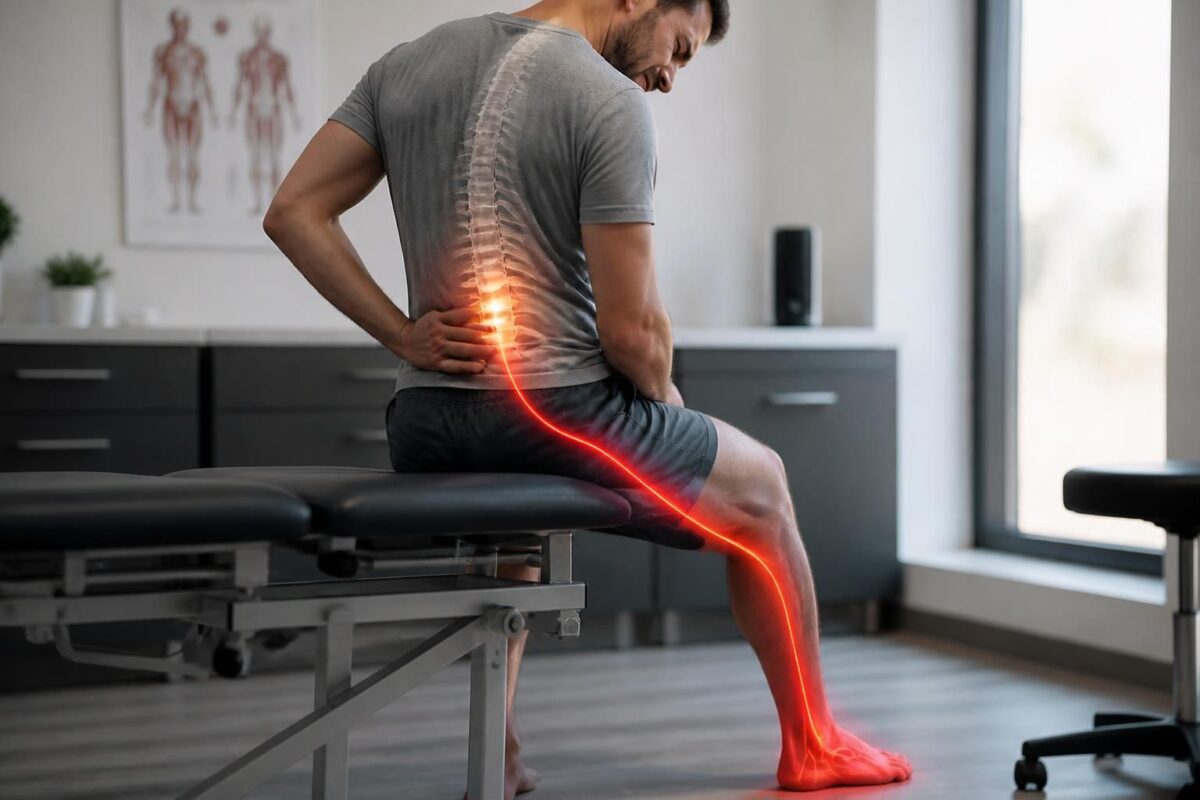
IN BRIEF
| In brief, sciatica related to the lumbar spine is pain that starts in the lower back and can radiate down to the foot when the sciatic nerve is irritated or compressed. This relationship is explained by the nerve’s path from the spine to the foot, making pain possible along the entire route. Common causes include lumbar disc herniation and spinal stenosis. A holistic and non-invasive approach, combining physiotherapy, osteopathy, and targeted exercises, provides quick relief, improves mobility, and helps prevent recurrences. Available in Montreal, this service caters to those seeking functional and pain-free management. |
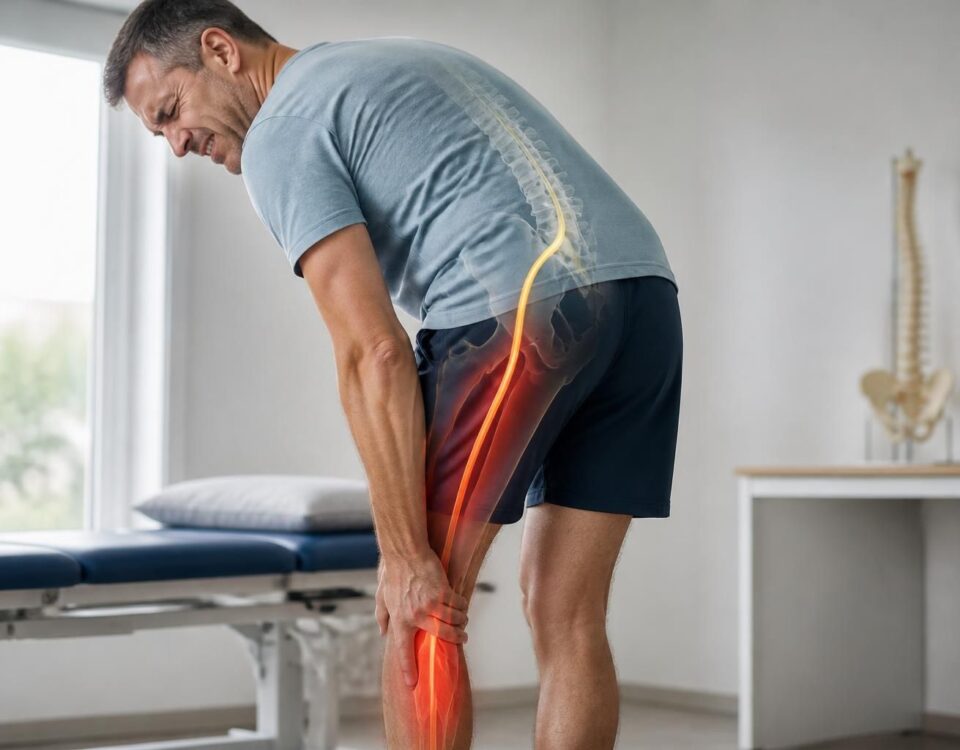
The sciatica can arise from discomfort in the lumbar spine and manifest as pain that reaches the foot through the path of the sciatic nerve.
The sciatic nerve originates from the lumbar roots (L4-L5-S1) and descends from the buttock to the foot, running along the back of the thigh and then the calf.
Common causes include lumbar disc herniation, foraminal stenosis, or piriformis syndrome, which irritate or compress the nerve and cause pain radiating to the foot, as well as numbness or weakness.
Diagnosis relies on clinical examination, supplemented if necessary by an MRI or a CT scan; the Lasègue test is often used to confirm nerve irritation.
Treatment favors conservative approaches: appropriate physical activity, physiotherapy, analgesics, and sometimes injections; surgery is considered in cases of persistent compression or severe motor signs.
The sciatica can cause pain that descends to the foot when the sciatic nerve is irritated or compressed along its pathway in the lumbar spine. This article explains how the lumbar spine can cause pain in the foot, what signs to look out for, the most common causes, and what management options to prioritize at the TAGMED Clinic in Montreal and Terrebonne. For more in-depth information, you can consult specialized resources on the signals sent by the leg and the associated pain mechanisms.
About the author
Dr. Sylvain Desforges, B.Sc., D.O., N.D., osteopath, is the founding president of
TAGMED
and the ACMA association. He dedicates his practice to chronic pain of the spine, lumbar pain, and pain associated with sciatica, especially when the pain radiates to the buttock, leg, calf, foot, or toes.
Through SOS Sciatica, he publishes educational content on the symptoms of sciatica, possible causes such as disc herniation, disc pinching, foraminal stenosis, or irritation of a lumbar nerve root, as well as on non-surgical approaches that may be considered based on the evaluation. At the TAGMED Clinic, care may include, depending on the case, motorized neurovertebral decompression, specific osteopathy, or precision percussion.
For an evaluation related to the
sciatica treatment in Montreal / Mont-Royal
or to the
sciatica treatment in Terrebonne,
consult the services available at the
TAGMED Clinic.
How the lumbar spine can influence the foot
The sciatic nerve originates from the lumbar and sacral roots and descends to the foot. When this nerve is irritated, the pain can follow its entire path, from the lower back, through the buttock and thigh, to the foot. The link between the spine and the foot is explained by the common path of the nerve and the sensitive areas it innervates. To better understand, see the signals sent by the leg and the irritation mechanisms at Sciatica in Montreal — understanding the signals sent by the leg.
Anatomical pathway and localization of pain
The sciatic nerve is formed by the roots L4, L5, S1, S2, and S3. It passes under the piriformis muscle in the pelvis, which explains why some pain starts in the buttock and then rises or extends along the back of the thigh and the sole of the foot. At the knee level, it divides into the tibial nerve and fibular nerve, which innervate the foot and ankle. This progression explains the pain that can affect the back of the thigh, the calf, and the sole of the foot. For visual understanding, refer to specialized anatomical resources on the subject.
Typical signs and symptoms
Pain is often felt on one side and can be described as shooting or burning, sometimes like an electric shock. Numbness, tingling, and muscle weakness in the foot or leg may occur. The Lasègue test may reveal irritation of the sciatic nerve when the leg is raised. Signs of aggravation exist during prolonged sitting, coughing, or straining. If sudden paralysis or loss of bladder control occurs, this constitutes a medical emergency and requires prompt attention.
Common causes and associative pathway
The most frequent cause is a lumbar disc herniation, which compresses a nerve root along its path. Other relevant causes include foraminal or spinal stenosis, piriformis syndrome, a tumor, or a rare infection. The pathway of the nerve can be affected by mechanical factors such as prolonged postures or heavy loads. To understand the mechanisms and associated options, consult dedicated resources like Sos Hernie Discale or Sciatica — when imaging does not suffice to explain the pain.
Diagnosis and imaging
The diagnosis begins with a clinical examination. The doctor evaluates the location of the pain, muscle strength, and reflexes. In case of doubt or persistent symptoms, imaging tests may be considered, including MRI or CT scans to visualize the lumbar structures. In some cases, additional tests specify nerve involvement. Clinical evaluation remains the cornerstone of diagnosis, with complementary explorations used selectively.
Specific Causes and Prevention
The most common cause remains lumbar disc herniation, but factors such as lumbar osteoarthritis or nerve compressions related to anatomical variations may play a role. Lifestyle habits focused on overall mobility, maintaining a stable weight, and proper posture can reduce the risk, without resorting to exercise programs proposed as the sole solution. For information on causes and prevention options, consult specialized resources on Sciatica in Montreal and related sources.
Treatment and Management
Management depends on the cause and severity. In the majority of cases, improvement occurs with conservative measures and a gradual return to activities. Available options at the TAGMED Clinic include specialized approaches such as motorized neurovertebral decompression and targeted osteopathy. Complementary options may include targeted injections for severe persistent pain or minimally invasive surgery when symptoms are severe or complicated. To learn about the care offered, visit TAGMED Clinic and compare with the information available on Sciatica — when imaging is not enough to explain the pain.
Impact on the Foot and Associated Measures
Pain may extend to the foot, with sensations of numbness and impaired motor function. The condition can affect walking and balance. Measures tailored to the clinic help restore function while avoiding movements that worsen the pain and prioritizing coordinated care with the specialized services of TAGMED.
Prevention and Lifestyle
To reduce the risk of recurrence, prioritize regular, suitable physical activity, maintain good posture, and avoid excessive loads or sudden movements. Practical advice and specific assessments can be discussed during a consultation at TAGMED Clinic.
For more information on signs and mechanisms, you can consult Sciatica — what an irritated nerve root means.
For a complementary approach in Montreal or Terrebonne, you can make an appointment through TAGMED Clinic.
Medical disclaimer: The information and advice provided on this site do not replace the opinion, diagnosis, or treatment of a healthcare professional. Please note that Dr. Sylvain Desforges, osteopath, is neither a doctor of medicine nor a physician, and is not a specialist in a medical specialty as defined by the Collège des médecins du Québec. Manual medicine, functional medicine, and sports medicine, as described on this site, exclude any treatment or medical diagnosis made by a medical doctor or medical specialist. Always consult your physician for any medical questions. For more details, please read our complete Legal Notice.
- Key Axis: path of the sciatic nerve – lumbar → buttock → thigh → leg → foot.
- Involved Roots: L4-L5 and S1.
- Common Lumbar Causes: lumbar disc herniation; foraminal stenosis; piriformis syndrome.
- Radicular Pain: radiates from the lower back to the foot, often on one side.
- Roots and Location: L5 → pain on the top of the foot and big toe.
- S1: pain in the heel, sole, and outer edge to the last 3 toes.
- Impact on the Foot: paresthesia, numbness, weakness when walking.
- Path in the Foot: division into tibial and fibular nerve, innervating the foot.
- Management: target the lumbar source, physiotherapy, posture, adapted activity.
- Practical Advice: stretching, mobility, regular activity, early consultation.

Pain in the foot may originate from the lower back when the sciatic nerve is irritated or compressed at the level of the lumbar roots. This article explains how the path of this nerve connects the lumbar spine and foot, what symptoms it may produce, what the common causes are, and what treatment and prevention strategies allow for quick and lasting relief.
Understanding the Path of the Sciatic Nerve and Its Connection to the Foot
The sciatic nerve is the longest and largest in the peripheral nervous system. It originates from the roots L4 to S3, traverses the pelvis, passes under the piriformis muscle, and descends along the back of the thigh before splitting near the knee into the tibial and fibular nerves. This trajectory explains why lumbar pain can radiate to the foot, and why the location of pain in the foot may vary depending on the affected root.
Depending on whether the involved root is L5 or S1, the pain may differently affect the foot: the pain may target the dorsum and big toe in the case of L5, or the heel, sole, and outer edge of the foot in the case of S1. In parallel, signs such as numbness, tingling, or weakness in the foot and ankle muscles may accompany this pain.

Herniated disc and acute sciatica: common causes
IN BRIEF The herniated disc and acute sciatica describe a deformation or bulge of the intervertebral disc that can compress a nerve root and cause low back pain and pain radiating down the leg. Common causes include disc degeneration, sudden…

Herniated disc and stronger pain in the leg than in the back
IN BRIEF In brief, herniated disc is a tear or protrusion of the intervertebral disc that compresses a nerve root, causing lower back pain and pain radiating down the leg (sciatica), often more intense than back pain. Rapid diagnosis and…

Herniated disc and pain without back pain: is it possible?
IN BRIEF Definition: Herniated disc is the rupture of the envelope of an intervertebral disc, with protrusion of the nucleus that may compress a nerve root. It can manifest as radicular pain that radiates to the buttock and leg, and…

Herniated disc and pain under the knee: why it’s important
IN BRIEF In brief, a herniated disc is the rupture of the envelope of an intervertebral disc, with protrusion of the nucleus that can compress a nerve root, causing pain below the knee and sciatica. Why is it important? Understanding…
Lumbar Causes Triggering Foot Pain
The main cause remains lumbar disc herniation, which compresses a root of the sciatic nerve and generates pain that can extend to the foot. Other mechanisms may be involved: foraminal stenosis leading to a narrowing of nerve passages, piriformis syndrome irritating the nerve as it passes near the muscle, or trauma and inflammation of the lumbar spine.
It is common for several factors to combine: prolonged posture, heavy lifting, or repetitive movements that awaken pain along the path of the sciatic nerve and in the foot.
Clinical manifestations in the foot
Pain in the foot may present as radiating pain starting from the lower back or buttock and progressing to the foot. Signs of involvement such as numbness, electric shock sensations, or weakness of the foot dorsiflexor muscles may appear. The exact location (dorsum or sole of the foot, big toe or outer edge) will depend on the affected root and the exact path of the nerve.
Evaluation and diagnosis
The diagnosis relies on clinical observation and listening to the symptoms described by the patient, as well as tests of strength and reflexes. The Lasègue test may be used to confirm irritation along the sciatic path. In persistent or atypical cases, additional examinations such as imaging of the lumbar spine may be considered to identify a hernia, stenosis, or other causes. An electromyogram can be useful when the diagnosis specifies the location of the nerve involvement.
Treatment and practical advice
Most cases of sciatic pain are managed effectively through non-surgical measures. Pain relievers and anti-inflammatories can be used short-term, combined with a gradual return to appropriate physical activity. Physical therapy and work on strengthening the core and gluteal muscles, along with specific stretches for the back and legs, help alleviate pain and prevent recurrences. Injections of corticosteroids may be considered in persistent painful cases, and surgery is rare, reserved for severe or complicated situations.
Practical advice can make a notable difference: stay active without excessive pain, adopt a correct posture at work, and prioritize regular exercises aimed at improving back mobility and pelvic stability. Osteopathy and other supervised manual approaches can complement the treatment and reduce the risk of recurrence.
| Element | Concise explanation |
|---|---|
| Origin of the sciatic nerve (roots L4–S3) | The longest nerve arises from the lumbar and sacral roots and extends to the foot. |
| Passage pelvis and piriformis | It passes through the pelvis and may go under the piriformis muscle, influencing pain. |
| Path buttock to thigh to popliteal fossa | It descends beneath the gluteals then along the posterior side of the thigh to the popliteal fossa. |
| Level of compression (L5 / S1) | Pain follows the compressed root, most often L5 or S1, and may then reach the foot. |
| Causes of irritation | Lumbar disc herniation is the main cause, with piriformis, foraminal stenosis, or trauma. |
| Mode of irritation along the path | The irritation radiates along the nerve path from the lower back to the foot. |
| Areas of the foot by root | L5 affects the dorsum of the foot and the big toe; S1 targets the heel and the outer edge. |
| Typical symptoms | Radiating pain with numbness and weakness in the lower limb. |
| Clinical diagnosis | Clinical examination and Lasègue test; MRI or EMG if necessary for precision. |
| Initial treatment | Conservative approach with adapted activity and physical therapy; surgery rare if major compression. |
Testimonials: how the lumbar spine can cause foot pain
Marie, 52 years old: It all started with pain in the lower back that gradually radiated to the buttock and foot. I thought it was just simple low back pain, but the symptoms persisted. Thanks to a targeted approach on the lumbar spine and the sciatic nerve, the sessions allowed the release of the nerve path and the pain gradually faded, giving me a smooth walk and comfort in daily life.
David, 39 years old: I first felt pain starting from the lower back and traveling along the path of the sciatic nerve to the foot. After an evaluation and targeted manipulations, the pain decreased and I returned to my activities without needing prolonged rest.
Sophie, 65 years old: A herniated disc compressed the sciatic nerve, and the pain settled in the buttock and then reached the foot. Specific osteopathy sessions and personalized advice helped reduce nerve irritation and allowed me to return to an active life without permanent pain.
Julien, 28 years old: After a long run, intense pain awoke in my foot and lower back. Targeted intervention on the path of the sciatic nerve released tensions, and the recommended exercises allowed me to resume sports without relapse.
Mireille, 60 years old: A pain that began in the buttock and projected sensations into the foot worried me. Thanks to a gentle and tailored approach, I avoided surgery and regained simple activities like walking and gardening without discomfort.
Lucas, 41 years old: I was explained that the sciatic nerve follows a precise path from the spine to the foot, and that the pain can project along this route. With a personalized plan and targeted exercises, the pain decreased and I regained a better quality of life with fewer recurrences.
About the author
Dr. Sylvain Desforges, osteopath is an osteopath specialized in lumbar pain and sciatica. Founder and president of TAGMED and active in supporting chronic spinal pain, he offers non-surgical approaches tailored to each patient’s evaluation. His educational content aims to better understand the symptoms and possible solutions when the sciatic nerve is involved, in order to improve quality of life and daily activities without always resorting to surgery.
Sciatica and lumbar spine: how pain can ascend to the foot
The link between sciatica and pain felt at the foot level is explained by the path of the sciatic nerve, the longest and largest in the peripheral nervous system. Arising from the lumbar and sacral roots, it travels through the buttock, thigh, then leg before extending to the toes. When this nerve is irritated or compressed at the lumbar spine level, the pain can manifest far from its starting point, radiating down to the foot. This progression explains why lumbar involvement can translate into painful sensations or sensory disturbances at the foot level, sometimes far from the back.
Dr Sylvain Desforges, a seasoned osteopath and expert in manual medicine, embodies an integrated approach that links lumbar anatomy to symptomatic expression in the extremities. His background is based on years of experience in chronic pain and a practice grounded in evidence-based data. Founder and president of TAGMED clinics and an active member of professional associations, he relies on a deep understanding of the sciatic nerve to distinguish local causes from those related to the spinal cord and the vertebrae.
At the core of his reasoning is the precise understanding of the sciatic nerve pathway. Originating from the lumbar and sacral roots L4 to S3, this nerve descends through the gluteal region, passes behind the femur, and branches at the knee before mapping the motor and sensory areas of the calf, the arch of the foot, and the toes. Depending on the affected root, pain may follow specific trajectories on the foot: an L5 involvement may lead to pain towards the top of the foot and the big toe, while an S1 involvement may affect the heel, the sole, and the outer edge of the foot. This anatomical knowledge is essential for adjusting the diagnosis and customizing the treatment.
Dr. Desforges’ clinical approach first prioritizes functional and diagnostic evaluation, relying on targeted examination and simple clinical tests. The Lasègue test, for example, helps identify irritation along the sciatic pathway. When symptoms are ambiguous or persist beyond a few weeks, complementary tools may be considered to clarify the location and extent of the injury, while remaining guided by clinical findings. The goal is to avoid systematic reliance on imaging and to favor an adapted and progressive management.
In his practice, Dr. Desforges offers a combination of non-invasive care and advanced technologies to treat sciatic pain and prevent recurrences. Osteopathy and manual medicine articles target mechanical restrictions of the spine and surrounding tissues, while complementary technologies may include, depending on the cases, approaches such as motorized spinal decompression, therapeutic laser, and shockwave therapies. The objective is clear: to restore mobility, relieve pain, and improve the function of the foot and leg without systematically resorting to surgery.
Beyond the techniques, his teaching relies on a patient-centered approach, focusing on education, self-management, and strengthening functional capacities. Practical advice on posture, trunk strengthening, and targeted stretching complements therapeutic options, aiming to reduce the risk of recurrence and optimize overall well-being. This specialist’s commitment is to provide evidence-based management tailored to the experiences and goals of each individual suffering from sciatica and its impacts on the foot.
The sciatica can cause pain that starts from the lower back and may reach the foot. This detailed conclusion explains how the lumbar spine can, through compression or irritation of the sciatic nerve, generate pain that radiates down to the foot. It describes the pathway of the nerve, clinical signs, possible causes, diagnostic options, and available treatments, while providing resources to explore each aspect and practical advice for prevention and management.
Sciatic nerve pathway and implications for the foot
The sciatic nerve, originating from the lumbar and sacral roots, follows a path that goes from the lumbar region, passes through the buttock, descends along the back of the thigh, and ends in the foot. This long trajectory explains why irritation or compression at different segments can cause radiating pain down to the toes. To visualize this pathway, you can refer to this article on the trajectory of the sciatic nerve.
Signs, symptoms, and diagnosis
Typical signs include pain that rises from the lower back to the back of the leg and sometimes to the foot, often on one side. Numbness, tingling, and muscle weakness may accompany this pain. The Lasègue test and other clinical evaluations help determine the presence of a disco-radicular conflict or nerve injury along the pathway. In case of persistent or atypical symptoms, complementary exams such as MRI or CT scans may be useful for identifying a herniated disc, stenosis, or other causes. For details on symptoms and their duration, see Top Santé.
Causes and lumbar mechanisms
The most common cause is a lumbar herniated disc, which compresses a nerve root in the spinal canal. Other factors include spinal stenosis, piriformis syndrome, and other vertebral pathologies. These injuries explain why pain can spread from the lower back to the buttock, thigh, and then to the foot. To understand the concept of disco-radicular conflict, consult this SOS Sciatique article.
Prevention and practical tips
Simple habits can reduce the risk and intensity of symptoms: regular physical activity, strengthening the muscles of the back and trunk, maintaining good posture, using proper techniques for lifting loads, and taking regular breaks when sitting. Additional resources explain why imaging alone is not always sufficient and propose preventive and adaptive approaches. To delve deeper, see SOS Sciatique – Terrebonne and Gesundmd.
Treatment options and management
In most cases, sciatica resolves with conservative measures: appropriate analgesics, physiotherapy, targeted exercises, and sometimes injections. In case of persistence or complications, surgical intervention may be considered. For summaries of approaches and outcomes, consult SOS Sciatique – Pain when walking or Medecindirect.
Supplementary resources and related readings
To deepen your understanding of the sciatic nerve pathway, its causes and mechanisms, you can consult additional resources such as Sciatica and pain – journey and Podexpert. For broader perspectives on sciatica, see Radicular pain vs referred pain and Limitations of imaging. For more technical and diverse readings, also check Medecindirect.

Disc herniation and calf pain: possible nerve pathway
IN BRIEF In short, a herniated disc can cause calf pain when the nerve root is irritated, with a typical nerve pathway of the sciatic nerve running from the back down to the calf and foot. This pain reflects the…
Herniated disc and big toe pain: possible L5 root
IN BRIEF In brief, the Disc herniation associated with a big toe pain related to the L5 nerve root is a nerve compression originating from the lumbar region and radiating to the top of the foot up to the big…

Herniated disc and heel pain: possible S1 root
IN BRIEF In brief, disc herniation and heel pain related to the S1 root describe a radiculopathy causing pain that radiates down to the heel and the outside edge of the foot. In Montreal, this service helps connect symptoms, examination,…

Herniated disc with foot weakness: cause to watch out for
IN BRIEF In brief, a herniated disc with foot weakness is a protrusion of an intervertebral disc that can compress a nerve root, causing lower back pain and foot weakness, often associated with radiating pain in the leg. Treatment aims…

Dr Sylvain Desforges, B.Sc., D.O., N.D., osteopath, is the founding president of TAGMED and of the ACMA association. He dedicates his practice to chronic spinal pain, low back pain and symptoms compatible with sciatica, particularly when pain radiates toward the buttock, leg, calf, foot or toes.
Through SOS Sciatique, he publishes educational content on sciatica symptoms, possible causes such as disc herniation, disc narrowing, foraminal stenosis or irritation of a lumbar nerve root, as well as non-surgical approaches that may be considered according to the evaluation. At Clinique TAGMED, care may include, depending on the case, motorized neurovertebral decompression, specific osteopathic care or precision percussion.
For an evaluation related to sciatica treatment in Montreal / Mount Royal or sciatica treatment in Terrebonne, please consult the services available at Clinique TAGMED.
Medical disclaimer
The information published on SOS Sciatique is provided for educational purposes only and does not replace a consultation, diagnosis, opinion or treatment provided by a physician or another authorized healthcare professional. The author of this article is neither a medical doctor nor a specialist in a medical specialty recognized by the Collège des médecins du Québec. The osteopathic, manual medicine or functional support approaches described on this site do not constitute medical acts and are not intended to replace medical follow-up.
Consult a physician or emergency service in cases of loss of bladder or bowel control, anesthesia in the saddle area, significant or progressive weakness in the leg or foot, fever, recent trauma, severe pain or rapid worsening of symptoms. For more details, please read our Legal Notice.