Sciatica in Montreal: nerve pain and sensory territory
02/11/2026
Sciatica and recurring pain episodes
02/11/2026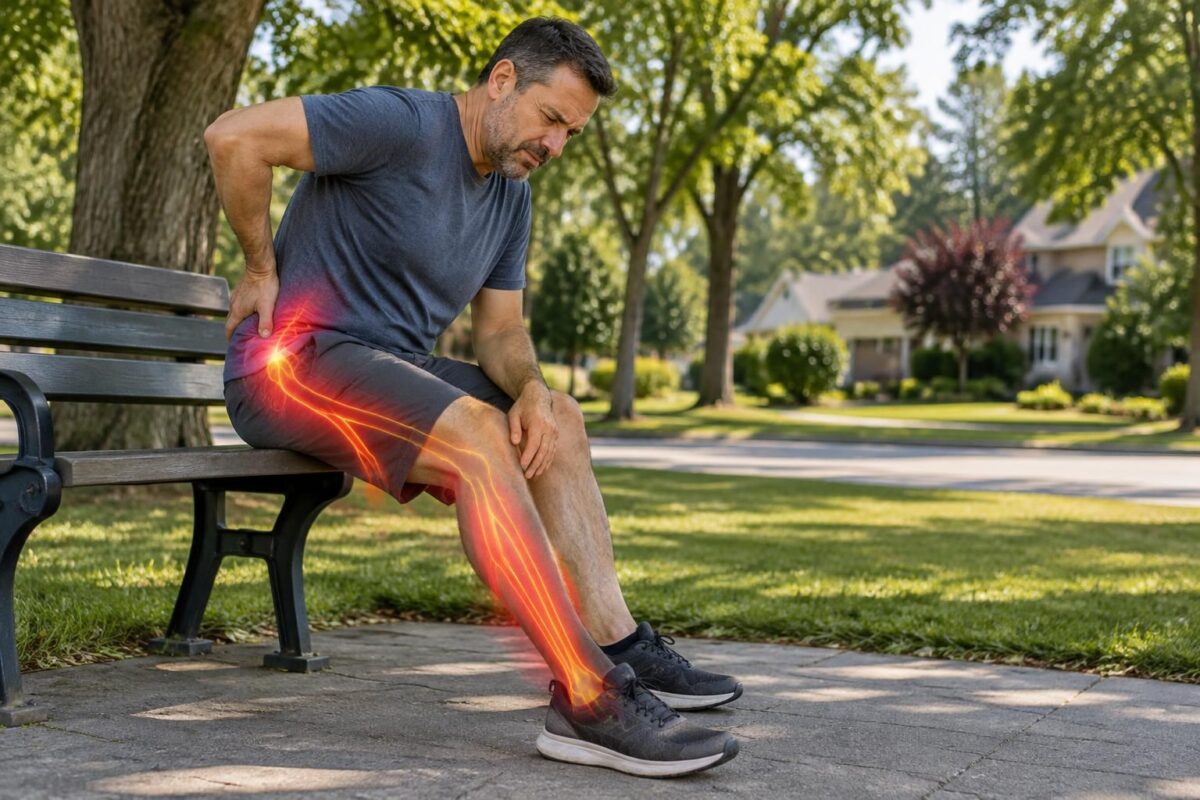
IN BRIEF
| Sciatica is a nerve pain that can start from the lower back and radiate into the buttock and leg, sometimes down to the foot, with tingling or numbness. In Terrebonne, identifying the affected sensory territory helps guide the evaluation and consider care tailored to the cause. Significant or progressive weakness, loss of sensation in the saddle area, or urinary or intestinal disorders require urgent medical consultation. |
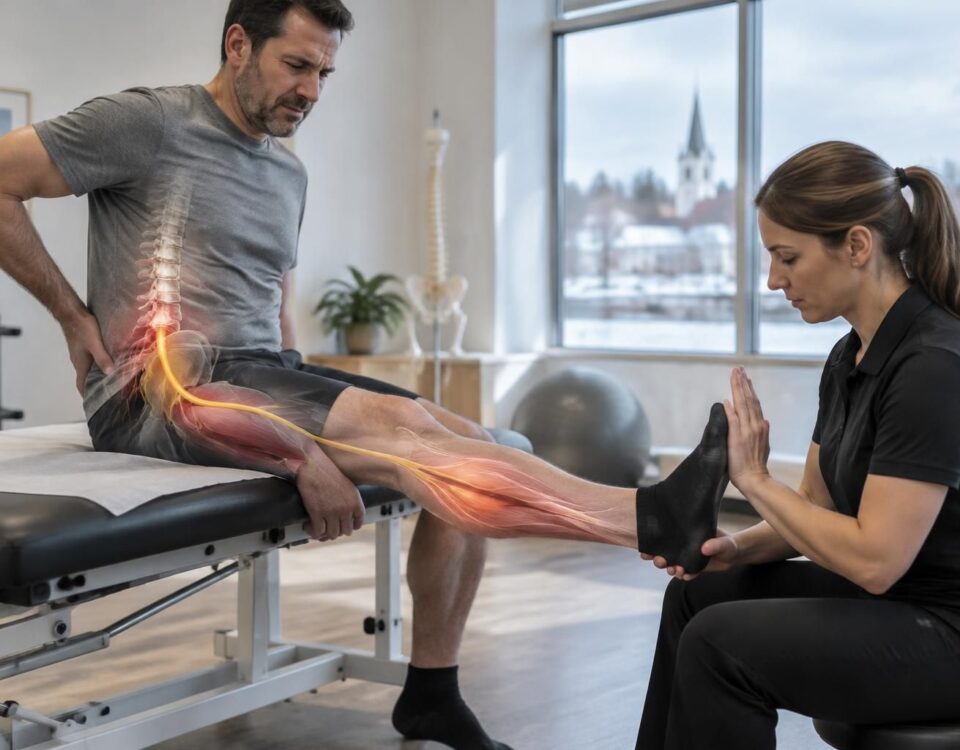
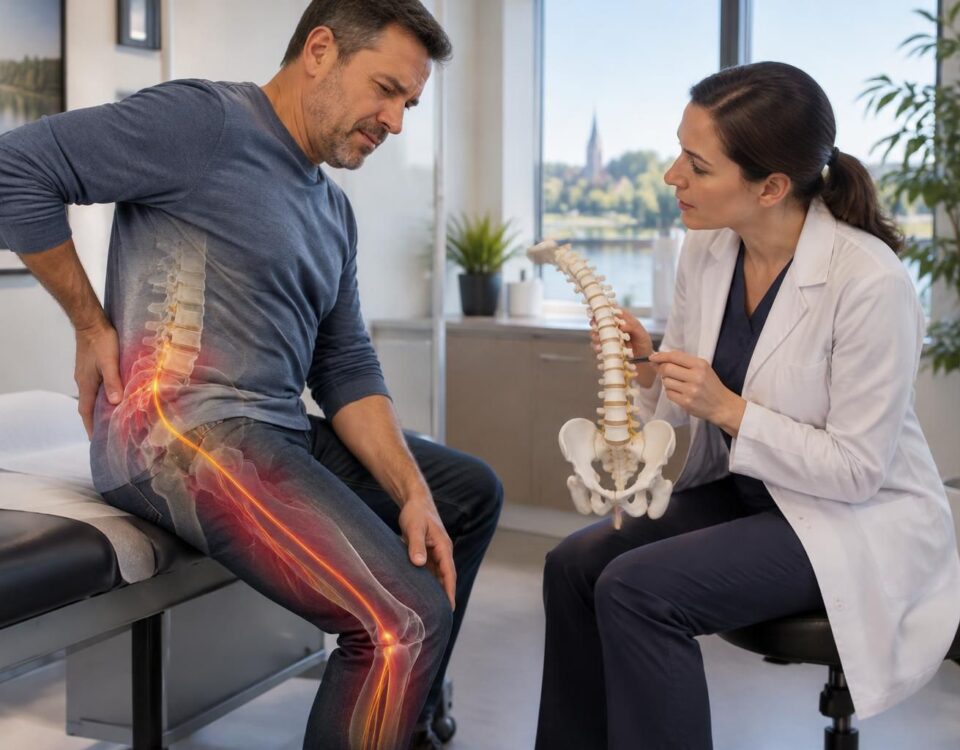
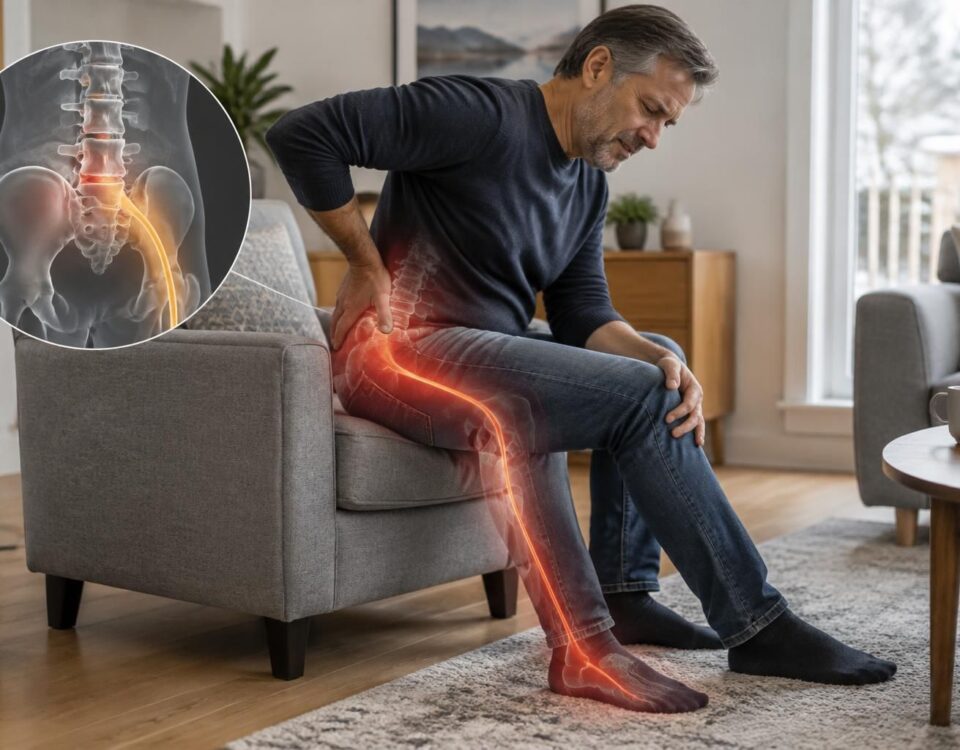
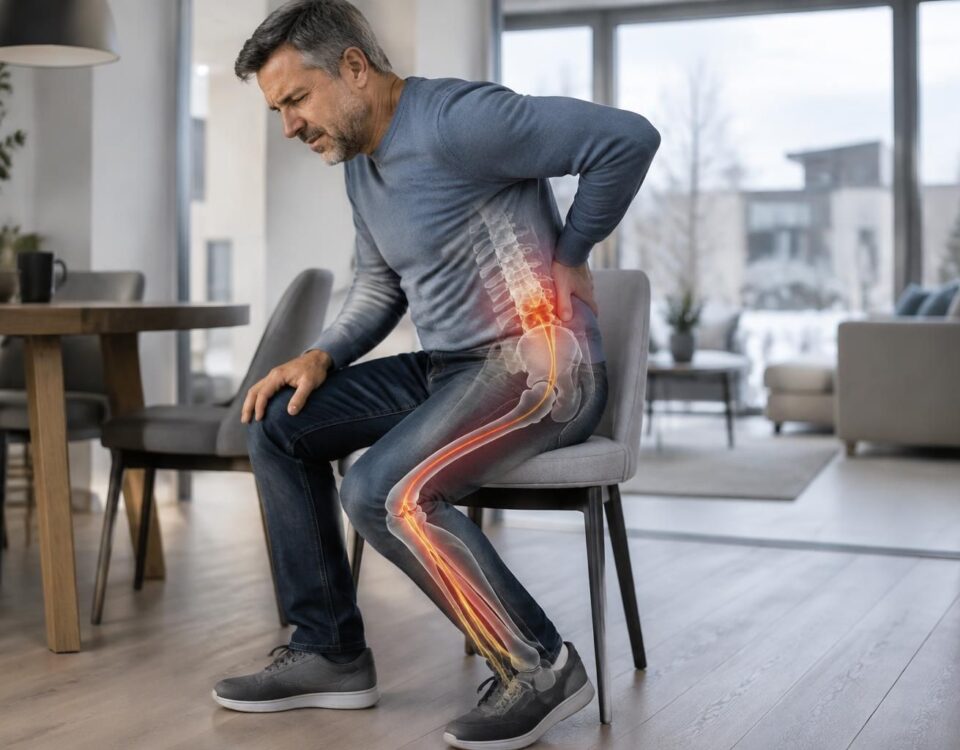
In Terrebonne, sciatica can cause nerve pain starting from the lower back or buttock and generally radiating on one side towards the back or side of the leg, sometimes down to the calf, foot, or toes. Tingling, numbness, or decreased sensitivity may follow in that area, depending on the irritated nerve root.
An evaluation can clarify the symptoms and guide management options. In cases of significant or progressive weakness, loss of urinary or bowel control, or numbness in the saddle area, seek medical assistance quickly.
A sciatica can cause pain that starts in the lower back or buttock and travels down one leg. Tingling, numbness, or weakness may also occur. The path of the symptoms provides clues, but it is not sufficient to identify the cause: a professional assesses sensitivity, strength, reflexes, and the evolution of the pain before suggesting management. The term sciatica often describes pain related to the irritation of a lumbar nerve root or the sciatic nerve. The nerve roots from the lumbar and sacral regions join to form this nerve. It passes through the buttock and the back of the thigh, then its branches extend towards the leg and foot. Nerve irritation can produce burning, electric, stabbing, or shooting pain. It may be accompanied by tingling, decreased sensitivity, or weakness. The pain often affects one side only, but its path varies from person to person. To learn more about possible mechanisms, consult our page on sciatica and this presentation of its anatomy, causes, and symptoms. Each nerve root contributes to the sensitivity of specific areas of the leg and foot. Professionals refer to these areas as sensitive territories. Their observation helps guide the evaluation, but the territories overlap. Therefore, pain alone cannot confirm which root is affected. Irritation of the L4 root may alter sensitivity around the knee and on part of the inner side of the leg. An issue at L5 may affect the outer side of the leg, the top of the foot, or the big toe. An issue at S1 may manifest at the back of the calf or on the outside edge of the foot. These descriptions are general and do not replace a medical examination. The symptoms may also travel up to the buttock, remain in the thigh, or extend down to the calf and foot. These variations do not indicate alone an aggravation or improvement. To compare lumbar levels, see the pages on the difference between L4, L5, and S1, on L4, L5, and S1 levels, and on the frequent involvement of L5-S1. A herniated disc, irritation of a nerve root, spinal canal narrowing, or changes related to osteoarthritis can contribute to sciatic symptoms. An injury or other health issues may also be involved. Sometimes, the evaluation does not reveal a single obvious cause. The pain may start in the lower back, pass through the buttock, and descend towards the thigh or calf. Some people primarily feel pain in the leg, with little back pain. To better understand this trajectory, see the pages on pain from the lower back to the calf and on pain that descends then rises back to the buttock. The page on leg pain and sciatica also describes different pain profiles. A healthcare professional first gathers information on the onset of the pain, its trajectory, associated sensations, and activities that alter it. The examination may check the sensitivity of several areas, the strength of the leg and foot, and certain reflexes. These elements help distinguish nerve pain from other possible causes of leg pain. Imaging, such as an MRI or CT scan, is not necessary in every case. A professional may consider it if symptoms persist, if the examination reveals concerning signs, or if the results may guide care decisions. Nerve and muscle tests can sometimes complement the evaluation. The Merck Manual also outlines the key points of diagnosis and management. Management depends on the probable cause, the intensity of symptoms, and their evolution. It may include relief measures and follow-up tailored to the situation. Surgery is sometimes considered when certain issues persist or lead to significant neurological signs. Only a qualified professional can determine appropriate medical options. At the TAGMED Clinic in Terrebonne, an evaluation can help examine the symptoms and discuss non-surgical options suitable for the case. Depending on the evaluation, care may include specific osteopathy or motorized neurovertebral decompression. These approaches do not replace a medical diagnosis and may not be suitable for all situations. Discover the services related to sciatica in Terrebonne. To make an appointment or check if an assessment is appropriate for your situation, contact the Clinique TAGMED. The decision to undergo treatment must take into account your symptoms, health status, and the results of the assessment. Consult a doctor or emergency service quickly in case of loss of control of the bladder or bowels, numbness in the saddle area, significant or progressive weakness in the leg or foot, fever, recent trauma, severe pain, or rapid deterioration. These signs require immediate medical evaluation. Sylvain Desforges, B.Sc., D.O., N.D., Doctor of Osteopathy and naturopath, is the founding president of TAGMED and the ACMA association. He dedicates his practice to chronic pain of the spine, low back pain, and pain associated with sciatica, particularly when the pain radiates towards the hip, leg, calf, foot, or toes. Through SOS Sciatique, he publishes educational content on the symptoms of sciatica, possible causes such as herniated discs, disc compression, foraminal stenosis, or irritation of a lumbar nerve root, as well as non-surgical approaches that may be considered based on the evaluation. At the Clinique TAGMED, care may include, as appropriate, motorized neurovertebral decompression, specific osteopathy, or precision percussion. For an evaluation related to sciatica treatment in Montreal or Mont-Royal, or sciatica treatment in Terrebonne, consult the services available at the Clinique TAGMED. Medical disclaimer: The information and advice provided on this site do not replace the opinion, diagnosis, or treatment of a healthcare professional. Please note that Sylvain Desforges, B.Sc., D.O., N.D., doctor of osteopathy, is neither a medical doctor nor a physician, and is not a specialist in a medical field as defined by the Collège des médecins du Québec. Manual medicine, functional medicine, and sports medicine as described on this site exclude any medical treatment or diagnosis made by a doctor or specialist. Always consult your doctor for any medical questions. For more details, please read our complete legal notice. The information published on SOS Sciatique is provided for educational purposes and does not replace a consultation, diagnosis, opinion, or treatment provided by a doctor or other licensed healthcare professional. The author of this article is neither a doctor nor a specialist in a medical specialty recognized by the Collège des médecins du Québec. The osteopathy, manual therapy, or functional support approaches described on this site do not constitute medical acts and are not intended to replace medical follow-up. Consult a doctor or emergency service in case of loss of bladder or bowel control, anesthesia in the saddle area, significant or progressive weakness in the leg or foot, fever, recent trauma, severe pain, or rapid deterioration. For more details, please read our legal notice.Understanding Nerve Pain Related to Sciatica
The Sensory Territory: What Symptoms May Indicate
Possible Differences Between L4, L5, and S1
Possible Causes and Symptoms in Terrebonne
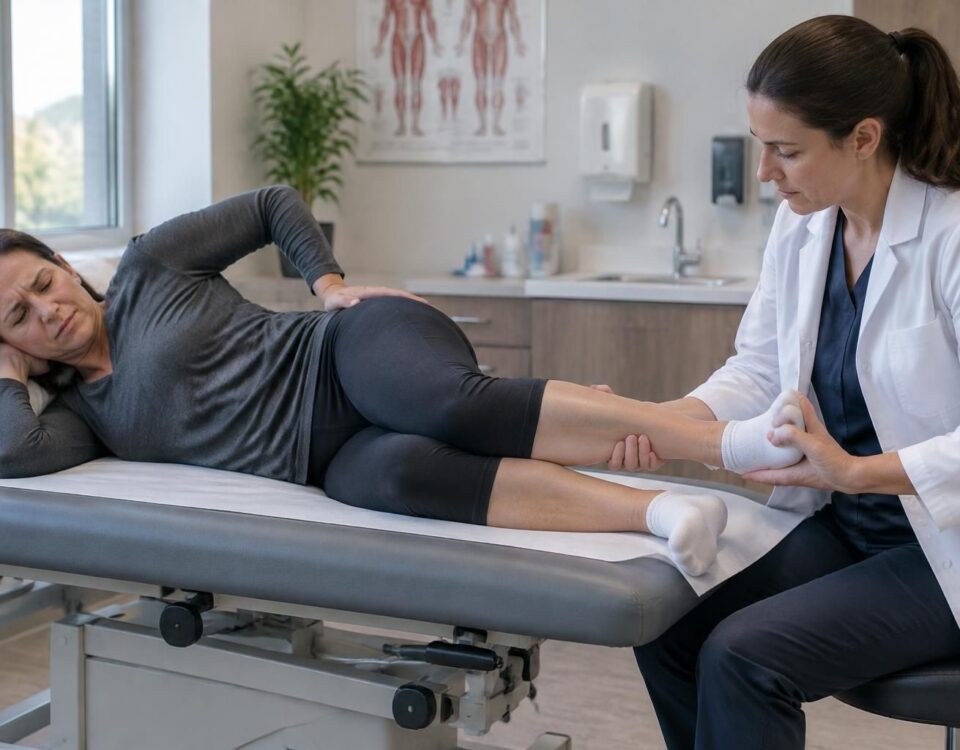
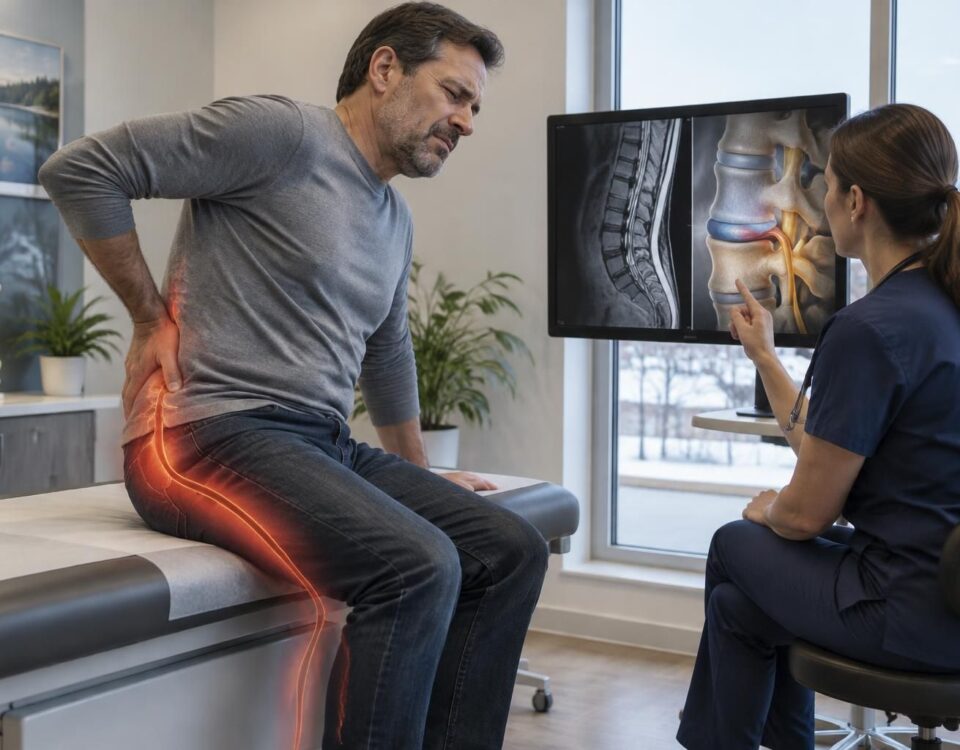
How the Evaluation is Conducted
Management Options and Consultation in Terrebonne
When to seek medical help quickly
About the author
Medical disclaimer
Nerve pain
Sensory territory

In Terrebonne, pain that starts from the lower back or hip and radiates down a leg may indicate sciatica, but its path and the sensations felt vary depending on the affected nerve root. Identifying the painful area, tingling, numbness, or potential weakness helps describe the symptoms and direct the evaluation. Appropriate recommendations begin with a professional examination, careful maneuvers, and close attention to signs of urgency.
Understanding nerve pain and its sensory territory
Sciatica refers to pain related to irritation or compression of a lumbar nerve root or the sciatic nerve. It often affects one side and can extend from the lower back to the hip, back or side of the thigh, and sometimes to the calf and foot. It can be described as burning, electric shock, stabbing pain, or a pulling sensation.
The sensory territory corresponds to areas of the skin whose sensitivity primarily depends on a nerve root. Depending on the affected root, numbness or tingling may manifest at different locations in the leg or foot. These areas overlap and do not always follow a perfectly clear path: the localization of symptoms alone does not allow for a diagnosis to be established.
Symptoms to note before a consultation
To prepare for an evaluation in Terrebonne, note the affected side, the starting point of the pain, and how far it radiates. Specify whether the sensation is constant or intermittent, which movements or activities exacerbate it, and whether you observe any loss of sensitivity or weakness. Also indicate whether coughing, sneezing, or certain positions affect the symptoms. This information can help the professional better understand your situation.
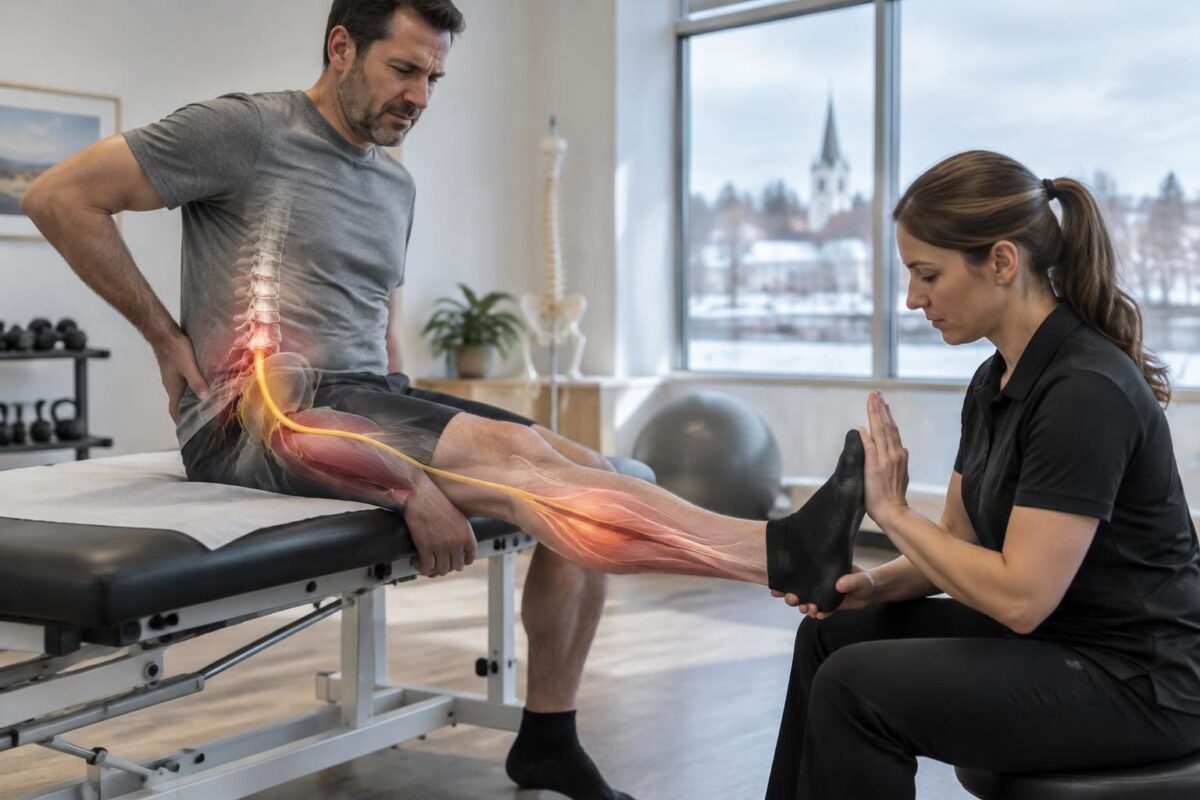
Sciatica in Terrebonne: muscle weakness according to the irritated nerve root
IN BRIEF Sciatica with muscle weakness can occur when a lumbar nerve root is irritated; affected movements, such as raising the foot or walking on tiptoes, provide clues but are not sufficient for a diagnosis. In Terrebonne, an evaluation can…
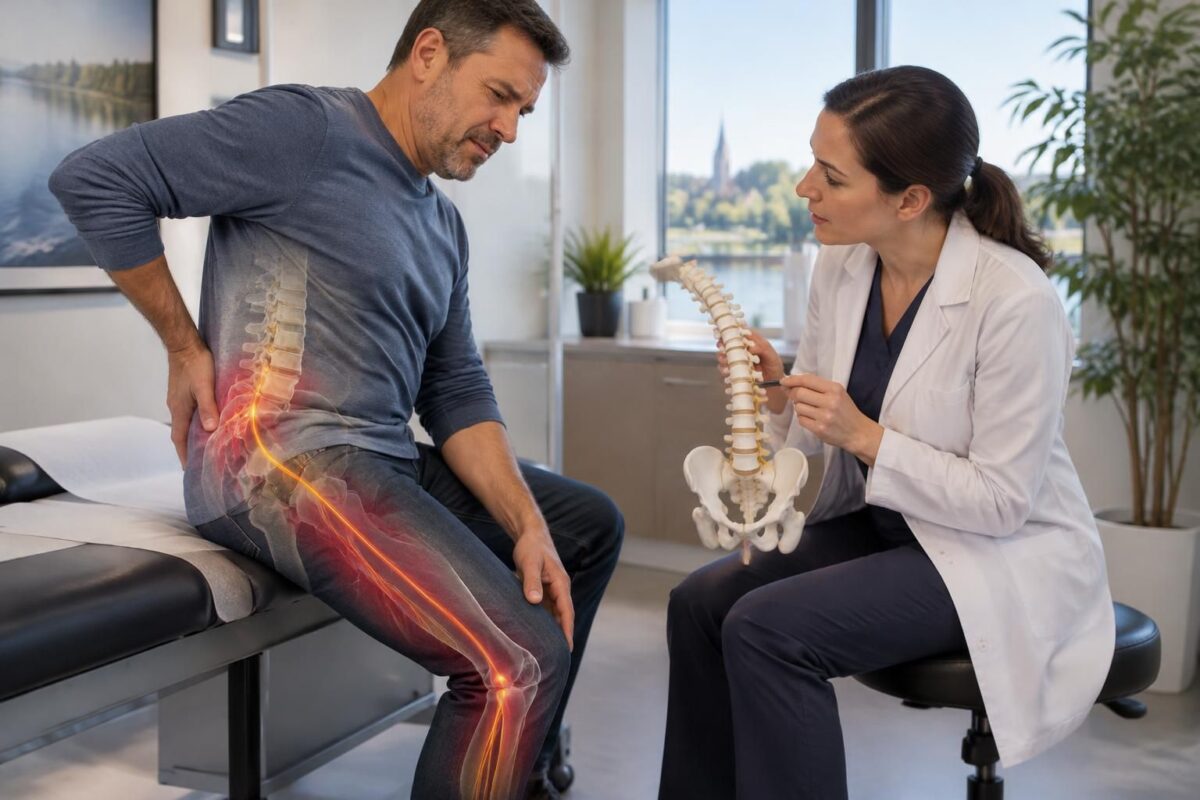
Sciatica in Terrebonne: L4, L5, S1, how to find your way?
IN SHORT Sciatica is a pain that can radiate from the buttock down the leg when a nerve root is irritated. The levels L4, L5, and S1 can produce overlapping symptoms; therefore, the pathway of the pain alone is not…

Sciatica in Terrebonne: L5 or S1 irritation, why the clinical examination matters
IN BRIEF Sciatica is pain related to the irritation of a nerve root, often L5 or S1. The pathway of symptoms, strength, sensitivity, and walking provide clues, but the territories may overlap: the clinical examination therefore helps guide the assessment…
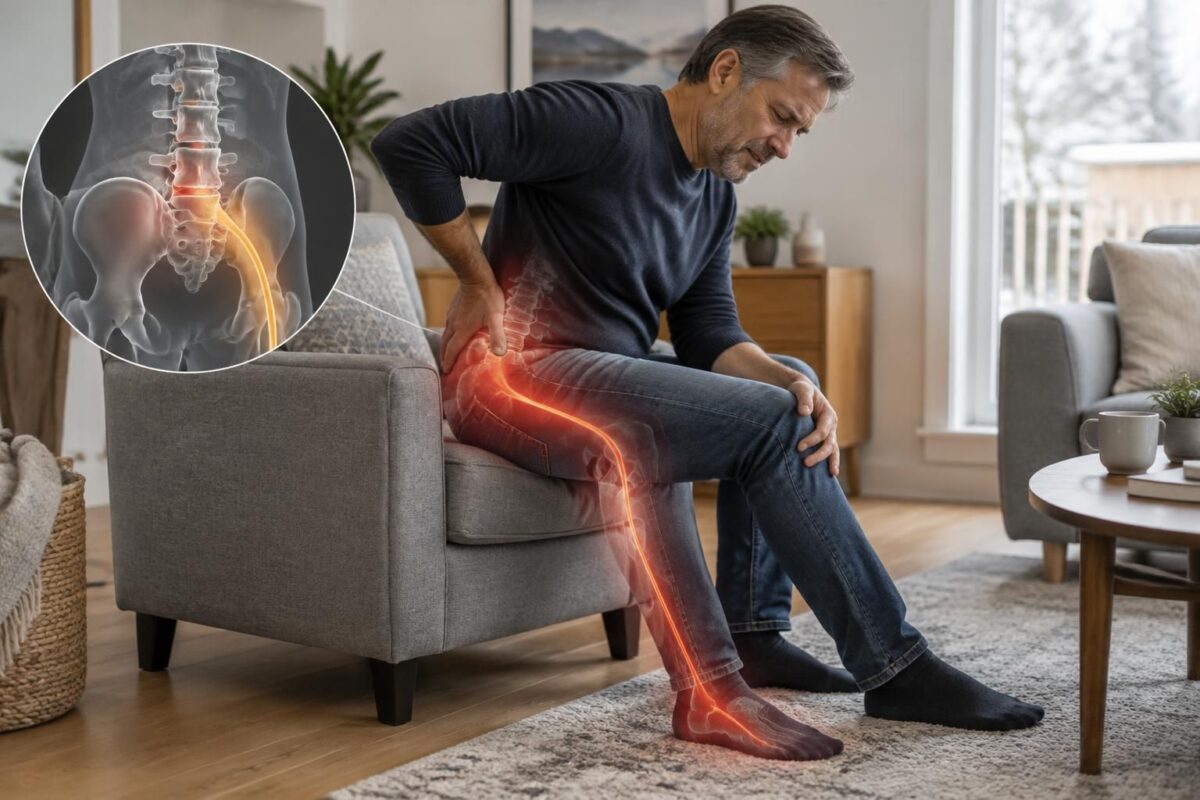
Sciatica in Terrebonne: L5-S1 Herniation and Pain Towards the Foot
IN BRIEF A sciatica related to a possible L5-S1 herniation can cause pain from the lower back or buttock down to the calf, heel, or foot. The path of the symptoms alone is not enough to confirm the cause: the…
Prudent daily recommendations
When the pain allows, favor gentle and frequent movements rather than prolonged bed rest. Short walks at a comfortable pace can be attempted without straining. Change positions regularly if you remain seated or standing for long periods. Temporarily avoid movements that trigger significant radiation, such as lifting loads with a bent back or sudden twists.
Heat or cold can provide temporary relief for some people. Use a barrier between the skin and the heat source or cold pack, and stop the application if the skin becomes painful or irritated. Stretching should not intensify the pain that radiates down the leg. If in doubt about the appropriate medications or exercises, consult a healthcare professional.
When to Seek an Evaluation
An evaluation checks strength, reflexes, and sensitivity, then determines if further examinations are needed. Care may vary depending on the cause and progression of symptoms; no manual or functional approach automatically suits everyone. In Terrebonne, make an appointment if the pain persists, recurs regularly, or limits your activities, especially if tingling or numbness accompanies the pain.
Consult a physician or emergency service immediately if there is loss of bladder or bowel control, numbness in the saddle area, significant or progressive weakness in the leg or foot, fever, recent trauma, or rapid worsening. These symptoms require urgent medical evaluation.
| Manifestation | Sensitive Marker |
|---|---|
| Radiated Pain | From the lower back or buttock to a leg, sometimes to the foot. |
| Burning or Shock | Pain often felt in the back or side of the leg. |
| Tingling | Possible tingling in the leg or foot. |
| Numbness | Area of decreased sensitivity, varying according to the affected nerve root. |
| Weakness | Possible difficulty moving the leg or foot; progressive weakness requires prompt evaluation. |
| Pain Aggravated by Certain Movements | Walking, coughing, or certain position changes may intensify symptoms. |
Testimonials in Terrebonne: Nerve Pain and Sensitive Territory
Note: The accounts below are illustrative examples, written to explain different ways in which pain compatible with sciatica may manifest. They do not correspond to verified patient testimonials.
“The pain radiated from the buttock to the calf” — In Terrebonne, a person describes a burning pain that starts in the lower back, passes through the buttock, and follows the back of the thigh to the calf. They also notice tingling in part of the foot. This pathway may suggest nerve irritation, but the location of symptoms alone is insufficient to determine the cause.
“I had a numb area on the side of my leg” — Another person reports a tingling sensation and decreased sensitivity on the side of the leg, sometimes down to the foot. The pain increases after a prolonged sitting period. A healthcare professional can assess sensitivity, strength, and reflexes to better understand these signs.
“The pain went down to my toes” — In this example, the pain is described as an electric shock that travels from the buttock down the leg to the toes. The person is concerned about the difference between localized muscle pain and pain that follows a nerve pathway. A clinical exam can help direct the evaluation; imaging or electrodiagnostic tests may sometimes be considered depending on the symptoms and their progression.
“I mostly had tingling, with little back pain” — Pain compatible with sciatica does not always manifest the same way for everyone. Some people experience mostly numbness, tingling, or weakness in part of the leg. It is useful to note where sensations occur, when they happen, and what aggravates them, without attempting to self-diagnose.
A significant or progressive weakness, loss of bladder or bowel control, or numbness in the saddle area requires urgent medical evaluation.
Sciatica refers to pain related to irritation of a nerve root in the lumbar region or the sciatic nerve. It can manifest in the lower back, buttock, and one leg, sometimes extending to the calf, foot, or toes. In Terrebonne, individuals consulting for this type of symptom often describe pain on one side, accompanied by burning, shocks, tingling, or numbness. The intensity and pathway vary according to the affected structure.
The sciatic nerve is formed by several nerve roots from the lower part of the spine. It passes through the buttock region and descends into the leg, where its branches contribute to sensitivity and movement. When a root is irritated or compressed, the pain may follow part of its sensitive territory, also called a dermatome. Depending on the affected root, sensations may be more pronounced in the buttock, back or side of the thigh, in the calf, on the top of the foot, or towards certain toes.
The pathway of the pain provides clues, but it is not sufficient to pinpoint the exact cause. Sensitive territories overlap and symptoms may vary from person to person. Therefore, a feeling of tingling or a less sensitive area does not, by itself, prove that a particular root is affected. The evaluation also considers muscle strength, reflexes, movements that worsen or relieve the pain, and the evolution of the symptoms.
Several situations can contribute to sciatic-type pain: a herniated disc, changes associated with osteoarthritis, narrowing of the canal or openings through which nerves pass, or irritation after exertion. Pain felt in the leg can also have other origins. This is why a clinical examination is important before choosing an approach. Based on the observed signs and their duration, a professional may recommend medical follow-up or imaging or electrodiagnostic tests.
Walking, running, stairs, coughing, or certain movements can intensify pain in some individuals; for others, symptoms change depending on posture or activity. An appropriate management plan aims to understand the associated factors, promote the maintenance of tolerable activities, and gradually adjust movements. Non-surgical approaches may be considered depending on the evaluation and needs. At TAGMED Clinic, services may include, as applicable, specific osteopathy, motorized neural decompression, or precision percussion. These treatments do not replace a medical diagnosis or prescribed follow-up.
In case of loss of bladder or bowel control, numbness in the saddle area, significant or progressive weakness in the leg or foot, you should seek medical care promptly. Severe pain, fever, recent trauma, or rapid worsening also require immediate evaluation.
About the Author
Sylvain Desforges, B.Sc., D.O., N.D., Doctor of Osteopathy and naturopath, is the founding president of TAGMED and the ACMA association. His practice focuses in particular on chronic spinal pain, lower back pain, and symptoms consistent with sciatica. He is interested in integrating manual approaches and technologies, including neurovertebral decompression, laser, and shockwaves, when these are appropriate to the situation.
Medical warning
This content is provided for educational purposes and does not replace a consultation, diagnosis, or treatment by a physician or another licensed health professional. The author is neither a physician nor a specialist in a medical specialty recognized by the Collège des médecins du Québec. The approaches described do not constitute medical acts and do not replace medical follow-up.
In Terrebonne, pain that starts from the lower back or buttock and radiates down the leg may suggest sciatica, but its path and changes in sensitivity vary according to the affected nerve root. Identifying where the pain, tingling, numbness, or weakness occurs helps describe the symptoms and guide the evaluation; however, this alone is not sufficient to make a diagnosis.
Nerve pain and sensory territory
Sciatica corresponds to pain that may follow the path of a lumbar nerve root or the sciatic nerve. It often affects one side and can manifest in the buttock, back or side of the thigh, calf, foot, or toes. The sensation is sometimes described as burning, jolting, sharp, or tingling. To better understand the role of the S1 root, consult this page on irritation of the S1 root.
The affected territory can give indications but does not definitively determine the cause. Pain or altered sensitivity in the toes, for example, should be described precisely to the professional evaluating you. You can learn more about loss of sensitivity in the toes and symptoms that may concern the calf in the context of L5-S1.
Difficulty lifting the foot or walking on the heels should also be reported quickly, especially if it is new or worsening. For more information on this symptom, consult the article dedicated to L5 and the difficulty of lifting the foot. Additional resources also describe sciatic nerve neuropathy and the clinical elements associated with lumbar radicular pain.
Several structures may contribute to the symptoms, including a herniated disc, foraminal stenosis, or irritation of a nerve root. The location of the pain alone cannot distinguish these possibilities. An accessible explanation of the links between nerve root, disc, and foramen can help better understand the terms used during evaluation.
The assessment generally relies on the reported symptoms and a clinical examination of strength, sensitivity, and reflexes. Depending on the duration, progression, and observed signs, a health professional may find it useful to request additional testing. To discover the different approaches to evaluation and management, also check the information on sciatic pain in Terrebonne and on chronic sciatica.
If symptoms persist, limit your activities, or return regularly, an individualized evaluation can help determine the next steps suitable for your situation. To learn more about the services offered locally, visit the page dedicated to sciatica in Terrebonne. A non-surgical approach may be considered based on the evaluation, with no guarantee of results and not replacing medical follow-up when necessary.
Consult a physician or emergency service promptly in case of loss of bladder or bowel control, numbness in the saddle area, significant or progressive weakness in the leg or foot, fever, recent trauma, or rapid worsening. These signs require urgent medical evaluation.
About the author
Sylvain Desforges, B.Sc., D.O., N.D., Doctor of Osteopathy and naturopath, is the founding president of TAGMED and the ACMA association. His practice focuses in particular on chronic spinal pain, lower back pain, and pain consistent with sciatica.
Through SOS Sciatique, he publishes educational content on the symptoms of sciatica, its possible causes, and non-surgical approaches that may be considered based on the evaluation. At TAGMED Clinic, care may include, as appropriate, motorized neurovertebral decompression, specific osteopathy, or precision percussion.
For an evaluation related to treatment of sciatica in Montreal / Mont-Royal or to treatment of sciatica in Terrebonne, consult the available services at TAGMED Clinic.
Medical warning
The information published on SOS Sciatique is provided for educational purposes and does not replace a consultation, diagnosis, opinion, or treatment performed by a physician or another licensed health professional. The author of this article is neither a physician nor a specialist in a medical specialty recognized by the Collège des médecins du Québec. The osteopathic, manual medicine, or functional support approaches described on this site do not constitute medical acts and are not intended to replace medical follow-up. For more details, please read our Legal Notice.

Sciatica in Terrebonne: L4-L5 protrusion and leg pain
IN BRIEF A L4-L5 disc protrusion is a bulging of a lumbar disc that may, depending on its relationship with the nerves, contribute to sciatica, with pain, tingling, or numbness in the leg. In Terrebonne, an assessment helps relate symptoms,…
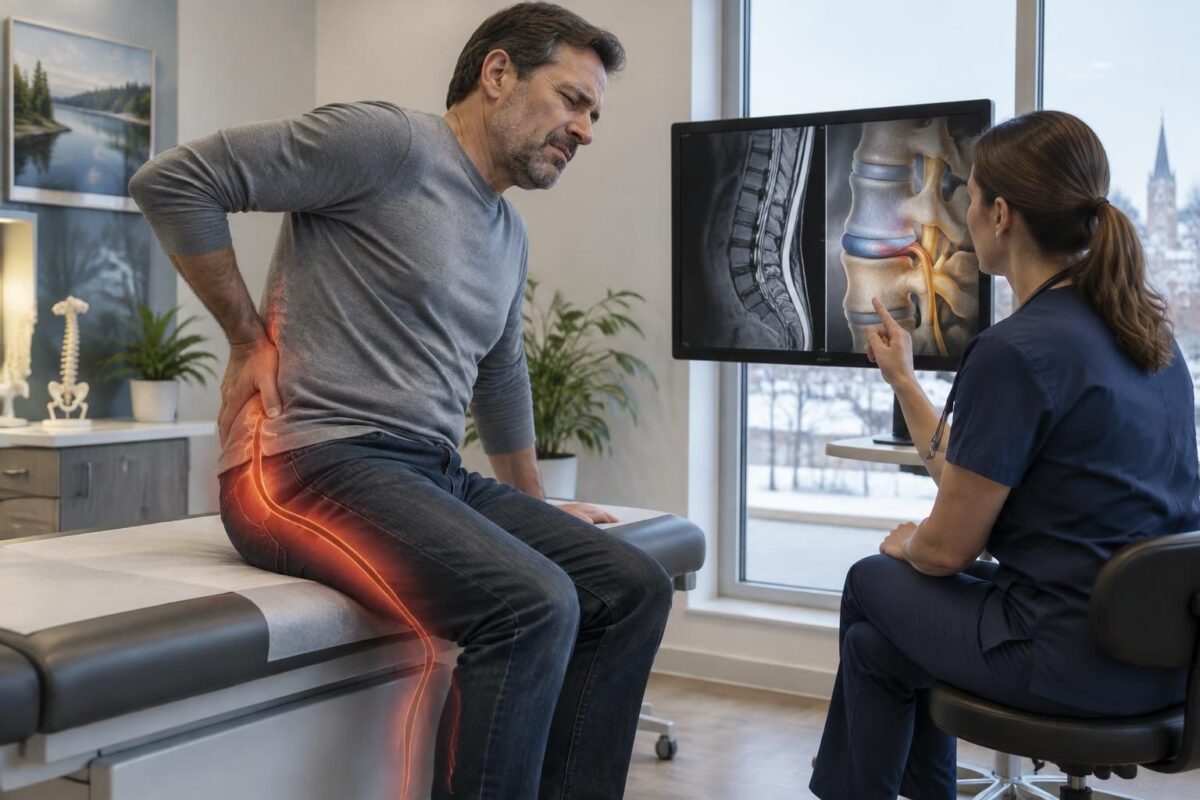
Sciatica in Terrebonne: what “disc-root conflict” means
IN BRIEF A disc-root conflict occurs when an intervertebral disc irritates or compresses a nerve root in the lower back. It can cause sciatica: lower back pain that radiates down into the buttock and leg, sometimes accompanied by sensory disturbances…
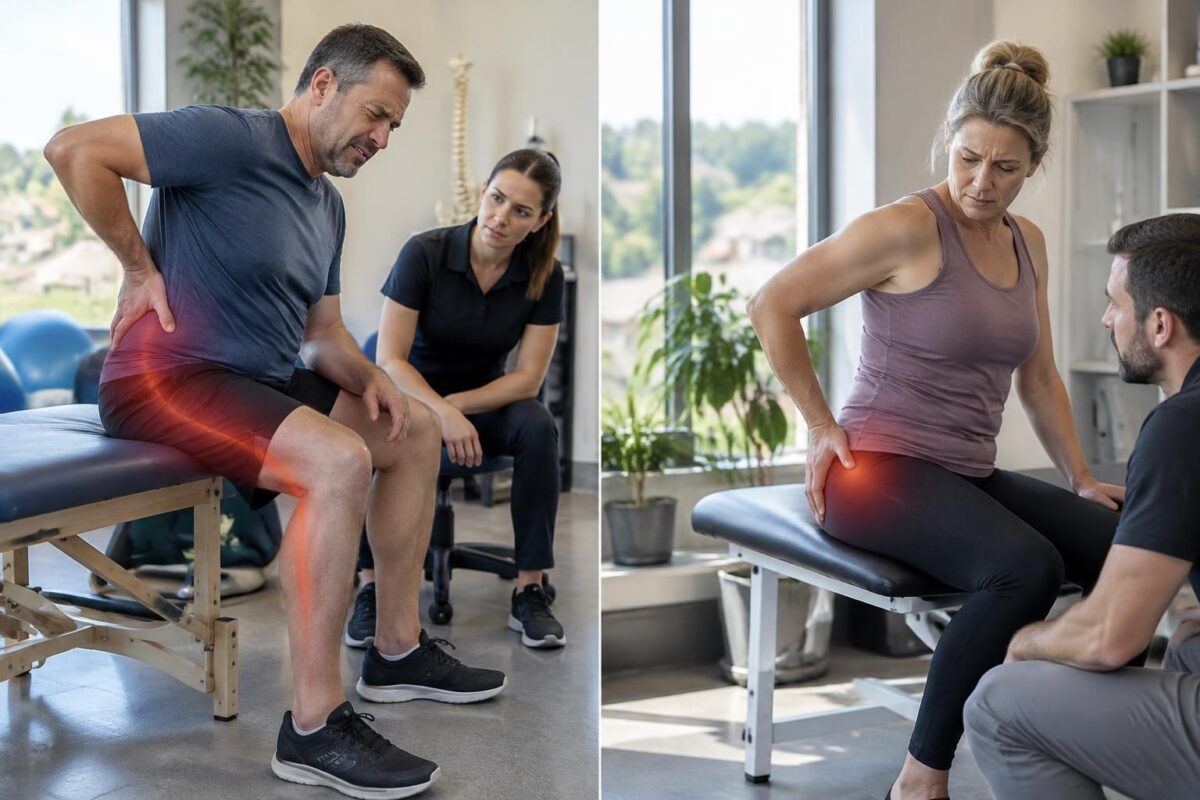
Sciatica in Terrebonne: radicular pain versus referred pain
IN BRIEF Sciatica refers to pain that radiates into the buttock and sometimes the leg. A radicular pain comes from the irritation of a nerve root and may be accompanied by tingling, numbness, or weakness; a referred pain spreads from…
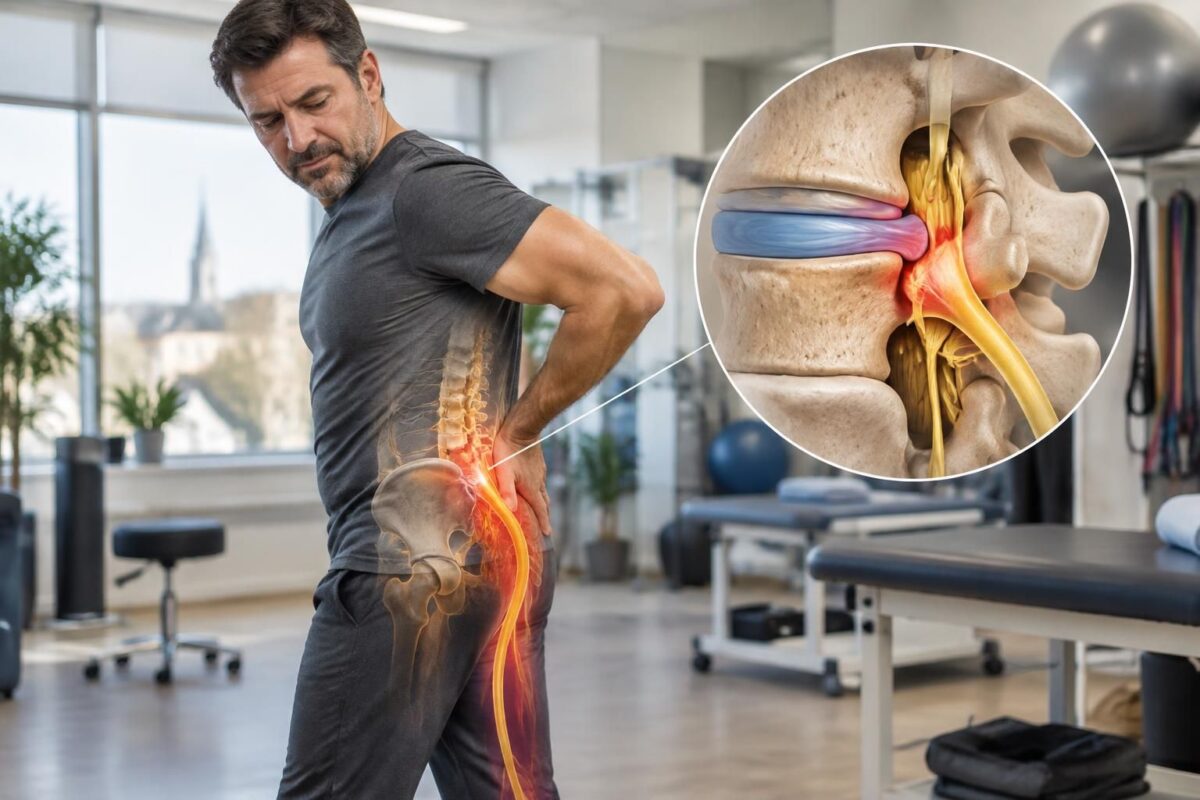
Sciatica in Terrebonne: nerve root, disc, and foramen explained simply
IN BRIEF Sciatica is pain that occurs when a nerve root in the lower back is irritated or compressed, sometimes by a disk or a narrowed foramen. Understanding these structures helps better locate the possible cause of symptoms and guide…

Sylvain Desforges, B.Sc., D.O., N.D., docteur en ostéopathie
Dr Sylvain Desforges, B.Sc., D.O., N.D., osteopath, is the founding president of TAGMED and of the ACMA association. He dedicates his practice to chronic spinal pain, low back pain and symptoms compatible with sciatica, particularly when pain radiates toward the buttock, leg, calf, foot or toes.
Through SOS Sciatique, he publishes educational content on sciatica symptoms, possible causes such as disc herniation, disc narrowing, foraminal stenosis or irritation of a lumbar nerve root, as well as non-surgical approaches that may be considered according to the evaluation. At Clinique TAGMED, care may include, depending on the case, motorized neurovertebral decompression, specific osteopathic care or precision percussion.
For an evaluation related to sciatica treatment in Montreal / Mount Royal or sciatica treatment in Terrebonne, please consult the services available at Clinique TAGMED.
Medical disclaimer
The information published on SOS Sciatique is provided for educational purposes only and does not replace a consultation, diagnosis, opinion or treatment provided by a physician or another authorized healthcare professional. The author of this article is neither a medical doctor nor a specialist in a medical specialty recognized by the Collège des médecins du Québec. The osteopathic, manual medicine or functional support approaches described on this site do not constitute medical acts and are not intended to replace medical follow-up.
Consult a physician or emergency service in cases of loss of bladder or bowel control, anesthesia in the saddle area, significant or progressive weakness in the leg or foot, fever, recent trauma, severe pain or rapid worsening of symptoms. For more details, please read our Legal Notice.