Sciatica and descending stairs: calf or foot pain
21/09/2026
Sciatica in Terrebonne: pain that wakes you up at night
22/09/2026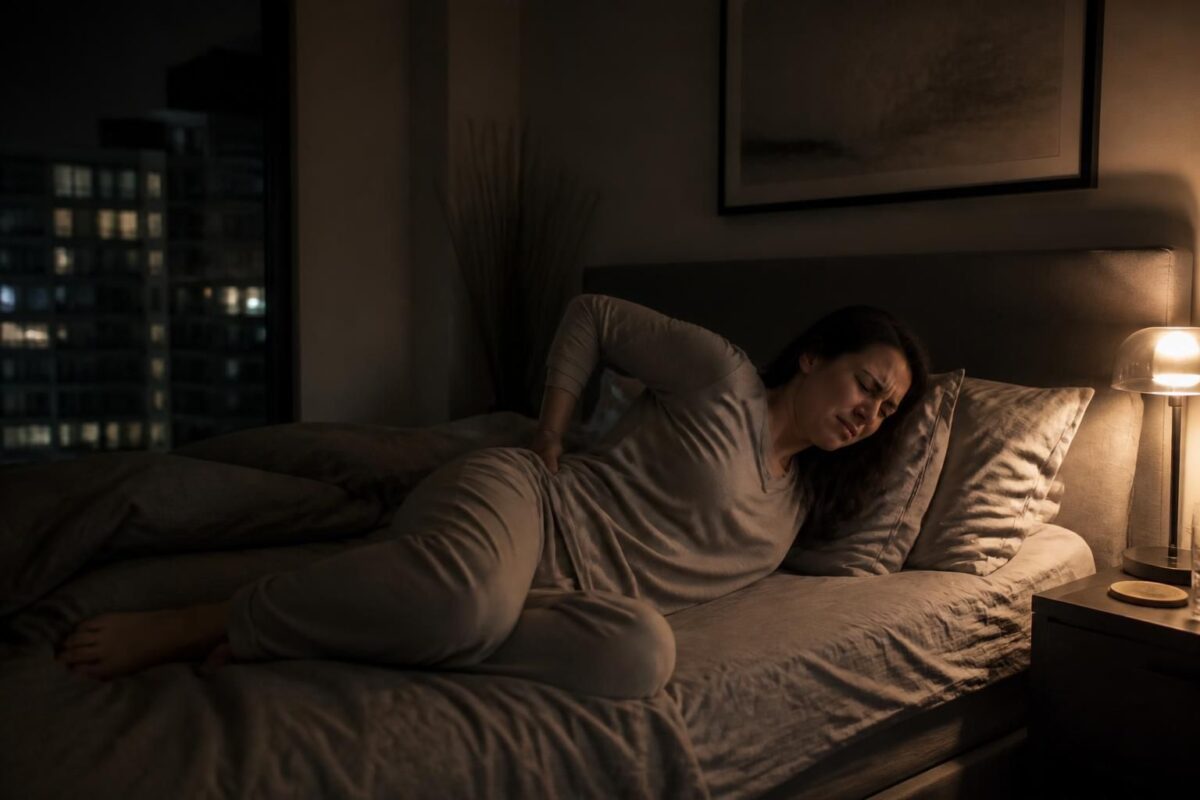
IN SHORT
| In short, nocturnal sciatica is pain that follows the path of the sciatic nerve and intensifies at rest, disrupting sleep. In Montreal, it can be managed with simple advice on nighttime posture and bedding: sleeping on your side with a pillow between your knees or on your back with support under the calves, and choosing a medium-firm mattress and a proper pillow, which immediately reduces pressure on the discs and the nerve. Understanding circadian mechanisms and associated inflammation can improve sleep and limit nighttime awakenings without immediately resorting to invasive treatments, while guiding towards a medical diagnosis if necessary. |
In Montreal, nocturnal sciatic pain is a common issue that can awaken individuals during sleep. At night, immobility and hormonal fluctuations promote inflammation around the nerve, and the pain can become more intense.
Simple adjustments to postural alignment and bedding can quickly reduce pressure on the nerve and improve rest. Adopting a proper posture can therefore transform your nights and your daily life.
- Sleep on your side with a pillow between your knees to maintain lumbar alignment.
- Or sleep on your back with a support under the calves to decrease disc pressure.
- Choose a medium-firm mattress and a proper pillow to support the spine.
- Keep the room temperature around 18–20°C and avoid excessive humidity.
- Prioritize gentle movements before bed to promote drainage and muscle relaxation.
This article, written by a healthcare professional, explains why nocturnal sciatica can awaken people in Montreal, what biological mechanisms are at play, and what pragmatic, non-surgical approaches can improve sleep and reduce pain. It offers simple clinical guidelines and local resources to guide you toward better quality rest without waiting for a complex intervention.
Nocturnal Causes and Biological Mechanisms
Nocturnal pain related to sciatica can be explained by a decrease in cortisol during sleep, combined with fluid stagnation and persistent inflammation around the nerve root. This combination increases the sensitivity of tissues around the nerve and can intensify pain when you are lying down. The brain, less distracted by external stimuli, focuses more on painful lumbar signals.
Nocturnal immobility reduces the drainage of inflammatory toxins in the tissues surrounding the nerve root. This accumulation can sustain ongoing irritation and promote stiffness that compresses the sciatic nerve. Maintaining light activity during the day and favoring positions that limit disc pressure can help break this cycle.
Pain can be perceived differently depending on its structural origin. Sciatica may arise from a tight gluteal muscle or result from a disc condition such as a protrusion or stenosis, which influences the choice of management. For Montreal patients, it is useful to distinguish the causes and discuss options that fit within a multidisciplinary and non-invasive approach.
To be informed about practical aspects and nuances between types of pain radiating down the leg, consult dedicated resources such as those that describe nocturnal mechanisms and aggravating factors. For example, online resources discuss how pain can differ based on positions and sleep habits, and offer simple reflexes to limit nerve irritation during the night.
The role of the circadian rhythm and inflammation is central. Hormonal variations and decreased local circulation during the night contribute to amplifying pain. Simple adjustments in posture and sleep environment can help alleviate these effects and facilitate restorative rest.
Nocturnal Posture and Sleep Hygiene
The key to reducing pressure on discs and nerve roots is spinal alignment and leg support. A proper posture can slow down nocturnal pain and promote the drainage of metabolic waste.
Lateral position with support between the knees. Place a firm pillow between your knees to prevent the upper leg from pulling on the pelvis. This configuration helps your spine stay aligned and limits lumbar twisting. If you are sensitive on one side, switch sides and observe your comfort.
Position on your back with support under the knees. Slide a bolster or two pillows under your knees to slightly elevate the legs and press the lumbar against the mattress. A slight opening of the hips can free space around the nerve roots and decrease disc pressure.
Avoid sleeping on your stomach. This position can accentuate lumbar curvature and increase tension on the nerves. If you cannot change, place a small flat pillow under your abdomen to limit lumbar flexion and reduce pressure.
Arrange your bedding for an aligned spine. A mattress that offers firm yet welcoming support prevents sagging of the pelvis and excessive curvature. A mattress that is too soft can worsen pressure on the discs. A proper pillow, made of memory foam or natural latex, helps stabilize the neck and cervical spine.
Room temperature and humidity. A room that is too cold or too humid can increase nocturnal muscle tightness and worsen pain. Maintaining a temperature around 18–20°C and prioritizing a dry environment can reduce nocturnal intensity.
For those seeking concrete and tailored advice, specialized resources present useful postural and environmental approaches. For example, resources emphasize the importance of nighttime comfort and simple adaptations to promote sleep, without imposing restrictive exercises.
Warning Signs and Care Pathways
First, be aware that persistent nocturnal pain may signal a cause requiring medical evaluation. Warning signs to watch for include a progressive loss of strength in the leg, sensory disturbances, loss of control over the bladder or bowels, and pain that remains very intense despite rest. If you experience these elements, contact a doctor quickly or go to the emergency room.
The doctor may offer a clinical assessment and imaging tests, such as an MRI or CT scan, to identify a herniated disc, spinal stenosis, or another structural cause. As part of a multidisciplinary care pathway, physiotherapy often intervenes to strengthen supportive muscles and improve posture in daily life. Within the TAGMED clinic, approaches such as motorized neurovertebral decompression and specific osteopathy may be considered based on the evaluation.
For care pathways and localized information, resources dedicated to Montreal and its surroundings describe available options and selection criteria for managing night pain. Online sources dedicated to sciatica and nighttime offer practical advice and additional readings.
Useful links to explore the nighttime and postural aspects of sciatica in Montreal:
Sciatica in Montreal – pain that descends then returns to the buttock,
Sciatica and Night,
Sciatica – the night,
and other relevant resources available on Clinique TAGMED.
Treatments and management in Montreal
In Montreal, clinical options may be offered to reduce inflammation and improve nighttime comfort without immediately resorting to invasive drug treatments. Motorized neurovertebral decompression and specific osteopathy may be considered after evaluation. To learn more about the approaches available in the region, see the following resources:
Sciatica at Night – TAGMED,
Sciatica at Night (English),
and additional resources on Sciatica and difficulty staying upright.
For a more comprehensive approach, training resources in osteopathy and professional associations guide professionals toward safe and effective practices. In this context, recognized organizations include ACMA and the College of Canadian Osteopaths. Specific references to training or high-level institutes can be consulted to inform training choices and clinical practices.
If you are looking for practical readings on nighttime pain management and sleep, resources presented on specialized platforms may address your questions, including content that discusses the links between mobility, sleep, and metabolic drainage.
Complementary resources and associated readings:
Sciatica and slow walking better tolerated,
Sciatica in Terrebonne – persistent pain in the heel,
and content on Sciatica – Night – Pain – Sleep.
To learn more about nighttime mechanisms and practical solutions, you can consult dedicated resources and the pages of Clinique TAGMED, which provide information and advice tailored to Montreal and its surroundings.
Medical disclaimer: The information and advice provided on this site do not replace the opinion, diagnosis, or treatment of a health professional. Please note that Dr. Sylvain Desforges, osteopath, is neither a medical doctor nor a physician, and is not a specialist in a medical specialty as defined by the Collège des médecins du Québec. Manual medicine, functional medicine, and sports medicine as described on this site exclude any medical treatment or diagnosis made by a doctor or medical specialist. Always consult your physician for any medical questions. For more details, please read our full Legal Notice.
- Frequent nighttime causes: herniated disc, lumbar osteoarthritis, spinal stenosis.
- Circadian rhythm: the drop in cortisol at night increases inflammation.
- Toxin stagnation: immobility promotes nerve irritation around the sciatic nerve.
- Resting position: lying down, pressure on the nerve may worsen.
- Psoas and tight muscles: tension compressing lumbar nerve structures.
- Multifactorial origin: simple sciatica vs. lumbosciatica, to be confirmed by examination.
- Nocturnal posture: sleeping on the side with a pillow between the knees and, if possible, between the waist and the mattress.
- Bed support: a semi-firm mattress and appropriate pillow for alignment.
- Quick techniques: gentle stretching, diaphragmatic breathing, McKenzie Method.
- Managing inflammation: ice for 20 minutes during a crisis, then local heat as needed.
- Sleep rhythm: calming routine and temperature 18–20 °C.
- When to consult: warning signs: progressive weakness, incontinence, persistent pain.

Quick Summary
This article guides you on nocturnal sciatica in Montreal and offers concrete recommendations to reduce the pain that wakes you at night. You will discover the biological causes related to sleep, simple postural alignment techniques, and bedding adjustments, as well as signs that indicate when to consult a professional. The goal is to help you regain restorative sleep and smoother mobility starting tonight.
Understanding Nighttime Pain and Its Mechanisms
Nocturnal sciatica worsening at night can be explained by the natural decrease in cortisol and the stagnation of inflammatory fluids when we are immobile. The brain focuses less on external stimuli and becomes more sensitive to painful lumbar signals, which can amplify the perception of pain. Additionally, the lack of movement slows down the drainage of toxins around the nerve root, encouraging local inflammation and a feeling of discomfort that persists at rest.
Simple Actions to Relieve Nocturnal Sciatic Nerve
Postural Alignment and Support
To immediately decrease disc pressure, prioritize postural alignment in sleep position. Sleeping on your side with a pillow between your knees or on your back with support under your calves helps maintain the spine’s alignment and relieve the sciatic nerve. Try both options based on your comfort and favor the one that brings you the most relief.
Routines and Preferred Positions
Avoid positions that worsen lumbar curvature and favor a slight flexion of the hips and knees. In case of leg pain, the supine position with knees slightly bent and apart facilitates disc drainage and reduces nerve compression. If needed, try a few minutes of slow, deep breathing before bed to calm the nervous system and decrease pain sensitivity.
Improving Your Sleep Environment
The choice of appropriate mattress and pillows is crucial. Opt for a medium-firm mattress that supports without restricting movement, and choose pillows that perfectly align the neck with the spine. Maintain a stable temperature around 18–20°C and avoid excessive humidity. Well-fitted bedding promotes muscle relaxation and limits contractions around the psoas and lumbar muscles, thus reducing nocturnal pain episodes.
When to Consult and What to Do in Montreal
If nighttime pain persists despite these adjustments, or if you observe loss of strength, incontinence, or unexplained pain worsening, it is essential to consult promptly. A physician or physiotherapist can offer a precise diagnosis (MRIs, scans) and direct you to suitable treatments, including manual approaches or personalized exercises.
Dr. Sylvain Desforges, B.Sc., D.O., N.D., Osteopath, osteopath and specialist in lumbar pain and sciatica, is the founding president of TAGMED and is active in managing nerve and joint pain. He offers non-surgical content and care focused on the enduring relief of symptoms and improvement of quality of life. For an evaluation related to treatment for sciatica in Montreal, Mont-Royal, or Terrebonne, check the services available at Clinique TAGMED.
About the Author
| Nighttime Aspect | Concise Text |
|---|---|
| Circadian Factors and Inflammation | Cortisol drops at night and inflammatory toxins stagnate; adopt a neutral posture and prioritize daytime movement to limit nighttime pain. |
| Sleep Posture | Side with a pillow between the knees or back with support under the calves to decrease pressure on the discs and nerve. |
| Sleeping Support | Medium-firm mattress and appropriate pillow promote alignment and avoid pressure points. |
| Role of Psoas and Muscles | Gentle stretches and muscle relaxation reduce nocturnal nerve compression. |
| Hydration and Toxins | Some activity in the evening helps drain fluids and inflammatory waste near the nerve. |
| Nocturnal Warning Signs | Gradual loss of strength, persistent numbness, incontinence, or very intense pain require prompt consultation. |
| Breathing Rhythm and Stress | Abdominal breathing and stress management lower cortisol and facilitate restorative sleep. |
| Non-Surgical Approaches | Physiotherapy and personalized postural advice to reduce nighttime awakenings. |
| Typical Structural Causes | Herniated disc, lumbar osteoarthritis, or spinal stenosis can explain awakenings; a precise diagnosis is necessary. |
Testimonials on Sciatica in Montreal: Pain that Wakes You at Night
Testimonial 1 – In Montreal, a patient suffered every night from nocturnal sciatica that woke her up screaming. By adopting a side posture with a pillow between her knees, she noticed an immediate reduction in pressure on the disc and much more restorative nights.
Testimonial 2 – A resident of Montreal describes that sleeping on his back with support under his calves decreased nerve pressure and allowed for quick falling asleep, reducing nighttime pain awakenings.
Testimonial 3 – A Montreal cyclist saw her nighttime awakenings decrease after introducing suitable bedding and gentle exercises at the end of the day, diminishing the intensity of the pain and improving rest.
Testimonial 4 – In Montreal, a man noticed that sleeping on his stomach aggravated nighttime sciatica; by avoiding this position and opting for a neutral one with a cushion, he reduced painful awakenings.
Testimonial 5 – In Montreal, a patient found that a medium-firm mattress and an ergonomic pillow decreased muscle tension around the nerve, lowering the pain and promoting rest.
Testimonial 6 – Another Montrealer found it helpful to practice breathing techniques and an evening routine, as this helps reduce cortisol and relax the muscles, decreasing nighttime pain.
Testimonial 7 – This testimonial from Montreal reminds us that it is essential to identify underlying causes (hernias, stenosis) and to combine professional advice with sleep adjustments to achieve pain-free rest.
In the Montreal medical landscape, nighttime sciatica represents a reality that affects many patients and profoundly disrupts sleep, mobility, and daily life. This biography traces the journey of a practitioner dedicated to understanding and treating these pains that arise when the body rests. Dr. Sylvain Desforges is recognized as an expert in osteopathy, naturopathy, and manual medicine, and he stands out as a key player in urban healthcare innovation. His mission: to optimize the health and well-being of those who suffer from back pain, sciatica, and lumbar pain that interrupts their sleep.
Founder and president of TAGMED clinics, as well as a major professional association, he places the care ecosystem at the heart of his approach. His method is based on integrated and evidence-based management, combining proven manual techniques with advanced technological tools. His mission is to provide concrete and sustainable solutions to improve the quality of life of Montreal patients, particularly those suffering from radiating pain that intensifies at rest when daily actions no longer alleviate it.
Dr. Desforges’ clinical approach revolves around comprehensive management of chronic pain and optimizing nighttime recovery mechanisms. He emphasizes precise listening to symptoms and identifying triggering factors, whether it’s a lumbosciatica related to disc damage, osteoarthritis, or deep muscle tension. In practice, this translates into a multidisciplinary approach, where osteopathy is combined with natural methods and appropriate technologies to reduce pressure on the nerve roots and promote more restorative sleep.
Among the core areas of his offerings, the integration of technologies such as motorized neuro-vertebral decompression, laser modalities, and shock wave therapies is increasingly prominent. These tools do not replace manual expertise, but they complement clinical evaluation and enhance the effectiveness of personalized treatment plans. In the context of nighttime sciatica care, the goal is clear: restore spinal alignment, release muscle tension, and improve circulation to reduce pain at the very moment the body requests either rest or recovery.
For residents of Montreal and the surrounding areas, this work translates into action-oriented consultations: rapid assessments, training patients in postures and behaviors conducive to sleep, and a gradual introduction of tailored solutions for each profile. The message is simple: proactive management, supported by clinical data and proven experience, can transform entire nights disturbed by pain into phases of authentic and restorative rest. The use of personalized plans and targeted interventions allows for measurable and sustainable results, facilitating a return to daily activities without fear of nighttime pain flare-ups.
This professional trajectory illustrates the ongoing commitment to patients suffering from nighttime sciatica in Montreal: to offer an integrated approach, based on evidence and tailored to each individual, to promote pain-free sleep and a better quality of life. Dr. Desforges’ journey remains a reference for those seeking concrete and effective solutions to the pain that wakes them at night.
Quick summary: nighttime sciatica is explained by the drop in cortisol and the stagnation of inflammatory toxins related to immobility. Simple actions like placing a cushion between the knees or under the calves can immediately reduce disc pressure and protect nerve fibers. In Montreal, specialized assessments and non-surgical approaches facilitate a return to restorative sleep and sustainable mobility. This paragraph provides an overview of mechanisms, useful actions, and local resources to act without delay.
The sciatica that wakes you at night often reflects an interaction between the circadian rhythm and the body’s ability to drain metabolic waste around the nerve root. By initially targeting nighttime posture and back support, it is possible to break the cycle of inflammation and quickly improve nighttime comfort. To explore the mechanisms and solutions further, you can consult the following resources: Why sciatica hurts more at night, nighttime and sleep, or guides on circadian factors and inflammation through detailed explanations.
For directly applicable practical advice, prioritizing an appropriate bedtime posture and proper support can make an immediate difference: sleeping on the side with a cushion between the knees and, if necessary, support under the knees when lying on the back. Specialized resources describe how these adjustments act on disc pressure and nerve irritation, particularly in the context of sciatica in Montreal and the surrounding areas (Sciatica in Montreal: symptoms that worsen at the end of the day, burning pain behind the thigh). For personalized support, explore the local options outlined in these guides.
If needed, additional resources address cases where discomfort persists despite adjustments: these are situations requiring quick evaluation and, if necessary, imaging tests to rule out a herniated disc, spinal stenosis, or other structural causes. Specialized pages provide alert criteria and corresponding care pathways (Sciatica crises and treatments, when to consult quickly, Terrebonne: symptoms worsening at the end of the day). These references help you identify the signs that require rapid medical attention.
For structured support related to Montreal, local explorations and management guides are also available through specialized resources and practitioners offering multidisciplinary approaches, including physiotherapy, stress management, and anti-inflammatory nutritional advice. Practical sources detail how to coordinate these areas for calmer sleep and more effective recovery.
Finally, feel free to use the links above as entry points to explore possible causes, treatment options, and prevention strategies suited to your nighttime context in Montreal and the surrounding area. Concrete solutions exist and can be implemented quickly to improve your nights and your quality of life.

Sciatica in Montreal: Symptoms Worsening in the Evening
IN BRIEF In brief, sciatica is a pain that starts in the lower back and can extend to the buttock and leg, with symptoms that worsen at the end of the day potentially limiting daily activities. What is it? It…

Sciatica in Montreal: intermittent pain or constant pain?
IN BRIEF In brief, sciatica in Montreal refers to pain that starts in the lower back and follows the path of the buttock, thigh, and sometimes the foot, which can be intermittent or constant. It often reflects an underlying mechanical…

Sciatica in Montreal: burning pain behind the thigh
IN BRIEF Sciatica is a pain that starts from the lower back or buttock and radiates down the back of the thigh, sometimes to the calf or foot, described as a burning sensation or electric shock. In Montreal, an osteopathic…
Sciatica in Montreal: numbness of the big toe and lower back pain
IN SHORT In short, sciatica associated with numbness of the big toe and lower back pain is a symptom resulting from compression or irritation of the sciatic nerve that extends from the lower back to the foot. In Montreal, this…
Sciatica in Montreal: loss of sensitivity in the toes
IN BRIEF In brief, sciatica associated with a loss of sensitivity in the toes is pain that starts in the lower back and can radiate down to the foot. In Montreal, this service offers an effective non-surgical approach based on…
Sciatica in Montreal: pain when sitting with tingling in the foot
IN SHORT In short, sciatica in Montreal is a radicular pain that often worsens in sitting position and may be accompanied by tingling in the foot. This approach emphasizes an assessment that links symptoms to function and neurological signs, rather…

Sciatica in Montreal: pain in the leg after prolonged standing
IN BRIEF In brief, sciatica in Montreal is pain that radiates into the leg after prolonged standing, often related to nerve irritation or lumbar stenosis and may be accompanied by numbness, tingling, or weakness. The diagnosis relies on the agreement…

Sciatica in Montreal: pain and numbness after walking
IN BRIEF In brief, sciatica in Montreal is a lumbar radiculopathy characterized by pain and numbness that starts from the lower back or buttock and radiates down the leg, especially after walking. In Montreal, the approach favors a functional assessment…

Dr Sylvain Desforges, B.Sc., D.O., N.D., osteopath, is the founding president of TAGMED and of the ACMA association. He dedicates his practice to chronic spinal pain, low back pain and symptoms compatible with sciatica, particularly when pain radiates toward the buttock, leg, calf, foot or toes.
Through SOS Sciatique, he publishes educational content on sciatica symptoms, possible causes such as disc herniation, disc narrowing, foraminal stenosis or irritation of a lumbar nerve root, as well as non-surgical approaches that may be considered according to the evaluation. At Clinique TAGMED, care may include, depending on the case, motorized neurovertebral decompression, specific osteopathic care or precision percussion.
For an evaluation related to sciatica treatment in Montreal / Mount Royal or sciatica treatment in Terrebonne, please consult the services available at Clinique TAGMED.
Medical disclaimer
The information published on SOS Sciatique is provided for educational purposes only and does not replace a consultation, diagnosis, opinion or treatment provided by a physician or another authorized healthcare professional. The author of this article is neither a medical doctor nor a specialist in a medical specialty recognized by the Collège des médecins du Québec. The osteopathic, manual medicine or functional support approaches described on this site do not constitute medical acts and are not intended to replace medical follow-up.
Consult a physician or emergency service in cases of loss of bladder or bowel control, anesthesia in the saddle area, significant or progressive weakness in the leg or foot, fever, recent trauma, severe pain or rapid worsening of symptoms. For more details, please read our Legal Notice.