Sciatica in Terrebonne: electric shock sensation in the calf
11/09/2026
Herniated disc and disc protrusion: terms often混合
11/09/2026
IN BRIEF |
Sciatica and dropping leg is pain that starts in the lower back and can extend down the leg, sometimes to the foot, due to irritation of a nerve root. This condition is common and often evolves favorably with a treatment focused on movement and pain management. It is crucial to consult quickly when experiencing warning signs such as loss of strength or sudden pain to avoid complications and access a personalized and non-surgical approach; in Montreal, this follow-up can be easily arranged to assist you. |
Sciatica is pain that follows the path of the sciatic nerve, starting from the lower back and possibly extending down the leg or to the foot. When it is accompanied by loss of strength in the leg or foot, this can be an important warning sign and require quick consultation to rule out a serious condition and obtain appropriate treatment.
- Significant loss of strength in the leg or foot
- Urinary or bowel issues
- Saddle anesthesia (sensitivity in the perineal area)
- Very intense and sudden pain, sometimes with fever
- Bilateral pain (on both sides) or history of cancer, immunosuppression, or unexplained weight loss
If you observe any of these signs, consult your healthcare provider, an osteopath, or a physical therapist without delay for a quick evaluation and tailored advice.
This article, written by a healthcare professional, explains why sciatica accompanied by leg weakness may require a quick consultation. Most episodes improve with simple management. However, a dropping leg may signal a more serious nerve issue and deserves prompt evaluation. You will find practical guidelines and reliable resources to guide your approach.
Sciatica is pain that starts in the lower back and can project along the path of the sciatic nerve to the foot. When a leg weakness occurs, the nerve may be affected and walking may become difficult. This weakness may be accompanied by other signs, such as numbness or strangling sensations in the leg.
A quick consultation helps determine whether the weakness results from a simple mechanical conflict or a nerve issue requiring specialized care. In some cases, “alert” signs appear and urgency is required. To better understand the signals that need prompt action, consult dedicated resources on this site and the guides published by relevant authorities.
Warning signs requiring quick consultation
Warning signs may indicate a serious condition and require immediate medical evaluation. Among them, marked loss of strength in the leg or foot, recent urinary or bowel disorders, or saddle anesthesia. In the presence of very intense pain associated with fever, a recent significant trauma, or history of cancer or immunosuppression, contact emergency services immediately.
For a practical overview of situations requiring quick consultation, refer to the guide “When to Consult” on the sossciatique site and continue reading to understand the next steps based on your case. When to consult for sciatica.
For specific questions about symptoms and possible pathways, you can also consult the following resources: What to do when to consult, or dedicated articles on symptoms of numbness and pain traveling up the leg.
What may explain leg weakness during sciatica
Several mechanisms may lead to leg weakness in the context of sciatica. Irritation or compression of a lumbar nerve root may diminish muscle strength. More significant impairment may result from disc conflict, a herniated disc, or degenerative processes. Each situation requires a precise clinical evaluation to determine the urgency and appropriate type of care.
In all cases, pain that extends with weakness must be taken seriously. For better guidance, you can refer to specialized resources that describe typical scenarios and signs to watch for during the progression of pain.
What to do in case of sciatica with a dropping leg: practical advice
In the presence of sciatica associated with leg weakness, contact a healthcare professional without delay. An evaluation by a doctor, an osteopath, or a physical therapist can confirm the source and exclude causes requiring urgent care.
If you do not present warning signs, general recommendations advise staying appropriately active and avoiding prolonged rest. Moving within your tolerance limits often aids recovery, without waiting for early imaging exams when unnecessary.
To be directed to the right specialist and understand relevant non-surgical options, consult the resources and services offered by Clinique TAGMED and its partners. Clinique TAGMED can provide a comprehensive evaluation and approaches suited for Montreal and Terrebonne.
For situations where a neurovertebral decompression or other specific treatments may be considered, personalized evaluation remains essential, and recommendations do not target general preventive measures without medical supervision.
Resources and useful links
To explore the issue further and understand specific warning signals, consult the following resources:
Sciatica in Montreal: pain from the lower back to the calf
Sciatica and the feeling of a numb leg
Other useful resources related to symptoms and care pathways can be consulted on the dedicated sites of sossciatique, cliniquetagmed, and the evaluation guides available on the network.
For additional references and general information on what to do in case of sciatica, you can explore the following articles and pages: Alert signs in osteopathic semantics, Sciatica: when to consult or worry, and Pathologies related to sciatica.
For questions related to neurovertebral decompression and other non-surgical treatment options, you can consult the following resources: Neurovertebral decompression, Herniated disc and sciatica, Herniated disc and sciatica – information.
For questions related to ergonomics and the evolution of symptoms in other contexts, local and national resources may be useful: Sciatica in Terrebonne: heavy or painful leg, Incomplete journey and concern.
For practical guidance and structured information, you can also refer to the content and services offered by TAGMED as part of a non-invasive treatment tailored to your situation.
Medical disclaimer: The information and advice provided on this site do not replace the opinion, diagnosis, or treatment of a health professional. Please note that Dr. Sylvain Desforges, osteopath, is neither a doctor of medicine nor a physician, and is not a specialist in a medical specialty as defined by the College of Physicians of Quebec. Manual medicine, functional medicine, and sports medicine as described on this site exclude any treatment or medical diagnosis made by a doctor or specialist. Always consult your physician for any medical questions. For more details, please read our full Legal Notice.
Alert signals requiring prompt consultation
- Significant loss of strength in the leg or foot (difficulty walking on the toes or heel).
- Recent urinary disorders: difficulty urinating, incontinence, loss of control.
- Defecation disorders: incontinence or loss of sensation.
- Saddle anesthesia: loss of sensitivity in the perineum or genital organs.
- Bilateral sciatica: pain in both legs.
- Very intense and sudden pain accompanied by fever.
- Recent significant trauma.
- History of cancer, immunodeficiency, or unexplained weight loss.
Actions and practical advice
- Consult quickly your treating physician or the emergency services if any of the signals appear.
- Note the symptoms and triggers (location, type of pain, progression).
- Avoid prolonged bed rest; stay active as tolerable.
- Avoid unnecessary early imaging as a first measure.
- Consult a trained professional (doctor, physiotherapist, osteopath) for assessment and guidance.
- In the meantime, favor simple and adapted movements to maintain mobility.

Sciatica is pain that follows the path of the sciatic nerve, starting from the lower back and potentially descending into the leg. When the leg gives way or becomes weak, it may indicate a more serious nerve injury and require prompt consultation. This article aims to explain why taking action without delay is essential, what alert signs to monitor, and what a professional can do to secure your return to movement and quality of life.
Understanding what “leg giving way” means
The loss of strength in the leg or the inability to support the body’s weight can occur when irritation of the sciatic nerve reaches its root or when transient pain mechanisms are associated with nerve compression. In this context, pain may be accompanied by targeted weakness of the muscles that work with the leg and foot, which can make walking difficult or uncertain.
What it reflects
In most cases of common sciatica, pain is related to nerve irritation without serious injury. But when the leg loses its strength, it can be a more serious signal, potentially related to significant nerve compression or, in extreme cases, a spinal cord disorder. In all cases, assessment is recommended to rule out situations requiring rapid intervention.
Alert signs requiring prompt consultation
Certain “emergency” situations may accompany a leg giving way and require medical attention without delay. Among them are significant loss of strength in the leg or foot, with difficulty walking on tiptoes or heels. Urinary or defecation disorders, saddle anesthesia (numbness of the perineum and nearby areas), or very intense pain associated with fever are signs requiring urgent evaluation. Furthermore, bilateral sciatica (in both legs) or significant recent trauma, as well as a history of cancer or immunodeficiency, justify quick referral to a doctor.
Major signs to know
Although rare, these signals may indicate a serious syndrome such as cauda equina or another condition requiring immediate care. If any of these signs appear, do not hesitate to contact emergency services or your treating physician.
Other signs to monitor
Outside of emergencies, keep in mind that pain that persists beyond 4 to 6 weeks, progressive worsening, the appearance of progressive sensory disturbances, pain that wakes you at night, or marked muscle fatigue require a consultation in the following days to reassess the situation and adjust the treatment plan.
Why consult quickly?
The benefits of early assessment
Acting early allows for distinguishing mild sciatica from a problem requiring specialized care. Quick evaluation helps to guide towards simple and safe actions that promote the resumption of movement without aggravating pain, and to decide if imaging or a specialized consultation is necessary.
What a professional can do quickly
Initial actions and guidance
A trained professional can identify red flags, provide appropriate movement advice, and, if necessary, refer to additional examinations. Depending on the assessment, non-pharmaceutical approaches and suitable manual techniques can be considered to stabilize the situation and facilitate the gradual return to daily and sports activities.
| Element | Quick actions and advice |
|---|---|
| Significant loss of strength in the leg or foot | Consult without delay; risk of increasing weakness and loss of mobility |
| Saddle anesthesia (loss of sensitivity in the perineum and surrounding areas) | Medical emergency; call emergency services if it persists |
| Recent urinary disturbances or incontinence | Immediate consultation; suspicion of cauda equina syndrome |
| Defecation issues | Medical emergency; loss of control requires rapid evaluation |
| Bilateral sciatica | Quick consultation; may indicate a serious problem |
| Very intense pain with fever | Quick appointment; evaluate infection or other serious cause |
| Recent significant trauma | Rapid evaluation recommended to rule out fracture or nerve injury |
| Pain that wakes you at night | Medical evaluation to identify cause and adapt treatment |
| Persistence >4-6 weeks despite care | Reassessment and adjustment of the treatment plan necessary |
| Progressive worsening of pain | Quickly revisit your doctor to adjust treatment |
Sciatica and dropping leg: why consult quickly? Testimonials and experiences
“I had sciatica radiating from my lower back down to the dropped leg while walking. When the pain became more intense and the limb lost its stability, I made an appointment quickly. The evaluation allowed us to rule out a serious emergency and establish a personalized movement plan that accelerated my recovery.”
“At first, I thought it was just a passing discomfort. But when my dropped leg occurred repeatedly, I consulted without delay. The professional explained the red flags and the measures to take immediately. The result: less pain and a faster return to my activities than expected.”
“One of the reasons that pushed me to act quickly was the fear that the pain would become permanent and that the loss of strength would worsen. Thanks to an early assessment, we identified what could be safe and what required prompt attention, with an adapted movement plan that supported my recovery.”
“If you are feeling pain from sciatica and your leg drops, do not hesitate to consult. The warning signs can be discreet at first, but a quick evaluation allows us to eliminate risks and guide toward the right measures before the situation deteriorates.”
“My advice would be simple: move with adjustment and consult early. Prolonged rest was not the key; it was precise evaluation and progressive movement that made the difference in quickly regaining better mobility and reducing pain.”
Sciatica is pain that starts in the lower back and can extend along the leg, sometimes down to the foot. It results from irritation or compression of the sciatic nerve and affects many people at different times in their lives. When the pain is accompanied by weakness in the leg or loss of sensation, it is referred to as a “dropped leg” and this can signal a clinical emergency that requires rapid evaluation.
In most cases, “common” sciatica arises from irritation of the lumbar nerve root, often related to a herniated disc or temporary mechanical conflict. Recovery can occur without heavy treatment, due to a management focused on movement, maintaining reasonable activity, and pain management. The goal is to avoid the fear of movement and promote a gradual return to daily activities.
But certain situations should be interpreted as warning signs. Patients who experience marked weakness in the leg or foot, urinary or defecation issues, anesthesia in the perineal area (saddle), or very intense pain associated with general signs should be evaluated without delay. These “red flags” can indicate more severe conditions and require urgent consultation to rule out serious pathologies.
On the other hand, other signs, although painful, do not warrant immediate urgency but require rapid follow-up with a healthcare professional. If pain persists beyond 4 to 6 weeks, worsens, or is accompanied by new sensory disturbances or hygiene-related pain that wakes you at night, it is advisable to seek an evaluation to guide towards the most suitable therapeutic options.
What to do in the case of common sciatica? The current recommendations are clear: remain active within tolerated limits, avoid absolute rest in bed, and build confidence in movement as a key factor for recovery. Imaging is not routinely performed initially and can reveal abnormalities even in people without pain. The goal is to prioritize management focused on progressive movement, personalized advice, and, if necessary, suitable manual techniques.
An assessment by a trained professional (doctor, physiotherapist, osteopath) can help identify warning signs, evaluate the degree of weakness, and propose a treatment plan. This approach not only allows for rapid symptom reduction but also avoids inappropriate treatments and promotes sustainable recovery.
Dr Sylvain Desforges is an expert in osteopathy, naturopathy, and manual medicine. He is the founding president of TAGMED clinics and the ACMA association. His practice is based on a patient-centered approach to managing chronic pain, particularly lumbar pain, and the integration of advanced technologies such as spinal decompression, laser therapy, and shockwave therapy. His mission is to provide evidence-based care to optimize the health and well-being of his patients. Discover his approach and services during his consultations and dedicated programs.
Quick Summary: This article explains what sciatica is, how a buckling leg can appear as a loss of strength, and why a prompt consultation is sometimes necessary. It reminds that most sciatica cases progress favorably with movement-focused approaches and pain management but also specifies the signs that should prompt immediate action.
What You Need to Know About Sciatica and a Buckling Leg
Sciatica is a pain that starts in the lower back and can radiate along the path of the sciatic nerve down to the leg, sometimes reaching the foot. A loss of strength in the leg or foot, sometimes described as a leg that “buckles,” is a warning sign that may indicate a more serious nerve injury and requires quick evaluation by a healthcare professional.
Signs requiring prompt consultation include a significant loss of strength in the leg, urinary or bowel disturbances, saddle anesthesia, very intense pain accompanied by fever, or a significant recent trauma. In these cases, contacting a physician or going to the emergency room is recommended, as it may indicate cauda equina syndrome or another condition requiring immediate care.
In the absence of these warning signs, current recommendations suggest remaining active as tolerable, avoiding prolonged bed rest, and prioritizing movements that support recovery. Imaging (MRI) is not routinely useful as a first-line strategy for simple sciatica without warning signs, as abnormalities may be present in people without pain. The goal is rather an appropriate evaluation by a professional (physician, physiotherapist, osteopath) to guide progressive movement strategies and, if necessary, targeted manual techniques.
To understand how these elements apply to your situation and to find additional resources, you can consult specialized sources on the topic, including the following links: When to consult for sciatica pain, Sciatica and leg, Sciatica: when to consult, or manage disabling sciatica.
Additional resources offer insights on cases where pain arises after a prolonged train journey or after exertion that heavily stresses the back, and describe non-surgical management options. For example, you can refer to articles like Sciatica and pain after a long journey or Sciatica in Terrebonne — low back pain radiating to the calf.
For further information on the specifics of symptoms and non-surgical treatments, you can consult specialized resources like Sciatica in Montreal or burning sensation in the heel.
If you are seeking expert guidance to assess and support a sciatica with a buckling leg, do not hesitate to consult a trained professional who can propose a tailored action plan, including progressive movements, postural advice, and, if necessary, targeted manual techniques. To inform yourself about referral criteria and clinical indications, you can consult additional resources like When to consult for sciatica pain and pain radiating to the leg when coughing.

Sciatica and pain relieved by bending: possible stenosis
IN BRIEF A sciatica-type pain relieved by leaning forward may be compatible with lumbar stenosis, a narrowing that can irritate or compress nerves. Flexion may temporarily decrease pressure, but does not confirm the diagnosis or treat the cause. A professional…

Sciatica and pain worsened while sitting: consider the disc?
IN BRIEF Sciatica aggravated in a seated position may be related to irritation of a nerve root, sometimes caused by a herniated disc. Remaining seated can exacerbate pain that radiates from the buttock down the leg, but this symptom alone…

Sciatica and pain relieved while seated: consider stenosis?
IN BRIEF A sciatica relieved in a seated position may suggest a lumbar stenosis and neurogenic claudication, but this sign alone is not sufficient for a diagnosis. Observing walking, weakness, and symptom evolution helps guide the evaluation and compare signs…
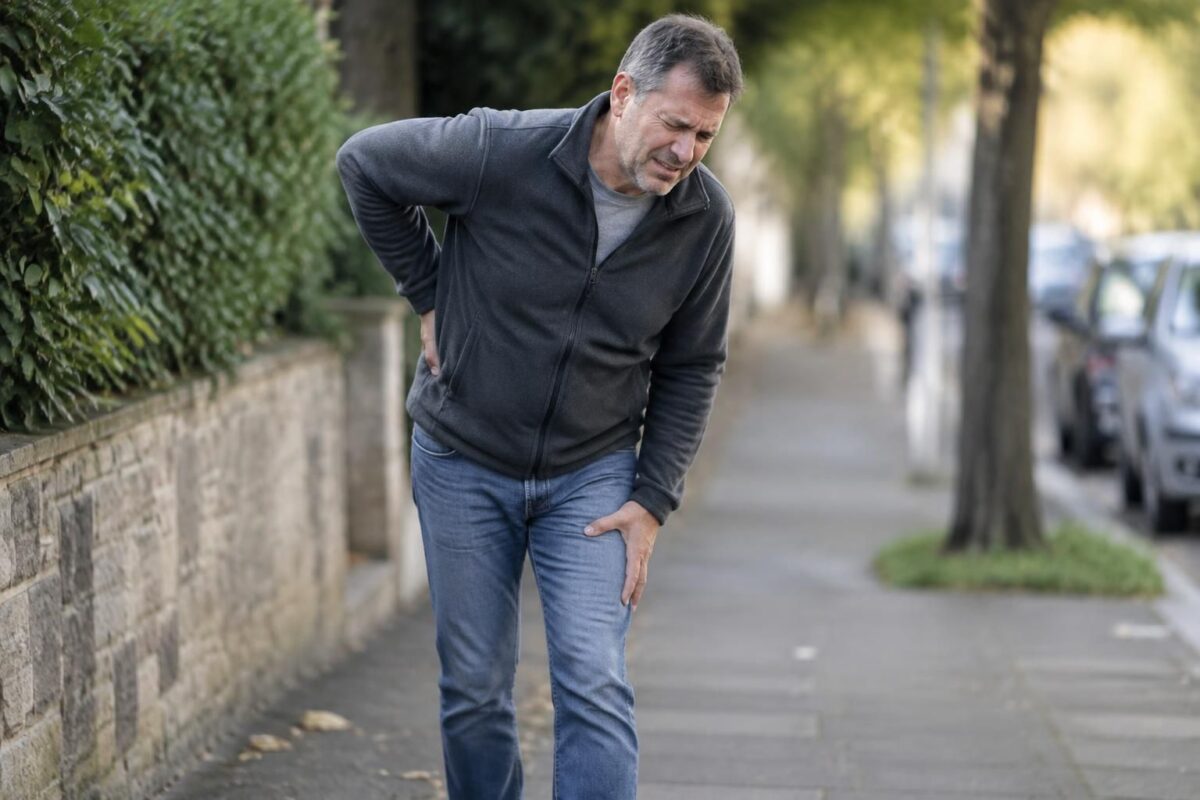
Sciatica and pain that worsens when walking
IN BRIEF A sciatica that worsens with walking is pain radiating from the buttock down the leg, exacerbated by walking. Several causes are possible: this symptom alone does not suffice for a diagnosis. Temporarily reduce walking duration, change positions, and…

Sciatica and pain that improves when walking
IN SUMMARY Sciatica is pain that radiates from the lower back or buttock down to the leg, sometimes all the way to the foot. If it decreases with walking, a gentle and regular walk can help limit stiffness and maintain…

IN BRIEF Sciatica is pain that often starts from the lower back or buttock and travels down the leg. Pain that worsens at the end of the day may be related to activities or prolonged positions, but it is not…

Sciatica and pain that worsens in the evening
IN BRIEF more painful sciatic pain in the evening is often related to inactivity, fatigue, and increased attention to sensations. This does not necessarily mean that the nerve is worsening. Gently changing positions, walking for a few minutes, and finding…

Sciatica and pain when turning in bed
IN BRIEF Sciatica can cause pain when turning in bed, as certain movements irritate the lower back or leg. Turn slowly, moving your shoulders and hips together; a cushion between the knees or under the knees can improve comfort. If…

Dr Sylvain Desforges, B.Sc., D.O., N.D., osteopath, is the founding president of TAGMED and of the ACMA association. He dedicates his practice to chronic spinal pain, low back pain and symptoms compatible with sciatica, particularly when pain radiates toward the buttock, leg, calf, foot or toes.
Through SOS Sciatique, he publishes educational content on sciatica symptoms, possible causes such as disc herniation, disc narrowing, foraminal stenosis or irritation of a lumbar nerve root, as well as non-surgical approaches that may be considered according to the evaluation. At Clinique TAGMED, care may include, depending on the case, motorized neurovertebral decompression, specific osteopathic care or precision percussion.
For an evaluation related to sciatica treatment in Montreal / Mount Royal or sciatica treatment in Terrebonne, please consult the services available at Clinique TAGMED.
Medical disclaimer
The information published on SOS Sciatique is provided for educational purposes only and does not replace a consultation, diagnosis, opinion or treatment provided by a physician or another authorized healthcare professional. The author of this article is neither a medical doctor nor a specialist in a medical specialty recognized by the Collège des médecins du Québec. The osteopathic, manual medicine or functional support approaches described on this site do not constitute medical acts and are not intended to replace medical follow-up.
Consult a physician or emergency service in cases of loss of bladder or bowel control, anesthesia in the saddle area, significant or progressive weakness in the leg or foot, fever, recent trauma, severe pain or rapid worsening of symptoms. For more details, please read our Legal Notice.