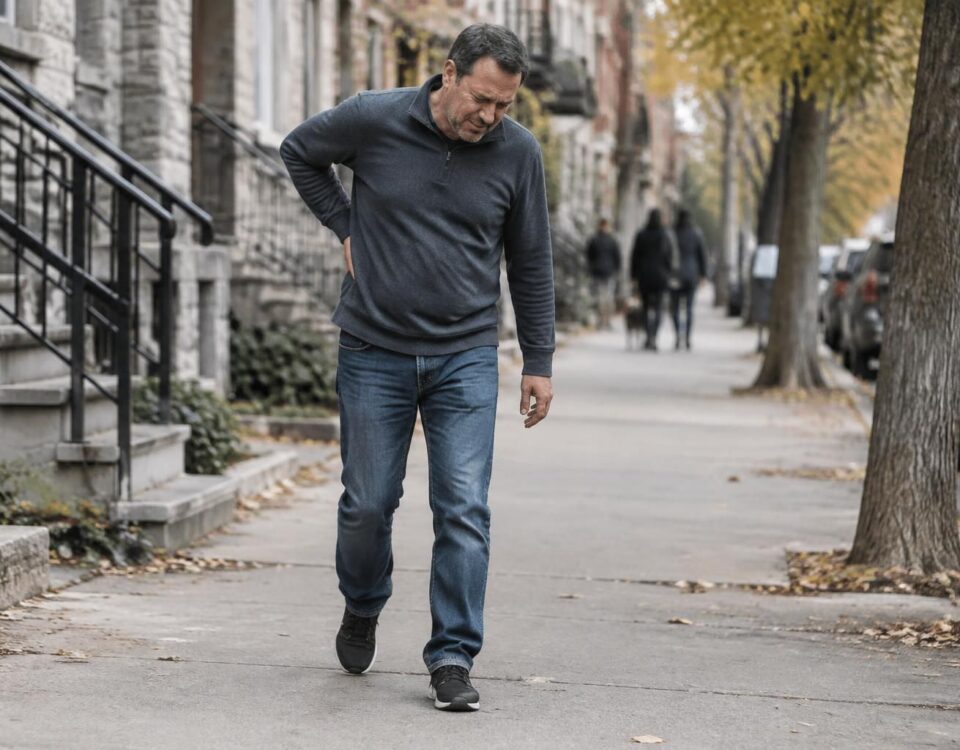
Sciatica and prolonged walking: why does the pain increase?
07/09/2026
Sciatica in Terrebonne: pain from the lower back to the calf
08/09/2026
IN BRIEF
| In brief, sciatica is a pain that starts in the lower back and can radiate down to the calf, caused by irritation or compression of the sciatic nerve. In Montreal, this service offers a personalized evaluation and non-surgical approach to quickly relieve pain, restore mobility, and prevent recurrences, with a progressive plan tailored to the patient’s pace. |
Sciatica in Montreal: pain from the lower back to the calf
Sciatica is a pain caused by irritation or compression of the sciatic nerve. The typical pattern often starts in the lower back or buttock and can travel down the leg to the calf, sometimes accompanied by tingling or muscle weakness.
In Montreal, a quick evaluation helps distinguish a common mechanical cause from a situation that requires appropriate management. After assessing mobility and warning signs, a personalized treatment plan is developed.
Non-surgical approaches, including osteopathy and targeted exercises, aim to relieve pain, restore mobility, and prevent recurrences, while respecting your pace.
Emergency warning signs to watch for: loss of urinary or bowel control, significant progressive weakness, fever, or pain after a major trauma. In case of doubt, consult a professional in Montreal promptly.
Ready to regain mobility? Schedule your personalized evaluation in Montreal today.
Sciatica in Montreal: pain from the lower back to the calf is a common complaint that warrants accurate evaluation. This article presents the signs, possible causes, and non-surgical approaches suited to the urban life of Montreal, with clear advice and relevant resources.
Sciatica is a pain resulting from irritation or compression of the sciatic nerve. It is not a disease in itself but a symptom that often indicates a problem elsewhere in the spine or pelvis. In Montreal, tailored evaluation allows distinguishing common mechanical causes from a disorder requiring specific management. Our approach combines listening, observation, and a personalized treatment plan within a non-surgical perspective.
Typical Signs and Symptoms to Watch For
Pain often starts in the lower back or buttock, then spreads down one leg to the calf, sometimes to the foot. This pain can be intense, burning, or feel like an electric shock. Tingling, numbness, or muscle weakness may accompany the nerve pathway. Some patients experience pain that intensifies after prolonged sitting or during certain movements. In case of nighttime pain, it is important to request an evaluation to understand the progression and adjust the treatment.
For individuals who have difficulty lifting their foot or feel a burning sensation behind the thigh, a quick evaluation is recommended. These signs may require appropriate and prompt management.
In some cases, the pain may change its pathway over the days or be associated with lower back pain that evolves with activity. For effective clinical examination, mobility, function, and warning signs should be checked by a professional.
To better understand these manifestations, you can consult dedicated resources on Sciatica: urgency or quick consultation and burning sensations behind the thigh.
Possible Causes and Diagnosis
Pain can result from a herniated disc, spinal canal narrowing, or another conflict around the sciatic nerve. Other factors, such as significant muscle tension or joint imbalances, can also contribute. A clinical evaluation is necessary to distinguish causes and plan appropriate management. Imaging is not always necessary at the beginning and depends on progression and neurological signs.
For further insight, you can consult resources on Understanding sciatica and its treatments in Montreal or pain in the buttock after prolonged sitting.
Evaluation and Management in Montreal
A comprehensive evaluation helps identify the exact cause and guide treatment towards effective non-surgical approaches. At TAGMED, in Montreal, we prioritize an osteopathic and functional approach tailored to each patient. The deployment may include, depending on the case, a motorized neurovertebral decompression and specific osteopathic care.
To learn more about the options available in Montreal, visit Sciatica and leg pain and sciatica in Montreal: changing pathway. You can also discover additional resources on leg pain.
In Montreal, our clinic can offer non-surgical options such as specific osteopathy and functional approaches, rather than invasive interventions. For your information, training in osteopathy relies on recognized institutions like NUMSS, NAO, National University of Medical Sciences, and National Academy of Osteopathy, and relevant professional associations include ACMA, College of Canadian Osteopaths, and Collège des Ostéopathes Canadiens.
Practical Tips for Daily Life
Adopt a neutral posture on a daily basis and avoid positions that aggravate the pain. Try to stay active without straining, and favor movements that do not trigger worsening. Simple measures like alternating periods of rest and light walking, and applying heat or cold outside sensitive areas, can provide temporary comfort. For more information, check out pain in the buttock after sitting for a long time and tingling or numbness.
When to consult and what alerts to monitor
Consult quickly if the pain persists, worsens, or severely limits your activities. New weakness, progressive numbness, or pain that prevents walking should prompt a rapid evaluation. In case of emergency signs such as loss of bladder control or chest pain, contact emergency services immediately. For additional resources, see emergency or quick consultation.
For specialized information and complementary approaches, you can refer to SOS Herniated Disc resources and pain after sitting for a long time.
For general reference, also discover the science and treatments in Montreal.
Useful links: emergency or quick consultation, Sciatica and leg pain, changing path, tingling/burning/numbness.
Medical disclaimer: The information and advice provided on this site do not replace the opinion, diagnosis, or treatment of a healthcare professional. Please note that Dr. Sylvain Desforges, osteopath, is neither a medical doctor nor a physician, and is not a specialist in a medical specialty as defined by the Collège des médecins du Québec. Manual medicine, functional medicine, and sports medicine as described on this site exclude any medical treatment or diagnosis made by a physician or medical specialist. Always consult your doctor for any medical questions. For more details, please read our full Legal Notice.
- Main symptom: Lower back pain radiating to the buttock and calf, typical of sciatica in Montreal.
- Descriptive diagnosis: The path alone does not confirm the cause; an evaluation is necessary.
- Early signs: Irritation, tingling and pain aggravated by walking or sitting posture.
- Clinical goal: Relieve pain, restore mobility, and prevent recurrences through a personalized approach.
- When to consult: Pain that persists or worsens, limiting daily activities.
- Local evaluation: Mobility, strength, and nervous alert signs to target treatment.
- Recommended approaches: Appropriate exercises, non-surgical manual therapy, and ergonomic advice.
- Prevention and lifestyle: Posture, regular physical activity, and weight management.

This sheet guides you on sciatica that starts from the lower back and can extend to the calf in Montreal. You will discover typical signs, possible causes, and practical recommendations for non-surgical management, with a personalized assessment to establish a personalized plan.
Understand sciatica and its manifestations
Sciatica occurs when the sciatic nerve is irritated or compressed. The nerve path starts in the lower back, crosses the buttock, and descends down the leg to the calf, sometimes to the foot. This pain is a symptom, not a unique disease, and it can reveal an underlying condition such as a herniated disc or spinal canal narrowing. In Montreal, a non-surgical approach is often effective when the assessment confirms correctable mechanical factors.
Radiating pain and localization
The most typical sign is radiating pain that follows the nerve path: from the lower back or buttock down the back of a leg, sometimes to the calf or foot. The intensity may vary, with stronger episodes during certain movements or prolonged walking.
Other common signs
Sensations of tingling or numbness in the leg or foot may accompany the pain. Muscle weakness may appear, making it difficult to walk, go up stairs, or maintain balance. Pain worsened by prolonged sitting and pain triggered by certain movements (bending, lifting an object) are also common.

Sciatica in Montreal: understanding L5-S1 foraminal compression
IN BRIEF L5-S1 foraminal compression is a narrowing of the opening where a nerve root exits, which can cause sciatica with pain, tingling, or weakness in the buttock and leg. In Montreal, an assessment allows for correlating symptoms, clinical examination,…

Sciatica in Montreal: why L5-S1 is often involved
IN BRIEF The sciatica L5-S1 often corresponds to irritation of the S1 root, sometimes related to a herniated disc. The pain may start in the buttock and descend behind the thigh to the calf or the foot. In Montreal, understanding…
Sciatica in Montreal: L5 and difficulty lifting the foot
IN BRIEF The difficulty in lifting the foot with sciatica can indicate weakness related to the involvement of the L5 root, sometimes caused by a herniated disc. This foot drop increases the risk of falling and requires prompt medical evaluation;…
When and how to consult in Montreal
Consult quickly if you experience significant weakness, marked loss of sensation, pain that worsens rapidly, or emergency signs such as pain accompanied by incontinence or fever. In Montreal, a professional evaluation helps identify the exact cause and determine the most suitable personalized plan.

Sciatica in Montreal: S1 and difficulty rising up on the toes
IN BRIEF S1 sciatica can cause pain from the buttock to the calf and foot, as well as difficulty getting on tiptoe. This weakness may suggest irritation of the S1 nerve root, but is not sufficient to establish a diagnosis.…

Sciatica in Montreal: L4-L5 and pain towards the top of the foot
IN BRIEF The sciatica related to L4-L5 can radiate from the lower back to the buttock and the leg; pain on the top of the foot may suggest involvement of the L5 root, but the pathways vary and symptoms overlap.…

Sciatica in Montreal: pain in the big toe, L5 root or another cause?
IN BRIEF Pain that radiates toward the big toe may indicate irritation of the L5 root, sometimes related to a herniated disc, but other causes are possible. In Montreal, evaluating the pain pathway, strength, sensitivity, and walking helps guide management…
Practical advice and home management
Adopt habits that reduce pressure on the sciatic nerve. Maintain a correct posture daily and favor appropriate physical activity, like gentle walking, without straining painful areas. Alternate activity periods with short rest when necessary and avoid prolonged immobility.
Heat or cold can provide temporary relief; use them cautiously and protect the skin. Gentle stretching and movements that do not reproduce nerve symptoms can be beneficial if performed pain-free. If the pain persists, seek advice and do not undertake series of exercises that worsen symptoms.
Role of a professional assessment in Montreal
A comprehensive assessment helps distinguish a common mechanical cause from a need for specific management. The practitioner examines mobility, function, and warning signs, then proposes targeted non-surgical approaches: adjustments or manual therapies, tailored exercises, and ergonomic advice. The goal is to reduce pain, restore mobility, and prevent recurrences.
What you can do now
To start, prioritize a consultation in Montreal to obtain a personalized plan and recommendations tailored to your situation. In the meantime, maintain moderate activity, favor walking, and avoid positions that worsen the pain. If emergency signs appear, contact emergency services without delay.
| Item | Description |
|---|---|
| Typical symptoms | Pain radiating from the lower back or buttock down the leg to the calf or foot; burning or electric sensations, usually on one side. |
| Location and pathway | Sciatic nerve: lumbar → buttock → behind the leg down to the foot. |
| Triggers and posture | Pain worsens with prolonged walking or sitting; favor moderate activities and breaks. |
| Warning signs | Marked weakness, progressive numbness, loss of urinary or bowel control, chest pain, or fever requiring emergency attention. |
| Diagnosis and assessment | Targeted clinical examination checking mobility, strength, and reflexes; imaging reserved for warning signs or persistence. |
| Treatment approach | Personalized and progressive plan focused on non-surgical approaches, tailored exercises, and ergonomic advice. |
| Access Montreal | Easy access to a local assessment in Montreal with quick appointment scheduling. |
| Practical advice | Maintain good posture, stay active with gentle movements and breaks, use heat/cold cautiously. |
| When to seek emergency care | Pain that worsens rapidly, significant weakness, persistent numbness, or loss of control require immediate evaluation. |
| Objective | Reduce pain, restore mobility, and prevent recurrences. |
Testimonials about Sciatica in Montreal: pain from the lower back to the calf
“I suffered from pain that started in my lower back and radiated down to my calf. In Montreal, after a comprehensive assessment, the practitioner was able to identify the causes and propose a progressive plan that respected my tolerance. Within weeks, the pain decreased and I resumed my daily activities without apprehension.”
“Before my appointment, every step caused a pain along the pathway of the sciatic nerve. The assessment revealed nerve irritation and a personalized plan of exercises and care helped me regain mobility and sleep. Since then, I can walk and work normally.”
“What stood out to me was the gradual approach tailored to my needs. The program in Montreal combined adjustments and practical advice, which allowed me to reduce flare-ups and avoid recurrences. I highly recommend it to anyone suffering from sciatica.
“I thought it was inevitable, but the process shows that a precise assessment and targeted care can make a difference. Today, the pain is much less present, and I have regained my quality of life, thanks to a clear and personalized plan.”
In Montreal, sciatica manifests as pain that starts from the lower back or buttock and can radiate down one leg to the calf or foot. This pain is generally a signal of irritation or compression of the sciatic nerve and can appear acutely or develop gradually. In this context, Dr. Sylvain Desforges, experienced osteopath, offers a comprehensive and personalized approach, focused on precise assessment, non-surgical management, and sustainable improvement of mobility and well-being for Montreal patients.
Dr. Desforges is recognized as an expert in osteopathy, naturopathy, and manual medicine, and he is the founding president of the TAGMED clinics as well as the ACMA association. His background is rooted in healthcare innovation, with a marked specialization in managing chronic pain of the spine and the integration of advanced technologies. Among these are motorized neurovertebral decompression, targeted osteopathy, and the use of the precision sensor, tools that enrich the non-surgical approach tailored to each patient.
The work of Dr. Desforges is based on a rigorous clinical evaluation that distinguishes a common mechanical problem from a situation requiring specific management. The objective is to check mobility, function, and warning signs that may indicate worsening. In the case of sciatica, this involves exploring daily movements, postural habits, and the effectiveness of movements, in order to precisely target the areas to be treated and develop a progressive, personalized plan adjusted according to the patient’s response.
The approach proposed for sciatica in Montreal combines non-invasive interventions and practical advice. After the assessment, the program can combine osteopathic techniques that respect the structures of the back with trunk strengthening exercises, in order to stabilize the spine and relieve pressure on the sciatic nerve. Complementary therapies, such as light stimulation protocols and postural recommendations, aim to facilitate a gradual return to daily activities and prevent recurrences. The goal is to reduce radiating pain, improve strength in the lower limbs, and recover smooth and pain-free walking.
For Montreal patients, the approach prioritizes clear communication and evidence-based decisions to ensure safe and effective care. Dr. Desforges emphasizes gradual and personalized recommendations, adjusted according to the patient’s progress and feedback obtained during sessions. If necessary, the team can direct patients to supplementary resources while prioritizing non-surgical options tailored to each individual’s goals.
Are you looking for a solution adapted to your lower back pain extending to your calf in Montreal? The office offers a comprehensive assessment aimed at identifying the underlying cause of your sciatica and proposing a personalized care pathway. Contact our team to discuss your situation and consider a plan that will help you regain mobility, comfort, and quality of life, without the systematic use of surgery.
This conclusion summarizes that sciatica, pain starting from the lower back and descending to the calf, is a revealing symptom of an underlying mechanism and not a unique disease. In Montreal, a comprehensive clinical assessment allows for distinguishing mechanical causes and developing a personalized treatment plan that is gradual, focused on relief, function, and prevention of recurrences.
In the case of pain radiating from the lower back to the calf, the approach must be structured. The sciatic nerve may be irritated by a herniated disc, muscle tension, or spinal canal narrowing. A thorough assessment examines mobility, strength, sensitivity, and warning signs to identify the cause and prioritize non-surgical treatments when possible, especially in Montreal.
To guide your understanding, consult specialized resources such as the pain that travels from the lower back to the leg, which illustrates how the pathway can evolve and influence care. Other relevant references will allow you to observe typical and atypical trajectories, including those described in Montérégie and elsewhere.
In Montreal, our approach prioritizes a targeted assessment followed by a personalized treatment plan that progresses in stages: postural corrections, adapted exercises, manual therapies, and ergonomic advice. The goal is to reduce pressure on the nerve and restore mobility without immediately resorting to surgery; see for example the pathways and symptoms described in resources such as understanding the trajectory of pain and daily advice on daily management.
In addition, simple measures can improve comfort and accelerate recovery: prioritize regular movement, alternate rest and light activity, and use heat or ice cautiously according to your tolerance. For specific cases and scenarios such as immobility and nerve pain, these resources provide useful guidelines.
If the pain persists or is associated with warning signs, a rapid assessment is recommended. In Montreal, our team can perform this assessment and propose appropriate options, including rehabilitation advice and progressive plans, as described in the cases described in Terrebonne for comparison and a better understanding of individual variations.

Sciatica in Montreal: why the affected root changes the pain pathway
IN BRIEF Sciatica refers to pain or nerve symptoms that vary depending on the affected lumbar root. Pain, tingling, or numbness may manifest in the buttock, thigh, calf, or foot. Understanding this distribution helps guide the assessment, without diagnosing based…

Sciatica in Montreal: L4-L5 disc, L5-S1 disc, and leg pain
IN BRIEF Sciatica refers to pain that can radiate from the lower back or buttock down the leg, sometimes related to nerve irritation near the L4-L5 or L5-S1 discs. The level of the disc alone is not sufficient to identify…

Dr Sylvain Desforges, B.Sc., D.O., N.D., osteopath, is the founding president of TAGMED and of the ACMA association. He dedicates his practice to chronic spinal pain, low back pain and symptoms compatible with sciatica, particularly when pain radiates toward the buttock, leg, calf, foot or toes.
Through SOS Sciatique, he publishes educational content on sciatica symptoms, possible causes such as disc herniation, disc narrowing, foraminal stenosis or irritation of a lumbar nerve root, as well as non-surgical approaches that may be considered according to the evaluation. At Clinique TAGMED, care may include, depending on the case, motorized neurovertebral decompression, specific osteopathic care or precision percussion.
For an evaluation related to sciatica treatment in Montreal / Mount Royal or sciatica treatment in Terrebonne, please consult the services available at Clinique TAGMED.
Medical disclaimer
The information published on SOS Sciatique is provided for educational purposes only and does not replace a consultation, diagnosis, opinion or treatment provided by a physician or another authorized healthcare professional. The author of this article is neither a medical doctor nor a specialist in a medical specialty recognized by the Collège des médecins du Québec. The osteopathic, manual medicine or functional support approaches described on this site do not constitute medical acts and are not intended to replace medical follow-up.
Consult a physician or emergency service in cases of loss of bladder or bowel control, anesthesia in the saddle area, significant or progressive weakness in the leg or foot, fever, recent trauma, severe pain or rapid worsening of symptoms. For more details, please read our Legal Notice.