



Herniated disc and painful cough: disc pressure and nerve irritation
26/08/2026
Sciatica in Montreal: pain that changes course over the days
27/08/2026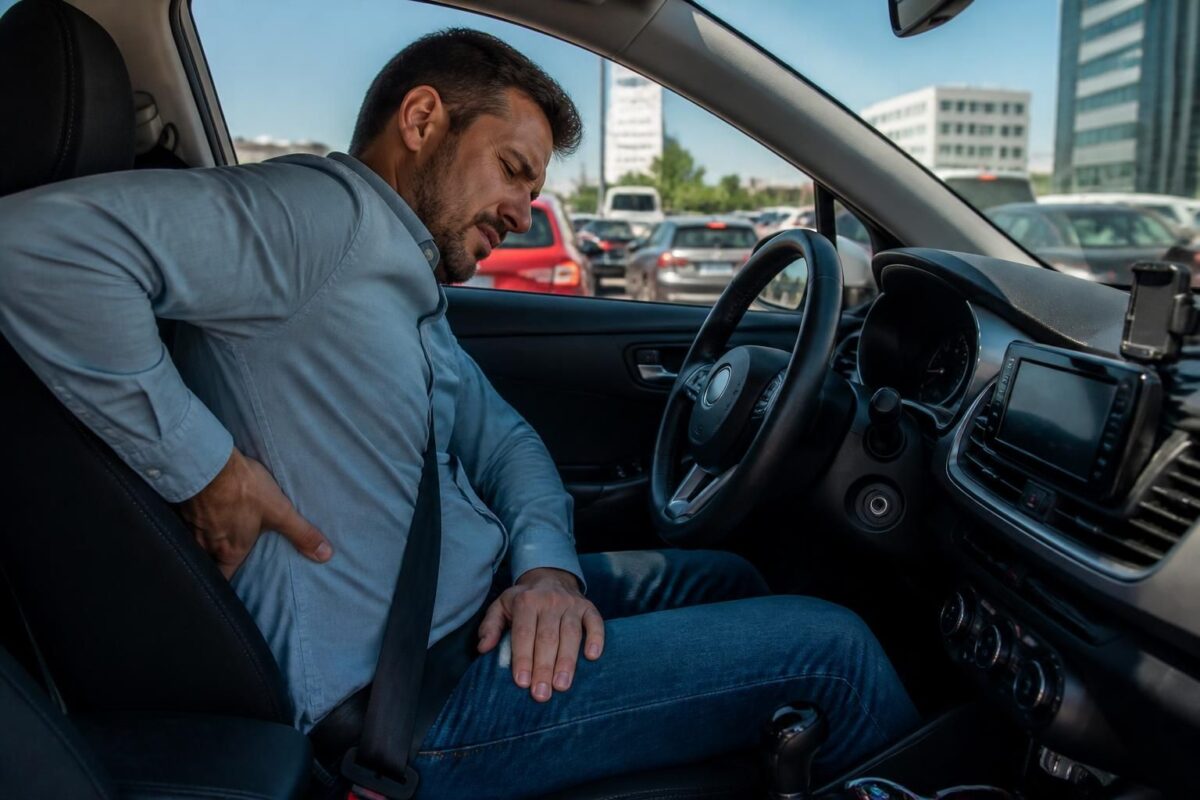
IN BRIEF
| In brief, Sciatica and Traffic Jams: Immobile Position and Nerve Pain describes how prolonged immobility during commutes can compress the sciatic nerve and trigger radicular pain. Benefits include pain reduction through simple postural adjustments, active micro-breaks, and lumbar support, improved mobility in daily life, and prevention of flare-ups during long sitting periods. The approach relies on alternating positions, avoiding crossed legs and overly low seats, maintaining a straight back, and practicing regular breaks to relieve the nerve without violent effort. Accessible in France, this approach is useful for individuals suffering from sciatica who spend a lot of time sitting in transport, at work, or at home. |
The sciatica can be worsened by an immobile position, such as during traffic jams, where pressure on the lumbar discs increases and compresses the nerve, triggering a nerve pain that can radiate to the buttock and leg.
To relieve it, avoid immobility: move every 20 to 30 minutes, prioritize a correct posture, and engage in regular walking on flat terrain. Adopt simple gestures like sitting with your back straight and knees bent at 90-110°, and use appropriate supports if necessary. Postural rehabilitation and walking help to relieve the nerve and sustainably reduce pain.
This article, written by a healthcare professional and expert, explains how an immobile posture during traffic jams can worsen nerve pain related to sciatica. It offers simple and concrete guidelines to limit nerve irritation and improve comfort during long commutes, without resorting to complex actions or inappropriate treatments.
Understanding the Link Between Immobility and Nerve Pain
The sciatica pain follows the path of the nerve that runs down the leg. An immobile position can increase pressure on lumbar structures and keep the nerve tense. This prolonged pressure can amplify pain and slow recovery when stuck in traffic.
Impact of Traffic Jams on the Sciatic Nerve
Remaining seated for long periods in a poorly adjusted car or on an uncomfortable seat promotes lumbar compression. The sciatic nerve can then become more sensitive. Repetitive gestures and micro-movements in the vehicle, if not appropriate, can also worsen the pain. To limit this risk, it’s essential to favor positions that support the back and allow for small frequent repositioning.
Good Practices in the Car and in Traffic Jams
Adjusting your position and staying active within the confines of the vehicle are two simple keys to limit nerve irritation.
- Adjust the seat so that the knees are close to 90° and slightly lower than the hips. A lumbar cushion helps maintain the natural lordosis.
- Keep your back straight and avoid slumping your torso. A supported posture limits pressure on the lumbar discs and the nerve.
- Don’t cross your legs. Keep your feet flat on the floor or on the pedals when necessary.
- Alternate foot and hand pressure. Make micro-movements of the ankles or fingers, and slightly move your torso when you can without leaving the steering wheel.
- Plan short breaks. Get out of the vehicle and walk a few steps every 20 to 30 minutes if traffic allows. In the car, make micro-stops when it’s safe to do so.
- Use an appropriate support, like a cushion between the lower back and the seat, to maintain a more natural posture and reduce strain on the nerve.
To delve deeper into postures and adjustments in the context of sciatic pain, you can consult specialized resources on recognized sites, such as sossciatique.com and clinique TAGMED.
What to Do in Case of Pain During a Traffic Jam
If pain occurs during the commute, focus on slow and steady breathing, then briefly adjust your position. Avoid sudden movements and twists. If the pain persists despite these adjustments, consider taking a longer break outside the vehicle and consult a professional if necessary.
Quick Table to Use During Commutes
Some simple guidelines to adjust your posture and limit pain.
- Sitting: back straight, feet flat, seat adjustment for a trunk-leg angle between 90° and 110°.
- Driving: spine aligned, obstacles avoided, knees slightly bent.
- Stay seated: alternate positions every 20-30 minutes.
- Break: get out of the vehicle and walk a few steps if possible.
Signs That Require Medical Attention
Some alerts require quick assessment. Loss of strength in the foot, sensory disturbances, or incontinence require urgent consultation. A pain that persists despite adjustments may also warrant specialized evaluation.
Role of Healthcare Professionals
A healthcare professional can help integrate these good postures and offer strategies tailored to your daily life. Consulting specialized expertise may be useful to optimize mobility and reduce nerve irritation. In some cases, options offered by specialized clinics, such as neurovertebral decompression or herniated disc, may be considered after evaluation. For clinical care, some facilities offer services in physiotherapy or osteopathy within recognized centers, including clinique TAGMED.
Association and professional resources in osteopathy and physiotherapy provide reliable references. For general information on prevention and relief, you can also check out the content available on sossciatique.com.
The neurovertebral decompression and conditions related to disc herniation require a cautious approach. Avoid unsuitable exercises or stretches without medical advice, and prioritize the advice of a specialist for your individual situation.
For more information related to expertise and professional resources, you can explore dedicated pages on the authorized sites mentioned above.
Medical disclaimer: The information and advice provided on this site do not replace the opinion, diagnosis, or treatment of a healthcare professional. Please note that Dr. Sylvain Desforges, osteopath, is neither a medical doctor nor a physician and is not a specialist in a medical specialty as defined by the Collège des médecins du Québec. Manual medicine, functional medicine, and sports medicine as described on this site exclude any treatment or medical diagnosis done by a physician or medical specialist. Always consult your doctor for any medical questions. For more details, please read our full Legal Notice.
- Situation
Prolonged sitting in traffic: rounded back and tilted pelvisQuick reaction
Straighten the back, 90°-110° angle between torso and thighs, lumbar cushion - Situation
Low or soft seat in the vehicleQuick reaction
Raise the seat, knees at 90°, maintain lordosis with support - Situation
Crossed legs at restQuick reaction
Feet flat, use of a footrest, pelvis in a neutral position - Situation
Twisting the torso to reach an objectQuick reaction
Turn the feet and torso together, nose aligned with the toes - Situation
Picking up an object or moving something in the carQuick reaction
Knees bent, back straight, using the thighs - Situation
Prolonged standing wait in lineQuick reaction
Change support, take small steps, discreet stretches - Situation
Prolonged driving without a breakQuick reaction
Take a break and do a micro-stretch, shoulders relaxed - Situation
Complete immobility in trafficQuick reaction
Plan active breaks every 20-30 minutes

In traffic jams, sciatica and nerve pain can worsen when the body remains motionless. This article offers simple and quick recommendations to implement, even while in a stationary vehicle, to protect the nerve and limit pain while waiting for a better recovery. The central idea: alternate postures, support the back, and practice micro-movements that activate circulation without unnecessarily straining the nerve.
Understanding the link between traffic jams and nerve pain
When you sit for a long time in traffic jams, pressure on the lumbar discs increases and blood circulation in the lumbar area can slow down. Static postures, such as a slouched back or crossed legs, encourage nerve compression and persistent inflammation. Even while driving, every stop or slowdown becomes an opportunity to correct these mechanisms and prevent pain from worsening.
What you can do in traffic jams
Adjust the seat to maintain lordosis
To limit the shearing of the nerve, position yourself to form an angle between the torso and legs between 90° and 110°. Use a lumbar cushion to maintain the natural curvature of the spine and prevent the back from sagging. A properly adjusted seat significantly reduces tension on the sciatic nerve.
Adopt micro-movements without leaving the vehicle
In the relative immobility of traffic jams, make discreet and regular gestures: contractions of the abdominal and gluteal muscles in a neutral position, gentle tilts of the pelvis, and small shoulder movements to ventilate your posture. Around the ischial tuberosities, favor light static micro-stretches and small knee bends (without pain). Ankle rotations and flexion/extension of the feet also help to relaunch blood flow.
Use accessories and promote positions to prioritize
A suitable cushion or lumbar support can provide assistance even in a car. Place it in the small of your back and on the seat to support the natural arch and prevent stiffness. If you can adjust the seat, opt for a position that keeps the shoulders free and the torso open, which reduces pressure on the nerve roots.
When to briefly get out and walk
If safety allows and traffic congestion permits, get out of your vehicle for a short walk of 1 to 2 minutes. This reactivates circulation and provides useful muscle relief. In the meantime, alternate your support and avoid staying fixed on your heels or in prolonged tension.
What to do after traffic congestion and warning signs
Warning signs requiring consultation
If you notice a loss of strength in your foot, sensory disturbances, saddle anesthesia, or difficulties urinating, seek medical consultation quickly. These signs may require a thorough evaluation and, at times, urgent intervention.
Role of professionals
Physical therapists and osteopaths can guide you on preferred postures and suggest mobility and strengthening exercises. The goal is long-term postural rehabilitation that reduces recurrences and allows you to resume normal activities with less pain.
| Axis | Impact and concise advice |
|---|---|
| Definition | Sciatica worsens when immobility and pressure during traffic jams strain the nerve, triggering nerve pain. |
| Prolonged sitting | Sitting increases disc pressure and on the sciatic nerve; prioritize breaks and frequent movements. |
| Standing still | Staying standing without moving decreases lumbar circulation and increases stiffness; alternate your support and take small steps. |
| Posture and lordosis | Maintaining a natural lordosis with a lumbar cushion and flat feet reduces tension on the nerve. |
| Crossing legs | Crossing legs causes pelvic twisting and increases compression of the sciatic nerve; keep feet flat. |
| Sleep and night | Sleeping on your stomach worsens curvature; favor sleeping on your side with a cushion between your knees or with your back slightly elevated. |
| Mobilization | Move gently: light walking and frequent breaks between traffic jams to activate circulation. |
| Driving | Adjust the seat, keep knees bent, and take micro-breaks when possible to reduce pressure on the nerve. |
| Warning signs | Worsening pain, loss of strength, urinary issues; consult quickly in case of cauda equina syndrome. |
Testimonials: Sciatica, traffic jams, and nerve pain in stationary position
“In my city commutes, traffic jams force me to remain still in the car. This stationary position compresses the roots and triggers a sciatica with nerve pain shooting down to my calf. I have therefore adopted simple adjustments: slightly elevated seat, lumbar cushion, and active breaks whenever possible, even a few steps in the parking lot. Since then, the episodes have spaced out, and I have smoother trips.”
“As a delivery driver, I spend hours on the road, and traffic jams confine me in a stationary position that aggravates my sciatica. The worst part is the twisting of the torso and crossing of legs that press on the nerve. I replaced my old bench with an adjustable seat, added a footrest, and I take mini-breaks to stretch. Result: less nerve pain and more control over my journeys.”
“I am a mom and use my car weekly for my children’s activities. Traffic jams and long waits aggravate my sciatica when I remain in a stationary position. I started varying my postures every 20 to 30 minutes, keeping my back straight with a lumbar cushion, and stopping to walk a few steps. My nerve pain has decreased, and I can resume my trips without screaming at every traffic jam.”
“During my business trips, traffic jams keep me stuck in a stationary position and my sciatica wakes up with nerve pain. I have learned not to remain rigid: no crossing legs, straight torso, lumbar cushion, and footrest, and taking walking breaks of two to three minutes whenever I can get out of the vehicle. Now, I move gently, and the pain is better managed.”
Dr. Sylvain Desforges is a recognized professional in the fields of osteopathy, naturopathy, and manual medicine. At the head of TAGMED clinics and the ACMA association, he has dedicated his career to innovation in health care. His work focuses particularly on the management of chronic pain and the integration of advanced technologies such as spinal decompression, laser treatment, and shockwave therapy. His mission is to provide evidence-based care to optimize the health and well-being of his patients. For those suffering from sciatica related to episodes of traffic jams or prolonged positions, he offers comprehensive, personalized support tailored to each profile and lifestyle rhythm.
In the context of traffic congestion, the stationary position becomes an aggravating factor: hours spent sitting in traffic exert increased pressure on the lumbar discs and fuel inflammation around the sciatic nerve. Dr. Desforges transforms this observation into a therapeutic opportunity: he emphasizes an integrated approach combining manual techniques, targeted exercises, and ergonomic advice that restore the body’s alignment and support natural mobility. He stresses the importance of avoiding fixed postures and inserting active breaks or micro-movements into daily journeys, so that every moment spent sitting or standing contributes to pain reduction. His message is clear: nerve pain can be managed when movement is thoughtful and measured, and when every position change becomes a step towards recovery.
This leader in multidisciplinary care relies on modern technologies. Spinal decompression, laser treatments, and shockwave therapies form part of an arsenal tailored for sciatic pain when inflammation and nerve compression hinder walking. Dr. Desforges combines these options with postural rehabilitation and mobility programs that strengthen stabilizing muscles and restore a physiological lordosis. His creed: treat the nerve without rushing, reactivate circulation, and free injured tissues through precise and supervised actions. Every patient benefits from a personalized plan developed after a thorough evaluation and attentive listening to their goals and daily constraints.
Beyond techniques, he acts as a true partner: he communicates clearly, sets concrete benchmarks, and tracks progress with measurable criteria. The network he leads brings together specialists who share this requirement for sustainable efficiency and rediscovered quality of life. The central message is that even the immobility imposed by traffic jams can become an opportunity to rebalance the body, as long as relevant positions and simple but effective gestures are adopted to relieve the sciatic nerve. Patients leave with concrete advice on posture in the car, journeys, and daily movements that reduce the risk of recurrence and sustainably improve their daily lives.
In short, this journey combines science and pragmatism: Dr. Desforges’s team offers patient-centered care, harmonizing advanced technologies, physiotherapy, and active prevention. For those navigating between traffic jams and nerve pain, he offers a clear vision: transform immobility into a healing tool and pain into a signal from a body that can sustainably rebalance itself, with long-term results.
Sciatica can become a real Achilles’ heel in traffic jams and during long periods of immobility. Remaining fixed in a position that compresses the nerve turns every stop into pain and can prolong the inflammatory cycle. This article shows how to detect harmful postures, prioritize simple adjustments, and integrate gestures that relieve the nerve, even in urban life, in order to prevent nerve pain from intensifying.
When you are stuck in traffic jams, the temptation is high to settle into a comfortable but static position. However, an immobile position can increase the compression of the sciatic nerve, especially if the back is hunched or the knees are misaligned. Adjusting your seating, softening or unloading pressure points, and planning short active breaks are simple gestures that help preserve the integrity of the lumbar canal and limit pain flare-ups.
To understand the mechanisms and postures to avoid, you can consult specialized resources that detail the effects of loading on the nerve and the areas to protect, such as reference guides on sciatica. Testimonies and practical explanations about nerve pathways and triggers in urban environments are also available on dedicated sites.
During car journeys, prioritize simple adjustments: a lumbar cushion to maintain lordosis, a seat at an appropriate height to keep trunk-thigh angles around 90° to 110°, and regular breaks to slightly stretch the legs. International and local resources offer concrete advice on journeys and related symptoms, especially concerning daily commutes and vibrations that can amplify pain (read here).
Maintaining stable alignment is key: avoid static postures and twisting of the torso. If you need to stay in the car or stand for long periods, alternate supports and make small movements to relieve the nerve without excessively straining the lumbar discs. To delve deeper into alternative options and postures to avoid while driving, consult dedicated resources.
Meanwhile, gentle mobility and strengthening exercises guided by a professional allow for effective postural rehabilitation. Working with a physiotherapist or an osteopath can facilitate the integration of these habits into your daily life and accelerate recovery, as suggested by the approaches and testimonies on manual techniques and tailored programs (discover here). Movement remains an ally: walking on flat and stable ground, even briefly and regularly, helps restore circulation and reduce pain.
Finally, remain alert to warning signs and neurological issues that require immediate evaluation. If you notice a loss of strength, significant numbness, or urinary or bowel issues, seek medical attention quickly. In any case, a coordinated approach with a specialist helps avoid complications and adopt sustainable postures that protect the sciatic nerve, even in a road and urban environment (see signs to watch for). To further explore mechanisms and therapeutic options, you can also consult specialized resources and professional exchanges available online.

Sciatica and pain that increases after a long walk
IN BRIEF in English In brief, Sciatica and pain that increases after a long walk is pain that follows the path of the sciatic nerve and may worsen during walking. This phenomenon can arise from nerve irritation or compression at…
Sciatica and pain that appears after a few minutes of walking
IN BRIEF Sciatica is a pain that follows the path of a nerve root from the lower back down to the leg. When it appears after a few minutes of walking, it indicates nerve irritation or compression, often due to…

Sciatica and prolonged walking: why does the pain increase?
IN BRIEF In brief, sciatica is pain that follows the path of the sciatic nerve and can intensify during prolonged walking, especially in the presence of lumbar stenosis or a herniated disc. The goal is an active and tailored management…

Sciatica and walking: helpful or aggravating?
IN BRIEF In brief, sciatica and walking is the analysis of whether walking can help or worsen pain related to the sciatic nerve. What is it? Sciatica is pain that radiates from the lower back down the leg, often due…

Sciatica and travel return: pain that travels down the leg
IN SHORT Sciatica is pain that runs down the leg, caused by irritation or compression of the sciatic nerve. In the context of return from travel, it may appear after long trips or repetitive movements. In practice, understanding this mechanism…

Sciatica and travel: how to recognize a worsening
IN BRIEF In brief, sciatica and travel describe the worsening of sciatic pain during a trip, with radiation into the leg and radicular signs. Benefits: it allows for quick identification of warning signs, adjustment of breaks and movements, and traveling…
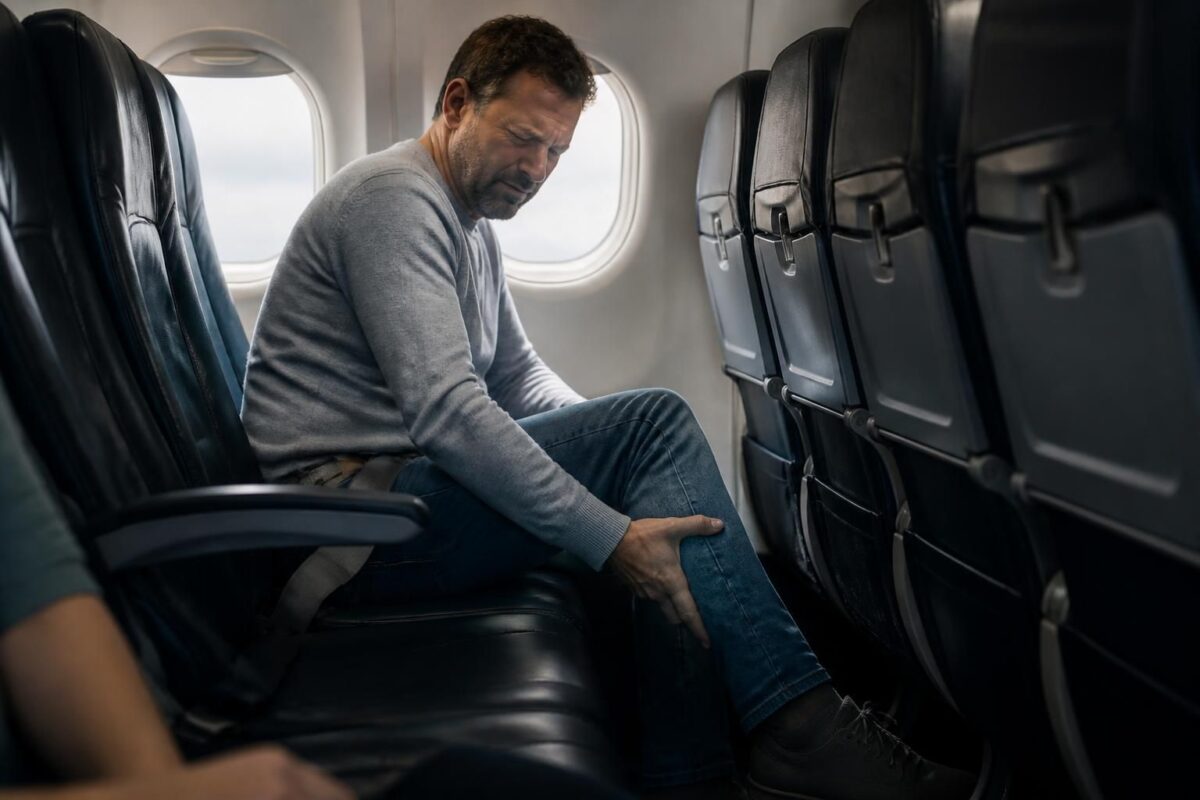
Sciatica and airplane: prolonged sitting and leg pain
IN BRIEF In brief, sciatica related to prolonged sitting on the plane describes pain that arises or worsens when one remains seated for long periods during a flight, due to pressure on the lumbar discs and the sciatic nerve. How…

Sciatica and train: pain after a long journey
IN BRIEF In brief, Sciatica after a long train journey is pain that radiates along the sciatic nerve after long periods of sitting. The problem often arises from an inadequate posture and a poorly mobilized pelvis during the trip. The…

Dr Sylvain Desforges, B.Sc., D.O., N.D., osteopath, is the founding president of TAGMED and of the ACMA association. He dedicates his practice to chronic spinal pain, low back pain and symptoms compatible with sciatica, particularly when pain radiates toward the buttock, leg, calf, foot or toes.
Through SOS Sciatique, he publishes educational content on sciatica symptoms, possible causes such as disc herniation, disc narrowing, foraminal stenosis or irritation of a lumbar nerve root, as well as non-surgical approaches that may be considered according to the evaluation. At Clinique TAGMED, care may include, depending on the case, motorized neurovertebral decompression, specific osteopathic care or precision percussion.
For an evaluation related to sciatica treatment in Montreal / Mount Royal or sciatica treatment in Terrebonne, please consult the services available at Clinique TAGMED.
Medical disclaimer
The information published on SOS Sciatique is provided for educational purposes only and does not replace a consultation, diagnosis, opinion or treatment provided by a physician or another authorized healthcare professional. The author of this article is neither a medical doctor nor a specialist in a medical specialty recognized by the Collège des médecins du Québec. The osteopathic, manual medicine or functional support approaches described on this site do not constitute medical acts and are not intended to replace medical follow-up.
Consult a physician or emergency service in cases of loss of bladder or bowel control, anesthesia in the saddle area, significant or progressive weakness in the leg or foot, fever, recent trauma, severe pain or rapid worsening of symptoms. For more details, please read our Legal Notice.