


Sciatica in Terrebonne: radicular pain versus referred pain
27/10/2026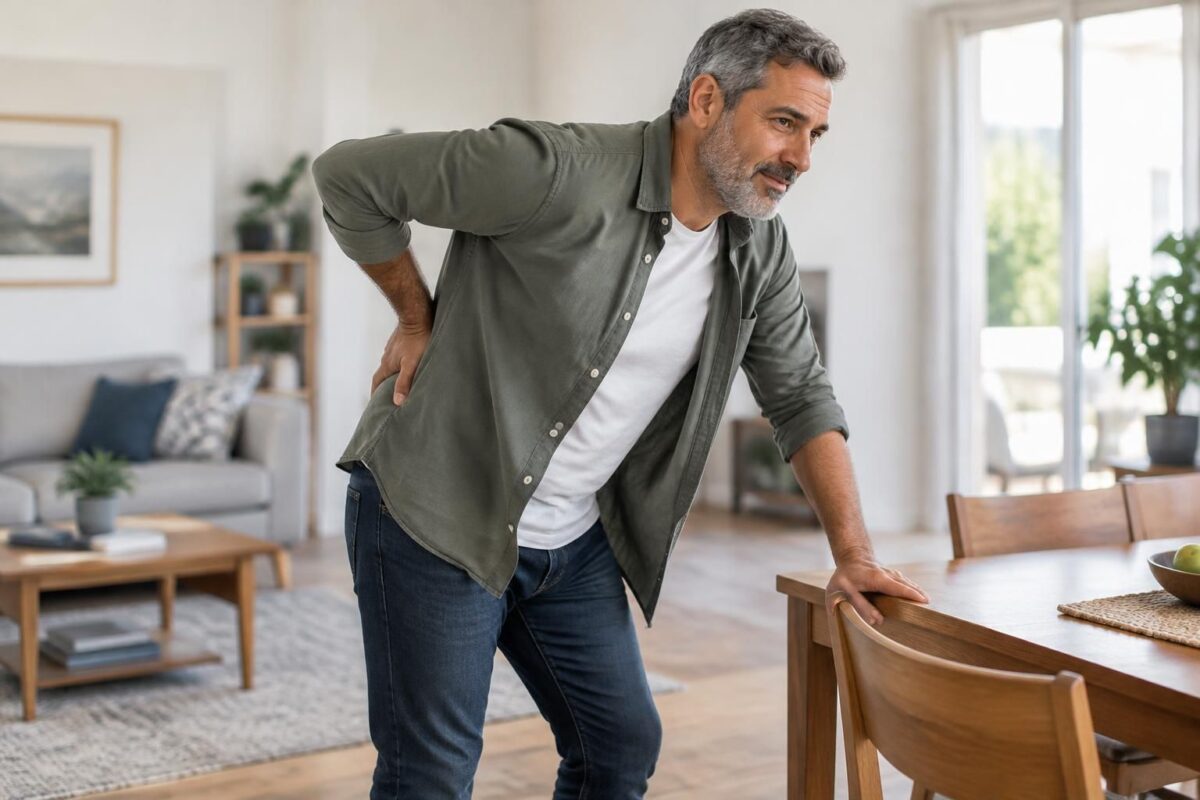
IN BRIEF
| A sciatica-type pain relieved by leaning forward may be compatible with lumbar stenosis, a narrowing that can irritate or compress nerves. Flexion may temporarily decrease pressure, but does not confirm the diagnosis or treat the cause. A professional evaluation helps identify the source of the symptoms and suitable options. Consult quickly if weakness progresses or if urinary or bowel issues occur. |
A sciatica-type pain that lessens when leaning forward may be consistent with lumbar stenosis, which is a narrowing that can irritate or compress nerves. Discomfort may increase when standing or walking and decrease when sitting, but this sign alone is not sufficient to establish a diagnosis. An evaluation by a healthcare professional can help determine the cause. In case of significant or progressive weakness, numbness in the saddle area, or urinary or bowel issues, consult without delay.
A pain that radiates from the lower back to the buttock or leg and lessens when you lean forward may suggest spinal stenosis, which is a narrowing of the canal where nerves pass. This sign is not enough to make a diagnosis: a professional assessment allows for the search of the cause, checks strength and sensitivity, and discusses suitable options. Sciatica-type pain can also have other origins, such as a herniated disc or nerve irritation.
Sciatica describes pain related to irritation or compression of a nerve root in the lower back. It may extend into the buttock, thigh, calf, or foot. Lumbar pain with radiating leg pain can have various causes. Its course, evolution, and associated symptoms help the professional guide the assessment.
In some cases of spinal stenosis, the spinal canal narrows and may reduce the available space for nerves. Some individuals experience more pain, heaviness, or weakness when standing or walking. They may feel relief when sitting or leaning forward. This profile may suggest stenosis, but does not confirm it alone.
Why Can Flexion Provide Relief?
The position of the back can change the space around the nerve structures. In some individuals with stenosis, leaning forward temporarily alleviates symptoms. A pain relieved in a sitting position should therefore be reported to the healthcare professional, especially if it returns when walking or standing.
The pain may also extend down to the calf. This path is consistent with nerve irritation but does not identify the cause alone. Refer to this page on sciatica pain radiating to the calf to better understand possible lumbar causes.
Spinal Stenosis and Other Possible Causes of Sciatica
Stenosis can be related to the aging of the joints and tissues of the spine. Other factors may also contribute to narrowing, including certain bony or discal changes. A herniated disc can also irritate or compress a nerve root. Symptoms may sometimes resemble each other; a clinical examination is necessary to distinguish them.
The issues may affect one or both legs and vary depending on posture or duration of walking. Persistent weakness, numbness, or decreased walking ability justify an evaluation. For older individuals, this resource dedicated to canal stenosis and sciatica in seniors provides additional information.
Pain remains a sign to interpret with caution. General information about sciatica can help recognize symptoms, but it does not replace professional advice. An article on the causes of sciatica may also provide context; in the presence of possible stenosis, do not start exercises or stretches without advice from a professional who understands your situation.

Sciatica and pain worsened while sitting: consider the disc?
IN BRIEF Sciatica aggravated in a seated position may be related to irritation of a nerve root, sometimes caused by a herniated disc. Remaining seated can exacerbate pain that radiates from the buttock down the leg, but this symptom alone…

Sciatica and pain relieved while seated: consider stenosis?
IN BRIEF A sciatica relieved in a seated position may suggest a lumbar stenosis and neurogenic claudication, but this sign alone is not sufficient for a diagnosis. Observing walking, weakness, and symptom evolution helps guide the evaluation and compare signs…
Sciatica and pain that worsens when walking
IN BRIEF A sciatica that worsens with walking is pain radiating from the buttock down the leg, exacerbated by walking. Several causes are possible: this symptom alone does not suffice for a diagnosis. Temporarily reduce walking duration, change positions, and…
How Does the Evaluation Proceed?
The professional will ask you about the onset of the pain, its course, positions that aggravate or relieve it, and its effect on your activities. They may check strength, sensitivity, and certain reflexes. Depending on the observed signs, a doctor may request imaging tests or other evaluations. Imaging is always interpreted alongside symptoms and clinical examination: a visible anomaly does not prove, by itself, that it is the cause of the pain.
Note the situations that trigger your symptoms: walking, standing, sitting, or leaning. Also indicate if the pain reaches the calf or foot, if it affects one leg or both, and if you’ve noticed weakness. This information facilitates the evaluation and helps prepare the next steps.
For guidance on the steps and signs that require a consultation, refer to the Health Insurance’s advice on sciatica and when to consult. You can also read this article on back pain with leg pain and spinal stenosis.

Sciatica and pain that improves when walking
IN SUMMARY Sciatica is pain that radiates from the lower back or buttock down to the leg, sometimes all the way to the foot. If it decreases with walking, a gentle and regular walk can help limit stiffness and maintain…

IN BRIEF Sciatica is pain that often starts from the lower back or buttock and travels down the leg. Pain that worsens at the end of the day may be related to activities or prolonged positions, but it is not…

Sciatica and pain that worsens in the evening
IN BRIEF more painful sciatic pain in the evening is often related to inactivity, fatigue, and increased attention to sensations. This does not necessarily mean that the nerve is worsening. Gently changing positions, walking for a few minutes, and finding…
Treatment Options and Follow-Up
Management depends on the likely cause, the intensity of symptoms, and their evolution. A doctor can explain medical options and determine if imaging or specialist advice is necessary. Some individuals may be directed toward a non-surgical approach; others may require surgical evaluation if symptoms are significant, persistent, or associated with neurological signs.
Surgery is not indicated for every sciatica or stenosis. When an intervention is considered, the surgeon explains the expected benefits, risks, and potential solutions. Robotic tools may assist certain surgical procedures, but they do not replace the judgment or responsibility of the surgeon. The choice of technique depends on the diagnosis and the situation of each patient.
To learn more about assessment options regarding a hernia, stenosis, or nerve irritation in Montreal, consult the information available from the TAGMED Clinic. For an assessment in Terrebonne, this page explains how to distinguish lower back pain from nerve pain. The proposed approaches should be chosen according to the assessment and do not replace medical follow-up.
When to seek help quickly?
Seek medical help quickly if you notice significant or progressive weakness in a leg or foot, loss of control of the bladder or bowels, or loss of sensation in the area between your legs. A fever, recent trauma, severe pain, or rapid worsening also require immediate evaluation. These signs may indicate a problem that necessitates urgent intervention.
About the author
Sylvain Desforges, B.Sc., D.O., N.D., osteopath and naturopath, is the founding president of TAGMED and the ACMA association. He dedicates his practice to chronic pain of the spine, lower back pain, and pain consistent with sciatica, particularly when the pain radiates down to the buttock, leg, calf, foot, or toes.
Through SOS Sciatique, he publishes educational content on sciatic symptoms, possible causes such as herniated discs, disc compression, foraminal stenosis, or irritation of a lumbar nerve root, as well as on non-surgical approaches that may be considered based on the evaluation. At the TAGMED Clinic, care may include, depending on the case, motorized neurovertebral decompression, specific osteopathy, or precise percussion.
For an evaluation related to the treatment of sciatica in Montreal / Mont-Royal or the treatment of sciatica in Terrebonne, consult the services available at the TAGMED Clinic.
Medical disclaimer
The information published on SOS Sciatique is provided for educational purposes and does not replace a consultation, diagnosis, opinion, or treatment performed by a physician or another licensed healthcare professional. The author of this article is neither a doctor nor a specialist in a medical specialty recognized by the Collège des médecins du Québec. The approaches of osteopathy, manual medicine, or functional support described on this site do not constitute medical acts and are not intended to replace medical follow-up. Consult a doctor or emergency service in case of loss of bladder or bowel control, loss of sensation in the saddle area, significant or progressive weakness in the leg or foot, fever, recent trauma, severe pain, or rapid deterioration. For more details, please read our Legal notice.
Medical disclaimer: The information and advice provided on this site do not replace the opinion, diagnosis, or treatment of a healthcare professional. Please note that Dr. Sylvain Desforges, osteopath, is neither a medical doctor nor a physician and is not a specialist in a medical specialty as defined by the Collège des médecins du Québec. Manual medicine, functional medicine, and sports medicine as described on this site exclude any medical treatment or diagnosis performed by a physician or medical specialist. Always consult your doctor for any medical questions. For more details, please read our full Legal Notice.
What it may suggest
- Sciatic pain sometimes related to lumbar stenosis.
- Possible relief when leaning forward or sitting.
When to consult
- Evaluation recommended if pain or difficulty walking persists.
- Consult quickly in case of progressive weakness or urinary or intestinal disturbances.

A type of sciatic pain that eases when you lean forward may be compatible with narrowing of the lumbar canal, known as spinal stenosis. However, this sign alone is not sufficient to establish a diagnosis: several back problems can cause similar symptoms. Monitor their progression and seek professional evaluation, especially if the pain limits walking or is accompanied by weakness.
Why can flexion relieve pain?
The lumbar canal houses the nerves that go to the legs. When it narrows, particularly due to age-related changes like osteoarthritis, certain positions can increase the pressure on these nerves. For some people, leaning forward—such as while resting on a cart—provides temporary relief. Pain, tingling, or heaviness may then decrease, only to return when standing or after walking.
This pattern may correspond to neurogenic claudication, sometimes associated with stenosis. However, a herniated disc or other nerve irritation can also cause sciatica. The posture that relieves you is useful information to communicate, but it does not alone indicate which structure is involved.
Helpful actions while waiting for an evaluation
Adapt your activities without immobilizing yourself
Identify activities and positions that worsen symptoms, then break them down. If walking triggers pain, try to cover a shorter distance at a comfortable pace, taking breaks. Avoid staying in a painful position for long periods, but do not impose complete rest on yourself without professional advice: prolonged inactivity can reduce strength and mobility.
Choose comfortable movements
You can prioritize movements that do not significantly increase pain and change positions regularly. Do not attempt vigorous stretches or online exercises if they exacerbate symptoms in the leg. A healthcare professional can determine if appropriate exercises, rehabilitation, or other measures are indicated based on your condition.
Medications, heat, or other relief methods do not necessarily treat the cause. Consult a doctor or pharmacist before taking a medication, especially if you have other health issues or are already undergoing treatment.
When to consult and what treatments to discuss?
Make an appointment if the pain returns, worsens, reduces your ability to walk, or is accompanied by numbness or persistent weakness. The assessment is based on your symptoms and a physical examination. Imaging may be considered if the professional deems it useful; its indication depends on the clinical picture.
Depending on the cause and severity, options may include non-surgical approaches and medical follow-up. An intervention is sometimes discussed when symptoms are significant and appropriate treatments do not provide sufficient relief. Robot-assisted surgery may guide certain surgical actions, but it is not suitable for everyone and does not guarantee a specific recovery: the decision rests with the surgical team after evaluation.
Recognize emergency signs
Consult an emergency service quickly in case of loss of bladder or bowel control, numbness in the saddle area, or marked or progressive weakness in a leg or foot. Severe pain or rapid worsening also requires immediate medical evaluation.
| Marker | Possible recall |
|---|---|
| Pain in the buttock or leg | Nerve irritation may be involved. |
| Pain decreased by bending forward | May suggest lumbar stenosis. |
| Prolonged standing or walking | Symptoms may increase. |
| Sitting or bent back rest | Relief is sometimes reported. |
| Numbness or weakness | A clinical evaluation is indicated. |
| Persistent or worsening symptoms | Consult a healthcare professional. |
| Loss of urinary or bowel control | Consult emergency services immediately. |
Illustrative testimonials: sciatic pain relieved by bending
Transparency note: the accounts below are fictional examples, created for educational purposes. They do not reflect the experience of real patients and cannot be used to make a diagnosis.
“While walking, the pain radiated down my leg”
After a few minutes of standing or walking, a person feels pain in the lower back, buttock, and thigh. They notice that stopping and bending forward, for instance against a counter, temporarily decreases discomfort. This type of relief can sometimes accompany a lumbar stenosis, but other causes of nerve pain are possible.
“The cart allowed me to go further”
Another person finds that they can walk longer when they lean on a shopping cart. Conversely, standing upright or going down a slope sometimes exacerbates their symptoms. Improvement in a bent position may suggest irritation or compression of the nerves in the lower back, especially in cases of stenosis, but does not suffice to confirm this hypothesis.
“Bending helped, but the numbness persisted”
In this scenario, the pain decreases when seated or bent, but tingling and a sense of weakness in the leg return when walking. The persistence of these signs warrants evaluation by a healthcare professional. It is important to specify how long they have been present, what triggers them, and whether they are worsening.
Being relieved by bending forward may be associated with a lumbar canal stenosis, which corresponds to a narrowing that can reduce space around nerve structures. However, this sign is not specific: a herniated disc, irritation of a nerve root, or other issues can cause similar symptoms. A clinical exam, and sometimes imaging tests prescribed by a doctor, can help investigate the cause.
Consult a doctor if the pain limits walking, returns regularly, is accompanied by numbness, or does not improve. Significant or progressive weakness, loss of bladder or bowel control, or numbness in the saddle area require urgent medical evaluation.
Sciatica relieved by bending: is lumbar stenosis possible?
Dr. Sylvain Desforges, osteopath and naturopath, dedicates his practice to supporting individuals living with chronic pain, especially in the spinal area. Founder and president of the TAGMED clinics and the ACMA association, he is interested in health innovation and the reasoned use of manual approaches and technologies such as neurovertebral decompression, laser, and shockwaves. His goal is to help each person better understand their symptoms and explore appropriate management options based on their assessment and situation.
Pain radiating from the lower back to the buttock or leg may suggest sciatica, usually associated with irritation or compression of a nerve root. However, the fact that the pain is relieved when bending forward also deserves attention. This posture can temporarily reduce pressure in certain areas of the spinal canal and sometimes alleviate symptoms of lumbar stenosis, which is a narrowing of the space through which the nerves pass.
Stenosis can gradually develop, particularly with age-related changes, osteoarthritis, or thickening of certain tissues. Other factors, such as a herniated disc, vertebral slippage, or an anatomical peculiarity, can also contribute to the narrowing. In some individuals, pain, tingling, or weakness appears mainly after a period of standing or during walking. Sitting or bending forward can then provide temporary relief. This condition is sometimes described as neurogenic claudication.
This improvement in flexion does not, however, confirm a diagnosis of stenosis on its own. The symptoms associated with nerve irritation vary from person to person, and several causes can produce similar pain. An evaluation by a licensed healthcare professional allows for a clarification of the history of symptoms, an examination of mobility and strength, and a determination of whether additional tests are necessary. Specifically report the distance you can walk, positions that worsen or relieve the pain, as well as any changes in sensitivity.
Management depends on the cause, intensity of symptoms, and their progression. Depending on the situation, a professional may discuss appropriate activity, rehabilitation, supervised medication treatments, or other non-surgical options. In a clinic, approaches like specific osteopathy or motorized neurovertebral decompression may be considered after evaluation; these do not suit everyone and do not replace a medical diagnosis. If symptoms persist, worsen, or limit daily activities, seek advice rather than relying solely on temporary solutions.
Surgery may be discussed in certain cases when nerve compression is significant, when limitations remain severe, or when conservative treatments do not provide sufficient relief. Robot-assisted surgery is a technology used by some teams to support planning and precision of complex procedures; it does not replace the judgment or the skill of the surgeon, and its benefits depend on the case and the procedure. The decision is based on a specialized evaluation and a discussion of risks, options, and treatment goals.
Consult a doctor or emergency service promptly if you experience loss of control of the bladder or bowels, numbness in the saddle area, significant or progressive weakness in the leg or foot, fever, recent trauma, or rapid worsening. These signs require immediate evaluation.
About the author
Sylvain Desforges, B.Sc., D.O., N.D., osteopath and naturopath, is the founding president of TAGMED and the ACMA association. His educational content focuses on lower back pain and symptoms compatible with sciatica. They do not replace a consultation, diagnosis, or treatment by a licensed healthcare professional. The author is neither a doctor nor a specialist in a medical field recognized by the Collège des médecins du Québec.
A sciatica-like pain that decreases when you bend forward may suggest lumbar stenosis, meaning a narrowing that can compress or irritate nerve structures. However, this sign alone is not sufficient to establish a diagnosis: a herniated disc or other causes can produce similar symptoms. A professional evaluation helps to understand the origin of the pain and to choose the appropriate course of action.
When bending forward relieves: a lead to evaluate
Some people notice that pain, tingling, or heaviness in the legs diminishes when they bend forward, sit, or lean on a cart. Conversely, standing or walking can exacerbate discomfort. This profile may be consistent with lumbar canal stenosis: depending on posture, the space available around the nerves may vary. This is an indication to report to the healthcare professional, and not proof on its own.
Sciatica refers to pain related to the irritation of a nerve root that can radiate from the buttock down the thigh, calf, or foot. It can sometimes be present even without significant lower back pain. To better understand its path and manifestations, consult this presentation on the anatomy, causes, and symptoms of sciatica, as well as information from the MSD Manual on sciatica.
A herniated disc can also irritate a nerve root. It can coexist with narrowing of the nerve exit space, called foraminal stenosis. The most common lumbar causes are presented in this guide dedicated to possible origins of sciatica, and the links between herniated disc and foraminal stenosis are detailed in this article. Morning pain or stiffness may also accompany certain disc problems but does not allow for the identification of the cause alone.
Specify during the evaluation what triggers or alleviates symptoms: walking distance, duration standing, sitting posture, trunk inclination, coughing, or sneezing. Also mention sensations of weakness, numbness, or tingling, as well as their location. This information, combined with the clinical examination and, when indicated, additional tests, helps to distinguish possible causes. Practical guidelines on prevention and relief are available in this guide on prevention and understanding sciatica.
Management depends on the cause, intensity of symptoms, and their evolution. It may include tailored advice, exercises, or supervised rehabilitation, and a medical evaluation if pain persists or limits activities. Neurovertebral decompression may be discussed in certain contexts after appropriate evaluation; it is not necessarily suitable for everyone and does not replace a diagnosis. If stenosis is suspected, note also if sitting relieves symptoms, as explained in this resource on sciatica and stenosis relieved in sitting position.
Surgery is only considered in certain situations, particularly when significant symptoms persist despite non-surgical management or when a neurological issue warrants it. Robot-assisted techniques can assist the surgeon in precise maneuvers, but they do not constitute an automatic treatment for sciatica or stenosis and do not guarantee a particular outcome. Options should be discussed with the medical team based on the diagnosis and the person’s goals. For an overview of the issues related to sciatica and spinal stenosis, also consult this article on these lumbar conditions.
Consult a doctor promptly in case of marked or progressive weakness in a leg or foot, loss of bladder or bowel control, or numbness in the saddle region. A fever, recent trauma, severe pain, or rapid worsening also justify immediate evaluation.
About the author
Sylvain Desforges, B.Sc., D.O., N.D., osteopath and naturopath, is the founding president of TAGMED and the ACMA association. He dedicates his practice to chronic spinal pain, lower back pain, and pain consistent with sciatica, especially when the pain radiates down to the buttocks, leg, calf, foot, or toes.
Through SOS Sciatique, he publishes educational content on the symptoms of sciatica, its possible causes—such as herniated disc, disc pinching, foraminal stenosis, or irritation of a lumbar nerve root—and the non-surgical approaches that may be considered based on the evaluation. At the TAGMED Clinic, care may include, depending on the case, motorized neurovertebral decompression, specific osteopathy, or precision impact.
For an evaluation related to the sciatica treatment in Montreal or Mont-Royal, or the sciatica treatment in Terrebonne, consult the services available at the TAGMED Clinic.
Medical Disclaimer
The information published on SOS Sciatique is provided for educational purposes and does not substitute for a consultation, diagnosis, opinion, or treatment performed by a physician or another authorized health professional. The author of this article is neither a doctor nor a specialist in a medical specialty recognized by the Collège des médecins du Québec. The approaches of osteopathy, manual medicine, or functional support described on this site do not constitute medical acts and are not intended to replace medical follow-up. For more details, please read our Legal Notice.

Sciatica and pain when turning in bed
IN BRIEF Sciatica can cause pain when turning in bed, as certain movements irritate the lower back or leg. Turn slowly, moving your shoulders and hips together; a cushion between the knees or under the knees can improve comfort. If…

Sciatica and pain when getting out of bed
IN BRIEF Sciatica upon getting out of bed is pain that radiates from the lower back to the buttock or leg and can be more pronounced after the night. Gradually rising, moving gently, and finding a comfortable sleeping position can…

Dr Sylvain Desforges, B.Sc., D.O., N.D., osteopath, is the founding president of TAGMED and of the ACMA association. He dedicates his practice to chronic spinal pain, low back pain and symptoms compatible with sciatica, particularly when pain radiates toward the buttock, leg, calf, foot or toes.
Through SOS Sciatique, he publishes educational content on sciatica symptoms, possible causes such as disc herniation, disc narrowing, foraminal stenosis or irritation of a lumbar nerve root, as well as non-surgical approaches that may be considered according to the evaluation. At Clinique TAGMED, care may include, depending on the case, motorized neurovertebral decompression, specific osteopathic care or precision percussion.
For an evaluation related to sciatica treatment in Montreal / Mount Royal or sciatica treatment in Terrebonne, please consult the services available at Clinique TAGMED.
Medical disclaimer
The information published on SOS Sciatique is provided for educational purposes only and does not replace a consultation, diagnosis, opinion or treatment provided by a physician or another authorized healthcare professional. The author of this article is neither a medical doctor nor a specialist in a medical specialty recognized by the Collège des médecins du Québec. The osteopathic, manual medicine or functional support approaches described on this site do not constitute medical acts and are not intended to replace medical follow-up.
Consult a physician or emergency service in cases of loss of bladder or bowel control, anesthesia in the saddle area, significant or progressive weakness in the leg or foot, fever, recent trauma, severe pain or rapid worsening of symptoms. For more details, please read our Legal Notice.


