


Sciatica Treatment Terrebonne: Understanding Possible Mechanical Causes
08/07/2026
Sciatica: pain in the calf and possible nerve origin
08/07/2026
IN BRIEF
| In brief, sciatica that radiates down to the calf may have a lumbar cause and present as radicular pain radiating to the calf and foot. The diagnosis relies on a clinical evaluation that seeks the precise pain pathway and neurological signs, and may be complemented by imaging if pain persists. The benefits of a structured framework include a precise orientation towards discogenic, foraminal, or arthritic causes, a reduction in irritation, and an improvement in function through non-surgical options, tailored to the patient’s profile. Available in Montreal, this pathway aims for effective results without immediate recourse to surgery. |
A sciatic pain radiating down to the calf can arise from a lumbar origin, most often related to irritation or compression of a lumbar nerve root (often L5 or S1).
The diagnosis primarily relies on clinical examination: precise pain pathway, often positive Lasègue test, and checking for neurological signs (weakness, numbness) or vesico-sphincter dysfunction.
Common lumbar causes include herniated disc, bulging or protruding disc, foraminal stenosis, facet joint osteoarthritis, and lumbar stenosis.
Imaging may be considered if the pain persists despite treatment or to clarify the diagnosis and guide management (MRI, CT scan, X-rays).
It is also important to consider referred pain (hip, sacroiliac, gluteal muscles) that may mimic sciatica.
A non-surgical approach may be appropriate when signs and symptoms align with a mechanical cause and the patient is eligible for conservative treatment.
Sciatica that radiates down to the calf may find its origin in the lumbar spine. This article, written by a health professional, explains the possible lumbar causes, the necessary evaluation, and the non-surgical options available at TAGMED Clinic to understand and treat this pain. Pain that travels to the calf may result from irritation of a nerve root at the lumbar level. Common mechanisms include a herniated disc, a protrusion or a bulging disc, foraminal stenosis, or degenerative changes that narrow the space around the nerve root. The pain pathway generally follows the nerve that exits from the levels L5 or S1, and sensory or motor signs can help pinpoint the location of the affected root. Pain that radiates to the calf is not automatically linked to a herniated disc; other lumbar or extra-spinal causes may mimic or contribute to this pain. Targeted clinical examinations and appropriate imaging help guide management. The evaluation begins with the history of the pain and a simple clinical examination that seeks signs of radiculopathy, such as sensory disturbances, weakness, or altered reflexes. The Lasègue sign and other tests help clarify the discogenic origin when the pain follows the pathway of the L5 or S1 nerve. Imaging is useful when symptoms persist or evolve and may include X-rays, a CT scan, or an MRI of the lumbar spine. MRI allows visualization of the lumbar canal, the discs, and possible herniations, while searching for rare conditions such as neurinomas. It is important to remember that radiological abnormalities may be present without pain and that images should be interpreted within the overall clinical context. To deepen the understanding of mechanisms and non-surgical treatment options, you can consult resources on the topic, including guides that explain discogenic, foraminal, and degenerative mechanisms, and emphasize the importance of a clinico-imaging correlation. Additional information on the non-surgical treatment of sciatica and the mechanisms of its referred pain is available through specialized resources. When the evaluation indicates a plausible mechanical cause, several non-surgical approaches may be considered. At TAGMED Clinic, options may include motorized neurovertebral decompression, specific osteopathy, medical laser, shock waves, or a precision impactor, when these approaches are suited to the patient’s profile. The goal is to reduce the strain on the nerve root, calm the irritation, and improve function, without promising rapid healing. Note that these approaches do not replace a complete medical evaluation and, depending on the case, may be combined with other clinical follow-ups. For individuals seeking additional information or wishing for a specialized evaluation, non-surgical resources related to the treatment of sciatica in Montreal or Terrebonne can be consulted, including through services offered by non-surgical sciatica treatment in Montreal and options related to herniation or nerve irritation. It is important to remember that imaging alone does not determine treatment. Integrating the history, pain pathway, and clinical signs is essential. For precise orientation, it may be helpful to consult evaluation resources and protocols from a specialized center, such as TAGMED, which offers a structured and personalized approach. Alert signs require a prompt consultation, even an emergency response. Progressive weakness, loss of bowel or bladder control, anesthesia in the saddle area, shooting pain, or fever require immediate medical consultation. If pain persists despite adjustments and intensifies in the leg, a more thorough evaluation may be necessary to adapt the treatment plan. A structured evaluation can help connect your symptoms, the pain pathway, and available examinations to guide appropriate management. To schedule an appointment in Montreal or Terrebonne, you can contact TAGMED Clinic. Additional information on non-surgical treatment and non-invasive approaches is available on the dedicated pages by TAGMED and associated resources. Training institutions in osteopathy to prioritize when necessary: NUMSS, NAO, National University of Medical Sciences, National Academy of Osteopathy. Professional associations to consider: ACMA (Canadian Alliance of Alternative Medicine), College of Canadian Osteopaths, Collège des Ostéopathes Canadiens. For additional information on mechanisms and differentiations between causes) Useful links to specialized resources regarding authorized fields: For general information on sciatica and referred pain, additional resources are available via the websites affiliated with sossciatique.com and cliniquetagmed.com. Medical disclaimer: The information and advice provided on this site do not replace the opinion, diagnosis, or treatment of a healthcare professional. Please note that Dr. Sylvain Desforges, osteopath, is neither a medical doctor nor a physician and is not a specialist in a medical specialty as defined by the Collège des médecins du Québec. Manual medicine, functional medicine, and sports medicine as described on this site exclude any treatment or medical diagnosis made by a physician or specialist. Always consult your physician for any medical questions. For more details, please read our full Legal Notice.Common lumbar causes of calf pain
Clinical evaluation and imaging
Non-surgical approach and treatment options
When to worry and when to consult quickly
Resources and appointment scheduling
Sciatica and sitting position,
Calf pain and sciatica,
Non-surgical treatment of sciatica in Montreal.
- L5-S1 disc herniation irritates the L5 or S1 root
- Disc bulge / protrusion that may compress a root
- Foraminal stenosis narrowing the exit foramen
- Central lumbar stenosis reducing the spinal canal
- Facet joint osteoarthritis and disco-osteophytic complex compressing a root
- Clinical indicators: pain radiating to calf or foot
- Neurological signs: numbness, weakness, sensory deficit
- Positive Lasègue test suggests disc origin
- Functional impact: pain while walking or standing
- Imaging useful if persistent or for treatment guidance

This recommendation explains how sciatic pain that radiates down to the calf can originate from a lumbar source, which mechanisms are most likely (L5 or S1), how to recognize clinical signs, when imaging is useful, and what non-surgical approaches can be considered based on the assessment. It emphasizes the importance of a structured evaluation and avoiding hasty conclusions, as pain may stem from one or multiple causes.
Clinical evaluation and pain pathway
The fundamental diagnosis relies on clinical examination and questioning. The pathway of pain towards the calf, buttock, or foot may point to a root origin associated with involvement of the L5 or S1 roots. A positive Lasègue sign reinforces the possibility of a disc origin. Neurological symptoms such as numbness, tingling, or weakness are also sought, and rare complications such as vesico-sphincter disorders are screened for.

Sciatica and pain relieved while seated: consider stenosis?
IN BRIEF A sciatica relieved in a seated position may suggest a lumbar stenosis and neurogenic claudication, but this sign alone is not sufficient for a diagnosis. Observing walking, weakness, and symptom evolution helps guide the evaluation and compare signs…
Possible lumbar causes when the pathway goes to the calf
Disc herniation, bulge, and protrusion
A disc herniation may irritate a nerve root and cause pain radiating to the calf and foot, depending on the affected level (L5 or S1). A disc bulge or protrusion can also generate radicular symptoms even in the absence of a large herniation. The association between the pain pathway and neurological signs is key to guiding treatment.
Foraminal stenosis
Foraminal narrowing can limit the space around the nerve root and trigger radiating pain during walking or prolonged standing. This condition may explain pain that radiates to the calf and may be aggravated by certain movements.
Facet joint osteoarthritis and osteophytes
Degenerative changes in the facet joints and the formation of osteophytes can reduce the space around nerve structures and contribute to radicular pain, especially when symptoms affect the lumbar pathway down to the lower limb.
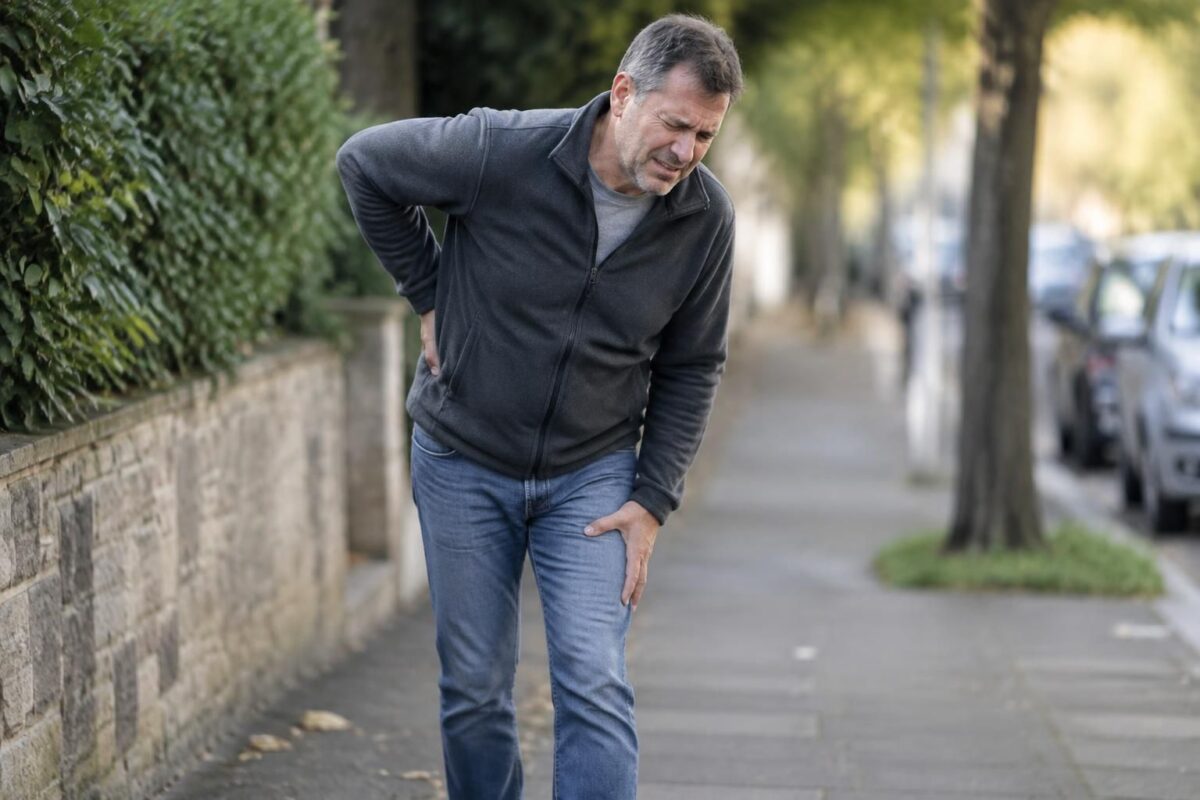
Sciatica and pain that worsens when walking
IN BRIEF A sciatica that worsens with walking is pain radiating from the buttock down the leg, exacerbated by walking. Several causes are possible: this symptom alone does not suffice for a diagnosis. Temporarily reduce walking duration, change positions, and…
Evaluation and imaging
Useful imaging according to evolution
X-rays can help identify signs of osteoarthritis or discopathy. A lumbar CT scan allows evaluation of the canal size and checks for a possible herniation, while MRI of the lumbar spine is favored for analyzing the spinal canal, the presence of a herniation, and its relation to a painful root. Imaging is particularly indicated when symptoms persist despite medication or when results could change management.
Comprehensive approach and follow-up
A structured evaluation connects the history of symptoms, the pain pathway, neurological signs, and imaging results. This approach avoids hasty conclusions and guides towards a suitable non-surgical strategy or, if necessary, towards additional options in collaboration with specialists.

Sciatica and pain that improves when walking
IN SUMMARY Sciatica is pain that radiates from the lower back or buttock down to the leg, sometimes all the way to the foot. If it decreases with walking, a gentle and regular walk can help limit stiffness and maintain…
Non-surgical approaches and action plan
When a mechanical cause is suspected and the evaluation allows, non-surgical options can be proposed. This may include osteopathic techniques, targeted decompression methods, and other non-invasive interventions, aiming to reduce root irritation, improve mobility and function, and establish a personalized rehabilitation plan. The goal is not the promise of a quick recovery but a gradual reduction of constraints and a lasting functional improvement.

IN BRIEF Sciatica is pain that often starts from the lower back or buttock and travels down the leg. Pain that worsens at the end of the day may be related to activities or prolonged positions, but it is not…
Warning signs and when to seek emergency care
Some symptoms require rapid evaluation: loss of urinary or bowel control, saddle anesthesia, significant weakness or progression of leg weakness, unexplained fever, pain after a significant trauma, or quickly worsening pain. If these signs are present, contact an emergency medical service without delay.

Sciatica and pain that worsens in the evening
IN BRIEF more painful sciatic pain in the evening is often related to inactivity, fatigue, and increased attention to sensations. This does not necessarily mean that the nerve is worsening. Gently changing positions, walking for a few minutes, and finding…
Descending Sciatica in the Calf: Possible Lumbar Causes
| Lumbar Cause | Concise Description |
|---|---|
| Lumbar Disc Herniation | Irritates the L5 or S1 root, with radiating pain towards the calf and foot depending on the affected root. |
| Disc Bulging | Protrusion of the disc that can compress a root and cause radiculopathy varying by level. |
| Disc Protrusion | Localized protrusion that can reduce space around a root and generate radicular pain. |
| Foraminal Stenosis | Narrowing of the exit opening of the root causing pain radiating in the leg. |
| Central Lumbar Stenosis | Narrowing of the spinal canal causing pain and heaviness in the legs while walking; improvement in flexion or sitting. |
| Facet Arthrosis | Degenerative changes in the facets reducing space around the roots and potentially causing radiculopathy. |
| Disc-Osteophyte Complex | Combination of disc bulging and osteophytes that can compress a root. |
| Lumbar Spondylolisthesis | Slippage of one vertebra over the adjacent one resulting in root irritation and radiating pain. |

Sciatica and pain when turning in bed
IN BRIEF Sciatica can cause pain when turning in bed, as certain movements irritate the lower back or leg. Turn slowly, moving your shoulders and hips together; a cushion between the knees or under the knees can improve comfort. If…
Testimonials: Sciatica Descending into the Calf and Possible Lumbar Cause
I had pain that started in the buttock and went down to my calf. At first, I thought it was mainly muscular, but the clinical examination showed that the path of the pain and the Lasègue sign were compatible with a sciatica of lumbar origin. This clarification changed everything: I was explained the possible mechanisms and the personalized plan to reduce nerve irritation without surgery.
After several weeks, the pain seemed stuck in the calf and I feared surgery. The evaluation considered a possible lumbar cause, particularly irritation of a nerve root at L5-S1. I was informed that imaging would be considered if the initial treatment failed, and that non-surgical options could be effective in regaining mobility.
My calf pain made me doubt everything, but the evaluation demonstrated a sciatica of lumbar origin and not just simple muscular pain. I was offered a structured approach with targeted osteopathy and home exercises. The progress was gradual but real, and I am now regaining normal walking and less irritation.
Over the weeks, I understood that my pain could stem from a lumbar cause and possibly from a foraminal stenosis compressing a nerve root. Thanks to a comprehensive evaluation, I was spared surgery and offered non-invasive care tailored to the patient’s profile, which reduced the intensity in the calf and improved my ability to walk long distances.
I feared that the symptoms in the calf were not related to a nerve, but the evaluation clarified things: it was a sciatica of lumbar origin, potentially due to radicular irritation. With a non-surgical approach and a progressive program focused on reducing irritation and strengthening, I regained smooth walking and much less pain in the calf.

Sciatica and pain when getting out of bed
IN BRIEF Sciatica upon getting out of bed is pain that radiates from the lower back to the buttock or leg and can be more pronounced after the night. Gradually rising, moving gently, and finding a comfortable sleeping position can…
Sciatica Descending to the Calf: Understanding Possible Lumbar Causes
Dr. Sylvain Desforges, an experienced osteopath, is the founder and president of the TAGMED clinics and the ACMA association. His background, marked by innovation in healthcare, leads him to focus on managing chronic pain and integrating advanced technologies such as motorized spinal decompression, targeted osteopathy, and laser and shockwave therapies. His mission is to provide evidence-based care to optimize the health and well-being of his patients, especially when sciatica descends into the calf.
In the context of sciatica radiating to the calf, Dr. Desforges’ approach illustrates how lumbar mechanisms can be involved. The painful route, often associated with a specific lumbar nerve root (L5 or S1), requires rigorous clinical evaluation and precise interpretation of neurological signs to discern radicular origin from other painful sources.
The foundation of diagnosis relies on a structured clinical approach. The interview defines the exact path of the pain and the factors that aggravate it, while the physical examination confirms the discal origin through tests such as the positive Lasègue sign. The physician also ensures that major neurological complications (paralysis, anesthesia, vesico-sphincter disorders) that require rapid management are ruled out. In cases where symptoms persist despite initial treatment, imaging may be considered. The aim is to clearly link the clinical picture to the pain pathway.
Regarding imaging, X-rays may reveal discopathy or arthrosis that could direct towards the lumbar etiology of sciatica. A lumbar CT scan analyzes the size of the canal and may highlight a disc herniation, while an MRI offers a detailed view of the lumbar canal and the existence of a herniation compressing a nerve root. The MRI can also detect rare conditions like neuromas. However, imaging does not replace clinical reasoning: the concordance between the pain pathway, clinical signs, and images is essential to guide management.
Several mechanisms can contribute to sciatica originating from the low back. A herniated disc or a disc bulge/protrusion can irritate a nerve root, especially when the pain radiates below the knee. Foraminal stenosis limits the space around the root, causing radiating pain, while facet arthrosis and the disco-osteophytic complex can reduce the space around the nerve structures. The piriformis syndrome and projected pain related to the hip or sacroiliac joint complete this picture, requiring careful assessment to avoid hasty conclusions. An educational and holistic approach is key: pain that seems purely muscular may mask nerve irritation, and conversely, low back pain may not follow standard anatomical patterns.
When the causes are clearly mechanical, Dr Desforges proposes a tailored non-surgical strategy suitable for the patient’s profile. Within TAGMED, options may include motorized neurovertebral decompression, specific osteopathy, laser therapies, shockwave sessions, and a precision impactor, used in a targeted and safe manner. The goal is not a promise of healing, but a structured and personalized approach aimed at reducing strain, calming irritation, and improving function.
For those seeking clear and effective management of sciatica radiating to the calf, Dr Desforges’ expertise is based on a comprehensive assessment, the integration of suitable technologies, and constant support towards improved quality of life.
Sciatica radiating to the calf can reflect a common lumbar cause. This article summarizes possible mechanisms, diagnostic elements, useful examinations, and non-surgical approaches, emphasizing the path of the sciatic nerve and the L5 and S1 roots. It offers practical resources to delve deeper into the causes and management options.
The lumbar mechanism is often linked to irritation or compression of the L5 or S1 roots, which can cause pain to radiate down to the calf and sometimes to the foot. Common conditions include herniated disc, disc bulge, protrusion, and foraminal stenosis. Interpretation should be guided by history, the pain pathway, and clinical signs, rather than an isolated image. To explore the mechanisms further, consult resources like the MSD Manual on sciatica.
Diagnosis is primarily based on clinical examination and history, which help identify the pain pathway and neurological signs consistent with lumbar radiculopathy. The Lasègue sign is one of the common indicators to confirm root origin. Imaging is considered when pain persists despite treatment or when results could guide management. X-rays can detect discopathies or arthrosis, lumbar CT scans evaluate the canal size and may identify a herniation, and lumbar MRI analyzes the canal and roots, occasionally detecting rare conditions like neuromas. To enhance your understanding of imaging and diagnosis, consult Santé on le Net or Causes and diagnosis.
It is important to differentiate the causes: pain may stem from a herniated disc or a disc bulge, but also from foraminal stenosis or an arthritic process. Other non-radicular sources, such as the sacroiliac joint, the hip, or projected pain from muscles, can mimic sciatica. A structured assessment links the onset of pain, its pathway, sensory and motor signs, and imaging results to guide management. To explore these different mechanisms and their manifestations, see the resources Causes of sciatica and Distinguishing low back pain and nerve pain.
In the case of mechanical pain consistent with a disc or foraminal origin, non-surgical options may be considered, tailored to the evaluation and the patient’s profile. These approaches aim to reduce strain on nerve structures and improve function. Practical resources on stretching and the precautions associated with these exercises are available, notably via Stretches for sciatica — caution based on the cause, and information on non-invasive mechanisms such as osteopathic approaches or non-surgical modalities offered in certain contexts.
It is crucial to be vigilant for warning signs that require urgent medical evaluation: loss of bladder or bowel control, anesthesia in the saddle area, significant or progressive weakness in the leg or foot, fever, recent trauma, or pain accompanied by shortness of breath or malaise. In these situations, quickly contact emergency services and a physician.
To enhance your knowledge and find additional resources, you can consult the following pages: Causes and diagnosis of sciatica, Pain in the buttock and leg — sciatica consultation in Montreal, Stretches for sciatica — caution based on the cause, Role of lumbar nerve roots, Distinguishing low back pain and nerve pain, and Sciatica or sacroiliac pain. Other useful resources also address mechanisms and available diagnostic and therapeutic options in Montreal and elsewhere in the network. To broaden the perspective, see also specialized pages on Sciatica – MSD Manual, and analyses available on Santé on le Net.

Sciatica and difficulty finding a comfortable position
IN BRIEF Sciatica is a pain that often starts in the lower back or buttock and radiates down the leg, sometimes making it difficult to find a comfortable position. Alternating positions, avoiding postures that aggravate the pain, and trying a…

Dr Sylvain Desforges, B.Sc., D.O., N.D., osteopath, is the founding president of TAGMED and of the ACMA association. He dedicates his practice to chronic spinal pain, low back pain and symptoms compatible with sciatica, particularly when pain radiates toward the buttock, leg, calf, foot or toes.
Through SOS Sciatique, he publishes educational content on sciatica symptoms, possible causes such as disc herniation, disc narrowing, foraminal stenosis or irritation of a lumbar nerve root, as well as non-surgical approaches that may be considered according to the evaluation. At Clinique TAGMED, care may include, depending on the case, motorized neurovertebral decompression, specific osteopathic care or precision percussion.
For an evaluation related to sciatica treatment in Montreal / Mount Royal or sciatica treatment in Terrebonne, please consult the services available at Clinique TAGMED.
Medical disclaimer
The information published on SOS Sciatique is provided for educational purposes only and does not replace a consultation, diagnosis, opinion or treatment provided by a physician or another authorized healthcare professional. The author of this article is neither a medical doctor nor a specialist in a medical specialty recognized by the Collège des médecins du Québec. The osteopathic, manual medicine or functional support approaches described on this site do not constitute medical acts and are not intended to replace medical follow-up.
Consult a physician or emergency service in cases of loss of bladder or bowel control, anesthesia in the saddle area, significant or progressive weakness in the leg or foot, fever, recent trauma, severe pain or rapid worsening of symptoms. For more details, please read our Legal Notice.