Sciatica: why the cause must guide the choice of treatment
30/06/2026
Sciatica in Montreal: A careful approach to avoid poor treatment
01/07/2026
In short The Sciatica sitting in the office is a pain that radiates from the lower back to the leg, triggered by the prolonged pressure on the lumbar discs and the tension of the muscles around the sciatic nerve when you sit for too long. What is it? This is a common problem related to posture and immobility at work. What are the advantages? pain reduction, maintaining mobility and professional efficacy, and relapse prevention through a Ergonomic layout, of Active breaks and simple exercises. How does it work? by adjusting your position (chair with Lumbar support, desk height, eye screen), using suitable accessories and practicing soft movements regularly, you unzip the discs and release tension to continue working in comfort. |
Short summary: Sciatica sitting in the office “Why does the leg become painful?
- disc pressure : When sitting, the lumbar spine supports a load up to 40% higher than in standing, which can aggravate a hernia and compress the sciatic nerve.
- Piriform tension : Staying in a bad posture can contract this deep muscle of the buttocks and compress the sciatic nerve when it comes out of the pelvis.
- Retroversion of the pelvis : A chair that is too low or too deep can tilt the pelvis backwards, flatten the lordosis and stretch the nerve.
- Leg position : Crossed or poorly positioned legs can compress vascular and nerve structures, aggravating irritation.
This article, written by a health professional and expert, explains why the sciatica Can become painful when sitting in the office. It offers clear explanations and concrete measures to preserve comfort, limit pain and continue work without compromising back health.
Mechanisms that Explain Pain in a Sitting Position
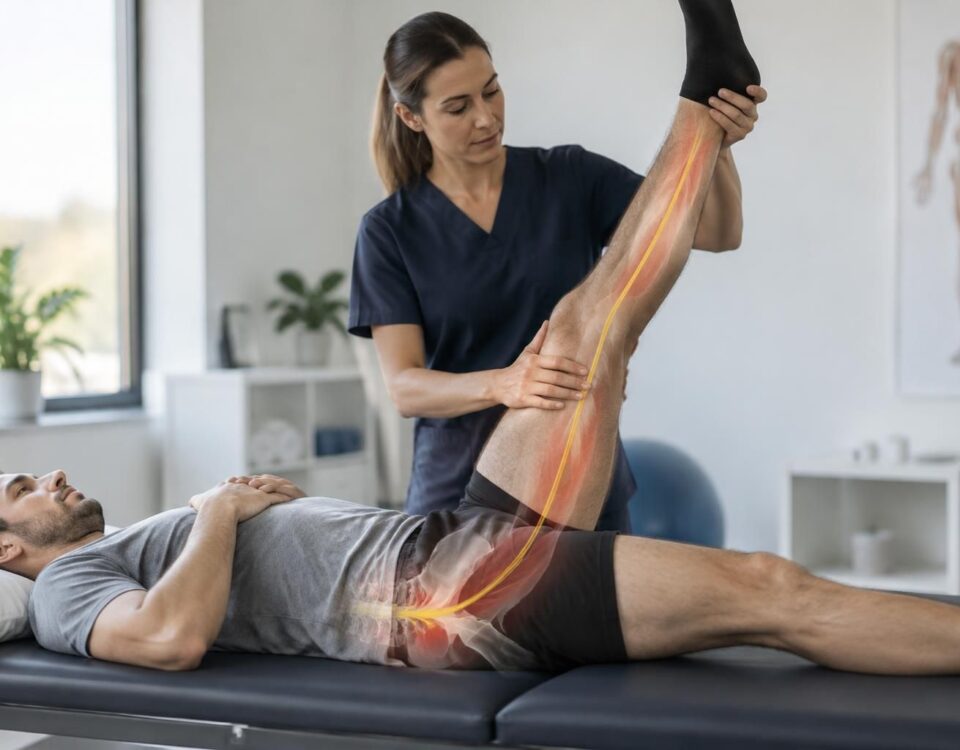
The sciatic nerve is the longest in the body. It takes birth in the lower back and descends along the leg. In a sitting position, several mechanisms can irritate this nerve. The pressure exerted on Intervertebral discs Increases sharply, which can aggravate a pre-existing disc herniation and compress the nerve. the piriformis muscle can be tightened and compress the nerve when it comes out of the pelvis, creating a piriform syndrome. The swing of the pelvis backwards, frequent with an ill-suited chair, can stretch the nerve and reduce the natural curve of the lower back. Finally, a poor position of the legs can compress the vascular and nervous structures, aggravating the pain.
The pain can therefore come from a combination of pressure on the lumbar disc, muscle tension and postural swaying. Understanding these mechanisms helps to target the corrections to the workplace and the small habits that make the difference on a daily basis.
frequent errors in the office that aggravate the pain
Many people adopt postures that amplify pain. Sag in the chair, adjust the chair too low, or place the screen too low force the head and back to turn, which disrupts the alignment of the trunk and pelvis. Stay course Without pause for more than 45 minutes and not supporting the lower back promote disc compression and muscle rigidity. An absence of lumbar support can push the column into a curve that overwrites the discs.
To limit these effects, avoid positions that accentuate the retroversion of the pelvis and favor regular posture alterations and active breaks during the day.
Arrange the workstation to support sciatica
Correct setting of the chair
Height : the feet should rest flat on the ground, the knees at 90° or slightly below hip level.
Seat depth : Leave 2 to 3 fingers between the back of the knee and the edge of the seat.
Folder : It should be slightly inclined backwards (100–110°) with lumbar support adapted to the hollow of the lower back.
armrests : Adjust them to relax the shoulders and hold the elbows at 90°.
Use a suitable ergonomic cushion
An ergonomic cushion can redistribute pressure and support natural lordosis even if the chair is well adjusted. A good cushion can make a difference for people who are sensitive to the prolonged sitting position and avoid painful compression points.
Position the screen at the right height
The upper edge of the screen should be at eye level. If necessary, use a monitor stand. This ruler avoids bending the neck and disturbing the overall alignment of the back.
The 45-5 rule and active breaks
Every 45 minutes of sitting work, get up 5 minutes. Walk, move and slightly stretch the muscles. This practice helps to decompress the discs and interrupt voltage cycles. If possible, choose a workstation Height adjustable To alternate positions and reduce nerve pressure.
Exercises and movement in the office
These are simple movements without agitation. Integrate active breaks every 30 to 60 minutes and favor gestures that improve pelvis and trunk mobility without forcing the sciatic nerve. Consult your doctor or physiotherapist before starting any prescription program.
Ergonomic equipment and aids to consider
Seat cushion : Reduces the pressure on the coccyx and supports the pelvis in lordosis.
footstool : Restores the angle of the knees when the feet do not touch the ground.
Height adjustable desk : Ideal for alternating positions and avoiding prolonged compression.
When to consult and which treatment options should be preferred
In case of very severe pain, loss of strength or neurological symptoms, consult a health professional quickly. For treatments, certain options may be considered after medical evaluation, including approaches available at the TagMed clinic in Montreal or Terrebonne. To find out more, you can consult resources on approaches associated with low back pain and sciatica, while respecting the limits of the treatments practiced and recommended by professionals.
To deepen the aspects related to posture and prevention, you can consult the following resources:
Sciatica#ATFP_CLOSE_TRANSLATE_SPAN# and Protrusion Disc, Decompression#ATFP_CLOSE_TRANSLATE_SPAN# Neurovertebral, Treatment#ATFP_CLOSE_TRANSLATE_SPAN# Montreal Sciathics, Weak#atfp_close_translate_span# Leg or Foot and Sciatica, Clinic#ATFP_CLOSE_TRANSLATE_SPAN# TAGMED.
For additional information on the positions to be avoided and on ergonomics at work, you can consult the available resources on hello#atfp_close_translate_span# Health and on specialized resources in prevention and posture.
To go further, here are some useful links in the field of health and ergonomics:
Sciatica#ATFP_CLOSE_TRANSLATE_SPAN# and Protrusion Disc, Decompression#ATFP_CLOSE_TRANSLATE_SPAN# Neurovertebral, Treatment#ATFP_CLOSE_TRANSLATE_SPAN# Montreal Sciathics.
Medical Disclaimer: The information and advice provided on this site does not replace the health professional’s diagnosis or treatment. Please note that Dr. Sylvain Desforges osteopath is neither a doctor of medicine nor a doctor, and is not a specialist in a medical specialty as defined by the Collège des Médecins du Québec. Manual medicine, functional medicine and sports medicine as described on this site exclude any medical treatment or diagnosis made by a doctor or specialist doctor. Always consult your doctor for any medical questions. For more details, please read our full legal notice.
This article was written as part of an informative content and does not replace a personalized medical consultation. For any medical questions, contact a qualified healthcare professional.
Sciatica sitting in the office: why the leg becomes painful?
- Lumbar pressure in sitting position : The load on the discs increases, risking aggravating a hernia.
- piriform syndrome : The piriform can compress the sciatic nerve when you sit for a long time.
- Retroversion of the pelvis : chair too low/deep and rocker that stretches the nerve.
- Leg position : crossed or misaligned legs that press the vascular and nervous structures.
- Chair setting : suitable height, correct depth, backrest with lumbar support and adapted armrests.
- Suitable ergonomic cushion : Redistributes pressure and preserves lordosis.
- Screen at eye level : Avoid bending neck and back.
- Regular active break : Rule of 45-5, 5 minutes every 45 minutes.
- Quick exercises in the office : piriform stretching, lumbar rotation, pelvic tilt.

When sitting in the office, the pain that extends to the leg often results from increased pressure on the sciatic nerve, associated with piriformis tension and poor management of the pelvic tilt. This phenomenon can become disabling after a few hours of work. This article gives you the reasons, mistakes to avoid and concrete solutions to stay productive while protecting your sciatica.
Why the leg becomes painful in a sitting position
The sciatic nerve is the longest in the body and can be irritated by mechanical stress when sitting. The pressure on the lumbar discs can increase up to about 40%, which can aggravate a hernia and pinch the nerve. The piriform May contract and compress the nerve when it comes out of the pelvis. A retroversion of the basin due to an unsuitable chair can flatten the lordosis and extend the nerve. Finally, crossed or poorly positioned legs disrupt blood and nerve flow, increasing irritation and pain.
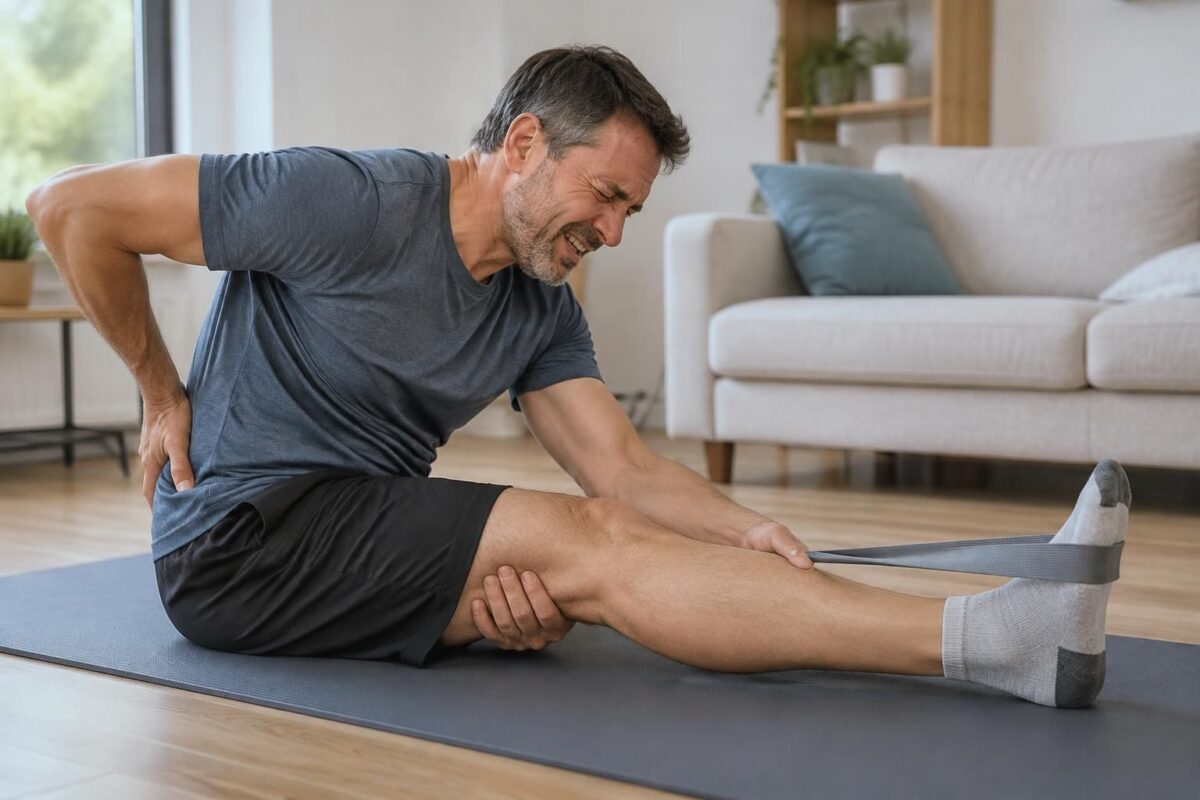
Sciatica and aggressive stretches: possible sign of worsening
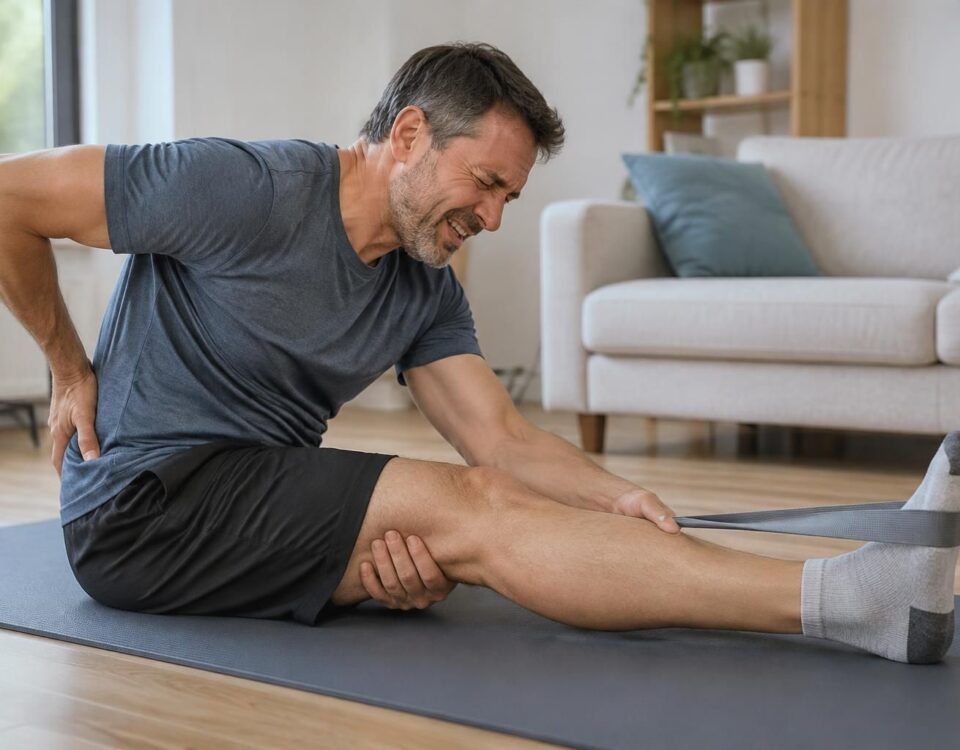
IN BRIEF Sciatica is pain that radiates from the lower back or buttock down the leg. Aggressive stretching does not necessarily relieve the nerve and can intensify the pain, especially if it moves further down to the foot or is…

Sciatica and calf stretching: when the pain increases
IN SHORT A calf stretch can exacerbate sciatica if it further irritates the nerve. It should not cause pain that increases or radiates down the leg: stop the movement and do not push through. Stretches may help with some tensions,…
Frequent errors in the office
Slumping in your chair is a first cause of aggravation: a slumped position creates hyperpressure on the lumbar discs and keeps the sciatic nerve under tension. A chair set too low increases the shift between knees and hips, favoring the retroversion of the pelvis. A screen that is too low forces you to bend the neck, disrupting the alignment of the trunk and lower back. Staying still for more than 45 minutes intensifies disc compression and muscle rigidity. Finally, a seat without lumbar support causes the column to adopt a C-curve and can overwrite the discs.
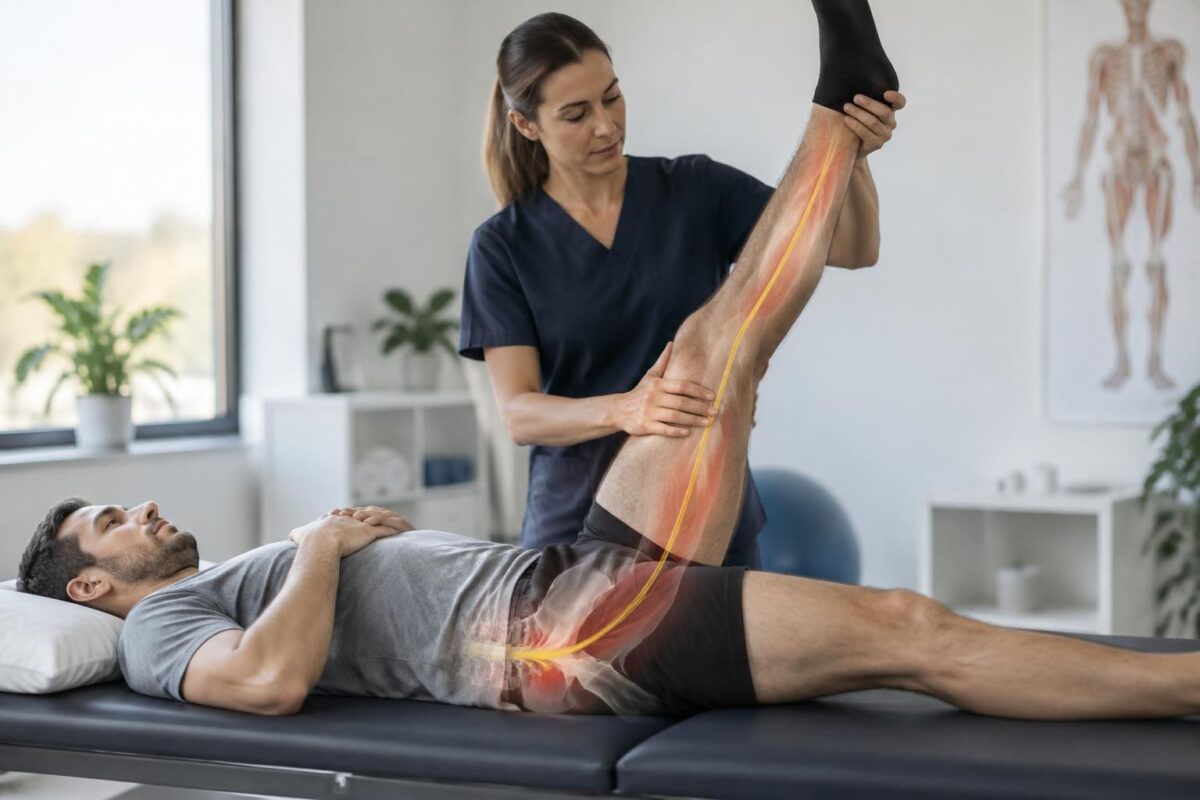
Sciatica and hamstring stretching: possible nerve tension
IN BRIEF Sciatica can make stretching the hamstrings uncomfortable, as the tension felt may come from the nerve rather than the muscle. A gentle stretch, with a straight back and without seeking maximum range, can help loosen the back of…
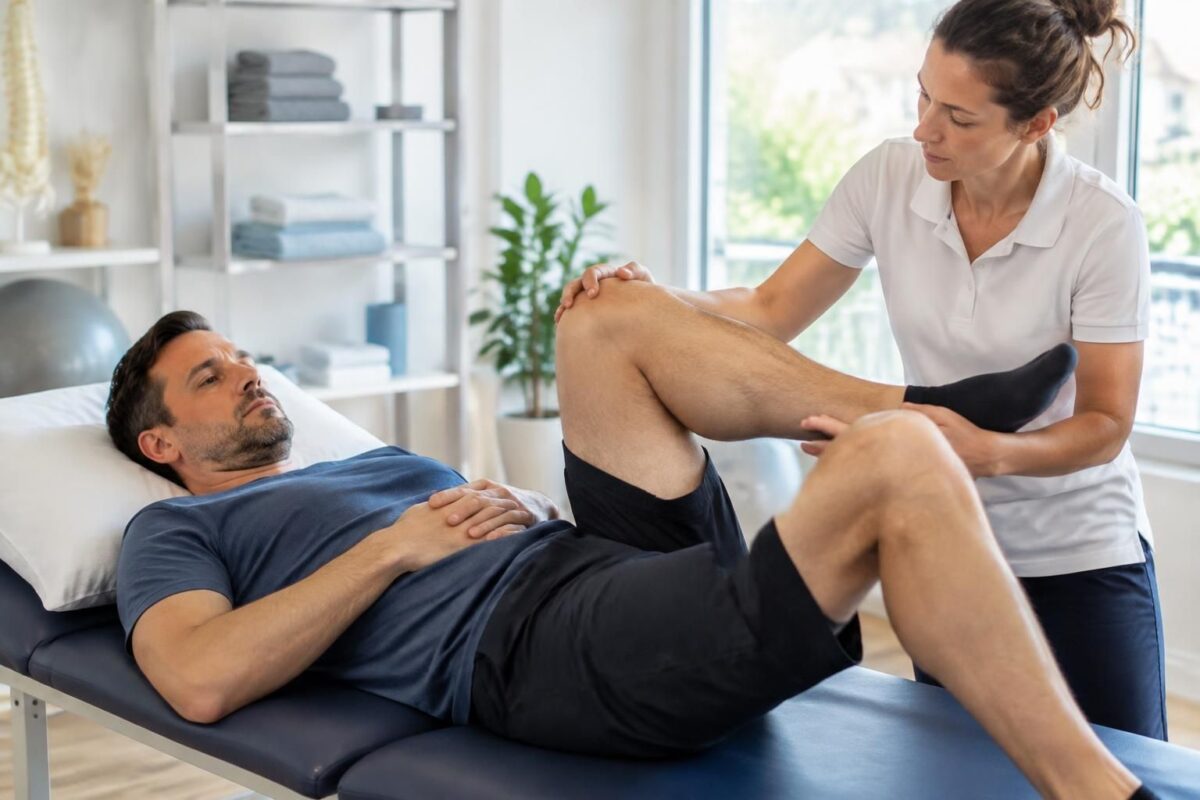
Sciatica and piriformis stretching: useful or worsening depending on the case
IN BRIEF Piriformis-related sciatica can cause deep pain in the buttock, sometimes radiating down the back of the thigh. A gentle stretch can loosen the hip and relieve discomfort if the muscle is involved, but it can worsen symptoms if…
Arrange your workstation for sciatica
Chair setting
Adjust the chair so your feet rest flat on the floor, with the knees at 90° or slightly below hip level. Leave 2-3 fingers between the back of the knees and the edge of the seat. The backrest should be tilted slightly backwards (100-110°) and a support lumbar must come in the hollow of the lower back. The armrests should allow relaxation of the shoulders and elbows to 90°.
Support and Accessories
One Ergonomic cushion redistributes pressure and maintains the lordosis. For specific cases, solutions like our SCIATIGUARD™, thought to unload compression areas around the sciatic nerve, can make a noticeable difference. A footrest can be useful when the feet do not touch the ground at the right height.
Monitor position and other settings
The top edge of the screen should coincide with the eye level. Use a support if necessary to avoid leaning the head and disturbing the alignment of the trunk.
Rule of 45-5
Every 45 minutes, get up 5 minutes to walk or stretch. If possible, choose an office Height adjustable To alternate positions and limit pressure on the column.

Sciatica and popular stretches: why to stay cautious
IN BRIEF Sciatica causes pain that radiates from the lower back down the leg. Popular stretches, such as the pigeon pose or hamstring stretches, are not always suitable: pulling on an irritated nerve can worsen the symptoms. Favor gentle movements,…

Sciatica and Pilates: movements to adapt
IN SHORT Sciatica causes pain that can radiate from the lower back down to the leg. The Pilates Reformer can promote a gradual return to movement and strengthen core control, provided that the movements, range, and resistance are adapted. Favor…
Quick exercises in the office
Simple exercises to do without leaving your space: Stretching the piriforme seated (cross an ankle on the opposite knee and lean slightly), lumbar rotation in soft, and tilting of the pelvis (alternating between digging and flattening the lower back, 10-15 repetitions).

Sciatica and core stability: variable tolerance depending on symptoms
IN BRIEF Core strengthening in case of sciatica consists of progressively strengthening the trunk muscles. Its tolerance varies depending on pain and symptoms: suitable without worsening the pain, it can support mobility and the resumption of activities, but does not,…

Sciatica and lunges: leg pain to watch out for
IN BRIEF Sciatica is pain that starts from the lower back or buttock and radiates down the leg. If a lunge triggers or worsens this pain, stop the movement and adjust your activity: this exercise does not address sciatica. Consult…
Practical advice on a daily basis
Moisturize yourself regularly and wear comfortable clothes. Avoid the back pockets that unbalance the pool, and schedule regular active breaks so as not to remain frozen. In case of acute pain, favor gentle gestures and consult a professional to adjust your post and treatment plan.
| Trigger | Impact and concise actions |
|---|---|
| Extended sitting position | prolonged, she Compresses lumbar discs and can Irritating the sciatic nerve; Correct with active breaks. |
| Poor pelvis posture | Retroversion of the pelvis Tights the sciatic nerve and aggravates the pain; Adjust the position. |
| File without lumbar support | Without support, the column can adopt a C-curve and Overwrite the lumbar discs. |
| Cross legs | position which Compresses vasculo-nervous structures; Focus on flat feet and hip alignment. |
| chair too low | generates Retroversion of the pelvis and amplifies the pain; Adjust height and depth. |
| badly positioned screen | Causes a cervical tension and back tensions; Place the screen at eye level. |
| Lack of active breaks | Breaks interrupt the Disc compression and relax the muscles. |
| Piriform contraction | The Piriform contraction may Compress the sciatic nerve; Favor targeted stretching. |
| Insufficient hydration | Discs contain 80% water, hydration supports their elasticity; Drink regularly. |
Testimonials: Sciatica sitting at the office — Why is the leg getting painful?
“I am Elena, graphic designer, and my work forces me to sit for hours in front of the screen. each break seems unwelcome and, soon, the pain linked to my sciatica extends along my leg. I discover little by little that the pressure on the lumbar discs may increase up to 40% in a sitting position, which irritates the sciatic nerve. Add a pelvic tilt and a tension of the piriform, and you get a pain that seems to start from the neck? No, from the lower back to the foot. »
“I am Arnaud, developer, and I thought for a long time that it was only a temporary back pain. sitting too long, especially with the Cross legs and the sagging back, the sciatica became painful over the entire length of the leg. The pressure on the lumbar discs is accentuated and the piriform contracts, compressing the nerve at the exit of the pelvis. A simple fit of my chair and adding a Ergonomic cushion changed everything: less pain and more comfort on a daily basis. »
“Claire, medical secretary, here. My screen was too low and I tended to tilt my head and round the back, which shifted the entire postural chain and hooked the sciatic nerve. As soon as I moved the screen up to eye level and added lumbar support, the pain that radiated into the leg has clearly diminished. I also moved to a stabilized sitting position, with the Relaxed legs And feet flat, and I started taking regular active breaks, which reduced painful episodes. »
“Max, accountant, I adopted the rule of 45 minutes and 5 minutes : Every half hour, I get up, walk or stretch my trunk slightly. This habit has slowed the recurrence of painful sessions in the sciatica; the sitting is no longer a trap but a framed episode. I also use a desk Height adjustable To quickly switch between sitting and standing, which prevents prolonged compression of the lumbar discs and the tension of the piriform. »
“Sophie, project manager, I needed more targeted support. In more than one Ergonomic cushion adapted, I adopted a configuration where the Lumbar support stay in place and my thighs remain relaxed. When the pain appears, I make small changes: no more active rest, and I favor short walks during the day. Result: the pain remains under control and my concentration returns more quickly. »
DR. Sylvain Desforges, expert in osteopathy, naturopathy and manual medicine, is the founding president of the Tagmed clinics and the ACMA association. With a career dedicated to health innovation, he specializes in chronic pain management and the integration of advanced technologies such as Spinal decompression, the laser and the Shockwave therapy. Its mission is to offer evidence-based care to optimize the health and well-being of its patients. In the context of the professional daily, he is particularly involved in the mechanisms of the sciatica related to the sitting position and on the arrangements that allow you to continue to work while limiting the pain.
The painful leg in the office is not the result of a simple back pain. The sciatic nerve, conductor of this pain, can be irritated by several constraints related to the posture and the time spent sitting. The lumbar disc supports increased pressure in the sitting position, sometimes favoring an aggravation of a pre-existing disc disease. The piriformis muscle can contract and compress the nerve at the exit of the pelvis, reinforcing the painful picture. The swinging of the pelvis in retroversion, due to an ill-suited chair, can stretch the sciatic nerve, while an inappropriate leg position accentuates vasculo-nervous irritation. These mechanisms, which Dr. Desforges follows closely in his work, explain why the pain can intensify as the day progresses.
In his approach, he favors a complete assessment of the workstation and daily habits. Each consultation is an opportunity to analyze the setting of the chair, the height of the screen, the eye-screen distance and the lumbar support, in order to reduce the mechanical stress on the spine and the sciatic nerve. Its system is based on a synergy between ergonomic advice, targeted therapies and exercise program adapted to the employee’s daily life. For example, the integration of support devices, ergonomic cushions and, when necessary, standing workstations, contributes to breaking the cycles of tension and pain.
On the therapeutic level, Dr. Desforges uses proven approaches to relieve and stabilize pain. Spinal decompression techniques can be considered when the compression mechanisms are preponderant, supplemented by gentle and personalized care. Laser and shock wave therapy sessions can promote tissue recovery and inflammation, always in a logic of Individualized support and based on available data.
At the same time, patient education occupies a central place. Simple and daily exercises – targeted stretching of piriform and hamstrings, strengthening the deep muscle plan and regular active breaks – maintains mobility without aggravating pain. The message of Dr. Desforges is clear: prevention involves anticipation, adaptation of the working environment and appropriate physical activity, designed to support the sciatic nerve and preserve the quality of professional life.
For those looking for an integrated, evidence-based approach, Dr. Desforges offers support that combines clinical expertise, advanced technologies and practical advice for the workplace. Discover her approach and the services available in her clinics and associates, to optimize your health and well-being.
This conclusion provides a clear overview of sciatica sitting at the office and explaining why the leg May become painful when staying too long seated, as well as practical solutions to reduce pain and preserve professional activity. It recalls the main mechanisms (pressure on the intervertebral discs, tension of the piriform muscle, retroversion of basin and leg position) and offers simple gestures, ergonomic aids and exercises that are easy to integrate into your day.
The sciatic nerve can become painful when the sitting is maintained for a long time and unsuitable. A Increased pressure on the lumbar discs, associated with a Piriform tension and to a Retroversion of the pelvis, may cause painful irradiation along the leg. adopt a lordosis natural and ensure good lumbar support thanks to a Adapted chair or to a Ergonomic cushion Helps to limit these mechanisms and reduce nerve irritation.
To act concretely, adjust your workstation: sitting at the right height with the knees at ~90°, back slightly inclined, and Screen at eye level. The Rule of 45-5 (Pause active every 45 minutes) Helps to unzip discs and release muscle tension. Tools like SCIATIGUARD™ or a Ergonomic cushion can redistribute pressure and preserve lordosis.
At the same time, favor simple exercises and micro-mauses: gentle stretching of the piriform, lumbar rotation, and tilts of the basin. These gestures, performed regularly, improve mobility and reduce pain in the leg without overloading the back. Also alternate between sitting and standing periods if possible, and stay hydrated to support the elasticity of the intervertebral discs.
If necessary, do not hesitate to ask a professional if the pain persists: a doctor, physiotherapist or osteopath will be able to assess the origin, propose a job development plan and appropriate rehabilitation. In cases of severe pain or associated with loss of strength or other symptoms, a quick opinion is essential. For those who wish to deepen the notions of interface between position and pain, several specialized resources offer up-to-date ergonomic guides and recommendations.
To go further and explore complementary approaches, you can consult resources such as Sciatica#ATFP_CLOSE_TRANSLATE_SPAN# and bulge disc, Sciatica#ATFP_CLOSE_TRANSLATE_SPAN# and prolonged sitting position, Decompression#ATFP_CLOSE_TRANSLATE_SPAN# Neurovertebral and pain, Sciatica#ATFP_CLOSE_TRANSLATE_SPAN# at work: Relieve pain in business, Positions#atfp_close_translate_span# to avoid. Other useful resources include Sciatica:#ATFP_CLOSE_TRANSLATE_SPAN# Positions to avoid, Comment#ATFP_CLOSE_TRANSLATE_SPAN# Sit with sciatica without aggravating the pain, and Comment#ATFP_CLOSE_TRANSLATE_SPAN# Sit with sciatica.

Dr Sylvain Desforges, B.Sc., D.O., N.D., osteopath, is the founding president of TAGMED and of the ACMA association. He dedicates his practice to chronic spinal pain, low back pain and symptoms compatible with sciatica, particularly when pain radiates toward the buttock, leg, calf, foot or toes.
Through SOS Sciatique, he publishes educational content on sciatica symptoms, possible causes such as disc herniation, disc narrowing, foraminal stenosis or irritation of a lumbar nerve root, as well as non-surgical approaches that may be considered according to the evaluation. At Clinique TAGMED, care may include, depending on the case, motorized neurovertebral decompression, specific osteopathic care or precision percussion.
For an evaluation related to sciatica treatment in Montreal / Mount Royal or sciatica treatment in Terrebonne, please consult the services available at Clinique TAGMED.
Medical disclaimer
The information published on SOS Sciatique is provided for educational purposes only and does not replace a consultation, diagnosis, opinion or treatment provided by a physician or another authorized healthcare professional. The author of this article is neither a medical doctor nor a specialist in a medical specialty recognized by the Collège des médecins du Québec. The osteopathic, manual medicine or functional support approaches described on this site do not constitute medical acts and are not intended to replace medical follow-up.
Consult a physician or emergency service in cases of loss of bladder or bowel control, anesthesia in the saddle area, significant or progressive weakness in the leg or foot, fever, recent trauma, severe pain or rapid worsening of symptoms. For more details, please read our Legal Notice.