


Sciatica Treatment Terrebonne: Evaluation of Pain, Strength, and Reflexes
01/08/2026
Sciatica: what an irritated nerve root means
01/08/2026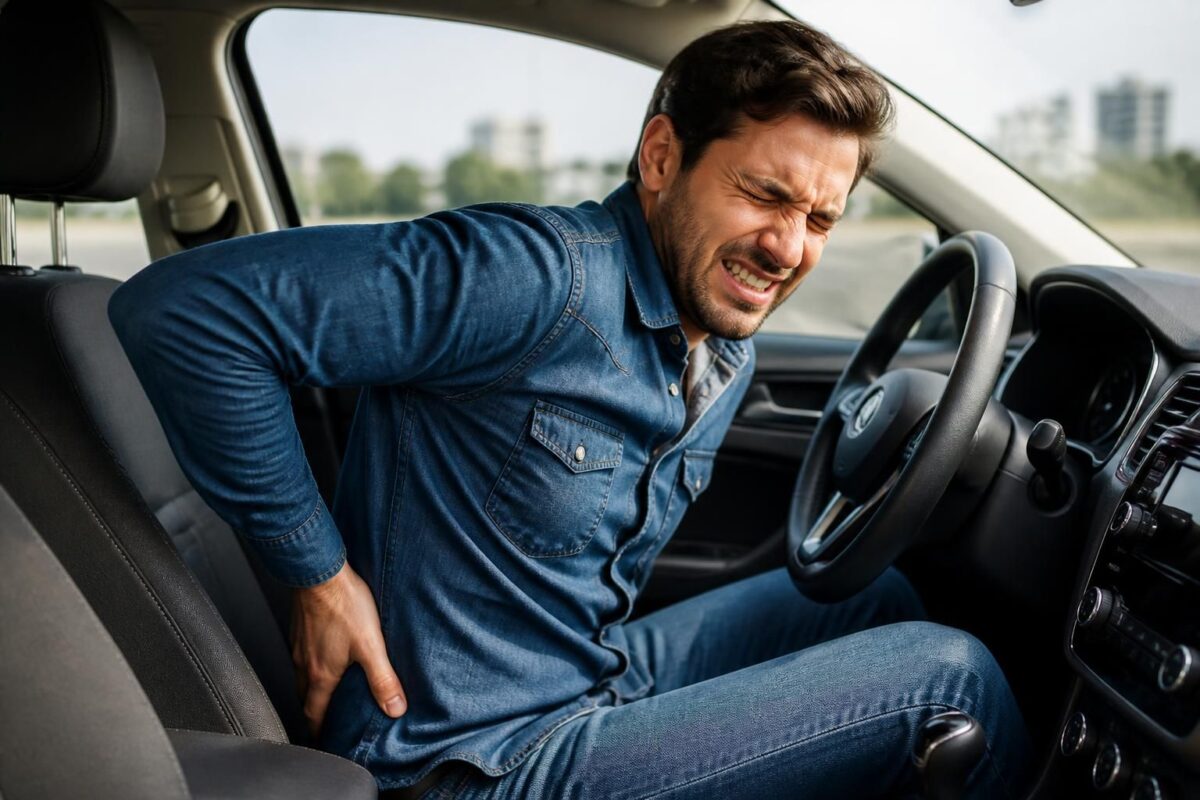
IN BRIEF In brief, sciatica and pain that increases when driving refer to irritation or compression of the sciatic nerve that worsens during driving, particularly with prolonged sitting, vibrations, and lack of movement. This association limits driving and can radiate pain down to the buttock, thigh, or foot. The benefits include better tolerance for driving through a proper posture, regular breaks, and core strengthening exercises to stabilize the spine and reduce tension. Available in Montreal, this service offers practical advice and non-surgical solutions for short and long trips while promoting road safety. |
Sciatica can intensify during car trips. Prolonged sitting, vibrations, and a restrictive posture increase pressure on the disc and nerve root, causing pain that starts from the buttock and can radiate down to the calf or foot, sometimes accompanied by electric shocks or numbness. Common causes include herniated discs or foraminal stenosis. To drive with sciatica, adopt a good posture, use a lumbar cushion, adjust the seat, take regular breaks, and walk/stretch. If the pain worsens, reaches the foot, or is accompanied by weakness or loss of sensation, seek medical attention promptly.
Driving can worsen sciatica. This article presents the mechanisms, signs to watch for, and concrete measures to drive while minimizing pain. You will discover simple tips on installation, breaks, and management options at TAGMED Clinic to drive more comfortably even in the presence of symptoms.
Mechanisms and Triggering Factors
Sciatica is an irritation or compression of the sciatic nerve. The nerve originates in the lower back and descends to the buttock and leg. In a car, prolonged sitting, hip flexion, and repeated vibrations increase pressure on the discs and nerve roots. This pressure can intensify pain and produce sensations such as electric shocks or numbness in the leg.
Driving also promotes poor posture and reduced mobility. The journey, accelerations, and braking can keep the spine in flexion or tension, which increases pain in some sensitive individuals.
Signs and Symptoms to Watch for While Driving
Pain may remain localized in the lower back or extend to the buttock, then to the thigh, then to the calf, and sometimes down to the foot. Numbness, tingling, or weakness in the foot may occur. If the pain descends below the knee or is accompanied by weakness or loss of control, a medical assessment becomes necessary.
A burning sensation or symptoms that occur after a few minutes of driving indicates a nervous reaction that should be monitored closely.
How to Sit and Drive When Sciatica is Present
Position yourself to support the lumbar curve. The pelvis should be slightly tilted forward. Avoid a seat that is too inclined. Bring the steering wheel closer to keep the legs relaxed and knees slightly bent. Use an ergonomic lumbar cushion if needed.
An automatic transmission can reduce repetitive movements of the left leg and decrease pain for some individuals.
Measures to Consider Before and During the Journey
Plan for regular breaks every 1 to 2 hours during long trips. Walking for a few minutes helps relax the lumbar muscles and restart circulation, which can limit pain.
Before a trip, check the seat adjustment and avoid lengthy drives when pain is already high. Simple vehicle adjustments and proper posture can make a significant difference.
If you need to make frequent trips and pain persists, a medical evaluation is recommended to identify possible causes and guide treatment.
When to Consult and What Approach to Prefer
Consult promptly if the pain is accompanied by significant weakness, difficulty manipulating the pedals, major loss of sensitivity, or urinary issues. These signs may indicate more severe nerve damage requiring tailored management.
For appropriate management, the assessment can determine if the symptoms stem from a disc, foraminal, or other cause, and guide non-surgical treatments offered at TAGMED Clinic.
Preventing Pain During Trips
Regular physical activity and core strengthening help stabilize the spine and reduce lumbar tensions. Before a long trip, prioritize breaks and ensure that the seat is well-adjusted and that your body position is comfortable.
To understand the different causes and non-surgical options associated with sciatica, you can refer to the following resources: nerve compression or chemical irritation and sciatica and car driving.
Treatment Options at TAGMED Clinic
Based on the assessment, non-surgical approaches may be considered at TAGMED Clinic in Montreal or Terrebonne. To learn about the available services, visit TAGMED Clinic.
To delve deeper into the aspects associated with pain while driving, some specialized resources explain how trajectories and symptoms evolve during the journey and after exiting the vehicle. For example, information on pain that increases when walking can help understand the link between mobility and pain.
For a more general approach, the following page offers complementary perspectives on mechanisms and possible treatments, while remaining focused on non-surgical management principles: sciatic pain in Terrebonne when walking becomes difficult.
For general information on driving and pain options, you can also consult additional resources on the TAGMED site and on pages dedicated to lumbar pain and sciatica.
Dr Sylvain Desforges, B.Sc., D.O., N.D., osteopath, is the founding president of
TAGMED and the ACMA association. He devotes his practice to chronic spinal pain, low back pain, and pain compatible with sciatica, particularly when pain radiates toward the buttock, leg, calf, foot, or toes.
Through SOS Sciatica, he publishes educational content on the symptoms of sciatica and non-surgical approaches that may be considered based on the evaluation. At TAGMED Clinic, care may include, as applicable, neurovertebral decompression, specific osteopathy, or precision impactor.
Medical disclaimer: The information and advice provided on this site do not replace the opinion, diagnosis, or treatment of a healthcare professional. Please note that Dr. Sylvain Desforges, osteopath, is neither a medical doctor nor a physician, and is not a specialist in a medical specialty as defined by the Collège des médecins du Québec. Manual medicine, functional medicine, and sports medicine as described on this site exclude any medical treatment or diagnosis made by a doctor or medical specialist. Always consult your doctor for any medical questions. For more details, please read our full Legal Notice.
“Medical disclaimer: The information and advice provided on this site do not replace the opinion, diagnosis, or treatment of a healthcare professional. Please note that Dr. Sylvain Desforges, osteopath, is neither a medical doctor nor a physician, and is not a specialist in a medical specialty as defined by the Collège des médecins du Québec. Manual medicine, functional medicine, and sports medicine as described on this site exclude any medical treatment or diagnosis made by a doctor or medical specialist. Always consult your doctor for any medical questions. For more details, please read our full Legal Notice.”
- Causes and trajectory: Sciatica often due to a herniated disc or foraminal stenosis, pain may radiate down to the buttock, thigh, calf, or foot.
- Factors in the car: prolonged sitting, vibrations, and flexed pelvis increasing disc pressure.
- Typical symptoms: lower back pain radiating to the thigh/foot, possible numbness and electric shocks.
- Warning signs: foot weakness, loss of sensation, pain that spreads quickly.
- Progression during the journey: pain may intensify with duration and limit mobility.
- When to consult: pain radiating below the knee, significant numbness, or notable weakness.
- Seat adjustment: seat that supports the lumbar curve, slightly tilted pelvis, bent knees, bring the steering wheel closer, use a lumbar cushion.
- Position and driving: prefer an automatic transmission if possible and avoid positions that strain.
- Breaks and movement: take a break every 1-2 hours, walk and stretch.
- Prevention and fitness: regular physical activity and strengthening of the core.
- Non-surgical management: appropriate professional assessment and non-invasive options as applicable.
- Signs requiring urgency: onset of marked weakness, loss of bladder control, or rapidly worsening pain.

This article presents practical recommendations for understanding why sciatica may worsen during car journeys and how to limit pain while ensuring safety on the road. You will find advice on posture, breaks, vehicle adjustments, and simple exercises to integrate into your daily routine.
Understanding why pain increases in the car
Sciatica results from irritation or compression of the sciatic nerve, the longest in the body. In the car, prolonged sitting, vibrations, and hip flexion increase pressure on the lumbar discs and nerve roots, which can cause pain to radiate to the buttock, thigh, calf, or foot.
Several mechanisms explain this exacerbation: immobility promotes stiffness and can degrade the space around the roots; a herniated disc or foraminal stenosis may be particularly sensitive to driving posture. Vibrations and a poorly adjusted seat can also amplify pain by altering the mechanical environment around the lumbar spine.

Sciatica and pain that improves when walking
IN SUMMARY Sciatica is pain that radiates from the lower back or buttock down to the leg, sometimes all the way to the foot. If it decreases with walking, a gentle and regular walk can help limit stiffness and maintain…

IN BRIEF Sciatica is pain that often starts from the lower back or buttock and travels down the leg. Pain that worsens at the end of the day may be related to activities or prolonged positions, but it is not…
Warning signs while driving
For some people, pain remains localized in the lower back, but for others, it descends towards the buttock, then the thigh, calf, or foot. Numbness, a feeling of electric shocks, or weakness in the foot that hinders pedal operation are signals that require prompt assessment.
Signs accompanied by progressively increasing pain, onset after a few minutes, or pain that persists after stopping the vehicle justify a consultation. In case of loss of control, associated fever, or very intense pain, quickly contact a healthcare professional.

Sciatica and pain that worsens in the evening
IN BRIEF more painful sciatic pain in the evening is often related to inactivity, fatigue, and increased attention to sensations. This does not necessarily mean that the nerve is worsening. Gently changing positions, walking for a few minutes, and finding…

Sciatica and pain when turning in bed
IN BRIEF Sciatica can cause pain when turning in bed, as certain movements irritate the lower back or leg. Turn slowly, moving your shoulders and hips together; a cushion between the knees or under the knees can improve comfort. If…
Reducing impact while driving
Posture and vehicle adjustments
Adjust the seat to support the lumbar curve and slightly tilt the pelvis forward. Avoid a seat that is too reclined and bring the steering wheel closer to avoid straining the legs. Keep the knees slightly bent and consider using a lumbar cushion if necessary. An automatic transmission can reduce repetitive leg movements and limit pain.
Managing journeys and breaks
Plan breaks every 60 to 90 minutes and walk for a few minutes to relax the muscles and restart circulation. Gentle stretching of the back and hamstrings can temporarily relieve tension and reduce pressure on the sciatic nerve.

Sciatica and pain when getting out of bed
IN BRIEF Sciatica upon getting out of bed is pain that radiates from the lower back to the buttock or leg and can be more pronounced after the night. Gradually rising, moving gently, and finding a comfortable sleeping position can…

Sciatica and difficulty finding a comfortable position
IN BRIEF Sciatica is a pain that often starts in the lower back or buttock and radiates down the leg, sometimes making it difficult to find a comfortable position. Alternating positions, avoiding postures that aggravate the pain, and trying a…
Good practices before and after the journey
Before the journey, prioritize core strengthening exercises and improve hip flexibility. Stay hydrated and wear comfortable clothing that allows for sufficient range of motion. After the journey, repeat gentle stretches and assess any worsening of pain at rest.

IN BRIEF Sciatica typically causes pain from the lower back to the buttock and leg; abdominal pain is not a typical sign and may have another cause. An evaluation helps to distinguish symptoms and guide management. Consult quickly if the…

IN BRIEF Sciatica corresponds to pain related to the irritation of a nerve, often felt in the lower back and may radiate to the buttock or leg. It can be accompanied by back pain, tingling, or numbness. An assessment helps…
When to consult and alternatives
Quickly check if the pain is accompanied by marked weakness, significant numbness, sensory disturbances in the foot, or difficulty controlling the vehicle. A professional can adapt a non-invasive approach and offer personalized options based on your situation.
| Criterion | Concise Statement |
|---|---|
| Origin and Mechanism | Sciatica: pain radiating the path of the sciatic nerve due to lumbar irritation or compression. It may extend to the buttock and leg. Pain in the car: aggravated by sitting position, vibrations, and lack of posture change. |
| Specific Triggers in the Car | Mechanical factors: sustained sitting position, bent hips, vibrations, lack of movement, inadequate seat adjustments. |
| Typical Symptoms While Driving | Lumbar pain that may radiate down to the buttock and leg; sometimes numbness or electrical sensations along the path. |
| Warning Signs / Emergencies | Marked weakness, urinary disturbances, significant loss of sensitivity or unbearable pain requiring rapid evaluation. |
| Impact on Driving | Variable tolerance to driving; may require frequent breaks, seat adjustments, and sometimes avoid long trips. |
| Immediate Measures on the Road | Pause and short walk, lumbar support, position change, prefer an automatic transmission if possible. |
| Prevention and Long-term Management | Regular physical activity, trunk strengthening, gentle stretching, and optimization of posture and seat. |
| Evaluation Elements to Differentiate | Differentiating discal vs radicular origin; assessing pain path and neurological signs to guide treatment. |
Testimonials about Sciatica and Pain That Increases While Driving
“Before, every trip in the car became a nightmare because of my sciatica. The pain started in the lower back and radiated down the leg as time passed, especially on long trips. The vibrations and prolonged sitting seemed to amplify the discomfort and triggered electrical shocks that made it impossible to drive calmly.”
“With traffic jams and frequent stops, the pain wouldn’t let go. Every acceleration or braking pulled on the nerve, and I often had to urgently reposition myself to limit the discomfort. Comfort at the wheel really depended on my posture and frequent breaks; otherwise, the sciatica took full control of the trip.”
“I started using a lumbar cushion and adjusted the seat to keep my pelvis in a slight forward tilt. After a few weeks, my daily trips became much more bearable, and the pain remains manageable even on long trips. The most important thing: learning to recognize the signals and take breaks rather than putting it all on the car’s positioning.”
“During periods of severe pain, driving was nearly impossible: I felt stuck in a position that irritated the sciatica, and I lingered in traffic without being able to move forward. By adjusting the driving position and prioritizing shorter trips with stops, I regained control and limited the pain’s progression down my leg.”
“Today, even during demanding work trips, I can tolerate the pain better thanks to a simple routine: regular breaks, gentle stretching, and maintaining an appropriate posture. The key is to listen to your body and adapt your driving rather than fight the symptoms.”
Detailed Biography of Dr. Sylvain Desforges and His Approach to Sciatica and Pain That Increases While Driving
Dr. Sylvain Desforges, a trained osteopath, with knowledge in naturopathy and manual medicine, is the founding president of TAGMED clinics and the ACMA association. His journey is guided by a constant desire to innovate in healthcare to provide concrete and measurable solutions to often debilitating pain. His practice emphasizes the mechanisms of chronic pain, particularly those affecting the spine, and the integration of advanced technologies to optimize recovery and patient well-being.
Specializing in pain that sustainably impacts daily life, he pays particular attention to sciatica and pain that can worsen during car travel. He understands that prolonged sitting, vibrations, and postural constraints related to driving can amplify irritation or compression of lumbar nerve roots. His approach thus connects the symptoms experienced to the precise path of the pain, the response upon rising, and the tolerance to driving, in order to develop a personalized and effective treatment plan.
To treat sciatica and associated pain, Dr. Desforges favors a combination of non-invasive techniques and technological tools. He may use motorized neurovertebral decompression to relieve tension and restore space around the nerve roots, specific osteopathy to target vertebral and muscular dysfunctions, and a percussion device to release local tensions painlessly. This multidisciplinary approach is adapted to the reality of car travel, where painful episodes may occur or evolve during a trip, a traffic jam, or a change in posture.
Alongside treatments, Dr. Desforges emphasizes education and prevention. He offers ergonomic advice for drivers, trunk strengthening exercises, and gentle stretching protocols to reduce lumbar tension and improve driving tolerance. His goal is clear: to enable everyone to drive with a controlled level of pain, maintain mobility, and avoid recurrences while remaining committed to an approach based on evidence and clinically demonstrated effectiveness.
His approach is based on attentive listening to the patient’s needs and close collaboration among the various disciplines of the TAGMED clinic. Through his work, he is committed to providing a personalized care that not only relieves pain but also sustainably improves quality of life and the ability to resume daily activities, including challenging road trips. For those seeking expert support for sciatica and pain specific to driving, he and his team offer an appropriate and secure approach.
Dr Sylvain Desforges continues to enrich his professional journey by sharing his expertise and methods within TAGMED Clinic and through educational content dedicated to sciatica. His mission remains to provide evidence-based care to optimize the health and well-being of his patients, particularly those whose pain worsens during car rides.
This summary explains why sciatica can worsen when driving, which mechanisms are at play, and what practical strategies allow you to drive with less pain. It also emphasizes the importance of a personalized assessment and non-surgical approaches tailored to your profile.
The pain associated with sciatica can intensify in a car due to prolonged sitting, vibrations, and maintained lumbar flexion. This combination can cause pain to radiate down to the buttock, thigh, calf, or foot, and may be accompanied by electric shocks or numbness. The message is clear: stay alert and adjust your driving when these symptoms appear.
Simple gestures can greatly help: adopt a good posture while driving, use a lumbar cushion if necessary, bring the steering wheel closer, keep your knees slightly bent, and plan regular breaks to walk and stretch. For certain situations, favoring an automatic gearbox can limit repetitive movements of the left leg and reduce pain during long trips.
When the pain progresses or extends to the calf or foot, and is accompanied by weakness or numbness, it is essential to (consult quickly), as worsening pain or signs of neurological issues may indicate a radiculopathy requiring appropriate care and specific non-surgical options.
A personalized assessment links the painful experience observed while driving to a potential disc origin (herniation, protrusion, lumbar canal), foraminal or radicular causes, or a gluteal/sacroiliac problem. This approach allows for the adjustment of advice and choices for non-invasive treatments, particularly trunk strengthening, targeted exercises, and optimization of the driving position. To explore further, you can consult resources that detail how travel influences pain and how to avoid it: Why travel can worsen pain and how to avoid it, Pain in the back thigh: sciatica or muscle pain, Sciatica and car, Sciatica and driving: protect your back in the car, Sciatica in Montreal: pain location, Pain worsened by lumbar twists.
Additionally, other resources explain how the exact location and course of the pain guide diagnosis and management: Pain in the calf resembling a cramp: possible sciatica, Driving and sciatica: relieve the pain, Mechanical causes and nerve inflammation and Sciatica and car.

Dr Sylvain Desforges, B.Sc., D.O., N.D., osteopath, is the founding president of TAGMED and of the ACMA association. He dedicates his practice to chronic spinal pain, low back pain and symptoms compatible with sciatica, particularly when pain radiates toward the buttock, leg, calf, foot or toes.
Through SOS Sciatique, he publishes educational content on sciatica symptoms, possible causes such as disc herniation, disc narrowing, foraminal stenosis or irritation of a lumbar nerve root, as well as non-surgical approaches that may be considered according to the evaluation. At Clinique TAGMED, care may include, depending on the case, motorized neurovertebral decompression, specific osteopathic care or precision percussion.
For an evaluation related to sciatica treatment in Montreal / Mount Royal or sciatica treatment in Terrebonne, please consult the services available at Clinique TAGMED.
Medical disclaimer
The information published on SOS Sciatique is provided for educational purposes only and does not replace a consultation, diagnosis, opinion or treatment provided by a physician or another authorized healthcare professional. The author of this article is neither a medical doctor nor a specialist in a medical specialty recognized by the Collège des médecins du Québec. The osteopathic, manual medicine or functional support approaches described on this site do not constitute medical acts and are not intended to replace medical follow-up.
Consult a physician or emergency service in cases of loss of bladder or bowel control, anesthesia in the saddle area, significant or progressive weakness in the leg or foot, fever, recent trauma, severe pain or rapid worsening of symptoms. For more details, please read our Legal Notice.


