




SOS Sciatica: Understanding, Relieving and Treating Sciatica
Wondering how to prepare for a sciatica consultation and take part in decisions about your care? This guide walks you through practical steps: gathering useful information, understanding the explanations you receive, discussing your options and tracking changes in everyday life.
The aim is to turn your observations into specific questions for your clinician. You will find guidance to organize your next steps, without diagnosing yourself or choosing a treatment based on a single symptom.

Before your appointment: three things to prepare
A consultation is more useful when you can describe how the problem has developed using a few concrete examples. Prepare a short timeline and your two or three main concerns; there is no need to create a complicated record.
Describe how the episode began
Note how long you have had symptoms, whether they developed gradually or after a specific event, and which activities have become difficult.
Report what has changed
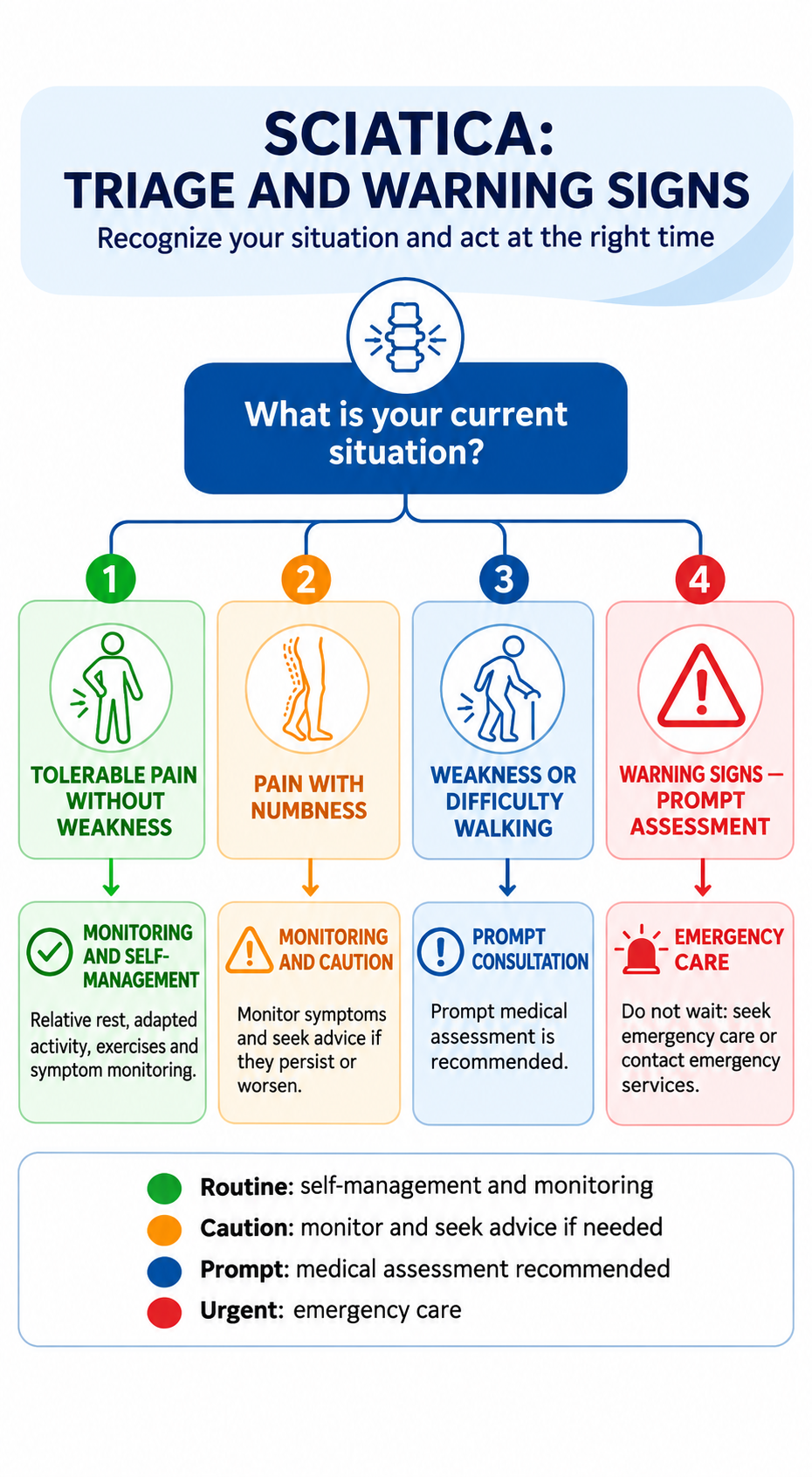
Explain when numbness, changes in your walking or a loss of strength first appeared. New or worsening weakness calls for prompt medical advice.
Summarize what you have already tried
Bring a list of treatments and medications you have tried, how long you used them, their effects and any available test results. Explain what improved your ability to function or made your symptoms worse.
How should you describe your symptoms to your clinician?
A concrete description is more useful than an assumed diagnosis
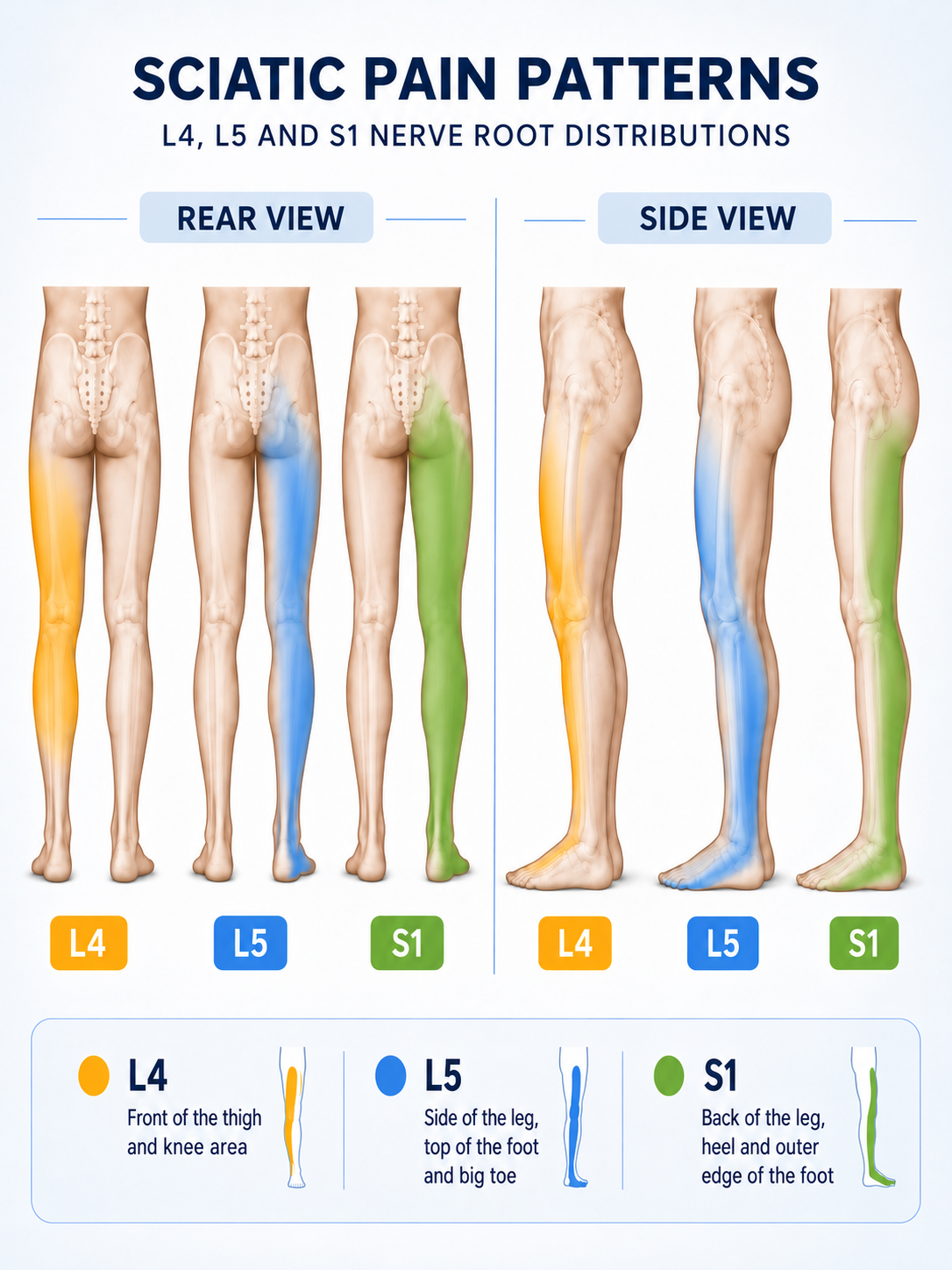
On a body diagram, mark the affected side, where your symptoms begin and the furthest point they reach. Distinguish pain, tingling and loss of sensation. Add an example of a limited activity, such as sitting, walking, driving or sleeping. The resources below provide useful terms for discussing your symptoms.
| Where you feel symptoms | Related resource |
|---|---|
| Buttock, back of the thigh, calf | Sciatic pain |
| Pain extending towards the big toe | L5-S1 / L4-L5 |
| Pain at the front of the thigh | Sciatica or femoral neuralgia? |
How can you prepare to discuss the cause of your sciatica?
If a diagnosis has been suggested or you already have an imaging report, bring it to your appointment. Ask how it affects your care in practical terms. This table suggests questions to ask; it cannot be used to interpret a test remotely.
| Term mentioned | Question to ask | Useful details to clarify |
|---|---|---|
| Lumbar disc herniation | How does this relate to my clinical examination? | Ask whether the side and spinal level described match your clinician’s observations. |
| Disc bulge, protrusion or disc space narrowing | What does this mean in my situation? | Clarify the practical implications for your activities and the options being considered. |
| Foraminal stenosis | What changes should I watch for? | Report changes in sensation, strength and how well you tolerate different positions. |
| Lumbar spinal stenosis | How should we assess my walking limitations? | Describe how far you can walk, the breaks you need and any changes in your independence. |
| Another diagnosis or an uncertain cause | What is the next useful step? | Ask whether medical advice, further testing or reassessment is indicated. |
Essential answers about sciatica
SOS Sciatique is organized as a resource centre: each page answers a specific question and guides you towards the next step.
Sciatica treatment
Understand the options, goals, limitations and situations that call for a consultation.
Sciatic pain
Recognize symptoms, pain patterns, neurological signs and symptoms that should not be dismissed.
Exercise: precautions depend on the cause
Before trying exercises, clarify the likely cause of your sciatica. A movement may be useful in one situation but aggravating in another, particularly when a herniated disc is involved.
Causes and assessment
Herniated discs, disc bulges, stenosis, nerve irritation and referred pain: understand the possible causes.
When should you seek care?
Warning signs, emergencies, persistent pain, weakness, numbness and unusual symptoms.
Specific situations
Chronic sciatica, pregnancy, recurring symptoms, sleeping positions, returning to walking and adapting activities.
Build a care plan and schedule its review
Before starting care, ask what problem the approach is intended to address, what benefits you can realistically expect and what limitations need to be considered. Discuss alternatives, costs and when you will review progress.
Work with your clinician to choose an observable goal, such as improving your ability to do an activity that matters to you. A plan should be adjusted according to progress, adverse effects or new symptoms.

| Option being discussed | Question to ask | Point to clarify |
|---|---|---|
| Individual biomechanical assessment | Which findings guide the care plan? | Ask what supports the proposed options and what would require a medical referral. |
| Motorized spinal decompression | Why consider this approach in my case? | Clarify uncertainties about benefits, contraindications, alternatives and criteria for stopping. |
| Targeted osteopathy | Which techniques will be used, and for what purpose? | Agree on tolerable limits and how to report a reaction after a session. |
| Precision percussion instrument | What role would this instrument have in the plan? | Ask how its usefulness will be assessed, without assuming that equipment guarantees a result. |
| Precautionary advice and activity modifications | How can I adapt the activities that matter to me? | Agree on practical adjustments and what to report at follow-up. |
Clinical practice guidelines do not recommend all clinic-based options in the same way. NICE NG59 advises against traction for low back pain with or without sciatica. Motorized decompression uses mechanical traction: its potential relevance and limitations should be discussed explicitly, without promises of a cure.
Sciatica exercises: first clarify the likely cause
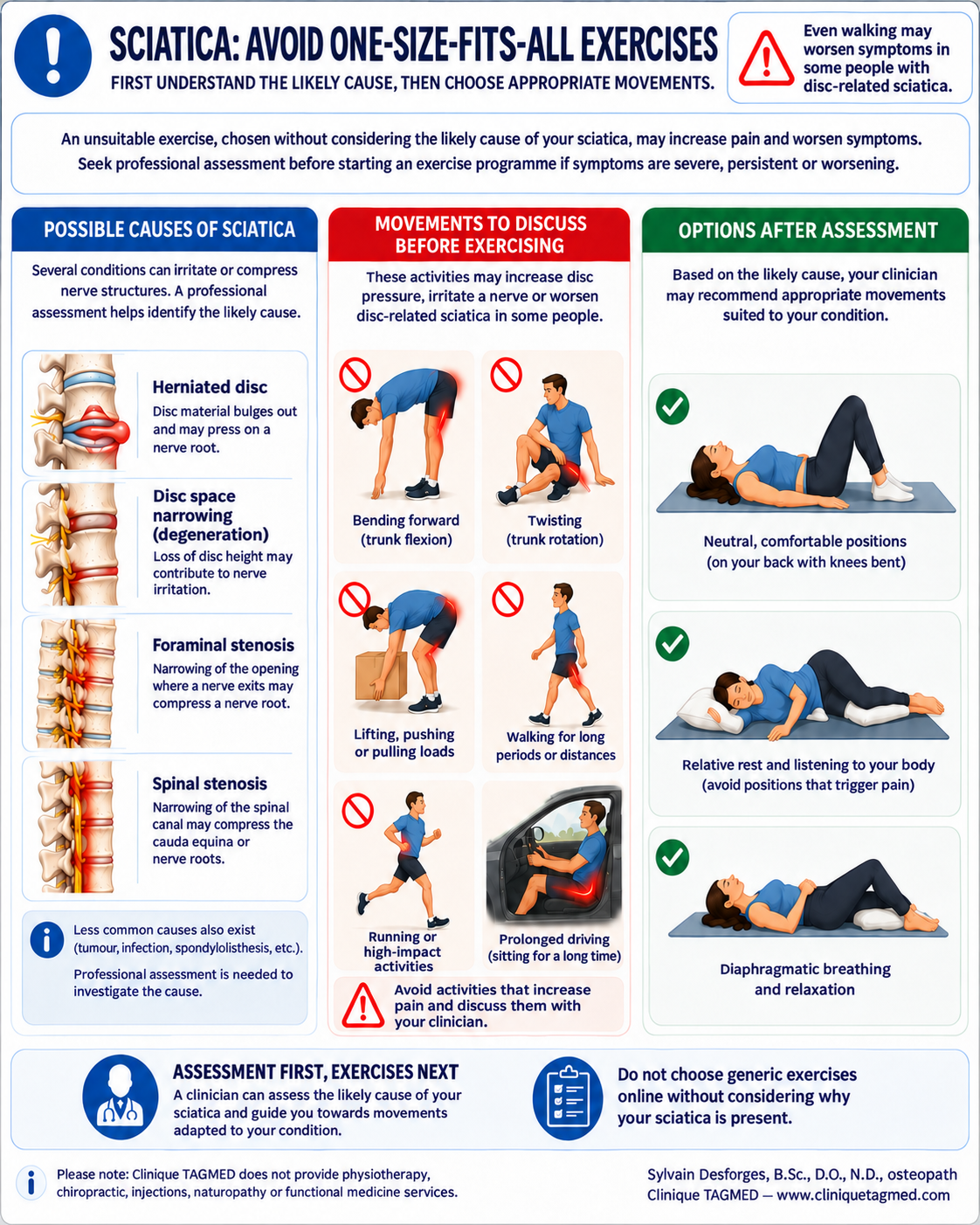
Before suggesting exercises for sciatic pain, it is essential to consider the likely cause of the symptoms. Sciatica may be associated with a herniated disc, disc bulge, stenosis, nerve root irritation, biomechanical overload or another source of referred pain.
A generic exercise may be poorly tolerated and can sometimes worsen symptoms, especially when pain is related to a herniated disc or nerve compression. Some movements may increase pressure on sensitive structures and cause pain to travel further down the leg.
Exercises should therefore be cautious, individualized and progressive movements, rather than a universal routine.
- Consider the likely cause of your sciatica before starting an exercise.
- Avoid movements that increase pain or cause it to travel further down the leg.
- Be cautious with repeated bending, twisting or aggressive stretching if a herniated disc is suspected.
- Watch for new or worsening numbness, loss of strength or difficulty walking.
- Seek an assessment before starting an exercise programme if pain is severe, persistent or recurrent.
Manage everyday activities between consultations
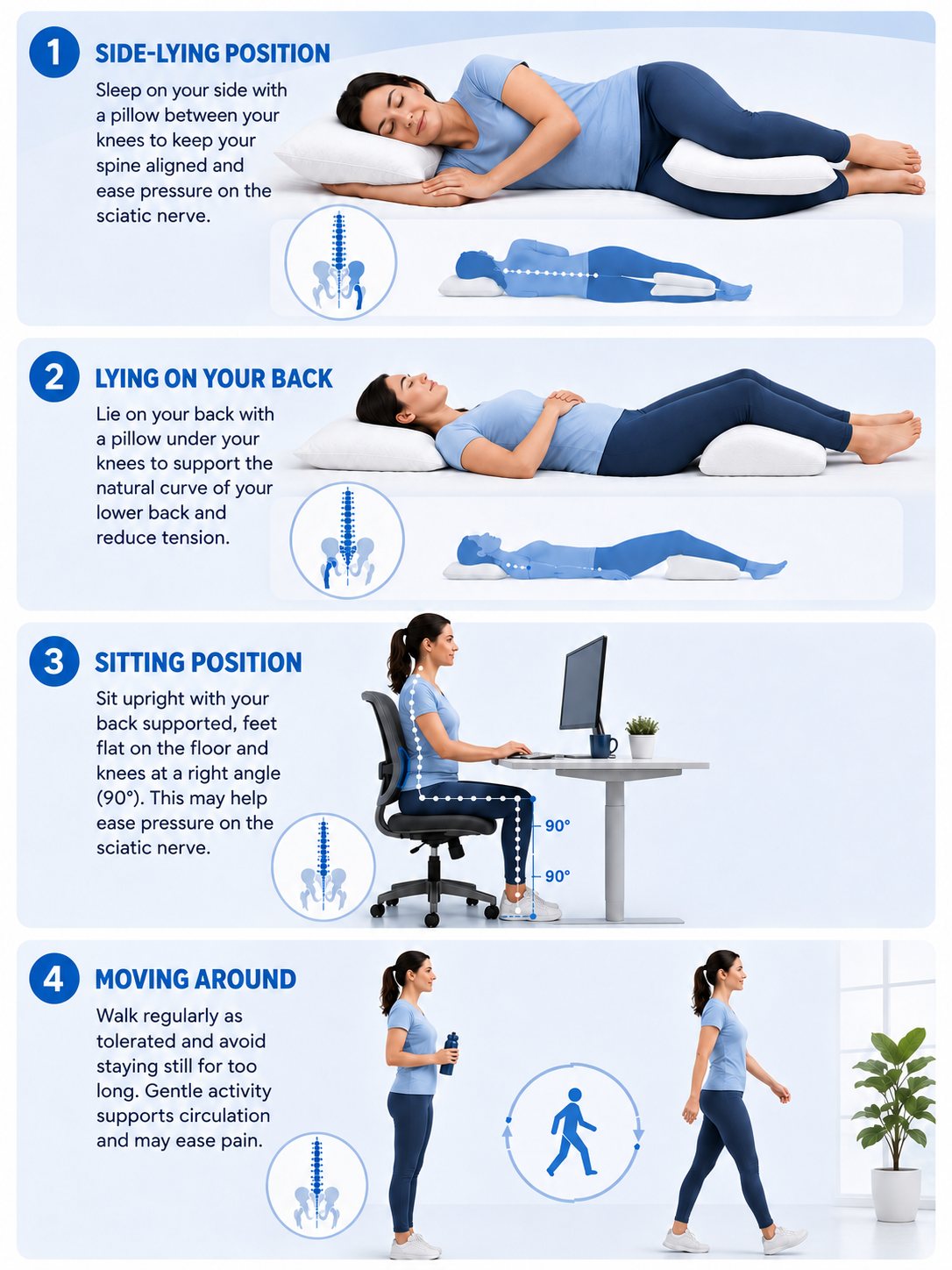
Identify the situations you find most difficult: driving, sitting at work, household tasks or interrupted sleep. Note how long you can tolerate them and what allows you to change position more comfortably. These examples can help you ask for specific adjustments.
Plan breaks and changes of position that suit your situation. The NHS encourages continuing normal activities as much as possible and avoiding prolonged inactivity. Ask how to adapt this advice if symptoms significantly limit your movements.
A clinic combining targeted osteopathy and advanced technology
Clinique TAGMED offers non-surgical, non-invasive care for spinal pain, joint pain, muscle pain and selected sports injuries.
For pain consistent with sciatica, an assessment helps determine whether an approach such as motorized spinal decompression, targeted osteopathy or precision percussion may be relevant. Medical laser and shockwave therapy are not used at Clinique TAGMED to treat back pain or sciatica.
Please note that Clinique TAGMED does not provide physiotherapy, chiropractic, injections, naturopathy or functional medicine services.
Clinique TAGMED Terrebonne
1150 rue Lévis, suite 200
Terrebonne, QC, J6W 5S6
Phone: 450-704-4447
Days: Monday, Wednesday and Friday
Clinique TAGMED Montréal / Mont-Royal
1140 avenue Beaumont
Mont-Royal, QC, H3P 3E5
Phone: 1-877-672-9060
Days: Tuesday and Thursday
Practical questions to prepare for your care
What should I write down before my first consultation?
Prepare a short timeline, a list of activities that are limited, the care you have already tried and your expectations. Note recent changes so you can describe them clearly.
Which documents should I bring to my appointment?
Bring available imaging reports and images, a list of your medications and a summary of previous care. Also mention your medical history and any unusual reactions to treatment.
Do I need an MRI before a consultation?
Not routinely. NICE recommends considering imaging in specialist settings when it is likely to change management. Your clinician will determine whether it is appropriate for your situation.
What should I ask about a proposed treatment?
Ask about its purpose, expected benefits, limitations, risks, alternatives and cost. Clarify the criteria for continuing, adapting or stopping the approach.
How can I set a useful goal for follow-up?
Choose an activity that matters to you, such as completing a journey, sleeping better or doing a usual task. Agree with your clinician on a simple way to track that ability.
What should I record between consultations?
Note the activities you do, how long they last, your tolerance and any effects after treatment. A brief record lets you compare days without relying only on a pain score.
What if new weakness appears between appointments?
Seek medical advice promptly rather than waiting for your next session. Significant or rapidly progressing weakness, new bladder or bowel problems, or loss of sensation in the saddle area require urgent assessment.
How should I report a reaction after a session or exercise?
Explain what you did, when the reaction began, how long it lasted and how it affected your activities. Contact your clinician to review the advice you received; if emergency warning signs are present, seek care without delay.
What should I ask if I am not making progress towards my goals?
Ask for a review of the plan and the reasons for the lack of progress. The discussion may include adjustments, another opinion or investigations when indicated; it should go beyond automatically repeating the same sessions.
Can I bring written questions?
Yes. Put them in order of priority and start with what affects your daily life most. Ask for explanations in different words or written instructions when that would make them easier to understand.
Why schedule a date to review progress?
This appointment allows you to compare results with the agreed goals, discuss reactions and check whether the plan remains appropriate. Clarify from the outset when this discussion will take place and which criteria will be used.
What should I check with my insurer before receiving care?
Check the covered professional category, benefit limits, required documents and reimbursement conditions. Clinique TAGMED services are not covered by the RAMQ; acceptance of an osteopathy receipt depends on your policy.
Prepare for your next discussion with Clinique TAGMED
Gather your observations, available test results and priority questions. A consultation provides an opportunity to discuss your situation, clarify the limitations of the proposed options and determine appropriate next steps.
Sylvain Desforges, B.Sc., D.O., N.D., Doctor of Osteopathy

Editorial information, sources and limitations
This content is intended to inform patients about sciatica, possible causes, warning signs, and care options. It does not replace an individualized assessment.
Reference sources
References are selected according to the subject of the page: guidelines, systematic reviews, then institutional resources.
- NICE NG59 – Low back pain and sciatica in over 16s — National guideline
- HAS – Management of patients with common low back pain — French national guideline
- Cochrane – Corticosteroid injections for treatment of sciatica — Systematic review
- NCBI Bookshelf – Sciatica — Clinical institutional resource
Complementary resources from the TAGMED network
These internal resources complement the clinical information and thematic linking. They do not replace national guidelines or systematic reviews.
Editorial note on decompression
Clinical resource from the TAGMED network; it does not replace national guidelines. Some guidelines use the term “traction” and recommend caution for low back pain with or without sciatica. Any decompression option should therefore be presented as an individualized clinical approach, with limitations, indications, and contraindications clearly explained.
Limitations of this information
The information on this page is general. It does not constitute a diagnosis, prescription, or guarantee of results. Pain radiating into the leg may have several causes; assessment should consider clinical history, examination findings, symptom progression, and, when appropriate, complementary tests.
When to seek urgent medical care
Seek urgent medical care if you experience loss of bladder or bowel control, saddle anesthesia, major or progressive leg weakness, unexplained fever, pain after significant trauma, or severe pain that rapidly worsens.
