Sciatica: Understanding the role of lumbar nerve roots
02/07/2026
Sciatica in Terrebonne: why the clinical evaluation always precedes the treatment
03/07/2026
In short In short, the sciatica In Montreal is a pain that can radiate from the lower back to the leg; Its effective management always starts with a Clinical evaluation specialized who identifies theorigin and the type of pain to avoid inappropriate treatments. The main advantages are Precise diagnosis, a personalized treatment plan and better coordination with the attending physician, reducing the risk of chronicity. How it works: From the first appointment, the professional performs neurodynamic tests and a functional evaluation, then designs an active and adapted program; theevaluation Systematically precedes any processing, which is particularly useful in Montreal for quick and coordinated management. |
In Montreal, when the Sciatica manifests itself, theClinical evaluation always precedes the treatment. This assessment is used to identify theorigin exact pain: irritation or compression of the sciatic nerve, most often linked to a slipped disc, but also to other causes such as piriformis syndrome or disorders sacroiliacs.
Without this diagnosis, generic treatments fail or aggravate the pain. From the first meeting, we make Neurodynamic tests and an assessment of mobility, in order to propose a Custom Plan including Active exercises, adapted manual techniques and a therapeutic education.
Thus, the preliminary assessment makes it possible to guide the therapeutic choices, to avoid Extended rest and the Unsuitable stretches, and quickly start a targeted approach to promote recovery and prevent recurrences.
This article, written by a health professional and expert, explains why, in Montreal, the clinical evaluation always precedes the treatment in case of sciatica. It demonstrates that only a precise diagnosis guides therapeutic choices, improves recovery and reduces the risk of recurrence. The key evaluation steps, warning signals and possible options are presented in specialized clinics in Montreal and its surroundings.
Key Elements of Clinical Evaluation
The first step is a targeted anamnesis. The doctor or health professional collects the exact location of the pain, its progression, the factors that aggravate or relieve it, and the relevant history. Then, a physical examination evaluates sensitivity, muscle strength and coordination, as well as mobility of the lumbar and pelvic segments. Simple neurodynamic tests can be performed to check for irritation or nerve compression. The differential diagnosis is crucial to differentiate a real sciatica from a cruralgia or a pseudo-sciatic syndrome linked to joint or musculotendinous problems.
The goal is to identify the exact cause and the aggravating factors in the patient’s lifestyle. This approach makes it possible to avoid inappropriate treatments and to refer to interventions compatible with the real diagnosis. To learn more about support mechanisms and options, see dedicated resources on specialized sites like Osteopathy and sciatic pain or neurovertebral decompression.
Why the evaluation precedes the treatment
A clear assessment prevents generic treatments that often fail. Improper care can prolong pain and decrease function. The evaluation makes it possible to target the exact source, to differentiate the causes and to propose a strategy that can be non-surgical or surgical as the case may be.

Sciatica in Montreal: heavy leg or painful leg?
IN BRIEF In brief, sciatica is pain that radiates along the sciatic nerve, starting from the lower back or buttock down to the leg. In Montreal, this service is particularly suitable for mechanical or postural sciatica and relies on a…
The role of treatments in Montreal after the evaluation
After a rigorous assessment, treatment options are discussed based on accurate diagnosis. In Montreal, the TagMed clinic offers treatments that follow the assessment and align with individual needs. These treatments may include a neurovertebral decompression Motorized when appropriate, targeted osteopathy and precision striker use for certain symptoms. Coordination with the attending physician is ensured, with reports structured after the session blocks to support prescription renewal decisions when necessary.
Resources complement the clinical approach. To understand the different perspectives on pain and treatment, you can explore information on areas like Sciatica and symptoms or Buttock pain and sciatica. Useful additional resources include Osteopathy – Full management and Precise diagnosis in sciatica.

Sciatica in Montreal: nighttime pain in the leg
IN BRIEF In brief, nocturnal sciatica is a root pain in the lower back that irritates the sciatic nerve and worsens when lying down, causing nighttime awakenings. In Montreal, this service offers a non-surgical approach focused on posture, bedding, and…
When to consult and what warning signs
Most sciatica does not require an emergency response. However, some signals require immediate medical evaluation and potentially emergency treatment. Consult without delay in the presence of anesthesia in the saddle (loss of sensation in the crotch), a disorder of urinary or intestinal control, a significant or progressive weakness of a limb, fever, recent trauma or intense back pain associated with neurological symptoms.
In practice, the evaluation always precedes the treatment. The patient is directed to the correct gateway according to the precise diagnosis. In most non-emergency cases, a consultation with the attending physician or directly with a specialized team can be considered on prescription and refundable according to local rules.

Sciatica in Montreal: pain from the lower back to the calf
IN BRIEF In brief, sciatica is a pain that starts in the lower back and can radiate down to the calf, caused by irritation or compression of the sciatic nerve. In Montreal, this service offers a personalized evaluation and non-surgical…
Additional references and resources
To deepen the framework of evaluation and non-invasive approaches when applicable, see the resources associated with neurovertebral decompression and osteopathic approach; Some pages address principles and options without proposing dangerous exercises for identifiable disc lesions. You can also view pain science-focused resources and therapeutic education approaches.
For more information on the options available in and around Montreal, visit the TagMed Clinic and the resources associated with Sosciatica and DecompressionEvertbrale as indicated below.
Tagmed Clinic – Montreal •
Osteopathy and sciatic pain •
neurovertebral decompression •
Burn in the leg •
Pain in the buttock •
Precise diagnosis •
Causes and diagnosis.
For more technical aspects and scientific insights, you can consult recognized training courses in the field, such as NUMSS or NAO, and refer to relevant professional associations such as ACMA, College of Canadian Osteopaths and College of Canadian Osteopaths according to needs.
Medical Disclaimer: The information and advice provided on this site does not replace the health professional’s diagnosis or treatment. Please note that Dr. Sylvain Desforges osteopath is neither a doctor of medicine nor a doctor, and is not a specialist in a medical specialty as defined by the Collège des Médecins du Québec. Manual medicine, functional medicine and sports medicine as described on this site exclude any medical treatment or diagnosis made by a doctor or specialist doctor. Always consult your doctor for any medical questions. For more details, please read our full legal notice. »
- Precise diagnosis : the evaluation identifies sciatica, cruralgia or pseudo-sciatica to guide the treatment.
- Determined origin : distinguish slipped disc, nerve compression or joint causes (hip, sacroiliac).
- Warning signals : identify the Medical Emergencies requiring quick support.
- Personalized route : Treatment plan adequate and appropriate prescription, in conjunction with the attending physician.
- Effects of diagnosis : the balance sheet guides the engagement, exercises and progression.
- Avoidance of traps : Do not favor prolonged rest or Inappropriate stretching in the acute phase.
- Coordination : communication between the patient, the doctor and the therapist for appropriate care.
- Autonomy and prevention : education and active program to prevent recurrences and maintain achievements.

Quick summary: In Montreal, the clinical evaluation always precedes the treatment of the sciatica In order to precisely identify the cause and adapt an active and personalized program. Without this diagnosis, therapeutic procedures may be unsuitable and ineffective. This approach, supported by international recommendations, favors movement, education and close coordination between the doctor and the therapist.

Sciatica in Montreal: hip pain or true nerve radiation?
IN BRIEF Sciatica is a nerve pain that follows the path of the sciatic nerve and can radiate from the buttock to the foot, which can be perceived as pain in the hip. Lower back pain, on the other hand,…
Why assessment is essential
The sciatica is not a single entity: it includes several mechanisms, including a herniated disc, nervous irritation or joint pain around the pelvis. A clinical evaluation makes it possible to distinguish these origins and to avoid applying a treatment that does not target the real problem.
Understanding key mechanisms
Knowing the precise origin immediately directs the choice of gestures: mobilizations, stabilization exercises, and appropriate physical activity advice. This precision avoids over-treatment and potential aggravations during the acute phase.

Sciatica pain in Montreal: incomplete journey, should we be concerned?
IN BRIEF In brief, sciatic pain is a lumbar nerve-origin pain whose pathway may be incomplete and may not reach the foot. In Montreal, the evaluation clarifies the pathway, strength, and function, and determines if imaging can change the approach.…
What an Effective Clinical Assessment Includes in Montreal
Balance sheet elements: an in-depth interview, followed by a structured physical examination. We are looking for neurodynamic signs (Lasègue test, slump test), lumbar and sacroiliac segments are assessed, and identifies aggravating lifestyle factors.
Differential diagnosis is essential. A distinction is made between sciatica of discal origin, cruralgia and syndromes imitating sciatica pain (for example localized joint or muscle pain). This sorting then guides the therapeutic plan and avoids unsuitable exercises that could aggravate the pain.
Practical elements of the first appointment
In practice, the evaluation aims to measure the degree of pain, the functional limitations and the potential risks, in order to establish a clear and personalized therapeutic path, adapted to your Montreal daily life.
Sciatica in Montreal: pain towards the little toe and S1 root
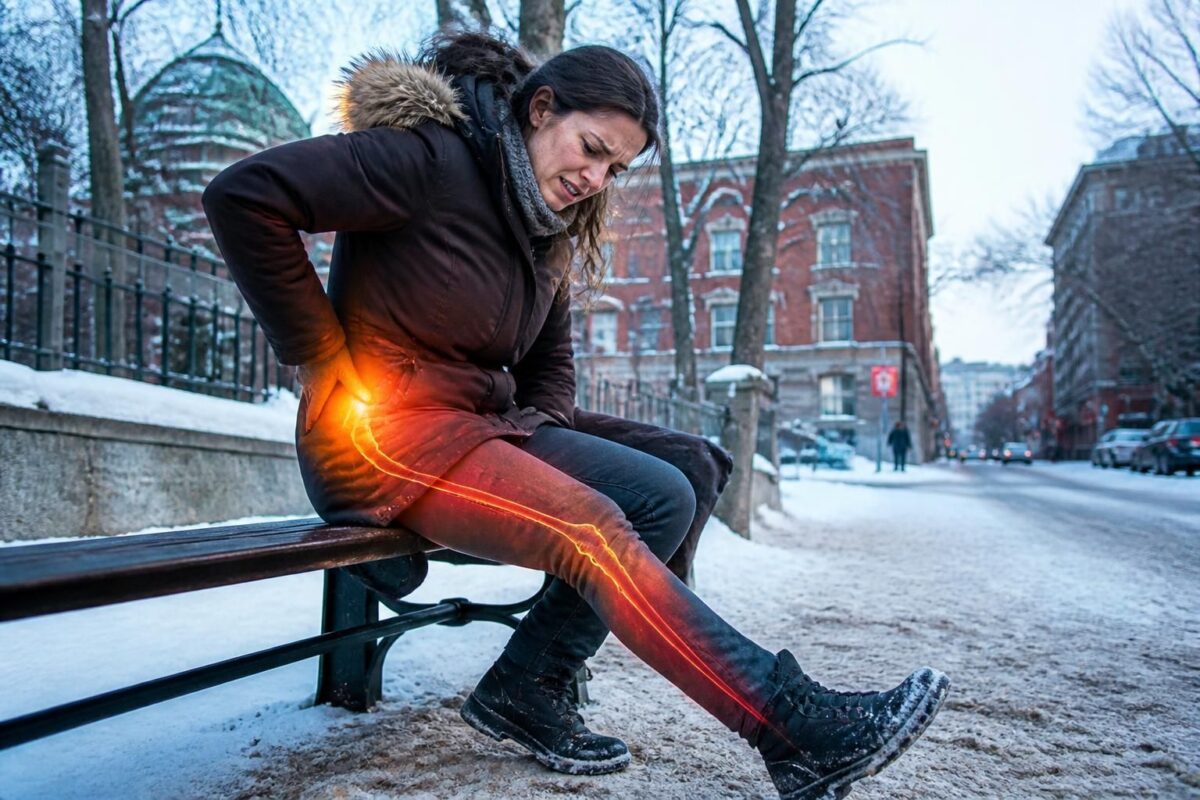
IN BRIEF Sciatica is pain radiating along the path of the sciatic nerve, typically from the lower back to the leg and down to the little toe when the S1 root is irritated or compressed. In Montreal, this phenomenon is…
The risks of treating without evaluation
Treating only on the basis of symptoms can prolong pain and delay recovery. Prolonged rest and unsuitable stretching, especially in the acute phase, can aggravate inflammation and lead to chronicity.
An inaccurate diagnosis can also lead to actions that do not help the underlying cause, delaying access to effective and personalized solutions. The clinical evaluation prevents these pitfalls by aligning the treatment with a specific reality.

Sciatica in Montreal: pain towards the top of the foot and L5 root
IN BRIEF Sciatica in Montreal with pain in the top of the foot and a possible involvement of the L5 root is a lumbar radiculopathy where the pain follows the path of the sciatic nerve to the dorsum of the…
The role of the patient and the team
In Montreal, success is based on active collaboration between the doctor, the physiotherapist and you. The evaluation triggers an active and progressive action plan, integrating targeted mobilizations, postural muscle strengthening and pain education and back protective movements.
Objectives of a coordinated approach
The goal is to make you autonomous while reducing recurrences: personalized program, regular follow-up and adjustments according to evolution, with clear communication between the professionals and you.

Sciatica in Montreal: pain radiating to the outer edge of the foot
IN BRIEF In brief, sciatica is pain that follows the path of the sciatic nerve, starting from the lower back and extending down to the foot, often radiating to the outer edge of the foot. In Montreal, this condition is…
Things to do now in Montreal
If pain radiating in the leg is present, first favor a complete clinical evaluation before starting generalized treatments. A well-targeted first consultation allows you to establish a plan adapted to your situation and to avoid the pitfalls of uniform approaches.
| etiology identified | The clinical evaluation specifies the origin of sciatica pain (discal hernia, sacroiliac joint dysfunction, piriform) and guides the choice of treatment. |
| Functional impact and risks of chronicization | The evaluation measures mobility, pain and the impact on activities to prevent chronicization and set appropriate goals. |
| testing and tools | The assessment combines neurodynamic tests and mobility assessment to guide the active program. |
| Treatment plan initial | We favor an active and personalized plan from the start, with gentle mobilizations and progressive reinforcement. |
| Coordination medical | The attending physician benefits from a clear report that supports the necessary follow-up and prescriptions. |
| Warning signals and orientation | Rapid detection of alert signals and referral to medical care if emergency symptoms appear. |
| Time limit and recovery | Early diagnosis and appropriate treatment reduce the risk of chronic pain and promote autonomy. |
| Prevention and recurrences | Prevention is based on targeted strengthening and education to limit recurrences. |
| Accessibility and support | A rapid clinical assessment allows effective management to be started without unnecessary delays. |
Montreal Testimonials: Why Clinical Evaluation Always Precedes Sciatica
In Montreal, more and more patients find that the success of a treatment for sciatica is first of all Complete clinical evaluation. Here are some feedback that illustrates this principle and how it transforms the therapeutic approach.
“When I started to feel pain radiating in the leg, I thought it all boiled down to stretching and a little rest. The team gave me a Detailed clinical report And identified the exact origin of my pain. Thanks to this precise diagnosis, they offered me a Personalized treatment plan which quickly targeted areas to be strengthened and movements to avoid. »
“My doctor directed me to a consultation in Montreal for sciatica. The first meeting was dedicated toevaluation : Neurodynamic tests, close analysis of movements and examination of aggravating factors in my daily life. Without this assessment, I would have lost weeks with inappropriate treatments. Today, the pain is managed and daily activities are gradually coming back. »
“I was convinced that the solution came from a single miracle exercise. The clinical evaluation proved me the opposite: each case of sciatic is played on different origins. By precisely identifying my cause (and not by applying a generic protocol), I was offered a progressive and personalized which avoided common errors and accelerated recovery. »
“As an active professional, I had no room for error. The Complete balance sheet Was the key: location, mobility and risk factors were scrutinized. The treatment was then thought out based on these data, with appropriate exercises and continuous supervision. Result: I returned to my activities without persistent pain. »
“It was not just about pain, but about understanding. The team took the time to explain the mechanism of sciatica after a Rigorous clinical evaluation, which allowed me to join the program and apply the advice on a daily basis. The follow-up and dialogue with the doctor remained constant, and that made all the difference. »
“After months of attempts without improvement, the precise diagnosis obtained during the evaluation directed the treatment towards targeted reinforcement exercises and adapted mobilizations. In a few weeks, I found mobility and a noticeable reduction in pain. All of this started with a crucial step: clinical evaluation before any treatment. »
If you suffer from sciatic in Montreal, favor a complete clinical evaluation before considering any treatment. This allows you to accurately diagnose the cause and develop a personalized plan that maximizes your chances of quick and lasting recovery.
Dr. Sylvain Desforges is a qualified osteopath whose expertise extends to osteopathy, naturopathy and manual medicine. Founding President of the TagMed and active clinics within the ACMA association, he combines a practice focused on health innovation with particular attention paid to the treatment of chronic spinal pain. His approach is fueled by a critical mind and commitment to evidence-based care to optimize the health and well-being of patients.
For him, the notion of Sciatica in Montreal cannot be limited to a single label. Each patient has a unique combination of mechanisms responsible for pain radiating along the leg, and a Clinical evaluation meticulous is essential to precisely identify the origin—whether disc, foraminal, muscular or joint. He makes sure to distinguish between the different tables that can mimic sciatica, such as cruralgia, pseudo-sciatic syndromes or joint irritations, in order to avoid inappropriate treatments that delay recovery.
The process begins at the first appointment with a Detailed anamnesis and a targeted physical exam. The doctor examines the sensory and motor signs, evaluates neurodynamic tests and analyzes the mobility of the spinal segments. This diagnostic approach makes it possible to develop a personalized plan rather than to apply a uniform protocol. In practice, this means that any treatment is preceded by a clinical assessment that guides therapeutic choices and avoids vain or inappropriate efforts.
In Montreal, Dr. Desforges combines manual techniques with technological tools to complete the assessment and support rehabilitation. After a Complete clinical evaluation, it favors active and individualized progression: controlled movements, lumbar stabilization exercises, reinforcement of deep postural plans and pain education strategies, in order to promote patient autonomy and prevent recurrences. Where necessary, targeted and safe interventions—such as complementary therapies—can be considered in addition to active work, always evidence-based and adapted to the present case.
Dr. Desforges’ philosophy is based on the principle that the best gateway to healing is a Accurate evaluation and appropriate therapeutic planning. By accurately identifying the origin of the pain and differentiating the mechanisms involved, it optimizes the chances of rapid and lasting recovery. This approach, which he applies in his Montreal clinics and associative activities, illustrates how a Clinical valuation and personalized management go far beyond standardized approaches for sciatica.
Consistent with his commitment to patient-centered medicine, he ensures that each stage of treatment is justified and documented, and that patients have the necessary tools to actively participate in their recovery. The objective is clear: to allow everyone to regain mobility, comfort and quality of life, while minimizing the risks of chronicity thanks to a rigorous clinical evaluation which precedes any treatment.
Quick Summary: For a sciatica at Montreal, theClinical evaluation always precedes the treatment. This step makes it possible to identify the origin (hernid disc, root irritation, joint problems), to distinguish cruralgia and pseudo-sciatica, and to point towards options non-surgical adapted while preventing chronicity. In practice, professionals favor active movement, neurodynamic tests and coordination with the attending physician to optimize recovery. Resources dedicated to Montreal guide the route, with specialized clinics and information guides.
A Clinical evaluation deepened is the cornerstone of any effective management of the sciatica at Montreal. Without this assessment, treatments are likely to be unsuitable, ignore a specific cause and expose to recurrent pain or chronicity. Evaluation enables to establish an accurate diagnosis and to design a personalized plan, combining exercises, mobilizations and education, possibly with options non-surgical.
The evaluation process includes a anamnesis, a targeted physical examination and Neurodynamic tests (Lasègue, Slump), an assessment of mobility and posture, and the identification of aggravating factors on a daily basis. This approach makes it possible to differentiate the sciatica of cruralgies And some Pseudosciatic syndromes, and to detect signs of medical emergency requiring rapid management. For simple cases, the evaluation refers to active treatments rather than passive therapies.
In Montreal, access to specialized professionals and structured programs facilitates support non-surgical effective. Local resources offer coordinated routes and options such as neurovertebral decompression or appropriate manual therapies. To learn more about the mechanisms and options available, see resources like TagMed Clinic – Treatment of Sciatica in Montreal and sciatica clinic. Other useful information can be found on SOS SCIATIC.
In practice, the objective is to allow you to quickly find your activities with a clear plan, adapted exercises and a coordinated follow-up with your doctor. Structured and supervised programs, focused on movement and reinforcement, optimize recovery and reduce the risk of recurrence, while avoiding invasive interventions where possible. To deepen the foundations of understanding the sciatica and access practical advice, you can consult educational resources available on the sites mentioned, including Physiosa – Understanding your sciatica and articles related to sciatica to montreal.

Dr Sylvain Desforges, B.Sc., D.O., N.D., osteopath, is the founding president of TAGMED and of the ACMA association. He dedicates his practice to chronic spinal pain, low back pain and symptoms compatible with sciatica, particularly when pain radiates toward the buttock, leg, calf, foot or toes.
Through SOS Sciatique, he publishes educational content on sciatica symptoms, possible causes such as disc herniation, disc narrowing, foraminal stenosis or irritation of a lumbar nerve root, as well as non-surgical approaches that may be considered according to the evaluation. At Clinique TAGMED, care may include, depending on the case, motorized neurovertebral decompression, specific osteopathic care or precision percussion.
For an evaluation related to sciatica treatment in Montreal / Mount Royal or sciatica treatment in Terrebonne, please consult the services available at Clinique TAGMED.
Medical disclaimer
The information published on SOS Sciatique is provided for educational purposes only and does not replace a consultation, diagnosis, opinion or treatment provided by a physician or another authorized healthcare professional. The author of this article is neither a medical doctor nor a specialist in a medical specialty recognized by the Collège des médecins du Québec. The osteopathic, manual medicine or functional support approaches described on this site do not constitute medical acts and are not intended to replace medical follow-up.
Consult a physician or emergency service in cases of loss of bladder or bowel control, anesthesia in the saddle area, significant or progressive weakness in the leg or foot, fever, recent trauma, severe pain or rapid worsening of symptoms. For more details, please read our Legal Notice.