
Sciatic pain in Montreal: what does pain down to the foot mean?
03/08/2026
Sciatica and nighttime pain: what should you watch out for?
03/08/2026
IN BRIEF
Definition: Sciatic pain down to the foot is pain that follows the path of the sciatic nerve, starting from the lower back and descending into the buttock, leg, and sometimes the foot. Benefits and applications: In Terrebonne, a conservative approach can provide quick and safe relief through professional assessment, tailored exercises, postural advice, and a gradual return to activities, without systematic recourse to surgery. How it works: the goal is to reduce irritation of the sciatic nerve, improve mobility, and prevent recurrences through a personalized plan including safe movements, targeted strengthening, and therapeutic follow-up. |
Sciatic pain down to the foot most often indicates irritation or compression of the roots of the sciatic nerve along its path. The sciatic nerve is the longest in the body and runs through the buttock, thigh, and extends down to the foot.
This phenomenon can be due to nerve irritation, disc compression, or other musculoskeletal disorders. When it reaches the foot, radiating pain reflects involvement of at least one branch of the nerve and may be accompanied by burning, tingling, numbness, or weakness.
- Typical symptoms: pain in the lower back or buttock that descends behind the thigh to the calf, ankle, or foot; electrical sensations, tingling, loss of sensitivity.
- Common causes: herniated disc, foraminal stenosis, radicular irritation, or other lumbar disorders.
- What pain down to the foot means: this may indicate lumbosciatica and warrants targeted assessment to adapt treatment.
- In Terrebonne: an assessment by a local physiotherapist or osteopath can offer you a tailored plan: safe exercises, manual therapy, postural advice, and neural mobilization, while promoting a gradual return to your activities.
- When to consult quickly: presence of loss of bowel/bladder control, significant weakness, or rapidly progressing pain.
Quick summary: Sciatic pain can descend from the lower back down to the foot. It reflects involvement of the sciatic nerve and may arise from nerve deployment or a mechanism at the lumbar or sacral level. In Terrebonne, an assessment by an experienced professional allows for identifying the cause and proposing suitable non-surgical options, prioritizing safety and a gradual return to activities. This article explains what pain down to the foot means, the signs to watch for, and local care options.
Understanding the Path of the Sciatic Nerve and What Pain Down to the Foot Means
The sciatic nerve is the largest nerve in the body. It originates from the lumbar and sacral roots, then descends through the buttock, behind the thigh, and splits around the knee to go towards the calf and foot. Sciatic pain typically follows this path and may manifest as localized pain in the lower back, in the buttock, then behind the thigh and down to the foot. Associated sensations can include burning, tingling, numbness, or muscle weakness. These symptoms often intensify with prolonged sitting or during efforts like coughing, sneezing, or bending. To understand the path and possible causes, you may refer to resources on the manifestations and journey of the sciatic nerve.
Possible Causes When Pain Radiates to the Foot
Pain that reaches the foot may be related to irritation or compression of a lumbar nerve root, particularly at the levels of L4 to S3, or an interface along the nerve’s path. Common causes include conditions such as a herniated disc, foraminal narrowing, or nerve irritation associated with painful lumbar. In some cases, the pain may be a sign of unilateral involvement affecting one leg, but bilateral pain or significant neurological signs require prompt medical evaluation. To delve deeper into the path and associated conditions, you can consult specialized resources on the subject.
Warning Signs and When to Consult
Watch for the following signs that require prompt evaluation:
- Severe and progressive pain that does not subside after a few days
- Significant weakness or numbness that compromises walking
- Loss of bowel or bladder control
- Sudden pain following trauma or significant injury
If in doubt, an evaluation with a professional in Terrebonne is recommended. Additional information on the path and presentation of pain can be consulted on resources dedicated to sciatic pain.
Management Approaches and Options in Terrebonne
In Terrebonne, non-surgical and tailored options may be considered within a multidisciplinary care framework. The use of osteopathic and manual approaches, combined with postural advice and a gradual return to activities, can be relevant based on the assessment. To access care at the TAGMED Clinic, you can refer to TAGMED Clinic. Online resources describe the journey and signs of evolution of sciatic pain and provide additional information on the mechanisms and management options.
Resources and Further Reading
To deepen understanding of the path and mechanisms of sciatic pain, consult dedicated resources on this topic at SOS Sciatique and other specialized pages. During a consultation, a professional can guide you to the most relevant information and adapt the therapeutic plan to your specific situation.
Thus, when pain radiates down to the foot, it is crucial to obtain an accurate assessment to determine the origin and appropriate treatment. In Terrebonne, patient-centered care focused on non-surgical options can be offered by specialists affiliated with TAGMED and other recognized facilities.
To learn more about detection, assessment, and treatment aspects, consult the following resources:
- Sciatic pain and loss of sensitivity – why consult
- Pain location – importance of location
- Pain in one leg – explanation
Note that the information provided here complements a clinical assessment and does not replace a medical diagnosis. For any medical questions, consult your doctor and the TAGMED team in Terrebonne.
Medical disclaimer: The information and advice provided on this site do not replace the advice, diagnosis, or treatment of a healthcare professional. Please note that Dr. Sylvain Desforges, osteopath, is neither a doctor of medicine nor a physician, and is not a specialist in a medical specialty as defined by the Collège des médecins du Québec. Manual medicine, functional medicine, and sports medicine as described on this site exclude any treatment or medical diagnosis made by a doctor or specialist. Always consult your physician for any medical questions. For more details, please read our full Legal Notice.
Analysis focus: location and clinical significance of radiation down to the foot, to guide essential actions.
- Sciatic nerve and pathway: pain starting from the lower back or buttock and descending to the foot.
- Significance: may reflect irritation or nerve compression at different lumbar levels.
- Associated symptoms: pain, burning, tingling, numbness, possible weakness in the leg.
- Aggravating factors: prolonged sitting, intense efforts, coughing/sneezing, sudden movements.
- Emergencies: loss of control, numbness in the genital area or marked weakness—consult quickly.
- First actions: stay active, avoid prolonged bed rest, walk briefly, favor gentle and safe movements.
- Treatment options: education, targeted exercises, neural mobilization, manual therapy, postural advice; rare surgery.
- When to consult: pain lasting > 4–6 weeks, or significant neurological signs require evaluation.
- Prevention: regular physical activity, appropriate strengthening and stretching, correct posture and good lifting technique.

The sciatic pain that extends down to the foot may signify irritation or compression of the roots of the sciatic nerve. This article provides a clear explanation, possible causes, assessment criteria, and treatment and exercise options to prioritize in Terrebonne for quick and safe relief.
What does pain reaching the foot mean?
The sciatic nerve is the longest and largest in the body. When its roots in the lower back become irritated or compressed, the pain can follow the nerve pathway and descend to the foot. This pain may be felt as a burning sensation, a stabbing pain, or an electric shock, and it may be accompanied by tingling, numbness, or weakness in the leg or foot. The fact that it reaches the foot often indicates nerve involvement that deserves an appropriate evaluation, even though it may persist or fluctuate depending on movements and positions.
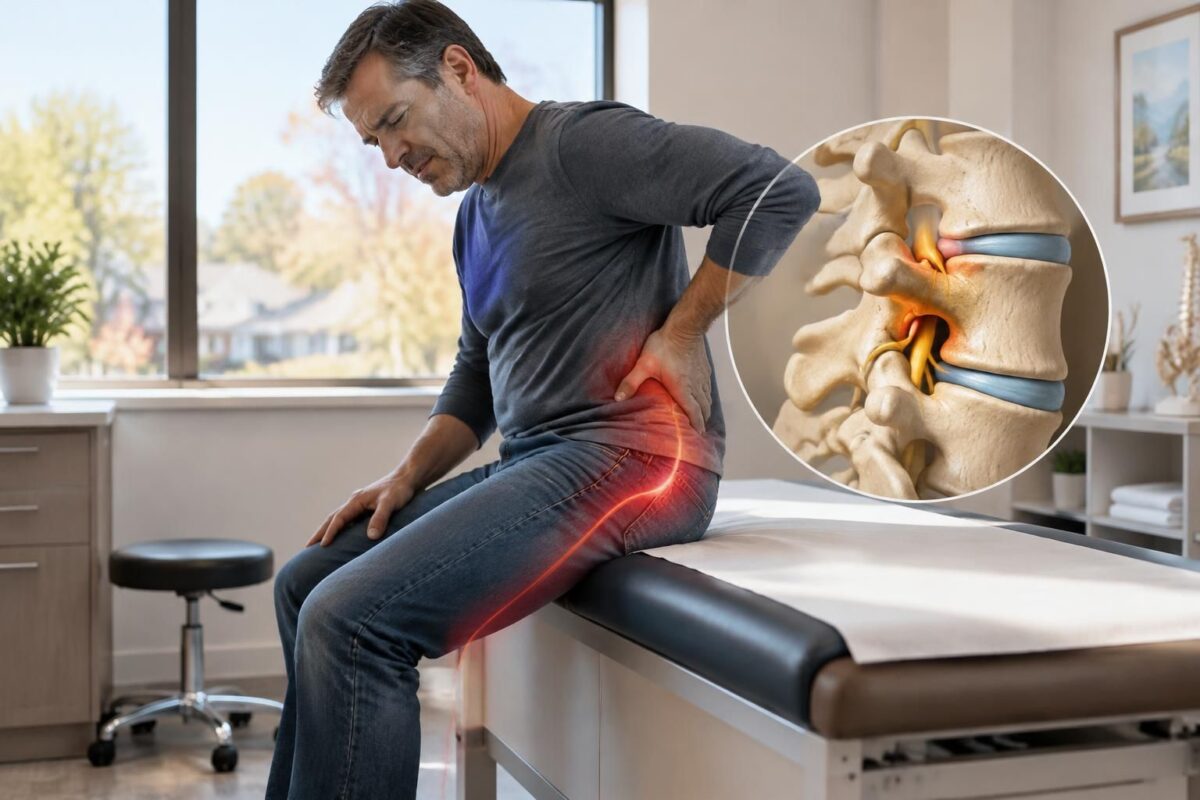
Sciatica in Terrebonne: understanding the L5-S1 foraminal compression
IN BRIEF The L5-S1 foraminal compression corresponds to a narrowing of the opening through which a nerve root passes, potentially contributing to sciatica. In Terrebonne, the assessment compares the side and course of the symptoms, neurological examination, imaging, and limited…

Sciatica in Terrebonne: why L5-S1 is often involved
IN BRIEF Sciatica corresponds to pain related to the irritation of a nerve root, which can extend from the buttock down to the leg. The L5-S1 level is often involved, as a disc herniation or irritation at this location can…
Common causes and warning signs
Common causes
The most common causes of pain descending to the foot include a herniated disc compressing a nerve root, foraminal pinching, or nerve irritation due to a repetitive position or movement. Conditions like spinal canal stenosis or irritations associated with lumbar osteoarthritis can also cause this type of radiating pain along the nerve.
Warning signs
Consult quickly if you experience marked weakness, significant numbness, loss of bowel or bladder control, or rapidly worsening pain. In the presence of these signs, urgent medical evaluation is recommended. In the absence of these signals, a gradual management approach with a professional remains the most effective way to determine the exact origin and tailor treatment.

Sciatica in Terrebonne: L5 and difficulty lifting the foot
IN SHORT The L5 sciatica can cause pain or numbness on the side of the leg, the top of the foot, and the big toe, sometimes with difficulty lifting the foot. In Terrebonne, an evaluation compares strength, sensitivity, reflexes, and…
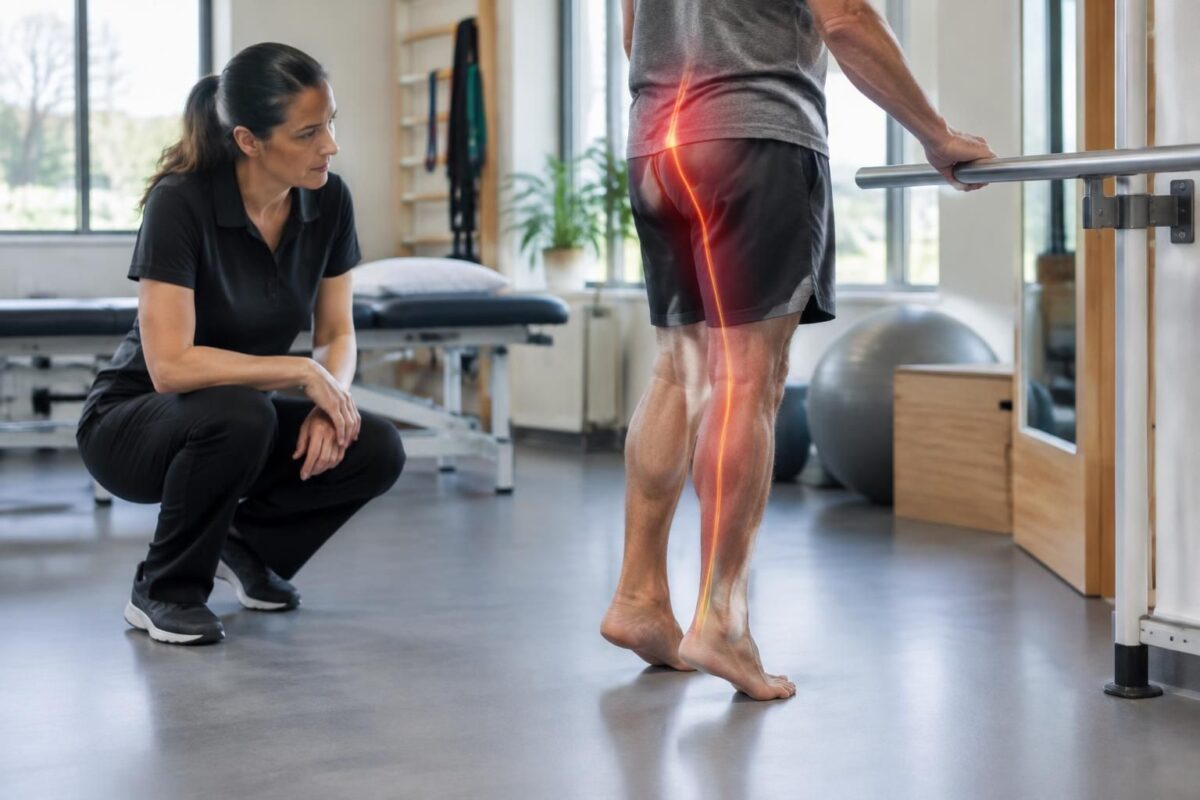
Sciatica in Terrebonne: S1 and difficulty standing on tiptoe
IN SHORT An S1 sciatica can irritate the nerve root associated with the calf and make it difficult to rise onto the balls of the feet. This sign should be evaluated with strength, sensitivity, reflexes, and walking: the pathway of…
Assessment and diagnosis in Terrebonne
In Terrebonne, a comprehensive assessment by a healthcare professional allows determination of whether the pain is of nerve, muscular, or disc origin. The clinical examination can check strength, reflexes, and sensitivity, while specific movements and neurological tests help locate the affected root. Depending on symptom evolution, additional examinations (imaging or nerve tests) may be considered to clarify the cause and guide treatment.

Sciatica in Terrebonne: L4-L5 and pain towards the top of the foot
IN BRIEF A L4-L5 sciatica can radiate to the outer side of the leg and the top of the foot, sometimes reaching the big toe. This pathway can guide the assessment, though it does not suffice to confirm the cause:…

Sciatica in Terrebonne: L5-S1 and symptoms in the calf
IN BRIEF A L5-S1 sciatica can cause pain that radiates down the calf, sometimes accompanied by tingling, numbness, or weakness. At Terrebonne, an assessment at the TAGMED Clinic helps to examine the symptom pathways, strength, and sensitivity, and then discuss…
Treatment options and safe exercises
Most episodes of sciatic pain reaching the foot are initially treated with a conservative and gradual approach. Stay active with suitable activities and avoid prolonged bed rest. Targeted exercises and gentle stretching can reduce irritation and improve mobility. Among useful options are:
Sciatic nerve mobility exercises and stretching of the gluteal and leg muscles tailored to your pain.
Progressive strengthening of the trunk and muscles around the pelvis to stabilize the spine and reduce tension on the discs.
Neural mobilization and manual therapy combined with postural advice and a gradual return to activities, under the supervision of a professional in Terrebonne.
In some cases, an osteopathic or manual approach can be useful as a complement to a personalized exercise program. If the pain persists despite these measures, a reassessment is indicated to adapt the treatment and explore other options, including non-surgical interventions followed by a professional.
| Aspect | Concise interpretation |
|---|---|
| Location and trajectory | Pain following the pathway of the sciatic nerve: lower back → buttock → back of the thigh → calf or foot. |
| Unilateralism | Most often unilateral; pain on both sides is possible but rare. |
| Clinical significance | Indicates irritation or compression of a lumbosacral root, typical of lumbosacral radiculopathy. |
| Warning signs | Marked weakness, genitourinary numbness, or urinary/intestine issues requiring rapid management. |
| Aggravating factors | Pain exacerbated by prolonged sitting, effort, or movement that stresses the back; avoid sudden movements. |
| Recommended evaluation | Complete clinical examination; imaging or electrodiagnostic tests if pain persists or neurological symptoms appear. |
| Conservative approaches | Stay active, targeted exercises, moderate stretching, neural mobilization, and gradual return to activities. |
| Imaging | Imaging recommended if pain persists beyond 6 weeks or warning signs appear. |
| Medical emergency | Loss of bowel/bladder control, significant weakness, or rapid and severe pain: emergency consultation. |
In Terrebonne, I noticed that sciatic pain that goes down to the foot can be a sign of irritation or compression of a nerve root of the sciatic nerve. This pathway to the foot is not trivial and deserves an appropriate evaluation to understand the origin and avoid complications.
For many, the pain following the path of the sciatic nerve all the way to the foot may suggest a lumbosacral radiculopathy or more pronounced nerve irritation. In Terrebonne, a professional assessment helps confirm the source and propose suitable solutions without the obligation of surgery.
It is essential to differentiate localized back pain from sciatic pain that reaches the foot. In our Terrebonne clinic, a comprehensive evaluation helps identify the factors that irritate the sciatic nerve and offer personalized exercises and postural advice.
With the support of a practitioner in Terrebonne, it is often observed that intervention does not only involve surgery: osteopathy and targeted exercises can soothe sciatic pain extending to the foot without resorting to an operation, and this in a gradual manner.
Today, well-applied mobility exercises and posture advice reduce the pain that reaches the foot and the tingling. If you live in Terrebonne and your sciatic pain extends to the foot, this plan can help you quickly regain your activities and peace of mind.
Dr. Sylvain Desforges, expert in osteopathy, naturopathy, and manual medicine, is the founding president of the TAGMED clinics and the ACMA association. His journey, shaped by a constant curiosity for innovation in healthcare, has led him to develop a practice focused on the management of chronic pain and the integration of advanced technologies. As part of a multidisciplinary approach, he applies tools such as motorized neuro-vertebral decompression, laser, and shock wave therapy to provide concrete and personalized solutions to his patients. In the Terrebonne area, he supports those suffering from sciatica and lower back pain, prioritizing a safe and evidence-based approach. His goal: to improve quality of life and allow everyone to resume their daily activities with confidence.
The term sciatic pain refers to pain that follows the path of the sciatic nerve, the largest nerve in the body, which originates at the lumbar and sacral roots (mainly from L4 to S3). This nerve travels through the buttock, runs behind the thigh, and branches around the knee to supply the leg and foot. When it is present all the way to the foot, the pain reflects irritation or compression of the nerve roots along this path, which requires a precise evaluation to determine the origin and adapt the treatment. In physiotherapy, the goal is to distinguish nerve irritation from more pronounced compression or another musculoskeletal disorder to target therapeutic actions.
In practice, Dr. Desforges conducts a thorough evaluation to determine if the pain originates from nerve irritation, compression, or another problem. Treatment is initially considered within a conservative framework, combining appropriate exercises, targeted stretching, neural mobilization, and manual therapy techniques. The aim is to reduce nerve irritation, improve mobility, and facilitate a gradual return to activities. The technologies he uses fit into this framework to optimize results and accelerate recovery while remaining focused on the patient’s symptoms and abilities.
For patients in Terrebonne, the plan may include postural advice, a gradual return to activities, and regular follow-ups to prevent recurrences. In cases where pain persists despite conservative measures, advanced options may be considered, always after evaluation and discussion of risks and benefits. Surgery is only considered in rare and serious situations when non-surgical treatments are insufficient and there are significant neurological signs. The use of therapeutic massage and associated therapies may be integrated as a complement, to reduce muscle tension and facilitate stretching, as part of a comprehensive plan.
As a dedicated health professional, Dr. Desforges is committed to providing evidence-based care to optimize the health and well-being of his patients. His approach, focused on innovation and the integration of effective technologies, allows for a holistic and personalized treatment of sciatic pain. For residents of Terrebonne seeking a clear explanation and pragmatic solutions for pain extending to the foot, his method offers visible and lasting results through a collaboration between osteopathy, manual medicine, and complementary therapies.
Sciatic pain extending to the foot may indicate irritation or compression of the sciatic nerve roots and reflect lumbar sciatica. In Terrebonne, a professional assessment allows for estimating the origin, evaluating strength and reflexes, and proposing a personalized plan to quickly relieve pain and facilitate a return to your activities.
Pain typically follows the path of the sciatic nerve: it may start in the lower back or in the buttock and descend along the back of the thigh to the calf, sometimes reaching the foot. When pain reaches the foot, this often indicates a more significant irritation or compression of the lumbosacral roots (for example, segments L5 to S1). To understand this pathway and its mechanisms, you can consult dedicated resources such as sciatic pain and foot and the general explanations available on Sciatica – MSD Manuals.
Several factors can explain pain that radiates to the foot: a herniated disc, a pinch or foraminal stenosis, irritation of the nerve roots, or associated muscle tension. A comprehensive assessment allows for distinguishing simple muscle pain from nerve damage, and determining whether further examinations are necessary. To better understand the pathway of the pain and the accompanying signs, refer to local and specialized resources such as understanding the pathway of pain and assessment of pain, strength, and reflexes.
The diagnosis relies on a careful clinical examination that checks muscle strength and reflexes, and may include imaging or neuro-muscular studies if necessary. Complementary resources show that imaging does not always explain pain on its own and may be requested based on the evolution of symptoms (When imaging is not enough). For general information on causes, symptoms, and treatments, you can consult Sciatica – Tops Santé and Sciatica – Médecin Direct.
In Terrebonne, conservative approaches are the first line of treatment. This includes staying active within the limits of pain, adapting daily activities, performing targeted exercises, and receiving postural advice and neural mobility techniques. Use of physiotherapy or manual therapy can accelerate healing and reduce inflammation around the nerves. Surgery is only considered exceptionally when non-surgical treatments are insufficient or when major neurological signs are present. Local resources describe these options and the specific evaluation framework in Terrebonne (pain aggravated when standing and foraminal compression).
To quickly alleviate discomfort, engaging in moderate and regular activity, adopting an adequate posture, and following a suitable exercise program is often effective. Simple techniques such as progressive movement and gentle stretching, under professional supervision, can help reduce irritation and improve mobility. Online resources emphasize the importance of not forcing when stretching and focusing on activities that relieve pain without increasing symptoms (Symptoms and duration – Sciatica).
If you are looking for additional information on pain pathways and practical advice tailored to Terrebonne, you can consult the following pages: pain pathway in Terrebonne, pain extending to the foot – Montreal, and more general resources such as Sciatica – MSD Manuals.
To enrich your understanding and access advice suited to your situation, here are some useful readings: sciatic pain and foot, lumbar twists and sciatic pain, and foraminal compression.
For any specialized assessment in Terrebonne, do not hesitate to request a consultation that includes the evaluation of pain, strength, and reflexes, in order to determine the most appropriate and rapid plan for you. Dedicated resources in Terrebonne describe this evaluation framework and the next steps to be taken.

Sciatica in Terrebonne: pain in the big toe, L5 root or another cause?
IN BRIEF Pain in the big toe accompanied by pain in the buttock or leg may be compatible with irritation of the L5 root, but other causes are possible. In Terrebonne, the evaluation notably compares strength, sensitivity, and gait to…

Sciatica in Terrebonne: why the affected root changes the pain path
IN BRIEF Sciatica is a pain related to the irritation of a lumbar nerve root, the path of which varies depending on the affected root. Damage to L5 can radiate to the top of the foot, while damage to S1…

Dr Sylvain Desforges, B.Sc., D.O., N.D., osteopath, is the founding president of TAGMED and of the ACMA association. He dedicates his practice to chronic spinal pain, low back pain and symptoms compatible with sciatica, particularly when pain radiates toward the buttock, leg, calf, foot or toes.
Through SOS Sciatique, he publishes educational content on sciatica symptoms, possible causes such as disc herniation, disc narrowing, foraminal stenosis or irritation of a lumbar nerve root, as well as non-surgical approaches that may be considered according to the evaluation. At Clinique TAGMED, care may include, depending on the case, motorized neurovertebral decompression, specific osteopathic care or precision percussion.
For an evaluation related to sciatica treatment in Montreal / Mount Royal or sciatica treatment in Terrebonne, please consult the services available at Clinique TAGMED.
Medical disclaimer
The information published on SOS Sciatique is provided for educational purposes only and does not replace a consultation, diagnosis, opinion or treatment provided by a physician or another authorized healthcare professional. The author of this article is neither a medical doctor nor a specialist in a medical specialty recognized by the Collège des médecins du Québec. The osteopathic, manual medicine or functional support approaches described on this site do not constitute medical acts and are not intended to replace medical follow-up.
Consult a physician or emergency service in cases of loss of bladder or bowel control, anesthesia in the saddle area, significant or progressive weakness in the leg or foot, fever, recent trauma, severe pain or rapid worsening of symptoms. For more details, please read our Legal Notice.