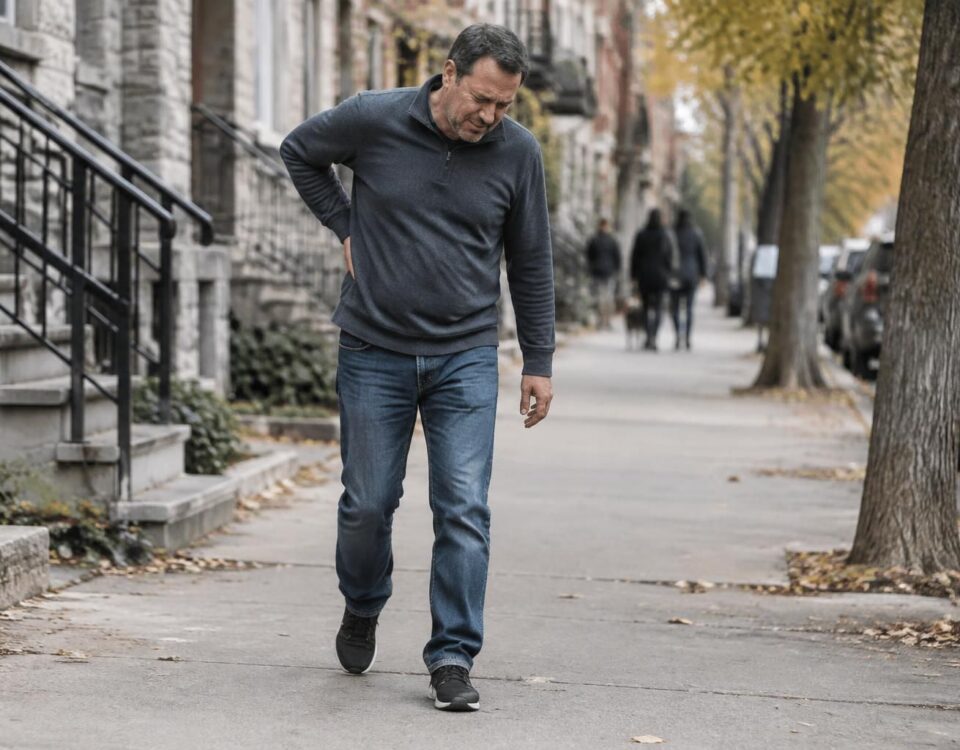
Sciatica and fast walking: why stay cautious
18/09/2026
Sciatica in Terrebonne: burning pain behind the thigh
19/09/2026
IN BRIEF
| Sciatica is a pain that starts from the lower back or buttock and radiates down the back of the thigh, sometimes to the calf or foot, described as a burning sensation or electric shock. In Montreal, an osteopathic approach offers a comprehensive assessment to identify the sources (sciatic nerve, piriformis, hamstrings) and a non-surgical plan aimed at reducing pain and improving mobility. The treatment adapts to your lifestyle and includes advice and targeted exercises, helping to prevent recurrences and facilitate a return to activity. |
In Montreal, sciatica typically manifests as a burning pain that starts from the lower back or buttock and travels along the thigh to the calf, sometimes as far as the foot. This pain can be of neurological origin (irritation or compression of the sciatic nerve, often related to a herniated disc) or muscular origin (localized pain behind the thigh at the level of the hamstrings), and both types can coexist. The diagnosis and non-surgical treatment in Montreal rely on targeted assessment and may include exercises and physiotherapy to improve mobility and reduce pain. Consult for a personalized management plan.
The burning pain behind the thigh may come from a sciatic episode or a muscular problem with the hamstrings. In Montreal, an osteopathic approach offers precise assessment and targeted care at the TAGMED Clinic, without systematically resorting to surgery. This article clarifies the possible causes, distinctive signs, diagnosis, and options available in this context.
Possible Origins
Sciatica is a nerve-related pain. It manifests as a burning sensation or electric shock that starts from the lower back or buttock and travels up the thigh to the calf or foot. This pain is often unilateral and can worsen with prolonged sitting, coughing, or leaning forward. A common cause is a lumbar disc herniation that compresses a nerve root.
The piriformis syndrome is another possible cause. The piriformis muscle can compress the sciatic nerve as it exits the pelvis. In this case, the pain is primarily in the buttock and sometimes radiates down the back of the thigh, worsening with external hip rotation or prolonged sitting.
The hamstrings can also be the source of less far-reaching pain. A strain or tear may cause sudden, intense pain in the back of the thigh. A biceps femoris tendinitis may present as progressive pain near the pelvis or knee, especially in runners. The proximal hamstrings syndrome can cause pain at the ischial tuberosity, felt while sitting and running, sometimes confused with sciatica.
Typical Signs and Symptoms
Sciatica often manifests as pain that descends along the leg. This pain can be accompanied by burning, tingling, or numbness. It may also come with mild weakness or discomfort during certain movements of the back or hip. Muscle pain in the hamstrings is primarily located in the muscle belly and worsens with effort, without necessarily descending to the foot. If in doubt, consider medical evaluation and imaging if necessary.
Diagnosis and Evaluation
The osteopathic assessment aims to identify mobility restrictions and interactions between the back, pelvis, and hips. Clinical tests may help distinguish between a muscular origin and a nerve-related origin. In cases of diagnostic doubt or suspicion of complete tear, medical imaging may be indicated, particularly lumbar MRI and/or hip MRI.
Treatment Options at TAGMED
At the TAGMED Clinic, patients benefit from a tailored osteopathic approach. Treatment may aim to improve the mobility of the lumbar spine, pelvis, and hips, and to reduce pain through targeted manual techniques and correction of mobility deficits. Care may include, depending on the case, motorized neurovertebral decompressions and other non-surgical modalities. Protocols are individualized and evolve based on the assessment.
For those participating in sports activities, an analysis of gait function or running mechanics may be considered as part of a comprehensive management plan in Montreal or Terrebonne.
When to Consult Quickly
Consult promptly in case of loss of urinary or bowel control, extremely severe pain after trauma, fever, or rapid aggravation of symptoms. Significant neurological signs or pain that persists despite treatment may require additional medical evaluation.
Resources and Useful Links
For further reading, you can consult dedicated resources on sciatica and its manifestations:
Sciatica in Montreal — electric sensation in the calf
Sciatica in Terrebonne — heavy or painful leg
Nerve irradiation — pain in the hip
Sciatic pain — Synapsia Osteopathy
Understanding sciatic nerve pain
Difficulty sitting and sciatic pain
Comparative Table of Approaches
| Therapy | Effect on Pain | Notes |
|---|---|---|
| Physiotherapy | Variable results depending on the cases | Often effective for rehabilitation but may be slower than other approaches depending on the diagnosis. |
| Osteopathy at TAGMED | Possible overall improvement in movements and pain | Non-surgical approach tailored to each patient. Prioritize initial evaluation and follow-up at TAGMED. |
| Neurovertebral Decompression (if indicated) | Specialized approach with no prescription for general exercises here | Detailed evaluation required; discussion with the practitioner before any implementation. |
Links to additional resources on sciatica and its manifestations include specialized sources in the field. For more information, visit sossciatique.com and cliniquetagmed.com.
Medical disclaimer: The information and advice provided on this site do not replace the opinion, diagnosis, or treatment of a healthcare professional. Please note that Dr. Sylvain Desforges, osteopath, is neither a doctor of medicine nor a physician and is not a specialist in a medical specialty as defined by the Collège des médecins du Québec. Manual medicine, functional medicine, and sports medicine as described on this site do not include any medical treatments or diagnoses made by a physician or specialist doctor. Always consult your doctor for any medical questions. For more details, please read our full Legal Notice.
- Sciatica: key characteristics: burning pain following the path of the nerve (lower back → buttock → thigh → calf/foot); unilateral pain; worsened by prolonged sitting, coughing, or sneezing.
- Possible origins: lumbar disc herniation or piriformis syndrome.
- Red flag signs: significant weakness in one leg, loss of sensation, loss of bladder or bowel control, fever.
- Assessment and referral: quick consultation with a physiotherapist or osteopath; MRI if diagnostic doubt or suspicion of rupture.
- Initial management: acute phase – temporary rest, icing 15–20 minutes several times a day; light compression; avoid NSAIDs within 48 hours.
- Rehabilitation: eccentric hamstring exercises; hip/pelvis strengthening; postural correction and gait analysis if a runner.
- Heat vs cold: cold for acute phase (24–48 h); heat afterward to promote vascularization and flexibility; heat can also help with sciatica pain.

Quick summary: In the face of burning pain behind the thigh in Montreal, it is important to distinguish sciatica from pain related to the hamstrings and to adopt appropriate, non-surgical management when possible. This article guides you to recognize the signs, direct your approach towards effective strategies, and organize a realistic action plan, with advice tailored to local practice and return to activity.
Understanding Sciatica-Type Pain Behind the Thigh
Sciatica often manifests as a burning sensation or electric shock that starts from the lower back or buttock and descends along the back of the thigh, into the calf and sometimes into the foot. It may be unilateral and worsen with prolonged sitting, coughing, or bending forward. The most common cause is a lumbar disc herniation compressing a nerve root. Piriformis syndrome can also cause pain radiating in the thigh by compressing the sciatic nerve near the pelvis. Additionally, muscle pain related to the hamstrings can mimic sciatica, making assessment key.
Sciatica in Montreal: L5 and difficulty lifting the foot
IN BRIEF The difficulty in lifting the foot with sciatica can indicate weakness related to the involvement of the L5 root, sometimes caused by a herniated disc. This foot drop increases the risk of falling and requires prompt medical evaluation;…

Sciatica in Montreal: S1 and difficulty rising up on the toes
IN BRIEF S1 sciatica can cause pain from the buttock to the calf and foot, as well as difficulty getting on tiptoe. This weakness may suggest irritation of the S1 nerve root, but is not sufficient to establish a diagnosis.…
Signs Indicating Nerve Pain vs. Muscle Pain
Nerve-related pain follows the path of the sciatic nerve: lower back or buttock towards the back of the thigh and sometimes down to the foot, accompanied by burning, tingling, or numbness. It is typically aggravated by sitting, coughing, or bending. In contrast, muscle pain in the hamstrings is localized at the back of the thigh, occurs during effort or stretching, and does not necessarily radiate to the foot. These distinctions help guide diagnosis and treatment.

Sciatica in Montreal: L4-L5 and pain towards the top of the foot
IN BRIEF The sciatica related to L4-L5 can radiate from the lower back to the buttock and the leg; pain on the top of the foot may suggest involvement of the L5 root, but the pathways vary and symptoms overlap.…

Sciatica in Montreal: pain in the big toe, L5 root or another cause?
IN BRIEF Pain that radiates toward the big toe may indicate irritation of the L5 root, sometimes related to a herniated disc, but other causes are possible. In Montreal, evaluating the pain pathway, strength, sensitivity, and walking helps guide management…
Recommended Non-Surgical Approaches in Montreal
Relevant Interventions and Therapies
An osteopathic or physiotherapeutic evaluation can help identify mobility restrictions of the pelvis, hips, and lumbar spine, as well as tensions in the hamstrings and the sciatic nerve. Treatment may combine relaxation techniques, targeted exercises, and adjustments in posture or gait, adapted to the specific diagnosis and your local reality in Montreal.
Exercises and Self-Management
In the acute phase, prioritize relative rest and appropriate symptomatic measures (heat or cold depending on the phase, avoiding movements that worsen the pain). After this period, incorporate eccentric hamstring strengthening, targeted stretching, and mobility work on the pelvis and hip. The goal is to improve lumbar stability and gait while reducing painful episodes and recurrences.

Sciatica in Montreal: why the affected root changes the pain pathway
IN BRIEF Sciatica refers to pain or nerve symptoms that vary depending on the affected lumbar root. Pain, tingling, or numbness may manifest in the buttock, thigh, calf, or foot. Understanding this distribution helps guide the assessment, without diagnosing based…

Sciatica in Montreal: L4-L5 disc, L5-S1 disc, and leg pain
IN BRIEF Sciatica refers to pain that can radiate from the lower back or buttock down the leg, sometimes related to nerve irritation near the L4-L5 or L5-S1 discs. The level of the disc alone is not sufficient to identify…
When to Consider Imaging and Medical Consultation
If symptoms persist beyond 4 to 6 weeks despite conservative measures, or if warning signs appear (marked weakness, loss of sensitivity, loss of bowel or bladder control, fever, recent trauma), a medical evaluation and imaging tests may be recommended to clarify the diagnosis and guide non-surgical therapeutic options.
| Element | Description |
|---|---|
| Origin | Pain can be of neurological origin (sciatica) or muscular (hamstring); sciatica radiates to the foot, while a muscle strain remains localized in the thigh. |
| Typical symptoms | Sciatica: burning or shock radiating from the lower back to the leg; worsening when sitting or coughing. Hamstrings: localized pain without distal irradiation. |
| Location | Pain behind the thigh, from the buttock to the back of the knee; possible irradiation if of nerve origin. |
| Triggers | Intense sport, sprinting, forced stretching for hamstrings; prolonged sitting or effort for sciatica. |
| Recommended tests | Clinical evaluation and, if doubts persist, lumbar MRI to differentiate between sciatica and muscle problems. |
| Initial management | Relative rest, ice for 15-20 minutes, light compression; avoid NSAIDs within 48 hours depending on the context. |
| Rehabilitation | Physiotherapy with progressive stretching and eccentric strengthening of the hamstrings; correction of hip/pelvis mobility and gait if running. |
| When to consult | Loss of bowel/bladder control, marked weakness in one leg, fever, post-traumatic pain, rapidly worsening pain. |
| Resources in Montreal | Local osteopathic or physiotherapeutic evaluation for sciatica, commonly practiced in Montreal and surrounding areas. |

Sciatica in Montreal: understanding the lumbar levels on an MRI
IN BRIEF A lumbar MRI shows the levels of the spine, such as L4-L5 and L5-S1, where a narrowing or herniation may sometimes be associated with sciatica. In Montreal, understanding these images along with the pain pathway, walking, and neurological…

Sciatica L4-L5 in Montreal: Possible pain, numbness, and weakness
IN BRIEF The L4-L5 sciatica refers to irritation of a lumbar nerve root that can cause pain radiating down the leg, tingling, or weakness. In Montreal, an evaluation allows for examining the symptoms and guiding the treatment based on their…
Sciatica Testimonials in Montreal: burning pain behind the thigh
Claire, Montreal: “I had a burning pain behind my thigh that started from my buttock and traveled along the biceps femoris to my calf. The pain occurred mainly when sitting and walking; it was difficult for me to stand for long periods. After an osteopathic evaluation in Montreal, the therapist identified muscle tensions and irritation of the sciatic nerve contributing to my pain. Thanks to a plan of tailored treatments and strengthening exercises, the pain gradually dissipated and I was able to resume my daily activities, then sports.”
Marc, Montreal: “My burning pain behind my thigh mainly appeared after long workdays or during commutes; I sometimes felt electrical shocks and had difficulty lying down. After an osteopathic evaluation in Montreal, the treatment focused on the mobility of the pelvis and hips, with eccentric exercises. Over the weeks, I regained my mobility and was able to return to my sports activities.”
Sophie, Montreal: “While running, I felt a burning pain behind my thigh that radiated down my leg. We feared a sciatica or piriformis syndrome. The osteopathic approach helped release tensions and correct mobility, and I was able to resume running after a few weeks without pain.”
Antoine, Montreal: “I suffered from a burning pain behind my thigh that woke me up at night. After an osteopathic consultation in Montreal, I started a rehabilitation program that included eccentric strengthening and advice on rest and sitting positions; today, the pain has almost disappeared and I can walk and drive normally.”
Sciatica in Montreal: Detailed Biography of Dr. Sylvain Desforges
Dr. Sylvain Desforges is recognized as a multidisciplinary practitioner whose areas of expertise include osteopathy, naturopathy, and manual medicine. His career is guided by a strong conviction: to provide patient-centered care that is evidence-based and tailored to each situation. His work is driven by an innovative spirit aimed at overall health, to sustainably improve the well-being and quality of life of individuals suffering from complex pain, particularly those related to sciatica and its nocturnal and diurnal manifestations in Montreal and its surroundings.
As the founding president of the TAGMED clinics and the ACMA, he has built a structure where clinical excellence is combined with an educational and collaborative approach. This approach promotes integrated and multidisciplinary care for patients with chronic pain, particularly those concerning the spine and lower limb. His leadership is shaped by rich experience in functional assessment, relapse prevention, and the customization of therapeutic protocols for each Montreal patient seeking sustainable solutions for pain behind the thigh and beyond.
In his practice focused on sciatic pain, Dr. Desforges offers an approach that takes into account the various possible origins that manifest behind the thigh with a burning or irritating sensation. His advanced evaluations aim to differentiate between discogenic, muscular, or postural factors, while considering the possible interactions between lumbar, pelvic, and gluteal structures. This perspective allows for tailored solutions, whether in motor education, postural corrections, or targeted interventions, to reduce nerve irritation and improve the mobility of Montreal patients.
The therapeutic pathway he advocates incorporates cutting-edge technologies to optimize results. Among these are motorized neurovertebral decompression, laser solutions, and shockwave therapy protocols. These tools, combined with a tailored osteopathic approach, address the mechanical and biological factors underlying sciatica pain. The goal is not only to rapidly relieve symptoms but also to support functional recovery and prevent recurrent episodes, particularly among athletes or active adults, who constitute a significant part of the Montreal patient population.
Dr. Desforges’ philosophy is based on evidence-based care, where each therapeutic choice is supported by evidence and individual assessment. His approach combines clinical expertise, careful use of advanced technologies, and transparent communication with patients to develop personalized plans that meet their goals. In an urban context like Montreal, his services aim to be accessible, comprehensive, and tailored to a variety of profiles, from the patient suffering from acute pain to the one seeking sustainable management of their sciatica and associated symptoms.
For those seeking proactive and integrated management of sciatica, the pathway proposed by Dr. Desforges resembles a solution firmly focused on the real benefit of the patient. His approach invites patients to discover a modern way of care, where osteopathy, naturopathy, and manual techniques combine to optimize physical function and quality of life in Montreal.
This article details the manifestations of sciatica in Montreal, focused on burning pain behind the thigh, its main causes such as herniated disc and piriformis syndrome, and the evaluation and non-surgical management options available locally. It highlights the differences with pain in the hamstrings, the signs to watch for, and practical resources to obtain an appropriate assessment and effective treatment in the Montreal area.
Pain behind the thigh can originate from two main categories: a neurological source related to sciatica and a muscular origin responsible for hamstring pain. Sciatic pain typically presents as a burning sensation, electrical shock, or numbness that starts from the lower back or buttock and radiates to the calf and foot. It is often worsened by prolonged sitting, coughing, or bending forward. This presentation may be associated with a lumbar herniated disc compressing a nerve root. The piriformis syndrome is another possible cause, where the deep gluteal muscle compresses the sciatic nerve and produces more pronounced pain in the buttock radiating into the thigh, especially during external rotation and prolonged sitting.
To clearly distinguish between sciatica and hamstring pain, it is useful to assess the trajectory of pain and its triggers. Sciatica presents with radiation down to the foot and worsens with coughing or sneezing, while a hamstring strain remains localized in the muscle belly and does not radiate down to the foot. In case of doubt, imaging such as lumbar MRI and possibly hip MRI may help confirm the diagnosis and guide treatment, particularly if a complete rupture is suspected.
In Montreal, non-surgical management relies on appropriate assessment and a personalized therapeutic plan. Osteopathy, physiotherapy, and corrections of hip and pelvic mobility deficits play a key role, as does gait analysis in athletes. In the acute phase, the RICE protocol (Rest, Ice, Compression, Elevation) may be recommended, with a gradual resumption of exercises and eccentric work of the hamstrings to promote recovery. For chronic pain, eccentric strengthening and mobility work are recommended, with adaptation based on the exact origin of the pain and functional performance.
For patients in Montreal and surrounding areas, local resources such as the TAGMED Clinic and osteopathy services in NDG offer specialized evaluations and tailored protocols. Dedicated pages and practical guides from SOS Sciatica and partner clinics provide useful information on mechanisms, treatments, and care pathways available in the city. For more information, you can consult resources like Sciatica and heavy legs while walking, Sciatica: pain behind the thigh, and Sciatica: solution.
To dive deeper into practical aspects, also check out the following resources that address symptoms and possible pathways in Montreal: Sciatica in Montreal: pain that descends but then rises toward the buttock, Pain and numbness after walking, and Persistent pain in the heel.
To learn about management options and specific advice for your situation, feel free to consult dedicated resources and make an appointment with a competent local practitioner. Pages like Sciatica – Osteopathy NDG or Causes and treatments of pain behind the thigh can also enrich your understanding and guide your care pathway in Montreal.

Dr Sylvain Desforges, B.Sc., D.O., N.D., osteopath, is the founding president of TAGMED and of the ACMA association. He dedicates his practice to chronic spinal pain, low back pain and symptoms compatible with sciatica, particularly when pain radiates toward the buttock, leg, calf, foot or toes.
Through SOS Sciatique, he publishes educational content on sciatica symptoms, possible causes such as disc herniation, disc narrowing, foraminal stenosis or irritation of a lumbar nerve root, as well as non-surgical approaches that may be considered according to the evaluation. At Clinique TAGMED, care may include, depending on the case, motorized neurovertebral decompression, specific osteopathic care or precision percussion.
For an evaluation related to sciatica treatment in Montreal / Mount Royal or sciatica treatment in Terrebonne, please consult the services available at Clinique TAGMED.
Medical disclaimer
The information published on SOS Sciatique is provided for educational purposes only and does not replace a consultation, diagnosis, opinion or treatment provided by a physician or another authorized healthcare professional. The author of this article is neither a medical doctor nor a specialist in a medical specialty recognized by the Collège des médecins du Québec. The osteopathic, manual medicine or functional support approaches described on this site do not constitute medical acts and are not intended to replace medical follow-up.
Consult a physician or emergency service in cases of loss of bladder or bowel control, anesthesia in the saddle area, significant or progressive weakness in the leg or foot, fever, recent trauma, severe pain or rapid worsening of symptoms. For more details, please read our Legal Notice.