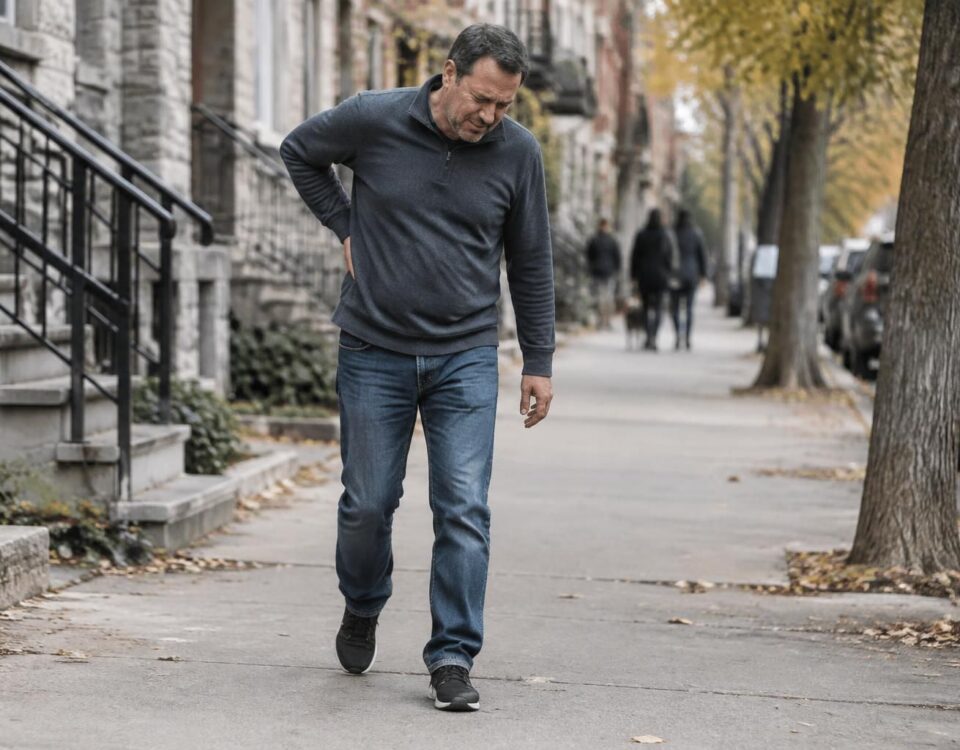
Sciatica and difficulty walking straight
29/09/2026
Sciatica in Terrebonne: radiating pain in the leg after physical exertion
30/09/2026
IN BRIEF Sciatica is a pain that starts from the lower back or the buttock and radiates down the leg; it can appear after physical exertion. In Montreal, an assessment helps identify aggravating movements and guide care. Acupuncture can be considered as a complementary option to relieve tension and pain, depending on the situation. |
After physical exertion, pain starting from the lower back or the buttock and radiating down the leg may suggest sciatica. An assessment in Montreal allows for clarification of the pain’s pathway, the movements that aggravate the symptoms, and the possible causes, guiding care according to your situation. Consult promptly if significant or progressive weakness appears.
After physical exertion, pain that starts from the lower back or buttock and radiates down the leg may indicate irritation of the sciatic nerve. In Montreal, an assessment helps clarify the pain’s pathway, the movements that aggravate it, and the signs that require medical advice. Relief depends on the cause; there is no set number of sessions that works for everyone.
Sciatica refers to pain related to irritation of a lumbar nerve root or the sciatic nerve. It can appear after lifting a heavy load, making a sudden movement, or returning to intense activity. Effort alone does not determine the cause of the pain.
The pain may remain in the buttock or radiate down the thigh, calf, and sometimes the foot. It may be accompanied by tingling, numbness, or a feeling of heaviness in the leg. To better recognize possible signs and know when to consult, read this guide on the symptoms of sciatica.
Why does the pain radiate down the leg after exertion?
A lumbar disc herniation, irritation of a nerve root, or certain muscle tensions can contribute to pain radiating down the leg. The fact that the pain starts after exertion does not prove that a disc is damaged. A professional must examine the symptoms and their evolution before proposing an approach.
The pathway of the pain provides information but is not sufficient to establish a diagnosis. Pain that goes towards the little toe may be related to irritation of the S1 root. To learn more, consult this article on pain towards the little toe and the S1 root.
Pain in the hip is not always sciatica. The location, sensations in the leg, and factors that trigger the pain help differentiate local pain from nerve radiation. You can read this article on hip pain and nerve irradiation.

Sciatica in Montreal: understanding L5-S1 foraminal compression
IN BRIEF L5-S1 foraminal compression is a narrowing of the opening where a nerve root exits, which can cause sciatica with pain, tingling, or weakness in the buttock and leg. In Montreal, an assessment allows for correlating symptoms, clinical examination,…
What symptoms to monitor after exertion?
Observe where the pain starts, how far it radiates down, and what aggravates it. For some people, standing for long periods exacerbates symptoms. This article explains the possible link between prolonged standing and pain in the leg.
A heavy or painful leg may accompany nerve irritation, but this symptom may also have other causes. Note if the sensation affects one side only, if it changes with position, and if weakness appears. For more information, see the details on heavy or painful leg.
Coughing or sneezing may sometimes increase lower back pain that radiates down the leg. This sign does not, on its own, confirm a disc herniation. To understand this situation, consult the article on pain that radiates down the leg when coughing. General advice on lower back pain radiating down the leg is also presented in this practical guide and in this guide on symptoms, causes, and relief of sciatica.

Sciatica in Montreal: why L5-S1 is often involved
IN BRIEF The sciatica L5-S1 often corresponds to irritation of the S1 root, sometimes related to a herniated disc. The pain may start in the buttock and descend behind the thigh to the calf or the foot. In Montreal, understanding…
How does an assessment proceed in Montreal?
An assessment starts with your history, the onset of the pain, and the effort that preceded it. The professional will also ask about your activities, your symptoms in the leg, and the positions that worsen or alleviate them.
The examination may include observing your posture and movements, as well as tests adapted to your situation. The goal is to better understand the pain pattern and identify signs that require medical evaluation. A medical image is not necessary in all cases; a doctor can determine if it is warranted.
The care must correspond to the results of the assessment and your health status. At the TAGMED Clinic, options may include specific osteopathy, precision impact therapy, or, when justified by the assessment, motorized neurovertebral decompression. These approaches are not suitable for everyone and do not replace medical advice.
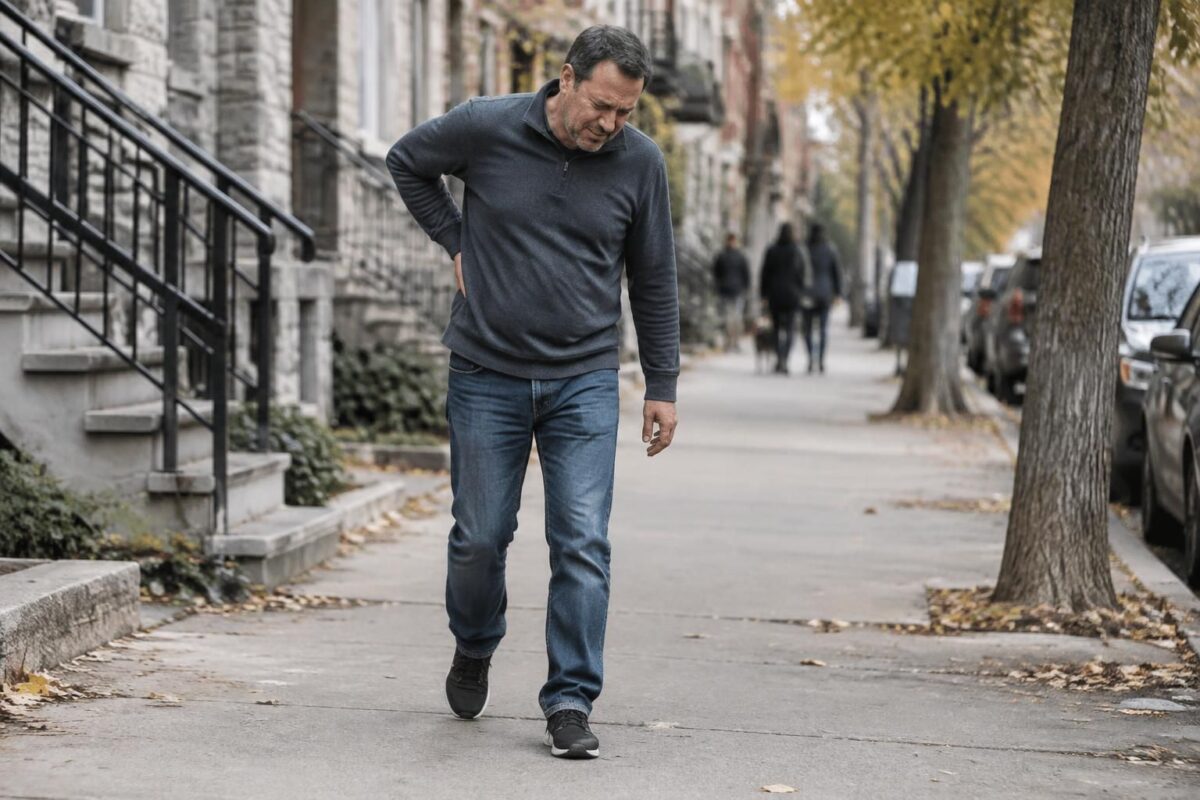
Sciatica in Montreal: L5 and difficulty lifting the foot
IN BRIEF The difficulty in lifting the foot with sciatica can indicate weakness related to the involvement of the L5 root, sometimes caused by a herniated disc. This foot drop increases the risk of falling and requires prompt medical evaluation;…
What relief options can be considered?
The management may aim to reduce the stresses that worsen symptoms and improve comfort in daily activities. The professional may discuss temporary changes in movements or positions that trigger the pain. In the presence of a disc herniation or another known issue, do not start exercises or stretching without suitable advice tailored to your case.
Acupuncture is sometimes used as a complementary approach to help manage pain and muscle tension. Reactions vary from person to person. Some feel a change quickly; others notice no benefit. The treatment does not mechanically remove a herniation and does not guarantee the elimination of nerve compression.
The number of sessions depends on the duration of the symptoms, their intensity, and the response to care. Some people with recent pain may notice progress after a few visits. Persistent or recurrent symptoms may require longer follow-up. A professional must reassess progress and modify the plan if necessary.
For general information on rehabilitation and activities to consider based on the situation, consult the TAGMED Clinic guide on sciatica. This content does not replace an individual assessment; avoid movements that trigger or increase your symptoms.

Sciatica in Montreal: S1 and difficulty rising up on the toes
IN BRIEF S1 sciatica can cause pain from the buttock to the calf and foot, as well as difficulty getting on tiptoe. This weakness may suggest irritation of the S1 nerve root, but is not sufficient to establish a diagnosis.…
When to consult quickly?
Seek medical help quickly if you lose control of your bladder or bowels, if you experience loss of sensation in the saddle area, or if you have significant or progressive weakness affecting your leg or foot. Consult also in case of fever, recent trauma, severe pain, or rapid deterioration.
A persistent, recurrent, or activity-limiting pain also deserves evaluation. For information on care in Montreal or Mont-Royal, visit the sciatica treatment page in Montreal. For Terrebonne, check the sciatica treatment page in Terrebonne.

Sciatica in Montreal: L4-L5 and pain towards the top of the foot
IN BRIEF The sciatica related to L4-L5 can radiate from the lower back to the buttock and the leg; pain on the top of the foot may suggest involvement of the L5 root, but the pathways vary and symptoms overlap.…
About the Author
Dr. Sylvain Desforges, B.Sc., D.O., N.D., osteopath, is the founding president of TAGMED and the ACMA association. He dedicates his practice to chronic pain of the spine, low back pain, and pain associated with sciatica, particularly when the pain radiates to the buttock, leg, calf, foot, or toes.
Through SOS Sciatique, he publishes educational content on sciatica symptoms, possible causes such as herniated discs, disc pinching, foraminal stenosis, or irritation of a lumbar nerve root, as well as non-surgical approaches that may be considered based on the evaluation. At TAGMED Clinic, care may include, depending on the case, motorized neurovertebral decompression, specific osteopathy, or precision percussion.
For an evaluation related to sciatica treatment in Montreal / Mont-Royal or sciatica treatment in Terrebonne, check the services available at TAGMED Clinic.

Sciatica in Montreal: pain in the big toe, L5 root or another cause?
IN BRIEF Pain that radiates toward the big toe may indicate irritation of the L5 root, sometimes related to a herniated disc, but other causes are possible. In Montreal, evaluating the pain pathway, strength, sensitivity, and walking helps guide management…
Medical Disclaimer
The information published on SOS Sciatique is provided for educational purposes and does not replace a consultation, diagnosis, advice, or treatment performed by a physician or another licensed health professional. The author of this article is neither a doctor nor a specialist in a medical specialty recognized by the Collège des médecins du Québec. The approaches of osteopathy, manual medicine, or functional support described on this site do not constitute medical acts and are not intended to replace medical follow-up.
Consult a doctor or emergency service in case of loss of bladder or bowel control, anesthesia in the saddle area, significant or progressive weakness of the leg or foot, fever, recent trauma, severe pain, or rapid deterioration. For more details, please read our Legal Notice.
Medical disclaimer: The information and advice provided on this site do not substitute for the opinion, diagnosis, or treatment by a health professional. Please note that Dr. Sylvain Desforges, osteopath, is neither a physician nor a medical doctor and is not a specialist in a medical specialty as defined by the Collège des médecins du Québec. Manual medicine, functional medicine, and sports medicine as described on this site exclude any medical treatment or diagnosis made by a physician or medical specialist. Always consult your doctor for any medical questions. For more details, please read our full Legal Notice.
To observe after exertion
- Pain starting from the lower back or buttock and radiating down the leg.
- Tingling or numbness in the calf, foot, or toes.
- Symptoms worsened by certain movements or prolonged sitting.
To consider in Montreal
- Have the pain path assessed, the triggering movements, and its evolution.
- Temporarily adjust activities and resume movements according to tolerance.
- Discuss care options, including acupuncture, based on your situation and history.
- Consult quickly in case of progressive weakness, loss of bladder or bowel control, or numbness in the saddle area.

Pain that starts from the lower back or buttock and descends into the leg after exertion may correspond to sciatica, but several structures can cause similar symptoms. In Montreal, an individualized evaluation helps to identify the path of radiation, the movements that aggravate the pain, and the signs requiring medical advice. In the meantime, prioritize tolerable movements, adapt your activities, and seek advice before starting treatment.

Sciatica in Montreal: why the affected root changes the pain pathway
IN BRIEF Sciatica refers to pain or nerve symptoms that vary depending on the affected lumbar root. Pain, tingling, or numbness may manifest in the buttock, thigh, calf, or foot. Understanding this distribution helps guide the assessment, without diagnosing based…
After exertion: understanding radiation in the leg
Lifting a load, gardening, running, or resuming an intense activity can trigger low back pain that extends to the buttock, thigh, calf, or foot. This radiation may be compatible with irritation of a nerve root, particularly in the presence of a lumbar herniated disc. Muscle tension, including that of the piriformis, or prolonged sitting can also contribute to symptoms. Pain alone, however, cannot precisely identify its cause.
Note when the symptoms began, how far they radiate down, and what exacerbates them: bending, coughing, walking, sitting, or carrying weights. These observations will help the professional better understand your situation. An evaluation may also address mobility, sensitivity, and strength without replacing a medical examination when indicated.

Sciatica in Montreal: L4-L5 disc, L5-S1 disc, and leg pain
IN BRIEF Sciatica refers to pain that can radiate from the lower back or buttock down the leg, sometimes related to nerve irritation near the L4-L5 or L5-S1 discs. The level of the disc alone is not sufficient to identify…
Resuming activities without causing a flare-up
Adapt effort rather than remaining immobile
If the pain allows it, maintain light activities and change positions regularly. Temporarily reduce movements that clearly trigger irradiation, especially repetitive movements or lifting loads away from the body. Gradually resume activities, observing the reaction during the activity and in the hours that follow. Avoid forced stretches or exercises that worsen numbness or pain in the leg.
Preparing for Daily Movements
To pick up an object, get close to it and bend at the hips and knees as comfortable. During seated periods, take short breaks to stand up or walk gently. There is no perfect posture suitable for everyone: instead, choose positions that alleviate your symptoms and vary them regularly.
Choosing Appropriate Support in Montreal
The care plan should take into account the duration of the symptoms, their intensity, your history, and your response to movements. Based on the assessment, a professional may discuss non-surgical approaches and the relevance of manual therapy, guided exercises, or acupuncture. These options may not be suitable for all situations and do not guarantee relief. Acupuncture may be considered as a complement for some individuals; it does not replace the evaluation of a cause requiring medical follow-up.
The number of sessions varies depending on progress: some acute sciatica improves over a few visits, while persistent or recurring symptoms may require longer follow-up. Progress should be regularly re-evaluated, with an adjustment to the plan if the pain does not improve, worsens, or changes in nature.
When to Seek Medical Advice Quickly
Consult a doctor or emergency service immediately in case of loss of bladder or bowel control, numbness in the saddle area, significant or progressive weakness in the leg or foot, fever, recent trauma, severe pain, or rapid deterioration. These signs require urgent medical evaluation.
About the Author
Dr Sylvain Desforges, B.Sc., D.O., N.D., osteopath, is the founding president of TAGMED and the ACMA association. His practice focuses on chronic spinal pain, lower back pain, and symptoms compatible with sciatica. The care provided at the TAGMED Clinic may include, based on the assessment, motorized neurovertebral decompression, specific osteopathy, or precision impact therapy.
Medical Warning
This content is provided for educational purposes and does not replace a consultation, diagnosis, opinion, or treatment by a doctor or another authorized healthcare professional. The author is neither a physician nor a specialist in a medical specialty recognized by the Collège des médecins du Québec. Osteopathy, manual medicine, or functional support approaches do not constitute medical acts and do not replace medical follow-up.
| Indicator | Sciatica after exertion in Montreal |
|---|---|
| Pain pathway | Pain starting from the lower back or buttock and radiating down the leg. |
| Possible triggers | Effort, herniated disc, piriformis tension, or prolonged sitting. |
| To monitor | Numbness, tingling, or increased pain during certain movements. |
| Evaluation | Identify the pathway of irradiation, aggravating movements, and associated factors. |
| Acupuncture | May be considered for tensions and pain, after reviewing the history. |
| Progression | The number of sessions varies depending on the duration of symptoms and the observed response. |
| Consult quickly | Progressive weakness, loss of bladder or bowel control, or numbness in the saddle area. |
Illustrative Testimonials on Sciatica in Montreal after Physical Exertion
Transparency note: the accounts below are fictional examples meant to illustrate different situations. They do not represent actual or verified opinions and do not predict the outcomes of support.
Marc, 46 years old — pain after lifting a load
“After moving boxes, I felt pain in my lower back that radiated into my buttock and the back of my leg. The evaluation helped me describe the pathway of irradiation and the movements that aggravated my symptoms. I was also given advice to gradually resume my activities.”
Isabelle, 53 years old — symptoms after a hike
“My leg started to hurt after a long hike. The pain went from my buttock to my calf and intensified when I sat for long periods. We discussed the aggravating factors and ways to temporarily adapt my movements. My progress was monitored over the sessions.”
André, 39 years old — discomfort after gardening
“After several hours of gardening, I felt sharp pain in my lower back, with pain radiating into one leg. I appreciated that time was taken to examine my symptoms before suggesting an approach. The advice on posture and modifying certain activities helped me manage my efforts better.”
Pain that radiates down the leg can have various causes, including a lumbar herniated disc or irritation of a nerve root. An evaluation can consider the pathway of pain, triggering movements, and other symptoms. Depending on the situation, acupuncture may be considered as a complementary approach; it does not replace medical advice or, when indicated, physiotherapy.
Consult a healthcare professional quickly in case of significant or progressive weakness, loss of bladder or bowel control, numbness in the saddle area, fever, recent trauma, or rapid deterioration of pain.
About the Author
Dr Sylvain Desforges, B.Sc., D.O., N.D., osteopath, is the founding president of TAGMED and the ACMA association. His practice focuses on chronic spinal pain, lower back pain, and pain compatible with sciatica.
Medical Warning
This information is provided for educational purposes and does not replace a consultation, diagnosis, or treatment by an authorized healthcare professional. The author is neither a physician nor a specialist in a medical specialty recognized by the Collège des médecins du Québec. Osteopathy, manual medicine, or functional support approaches do not constitute medical acts and do not replace medical follow-up.
Sciatica in Montreal: irradiation in the leg after physical exertion
After physical exertion, pain that starts from the lower back and radiates into the buttock or leg may suggest sciatica. It can appear after lifting a load, making a sudden movement, engaging in an unusual activity, or maintaining a posture for a long time. The intensity varies: some people experience moderate discomfort, while others describe sharp pain, jolts, tingling, or a burning sensation down into the calf or foot.
The term “sciatica” generally refers to a set of symptoms associated with irritation of a nerve root located in the lower back, rather than a single disease. A lumbar herniated disc, nerve irritation, or certain changes in spinal structures may contribute to the pain. The muscles in the buttock region, including the piriformis, may also be tight and contribute to the symptoms. Prolonged sitting or repetitive movements can exacerbate them. However, the cause cannot be solely determined from the pain’s trajectory: an evaluation is necessary.
In Montreal, Dr. Sylvain Desforges, B.Sc., D.O., N.D., is an osteopath and founding president of TAGMED clinics as well as the ACMA association. His background focuses on the management of chronic pain and the exploration of care approaches integrating technologies, including neurovertebral decompression, laser, and shockwave therapy. His aim is to guide individuals toward care that is suitable for their situation, taking into account their history, symptoms, and available data.
When pain radiates into the leg after exertion, the evaluation focuses on its location, progression, the movements that trigger it, and the activities that relieve it. The presence of sensory disturbances or weakness should also be considered. This information helps determine whether a manual or functional approach may be appropriate, if other care needs to be coordinated, or if a medical consultation is indicated. The care plan is individualized: there is no fixed number of sessions applicable to everyone, and results cannot be guaranteed.
In addition to professional management, certain adaptations may be discussed: temporarily modifying movements that trigger the pain, varying positions, and gradually resuming activities according to tolerance. Avoiding any movement for fear of pain is not necessarily the best strategy; however, resumption should remain cautious and appropriate. If the pain persists, intensifies, or recurs frequently, an evaluation can help better understand the factors at play and choose the next steps.
Dr. Sylvain Desforges, B.Sc., D.O., N.D., osteopath, dedicates his practice to chronic spinal pain, lower back pain, and symptoms compatible with sciatica. The approaches offered at TAGMED Clinic may include, based on the assessment, specific osteopathy, motorized neurovertebral decompression, or precision percussion. These treatments do not replace a diagnosis or medical follow-up.
Important to remember for your safety: consult a doctor or emergency service quickly in case of loss of urinary or bowel control, numbness in the saddle area, significant or progressive weakness of the leg or foot, fever, recent trauma, severe pain, or rapid deterioration. The information presented is educational and does not replace a consultation with a licensed health professional.
After physical effort, pain that starts from the lower back or buttock and radiates into the leg may correspond to nerve irritation, but its trajectory alone is not enough to confirm sciatica. In Montreal, an evaluation can clarify the symptoms, the movements that aggravate them, and the signs needing medical management, and then consider appropriate measures.
Radiation in the leg after physical exertion
Lifting a load, twisting, or resuming an intense activity can trigger or accentuate lower back pain radiating to the buttock, thigh, calf, or foot. A herniated or bulging disc, irritation of a nerve root, and certain muscle tensions are among the possible causes, although it is not possible to distinguish them solely based on a symptom. To better understand the mechanisms and triggering factors, consult resources on sciatic pain after exertion and bulging disc associated with sciatica.
Note where the pain starts, how far it radiates, and whether it is accompanied by burning, tingling, or numbness. A burning pain in the leg, numbness in the foot, or tingling in the toes can accompany nerve irritation but should be interpreted in their context. Additional information on sciatic pain in the leg and understanding sciatica can also help prepare for a consultation.
Prolonged sitting may exacerbate symptoms in certain individuals. If pain increases when you are seated or is more concentrated in the foot, these details are useful to report during the evaluation; also see the information on foot pain aggravated in seated position. Pain that wakes you at night should also be described to the healthcare professional, especially if it becomes persistent or worsens: nocturnal pain and sciatica in Montreal.
While waiting for an opinion, avoid repeating the movements that clearly provoke an aggravation, while maintaining gentle activity according to your tolerance. Strict prolonged rest is not necessarily indicated for everyone. A professional can examine the pain’s trajectory, mobility, and strength, then consider your history before suggesting relief measures or referring you to other care.
Acupuncture may be considered by some individuals as a complementary approach, after verifying its relevance and safety based on their situation. It does not, by itself, establish the cause of pain or confirm that a nerve is compressed. To learn more about this approach, consult the information from the acupuncture clinic for sciatica in Montreal. The number of sessions and response to treatment varies from person to person; progress should be reassessed rather than presumed in advance.
A new or progressive weakness in the leg or foot, a loss of control of the bladder or bowels, or numbness in the saddle area require urgent medical evaluation. Also consult a professional if the pain is severe, worsens rapidly, or occurs after significant trauma.

Dr Sylvain Desforges, B.Sc., D.O., N.D., osteopath, is the founding president of TAGMED and of the ACMA association. He dedicates his practice to chronic spinal pain, low back pain and symptoms compatible with sciatica, particularly when pain radiates toward the buttock, leg, calf, foot or toes.
Through SOS Sciatique, he publishes educational content on sciatica symptoms, possible causes such as disc herniation, disc narrowing, foraminal stenosis or irritation of a lumbar nerve root, as well as non-surgical approaches that may be considered according to the evaluation. At Clinique TAGMED, care may include, depending on the case, motorized neurovertebral decompression, specific osteopathic care or precision percussion.
For an evaluation related to sciatica treatment in Montreal / Mount Royal or sciatica treatment in Terrebonne, please consult the services available at Clinique TAGMED.
Medical disclaimer
The information published on SOS Sciatique is provided for educational purposes only and does not replace a consultation, diagnosis, opinion or treatment provided by a physician or another authorized healthcare professional. The author of this article is neither a medical doctor nor a specialist in a medical specialty recognized by the Collège des médecins du Québec. The osteopathic, manual medicine or functional support approaches described on this site do not constitute medical acts and are not intended to replace medical follow-up.
Consult a physician or emergency service in cases of loss of bladder or bowel control, anesthesia in the saddle area, significant or progressive weakness in the leg or foot, fever, recent trauma, severe pain or rapid worsening of symptoms. For more details, please read our Legal Notice.