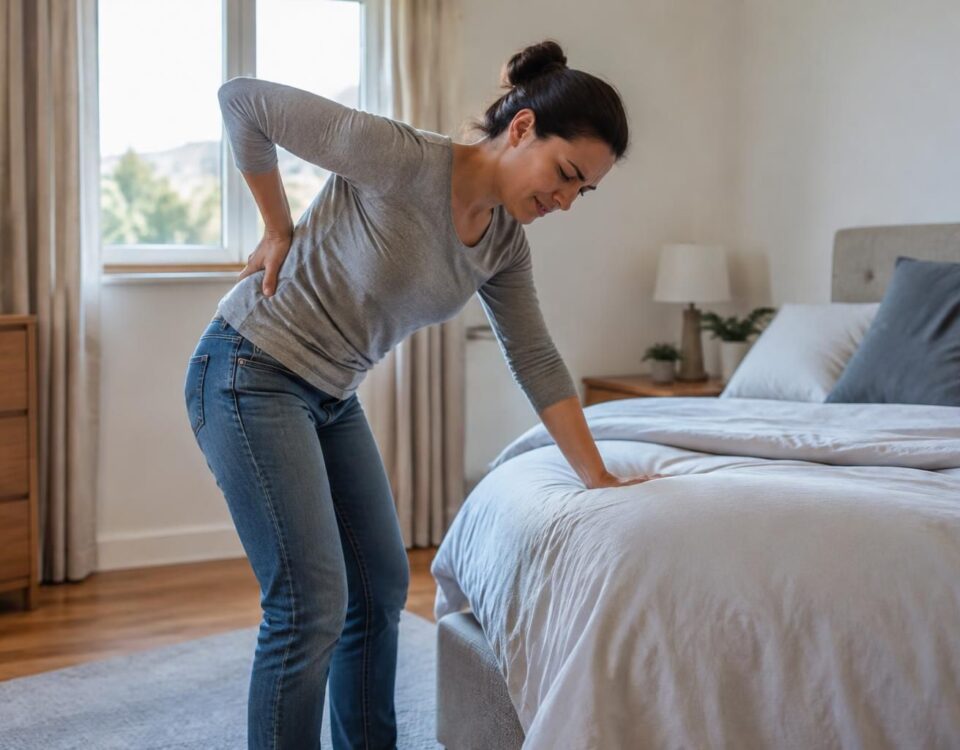
Disc protrusion and pain after twisting the back
17/10/2026
Sciatica in Montreal: pain in the big toe, L5 root or another cause?
18/10/2026
IN BRIEF
| Sciatica is pain that starts from the lower back or buttock and radiates down the leg. If a lunge triggers or worsens this pain, stop the movement and adjust your activity: this exercise does not address sciatica. Consult a healthcare professional if symptoms persist or worsen, and urgently if there is significant weakness or loss of sensation. |
Lunges can strain the lower back and exacerbate pain related to sciatica. If the pain travels down the leg, or is accompanied by tingling or numbness, stop the exercise and seek advice from a healthcare professional. Progressive muscle weakness or urinary issues require urgent medical attention.
Pain in the leg during a lunge may indicate irritation of the sciatic nerve, but it can also have another origin. Stop the movement if it triggers sharp pain, tingling, or numbness. Pain alone does not allow for a diagnosis: a healthcare professional can identify the cause and advise you on resuming activity. The lunge requires coordinated movement of the hips, pelvis, and lower back. If a position increases pain or tension in the leg, the movement may awaken already present symptoms. This does not necessarily mean the lunge caused an injury or sciatica. Sciatica refers to pain related to irritation of a nerve root. It can originate from the lower back or buttock and radiate down to the thigh, calf, or foot. However, pain in the leg is not always sciatica. To learn more, consult our guide on the symptoms, causes, and relief of sciatica, as well as information from the MSD Manual on sciatica. Watch for pain that travels down one leg, a burning sensation or electric shock, tingling, numbness, or weakness. Also note if the pain occurs with each repetition, increases after exercise, or persists at rest. These details will help the healthcare professional understand your situation. Pain may vary depending on the affected nerve root. Irritation of the S1 root or an issue in the L4-L5 region may present different symptoms. These descriptions are not enough to determine the source of your pain: only a proper assessment can guide the diagnosis. You can read these resources on the irritation of the S1 root and L4-L5 protrusion and possible pain. Stop the set if the pain becomes sharp or travels further down the leg. Do not push to complete repetitions and do not resume the movement as long as the symptoms are present. Stay attentive to their evolution and seek advice from a healthcare professional, especially if discomfort recurs with each attempt. Do not decide alone that it is just a simple muscle strain. The professional can examine the pain, strength, and sensitivity, then determine if further tests are needed. Information on the causes, symptoms, and treatments of sciatica and on the distinction between sciatica and cruralgia can help you better understand the terms, but does not replace an individual examination. Not necessarily. The answer depends on the cause of the pain and its evolution. A lunge that causes no symptoms does not hold the same significance as a movement associated with pain radiating below the knee, tingling, or weakness. Seek guidance before resuming if the symptoms are recent, intense, or persistent. Returning too quickly can rekindle the pain. The pace of returning to activity must consider your symptoms and the advice received. Also consult information on gradual resumption of activity and precautions regarding movements involving the legs and pelvis. Contact a professional promptly if the pain worsens, does not improve, or is accompanied by loss of sensation or increasing weakness. Loss of bladder or bowel control, numbness of the perineum, or significant weakness require urgent medical evaluation. Pain that occurs also after prolonged walking should be described during the evaluation. Note the distance walked, where the pain appears, and the time needed for it to decrease. To delve deeper into this topic, consult the article on sciatica after a long walk and the advice from Doctolib on understanding and preventing sciatica. A lumbar support belt can provide temporary support to some individuals during their daily activities. It does not address the cause of sciatica and does not replace medical advice. Its choice depends on the situation and should be made with a professional. At TousOrtho, our specialists can provide information on support devices tailored to your needs. The belt should not be used to continue a movement that triggers pain in the leg. If symptoms appear during lunges, stop the exercise and have the situation evaluated before resuming. For complementary information, consult our guide on sciatica, its symptoms, and relief options. Medical disclaimer: The information and advice provided on this site do not replace the opinion, diagnosis, or treatment of a healthcare professional. Please note that Sylvain Desforges, B.Sc., D.O., N.D., Doctor of Osteopathy, is neither a medical doctor nor a physician, and is not a specialist in a medical specialty as defined by the Collège des médecins du Québec. Manual medicine, functional medicine, and sports medicine as described on this site exclude any medical treatment or diagnosis made by a physician or medical specialist. Always consult your doctor for any medical questions. For more details, please read our complete Legal Notice.Why can lunges trigger pain?
Signs to watch for during the movement
What to do if a lunge causes pain in the leg?
Should all lunges be avoided?
When to quickly seek medical advice?
Can a lumbar support help?
What to watch for during lunges
- Pain that travels down the leg
- Tingling or numbness
- Weakness or intensifying pain
The right reflexes
- Stop lunges if the pain radiates
- Resume only if the movement is tolerated
- Consult if symptoms persist or worsen

Pain that travels down the leg during lunges may signal irritation of the sciatic nerve, but it alone does not determine the cause. Reduce or stop the exercise if the pain radiates, increases, or is accompanied by tingling or numbness. Gradually resume, favoring comfortable movements, and seek medical advice if symptoms persist, worsen, or affect your strength or sensitivity.
Sciatica and lunges: recognize the signs to watch for
Sciatica describes pain related to irritation of a nerve root in the lower back. It may start from the lower back or buttock and travel down into the thigh, calf, or even to the foot. It may sometimes present as a burning sensation, pulling, or an electric shock feeling, with tingling, numbness, or muscle weakness.
A localized muscle discomfort after a session is not necessarily sciatica. However, pay attention to any pain that follows the leg, especially if it occurs during lunges or intensifies with each repetition. The affected side alone is not enough to identify the cause: only a healthcare professional can evaluate your symptoms and perform the necessary examination.

Sciatica and household chores: twists, bends, and loads
IN BRIEF Sciatica can be aggravated by bending, twisting, and carrying loads while doing housework. Breaking tasks into smaller parts, taking breaks, and adjusting movements help manage effort without necessarily stopping everything. In Montreal, an assessment can help tailor activity…

Sciatica and Making the Bed: Repeated Flexion and Lumbar Irritation
IN SHORT Sciatica is pain related to irritation or compression of the sciatic nerve. Making your bed can strain the lower back if bending is repeated, especially when rounding the back or twisting the torso. To limit lumbar irritation, bend…
What to do if pain appears during exercise?
Immediately adapt the movement
Stop the set if the pain becomes sharp, travels further down the leg, or is accompanied by unusual sensations. Do not try to “push through” the pain. Rest briefly in a comfortable position, then observe if the symptoms decrease. Avoid resuming lunges the same day if they trigger or worsen the radiating pain.
If the discomfort is mild and does not extend down the leg, you can reduce the range of motion, slow down the movement, or temporarily replace lunges with a more comfortable activity, like gentle walking. Keep your back in a natural position and avoid torso rotations with a load. The goal is to stay active without causing aggravation.
Resume gradually
After a painful phase, resume exercises step by step, without load and with reduced range of motion. Increase only one difficulty at a time: number of repetitions, depth, or adding a load. If the radiating pain returns, stop the movement and consult a doctor or a physiotherapist before continuing. Exercises tailored to your situation may be proposed after evaluation.

Sciatica and bending over the sink: pain in the leg
IN BRIEF Sciatica is pain related to irritation or compression of the sciatic nerve, which can extend from the lower back down to the leg. Bending over the sink can exacerbate the pain, especially if this position increases pressure on…

Sciatica and washing feet: lumbar flexion to monitor
IN BRIEF Sciatica can make washing your feet uncomfortable, as bending forward accentuates lumbar flexion and may trigger pain. To limit strain, sit down, bring your foot closer to you, or use a long-handled aid. These adjustments make personal hygiene…
When to seek medical advice?
Consult if the pain is significant, does not improve, returns regularly, or is accompanied by loss of sensitivity or weakness in the leg. Pain in the leg is not always sciatica, and imaging is not routine: the healthcare professional will decide on the assessment based on your signs and their evolution.
Some symptoms require urgent care: difficulty controlling the bladder or bowels, numbness of the perineum, increasing muscle weakness, unbearable pain, or fever associated with back pain. Do not continue training in these situations.

Sciatica and dressing: daily gestures to adapt
IN BRIEF Sciatica can make dressing uncomfortable, but a few simple gestures help limit tension. Sit down to put on pants, socks, and shoes, choose easy-to-wear clothing, and avoid bending or twisting suddenly. These adjustments make daily dressing easier without…
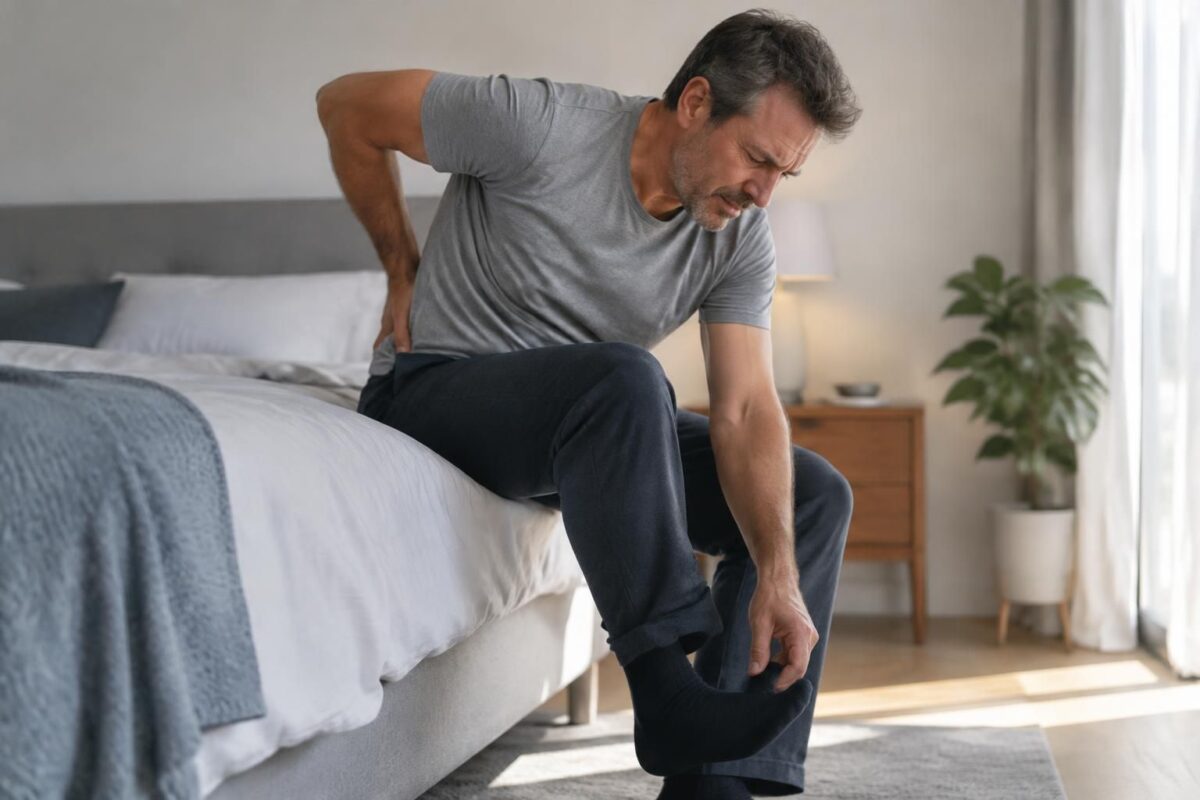
Sciatica and putting on socks: bending and pain in the leg
IN BRIEF Sciatica can make it difficult to put on your socks: bending over can increase the pain that radiates down the leg. Sitting down, using a sock aid, or avoiding painful bends can make this daily task easier. If…
Lumbar support as a complement
A lumbar support belt can provide temporary support during certain activities or when resuming, according to a professional’s advice. It does not address the cause of sciatica and does not replace medical evaluation or gradual strengthening. When well-fitted, it can complement a cautious resumption without becoming a long-term substitute for movement and appropriate muscle work.
| Situation during lunges | Sign to watch for |
|---|---|
| Pain radiating from the lower back down one leg | May suggest sciatica; interrupt the movement if it increases the pain. |
| Burning, electric shock, or pulling sensation | Note the path and intensity of the pain. |
| Tingling or numbness | Watch for their onset and evolution. |
| Weakness or loss of sensitivity in the leg | Seek medical advice quickly. |
| Persistent pain or pain that worsens | Consult a healthcare professional to evaluate the cause. |
| Loss of bladder or bowel control, or numbness of the perineum | Medical emergency: seek immediate care. |

Sciatica and tying your shoes: why the pain can radiate down
IN BRIEF Sciatica is pain related to the irritation of a nerve in the lower back, which can radiate into the buttock and leg. Leaning down to tie your shoes may accentuate the pain or cause it to descend further.…

Sciatica and picking up an object from the ground: movement to watch out for
IN BRIEF Sciatica is pain that follows the path of the sciatic nerve. To pick up an object from the ground, avoid bending abruptly while rounding your back or twisting: bend your knees, tilt your hips, and keep the object…
Sciatica and lunges: testimonies to better monitor leg pain
These testimonies are fictional and provided for informational purposes. Pain that travels into the buttock or leg during lunges may have different causes. It cannot, by itself, diagnose sciatica.
“I was doing lunges to strengthen my legs. A sharp pain started from my lower back and followed the back of my thigh. I stopped the exercise rather than forcing it. Since the discomfort persisted, I mentioned it to my doctor.” — Camille, 38 years old
“After a set of lunges, I felt tingling all the way down my calf. It wasn’t just muscle fatigue: the sensation returned when I resumed the movement. I paused the exercise and sought advice from a healthcare professional.” — Julien, 45 years old
“My pain felt like pulling in the leg, especially when I went too low in the lunge. I reduced the range, but the discomfort persisted. My physiotherapist helped me adapt the movements to my situation.” — Sarah, 32 years old
Pain radiating from the lower back to the leg, especially if accompanied by burning, electric shocks, numbness, or tingling, deserves special attention. Stop lunges if they trigger or worsen these symptoms and seek advice from a doctor or physiotherapist before resuming.
Consult quickly in case of progressive muscle weakness. A loss of bladder or bowel control, or numbness of the perineum, requires urgent care.
Sciatica and lunges: leg pain to watch for
Sylvain Desforges dedicates his career to health innovation and the management of chronic pain. An expert in osteopathy, naturopathy, and manual medicine, he is the founding president of the TAGMED clinics and the ACMA association. His approach emphasizes evidence-based care and improving the health and well-being of his patients.
This expertise is relevant in a field where back and leg pain require special attention. Pain that radiates into the buttock, thigh, or calf may indicate sciatica, which means irritation of a nerve root or the sciatic nerve. Discomfort may manifest as burning, pulling, or electrical sensations. Tingling, a numb area, or feelings of weakness may also occur.
The practice of lunges can become uncomfortable when pain is already present. This exercise primarily engages the leg and glute muscles while requiring control of the pelvis and trunk posture. If the movement triggers or exacerbates pain radiating into the leg, it is better to stop the set than to push through. Sharp pain, compensatory movement, or loss of stability are signs to take seriously.
Pain during a lunge does not automatically mean it is sciatica. Various muscular, joint, or nerve issues can cause similar discomfort. The path of the pain, associated sensations, and clinical examination help a healthcare professional determine its origin. A diagnosis cannot be made based solely on the exercise that triggers the pain.
In his practice, Dr. Desforges specializes in the management of chronic pain and the integration of advanced technologies, including spinal decompression, laser therapy, and shock waves. These tools may not be suitable for every situation: the choice of treatment depends on the patient assessment and their needs. The goal of his approach is to offer thoughtful care, supported by available knowledge, rather than a one-size-fits-all solution to pain.
In case of symptoms, it is helpful to note when they occur: during the lunge, after exertion, or at rest. Also, identify their location, intensity, and progression. While waiting for appropriate advice, avoid movements that significantly worsen the pain and only maintain tolerated activities. Prolonged bed rest is generally not a sufficient response; activities should be adjusted according to the situation and a professional’s guidance.
A prompt medical evaluation is necessary if the pain is accompanied by progressive weakness, significant loss of sensitivity, or new difficulties in controlling the bladder or bowels. These signs may indicate a condition requiring urgent care. For persistent or recurrent pain, the healthcare professional determines if further examination or specialized referral is indicated.
Sylvain Desforges’ journey combines expertise in manual therapies, a focus on innovation, and attention to available evidence. In the context of sciatica and returning to exercises like lunges, this approach emphasizes the importance of not trivializing pain that radiates into the leg and selecting care based on the identified cause.
Lunges engage the legs, glutes, and lower back. If pain radiates into the leg during this exercise, it deserves attention: it may be related to nerve irritation, but radiating pain is not necessarily sciatica. The path of symptoms, their intensity, and their progression assist in determining the appropriate course of action.
Sciatica and Lunges: Points of Caution
Sciatica can cause pain that starts from the lower back or buttock and radiates down one leg, sometimes to the foot. It may be accompanied by burning, tingling, numbness, or muscle weakness. The path varies depending on the affected nerve root: resources on roots L4, L5, and S1 and on variation of the path according to the affected root help to better understand these differences. Pain extending to the big toe, for example, is described in cases involving the L5 root, but this sign alone is not sufficient to establish a diagnosis.
If lunges trigger sharp pain or radiation into the leg, stop the exercise and do not push to finish the set. You may resume with a reduced range of motion or a less demanding movement, but only if it remains comfortable. Also, avoid compensating by arching the back or twisting the torso under strain. Lifting movements and their risks vary depending on the cause of the pain, as this point explains regarding sciatica and deadlifts.
Pain in the leg is not always sciatica: a healthcare professional can evaluate its origin, test strength and sensitivity, and then recommend appropriate activities. Imaging is not necessary in every case and depends on symptoms and their progression. To learn more about possible manifestations, consult information on pains that can accompany sciatica, symptoms and management, or the fact sheet from France Santé Pro.
Seek medical advice if pain persists, worsens, or limits your activities. A progressive muscle weakness, significant loss of sensitivity, numbness of the perineum, urinary or anal issues, or fever associated with pain require urgent evaluation. Signs to watch for are detailed by PasseportSanté. Additional resources also present symptoms, duration, and possible treatments for sciatica.

Sylvain Desforges, B.Sc., D.O., N.D., docteur en ostéopathie
Dr Sylvain Desforges, B.Sc., D.O., N.D., osteopath, is the founding president of TAGMED and of the ACMA association. He dedicates his practice to chronic spinal pain, low back pain and symptoms compatible with sciatica, particularly when pain radiates toward the buttock, leg, calf, foot or toes.
Through SOS Sciatique, he publishes educational content on sciatica symptoms, possible causes such as disc herniation, disc narrowing, foraminal stenosis or irritation of a lumbar nerve root, as well as non-surgical approaches that may be considered according to the evaluation. At Clinique TAGMED, care may include, depending on the case, motorized neurovertebral decompression, specific osteopathic care or precision percussion.
For an evaluation related to sciatica treatment in Montreal / Mount Royal or sciatica treatment in Terrebonne, please consult the services available at Clinique TAGMED.
Medical disclaimer
The information published on SOS Sciatique is provided for educational purposes only and does not replace a consultation, diagnosis, opinion or treatment provided by a physician or another authorized healthcare professional. The author of this article is neither a medical doctor nor a specialist in a medical specialty recognized by the Collège des médecins du Québec. The osteopathic, manual medicine or functional support approaches described on this site do not constitute medical acts and are not intended to replace medical follow-up.
Consult a physician or emergency service in cases of loss of bladder or bowel control, anesthesia in the saddle area, significant or progressive weakness in the leg or foot, fever, recent trauma, severe pain or rapid worsening of symptoms. For more details, please read our Legal Notice.