Sciatica in Montreal: S1 and difficulty rising up on the toes
22/10/2026
Sciatica and pain that improves when walking
22/10/2026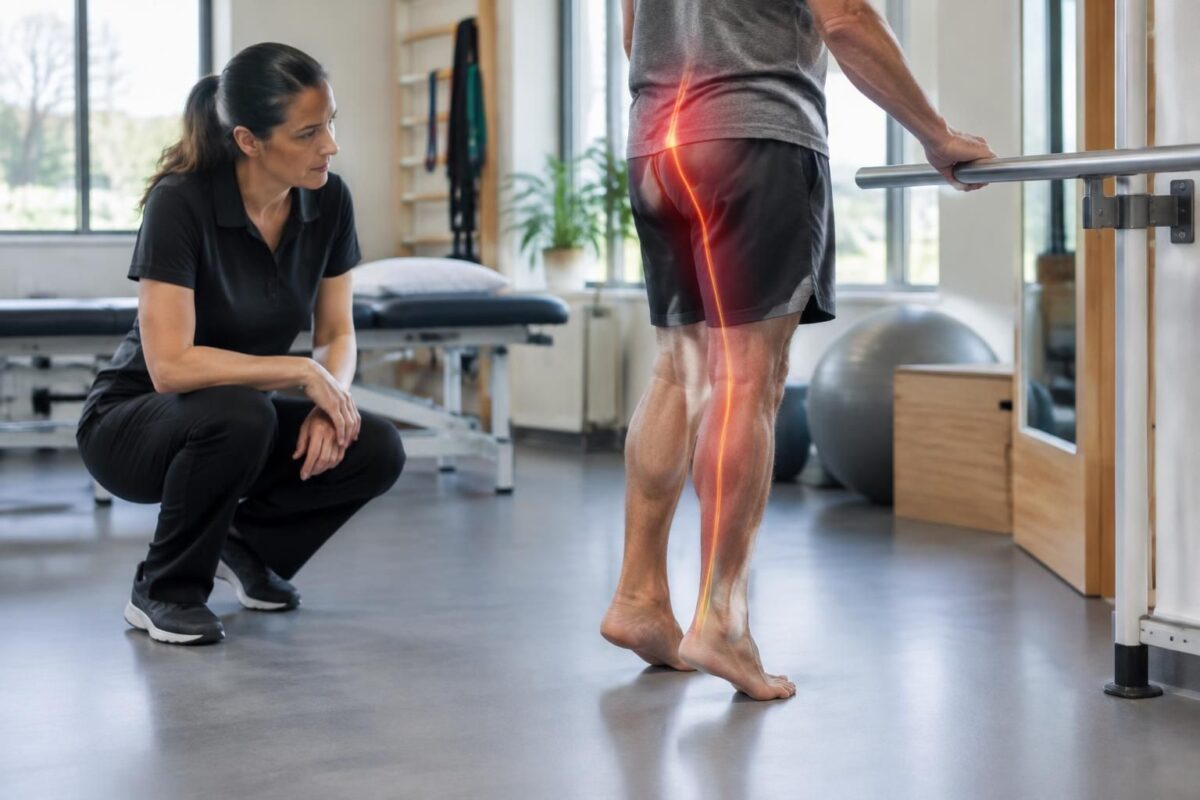
IN SHORT
| An S1 sciatica can irritate the nerve root associated with the calf and make it difficult to rise onto the balls of the feet. This sign should be evaluated with strength, sensitivity, reflexes, and walking: the pathway of pain alone does not confirm the affected root. In Terrebonne, an assessment helps guide management and monitor progress. Consult quickly if weakness appears or worsens; urinary or intestinal disturbances, or numbness in the saddle area, require urgent evaluation. |
An S1 root sciatica can be accompanied by weakness in the calf and make it difficult to rise onto the balls of the feet. This sign alone is not sufficient to confirm the diagnosis: a professional must compare strength, sensitivity, reflexes, and walking.
In Terrebonne, request a medical evaluation if this difficulty is new or worsening. Significant or progressive weakness, urinary or intestinal disturbances, or numbness in the saddle area require urgent consultation.
A new difficulty in rising onto the balls of the feet may signal decreased strength in the calf muscles. With pain traveling down the back of the leg to the heel or the outer edge of the foot, this sign may be consistent with irritation of the S1 nerve root. However, it is not sufficient to confirm sciatica. In Terrebonne, a clinical evaluation can verify strength, sensitivity, walking, and signs that require rapid medical attention.
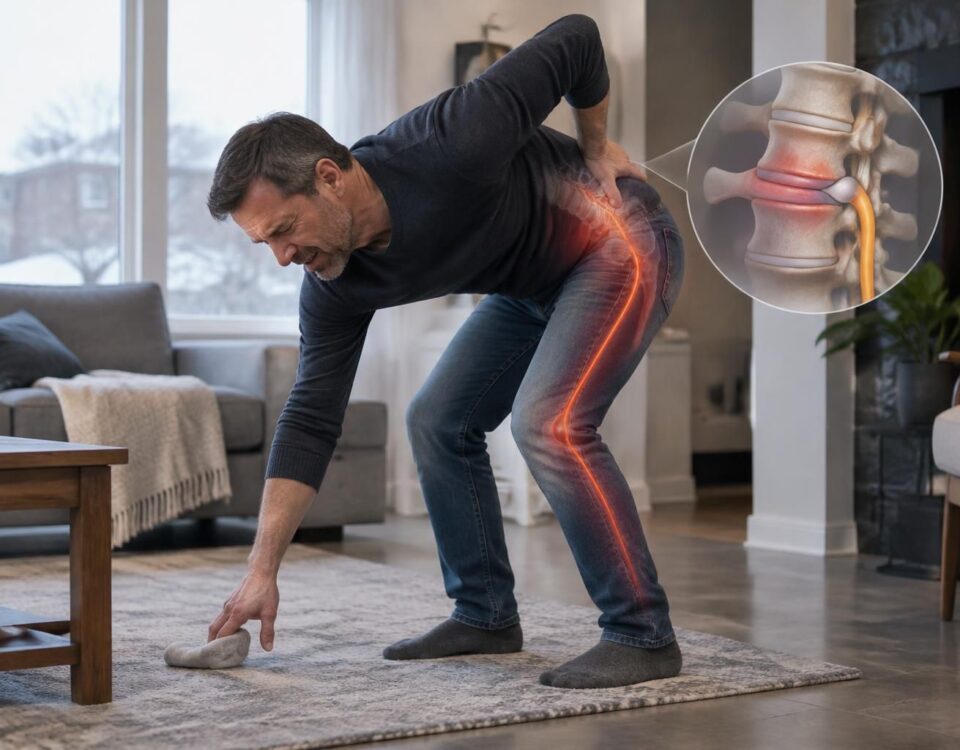
The S1 nerve root contributes, among other things, to calf strength and sensitivity in certain areas of the foot. If this root is irritated or compressed, a person may feel pain behind the buttock and leg, sometimes down to the heel or the outer edge of the foot. They may also have difficulty pushing off the foot or standing on tiptoes.
These signs alone do not establish a diagnosis. Pain in the leg can have multiple causes, and symptoms do not always follow a precise nerve pathway. To better understand the manifestations and possible progression, consult our guide on the associated symptoms of irritation of the S1 root in Terrebonne.
What is the link between S1 and rising onto the balls of the feet?
The calf muscles help push the foot downward. This action is particularly involved when walking on tiptoes. The S1 root participates in this function. A decrease in strength may therefore make this movement more difficult on one side than the other.
Rising onto the balls of the feet is a component of the examination, but it is not sufficient to identify the cause of the problem. Pain, balance issues, an injury to the foot or calf, and other nerve impairments can also limit this movement. A professional examines overall function.
What symptoms can accompany S1 involvement?
Pain consistent with S1 irritation can radiate down the back of the thigh and calf. It can reach the heel or the outer edge of the foot. Some individuals also feel burning sensations, electric shocks, tingling, or numbness. The pathway varies from person to person and does not confirm the affected root on its own.
To explore pain radiating to the calf and the outer edge of the foot, consult this page on S1 type pain to the calf and outer edge of the foot. Pain in the front of the thigh may rather suggest a cruralgia, but only an examination can help distinguish the possible causes. You can read about the differences between sciatica and cruralgia.
Should difficulty standing on tiptoes be a concern?
A new decrease in strength warrants evaluation, especially if it is progressive or hampers walking. A foot that no longer pushes normally, a changed gait, or a weakness that spreads require rapid medical attention. Pain can vary from day to day; function and its progression also matter.
Significant or rapidly progressive weakness, a foot drop, a loss of sensitivity in the saddle area, or recent changes in urinary or bowel control require urgent evaluation. If in doubt regarding these signs, contact medical services without waiting for an appointment for manual care.
A foot drop corresponds to difficulty raising the front of the foot. This sign is not the same as difficulty pushing off the balls of the feet, but any new weakness in the foot or leg justifies appropriate evaluation.

Sciatica in Terrebonne: disc herniation and painful cough
IN BRIEF In Terrebonne, sciatica related to a herniated disc may be accompanied by pain that increases when coughing, as the pressure exerted can further irritate a nerve root. An evaluation helps to understand the origin of the symptoms and…
How does a professional evaluate possible S1 involvement?
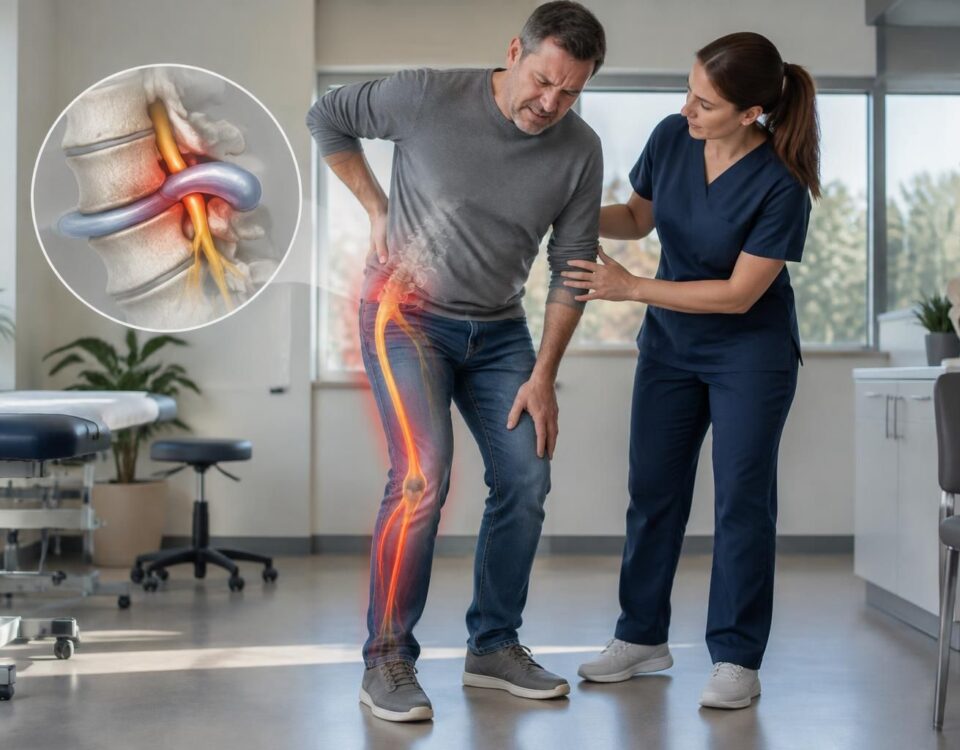
The evaluation begins with symptoms and their progression. The professional may compare the strength of both legs, sensitivity, certain reflexes, and walking patterns. They also check if the signs correspond to a nerve impairment or can be explained otherwise.
Disc levels and nerve roots are not interchangeable. A disc involvement at L5-S1 can sometimes affect the S1 root, but an image does not automatically confirm the cause of symptoms. The affected side, clinical examination, and correspondence with complaints must be considered. To learn more, consult the pages on L4-L5 and L5-S1 levels and on the difference between L4-L5 and L5-S1.
Is an MRI always necessary?
No. An MRI is not automatically necessary as soon as pain radiates down the leg. The healthcare professional may consider it if the result is likely to modify management, especially in the presence of significant weakness, persistent symptoms, or warning signs. A visible anomaly on imaging must be correlated with the examination and symptoms.

Sciatica in Terrebonne: pain worsened in sitting position and lumbar disc
IN SHORT Aggravated sciatica in a sitting position may be related to the irritation of a lumbar nerve root, sometimes associated with a lumbar disc. In Terrebonne, varying positions, taking short active breaks, and getting an evaluation can help better…
What are the management options in Terrebonne?
The choice of care depends on the probable cause, the intensity of symptoms, muscle strength, and progression. When neurological function remains stable, a professional may discuss non-surgical management and plan for reevaluation. A worsening weakness requires a prompt medical evaluation, without delaying it to continue a care program.
At the TAGMED Clinic, the evaluation allows for discussing options tailored to the situation. Depending on the results and needs, the approach may include specific manual therapy or a motorized neurovertebral decompression. These options are not suitable for everyone and do not replace a medical diagnosis or an urgent referral when needed.
A useful follow-up plan defines the changes to monitor: calf strength, gait quality, sensitivity, pain, and ability to perform important activities. If strength decreases, if numbness spreads, or if gait deteriorates, the plan should be reevaluated.

Sciatica in Terrebonne: pain worsened by flexion and disc-related cause
IN BRIEF Aggravated sciatica by flexion is pain that starts in the lower back and radiates into the buttock or leg; a lumbar disc herniation can irritate a nerve root, although it may not be the only possible cause. In…
Frequently Asked Questions about S1 and Difficulty Standing on Tiptoes
Does difficulty standing on tiptoes confirm S1 sciatica?
No. This difficulty may be compatible with S1 involvement, but it can also have other causes. An examination of strength, sensitivity, reflexes, and gait helps guide the evaluation.
Does S1 sciatica necessarily mean a herniated disc?
No. A herniated disc can irritate a nerve root, but other causes can produce similar symptoms. The diagnosis is not solely based on an image or the path of pain.
What should I bring to a consultation in Terrebonne?
Note the onset of symptoms, their progression, painful or numb areas, and changes in strength or gait. Bring a list of your medications and, if you have them, any imaging or previous examination reports.
When should I seek emergency consultation?
Consult quickly in case of significant or progressive weakness, foot drop, numbness in the saddle region, or new urinary or bowel disturbances. A fever, recent trauma, or rapid worsening also justifies immediate medical evaluation.
About the Author
Sylvain Desforges, B.Sc., D.O., N.D., osteopath and naturopath, is the founding president of TAGMED and the ACMA association. He dedicates his practice to chronic pain in the spine, back pain, and pain associated with sciatica, particularly when the pain radiates down to the buttock, leg, calf, foot, or toes.
Through SOS Sciatique, he publishes educational content on sciatica symptoms, possible causes such as herniated discs, disc compression, foraminal stenosis, or irritation of a lumbar nerve root, as well as non-surgical approaches that may be considered based on the evaluation. At the TAGMED Clinic, care may include, as appropriate, motorized neurovertebral decompression, specific osteopathy, or precision percussor therapy.
For an evaluation related to sciatica treatment in Montreal / Mont-Royal or sciatica treatment in Terrebonne, check the services available at the TAGMED Clinic.
Medical Disclaimer
The information and advice provided on this site do not replace the opinion, diagnosis, or treatment of a health professional. Please note that Sylvain Desforges, B.Sc., D.O., N.D., Doctor of Osteopathy, is neither a medical doctor nor a physician and is not specialized in any medical specialty as defined by the Collège des médecins du Québec. Manual medicine, functional medicine, and sports medicine as described on this site exclude any treatment or medical diagnosis made by a physician or medical specialist. Always consult your doctor for any medical questions. For more details, please read our Complete Legal Notice.
- Pain or numbness toward the calf, heel, or outer edge of the foot.
- Difficulty pushing off the forefoot or standing on tiptoes.
- These signs guide the evaluation but are not sufficient to confirm the cause.
- Have strength, sensitivity, reflexes, and gait evaluated.
- Consult quickly if weakness is new or worsening.
- Seek emergency help in case of urinary or bowel disturbances, or numbness in the saddle region.

A new difficulty in standing on tiptoes with pain radiating down the leg may require a prompt evaluation. This movement notably engages the calf muscles, associated among others with the S1 nerve root. In Terrebonne, have your strength and symptoms checked by a health professional rather than relying solely on a nerve map or MRI image.

Disc herniation in Terrebonne: why some stretches worsen
IN BRIEF Discogenic sciatica is pain related to the irritation of a nerve, sometimes worsened by certain stretches that intensify the symptoms. In Terrebonne, avoiding movements that cause pain to radiate down the leg and focusing on an appropriate approach…
Why are tiptoes important?
The S1 nerve root contributes to the functioning of certain calf muscles. Weakness may make it difficult to push off the foot, climb stairs, or walk on tiptoes. It may accompany pain radiating into the buttock, back of the thigh or calf, sometimes down to the heel or outer edge of the foot.
However, these signs alone do not confirm S1 involvement. Nerve territories overlap and vary from person to person. Foot pain or difficulty standing on tiptoes can have various causes. A clinical examination is necessary to assess strength, sensitivity, reflexes, and gait, and to guide the further evaluation.

Sciatica disc in Terrebonne: movements to avoid at the beginning
IN BRIEF Disc-related sciatica corresponds to a nerve irritation that can cause pain from the lower back to the buttock or leg. Initially, avoid movements that worsen the pain, such as deep bends, sudden twists, and carrying heavy loads. In…
When to request an evaluation?
New or worsening weakness
If you suddenly cannot stand on your tiptoes, if the weakness progresses or if your walking deteriorates, quickly contact a doctor or a healthcare service. Do not delay assessment to try several exercises or wait for the end of a care program. Motor weakness deserves special attention, even if pain fluctuates or decreases.
Signs requiring urgent care
Go to the emergency room if you have new difficulty controlling or expelling urine or stool, numbness around the genitals or anus, or significant or rapidly progressing weakness. A fever, recent trauma, or rapid deterioration also warrants prompt medical advice.

Sciatica in Terrebonne: disc herniation with leg weakness
IN SHORT Sciatica related to a disc herniation can cause pain that radiates down the leg, sometimes accompanied by weakness. In Terrebonne, an assessment helps guide management based on symptoms and their progression. A new, significant, or progressive weakness requires…
What to do while waiting for the examination?
Avoid efforts that clearly trigger your symptoms, but do not impose prolonged bed rest without professional advice. If tolerable, maintain gentle movements and cautious mobility. Do not force repeated rises on your tiptoes to “test” your strength: this does not replace an examination and could worsen your symptoms.
Note when the difficulty began, whether it affects one side only, if it is worsening, and if you feel numbness or tingling. Also mention any changes in your ability to walk, climb stairs, or stand. This information will help the professional monitor the evolution.

Sciatica in Terrebonne: herniated disc with foot numbness
IN BRIEF Sciatica related to a herniated disc can irritate a nerve root and cause pain that radiates down the leg, sometimes with a numbness in the foot. In Terrebonne, an evaluation helps to better understand the symptoms and consider…
How to guide care in Terrebonne?
The evaluation can compare both legs and check calf strength, reflexes, sensitivity, and walking. Imaging is not systematic: it is considered when the result can modify the approach, for example, based on neurological signs, evolution, or persistence of symptoms.
If a non-surgical plan is appropriate, ask what functional objectives will be monitored and when the situation will be reassessed. Care must be tailored to your condition and revised if weakness progresses or if no measurable improvement appears. Pain compatible with sciatica does not automatically mean that a herniated disc is the cause, and MRI alone is not enough to establish the diagnosis.

Sciatica in Terrebonne: lumbar disc and nerve root inflammation
IN BRIEF Lumbar disc-related sciatica occurs when irritation or inflammation of a nerve root causes pain that may radiate from the buttock down to the leg. In Terrebonne, an evaluation can help better understand the cause of symptoms and identify…
About the author
Sylvain Desforges, B.Sc., D.O., N.D., osteopath and naturopath, is the founding president of TAGMED and the ACMA association. His practice focuses particularly on chronic spinal pain and lower back pain that may radiate to the buttock or leg. The approaches proposed in the clinic depend on the evaluation and situation of each individual.
Medical disclaimer
This content is provided for educational purposes and does not replace a consultation, diagnosis, or treatment by a licensed healthcare professional. The author is neither a doctor nor a specialist in a medical specialty recognized by the Collège des médecins du Québec. Osteopathy, manual medicine, or functional support approaches are not medical acts and do not replace medical follow-up.
| Item to evaluate | Clinical marker |
|---|---|
| Rising on tiptoes | A new difficulty may indicate weakness in the calf. |
| S1 root | It may be involved, but this sign alone does not confirm the diagnosis. |
| Other possible signs | Pain towards the back of the leg, the heel, or the outer edge of the foot. |
| Clinical examination | Compare strength, sensitivity, reflexes, and walking on both sides. |
| Imaging results | An abnormality on MRI must correspond to the symptoms and examination. |
| Progressing weakness | Request a medical evaluation quickly. |
| Urinary or intestinal issues | Consult urgently, especially with loss of bowel sensation. |
| Follow-up in Terrebonne | Establish functional measures and a re-evaluation date. |
Illustrative testimonials: sciatica in Terrebonne, S1 symptoms, and difficulty standing on tiptoes
Note: the narratives below are fictitious examples created for educational purposes. They do not correspond to actual patient testimonials and do not allow for a diagnosis.
“The pain extended down to my heel”
A typical narrative: a person feels pain starting from the lower back or buttock and descending behind the thigh to the calf. The heel and outer edge of the foot are sometimes numb or tingling. This pathway may be compatible with irritation of the S1 root, but it is not sufficient to confirm the cause.
“I could no longer rise on my tiptoes”
In this example, a person notices a difference between their two legs when trying to stand on tiptoes. This difficulty may indicate a decrease in strength of the calf muscles, a function associated with S1. A healthcare professional must check strength, sensitivity, reflexes, and walking: description alone does not determine which root is affected.
“The symptoms varied from day to day”
In another fictitious narrative, the pain is sometimes limited to the buttock and calf, then descends to the foot after a more challenging day. Variations in the pathway and intensity may occur, but the evolution of strength and walking ability deserves special attention.
In Terrebonne as elsewhere, pain behind the leg or foot does not confirm a S1 sciatica on its own. Sensory pathways overlap and vary from person to person. The evaluation considers symptoms, neurological examination, and, when it can modify management, additional tests.
If you have a new or worsening weakness, if you can no longer rise on tiptoes or if your walking changes, quickly seek medical advice. New urinary or intestinal problems, loss of sensation in the saddle area, or significant or progressive weakness require urgent evaluation.
Medical disclaimer: this information is educational and does not replace a consultation, diagnosis, or treatment by a licensed healthcare professional. The author of this article is neither a doctor nor a specialist in a medical specialty recognized by the Collège des médecins du Québec. Osteopathy, manual medicine, or functional support approaches do not replace medical follow-up.
Sciatica in Terrebonne: possible S1 involvement and difficulty rising on tiptoes
Pain that travels down the buttock, behind the thigh, and into the calf or foot may indicate sciatica. If you also have difficulty rising onto your tiptoes, this change warrants particular attention. It may be associated with a decrease in strength of the calf muscles, particularly those involved in plantar flexion of the ankle. The nerve root S1 contributes to this function, but this sign alone cannot confirm a specific injury or determine the cause.
Sciatica commonly refers to pain following part of the path of the sciatic nerve; the medical term sciatalgia more precisely describes this pain. Irritation of the S1 root can cause symptoms in the back of the leg, towards the heel or the outer edge of the foot. However, the paths vary from person to person and overlap with those of other nerve roots. Therefore, the painful area alone is not sufficient to identify the affected level.
Difficulty rising onto the tiptoes can be noticed while walking, on stairs, or when trying to stand on one foot. A healthcare professional can compare both sides, examine calf strength, observe walking on heels and toes, check sensitivity, and test certain reflexes. They will also consider the evolution of symptoms, the movements that change them, and the activities that have become difficult. These observations help guide the evaluation but do not replace a medical diagnosis when necessary.
An S1 injury may sometimes be linked to a herniated disc, particularly in the L5-S1 region, but an MRI image does not automatically confirm that this anomaly explains the symptoms. Visible changes on imaging may be present without pain. The evaluation must relate examination results, the affected side, functional capacities, and available images. An MRI or another examination is generally considered when its result could modify management, particularly in the presence of weakness, persistent symptoms, or troubling signs.
In Terrebonne, as elsewhere, the priority is to clarify whether strength is genuinely decreased and if this decrease is progressing. Fluctuating pain does not always indicate worsening, but new weakness, deteriorating walking, or a foot that no longer responds normally justifies rapid medical evaluation. New urinary or intestinal disturbances, numbness in the saddle area, or significant weakness require urgent management. One should not wait until the end of a care program if these signs appear.
When neurological function is stable, options can be discussed based on the likely cause, the person’s preferences, and their goals. A plan may include suitable activity, gradual resumption of movements, and monitoring of walking and strength. Manual care or technologies do not automatically suit all situations and should not delay a medical consultation if motor deficits progress. It is helpful to agree in advance on a reassessment date and the criteria that would lead to modifying the plan.
Sylvain Desforges, B.Sc., D.O., N.D., is an osteopath and naturopath, as well as the founding president of TAGMED clinics and the ACMA association. His practice and educational content focus on chronic spinal pain, lower back pain, and symptoms compatible with sciatica. His approach is interested in assessing needs, functional objectives, and non-surgical options that may be considered based on each situation. Services may include, when appropriate, specific osteopathy or motorized neurovertebral decompression.
Medical warning: this information is educational and does not replace a consultation, diagnosis, or treatment by a licensed healthcare professional. The author is neither a physician nor a specialist in a medical specialty recognized by the Collège des médecins du Québec. Manual and functional approaches do not constitute medical acts and do not replace medical follow-up.
A new difficulty rising onto the tiptoes may justify an evaluation, especially if accompanied by pain that travels down the buttock, calf, or outer edge of the foot. This sign may be compatible with an S1 nerve root injury, but it is not sufficient to confirm sciatica or determine its cause: the examination must also check strength, sensitivity, reflexes, and walking style.
Sciatica in Terrebonne: understanding the possible link with S1
The nerve root S1 is involved in controlling certain calf muscles, which allow pushing the foot down and rising onto tiptoes. Irritation or injury to this root may be accompanied by pain in the back of the leg, tingling in the heel or outer edge of the foot, or a decrease in strength. However, symptoms vary from person to person and their paths do not always perfectly match anatomical maps. To better understand this root, consult our page on sciatica S1.
Not being able to rise onto tiptoes may also have other explanations, such as the pain itself, a problem affecting a structure of the foot or calf, or another neurological cause. A test done alone at home does not allow for a diagnosis. The professional generally compares both sides and can observe walking on tiptoes, assess calf strength, reflexes, and sensitivity. You can read more details on walking on tiptoes and the S1 root.
What the examination must clarify
An evaluation takes into account the overall picture: how long the symptoms have been present, where the pain radiates, what worsens or relieves it, and whether strength or sensitivity has changed. The level indicated on an MRI does not, by itself, determine which root is responsible for the symptoms. For example, the disc levels L4-L5 and L5-S1 may concern different roots, but the correspondence must be verified with the clinical examination. To deepen this distinction, consult the guide on the difference between L4-L5 and L5-S1 in Terrebonne.
Tingling in the heel may be compatible with irritation of S1, without being specific to this root. Likewise, pain located on the back of the foot, in the calf, or behind the thigh does not alone allow precise identification of the nerve level. The examination must combine several clues rather than relying on a single symptom. To learn more, consult the articles on tingling in the heel and S1 and on the anatomy, causes, and symptoms of sciatica.
When to seek a quick evaluation
If the difficulty in getting on tiptoe is new, worsens, or is accompanied by a foot drop, deteriorating gait, or marked weakness, seek medical advice quickly. Progressive weakness deserves special attention, even if the pain fluctuates or temporarily decreases. In the presence of urinary or intestinal incontinence, numbness in the saddle area, or significant and rapidly progressive weakness, consult an emergency service without delay.
In Terrebonne, a clinical evaluation can help clarify the problem and determine if further examinations are useful. An X-ray or MRI is not automatically necessary: it is primarily considered when the results could change the management, for example in the presence of neurological deficits, warning signs, or persistent symptoms. To discover the steps of a local evaluation, consult the resource dedicated to the sciatica evaluation in Terrebonne.
Monitor progress without jumping to conclusions
When neurological signs are stable, management can be gradually adapted to the symptoms, goals, and tolerance of the person. It is useful to track concrete milestones: ability to walk, climb stairs, stand on tiptoes, level of numbness, and participation in usual activities. If these aspects do not improve, if the painful area changes, or if weakness appears, the plan should be re-evaluated rather than automatically continued.
Pain can also vary with positions and activities. Discomfort after prolonged standing or difficulty finding a comfortable position does not, by itself, confirm S1 involvement. Note the circumstances that change the symptoms and share this information with the professional assessing you. You can consult the resources on pain after prolonged standing, difficulty finding a comfortable position, and pain felt in the back.
About the author
Sylvain Desforges, B.Sc., D.O., N.D., osteopath and naturopath, is the founding president of TAGMED and the ACMA association. He dedicates his practice to chronic spinal pain, lower back pain, and pain compatible with sciatica, particularly when the pain radiates to the buttock, leg, calf, foot, or toes.
Through SOS Sciatique, he publishes educational content on sciatica symptoms, possible causes, and non-surgical approaches that can be considered based on the assessment. At the TAGMED Clinic, care may include, as appropriate, motorized neurovertebral decompression, specific osteopathy, or precision percussor therapy.
For an evaluation related to sciatica treatment in Montreal / Mont-Royal or sciatica treatment in Terrebonne, consult the available services at the TAGMED Clinic.
Medical Disclaimer
The information published on SOS Sciatique is provided for educational purposes and does not replace a consultation, diagnosis, opinion, or treatment performed by a physician or other authorized health professional. The author of this article is neither a physician nor a specialist in a medical specialty recognized by the Collège des médecins du Québec. The osteopathy, manual medicine, or functional support approaches described on this site do not constitute medical acts and are not intended to replace medical follow-up.
Consult a physician or an emergency service in the case of urinary or intestinal incontinence, anesthesia in the saddle area, significant or progressive weakness of the leg or foot, fever, recent trauma, severe pain, or rapid aggravation. For more details, please read our Legal Notice.

Sylvain Desforges, B.Sc., D.O., N.D., docteur en ostéopathie
Dr Sylvain Desforges, B.Sc., D.O., N.D., osteopath, is the founding president of TAGMED and of the ACMA association. He dedicates his practice to chronic spinal pain, low back pain and symptoms compatible with sciatica, particularly when pain radiates toward the buttock, leg, calf, foot or toes.
Through SOS Sciatique, he publishes educational content on sciatica symptoms, possible causes such as disc herniation, disc narrowing, foraminal stenosis or irritation of a lumbar nerve root, as well as non-surgical approaches that may be considered according to the evaluation. At Clinique TAGMED, care may include, depending on the case, motorized neurovertebral decompression, specific osteopathic care or precision percussion.
For an evaluation related to sciatica treatment in Montreal / Mount Royal or sciatica treatment in Terrebonne, please consult the services available at Clinique TAGMED.
Medical disclaimer
The information published on SOS Sciatique is provided for educational purposes only and does not replace a consultation, diagnosis, opinion or treatment provided by a physician or another authorized healthcare professional. The author of this article is neither a medical doctor nor a specialist in a medical specialty recognized by the Collège des médecins du Québec. The osteopathic, manual medicine or functional support approaches described on this site do not constitute medical acts and are not intended to replace medical follow-up.
Consult a physician or emergency service in cases of loss of bladder or bowel control, anesthesia in the saddle area, significant or progressive weakness in the leg or foot, fever, recent trauma, severe pain or rapid worsening of symptoms. For more details, please read our Legal Notice.