Sciatica and exercises found on the Internet: caution depending on the cause
29/10/2026
Sciatica in Terrebonne: L5-S1 Herniation and Pain Towards the Foot
30/10/2026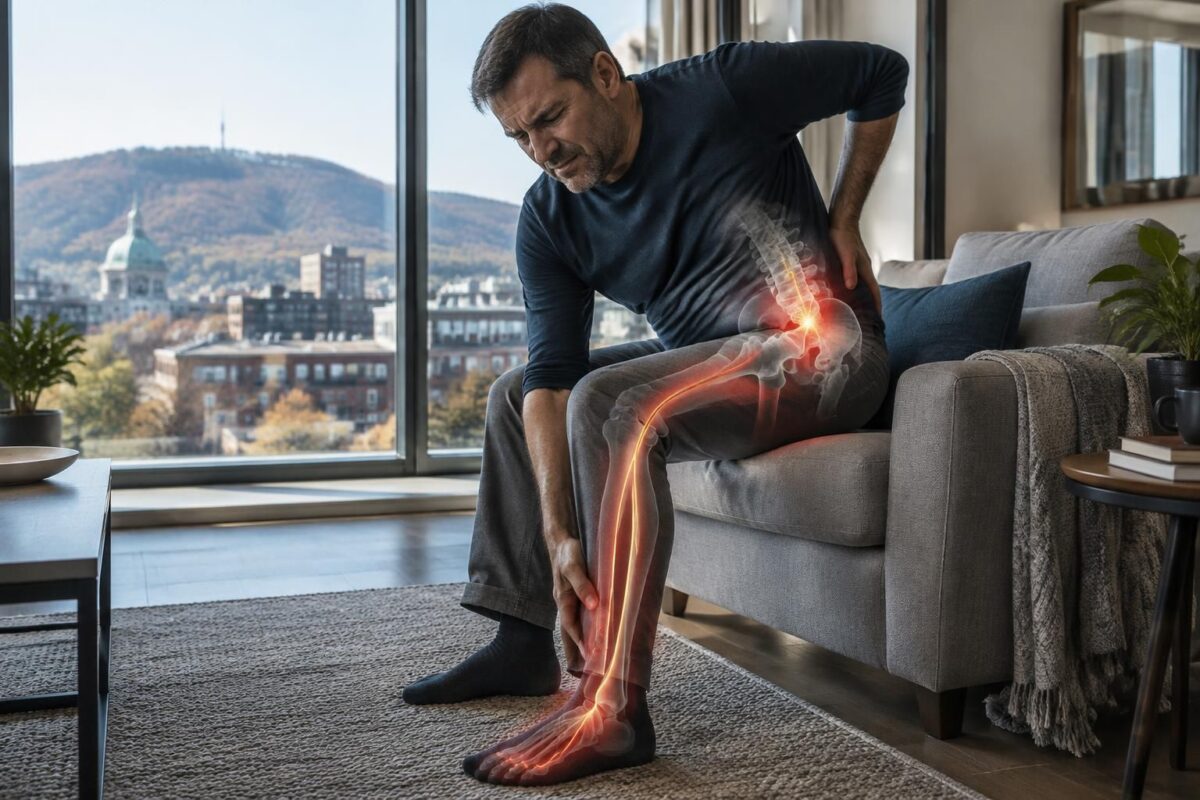
IN BRIEF A L5-S1 disc herniation can irritate the S1 nerve root and cause sciatica in Montreal, with pain or numbness radiating down to the calf, heel, or foot. The assessment correlates symptoms, strength, and sensitivity with imaging, if relevant; a visible herniation alone is not sufficient to confirm the cause. Management is tailored to each situation and may prioritize non-surgical options. Worsening weakness, a dropped foot, or urinary or bowel issues require urgent evaluation. |
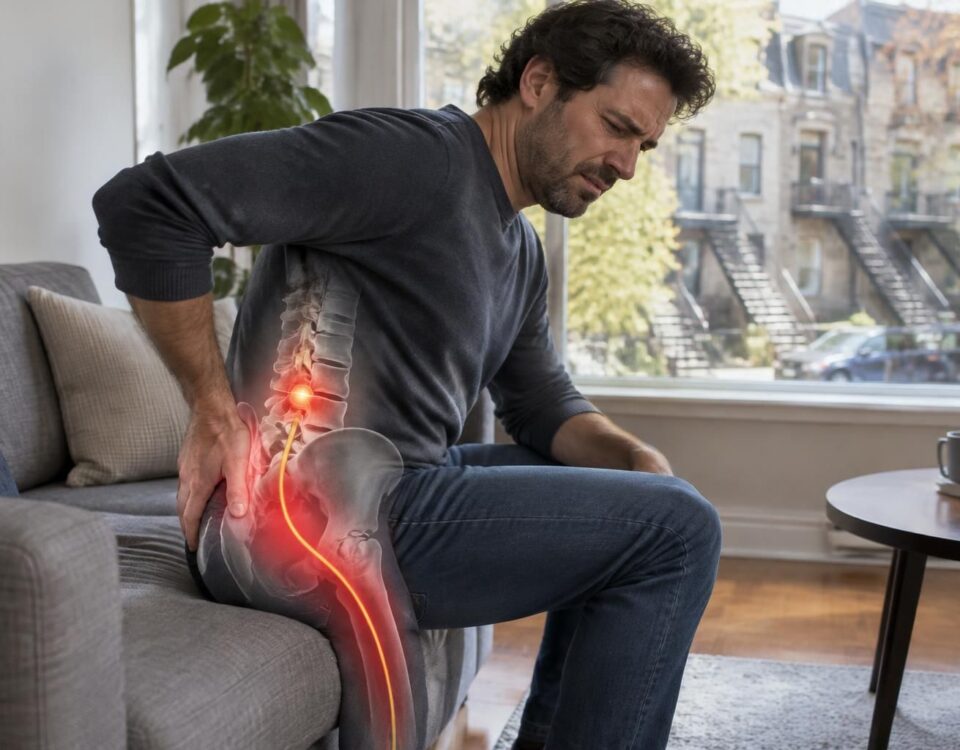
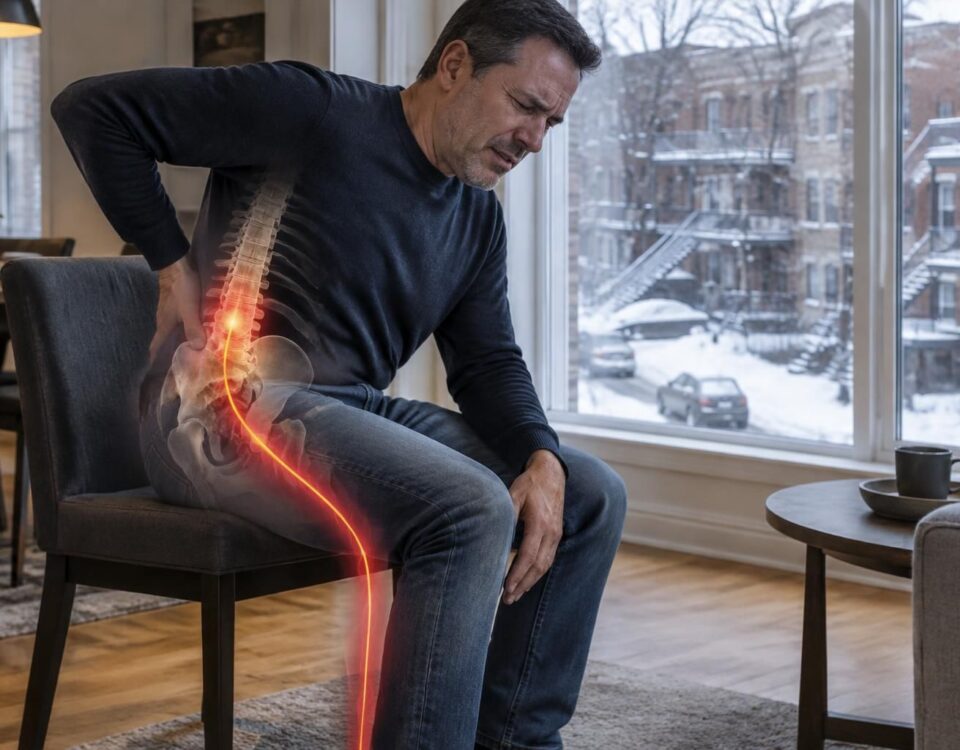
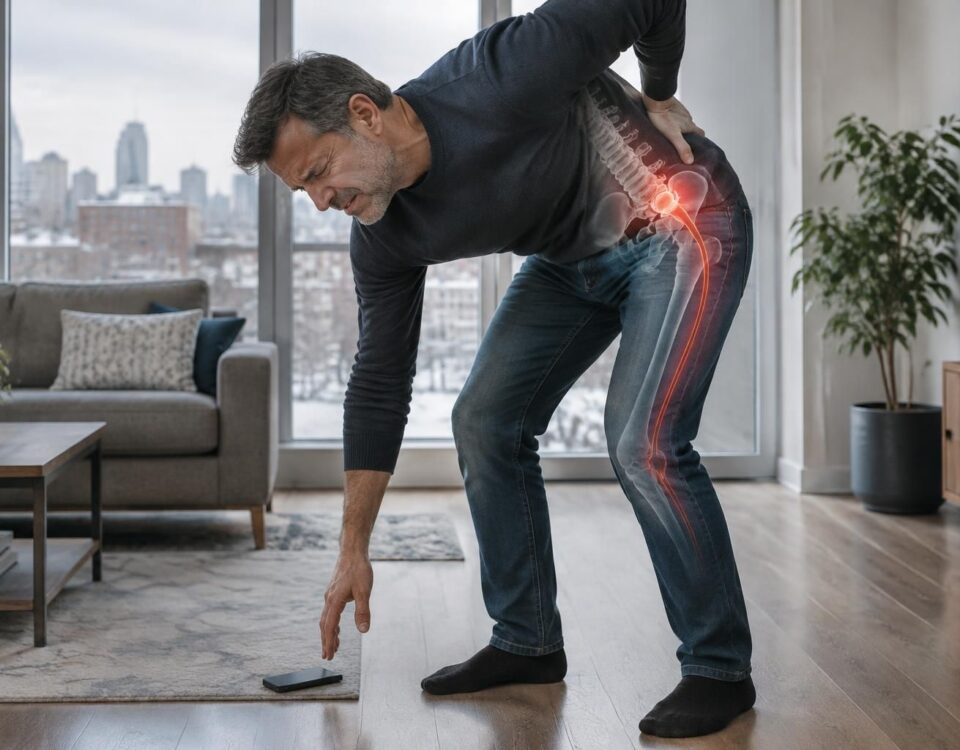
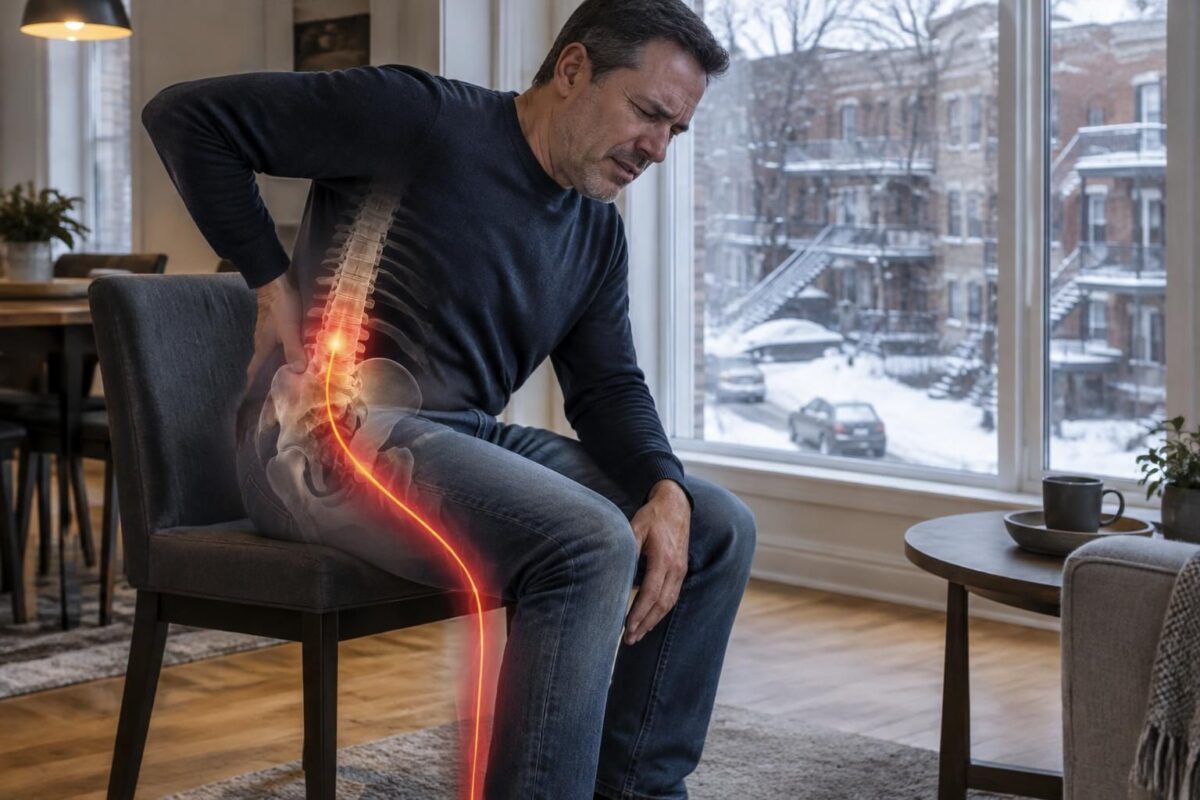
A L5-S1 disc herniation can irritate the S1 nerve root and cause pain that radiates from the buttock down the back of the leg, calf, heel, or outer edge of the foot. Tingling or weakness may also occur. An MRI must be interpreted in relation to the symptoms and examination, as a visible herniation does not always cause pain.
In Montreal, an assessment helps clarify the pathway of symptoms, strength, and sensitivity, and then discuss an appropriate management plan. Consult quickly if weakness worsens; urinary or bowel issues, or numbness in the saddle region, require urgent evaluation.
A L5-S1 disc herniation can irritate a nerve root and cause pain that starts in the lower back or buttock, then radiates down the back of the leg to the calf, heel, or edge of the foot. The location of symptoms, strength, sensitivity, and function help guide the evaluation. An MRI alone is insufficient to establish the cause of the pain or to choose a treatment. The L5-S1 level is located at the junction between the last lumbar vertebra and the sacrum. A herniation at this site can affect the S1 root, often associated with pain behind the thigh and calf, then towards the heel or outer edge of the foot. Sensations vary from person to person: sharp pain, burning, electric shock, tingling, or numbness. Pain may increase when sitting, driving, during certain movements, or when the person turns in bed. For a better understanding of this last symptom, consult our page on sciatica and pain when turning in bed. An S1 root involvement may produce symptoms towards the heel, sole, or outer edge of the foot. Some signs may also relate to the strength to push off the forefoot. Rising onto the toes may then seem more difficult on the affected side. However, no isolated symptom confirms an S1 involvement. Pain on the top of the foot may follow a different nerve pathway, but it does not alone determine the affected level. Other causes, such as a local foot issue or irritation of another root, may also be present. To compare certain pain profiles, consult the page on pain on top of the foot associated with sciatica. The L5 and S1 roots can cause pain in the leg and foot. L5 involvement is often associated with symptoms on the side of the leg or the top of the foot. S1 involvement may more often concern the back of the calf, heel, and outer edge of the foot. These pathways are guidelines, not absolute rules. The examination compares the pain pathway with sensitivity, strength, and functional movements. The professional can particularly check certain foot movements and walking on the toes. The Achilles reflex may also be assessed. A single sign does not confirm a diagnosis. Discover more details on the differences between L4, L5, and L5-S1 in Montreal or on the differences between L4, L5, and L5-S1 in Terrebonne. A new difficulty to push off the forefoot or to walk on toes warrants evaluation. To learn more about this sign, consult our page on the S1 root and difficulty rising up on the toes. An MRI can show a disc herniation, but this image must correspond to the symptoms and examination findings. Some people have disc changes without pain. The level, side, and position of the herniation must therefore be compared to the symptom pathway and the observed signs. Imaging is most useful when it can alter management or when a professional needs to verify certain hypotheses. An MRI report does not replace clinical evaluation. For a general overview of L5-S1 herniation, also consult this guide on L5-S1 disc herniation. A thorough evaluation begins with the history of symptoms: their onset, evolution, trajectory, and the movements or positions that aggravate them. The professional also inquires about numbness, weakness, history, and prior examinations. They then check function, sensitivity, and certain movements associated with the nerve roots. The proposed plan depends on these results, the duration of symptoms, and their impact on walking, sleep, work, and daily activities. The goal is to define realistic steps and monitor progress, rather than choosing a technique solely based on an image. To learn more about the link between herniation and nerve pain, consult this page on how a disc herniation can cause sciatica or the guide on sciatica at levels L4-L5 and L5-S1 in Montreal. Management varies depending on the situation. A healthcare professional can discuss pain management options and daily activities suitable for the person’s tolerance. Medications should be used according to the advice of the doctor or pharmacist, taking into account history and other treatments. At TAGMED Clinic, an evaluation may allow for discussion of non-surgical approaches, such as specific osteopathy or, for certain profiles, motorized neurovertebral decompression. The latter is not suitable for all cases and does not constitute a guaranteed treatment. The data and recommendations do not justify presenting it as a standard solution for each herniation. The choice must consider signs, possible contraindications, and the person’s expectations. Traction is not recommended by NICE for treating low back pain with or without sciatica. Any discussion regarding motorized decompression should therefore remain transparent: results may vary and this approach does not replace medical advice when necessary. Consult the information from the TAGMED Clinic on L5-S1 herniated disc and sciatica as well as its L5-S1 herniated disc treatment guide. The available care and services depend on the professionals present and their skills. Mentioning a technique does not mean that every professional in the clinic personally performs it. An intervention or guidance must respect the scope of practice of the concerned professional. Consult a doctor or an emergency service quickly if you notice new or worsening weakness, significant difficulty in lifting your foot, deterioration in walking, significant loss of sensitivity, or rapidly worsening pain. New urinary or intestinal disorders, numbness around the perineum or anal region, significant weakness in both legs, fever, or pain after trauma require urgent evaluation. Do not delay this evaluation to try manual therapy or decompression treatment. Recovery is also measured by function. Less frequent pain, easier walking, less disturbed sleep, or better tolerated sitting position may indicate improvement. Complete disappearance of pain is not the only useful marker. If symptoms persist, limit activities, or are accompanied by weakness, request a professional evaluation. For care options related to sciatica, consult the services of the TAGMED Clinic in Montreal and Mont-Royal or the TAGMED Clinic in Terrebonne. Sylvain Desforges, B.Sc., D.O., N.D., Doctor of Osteopathy and Naturopath, is the founding president of TAGMED and the ACMA association. His practice focuses on chronic pain of the spine, low back pain, and pain consistent with sciatica, especially when the pain radiates down to the buttock, leg, calf, foot, or toes. Through SOS Sciatique, he publishes educational content on the symptoms of sciatica, its possible causes, and non-surgical approaches that may be considered after evaluation. At the TAGMED Clinic, care may include, depending on the case and available professionals, motorized neurovertebral decompression, specific osteopathy, or precision percussion therapy. For an evaluation related to sciatica treatment in Montreal or Mont-Royal, or to sciatica treatment in Terrebonne, consult the available services at the TAGMED Clinic. The information published on SOS Sciatique is provided for educational purposes. It does not replace a consultation, diagnosis, opinion, or treatment performed by a doctor or another licensed health professional. The author is neither a physician nor a specialist in a medical specialty recognized by the Collège des médecins du Québec. The approaches to osteopathy, manual medicine, or functional support described on this site do not constitute medical acts and are not intended to replace medical follow-up. Medical disclaimer: The information and advice provided on this site do not replace the opinion, diagnosis, or treatment of a health care professional. Please note that Sylvain Desforges, B.Sc., D.O., N.D., Doctor of osteopathy, is neither a medical doctor nor a physician, and is not a specialist in a medical specialty as defined by the Collège des médecins du Québec. Manual medicine, functional medicine, and sports medicine as described on this site exclude any medical treatment or diagnosis made by a physician or medical specialist. Always consult your doctor for any medical concerns. For more details, please read our complete legal notice.Pain in the heel, sole, or outer edge of the foot
How to distinguish L5 involvement from S1 involvement?
Why MRI alone is not sufficient to explain the pain
How does an evaluation proceed in Montreal?
Non-surgical options and limits of care
When to seek medical help quickly?
Guidelines for monitoring progress
About the author
Medical disclaimer
Identifying the S1 pathway
- Pain that can radiate from the buttock to the back of the calf, heel, or outer edge of the foot.
- Tingling or numbness possible in the leg or foot.
- A weakness in standing on tiptoes warrants evaluation.
- An MRI image must correspond to the symptoms and examination to be relevant.
Select the next step
- In Montreal, request an evaluation if the pain persists or limits walking, sleep, or work.
- Maintain gentle and appropriate activity; avoid movements that significantly worsen the pain.
- A neurovertebral decompression is not indicated for everyone and does not guarantee a result.
- Emergency: progressive weakness, foot drop, loss of bladder or bowel control, or numbness in the anal region.

A pain that starts from the lower back or buttock and radiates down to the foot may correspond to nerve irritation, sometimes associated with a L5-S1 herniated disc. In Montreal, the first step is to evaluate the symptoms and their evolution rather than solely relying on an MRI image. Here are guidelines to adjust your activities, understand non-surgical options, and recognize signs that require prompt consultation.
Understanding pain related to an L5-S1 herniated disc
The L5-S1 junction is located at the base of the lumbar spine. A herniation at this level can irritate a nerve root, often the one associated with the S1 territory. The pain may then travel behind the thigh and calf to the heel, sole, or outer edge of the foot. Tingling, numbness, or weakness may also be present.
This pathway does not confirm, on its own, a sciatica related to a herniation: calf or foot pain may have other causes. Similarly, a hernia visible on imaging does not necessarily explain the symptoms. Evaluation correlates the observed side and level with the pain, sensitivity, strength, reflexes, and functional difficulties.
Sciatica in Montreal: disc bulge and buttock pain
IN BRIEF A disc bulge can irritate a nerve root and cause buttock pain, sometimes accompanied by pain that travels down the leg: this is referred to as symptoms compatible with sciatica. In Montreal, an evaluation helps specify the cause…
Sciatica in Montreal: disc protrusion and pain under the knee
IN BRIEF A disc protrusion can irritate a nerve root and contribute to sciatica with pain below the knee, sometimes down to the calf or foot. In Montreal, an evaluation helps clarify the cause of symptoms and consider suitable non-surgical…
What to do at the onset of a painful episode?
Stay active without forcing
Temporarily reduce movements that significantly increase pain, but avoid prolonged immobility. Short walks or regular position changes may be better tolerated than sitting or lying down for long periods. Adjust the duration according to your symptoms: seek a manageable activity, not a performance.
Avoid movements that worsen symptoms
Do not force the stretching of the painful leg and do not resume heavy loads or sports too quickly. Reactions vary from person to person: a bending or extending of the back may relieve some patients and irritate others. If a movement intensifies the discharges, numbness, or pain towards the foot, stop it and seek advice from a health professional.

Sciatica in Montreal: herniated disc and painful cough
IN BRIEF Sciatica is a pain that extends from the lower back to the buttock and leg; a herniated disc can irritate a nerve root. Coughing can exacerbate the pain by increasing pressure in the back. In Montreal, an evaluation…

Sciatica in Montreal: pain worsened when sitting and lumbar disc
IN BRIEF Worsening sciatica in a sitting position may be related to lower back irritation, sometimes associated with a disc, without this sign being sufficient to establish the cause. In Montreal, an evaluation that considers symptoms, strength, sensitivity, and function…
Management options in Montreal
A tailored plan starts with an assessment of pain, activities that have become difficult, and neurological signs. Depending on the situation, a professional may suggest self-management advice, a gradual resumption of movements, and a functional rehabilitation program. Pain or anti-inflammatory medications should be discussed with a doctor or pharmacist, considering your health and treatments.
Manual therapies may be considered when appropriate, with an intensity suited to the symptoms. Motorized neuro-spinal decompression is not a guaranteed standard treatment; recommendations on traction do not advocate it as a general solution for low back pain or sciatica. Before pursuing this approach, request an explanation of its limitations, risks, and other possible options. At TAGMED Clinic, an evaluation can help determine if conservative care is appropriate for your situation.

Sciatica in Montreal: pain worsened by flexion and disc-related cause
IN BRIEF Flexion-Aggravated Sciatica is pain that starts in the lower back and may radiate into the buttock or leg; irritation related to a lumbar disc can be a possible cause. In Montreal, an assessment helps clarify the origin of…

Discogenic sciatica in Montreal: why some stretches worsen
IN BRIEF Disc-related sciatica refers to pain related to the irritation of a nerve root, often near a herniated disc. Certain stretches, especially those that emphasize bending or pull on the leg, can worsen symptoms rather than relieve them. In…
When to seek immediate consultation?
Consult urgently in case of loss of control of the bladder or bowels, numbness in the saddle area, significant or progressive weakness, or a foot that becomes difficult to lift. A rapid deterioration in walking, fever, or pain after significant trauma also justifies a quick assessment. If the pain persists, spreads further, or severely limits your activities, make an appointment to reassess the situation.
About the author
Sylvain Desforges, B.Sc., D.O., N.D., Doctor of Osteopathy and Naturopath, is the founding president of TAGMED and the ACMA association. His practice particularly focuses on chronic spinal pain, lower back pain, and symptoms consistent with sciatica.
Medical warning
This information is educational and does not replace a consultation, diagnosis, or treatment provided by a licensed health professional. The author is neither a doctor nor a specialist in a medical specialty recognized by the Collège des médecins du Québec. Osteopathy, manual medicine, and functional support approaches do not replace medical follow-up.
| Clinical marker | To know |
|---|---|
| Possible pathway | Some irritation from S1 to L5-S1 can cause pain behind the leg down to the heel or the outer edge of the foot. |
| Other sensations | Pinpricks or numbness may accompany pain. |
| Strength and function | Difficulties standing on tiptoe deserve evaluation. |
| Examination | The professional checks strength, sensitivity, reflexes, and walking. |
| MRI | A visible hernia must correspond to the side and symptoms to be relevant. |
| First measures | Adapt painful movements and maintain tolerated activities, without prolonged immobility. |
| Evolution | Track walking, sleep, and tolerance in a sitting position, not just pain. |
| Emergency | Progressive weakness, dropped foot, or urinary or bowel troubles: consult without delay. |

Sciatica disc in Montreal: movements to avoid at the start
IN BRIEF Disc-related sciatica refers to pain related to the irritation of a nerve, sometimes associated with a lumbar disk. Initially, avoid movements that worsen your symptoms, such as lifting a load by bending over or performing repeated twists. Adjusting…

Sciatica in Montreal: disc herniation with leg weakness
IN BRIEF Sciatica related to a herniated disc can irritate a nerve root and cause pain that travels down the leg, sometimes accompanied by weakness. In Montreal, an evaluation helps clarify the cause and guide appropriate care; nonsurgical approaches can…
Illustrative testimonials: sciatica in Montreal, L5-S1 hernia, and pain down to the foot
Transparency note: the situations below are fictional examples inspired by commonly described symptoms. They do not correspond to real patient testimonials and do not predict treatment outcomes.
Illustrative example — pain in the heel and the side of the foot: “The pain started from the lower back, went through the buttock and the back of the calf, then reached the heel. The MRI report mentioned an L5-S1 hernia, but I understood that it was also necessary to check if the side and level matched my symptoms.” In some cases, irritation of the S1 root may produce a painful pathway to the heel or the outer edge of the foot; other causes remain possible.
Illustrative example — numbness and difficulty walking on tiptoes: “In addition to the stinging in my leg, I noticed a feeling of numbness and had more difficulty lifting myself on the affected tiptoe.” An evaluation can examine strength, sensitivity, walking, and reflexes. No isolated sign can confirm an S1 root injury.
Illustrative example — pain worsened in a sitting position: “Car rides and long periods of sitting increased the pain all the way to my foot. I needed guidance to adjust my activities without being immobile all day.” Tolerance for sitting positions varies from person to person. A professional can help identify movements that worsen symptoms and consider a gradual resumption of activities.
Illustrative example — MRI and symptoms that do not always match: “The image showed a disc anomaly, but I wanted to know if it really explained my pain.” A visible hernia on imaging is not necessarily the cause of symptoms. Interpretation takes into account the pain pathway, the affected side, function, and clinical examination; imaging is considered in context and its utility for guiding management.
In Montreal and Mont-Royal, an evaluation process can serve to clarify suitable non-surgical options for the situation. Depending on the case and available services, TAGMED Clinic offers an evaluation and approaches such as specific osteopathy or motorized neuro-spinal decompression. Traction or decompression is not a guaranteed standard treatment: their suitability should be discussed transparently, and clinical recommendations do not advocate traction for all low back pains with or without sciatica.
Quickly consult a doctor or an emergency service in case of new or progressive weakness, foot drop, deterioration of gait, loss of urinary or bowel control, or numbness in the saddle area. A pain in the calf or foot may also have a non-nerve-related cause and deserves evaluation if it persists or worsens.
About the author
Sylvain Desforges, B.Sc., D.O., N.D., Doctor of Osteopathy and Naturopath, is the founding president of TAGMED and the ACMA association. His practice is dedicated to chronic spinal pain, lower back pain, and symptoms compatible with sciatica, particularly when pain radiates towards the buttock, leg, calf, foot, or toes.
Through SOS Sciatique, he publishes educational content on sciatica symptoms, possible causes—including herniated discs, disc pinching, foraminal stenosis, or irritation of a lumbar nerve root—and non-surgical approaches that may be considered after evaluation. The care provided at TAGMED Clinic depends on the case, available services, and the qualifications of the concerned professional.
Medical warning
This information is provided for educational purposes and does not replace a consultation, diagnosis, opinion, or treatment by a doctor or another authorized health professional. The author is neither a doctor nor a specialist in a medical specialty recognized by the Collège des médecins du Québec. The osteopathy, manual medicine, or functional support approaches described are not medical acts and do not replace medical follow-up.
Sciatica in Montreal: L5-S1 herniation and pain radiating to the foot
A lower back pain that extends into the buttock, then behind the thigh and calf to the foot, may suggest sciatica. When the symptoms are associated with a herniation at L5-S1, they may also be accompanied by tingling, numbness, or a sensation of electrical shock. The pain varies from person to person: sometimes, the lower back is primarily affected; in other cases, the leg becomes the main issue.
The L5-S1 space is located at the junction of the last lumbar vertebra and the sacrum, in a region used during walking, bending, rotating, and lifting loads. A herniation occurs when part of the disc bulges out and may irritate a nerve root. In this area, the S1 root is often involved. The pain may then follow the back of the leg towards the heel, the sole, or the outer edge of the foot, though this pathway is not the same for everyone.
However, an MRI image alone is not sufficient to establish that the herniation is the cause of the symptoms. Disc changes may also be observed in people who do not experience any pain. The evaluation must relate the affected side, the path of symptoms, sensitivity, strength, and functional capabilities to imaging results when indicated. At L5-S1, the examination may specifically check for plantar flexion, walking on tiptoes, and the Achilles reflex. None of these signs, taken in isolation, confirms a diagnosis.
In Montreal, a useful first step is to clarify the symptoms and their progression with a health professional. It may be relevant to note the positions or activities that aggravate the pain, the areas of numbness, and tasks that have become difficult, such as sitting, driving, walking, or sleeping. Imaging is not necessary in every situation; it is generally considered when the result could change management decisions.
Depending on the evaluation, a conservative approach may include temporarily adjusting activities, maintaining tolerated movements, and gradually resuming daily tasks. Prolonged complete rest is not automatically advisable. Pain or anti-inflammatory medications should be discussed with a doctor or pharmacist, taking into account individual history and risks. Manual care and exercises should also be chosen according to the symptoms: a technique or stretch suitable for one person may irritate another’s symptoms further.
Motorized neurovertebral decompression may be discussed in certain contexts, but it is not a guaranteed standard treatment. Recognized recommendations do not advocate traction as a systematic solution for low back pain with or without sciatica. Any option must come with a transparent explanation of its limitations and not delay a necessary medical evaluation. The goal of follow-up remains to measure concrete changes: easier walking, better tolerated sitting position, or decreased symptoms in the leg.
Sylvain Desforges, B.Sc., D.O., N.D., Doctor of Osteopathy and Naturopath, is the founding president of TAGMED and the ACMA association. His practice focuses particularly on chronic spinal pain and pain compatible with sciatica. At TAGMED Clinic, services may include, depending on evaluation and available professionals, specific osteopathy, precision percussion, or motorized decompression. Describing an approach does not mean that it is suitable for all cases or that it is performed by each professional at the establishment.
Significant or progressive weakness, difficulty in lifting the foot, deterioration of gait, loss of urinary or bowel control, or numbness in the saddle area require urgent medical evaluation. These signs should not wait for a routine appointment.
Medical warning: this information is educational and does not replace a consultation, diagnosis, or treatment by an authorized health professional. The author is neither a doctor nor a specialist in a medical specialty recognized by the Collège des médecins du Québec. Osteopathy care and manual approaches do not replace medical follow-up.
In Montreal, an L5-S1 herniation may irritate a nerve root and cause pain that radiates from the buttock to the back of the leg, calf, heel, or foot. The path and intensity of symptoms vary from person to person: therefore, an evaluation must consider pain, strength, sensitivity, and function and not rely solely on an MRI image.
Understanding the pain that reaches the foot
At the L5-S1 level, irritation of the S1 root may be associated with pain behind the thigh and calf, sometimes extending to the heel or outer edge of the foot. Tingling, numbness, or difficulty standing on tiptoes may also be present, though these signs alone are not sufficient to confirm the origin of the symptoms. To better understand this pathway, please visit our page on L5-S1 protrusion and sciatica pain towards the foot as well as the guidelines on L5-S1 sciatica with pain in the heel or foot.
Pain in the calf or foot is not always caused by a nerve. The clinical evaluation compares the pathway of the pain to sensory signs, movements, strength, and reflexes. It also serves to verify if the imaging results correlate with the side and level of symptoms. Additional information about sciatica related to a lumbar disc herniation, anatomy and management of sciatica, and the differences between L4-L5 and L5-S1 can help better locate the problem.
Evaluation and Management Options in Montreal
The first step is to specify how long the symptoms have been present, what triggers or alleviates them, and whether there is any weakness or loss of sensation. A visible herniation on the MRI does not alone establish that it explains the pain. Imaging is generally considered when its results can alter the management. To explore possible steps, consult the guide on sciatica and disc herniation or information regarding the treatment of sciatica.
Depending on the assessment, measures may include maintaining tolerated activities, temporarily adapting movements that worsen symptoms, and a gradual return to movement. Medications should be discussed with a licensed healthcare professional. Some manual or functional approaches may be considered based on the profile and phase of the issue. Motorized neurovertebral decompression is not suitable for all situations and does not constitute a guaranteed treatment or a standard solution: the data and indications must be explained clearly before any decision.
To obtain general information on symptoms and options associated with a L5-S1 disc herniation, it is also useful to keep in mind that recovery times vary from person to person. Follow-up mainly concerns the evolution of walking, tolerance to sitting, sleep, and daily activities. Pain that particularly manifests upon waking can be addressed in this resource on sciatica and pain upon getting out of bed.
When to Seek Urgent Evaluation
Consult a medical service promptly if you notice new or progressive weakness, foot drop, deteriorating gait, loss of bladder or bowel control, or numbness in the saddle area. Severe pain accompanied by fever, significant trauma, or rapid deterioration also requires immediate attention. For persistent or limiting symptoms without signs of urgency, an evaluation clarifies options, especially if you are seeking treatment for sciatica in Montreal. Symptoms associated with L5 root irritation are described on this page about the L5 root.
About the Author
Sylvain Desforges, B.Sc., D.O., N.D., Doctor of Osteopathy and Naturopath is the founding president of TAGMED and the ACMA association. He dedicates his practice to chronic spinal pain, low back pain, and pain compatible with sciatica. The care provided at TAGMED Clinic depends on the evaluation and relevant professionals; it may include, as applicable, specific osteopathy or motorized neurovertebral decompression.
Medical Disclaimer
This information is provided for educational purposes and does not replace consultation, diagnosis, or treatment by a physician or other licensed healthcare professional. The author is neither a physician nor a specialist in a medical field recognized by the Collège des médecins du Québec. In case of loss of bladder or bowel control, anesthesia in the saddle area, significant or progressive weakness, fever, recent trauma, or rapid deterioration, consult a healthcare professional or emergency service. Also consult our legal notice.

Sylvain Desforges, B.Sc., D.O., N.D., docteur en ostéopathie
Dr Sylvain Desforges, B.Sc., D.O., N.D., osteopath, is the founding president of TAGMED and of the ACMA association. He dedicates his practice to chronic spinal pain, low back pain and symptoms compatible with sciatica, particularly when pain radiates toward the buttock, leg, calf, foot or toes.
Through SOS Sciatique, he publishes educational content on sciatica symptoms, possible causes such as disc herniation, disc narrowing, foraminal stenosis or irritation of a lumbar nerve root, as well as non-surgical approaches that may be considered according to the evaluation. At Clinique TAGMED, care may include, depending on the case, motorized neurovertebral decompression, specific osteopathic care or precision percussion.
For an evaluation related to sciatica treatment in Montreal / Mount Royal or sciatica treatment in Terrebonne, please consult the services available at Clinique TAGMED.
Medical disclaimer
The information published on SOS Sciatique is provided for educational purposes only and does not replace a consultation, diagnosis, opinion or treatment provided by a physician or another authorized healthcare professional. The author of this article is neither a medical doctor nor a specialist in a medical specialty recognized by the Collège des médecins du Québec. The osteopathic, manual medicine or functional support approaches described on this site do not constitute medical acts and are not intended to replace medical follow-up.
Consult a physician or emergency service in cases of loss of bladder or bowel control, anesthesia in the saddle area, significant or progressive weakness in the leg or foot, fever, recent trauma, severe pain or rapid worsening of symptoms. For more details, please read our Legal Notice.