

Disc bulge and sciatica: possible cause or simple discovery?
04/11/2026
Sciatica in Montreal: why an MRI must be correlated with symptoms
05/11/2026
IN BRIEF
| Sciatica causes pain that radiates from the lower back or buttock down the leg. During exercise, stop the movement if it worsens the pain or causes discomfort: gentle, adapted activities can help you stay active without guaranteeing recovery. New weakness, urinary or bowel issues, or numbness around the genitals require urgent medical evaluation. |
In the case of sciatica, pain that occurs or intensifies during exercise is a sign to watch for: stop the movement and do not force the stretch. Only resume gentle and tolerated activities. Consult quickly if the pain worsens or if you notice gradual weakness or numbness. Urinary or bowel issues, or loss of sensation around the genitals or anus, require urgent care.
Pain during exercise may accompany sciatica, but its intensity, location, and progression matter. Pain that radiates down the leg, worsens, or is accompanied by weakness deserves special attention. Some symptoms require urgent medical assistance. This article outlines the signs to watch for and situations in which to stop activity or seek consultation.
Sciatica refers to pain related to irritation or compression of a nerve root. It often starts in the lower back or buttock and radiates down one leg, sometimes all the way to the foot. Tingling, numbness, or weakness may also occur.
Pain during a movement alone does not confirm sciatica. It may stem from another cause. A healthcare professional assesses symptoms, strength, sensitivity, and reflexes to guide the diagnosis. To recognize possible manifestations, also consult this guide on the symptoms of sciatica to monitor and these signs and management pathways.
When should pain during activity sound the alarm?
Stop the activity if the pain significantly increases, radiates further down the leg, or remains stronger after exertion. Also take a break if a movement triggers new numbness, pronounced tingling, or a loss of strength.
A slight and temporary discomfort does not always mean the situation is worsening. However, do not force yourself to “push through” sharp or increasing pain. Lunges and certain sports movements may exacerbate symptoms in some individuals. You can read the precautions discussed in this article on lunges and leg pain.
Generic exercises are not suitable for everyone. The appropriate movement depends on the cause of the symptoms and your overall health. To understand why an online program may not suit you, consult this advice on generic exercises and sciatica.
What signs require urgent assistance?
A new difficulty urinating, loss of bladder or bowel control, or numbness around the genitals or anus require urgent evaluation at a hospital. Significant weakness or progression in the legs, especially if both legs are affected, also demands immediate care.
Paralysis, extreme pain that does not subside, or fever associated with pain also justify prompt medical consultation. Do not continue exercising to see if these signs go away. In France, call 15 or 112 in case of emergency.
Should I stop sports?
The answer depends on the pain and its progression. Prolonged bed rest is generally not recommended, but that doesn’t mean you should continue a session that worsens the symptoms. Reduce or stop the painful activity and seek advice if the pain returns with every effort.
Sports, running, and weightlifting put different strains on the back and legs. A professional can help you determine whether to temporarily modify your activity or seek an examination. For more on sports, consult these resources on sports with sciatica, running and resuming after pain, and pain after weightlifting.
Recovery guidelines are not the same for everyone. Worsening pain or a decrease in strength calls for professional advice rather than a threshold set by a video or article. This information on returning to sports after sciatica and situations where stretches worsen pain can complement this reading.
What are the possible causes?
A herniated disc can compress a nerve root and cause sciatica-like pain. Other possible causes include narrowing around a nerve root or irritation related to different back and hip structures. Only an examination can guide the diagnosis.
The choice of treatment depends on the cause, duration of symptoms, and their severity. To learn more about the main orientation steps, refer to the information on orientation and treatment of sciatica. If stretches trigger or intensify pain, do not seek a greater range of motion: consult a professional.
When to make an appointment?
Consult if the pain worsens, limits your activities, or does not improve. Also make an appointment if numbness persists, if sensitivity changes, or if you notice weakness, even without intense pain. A professional can assess the situation and determine if further examinations are needed.
For general information on signs and relief options, you can check this article on signs of sciatica and natural pathways. These resources do not replace a medical examination and do not allow you to choose an exercise program on your own.
Medical Disclaimer: The information and advice provided on this site do not replace the opinion, diagnosis, or treatment of a health professional. Please note that Sylvain Desforges, B.Sc., D.O., N.D., doctor of osteopathy, is neither a medical doctor nor a physician and is not specialized in a medical specialty as defined by the Collège des médecins du Québec. Manual therapy, functional medicine, and sports medicine as described on this site exclude any treatment or medical diagnosis performed by a physician or specialist. Always consult your doctor for any medical questions. For more details, please read our full Legal Notice.
What to Watch For
- Worsening pain or pain that travels further down the leg.
- New or worsened tingling or numbness.
- Weakness in the leg or foot.
What to Do?
- Stop movement if it causes pain or discomfort; do not force the stretch.
- Only resume tolerated activities and seek advice if symptoms persist or worsen.
- Emergency: difficulty urinating, loss of bowel control, or numbness around the genital area.

Pain during exercise with sciatica does not always mean you must stop all activity, but certain changes should be taken seriously. Favor gentle and suitable movements, monitor the evolution of pain, tingling, and strength in the leg, and interrupt exercise if it significantly worsens your symptoms. New weakness, urinary problems, or loss of sensitivity around the genital area require urgent medical evaluation.
Understanding Sciatica Pain During Exercise
Sciatica refers to pain related to irritation or compression of a nerve root. It can start from the lower back or buttock and travel down the leg, sometimes to the foot. Tingling, numbness, or weakness may also appear. The cause and symptoms vary from person to person: an appropriate exercise for one may not be suitable for another.
A mild and temporary discomfort during movement does not mean the same as pain that increases, travels further down the leg, or remains worsened after activity. Observe what happens during exercise, just after, and in the hours that follow. Do not attempt to push through increasing pain or achieve a maximum stretch.
Adapting Activity Without Forcing
Choosing Tolerated Movements
Prolonged bed rest is generally not advised. If your symptoms allow it, maintain gentle activity: walking for a few minutes, changing positions regularly, or breaking up daily tasks. Gradually increase the duration or intensity according to your tolerance, rather than immediately resuming an intense training schedule.
Stretching, mobility exercises, and strengthening do not automatically suit all cases of sciatica. Their choice depends, in particular, on your condition, the suspected cause, and the evolution of symptoms. If the diagnosis has not been established, if you have undergone surgery, or if you are pregnant, seek advice from a health professional before starting a program. A physiotherapist can help you adapt movements.
Recognizing When to Stop an Exercise
Stop the movement and reassess the situation if it causes sharp or significantly more intense pain, pain that travels further down the leg, discomfort, or an unusual worsening of tingling. Do not have someone else push your leg to accentuate a stretch. A general video does not replace personalized advice and cannot determine the cause of the pain.
If symptoms recur every time you exercise, diminish your capabilities, or remain worsened after the session, suspend that exercise and seek advice from a professional. Consult if the pain increases, prevents you from carrying out your usual activities, or does not improve despite the measures taken.
Spotting Warning Signs
Some symptoms require urgent medical evaluation: new difficulty urinating, loss of control of bladder or bowel, or loss of sensitivity around the genital area or anus. Significant or worsening weakness, especially in both legs, should also raise concerns. In France, call 15 or 112 if the situation requires it.
A fever associated with pain, paralysis, or extreme pain also justifies prompt medical advice. In these situations, do not continue exercises and do not wait for symptoms to pass. In the absence of emergency signs, a doctor can assess strength, sensitivity, and reflexes, then determine if rehabilitation or other care is indicated.
Sciatica and Pain During Exercise: Signs to Watch For
| Observed Sign | What to Do |
|---|---|
| Worsening pain or pain that travels further down the leg | Stop movement and reduce effort. |
| Pain or discomfort caused by an exercise | Interrupt the exercise. |
| Numbness that appears or worsens | Stop and seek medical advice. |
| New weakness in a leg | Obtain a medical evaluation quickly. |
| Significant symptoms in both legs | Consult urgently. |
| Difficulty urinating, loss of control of bowel, or numbness around the perineum | Immediate medical emergency. |
Sciatica and Pain During Exercise: Testimonials to Identify Signs to Watch For
These testimonials are fictional and presented for example purposes: every case of sciatica and every reaction to exercise is different. They do not replace medical advice.
“I resumed walking in short periods. A slight discomfort in the buttock appeared, but it did not intensify and eased when I slowed down. I continued cautiously, without trying to push my limits.” Gentle activity may be tolerated, but it is preferable to adapt the effort to your symptoms rather than follow a fixed number of repetitions.
“While stretching, the pain became sharper and spread lower down the leg. I stopped instead of trying to stretch further.” An exercise that significantly increases pain, causes discomfort, or worsens symptoms should be interrupted. A healthcare professional can help determine if the movement is appropriate.
“For a few days, I noticed my foot seemed less sensitive. As the numbness persisted, I sought advice before resuming my exercises.” A new or progressing loss of sensation warrants medical advice, especially if accompanied by leg weakness.
“My leg started to weaken, and I had difficulty controlling it. I stopped exercising and quickly sought medical help.” A new or significant weakness, paralysis, or extreme pain justifies urgent evaluation.
“I had difficulty urinating and numbness around the anus. I didn’t wait to see if it would pass after stretching.” Recent bladder or bowel issues, or numbness around the genitals or anus, require immediate care. Call for assistance — 15 or 112 in France — or go to the emergency room.
In the case of sciatica, prioritize gentle movements and activities you can tolerate, without forcing or seeking maximal stretch. Have symptoms that worsen, persist, or limit your activities evaluated, and seek advice before starting a program if your medical situation requires.
Sylvain Desforges: sciatica and pain during exercise, signs to watch for
Sylvain Desforges specializes in osteopathy, naturopathy, and manual medicine. Founder and president of TAGMED clinics and the ACMA association, he has dedicated his career to health innovation and the management of chronic pain. His approach aims to combine available medical knowledge with care tailored to each person’s situation to support their health and well-being.
In the context of sciatica, this individualization is particularly important. Sciatica refers to pain related to the irritation or compression of a nerve root contributing to the sciatic nerve. It can start in the lower back or buttock and then descend into the leg down to the foot. Tingling, a sensation of numbness, or weakness may also appear. However, pain during exercise alone does not allow for identifying the cause of the problem.
Movement can be part of recovery, but it must be adjusted to the symptoms and capabilities of the person. Prolonged bed rest is generally not recommended: when pain permits, short walks, gentle movements, and regular position changes can help maintain daily activity. It’s not about forcing or following a fixed number of repetitions. Exercises that are suitable for one person may worsen symptoms for another.
Pain that appears or increases during movement is a signal to consider. Exercise should be interrupted if it causes significant pain, discomfort, or a persistent worsening of symptoms. One should not seek to achieve maximal stretch, nor ask someone to push a leg to deepen the movement. A sensation of tension or a nerve “pulling” is not an objective to pursue. If symptoms worsen or do not improve, a healthcare professional can reevaluate the situation.
Some signs require urgent medical evaluation. New difficulty urinating, loss of control over urine or stools, or loss of sensation around the genitals or anus should lead to immediate consultation. Marked or worsening weakness, paralysis, significant symptoms in both legs, fever, or extreme pain also warrant urgent advice. In these situations, one should not wait to see if stretching brings relief.
Dr. Desforges’ professional background also includes the integration of technologies such as spinal decompression, laser, and shock waves in the management of certain chronic pain. However, the choice of care depends on the clinical assessment and should be discussed with a professional: a technology or a video of exercises does not replace a diagnosis or an individualized rehabilitation program. Pain medications may also have contraindications and should be chosen with the advice of a doctor or pharmacist.
Before starting a program, it is wise to seek advice if the diagnosis is not established, after a procedure, during pregnancy, or in the presence of another illness or injury. The assessment may specifically look at strength, sensitivity, and reflexes. Imaging is not systematic at the beginning of uncomplicated sciatica: its usefulness depends on the observed signs and how the result might modify the management.
Sciatic pain that appears or increases during exercise deserves to be monitored without panic or forcing. The course of action depends on its intensity, progression, and associated symptoms: slight discomfort may invite adaptation of the activity, while new weakness, marked numbness, or urinary issues necessitate a quick evaluation.
Sciatica and pain during exercise: signs to watch for
Sciatica can cause pain starting from the lower back or buttock and descending into one leg, sometimes all the way to the foot. Tingling, a burning sensation, or reduced sensitivity may also appear. During exertion, pay attention to the evolution of these signs: pain becoming more intense, spreading further down the leg, or accompanied by a loss of strength justifies interrupting the exercise and seeking advice.
Slight pain does not necessarily indicate worsening, but it should not be ignored if it returns regularly or persists after activity. Resources on sciatic pain related to exertion and pain after sports can help better understand these situations, without replacing medical advice tailored to your symptoms.
Adapt activity rather than force
Except for urgent signs, prolonged bed rest is generally not recommended. It is often preferable to maintain tolerated movements, reducing intensity or duration if necessary. Short movements and regular position changes can be more manageable than a long session. If pain increases while walking, stop or adapt the activity and consult advice on sciatica aggravated by walking.
Running, strengthening exercises, and stretching do not suit everyone in the same way. A gradual return can be considered when symptoms allow, but it should remain guided by your tolerance and, if necessary, by a professional. To reflect on resuming running, consult the guidelines on running with sciatica. The articles on pain after sports and alert signals and on sciatica that persists despite physiotherapy also provide insights.
Avoid seeking a maximum stretch or continuing a movement that causes sharp pain, discomfort, or worsening of symptoms. Exercises should be chosen based on your situation, not automatically copied from a video. You can consult advice on exercises to do or avoid, as well as on exercises shown in videos, keeping in mind that no sequence guarantees the disappearance of sciatica.
Recognize situations that require medical advice
Stop the activity and seek medical advice if the pain progresses, significantly limits your movements, or is accompanied by a worsening numbness or weakness in the leg. Nerve pain is not diagnosed solely based on its location: a professional can examine strength, sensitivity, and reflexes to assess the situation. Nerve symptoms not to be taken lightly are detailed in this resource dedicated to sciatica and neurological signs.
A new difficulty urinating, loss of control over urine or stools, or numbness around the genitals or anus requires urgent medical evaluation. Significant weakness or symptoms affecting both legs should also be taken seriously. In these circumstances, do not attempt to check if stretches improve the situation: contact your local emergency services.
Choose suitable support
The cause of the pain, its progression, and your health condition influence the choice of care. A professional can help you determine which movements are appropriate and if rehabilitation is indicated. Some manual approaches can be discussed with a qualified practitioner; however, the presentation of osteopathic approaches for spinal pain does not mean they are suitable for all sciatica cases.
If the pain occurs during exertion, persists after exercise, or returns with each resumption, note the triggering movements, the duration of the symptoms, and their potential spread in the leg. These observations will help the doctor or physiotherapist tailor the recommendations, without imposing a standard program or continuing an activity that significantly worsens the signs.

Sciatica and Making the Bed: Repeated Flexion and Lumbar Irritation
IN SHORT Sciatica is pain related to irritation or compression of the sciatic nerve. Making your bed can strain the lower back if bending is repeated, especially when rounding the back or twisting the torso. To limit lumbar irritation, bend…
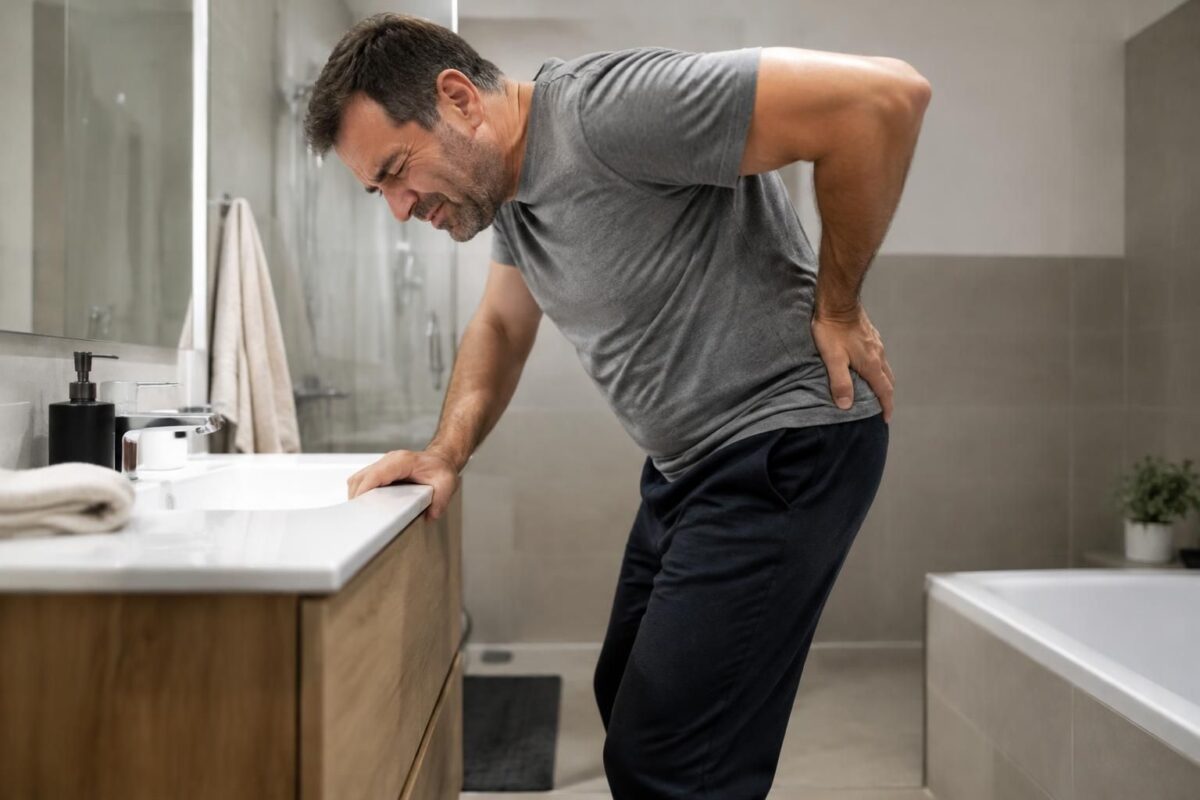
Sciatica and bending over the sink: pain in the leg
IN BRIEF Sciatica is pain related to irritation or compression of the sciatic nerve, which can extend from the lower back down to the leg. Bending over the sink can exacerbate the pain, especially if this position increases pressure on…

Sciatica and washing feet: lumbar flexion to monitor
IN BRIEF Sciatica can make washing your feet uncomfortable, as bending forward accentuates lumbar flexion and may trigger pain. To limit strain, sit down, bring your foot closer to you, or use a long-handled aid. These adjustments make personal hygiene…

Sciatica and dressing: daily gestures to adapt
IN BRIEF Sciatica can make dressing uncomfortable, but a few simple gestures help limit tension. Sit down to put on pants, socks, and shoes, choose easy-to-wear clothing, and avoid bending or twisting suddenly. These adjustments make daily dressing easier without…
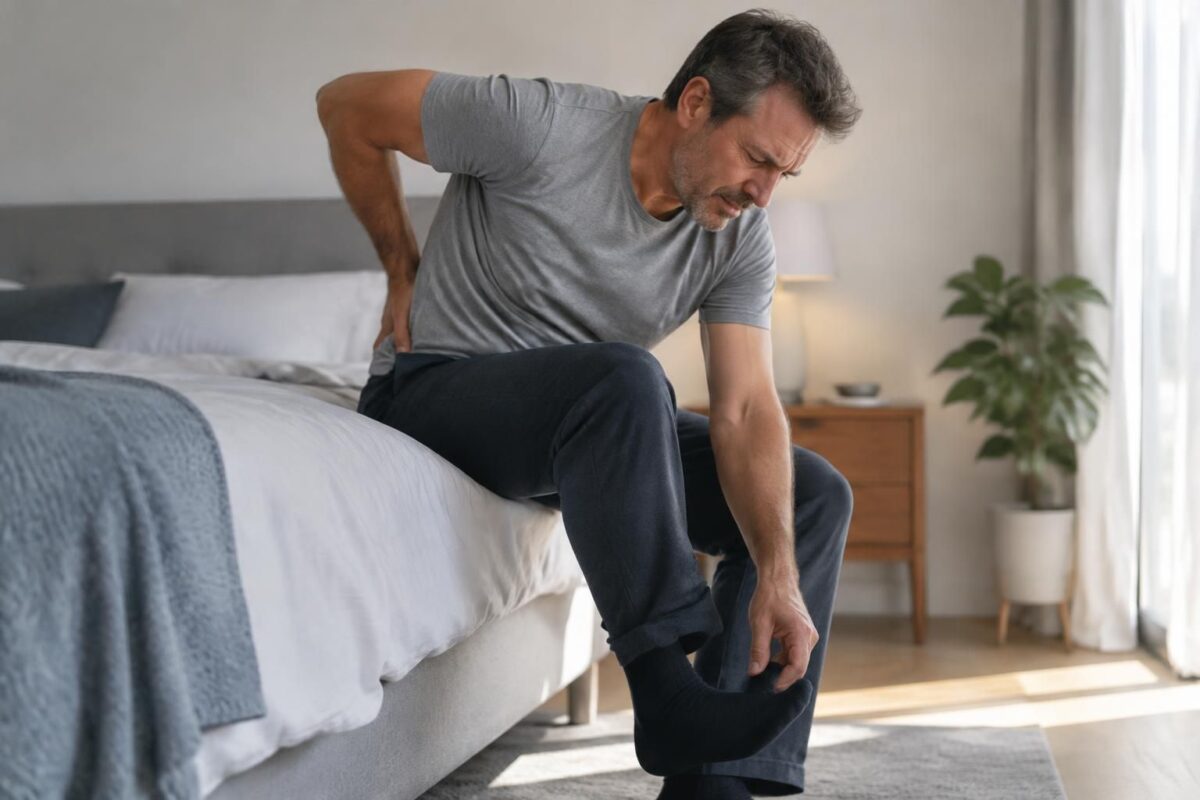
Sciatica and putting on socks: bending and pain in the leg
IN BRIEF Sciatica can make it difficult to put on your socks: bending over can increase the pain that radiates down the leg. Sitting down, using a sock aid, or avoiding painful bends can make this daily task easier. If…

Sciatica and tying your shoes: why the pain can radiate down
IN BRIEF Sciatica is pain related to the irritation of a nerve in the lower back, which can radiate into the buttock and leg. Leaning down to tie your shoes may accentuate the pain or cause it to descend further.…

Sciatica and picking up an object from the ground: movement to watch out for
IN BRIEF Sciatica is pain that follows the path of the sciatic nerve. To pick up an object from the ground, avoid bending abruptly while rounding your back or twisting: bend your knees, tilt your hips, and keep the object…

Sciatica and bending forward: lumbar disc or nerve tension?
IN BRIEF Forward-bending sciatica may be related to irritation of the lumbar disc or tension on the sciatic nerve. This movement alone does not allow for determining the cause. Identifying the movements that trigger the pain helps guide the evaluation…

Sylvain Desforges, B.Sc., D.O., N.D., docteur en ostéopathie
Dr Sylvain Desforges, B.Sc., D.O., N.D., osteopath, is the founding president of TAGMED and of the ACMA association. He dedicates his practice to chronic spinal pain, low back pain and symptoms compatible with sciatica, particularly when pain radiates toward the buttock, leg, calf, foot or toes.
Through SOS Sciatique, he publishes educational content on sciatica symptoms, possible causes such as disc herniation, disc narrowing, foraminal stenosis or irritation of a lumbar nerve root, as well as non-surgical approaches that may be considered according to the evaluation. At Clinique TAGMED, care may include, depending on the case, motorized neurovertebral decompression, specific osteopathic care or precision percussion.
For an evaluation related to sciatica treatment in Montreal / Mount Royal or sciatica treatment in Terrebonne, please consult the services available at Clinique TAGMED.
Medical disclaimer
The information published on SOS Sciatique is provided for educational purposes only and does not replace a consultation, diagnosis, opinion or treatment provided by a physician or another authorized healthcare professional. The author of this article is neither a medical doctor nor a specialist in a medical specialty recognized by the Collège des médecins du Québec. The osteopathic, manual medicine or functional support approaches described on this site do not constitute medical acts and are not intended to replace medical follow-up.
Consult a physician or emergency service in cases of loss of bladder or bowel control, anesthesia in the saddle area, significant or progressive weakness in the leg or foot, fever, recent trauma, severe pain or rapid worsening of symptoms. For more details, please read our Legal Notice.