

Disc bulge and pain in sitting position
10/11/2026
L4-L5 disc herniation and sciatica in Montreal: pain towards the foot
11/11/2026
IN BRIEF
| Sciatica can make movement more anticipated and controlled, especially when pain persists. Gradually adjusting one’s movements helps preserve protective strategies while regaining more movement options. The support aims to move with less constraint and to enhance daily autonomy. |
With chronic sciatica, moving is sometimes still possible but requires more anticipation and control. Avoiding certain movements or performing them with caution can help protect oneself, but this adjustment can also make movement more restrictive in daily life.
The support aims to gradually rediscover multiple ways to move, in concrete situations and at an adapted pace. The goal: to broaden movement possibilities and foster greater ease and autonomy.
Sciatica can make certain movements more difficult or worrisome, without necessarily making them impossible. Adapting the way of moving can help maintain daily activities without placing excessive strain on the body. This approach does not involve forcing or avoiding all movement: it takes into account symptoms, context, and the progression of pain, with the help of a healthcare professional when necessary.
Pain that starts from the lower back or buttock and radiates down the leg may be associated with irritation of a nerve root. Symptoms vary depending on their cause and intensity. To better understand why pain related to a herniated disc can radiate down the leg, one must consider the pathway of the nerve and the medical assessment.
When pain lasts, a person may start to anticipate certain movements, slow them down, or avoid them. These reactions may temporarily reduce anxiety. But when they increasingly limit activities, they deserve to be examined with a professional. The goal is not to correct a movement deemed “bad,” but to find a way to move that remains suitable for the situation.
Movement may remain possible, but become more demanding
A person may still perform a movement while needing more time, attention, or precautions. Getting up, sitting, or walking may then require significant preparation. This difference between “being able to do” and “being able to do easily” matters in the assessment of chronic pain.
Controlled movement is not about perfect posture or a single technique. It refers to a way of adjusting effort and range to what the person feels. It may involve temporarily modifying the pace of an activity or changing position when sitting for a long time increases discomfort. Breaks at work should also consider the individual and their symptoms, as explained in this article on breaks at the office and sciatica.
Controlling does not mean tensing up
Excessive caution can make each movement more tiring. The person then constantly monitors their back or leg and reduces the variety of their movements. Professional support can help distinguish a useful adjustment from a strategy that has become too constraining.
The aim is not to eliminate all precautions. It is to allow for more choices in daily life when possible and without worsening symptoms. Joint mobility and how it impacts activities can also be discussed with a professional, as presented in this resource on osteopathy and mobility.

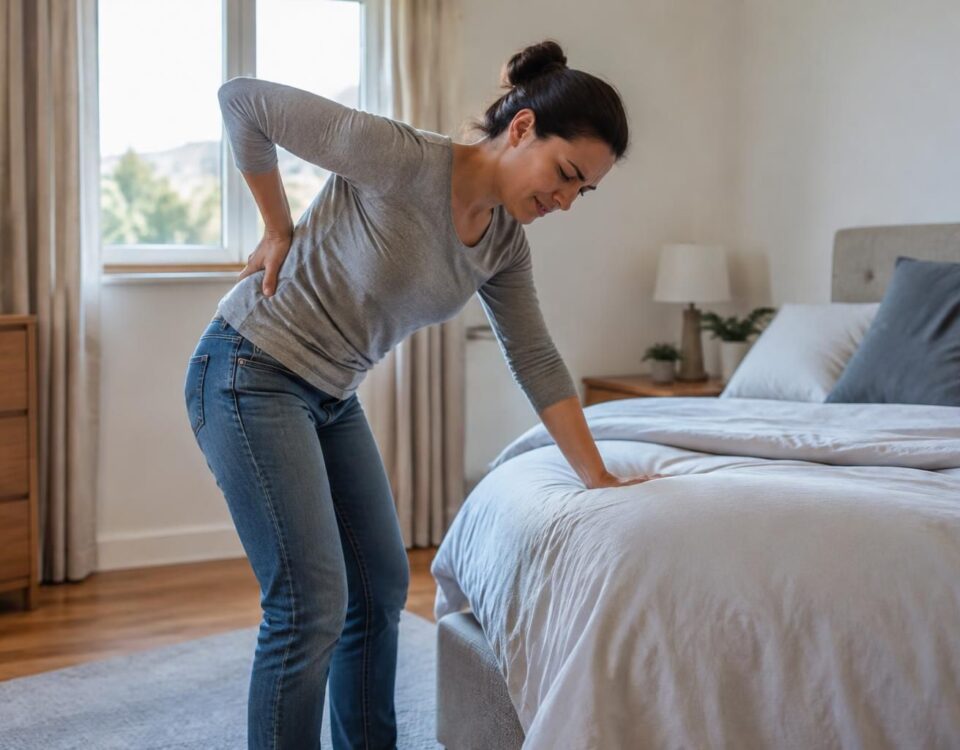
Sciatica and Making the Bed: Repeated Flexion and Lumbar Irritation
IN SHORT Sciatica is pain related to irritation or compression of the sciatic nerve. Making your bed can strain the lower back if bending is repeated, especially when rounding the back or twisting the torso. To limit lumbar irritation, bend…
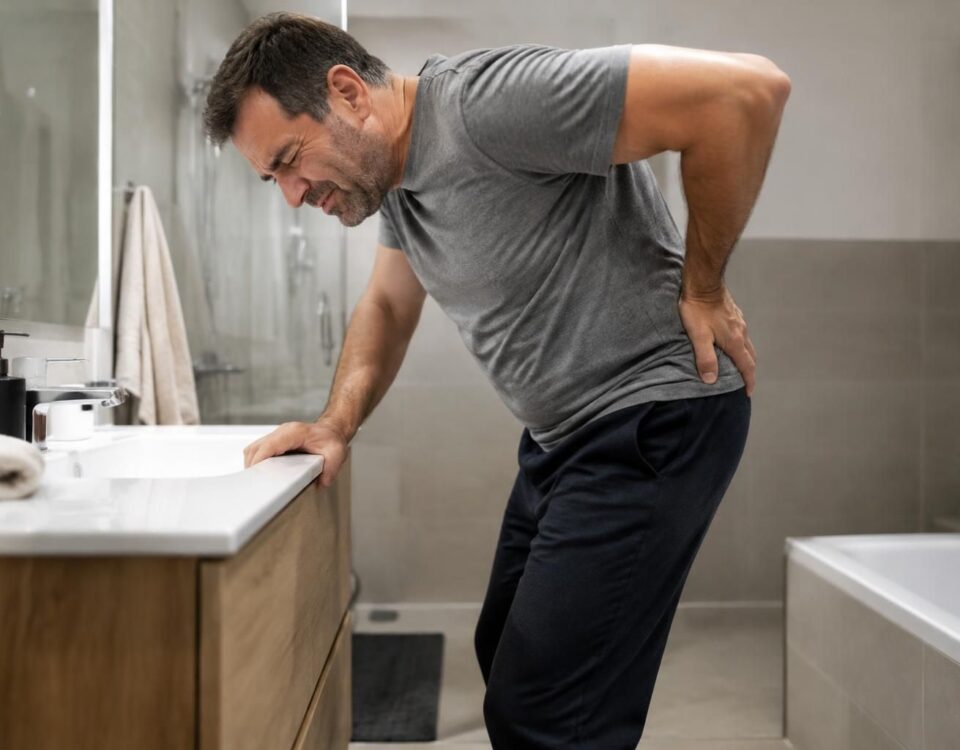
Sciatica and bending over the sink: pain in the leg
IN BRIEF Sciatica is pain related to irritation or compression of the sciatic nerve, which can extend from the lower back down to the leg. Bending over the sink can exacerbate the pain, especially if this position increases pressure on…

Sciatica and washing feet: lumbar flexion to monitor
IN BRIEF Sciatica can make washing your feet uncomfortable, as bending forward accentuates lumbar flexion and may trigger pain. To limit strain, sit down, bring your foot closer to you, or use a long-handled aid. These adjustments make personal hygiene…
Adapting activity to the body’s response
Pain does not alone provide a precise diagnosis. A mild and temporary discomfort does not automatically mean that damage is worsening. Conversely, sharp pain, persistent aggravation, or the appearance of new symptoms warrants re-evaluation. A healthcare professional can assess the situation and clarify the appropriate guidelines.
It is better not to copy a program found online without prior evaluation. The exercises presented in general resources, such as advice on sciatica and exercises or the movements suggested to relieve sciatica, may not necessarily be suitable for every cause of pain. In the presence of a herniated disc or another identified condition, seek medical advice before undertaking exercises or stretches.
Considering the evolution of symptoms
A professional can help identify activities that trigger symptoms, those that soothe them, and the changes that occur over time. This observation allows recommendations to be adapted to real life, rather than following a one-size-fits-all rule.
Pain that radiates further down the leg after a movement deserves special attention, especially if this change persists. The resource dedicated to pain radiating further down after a movement emphasizes the importance of interpreting symptoms with caution. Pain may also appear in the leg without marked back pain; this point is presented in this article on herniated disc and pain without back pain.

Sciatica and dressing: daily gestures to adapt
IN BRIEF Sciatica can make dressing uncomfortable, but a few simple gestures help limit tension. Sit down to put on pants, socks, and shoes, choose easy-to-wear clothing, and avoid bending or twisting suddenly. These adjustments make daily dressing easier without…
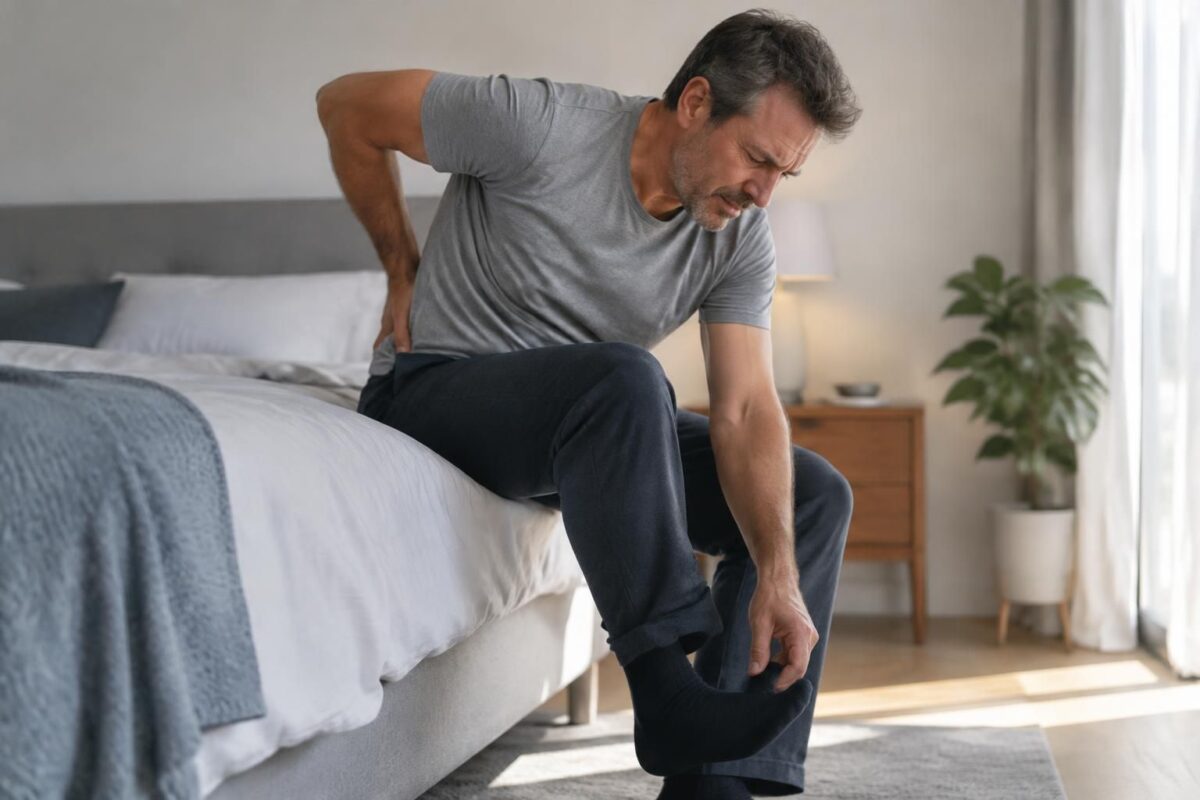
Sciatica and putting on socks: bending and pain in the leg
IN BRIEF Sciatica can make it difficult to put on your socks: bending over can increase the pain that radiates down the leg. Sitting down, using a sock aid, or avoiding painful bends can make this daily task easier. If…

Sciatica and tying your shoes: why the pain can radiate down
IN BRIEF Sciatica is pain related to the irritation of a nerve in the lower back, which can radiate into the buttock and leg. Leaning down to tie your shoes may accentuate the pain or cause it to descend further.…
The role of professional assessment
An assessment allows for a clearer understanding of symptoms, their duration, their effect on activities, and associated signs. It also helps determine whether specific care is necessary. Rehabilitation can include education about pain and movement, but its content should depend on the assessment and is not just a list of exercises.
To better understand how care can be organized, consult this resource on rehabilitation and sciatic pain. The principles of neurodynamics are also described in an article dedicated to neurodynamics of sciatica and in this guide on the neurodynamics of the sciatic nerve. This information does not replace professional advice tailored to your condition.
Quickly consult a professional if the pain is accompanied by new or worsening weakness, significant loss of sensation, or difficulties in controlling the bladder or intestines. These signs require urgent medical evaluation.
Resources to Better Understand Sciatica
Sciatica can have various causes. General information on symptoms, activities, and management options can help prepare for a consultation, but it cannot provide a remote diagnosis. To explore other perspectives, you can consult resources on joint mobility, sciatic pain, and exercises mentioned in general advice. In the case of a herniated disc or persistent symptoms, ask a professional if this advice is appropriate before following it.
Medical disclaimer: The information and advice provided on this site do not replace the advice, diagnosis, or treatment of a healthcare professional. Please note that Sylvain Desforges, B.Sc., D.O., N.D., Doctor of osteopathy, is neither a medical doctor nor a physician, and is not a specialist in a medical specialty as defined by the Collège des médecins du Québec. Manual medicine, functional medicine, and sports medicine as described on this site exclude any medical treatment or diagnosis by a physician or specialist doctor. Always consult your doctor for any medical questions. For more details, please read our full Legal Notice.
- Anticipating movement can help feel secure, but requires more attention.
- Avoiding certain gestures can provide short-term protection while reducing explored movements.
- Controlling each gesture can make the action more tiring, even when it remains possible.
- Gradually adapting effort allows movement exploration without forcing.
- Varying ways to move helps regain more options in daily life.
- Having support allows adjusting movements to pain and personal situation.

With sciatica, moving can remain possible while requiring more attention and effort. Adapting movement does not mean giving up: it allows gradually resuming useful gestures, considering symptoms and abilities. The goal is to regain more options without forcing or letting pain dictate every movement.
Sciatica: When Movement Becomes More Controlled
A pain that starts from the lower back or buttock and radiates down the leg can make certain gestures less spontaneous. Standing up, walking, or sitting can then be accompanied by anticipation: one slows down, alters posture, or avoids certain movements for fear of triggering pain.
These adjustments can help continue activities. However, when they become systematic, they risk gradually reducing the gestures one dares to perform. Movement remains possible, but its execution may seem more demanding and less natural.
Why Adaptation Matters
Respect Current Capabilities
Pain and tolerance for activity can vary from day to day. An adapted approach consists of adjusting the range, duration, or pace of a gesture rather than immediately trying to perform it as before. A shorter walk, regular breaks, or a slower movement can be helpful steps.
Adapting is not a sign of weakness. It helps stay active without imposing excessive strain. On the contrary, forcing oneself despite sharp pain or significant worsening is not a recommended strategy.
Avoiding Caution from Reducing All Possibilities
Protection is sometimes useful, especially when symptoms are significant. However, sustainably avoiding all gestures associated with pain can limit daily activities. With a professional, it is possible to gradually explore different ways of moving and identify those that are best tolerated.
This progression aims to regain confidence and variety, not to correct a gesture that would necessarily be “bad.” Learning to move differently can be just as important as seeking to move more.
Guidelines for Gradual Resumption
Prioritize Measured Progression
Start with an accessible activity and increase only one component at a time: duration, distance, or range. Observe how you feel during the activity and afterward. Mild and temporary discomfort does not always mean you need to stop completely, but intense pain or marked aggravation warrants reducing effort and seeking advice.
If you sit for long periods, change positions regularly and get up to walk for a few moments. These breaks can prevent you from staying in an uncomfortable posture for too long.
Getting Support for Appropriate Exercises
Mobility exercises, including those targeting the sciatic nerve, may not be suitable for all situations. Before starting a program, consult a physical therapist or a doctor who can assess your symptoms and adapt movements to your case. Do not force an exercise that causes sharp pain, increasing tingling, or lasting aggravation.
Support can also help define concrete goals: walking to a specific place, resuming a household task, or sitting more comfortably. Progress is then measured by the ability to engage in more activities with better-adjusted strategies, and not just by the immediate disappearance of pain.
| When movement is controlled | What adaptation can change |
|---|---|
| The gesture is anticipated | Less spontaneity |
| Some movements are avoided | Fewer options available |
| Every action requires attention | More effort on a daily basis |
| Prudence helps to continue activities | A useful protection at first |
| Control becomes a habit | A more restrictive organization |
| We experiment with other ways to move | More possibilities |
The testimonies below are illustrative examples and not accounts of identifiable patients. Each sciatica and each journey is different.
“I could walk, but I thought about every step.”
At first, I mainly focused on not triggering the pain. I shortened my steps and avoided certain movements. Being supported helped me try different ways to move, gradually, without trying to control everything at once.
“Movement was possible, but it cost me a lot.”
I could do my activities, but I anticipated every gesture and ended up exhausted. We adapted the exercises to what I could tolerate that day. I understood that progressing didn’t necessarily mean doing more, but regaining options for movement that suited me.
“I was afraid to bend.”
After several painful episodes, I had gotten used to avoiding certain gestures. My physical therapist suggested we re-explore them step by step, adjusting the amplitude and rhythm. This allowed me to move with less apprehension, without forcing or ignoring my body’s signals.
“I thought I had to maintain a perfect posture.”
I constantly monitored how I sat and got up. In consultation, I discovered there were several ways to make the same movement. This variety helped me feel less constrained in my daily gestures.
“Some days, I could do more than others.”
I learned to adapt my movements according to my symptoms and my level of fatigue. Instead of following a rigid progression, we sought an adjusted level of effort. This approach helped me stay active without viewing every variation of pain as a failure.
In sciatica, adapting movement does not involve eliminating all precautions or forcing despite pain. The goal may be to gradually explore different possibilities, with professional support tailored to your situation.
Sylvain Desforges is an expert in osteopathy, naturopathy, and manual medicine. Founder and president of TAGMED clinics and the ACMA association, he dedicates his career to innovation in health and supporting people facing persistent pain. His approach focuses especially on how pain influences movement, habits, and daily activities.
Sciatica can cause pain that radiates from the lower back down to the buttock and leg. But its effects are not limited to the painful sensation. A person can continue to walk, sit, or bend, all while performing these actions with more caution. They may anticipate the pain, reduce the range of their movements, or avoid certain positions. These adaptations are often understandable responses to an uncomfortable or unpredictable experience.
In the management of chronic pain, Dr. Desforges places significant emphasis on understanding these strategies. The ability to perform a movement does not necessarily mean it is easy, spontaneous, or energy-efficient. An action may remain doable but require more attention and effort. Over time, control and avoidance can become habits, limiting the options to which the person has spontaneous access.
The goal is not to blame someone for how they move or to abruptly eliminate their protective strategies. Rather, it involves understanding their role and gradually finding other ways to accomplish important gestures. For a person suffering from sciatica, this may involve a gradual return to certain movements, with an adapted difficulty and attention to the body’s reactions. This process must take into account the individual situation and does not replace a professional assessment.
Specialized in chronic pain management, Dr. Desforges advocates for care based on available data tailored to the needs of each patient. His work aligns with an approach that can combine clinical evaluation, movement support, and, when indicated, advanced technologies. Among those offered in his fields of activity are spinal decompression, laser, and shockwave therapy. Their relevance, however, depends on the situation and the evaluation made by a professional.
For him, support is not only about seeking to reduce pain. It can also help the person regain more possibilities in situations that matter to them: sitting more comfortably, resuming an activity, or moving with less apprehension. The aim is to develop a progressive adaptation rather than imposing a performance or a unique correction of the gesture.
This reflection on sciatica and controlled movement aligns with his mission: to contribute to optimizing the health and well-being of patients through informed and personalized care. It invites consideration of not only what a person can do but also how they go about it, the effort it requires, and the possibilities they wish to regain in their daily lives.
In chronic pain, moving often remains possible, but the gesture may become more anticipated, controlled, and costly in energy. Understanding this adaptation helps envision support that does not seek to impose a “perfect” movement but rather to gradually restore more options in the situations that matter in day-to-day life.
When movement becomes more controlled
With sciatica or persistent pain, it is common to think more before bending, walking, or sitting. One might reduce the range of a gesture, perform it more slowly, or avoid certain positions for fear of triggering pain. These reactions do not necessarily mean that the body can no longer move: they can be ways of coping with a painful or uncertain experience.
This caution can be useful at certain times. It sometimes allows one to continue activities while considering the symptoms. However, when it becomes ingrained in all actions, it can make movement more demanding and reduce spontaneous opportunities. The goal is not to eliminate all precautions but to find a flexibility between protection and resuming activity.
The interest of a gradual adaptation
Relevant support takes into account the person, the symptoms, and their actual activities. Rather than forcing a gesture or seeking an ideal posture, a professional can help explore several ways to move, gradually adjusting the amplitude, rhythm, and difficulty. This approach allows identifying what is tolerable today and evolving activities over time.
The body’s response after exertion also deserves to be observed without jumping to conclusions. Temporary discomfort, muscle soreness, and nerve irritation do not always overlap: this article on pain after exercise in case of sciatica may help better distinguish these situations. In case of doubt, worsening, or unusual symptoms, seek the opinion of a healthcare professional.
Rediscovering more possibilities in daily life
Progress is not only measured by the amount of movement or strength. It can also correspond to feeling less obliged to control everything, resuming an avoided activity, or having several ways to accomplish a gesture. For sciatica, exercises must be adapted to the cause of the symptoms and their intensity; squats, for example, are not necessarily suitable for all situations, as explained in this point on caution with squats.
A physiotherapist or another qualified professional can guide you in this progression and adapt the exercises to your situation. Additionally, you can consult resources on gentle movements to relieve sciatica and neurodynamic exercises. This information does not replace a personalized assessment but can support a structured and gradual approach.

Sciatica and picking up an object from the ground: movement to watch out for
IN BRIEF Sciatica is pain that follows the path of the sciatic nerve. To pick up an object from the ground, avoid bending abruptly while rounding your back or twisting: bend your knees, tilt your hips, and keep the object…

Sciatica and bending forward: lumbar disc or nerve tension?
IN BRIEF Forward-bending sciatica may be related to irritation of the lumbar disc or tension on the sciatic nerve. This movement alone does not allow for determining the cause. Identifying the movements that trigger the pain helps guide the evaluation…

Sylvain Desforges, B.Sc., D.O., N.D., docteur en ostéopathie
Dr Sylvain Desforges, B.Sc., D.O., N.D., osteopath, is the founding president of TAGMED and of the ACMA association. He dedicates his practice to chronic spinal pain, low back pain and symptoms compatible with sciatica, particularly when pain radiates toward the buttock, leg, calf, foot or toes.
Through SOS Sciatique, he publishes educational content on sciatica symptoms, possible causes such as disc herniation, disc narrowing, foraminal stenosis or irritation of a lumbar nerve root, as well as non-surgical approaches that may be considered according to the evaluation. At Clinique TAGMED, care may include, depending on the case, motorized neurovertebral decompression, specific osteopathic care or precision percussion.
For an evaluation related to sciatica treatment in Montreal / Mount Royal or sciatica treatment in Terrebonne, please consult the services available at Clinique TAGMED.
Medical disclaimer
The information published on SOS Sciatique is provided for educational purposes only and does not replace a consultation, diagnosis, opinion or treatment provided by a physician or another authorized healthcare professional. The author of this article is neither a medical doctor nor a specialist in a medical specialty recognized by the Collège des médecins du Québec. The osteopathic, manual medicine or functional support approaches described on this site do not constitute medical acts and are not intended to replace medical follow-up.
Consult a physician or emergency service in cases of loss of bladder or bowel control, anesthesia in the saddle area, significant or progressive weakness in the leg or foot, fever, recent trauma, severe pain or rapid worsening of symptoms. For more details, please read our Legal Notice.