Why osteopathy is essential for a good quality of life
27/06/2026
Osteopathic manipulations to relieve lower back pain
27/06/2026
In short
| In short, theOsteopathy and joint mobility is an approach that aims to improve theNatural amplitude of the joints To allow movements more fluid and effective. The main advantages include pain reduction, posture improvement, Best recovery and Injury prevention, which optimizes performance and comfort on a daily basis. Its operation is based on a Restriction Assessment and gentle techniques that restore mobility and rebalance tensions. accessible to Montreal, this service is particularly suitable for regular athletes, yoga practitioners and any active person wishing Move better and longer. |
osteopathy and mobility : improve the Joint movements To gain freedom, performance and comfort.
- theosteopathy aims to free up Movement restrictions and to restore theamplitude natural joints.
- By rebalancing the tensions and optimizing thealignment, it improves the mobility and the posture.
- Thanks to gentle techniques and simple exercises, it promotes a fluidity gestures and a better coordination.
- Result: less pain, better performance in everyday life and in sport, and faster recovery. Consult an osteopath to assess your mobility and guide a personalized plan.
Quick Summary: Losteopathy Acts on the mobility of Joint movements To improve the fluidity of gestures, optimize the posture and prevent pain. This article outlines the basics of Joint mobility, the role of the osteopath, and the actions to be favored to maintain and improve movements on a daily basis, while remaining in a secure and adapted approach to everyone.
What is joint mobility and why it counts
The Joint mobility Refers to the ability of an articulation to move freely in its natural amplitude. It depends on the Muscle flexibility, from theElasticity of tissues (ligaments, tendons), good Joint alignment and a good coordination between the muscles and the nervous system. Appropriate mobility allows the body to move without constraints, to cushion shocks and to avoid compensation that can lead to pain or injury in the long term.
how Losteopathy acts on mobility
In consultation, the osteopath spots movement restrictions that limit performance or cause pain. By Gentle techniques, he seeks to Restore mobility, to Rebalance tensions and improve the posture overall. The goal is to optimize recovery after exercise and support the body’s ability to move smoothly and accurately, without pain.
Maintain and improve daily mobility
Mobility is worked through a regular and adapted approach. It’s about adopting habits that support theJoint amplitude, breathing and muscle relaxation. Regular visits to the osteopath can help detect and correct early tensions and protections that limit movement. an approach centered on posture, coordination and overall well‑being improves the quality of daily and sporting gestures.
The role of structures and breathing in movement
Mobility does not depend only on muscles. The fascias, joints and the nervous system play a crucial role in how we move. An osteopathic approach aims to harmonize these elements, so that the movement remains fluid, energetic and reagent Faced with the demands of daily life and physical activity.
Resources and training
Resources and training in osteopathy are part of NUMSS, NAO, National University of Medical Sciences and National Academy of osteopathy. To explore certain aspects, you can consult articles and guides on specialized resources such as Osteopathy and recovery after muscle injuries, or Osteopathy and joint pain. Other useful information is available on Osteopathy and tendonitis, Post-sports injury recovery and on Joint mobility and performance.
The work is in a recognized professional setting. Relevant associations and organizations include ACMA, College of Canadian Osteopaths and College of Canadian Osteopaths. For practices and treatments, the approach focuses on manual techniques and individual evaluation, rather than generic programs. Specific resources can be accessed via the dedicated pages of partner clinics and specialized centres.
To learn more about the practical implications of osteopathy in mobility and movement, visit specialized resources such as Leg pain and mobility or Well-being and mobility. You can also consult Mobility and effective training.
If you are looking for specific information on the links between mobility and recovery after injury, refer to the dedicated resources and your graduate osteopath, in order to obtain an assessment adapted to your personal situation.
Medical disclaimer : The information and advice provided on this site does not replace the advice, diagnosis or treatment of a health professional. Please note that Dr. Sylvain Desforges osteopath is neither a doctor of medicine nor a doctor, and is not a specialist in a medical specialty as defined by the Collège des Médecins du Québec. Manual medicine, functional medicine and sports medicine as described on this site exclude any medical treatment or diagnosis made by a doctor or specialist doctor. Always consult your doctor for any medical questions. For more details, please read our full legal notice.
- Precise diagnosis : Identify joint restrictions and muscle imbalances.
- measured release : Gentle techniques to restore the amplitude without pain.
- Musculoskeletal balance : restore functional posture and fluidity.
- Optimized recovery : better recover and release tensions after exercise.
- Autonomy and exercises : Simple gestures to do on a daily basis.
- compensation prevention : Avoid myo-fascial chains that limit movement.
- Breathing and posture : Alignment and breath to release the joints.
- Personalized follow-up : adaptation of the treatment to progress and activities.

In this article, learn how theosteopathy can optimize your Joint mobility and improve your Joint movements. By combining a targeted evaluation and gentle gestures, you gain fluidity, prevent pain and boost your performance, whether you are sporty, active on a daily basis or in search of lasting comfort.
Understanding joint mobility
What is joint mobility?
The Joint mobility is the ability of your joints to move freely in their natural amplitude, without unnecessary blockages or resistance. It depends on the muscle flexibility, from theElasticity of tissues (ligaments, tendons), of a Joint alignment optimal and good Neuromuscular coordination.
factors that influence it
A balance between strength, flexibility and stability is essential. Excessive muscle tension, joint restrictions or postural imbalances can limit amplitude and promote long-term painful compensation.

How osteopathy improves the quality of life of active people
In short In short, theosteopathy is a global approach that Optimizes mobility and the function of the body of ACTIVE PEOPLE, for a better quality of life. It helps prevent injury and reduce Musculoskeletal pain While promoting the Sports recovery.…

Osteopathy and sports recovery: prepare the body for lasting performance
In short In short, Osteopathy and Sports recovery is one Global manual approach that sustainably prepares the body for the effort by restoring mobility and circulation After the effort. It is a discipline that acts on the sinews, the joints,…
Link between mobility and performance
Concrete impact on movements
The more your joints work freely, the more fluid and effective your gestures are. For example, mobile hips improve propulsion in the runner, sufficient shoulder amplitude optimizes swimming propulsion and a well-aligned back supports better indoor posture.
Conversely, a reduced mobility May cause other segments to compensate, increasing the risk of injury and lasting pain.
Why Osteopathy Is Essential For Recovery People
In short In short, Osteopathy in convalescence is an approach manual and holistic which helps to accelerate the recovery by restoring The balance, the mobility and a good circulation fabrics. it contributes to Reduce the pain, support the Back to…

Osteopathic manipulations to strengthen post-traumatic muscles
In short In short, Osteopathic manipulations for Strengthen post-traumatic muscles constitute a gentle manual approach aimed at restoring the mobility, reduce the pain and facilitate the Functional rehabilitation After a injury. What is Is it? A series of precise gestures…
How to maintain and improve your daily mobility
Exercises and routines
Mobility is worked with regular practice. Before the effort, choose Dynamic mobility exercises : hip circles, arm rotations, knees, and Active stretches controlled. After the effort, choose Static stretching moderates to maintain tissue elasticity.
– Vary activities to solicit the body in all directions and integrate exercises of sheathing With controlled amplitude to stabilize the joints. Conscious breathing helps release tension and improve coordination.

Osteopathy and prevention of work-related musculoskeletal disorders
In short theosteopathy is one Manual approach that restores body balance and prevents MSD related to work. Its advantages: reduction of tension, improvement of mobility and prevention of chronic pain. She is preventive and healing, suitable for office and trades…

The benefits of osteopathy to treat muscle imbalances
In short theosteopathy is a manual approach to restore themuscle harmony and postural considering the body as a whole. Its main benefits include the reduction of aches and tensions, the improvement of the mobility and from the posture, and prevention…
The role of osteopathy in joint mobility
What the osteopath can do
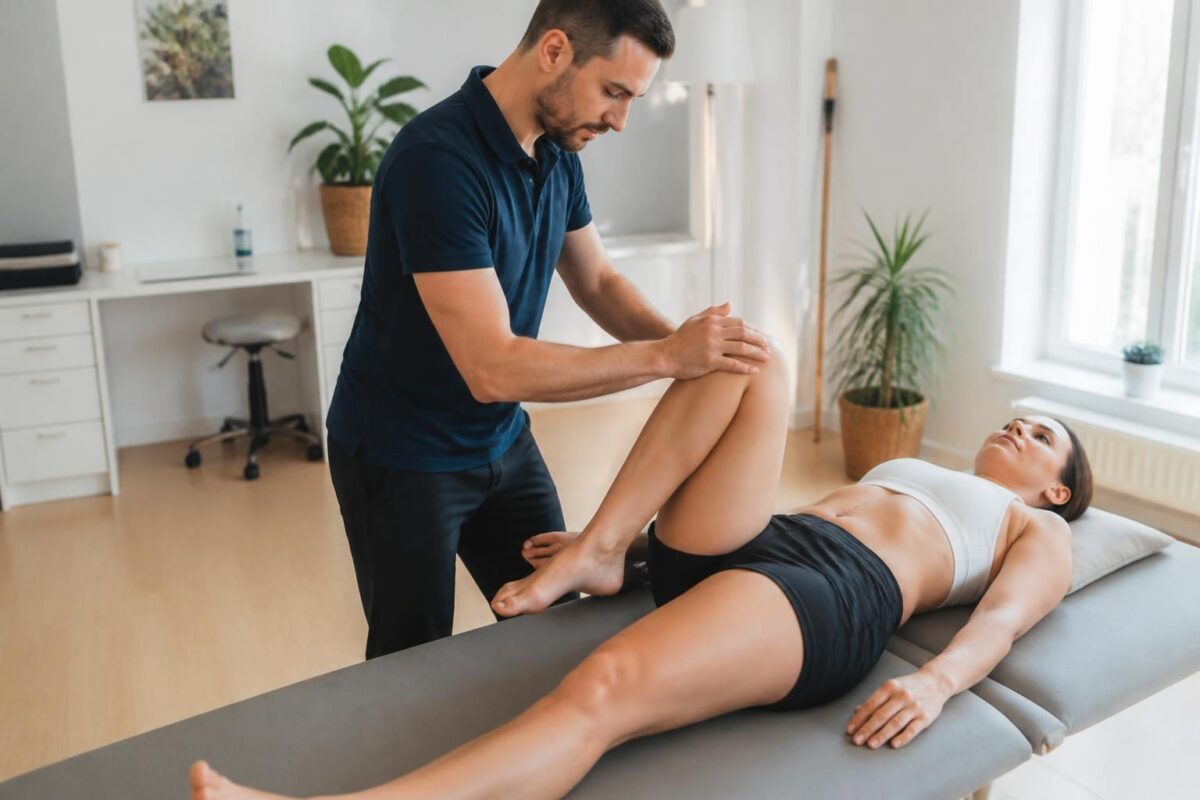
theosteopathy Helps to identify and treat movement restrictions (joints, muscular, visceral) that limit mobility or cause pain. Through gentle techniques, it can restore mobility, rebalance tension and improve overall posture.
It optimizes recovery after exercise and prepares the body to progress in a sustainable way, in addition to personal work on mobility.
Osteopathy and chronic leg pain: regaining an optimal quality of life
In short In short, Osteopathy is one Global manual approach aimed at reducing Chronic leg pain and improve the quality of life. What is it? Non-drug therapy using the hands to identify restrictions and treat lesional chains. How does it…
How osteopathy supports recovery after complex surgery
In short In short, Post-operative osteopathy is an approach fresh which supports the recovery After a Complex surgery. It helps to reduce the pain and the fatigue, improves the mobility and accelerates the healing thanks to a better vascularization and…
Prevent injuries through better mobility
Prevention and routine
a joint hypomobile May lead to compensation in other areas and promote tendonitis, sprains or low back pain. maintain a Regular mobility Distributes stress better, reduces friction and accelerates recovery.
The key is regularity rather than intensity. A few minutes dedicated daily are enough to prevent tension and gain fluidity.
| Aspect | Concise impact |
|---|---|
| Detection restrictions | IDENTIFICATION OF Joint restrictions and muscular to guide the treatment. |
| techniques in use | techniques sweet and adapted to restore theamplitude and the mobility. |
| Amplitude and mobility | measurable improvement of theamplitude and from the fluidity Movements. |
| Posture overall | rebalancing of the posture To optimize movement and prevent compensation. |
| Recovery and tolerance | top recovery and exercise tolerance through better circulation. |
| Prevention pains | reduction of risks injury and chronic pain through preserved mobility. |
| habits daily | Integration ofhabits simple to maintain mobility sustainably. |
| Performance sportswoman | movements more fluids and efficient in physical activity. |
| Monitoring and progression | Regularity of sessions and guided self-treatment for progress durable. |
Testimonials: osteopathy and mobility to improve joint movements
“Since my first session ofosteopathy, my mobility won in amplitude and my joints move without constraint. The pain became more discreet and my movements seem more fluids daily and in sports. »
“I had a posture hesitant and a balance fragile; After a few sessions, my mobility strengthened and my posture is more aligned, with safer gestures during my workouts. »
“In my everyday life, the improvement of the flexibility around joints Makes daily gestures easier, like climbing stairs or turning your head painlessly. »
“As a regular sportsman, theosteopathy optimized coordination between sinews and the the nervous system, reinforcing my performance and reducing the risk of injury. »
“Thanks to the work on the Joint mobility, my recovery After the effort is faster and I feel less stiff when I wake up, which allows me to resume the sessions with energy. »
Dr Sylvain Desforges, osteopath and key player in the field, is recognized for an integrated approach that combines osteopathy, naturopathy and manual medicine. At the head of TagMed and the ACMA association, he places health innovation at the heart of his practice and devotes himself to the Management of Chronic pain, in particular by the introduction of advanced technologies such as spinal decompression, laser and shock wave therapies. His approach is based on clinical evidence and attentive listening to patients, in order to optimize their health and well-being on a daily basis. His vision associates mobility, posture and movement as pillars of sustainable performance.
To understand the Joint mobility, it must be seen as the ability of the joints to move freely in their Natural amplitude. This capacity depends on multiple factors: the flexibility muscles, tissue elasticity (ligaments and tendons), proper alignment of articular surfaces and coordination between the muscles and the nervous system. In short, a mobility Sufficient allows the body to move without constraint, to cushion shocks and to avoid compensation which, in the long term, causes pain or injury.
It is often believed that the performance is measured only by force. However, to move effectively, each joint must fulfill its role. For example, a runner whose hips lacks amplitude can compensate by the back or knees and expose themselves to injury; A swimmer with low-moving shoulders sees his propulsion reduced; A fitness practitioner without chest flexibility can adopt a posture that degrades technique and results. The more the joints are mobile, the more fluid, powerful and precise the gestures become.
The good news is that the Joint mobility Works regularly and without seeking immediate performance. Before exercise, favor dynamic mobility exercises that prepare the body: hip circles, arm rotations, knees; Prefer active stretching without forcing and integrate sheathing exercises with a controlled amplitude. These gestures activate the muscles, strengthen circulation and prepare your joints for exercise, while they promote better neuromuscular coordination.
The role of osteopathy in Joint mobility Consists of screening and correcting the limitations that hinder the movement. The osteopath identifies joint, muscle and sometimes visceral restrictions, and uses gentle techniques to restore mobility, rebalance tension and improve overall posture. By working on mobility, recovery after exercise can also be optimized, which contributes to a lasting and painless progression.
Preventing injuries involves maintaining a mobility sufficient rather than by the intensity of the training taken in isolation. A hypomobile joint leads to compensations that require other areas and increase the risk of tendonitis, sprains or low back pain. By maintaining the mobility On a daily basis, you distribute the stresses better, reduce friction and facilitate muscle recovery. Even short daily sessions, if they become usual, can bring significant gains.
By integrating these principles, each movement gains in fluidity and precision, and your body can accept effort without constraints.
This approach highlights how Joint mobility Influences daily movements and athletic performance, and how Osteopathy Can optimize this mobility to prevent pain and injury. By summarizing the essential notions, this article explains what mobility is, why it counts, how to maintain it and the specific role of osteopathic practices in the improvement of joint movements, with resources to deepen.
A Joint mobility Sufficient allows shocks, to avoid compensation and to execute movements with fluidity and precision. When the joints lack amplitude, the muscle chains take over ineffectively, increasing the risk of pain and fatigue. By working on mobility, we optimize the efficiency of the movement and comfort on a daily basis.
The role of theosteopathy Is central to identifying and correcting joint, muscle or visceral movement restrictions that limit performance. Through gentle and appropriate techniques, the osteopath can restore mobility, rebalance tension and improve general posture, while promoting faster recovery after exercise. These interventions are part of a global approach combining personal work and professional follow-up.
To maintain the mobility On a daily basis, favor Dynamic mobility exercises Before the effort, stretching at the end of the session and a diversified rotation of physical activities. Regular practice, breathing and relaxation play a key role in preventing stiffness and pain. Integrating movements in all directions and maintaining proper muscle-nervous synchronization maximizes results.
Prevention requires regularity rather than excessive intensity. A few minutes of mobility per day can reduce joint friction, improve recovery and limit the risk of tendonitis, sprains or low back pain. by combining osteopathy And individual exercises, you give your body the best chance of remaining mobile and performing in the long term.
To deepen these concepts and discover practical resources, consult the following articles and guides in particular: Osteopathy and mobility – Improve joint movements, Preserving your mobility on a daily basis, Why osteopathy is essential, and other useful resources on Osteopathy and osteoarthritis and the non-invasive management of lower back pain on Osteopathy and lower back pain. Other useful readings exist through the following information pages: Osteopathy and arthritis – Quality of life, Benefits for amateur athletes, and Support after an accident. additional resources like Joint mobility maintenance – Videos and stretching offer practical exercises.

Dr Sylvain Desforges, B.Sc., D.O., N.D., osteopath, is the founding president of TAGMED and of the ACMA association. He dedicates his practice to chronic spinal pain, low back pain and symptoms compatible with sciatica, particularly when pain radiates toward the buttock, leg, calf, foot or toes.
Through SOS Sciatique, he publishes educational content on sciatica symptoms, possible causes such as disc herniation, disc narrowing, foraminal stenosis or irritation of a lumbar nerve root, as well as non-surgical approaches that may be considered according to the evaluation. At Clinique TAGMED, care may include, depending on the case, motorized neurovertebral decompression, specific osteopathic care or precision percussion.
For an evaluation related to sciatica treatment in Montreal / Mount Royal or sciatica treatment in Terrebonne, please consult the services available at Clinique TAGMED.
Medical disclaimer
The information published on SOS Sciatique is provided for educational purposes only and does not replace a consultation, diagnosis, opinion or treatment provided by a physician or another authorized healthcare professional. The author of this article is neither a medical doctor nor a specialist in a medical specialty recognized by the Collège des médecins du Québec. The osteopathic, manual medicine or functional support approaches described on this site do not constitute medical acts and are not intended to replace medical follow-up.
Consult a physician or emergency service in cases of loss of bladder or bowel control, anesthesia in the saddle area, significant or progressive weakness in the leg or foot, fever, recent trauma, severe pain or rapid worsening of symptoms. For more details, please read our Legal Notice.