Sciatica disc in Montreal: movements to avoid at the start
19/11/2026
Sciatica and pain with fever: why consult?
19/11/2026
IN BRIEF
| Disc-related sciatica corresponds to a nerve irritation that can cause pain from the lower back to the buttock or leg. Initially, avoid movements that worsen the pain, such as deep bends, sudden twists, and carrying heavy loads. In Terrebonne, an assessment can help tailor movements and activities to your symptoms. Consult quickly in case of progressive weakness or loss of bladder or bowel control. |
In case of disc-related sciatica in Terrebonne, temporarily avoid movements that trigger or worsen the pain: repeated bending of the back, sudden twists, carrying heavy loads, and forced stretching. Long periods of sitting can also aggravate symptoms. Prefer gentle movements without trying to “push through” the pain, and have the situation evaluated by a healthcare professional.
Consult quickly in case of significant or progressive weakness of the leg, loss of bladder or bowel control, or numbness in the saddle area.
At the onset of disc-related sciatica in Terrebonne, certain actions may increase pain radiating down to the buttock or leg. Temporarily limit movements that trigger or aggravate your symptoms, especially repeated bending, twisting, and lifting heavy loads. However, the appropriate conduct depends on your condition and the evaluation by a professional.
Disc-related sciatica can occur when a structure of the disc irritates a nerve root. It can cause pain in the lower back, buttock, or leg, sometimes down to the foot. The pain and movements that trigger it vary from person to person.
Initially, avoid straining to “unlock” the back or repeating a movement that causes pain to radiate down the leg. A slight and temporary discomfort does not always mean that an injury is worsening. On the other hand, a pain that significantly increases, extends further down the leg, or is accompanied by weakness deserves special attention.
Limit repeated bending of the lower back
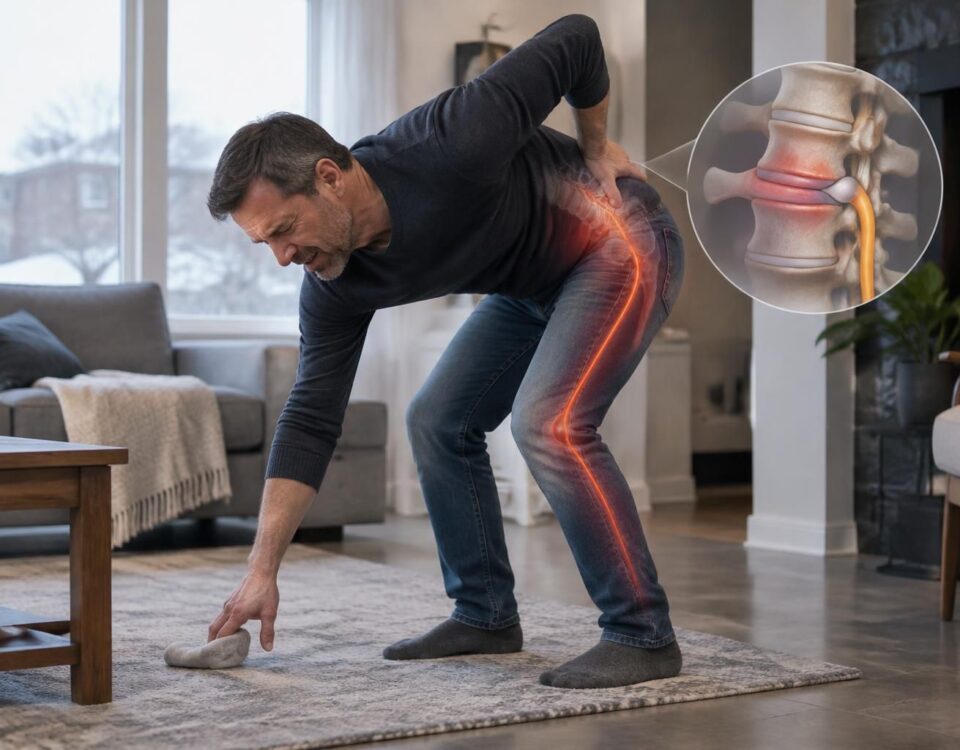
Bending forward several times can provoke or amplify symptoms in some individuals. Be careful when picking up an object, cleaning, or staying bent for long periods. When dressing, adjust your position instead of forcing it if pain arises, for example when tying your shoes with sciatica.
Bending is not forbidden for everyone. The useful guideline is your reaction: if the action clearly increases pain or radiates it further down the leg, reduce it temporarily and seek an evaluation.
Avoid sudden twists and heavy loads
Turning the torso while carrying a load can further irritate an already painful area. At first, avoid sudden movements, twisting efforts, and transporting heavy objects. Do not try to test your limits by repeating a painful action.
If you need to move an object, ask for help when possible. Also, reduce tasks that require repeated bends and rotations until you receive advice tailored to your situation.
Don’t stay in a position that worsens pain for long
A prolonged sitting or standing position can increase discomfort in some people. Change positions with caution and avoid staying still for long if it intensifies your symptoms. Bed rest for sciatica is not always the best response: prolonged rest can reduce daily activities without addressing the cause of the pain.
There is no single position that suits everyone. Choose a more comfortable posture and adjust your activities according to your symptoms. Do not force a movement to comply with a general rule found online.
Why pain may radiate down the leg
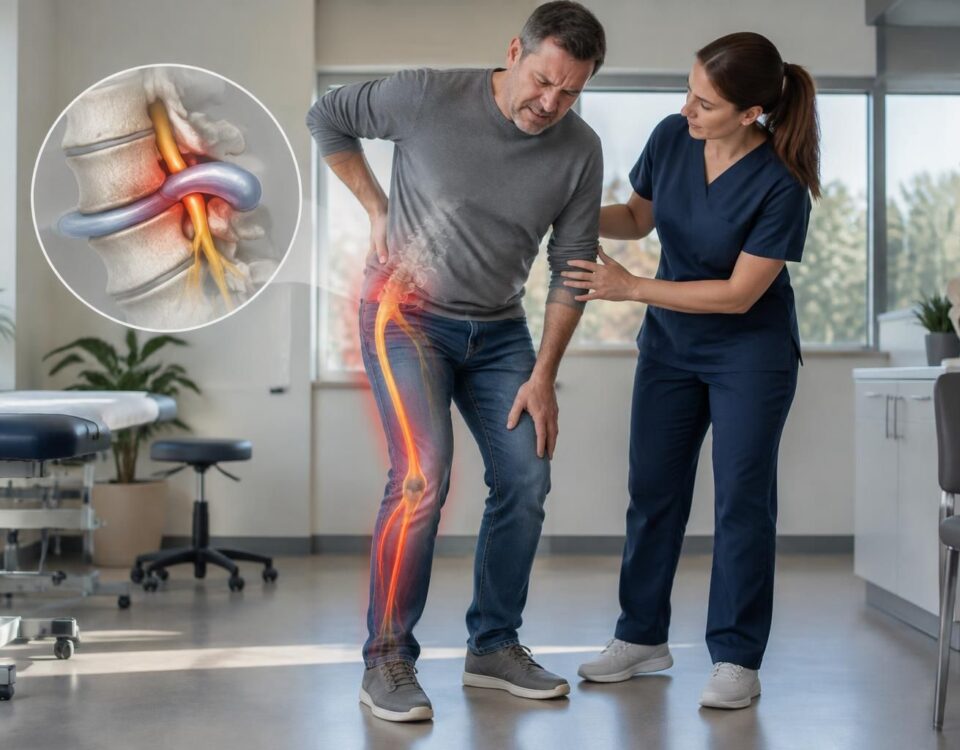
Pain in the leg may be related to irritation of a nerve root in the lower back. Pain that radiates down does not alone confirm a herniated disc or another disc problem. A healthcare professional can evaluate your symptoms and determine whether further examinations or medical follow-up are necessary.
To better understand this phenomenon, consult our page on disc-related sciatica and pain radiating down the leg. A disc pinch may also be mentioned during an evaluation, but only a qualified professional can interpret the signs and examinations in context.
Sciatica in Terrebonne: disc herniation and painful cough
IN BRIEF In Terrebonne, sciatica related to a herniated disc may be accompanied by pain that increases when coughing, as the pressure exerted can further irritate a nerve root. An evaluation helps to understand the origin of the symptoms and…

Sciatica in Terrebonne: pain worsened in sitting position and lumbar disc
IN SHORT Aggravated sciatica in a sitting position may be related to the irritation of a lumbar nerve root, sometimes associated with a lumbar disc. In Terrebonne, varying positions, taking short active breaks, and getting an evaluation can help better…
When to request an evaluation in Terrebonne
Request an evaluation if the pain persists, recurs frequently, or limits your activities. Recurring symptoms can have multiple causes. Our page on recurrent sciatica presents useful information to discuss during a consultation.
At the TAGMED Clinic, an evaluation can help determine if a non-surgical approach is appropriate. Depending on the case, care may include a motorized neurovertebral decompression, specific osteopathy, or a precision impactor. These options are not suitable for everyone and do not replace a medical diagnosis. To know the services offered, consult the page on sciatica treatment in Terrebonne.
Consult a doctor or emergency service quickly in case of loss of bladder or bowel control, numbness in the saddle area, significant or progressive weakness of the leg or foot, fever, recent trauma, severe pain, or rapid deterioration.

Sciatica in Terrebonne: pain worsened by flexion and disc-related cause
IN BRIEF Aggravated sciatica by flexion is pain that starts in the lower back and radiates into the buttock or leg; a lumbar disc herniation can irritate a nerve root, although it may not be the only possible cause. In…

Disc herniation in Terrebonne: why some stretches worsen
IN BRIEF Discogenic sciatica is pain related to the irritation of a nerve, sometimes worsened by certain stretches that intensify the symptoms. In Terrebonne, avoiding movements that cause pain to radiate down the leg and focusing on an appropriate approach…
About the author
Sylvain Desforges, B.Sc., D.O., N.D., Doctor of Osteopathy and naturopath, is the founding president of TAGMED and the ACMA association. He dedicates his practice to chronic pain in the spine, lower back pain, and pain consistent with sciatica, especially when the pain radiates down to the buttock, leg, calf, foot, or toes.
Through SOS Sciatique, he publishes educational content on the symptoms of sciatica, possible causes such as disc herniation, disc pinching, foraminal stenosis, or irritation of a lumbar nerve root, as well as non-surgical approaches that may be considered based on the assessment. At the TAGMED Clinic, care may include, depending on the case, motorized neurovertebral decompression, specific osteopathy, or precision impactor.
For an assessment related to sciatica treatment in Montreal / Mont-Royal or sciatica treatment in Terrebonne, check the services available at the TAGMED Clinic.

Sciatica in Terrebonne: disc herniation with leg weakness
IN SHORT Sciatica related to a disc herniation can cause pain that radiates down the leg, sometimes accompanied by weakness. In Terrebonne, an assessment helps guide management based on symptoms and their progression. A new, significant, or progressive weakness requires…

Sciatica in Terrebonne: herniated disc with foot numbness
IN BRIEF Sciatica related to a herniated disc can irritate a nerve root and cause pain that radiates down the leg, sometimes with a numbness in the foot. In Terrebonne, an evaluation helps to better understand the symptoms and consider…
Medical Disclaimer
Medical disclaimer: The information and advice provided on this site do not replace the opinion, diagnosis, or treatment of a healthcare professional. Please note that Sylvain Desforges, B.Sc., D.O., N.D., Doctor of Osteopathy, is neither a medical doctor nor a physician, and is not specialized in a medical specialty as defined by the Collège des médecins du Québec. Manual therapy, functional medicine, and sports medicine as described on this site exclude any medical treatment or diagnosis made by a doctor or medical specialist. Always consult your doctor for any medical questions. For more details, please read our full Legal Notice.
During a painful phase, temporarily avoid movements that increase pain in the leg. Adapt your movements according to your symptoms.
To Avoid
- Bending sharply forward.
- Picking up a load while rounding the back.
- Twisting the torso while carrying an object.
- Staying seated for long periods without changing position.
To Do Instead
- Smoothly change position.
- Keep objects close to the body.
- Walk briefly if it remains tolerable.
- Reduce or stop a movement that exacerbates symptoms.

In the case of disc herniation sciatica in Terrebonne, certain movements may temporarily aggravate the pain, especially at the onset of a flare. It is generally wise to limit repeated bending of the back, sudden twisting, lifting heavy loads, and forced stretching, while not remaining immobile all day. The goal is to move gently, within a tolerable range, and to seek an assessment if symptoms persist or worsen.

Sciatica in Terrebonne: lumbar disc and nerve root inflammation
IN BRIEF Lumbar disc-related sciatica occurs when irritation or inflammation of a nerve root causes pain that may radiate from the buttock down to the leg. In Terrebonne, an evaluation can help better understand the cause of symptoms and identify…

Sciatica and disc pinching in Terrebonne: when space decreases
IN BRIEF The disc bulge corresponds to a reduction in the space between two vertebrae; it can sometimes contribute to nerve irritation and sciatica, with pain that radiates down the buttock or leg. In Terrebonne, an assessment allows for a…
Movements to Limit Initially
Repeated Bending and Curved Positions
Bending forward to pick up an object, slumping for long periods in a chair, or performing multiple bends can increase irritation in some individuals. Temporarily limit these movements, especially if they exacerbate pain further in the buttock or leg. To bend down, get close to the object, bend your knees as much as your symptoms allow, and keep your back in a comfortable position.
Quick Twists and Combined Movements
Avoid twisting your torso sharply, especially while bending or lifting something. Movements such as turning a box by pivoting from the waist or exiting a car quickly can be irritating. Instead, turn with your feet and body as a whole, without forcing the range. If a rotation triggers sharp pain or persistent worsening, reduce the movement.
Heavy Loads and Impact Activities
At first, pause the transport of heavy loads, demanding dumbbell exercises, jumps, and activities that cause repeated jolts. If you must carry a light object, keep it close to your body and avoid lifting it by bending and twisting simultaneously. Gradually resume more demanding tasks when daily movements are better tolerated.
Do Not Force Stretching and Avoid Prolonged Inactivity
Intense stretching of the hamstrings or buttock is not always appropriate when the pain is consistent with nerve irritation. Do not try to “unlock” the leg by pulling hard on it. Stop an exercise that significantly increases symptoms, causes additional tingling, or makes the pain progress lower in the leg.
Conversely, prolonged bed rest can also reduce tolerance for activities. Try to change positions often and take short walks if they remain comfortable. The response varies from person to person: a posture that relieves one person can be irritating for another. An assessment in Terrebonne can help adapt movements and care to your symptoms, without presuming their cause.
When to Seek an Evaluation Promptly
Consult a healthcare professional if the pain intensifies, persists, significantly limits your activities, or is accompanied by new weakness. Seek urgent medical help in cases of loss of bladder or bowel control, numbness in the saddle area, or significant or progressive weakness in the leg or foot. Fever, recent trauma, or rapid worsening also warrant medical evaluation.
About the author: Sylvain Desforges, B.Sc., D.O., N.D., is an osteopath and naturopath, founding president of TAGMED and the ACMA association. His practice focuses on chronic spinal pain and pain consistent with sciatica.
Medical Warning: This content is provided for educational purposes and does not replace a consultation, diagnosis, or treatment by a licensed health professional. The author is neither a physician nor a specialist in a recognized medical specialty. Osteopathy and manual medicine approaches do not replace medical follow-up.
| Movement to Limit at the Beginning | Adaptation |
|---|---|
| Bending forward with straight legs | Bend your knees and keep your back comfortable. |
| Picking up a load while twisting | Avoid twisting; bring the load closer to your body. |
| Sitting for long periods without a break | Change positions regularly. |
| Stretches that trigger pain in the leg | Stop the exercise if symptoms worsen. |
| Sudden or repeated movements of the lower back | Prefer slow and tolerated movements. |
| Prolonged bed rest | Maintain light activity according to your tolerance. |
The testimonials below are fictitious and provided for illustrative purposes. They do not correspond to verified patient opinions and do not predict the evolution of disc-related sciatica. Symptoms and tolerated movements vary from person to person.
“At first, quickly bending down to pick something up caused pain to travel down my buttock and leg. I stopped forcing it and requested an assessment to know which movements to modify without completely stopping moving.” — Fictitious testimonial
In the early days, it can be helpful to limit repeated bending of the lower back, especially when combined with a load: bending over with straight legs, lifting an object away from the body, or staying hunched over for long periods. This doesn’t mean avoiding all bending permanently; the goal is to not repeat a movement that significantly increases symptoms.
“I was twisting my torso while carrying bags and getting up suddenly from the couch. By breaking down tasks and keeping objects close to me, I found some movements easier to tolerate.” — Fictitious testimonial
At the beginning, be cautious with sudden trunk rotations under load, rapid movements combining bending and twisting, as well as lifting heavy objects. To pick up an object, get close to it, bend your knees if it suits you, and avoid pivoting while carrying the load. Adapt these tips to your pain and abilities.
“Sitting for long periods made me uncomfortable. I started to change positions regularly and take short walks, rather than staying still all day.” — Fictitious testimonial
Long periods of sitting or lying down can be challenging for some people. Try frequent breaks and gentle movements, without attempting to push through intensifying pain that radiates further down the leg. Prolonged bed rest is generally not a strategy to favor without professional advice.
In Terrebonne, an assessment can help clarify which movements to modify and the activities to gradually resume. An adapted approach considers your symptoms, their evolution, and your tolerance; no exercise or care can be guaranteed to suit everyone.
Consult a doctor or emergency service promptly in case of loss of bowel or bladder control, numbness in the saddle area, significant or progressive weakness of the leg or foot, fever, recent trauma, severe pain, or rapid worsening.
About the Author
Sylvain Desforges, B.Sc., D.O., N.D., Doctor of Osteopathy and Naturopath, is the founding president of TAGMED and the ACMA association. His practice is dedicated to chronic spinal pain, lower back pain, and pain compatible with sciatica, particularly when it radiates into the buttock, leg, calf, foot, or toes.
Through SOS Sciatique, he publishes educational content on the symptoms of sciatica, its possible causes, and non-surgical approaches that may be considered based on the assessment. The care provided in the clinic may include, as appropriate, motorized neurovertebral decompression, specific osteopathy, or precision impact therapy.
Medical Warning
This information is provided for educational purposes and does not replace a consultation, diagnosis, opinion, or treatment made by a physician or another licensed health professional. The author is neither a physician nor a specialist in a medical specialty recognized by the Collège des médecins du Québec. The approaches of osteopathy, manual medicine, or functional support described do not constitute medical acts and are not intended to replace medical follow-up.
Disc-related Sciatica in Terrebonne: Movements to Avoid at the Beginning
A disc-related sciatica can occur when a lumbar disc irritates or compresses a nerve root. Pain can then radiate from the lower back down into the buttock, thigh, calf, or foot. Tingling or a feeling of numbness may also appear. Symptoms vary from person to person: the term “disc-related sciatica” alone does not allow for precise determination of the cause or the appropriate treatment.
At the beginning of an episode, some movements may exacerbate the pain. It is often wise to limit repeated bending of the trunk, such as bending multiple times to pick up objects, as well as movements where one bends while twisting. Lifting a load away from the body, quick twists, and efforts made while holding one’s breath may also be poorly tolerated. These precautions do not mean that a movement is dangerous for everyone: it is mainly important to observe the reaction of symptoms and avoid forcing through pain that intensifies or spreads further down the leg.
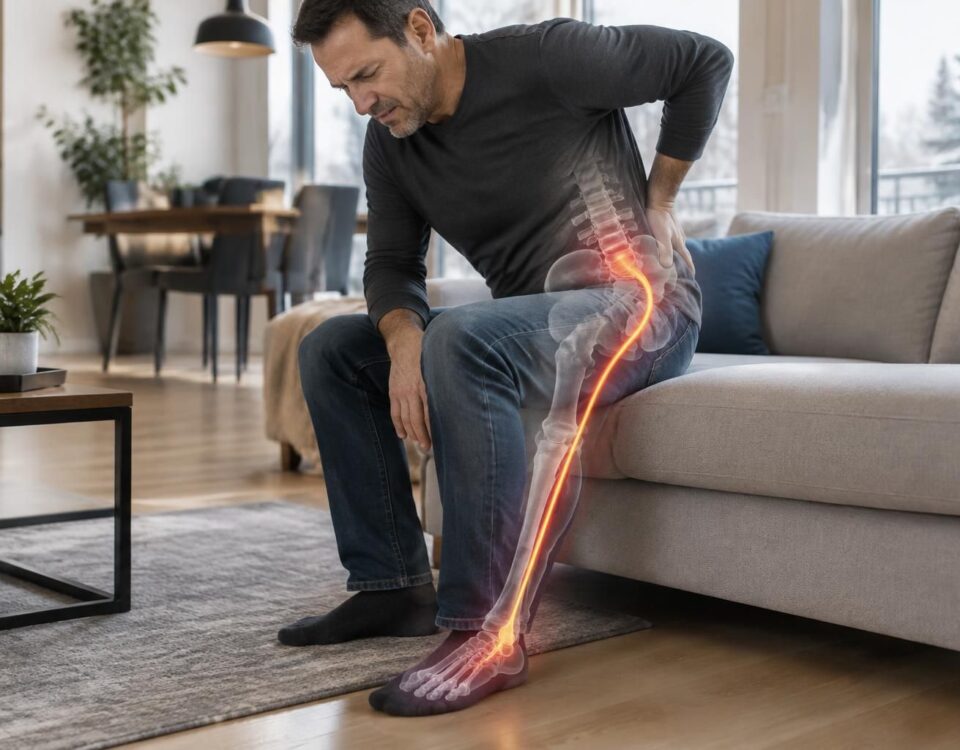
Prolonged sitting can also increase discomfort for some individuals, especially during long journeys or workdays without breaks. It can be helpful to change positions regularly and to stand briefly if it is bearable. Conversely, staying in bed for long periods is generally not a strategy to favor without professional advice. Gentle activity, adapted to symptoms, can help maintain mobility. Short walks, for instance, may suit some individuals, but should be stopped or adjusted if they significantly worsen the pain.
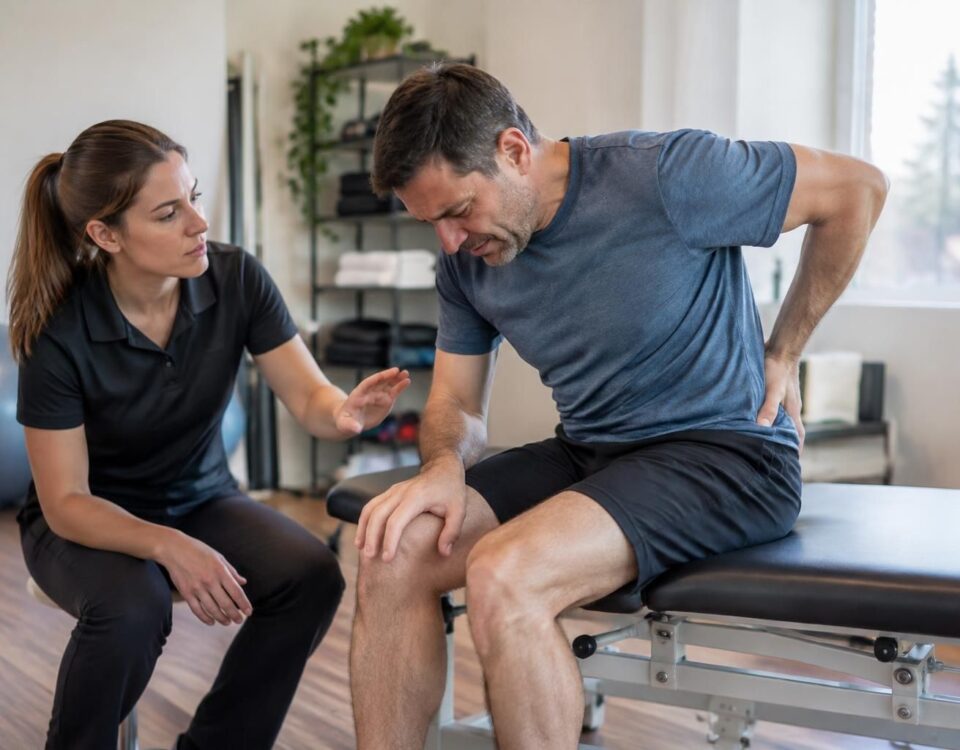
In Terrebonne, a personalized assessment can help better understand the movements that trigger symptoms, their evolution, and functional limits. It does not replace a medical examination when one is necessary. The professional can take into account the intensity of the pain, its distribution in the leg, unusual sensations, and daily activities. Support options should be chosen based on the situation, without presuming that one approach suits everyone.
Sylvain Desforges, B.Sc., D.O., N.D. is an osteopath and naturopath, founding president of the TAGMED clinics and the ACMA association. His practice focuses on chronic spinal pain and low back pain compatible with sciatica. His approach includes an assessment of the person’s needs and, when indicated, modalities such as specific osteopathy, motorized neurovertebral decompression, or certain therapeutic devices. These services do not constitute a medical diagnosis and their relevance depends on each case.
The information presented here is educational and does not replace a consultation with a physician or another licensed healthcare professional. Quickly consult a medical service in case of loss of bladder or bowel control, numbness in the saddle area, significant or progressive weakness in the leg or foot, fever, recent trauma, or rapid aggravation of symptoms.
In the case of disc sciatica in Terrebonne, certain movements may temporarily worsen the pain, especially when they combine bending the back, load, and twisting. At first, the goal is not to completely immobilize the back but to reduce movements that worsen the symptoms, to stay active as tolerated, and to have the situation evaluated if the pain persists or intensifies.
Movements to Avoid Initially
Avoid suddenly bending forward to pick up an object, especially if your knees remain straight. This position can increase tension in the lower back and cause radiation to the buttock or leg in some people. To reach an object, get closer, bend your knees, and keep it close to your body, without straining into a painful range.
Limit movements that combine flexion and rotation, such as twisting the torso while lifting a bag or pivoting quickly when getting out of a car. Instead, turn with your feet and move your entire body in one motion. Heavy loads, moving bulky objects, and exercises that trigger a descending pain into the leg should be suspended or adapted initially.
Long periods of sitting can also worsen symptoms in some people, especially if they remain slumped or inactive. Try to change positions regularly and take short walks if they are well tolerated. Conversely, prolonged bed rest is generally not a strategy to be favored: maintain gentle activities compatible with your level of pain, without attempting to “tough it out” through a significant worsening.
Finally, avoid forced stretches, manipulations done without assessment, and exercises found online that replicate or exacerbate pain, numbness, or tingling. A disc herniation may be a possible cause, but symptoms alone do not confirm its presence or precisely identify the affected structure. To better understand the possible link, consult the resources on sciatica and disc herniation in Terrebonne and on frequent symptoms of an L5-S1 disc herniation.
A protrusion or disc bulge may also be discussed as a possible cause of nerve irritation, although this observation alone is not sufficient to establish a diagnosis. You can read information on sciatica and disc bulge in Terrebonne. For resources regarding Montreal, also see the link between sciatica and disc herniation and the difference between disc protrusion and disc herniation.
Request an evaluation from a healthcare professional if your symptoms limit your activities, do not improve, or change. Quickly consult a physician or emergency service in case of loss of urinary or bowel control, numbness in the saddle area, significant or progressive weakness in the leg or foot, fever, recent trauma, severe pain, or rapid worsening.
About the Author
Sylvain Desforges, B.Sc., D.O., N.D., Doctor of Osteopathy and naturopath is the founding president of TAGMED and the ACMA association. He dedicates his practice to chronic spinal pain, low back pain, and pain compatible with sciatica, especially when pain radiates towards the buttock, leg, calf, foot, or toes.
Through SOS Sciatique, he publishes educational content on sciatica symptoms, possible causes such as disc herniation, disc pinching, foraminal stenosis, or irritation of a lumbar nerve root, as well as non-surgical approaches that may be considered based on assessment. At the TAGMED Clinic, treatments may include, depending on the case, motorized neurovertebral decompression, specific osteopathy, or precision impact therapy.
For an evaluation related to sciatica treatment in Montreal / Mont-Royal or sciatica treatment in Terrebonne, consult the services available at the TAGMED Clinic.
Medical Disclaimer
The information published on SOS Sciatique is provided for educational purposes and does not replace a consultation, diagnosis, opinion, or treatment carried out by a physician or another licensed healthcare professional. The author of this article is neither a doctor nor a specialist in a medical specialty recognized by the Collège des médecins du Québec. The osteopathy, manual medicine, or functional accompaniment approaches described on this site do not constitute medical acts and are not intended to replace medical follow-up.
Consult a physician or emergency service in case of loss of urinary or bowel control, numbness in the saddle area, significant or progressive weakness in the leg or foot, fever, recent trauma, severe pain, or rapid worsening. For more details, please read our Legal Notice.

Sylvain Desforges, B.Sc., D.O., N.D., docteur en ostéopathie
Dr Sylvain Desforges, B.Sc., D.O., N.D., osteopath, is the founding president of TAGMED and of the ACMA association. He dedicates his practice to chronic spinal pain, low back pain and symptoms compatible with sciatica, particularly when pain radiates toward the buttock, leg, calf, foot or toes.
Through SOS Sciatique, he publishes educational content on sciatica symptoms, possible causes such as disc herniation, disc narrowing, foraminal stenosis or irritation of a lumbar nerve root, as well as non-surgical approaches that may be considered according to the evaluation. At Clinique TAGMED, care may include, depending on the case, motorized neurovertebral decompression, specific osteopathic care or precision percussion.
For an evaluation related to sciatica treatment in Montreal / Mount Royal or sciatica treatment in Terrebonne, please consult the services available at Clinique TAGMED.
Medical disclaimer
The information published on SOS Sciatique is provided for educational purposes only and does not replace a consultation, diagnosis, opinion or treatment provided by a physician or another authorized healthcare professional. The author of this article is neither a medical doctor nor a specialist in a medical specialty recognized by the Collège des médecins du Québec. The osteopathic, manual medicine or functional support approaches described on this site do not constitute medical acts and are not intended to replace medical follow-up.
Consult a physician or emergency service in cases of loss of bladder or bowel control, anesthesia in the saddle area, significant or progressive weakness in the leg or foot, fever, recent trauma, severe pain or rapid worsening of symptoms. For more details, please read our Legal Notice.