Sciatica and household chores: twists, bends, and loads
22/11/2026
Sciatica in Terrebonne: disc herniation and painful cough
23/11/2026
IN BRIEF
| Sciatica is a pain that extends from the lower back to the buttock and leg; a herniated disc can irritate a nerve root. Coughing can exacerbate the pain by increasing pressure in the back. In Montreal, an evaluation can help identify the cause and guide appropriate care; most episodes improve without surgery. Progressive weakness or urinary or bowel issues require urgent consultation. |
Sciatic pain exacerbated by coughing may be related to irritation of a nerve root, sometimes caused by a lumbar herniated disc. The pain can originate from the lower back or buttock and radiate down the leg, accompanied by tingling or numbness. An examination can assess the cause and management options in Montreal. Consult promptly if weakness occurs; loss of control of the bladder or bowels, or numbness in the saddle area requires urgent evaluation.
A cough can intensify pain that starts from the lower back or buttock and radiates down the leg. A herniated disc can irritate a nerve root and cause this sciatica, but pain triggered by coughing alone is not sufficient to confirm the underlying cause. An evaluation can link symptoms to their origin and determine appropriate management.
Sciatica describes pain, tingling, or numbness that follows the path of a nerve into the buttock and leg. It corresponds to a symptom rather than a specific disease. A lumbar herniated disc can compress or irritate a nerve root and cause these symptoms.
Coughing, sneezing, or straining can temporarily increase pressure in the trunk. For some individuals, these actions can awaken or amplify pain in the lower back or leg. This reaction may be consistent with nerve irritation, but it alone does not diagnose a herniated disc.
Why can coughing exacerbate sciatic pain?
Coughing quickly mobilizes the trunk muscles and changes pressure in the abdomen and around the spine. If a nerve root is already irritated, this change can cause brief pain, sometimes felt as an electric shock. The pain may stay in the lower back or extend into the buttock, thigh, calf, or foot.
The pain can also vary depending on the affected nerve root. Its path, areas of numbness, and changes in strength provide useful information during evaluation. For more information, consult this page on the path of pain according to the affected nerve root.

Sciatica in Montreal: pain worsened when sitting and lumbar disc
IN BRIEF Worsening sciatica in a sitting position may be related to lower back irritation, sometimes associated with a disc, without this sign being sufficient to establish the cause. In Montreal, an evaluation that considers symptoms, strength, sensitivity, and function…
Herniated disc and possible symptoms
A lumbar disc is located between two vertebrae. A part of the disc can protrude and irritate a nearby nerve root. The pain can then radiate down a leg, often on one side only. Painful coughing may accompany this picture, but other causes can produce similar symptoms.
Pain, tingling, and numbness
An individual may feel a burning sensation, tingling, or a less sensitive area in the leg or foot. The pain may worsen when sitting, during exertion, or while coughing. To better understand the possible link between the disc and the symptoms, consult the pages on herniated disc and sciatica in Montreal and on numbness in the foot associated with a herniated disc.
Pain in the buttock or difficulty staying seated
Pain is not always accompanied by significant back pain. Some individuals primarily experience deep pain in the buttock. Others find it difficult to remain seated, especially during a cough or long journey. These symptoms merit evaluation, as issues in the hip or buttock muscles can also mimic sciatica.
You can read this information about pain in the buttock without back pain and about sciatica that prevents sitting.

Sciatica in Montreal: pain worsened by flexion and disc-related cause
IN BRIEF Flexion-Aggravated Sciatica is pain that starts in the lower back and may radiate into the buttock or leg; irritation related to a lumbar disc can be a possible cause. In Montreal, an assessment helps clarify the origin of…
How evaluation helps clarify the cause
A professional evaluation traces the path of the pain and checks for changes in sensitivity, strength, and reflexes. It also considers movements or positions that exacerbate symptoms, as well as their duration. This information helps guide subsequent steps without replacing a medical diagnosis.
Imaging, such as MRI, may be considered by a healthcare professional based on the symptoms and their progression. An image must be interpreted with the history and examination: the presence of a bulging disc does not automatically prove it explains the pain. For more information on this topic, consult sciatic symptoms and their assessment.

Discogenic sciatica in Montreal: why some stretches worsen
IN BRIEF Disc-related sciatica refers to pain related to the irritation of a nerve root, often near a herniated disc. Certain stretches, especially those that emphasize bending or pull on the leg, can worsen symptoms rather than relieve them. In…
What management options should be considered?
The choice of care depends on the probable cause, the intensity of the symptoms, and their progression. A cautious approach aims to understand what irritates the nerve region before proposing care. If a herniated disc is suspected, avoid commencing exercises or stretches without professional advice, especially if pain increases or if weakness appears.
At the TAGMED Clinic, an evaluation can help examine the symptoms and discuss available non-surgical options based on the situation. Motorized neurovertebral decompression may be considered in certain cases after evaluation; it is not suitable for everyone and does not replace medical follow-up.
Most episodes of sciatica improve over time, but the timelines vary. Persistent pain, worsening, or changes in strength warrant re-evaluation. To discover the services offered, consult the information on the treatment of herniated discs and sciatica.

Sciatica disc in Montreal: movements to avoid at the start
IN BRIEF Disc-related sciatica refers to pain related to the irritation of a nerve, sometimes associated with a lumbar disk. Initially, avoid movements that worsen your symptoms, such as lifting a load by bending over or performing repeated twists. Adjusting…
When to quickly request medical assistance?
Quickly consult a health professional if the pain persists, if the numbness spreads, or if weakness appears in the leg or foot. Significant or progressive weakness requires immediate evaluation.
Go to the emergency room in case of loss of control over the bladder or bowels, numbness in the saddle region, or significant weakness in the legs. These signs may indicate a medical emergency. Pain associated with fever, recent trauma, or rapid deterioration also requires prompt evaluation.

Sciatica in Montreal: disc herniation with leg weakness
IN BRIEF Sciatica related to a herniated disc can irritate a nerve root and cause pain that travels down the leg, sometimes accompanied by weakness. In Montreal, an evaluation helps clarify the cause and guide appropriate care; nonsurgical approaches can…
About the author
Sylvain Desforges, B.Sc., D.O., N.D., Doctor of Osteopathy and naturopath, is the founding president of TAGMED and the ACMA association. His practice focuses on chronic pain of the spine, lower back pain, and pain compatible with sciatica, particularly when it radiates down to the buttock, leg, or foot.
Through SOS Sciatique, he publishes educational content on the symptoms of sciatica, their possible causes, and non-surgical approaches that may be considered based on the evaluation. The care offered at TAGMED Clinic may include, depending on the case, motorized neurovertebral decompression, specific osteopathy, or precision impact techniques.
For an evaluation related to sciatica treatment in Montreal or Mont-Royal, or sciatica treatment in Terrebonne, consult the services available at TAGMED Clinic.

Sciatica in Montreal: herniated disc with foot numbness
IN BRIEF Sciatica related to a herniated disc can cause pain that radiates down the leg and numbness in the foot. In Montreal, an assessment helps to investigate the cause of the symptoms and consider appropriate management without assuming the…
Medical Disclaimer
Medical disclaimer: The information and advice provided on this site do not replace the opinion, diagnosis, or treatment of a health professional. Please note that Sylvain Desforges, B.Sc., D.O., N.D., a doctor of osteopathy, is neither a medical doctor nor a specialist as defined by the Collège des médecins du Québec. Manual medicine, functional medicine, and sports medicine as described on this site exclude any medical treatment or diagnosis made by a physician or specialist. Always consult your doctor for any medical questions. For more details, please read our Complete Legal Notice.
When coughing exacerbates sciatica
- A cough can intensify pain that radiates from the lower back to the buttock or leg.
- A lumbar disc herniation may irritate a nerve root, but this symptom alone is not sufficient to confirm the cause.
- Note the pathway of the pain, the numbness, and the movements that worsen it.
Evaluation and precautions in Montreal
- An evaluation allows for checking strength, sensitivity, and reflexes, and then guiding the management.
- In the meantime, avoid activities that trigger pain and change positions regularly.
- Medical emergency in cases of progressive weakness, numbness in the saddle region, or loss of urinary or bowel control.

Pain that starts from the lower back or buttock and radiates down the leg may be compatible with sciatica. When a cough, sneeze, or effort exacerbates this pain, nerve irritation, sometimes associated with a disc herniation, may be involved, but this sign alone is not sufficient for diagnosis. In Montreal, an appropriate evaluation helps distinguish possible causes and choose appropriate measures.

Sciatica in Montreal: lumbar disc and inflammation of the nerve root
IN BRIEF Disc-related sciatica occurs when irritation of the nerve root causes pain that may radiate down into the buttock and leg. In Montreal, an assessment helps identify the cause of the symptoms and consider appropriate non-surgical care based on…
Why can coughing exacerbate pain?
Coughing causes a brief increase in pressure in the trunk and mobilizes the spine. If a lumbar nerve root is already irritated, this movement can trigger sharp pain or discharge radiating to the buttock, thigh, calf, or foot. A disc herniation is a possible cause, but other back or hip problems can produce similar symptoms.
Observe the path of the pain, the positions that worsen it, and the possible presence of tingling, numbness, or weakness. Pain that radiates below the knee, in particular, should be described precisely to a professional. However, the intensity of the pain during coughing alone does not confirm a disc herniation.

Sciatica and disc pinching in Montreal: when space decreases
IN BRIEF The disc herniation refers to a decrease in space between two vertebrae; it can irritate a nerve root and contribute to sciatica, with pain that radiates into the buttock or leg. In Montreal, an assessment helps specify the…
Recommendations for the first few days
Stay active without straining
As long as it remains tolerable, prioritize short walks and change positions regularly. Avoid sitting for long periods without breaks, as well as movements that clearly trigger pain. Prolonged bed rest is generally not a strategy to pursue without professional advice.
Limit efforts that strain the back
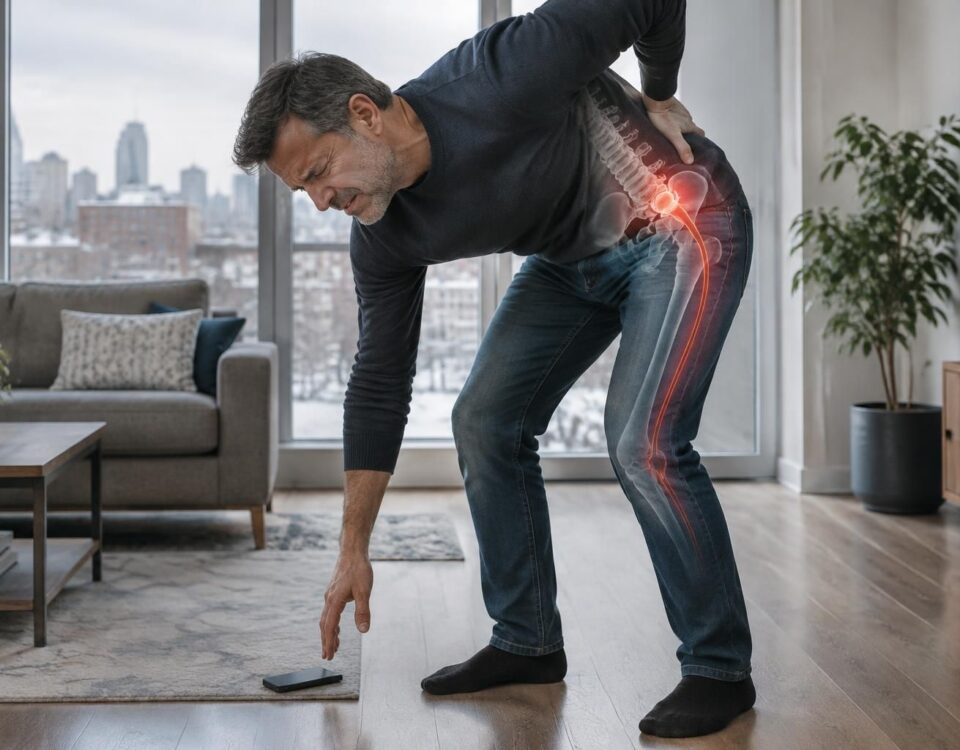
Temporarily reduce lifting heavy loads and twisting the trunk. To pick something up, get close to it, bend your knees, and avoid twisting your back while carrying the load. When you cough, take a stable and comfortable position; do not hold back your cough in an attempt to make the pain disappear.
Adopt a comfortable sleeping position
You can try sleeping on your side with a pillow between your knees, or on your back with a cushion under your knees. Choose the position that reduces discomfort the most and avoid stretches that increase pain in the leg.
When to request an evaluation?
Consult a health professional if the pain persists, worsens, disrupts sleep, or limits your activities, or if numbness or weakness appears. An evaluation may include examining movements, sensitivity, and strength. Imaging is not necessary in all cases and its usefulness depends on the clinical picture.
In Montreal or Mount Royal, the TAGMED Clinic offers evaluations and non-surgical approaches depending on the situation. Specific osteopathy or motorized neurovertebral decompression may be considered after assessment; they do not replace a medical diagnosis. For persistent pain or neurological symptoms, also seek the advice of a physician.
Signs Requiring Urgent Help
Go immediately to the emergency room in case of loss of bladder or bowel control, numbness in the saddle area, or significant or progressive weakness in a leg or foot. Pain accompanied by fever, occurring after recent trauma, or that is rapidly worsening also warrants prompt medical evaluation.
About the Author
Sylvain Desforges, B.Sc., D.O., N.D., Doctor of Osteopathy and Naturopath, is the founding president of TAGMED and the ACMA association. His practice focuses in particular on chronic spinal pain, lower back pain, and pain consistent with sciatica.
Medical Disclaimer
This content is provided for educational purposes and does not replace a consultation, diagnosis, or treatment by a licensed health professional. The author is neither a physician nor a specialist in a medical specialty recognized by the Collège des médecins du Québec. The approaches described do not constitute medical acts and do not replace medical follow-up.
| What You Notice | What It May Indicate |
|---|---|
| The cough accentuates pain that radiates down the leg | Irritation of a nerve root, sometimes associated with a lumbar disc herniation. |
| The pain starts from the lower back or buttock | A pathway consistent with sciatica, to be confirmed by an evaluation. |
| The pain goes below the knee | A useful sign to describe during a consultation in Montreal. |
| Tingling or numbness accompanies the pain | The sensitivity of the nerve may be affected; monitor its evolution. |
| A weakness appears or worsens in the leg or foot | Consult a health professional promptly. |
| The pain does not decrease or limits your activities | An evaluation can help clarify the cause and appropriate options. |
| Loss of urinary or bowel control, or numbness in the saddle area | Medical emergency: go immediately to the emergency room. |
Illustrative Testimonials on Sciatica in Montreal: Herniated Disc and Painful Cough
Important: the accounts below are fictitious and serve solely to illustrate possible experiences. They do not represent real patients and do not predict treatment outcomes. Pain radiating down the leg can have multiple causes; only a health professional can assess your situation.
Fictional Example — Pain Amplified by Coughing
“For the past few weeks, I had been experiencing pain in my lower back and a pain radiating down my buttock and the back of my leg. Every time I coughed or sneezed, I felt a sharper jolt. Since I live in Montreal and work sitting down, long periods in front of the computer made the symptoms difficult to manage. I consulted to evaluate the cause rather than assume it was necessarily a herniated disc.”
Fictional Example — Suspected Herniated Disc
“My pain extended from my lower back to my calf, with tingling at times. Coughing and certain movements seemed to exacerbate the discomfort. During the evaluation, I was told that these signs could be consistent with nerve irritation, but that an examination was necessary to determine the cause and choose the appropriate next steps.”
Fictional Example — Gradually Resuming Activities
“I had reduced my movements because sitting for long periods and coughing made me fear an exacerbation. I was advised to monitor the evolution of my symptoms and adapt my activities without overexerting myself. I also noted the moments when the pain radiated down my leg so that I could clearly describe what I felt during my appointment in Montreal.”
Pain that increases with coughing can sometimes accompany irritation of a nerve root, particularly in the presence of a herniated disc, but this sign alone is not sufficient to establish a diagnosis. Consult a health professional for an appropriate evaluation, especially if the pain persists, worsens, or is accompanied by numbness or weakness.
Consult a medical service without delay in case of loss of bladder or bowel control, numbness in the saddle area, or significant or progressive weakness in a leg. These symptoms require urgent evaluation.
Sylvain Desforges, B.Sc., D.O., N.D., Doctor of Osteopathy and Naturopath, is the founding president of TAGMED clinics and the ACMA association. His professional journey is dedicated to managing chronic pain, particularly those affecting the spine, lower back, and legs. In his educational content, he explains the possible mechanisms of sciatica and the importance of distinguishing symptoms from their causes, in order to help individuals better prepare for a professional evaluation.
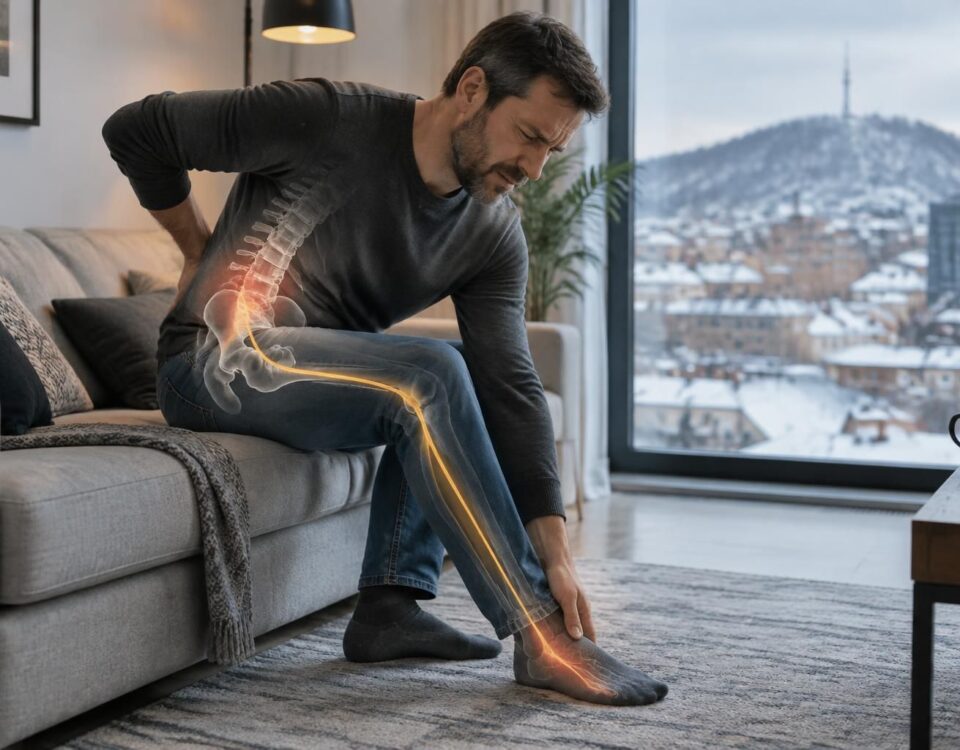
In Montreal, pain that starts from the lower back and radiates into the buttock or leg may be consistent with sciatica. This term describes a set of symptoms associated with irritation of a nerve root or the sciatic nerve; it does not alone denote a precise diagnosis. The pain may manifest as burning, aching, or electric shock. Tingling, numbness, or weakness may also be present. The pathway and evolution of symptoms provide clues but do not alone allow for identifying their origin.
A lumbar disc herniation is among the possible causes. When a part of a disc exerts pressure or causes irritation near a nerve root, the pain can project into part of the leg, sometimes as far as the foot. Certain movements, prolonged sitting, or exertion can exacerbate the discomfort. However, joint issues, narrowing of the nerve passageways, or muscular pain can produce similar symptoms. An appropriate evaluation serves to examine these possibilities and determine whether medical examinations or imaging are indicated.
The painful cough also needs to be described accurately. Coughing or sneezing briefly increases pressure in the trunk and may intensify any pre-existing pain in the back or leg. This phenomenon may be consistent with nerve irritation, but it does not confirm a herniated disc. It is useful to note whether the pain appears only during coughing, whether it radiates below the knee, and whether it is accompanied by numbness or loss of strength. This information can guide the discussion with a health professional.
In his practice, Sylvain Desforges is interested in the reasoned integration of care methods and technologies, notably motorized neurovertebral decompression, specific osteopathy, and, based on evaluation, certain modalities like laser or shockwaves. These approaches may not necessarily be suitable for all situations and do not replace a medical diagnosis. The choice of support depends on the symptoms, history, examination, and, when necessary, a physician’s opinion. The objective is to establish an adapted approach rather than applying a uniform solution to all sciatic pain.
To prepare for a consultation in Montreal, it may be helpful to note how long the pain has been present, its exact pathway, the positions that aggravate or relieve it, as well as any treatments already tried. It is important to seek a medical evaluation quickly in cases of significant or progressive weakness, loss of control of the bladder or bowels, or numbness in the saddle region. These signs require urgent attention.
Medical Warning: this information is educational and does not replace a consultation, diagnosis, or treatment by a licensed health professional. Sylvain Desforges is neither a physician nor a specialist in a medical specialty recognized by the Collège des médecins du Québec. Osteopathy care and manual approaches do not replace medical follow-up.
In Montreal, a lumbar disc herniation can irritate a nerve root and cause sciatic-like pain that radiates from the lower back to the buttock and leg. Coughing or sneezing may exacerbate this pain, but this sign alone is not sufficient to confirm a herniation: the evaluation must take into account the symptom pathway, strength, sensitivity, and, if necessary, imaging results.
Sciatica, disc herniation, and cough pain
When a person coughs, sneezes, or strains, the pain may spread into the leg if a nerve root is already irritated. Sharp or electric pain, especially when it radiates below the knee, may be compatible with sciatica. However, other issues with the back, hip, or buttock can produce similar symptoms. To better understand the connection between discs, nerve roots, and foramina, consult this explanation on compression or irritation of a nerve root, as well as the general presentation of sciatica and its possible causes.
The painful territory provides clues but does not alone establish a diagnosis. Tingling or reduced sensitivity may accompany the pain; their location can help the professional guide their examination. To learn more, read these resources on the sensitive territory related to nerve pain, the L5 root, and the pain in the big toe, which can have multiple origins.
Evaluating symptoms and choosing the next steps
The fact that the pain appears upon waking, increases while sitting, or is triggered by coughing deserves to be described accurately during a consultation. Note how long it has been present, how far it radiates, what aggravates or relieves it, as well as any numbness or changes in strength. This information helps to decide whether a clinical examination is sufficient initially or if imaging is pertinent. You can also consult resources on pain radiating down the leg upon waking and sciatica associated with a herniated disc.
Management depends on the cause and evolution. Several episodes gradually improve with appropriate non-surgical care; intervention is only considered in certain situations, after evaluation. To explore different resources on care options, consult the Sciatica Clinic, the page on sciatica treatment in Montreal, information from the TAGMED Clinic on herniated disc and chronic sciatica, and the page of Synergy Spine Center on sciatica for patients in Montreal. The care and services offered vary by location and professional; check their availability and applicable terms directly.
Consult a professional quickly if the pain persists, worsens, or is accompanied by new weakness. Loss of control of the bladder or bowels, numbness in the saddle region, or significant or progressive weakness requires urgent medical evaluation. This information is educational and does not replace an opinion, diagnosis, or treatment by a licensed health professional.

Sylvain Desforges, B.Sc., D.O., N.D., docteur en ostéopathie
Dr Sylvain Desforges, B.Sc., D.O., N.D., osteopath, is the founding president of TAGMED and of the ACMA association. He dedicates his practice to chronic spinal pain, low back pain and symptoms compatible with sciatica, particularly when pain radiates toward the buttock, leg, calf, foot or toes.
Through SOS Sciatique, he publishes educational content on sciatica symptoms, possible causes such as disc herniation, disc narrowing, foraminal stenosis or irritation of a lumbar nerve root, as well as non-surgical approaches that may be considered according to the evaluation. At Clinique TAGMED, care may include, depending on the case, motorized neurovertebral decompression, specific osteopathic care or precision percussion.
For an evaluation related to sciatica treatment in Montreal / Mount Royal or sciatica treatment in Terrebonne, please consult the services available at Clinique TAGMED.
Medical disclaimer
The information published on SOS Sciatique is provided for educational purposes only and does not replace a consultation, diagnosis, opinion or treatment provided by a physician or another authorized healthcare professional. The author of this article is neither a medical doctor nor a specialist in a medical specialty recognized by the Collège des médecins du Québec. The osteopathic, manual medicine or functional support approaches described on this site do not constitute medical acts and are not intended to replace medical follow-up.
Consult a physician or emergency service in cases of loss of bladder or bowel control, anesthesia in the saddle area, significant or progressive weakness in the leg or foot, fever, recent trauma, severe pain or rapid worsening of symptoms. For more details, please read our Legal Notice.