


Sciatica in Terrebonne: understanding the relationship between lumbar disc and sciatic nerve
02/08/2026
Sciatica: what a disco-radicular conflict means
02/08/2026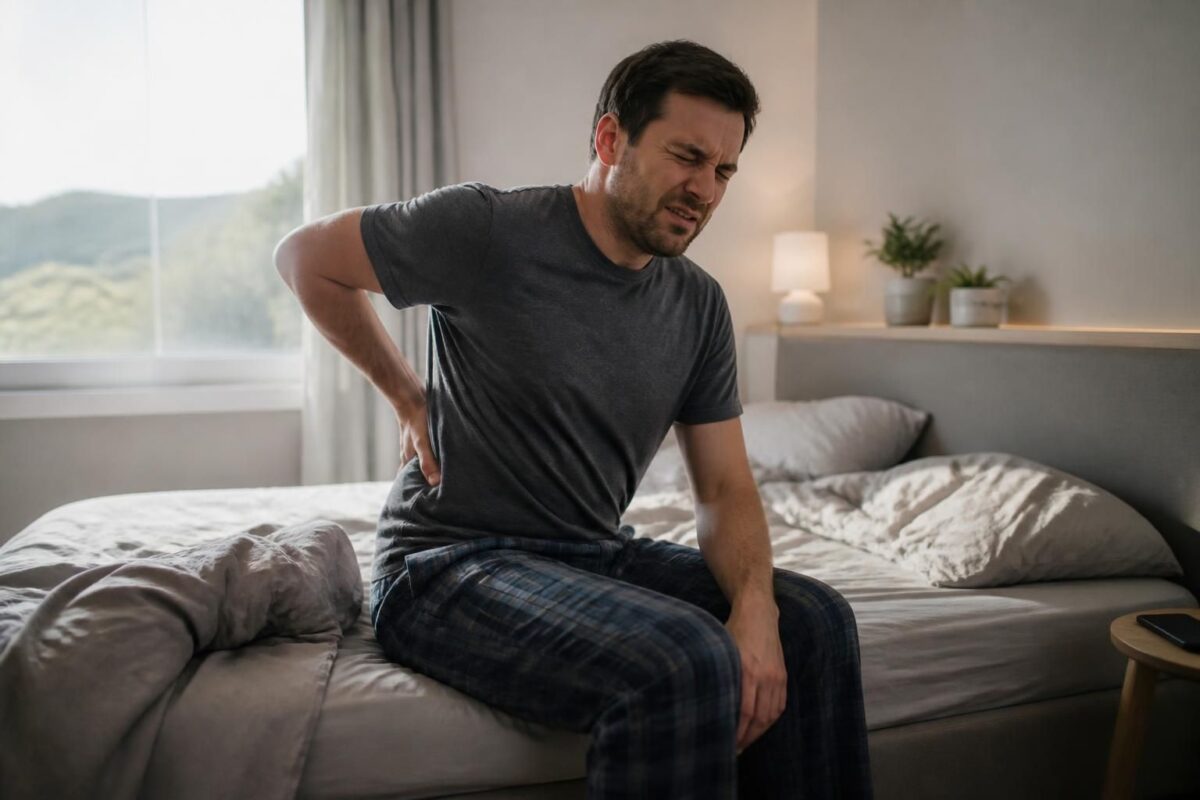
IN SHORT
Sciatica and waking pain describe pain that follows the path of the sciatic nerve and is often stronger in the morning. Possible causes: rehydration of the discs during the night, nighttime stiffness, and increased nerve sensitivity upon waking. Benefits: understanding this mechanism allows for getting up without pain, moving cautiously, and preventing relapses. How it works: gradually moving after waking, adopting a proper sleeping position, and practicing light walking or simple exercises. In Montreal, this approach can help individuals start their day more comfortably. |
Brief summary on sciatica and waking pain: possible causes
- Rehydration of the discs during the night, when the spine relaxes in a lying position and the intervertebral discs gain volume.
- Increased sensitivity of the nervous system in the morning, with waking accompanied by higher nerve reactivity.
- Nighttime immobility and stiffness: little movement for several hours, reducing the mobility of the sciatic nerve upon rising.
- Poor sleeping position (pelvic twist, crossed legs, overly arched or hunched back) that can exacerbate waking pain.
- Mechanically induced pain and reversible with movement and appropriate physical activity.
This article, written by a healthcare professional expert in the field, explains why sciatica may be more painful upon waking. You will discover possible causes, nighttime mechanisms, mistakes to avoid, and simple actions to rise without pain and gradually reduce morning discomfort. Reliable resources and clinical approaches explained by specialists will help you better understand and take action.
The waking pain related to sciatica arises from several simple and natural mechanisms. It does not necessarily indicate a worsening condition, but rather an interaction between nighttime rest, the tissues, and the sciatic nerve.
Nocturnal disc hydration and morning pain
During the night, when lying down, the pressure on the spine decreases. The intervertebral discs can rehydrate and slightly increase in volume. If a nerve is already irritated, this increase may amplify sensitivity upon waking. This phenomenon is physiological and does not mean that the disc is “getting worse.”
To delve deeper into the interaction between the lumbar disc and the sciatic nerve, see the following resources: lumbar disc and sciatic nerve relationship.
Role of the nervous system and waking
In the morning, the body emerges from a state of deep rest, and the nervous system becomes more reactive. This increased reactivity makes pain more noticeable, especially when the nerve is irritated.
Nocturnal immobility and stiffness
Several hours without movement can increase stiffness. The pelvis may remain in a fixed position, and the sciatic nerve glides less, intensifying the sensation upon rising.
Sleeping position and pain
Pelvic twists, crossed legs, or an overly arched or hunched back during the night can worsen waking pain. Morning pain often reflects the nighttime position more than the pain felt during the day.
Signs that may or may not indicate severity
In most cases, morning pain is mechanical and reversible. If the pain is associated with a progressive loss of strength, persistent numbness, or urinary issues, seek medical advice promptly.
Why pain decreases after walking
Walking gets the nerve moving, improves local circulation, and decreases stiffness. It also reassures the nervous system. If pain diminishes after 5 to 15 minutes of walking, this is a good prognostic sign.
To explore this mechanism and other aspects, consult resources on the relationship between pain and movement after waking, particularly explanations related to circulation and nerve sensitivity: signals sent by the leg.
Errors to avoid upon waking
Avoid getting up abruptly, forcing to “unblock” or testing the pain right after waking. Stay calm, don’t freeze in fear, and avoid believing it’s a major relapse.
How to get up correctly with sciatica
Step 1 — Wake up the body before getting up: breathe calmly for 4 to 5 cycles, move your feet and knees slightly, and gently tilt your pelvis.
Step 2 — Get out of bed without twisting: roll to the side, bend your knees, push with your arms. Avoid any sudden trunk rotation.
Step 3 — Walk for a few minutes: move forward without rushing, breathe normally, adopt a relaxed posture. Pain often decreases quickly.
For complementary approaches, you may consult resources on mechanical treatments and pain-free rising strategies in clinics associated with TAGMED and the pages dedicated to the TAGMED Clinic.
How to sustainably reduce sciatica in the morning
Correcting your sleeping position can reduce morning pain. Favor sleeping on your back with a pillow under your knees or on your side with a pillow between your knees. Avoid nighttime twisting.
Moving more during the day can limit nighttime episodes. Avoid long periods of sitting and favor regular micro-movements and daily walking. An active body during the day suffers less at night.
Breathing also plays a role. Practice abdominal breathing with a slow exhalation to reduce tension and nerve sensitivity.
Not fearing morning pain is a key component. Understanding the mechanisms and following a progression helps to defuse it. For a structured and gradual plan tailored to each phase, you can explore specific resources:
More information on mechanical approaches and protocols in Terrebonne or Montreal can be found in the dedicated pages on neurovertebral decompression and the osteopathic approach within the TAGMED network and its partners:
• signals sent by the leg
• relationship between lumbar disc and sciatic nerve
• imaging and pain
• pain from buttock to foot
• mechanical treatment of sciatica
• lumbar disc and sciatic nerve
• relationship between disc and nerve
• buttock to foot
• imaging is not enough
• specialized resources
For a tailored clinical approach, the TAGMED clinic offers targeted care in Montreal and Terrebonne, and the team can guide you towards mechanical options when relevant.
When to consult and other considerations
If the pain is associated with progressive loss of strength, significant numbness, urinary issues, or very intense pain, consult quickly. To guide you toward an appropriate evaluation, you can consult professional resources and relevant associations such as ACMA and the College of Canadian Osteopaths.
Sciatica is common and can be effectively managed through a structured and progressive approach. For more information on clinical aspects and signals to watch out for, refer to public resources and specialized clinics within the TAGMED network.
Medical disclaimer: The information and advice provided on this site do not replace the opinion, diagnosis, or treatment of a health professional. Please note that Dr. Sylvain Desforges, osteopath, is neither a medical doctor nor a physician, and is not specialized in a medical specialty as defined by the Quebec College of Physicians. Manual medicine, functional medicine, and sports medicine as described on this site exclude any medical treatment or diagnosis made by a physician or a medical specialist. Always consult your doctor for any medical questions. For more details, please read our full Legal Notice.
- Disc rehydration during sleep → increased nerve sensitivity upon waking.
- Nervous system sensitivity when transitioning from rest to activity; sharper pain in the morning.
- Nocturnal stiffness and immobility → traction and tension on the sciatic nerve.
- Unfavorable sleeping position (twisting, rotating pelvis, crossed legs) triggers morning pain.
- Mobilization after getting up: walking quickly improves pain and prognosis.
- Posture and heavy loads upon waking exacerbate symptoms.
- Breathing and relaxing the psoas reduce nerve tension.
- Fear and anxiety around pain: understanding and progressing reduces discomfort.

Sciatic pain upon waking is common and often mechanical. This article presents possible causes and practical recommendations for getting up without pain, by addressing sleep, mobility, and breathing.
Possible causes of sciatic pain upon waking
Disc rehydration during the night can slightly increase their volume once lying down, which may irritate an already sensitive nerve and amplify the pain upon waking. This does not indicate a worsening of the disc but rather a normal physiological phenomenon when resuming activity.
Nocturnal stiffness results from several hours of immobility of the muscles and a fixed pelvis position. This stagnation can reduce the mobility of the sciatic nerve and intensify the pain upon awakening, then decrease with movement.
The nervous system is more reactive at the time of waking: the body is coming out of a state of rest and the nerve may seem more sensitive, making the pain more pronounced when resuming activities.
The poor sleeping position largely contributes to morning pain: pelvis twisting, feet or legs in constraining positions, excessive arching, or overly rounded back. These positions leave a painful imprint upon waking and reflect more the bed than the intensity of the previous day’s pain.
Generally, stronger pain in the morning does not indicate a severe progression of sciatica. It is most often mechanical and reversible, and improves with movement and gradual use of the body throughout the day.

Sciatica and pain that improves when walking
IN SUMMARY Sciatica is pain that radiates from the lower back or buttock down to the leg, sometimes all the way to the foot. If it decreases with walking, a gentle and regular walk can help limit stiffness and maintain…

IN BRIEF Sciatica is pain that often starts from the lower back or buttock and travels down the leg. Pain that worsens at the end of the day may be related to activities or prolonged positions, but it is not…

Sciatica and pain that worsens in the evening
IN BRIEF more painful sciatic pain in the evening is often related to inactivity, fatigue, and increased attention to sensations. This does not necessarily mean that the nerve is worsening. Gently changing positions, walking for a few minutes, and finding…

Sciatica and pain when turning in bed
IN BRIEF Sciatica can cause pain when turning in bed, as certain movements irritate the lower back or leg. Turn slowly, moving your shoulders and hips together; a cushion between the knees or under the knees can improve comfort. If…
How to get up and move without worsening the pain
Change sleeping position and optimize nighttime environment
Prefer a position that maintains pelvic and spinal alignment: sleep on your back with a small cushion under your knees or on your side with a cushion between your knees to avoid twisting. An appropriate mattress and a neutral pillow help limit pressure on the nerve.
Gentle awakening and progressive getting up
Waking the body with cycles of calm breathing (4 to 5 deep breaths) followed by gently moving the feet and knees can prepare the back to get up smoothly. Rolling onto your side, bending your knees, and then pushing with your arms to get out of bed avoids abrupt twists.
Gentle walking and movements after getting up
Walking for a few minutes at a moderate pace, with fluid breathing and relaxed posture, can quickly diminish pain and get the nerve moving, while improving circulation and flexibility.
Breathing and Stress Management
Diaphragmatic breathing and slow exhalation help relax the psoas and reduce nerve sensitivity. A calmer mind can also limit painful anticipation and promote better effort tolerance.
When to Consult and What to Avoid
If morning pain persists despite gentle management, or is accompanied by a loss of strength, significant numbness, or urinary issues, a medical evaluation is recommended. Avoiding prolonged immobility and passive waiting can prevent worsening.
| Possible Cause | Concise Description |
|---|---|
| Nocturnal Disc Rehydration | The discs absorb water while lying down, which can temporarily increase sensitivity if a nerve is already irritated. |
| Increased Nerve Sensitivity Upon Waking | The transition from rest to activity increases the nerve pain felt. |
| Nocturnal Stiffness and Immobility | Less movement during the night increases stiffness and sensitivity upon rising. |
| Poor Sleeping Position | Twisted pelvis, arched back, or crossed legs can amplify pain upon waking. |
| Sciatic Nerve Irritation or Compression | Pain follows the path of the sciatic nerve and may be more intense in the morning. |
| Beneficial Effect of Movement | Walking activates the nerve, improves circulation, and decreases stiffness. |
| Improper Rising Position | Rising with trunk rotation increases tension on the nerve. |
| Lifestyle Factors and Posture | Regular activity and good posture reduce painful awakenings. |
Testimonials: Sciatica and Morning Pain – Possible Causes
My name is Annie, 45 years old, and every morning my awakening is marked by sciatic pain that keeps me in bed. Rising becomes difficult and the pain seems to intensify just after waking. I have been told that this may come from disc rehydration during the night, which can temporarily increase the sensitivity of the irritated nerve upon rising. Since then, I alternate between a few quick steps and gentle stretches to ease the transition from rest to activity.
Marc, 52 years old: “Waking up is the most difficult moment of my sciatica: the nervous system is still in rest mode and reacts more strongly. By walking for a few minutes and breathing calmly, the pain decreases, and the day can begin normally.”
Chloé, 39 years old: “After a night without moving, my stiffness and the less mobile sciatic nerve wake me up with sharp pain. This nocturnal immobility is one of the frequent causes and can be corrected with gentle movements upon waking.”
Julien, 58 years old: “My poor nocturnal posture was the real coach of my pain: overly arched back, twisted pelvis, and misaligned legs. Waking up comes with pain, which then eases by adopting a neutral position and moving slightly.”
Sophie, 33 years old: “I learned that morning walking can be a true ally: starting with a few minutes, the morning pain quickly faded, and my mind reassured itself that this is not a relapse but a manageable mechanical reaction.”
Sciatica and Morning Pain: Possible Causes and Therapeutic Pathway
This osteopath and manual medicine practitioner is recognized for his integrated approach to lower back pain and sciatica, particularly when pain manifests upon waking. Founder and president of TAGMED and a committed player in ACMA, he emphasizes evidence-based and innovative care. His practice combines osteopathy, naturopathy, and manual approaches to illuminate the mechanisms underlying morning pain and guide patients toward sustainable solutions tailored to their lifestyle. Through his commitment to education and personalized support, he aims to provide each person with a clear pathway to symptom reduction and improved quality of life.
Sciatica and morning pain do not necessarily indicate a biological “failure.” They rather reflect the combined action of mechanical, nerve, and neurological factors that manifest after a period of rest. The rehydration of intervertebral discs during the night, particularly after a day of compression due to gravity, can temporarily increase sensitivity if a nerve is already irritated. The nervous system is also more reactive upon waking, which sometimes intensifies pain perception. Nocturnal immobility promotes increased stiffness and discomfort during the first movement. Finally, certain poor sleeping positions can mechanically worsen pain by causing pelvic twists, asymmetrical positions, or prolonged tensions on the back and legs. These mechanisms, examined during a personalized assessment, allow for the development of a targeted and progressive treatment plan.
The clinical biography highlights a strategy that combines in-depth knowledge and specialized techniques. Guidance is provided by a careful assessment of pain sources and an understanding of the mechanisms to offer interventions that avoid surgery when unnecessary. In practice, the approach may include specific osteopathic techniques, motorized nerve decompression methods, and, when relevant, the use of precision impactors. This integration aims to quickly restore mobility, reduce nerve tension, and promote better movement tolerance, essential concepts for morning pains related to sciatica.
Practically, the professional biography emphasizes the importance of patient education and self-management. Clear and reproducible advice is incorporated into a routine that combines verified postures during rest and rising, gentle exercises, and a gradual intensification of physical activity. Concrete recommendations include strategies for rising gently, calibrated stretching movements, and integrating a tailored daily program aimed at limiting pain fluctuations and promoting sustainable improvement. The central message is that morning pain can diminish through a proactive and personalized approach, combining therapeutic support with lifestyle changes.
This approach, centered on prevention and functional recovery, is based on a philosophy that values listening, rigorous assessment, and the application of body-respecting techniques. By combining clinical expertise with appropriate technologies, this expert is committed to guiding patients towards a gradual reduction in pain and greater autonomy in their daily lives, without systematically resorting to heavy interventions.
Quick summary: morning sciatic pain is common and multifactorial. It can result from the rehydration of intervertebral discs during the night, nighttime stiffness, and an increased sensitivity of the nervous system upon rising, as well as a poor sleeping position. Walking and simple adjustments to posture and breathing can help gradually reduce the pain. This article explores possible causes and the mechanisms involved, without relying on a single diagnosis.
Among the possible causes of morning pain related to sciatica, several mechanisms accumulate. The rehydration of the discs after a night lying down can increase the sensitivity of the sciatic nerve if it is already irritated, without indicating deterioration of the disc itself.
Nighttime stiffness and prolonged immobility contribute to decreased mobility of the nerve and adjacent tissues, which may manifest as a feeling of blockage and pain upon rising that then fades with movement and walking.
The sleeping position plays an important role: twists, overly arched backs, or crossed legs can amplify morning pain. The reflection of these nighttime positions may be more telling than the pains felt during the day.
The nervous system is also a key player: upon waking, the body emerges from a deep state of rest and may perceive pain as more pronounced, even when the origin is primarily mechanical or functional.
To limit the onset or amplification of pain upon waking, several strategies can be considered without immediately resorting to invasive treatments: prioritize regular physical activity, practice slow breathing and gentle exercises, work on posture, and adopt an appropriate sleeping position, such as sleeping on the back with a pillow under the knees or on the side with a pillow between the knees. For more in-depth information, you can consult useful resources such as this article and this resource on pain that increases when standing.
To broaden the context and explore the different dimensions of sciatica and its causes, other sources address the links between nighttime pain, lumbar support, and root pain mechanisms: causes of sciatica, causes, symptoms and treatments, and symptoms and treatments.
Additional elements on the relationship between waking pain and irritated nerve roots, as well as appropriate management approaches, are available here: irritated nerve root and care plan, not to mention resources on sleep and nighttime pain: night pain.

Sciatica and pain when getting out of bed
IN BRIEF Sciatica upon getting out of bed is pain that radiates from the lower back to the buttock or leg and can be more pronounced after the night. Gradually rising, moving gently, and finding a comfortable sleeping position can…

Sciatica and difficulty finding a comfortable position
IN BRIEF Sciatica is a pain that often starts in the lower back or buttock and radiates down the leg, sometimes making it difficult to find a comfortable position. Alternating positions, avoiding postures that aggravate the pain, and trying a…

IN BRIEF Sciatica typically causes pain from the lower back to the buttock and leg; abdominal pain is not a typical sign and may have another cause. An evaluation helps to distinguish symptoms and guide management. Consult quickly if the…

IN BRIEF Sciatica corresponds to pain related to the irritation of a nerve, often felt in the lower back and may radiate to the buttock or leg. It can be accompanied by back pain, tingling, or numbness. An assessment helps…

Dr Sylvain Desforges, B.Sc., D.O., N.D., osteopath, is the founding president of TAGMED and of the ACMA association. He dedicates his practice to chronic spinal pain, low back pain and symptoms compatible with sciatica, particularly when pain radiates toward the buttock, leg, calf, foot or toes.
Through SOS Sciatique, he publishes educational content on sciatica symptoms, possible causes such as disc herniation, disc narrowing, foraminal stenosis or irritation of a lumbar nerve root, as well as non-surgical approaches that may be considered according to the evaluation. At Clinique TAGMED, care may include, depending on the case, motorized neurovertebral decompression, specific osteopathic care or precision percussion.
For an evaluation related to sciatica treatment in Montreal / Mount Royal or sciatica treatment in Terrebonne, please consult the services available at Clinique TAGMED.
Medical disclaimer
The information published on SOS Sciatique is provided for educational purposes only and does not replace a consultation, diagnosis, opinion or treatment provided by a physician or another authorized healthcare professional. The author of this article is neither a medical doctor nor a specialist in a medical specialty recognized by the Collège des médecins du Québec. The osteopathic, manual medicine or functional support approaches described on this site do not constitute medical acts and are not intended to replace medical follow-up.
Consult a physician or emergency service in cases of loss of bladder or bowel control, anesthesia in the saddle area, significant or progressive weakness in the leg or foot, fever, recent trauma, severe pain or rapid worsening of symptoms. For more details, please read our Legal Notice.


