Herniated disc and sciatica: why the leg can be numb
02/10/2026
Sciatica in Montreal: nerve symptoms not to be taken lightly
03/10/2026
IN BRIEF
| Sciatica can hurt more during the first steps after sitting for a long time: a sensitized nerve may tolerate maintained posture and the restart of movement less well. Gradually standing up, walking for a few minutes, and varying positions often help manage pain better, without this discomfort necessarily indicating a new injury. In Versailles, the Kiné Sport Versailles team can support the resumption of appropriate activity. |
Sciatica and walking after sitting: why pain increases at the start
After sitting for a long time, the lower back and leg have endured prolonged strain. With sciatica, the nerve may be more sensitive: the first steps can temporarily awaken pain, pulling sensations, or tingling. This does not necessarily mean that a new injury has occurred. Stand up gradually and resume walking at a comfortable pace. To limit discomfort, regularly alternate positions and avoid sitting for long periods without moving.
After sitting, some people experience stronger sciatica pain during the first steps. This increase can result from a change in posture, temporary stiffness, and increased sensitivity of the nerve. It does not necessarily mean that a new injury has occurred. The duration of symptoms, their evolution, and the presence of weakness or numbness are also important to monitor.
Maintaining a seated position for a long time can make the lower back and leg more sensitive. When standing up, the body quickly transitions from a stable posture to walking. The first movements can then awaken pain, which sometimes decreases after a few steps. This reaction varies according to the person and the cause of the sciatica.
The transition from sitting to walking engages the back
In a seated position, the pelvis and lower back remain in a relatively fixed posture. The body adapts to this position, even if it’s not perfect. When standing up, the muscles and joints change roles to stabilize the trunk and move the legs. This transition can cause discomfort in someone whose nerve symptoms are already sensitive.
The seated position does not necessarily “pinch” the sciatic nerve. However, a maintained posture can keep strain in the same place for a while. In a sensitive person, pain may increase upon standing or during the first steps. To understand how to adjust seating, also consult these tips on sitting with sciatica and this guide on sciatica in a seated position.
Why pain may lessen after a few steps
The first steps gradually get the body moving again. Walking alternates supports and mobilizes the pelvis, back, and legs. Some people feel the pain decrease. Others find that it persists or intensifies. There is no single progression for all sciatica cases.
A pain that decreases after a few steps does not alone confirm a diagnosis. Similarly, a pain that increases does not automatically prove that damage is worsening. The trajectory of symptoms, their duration, and associated signs should be considered by a healthcare professional.
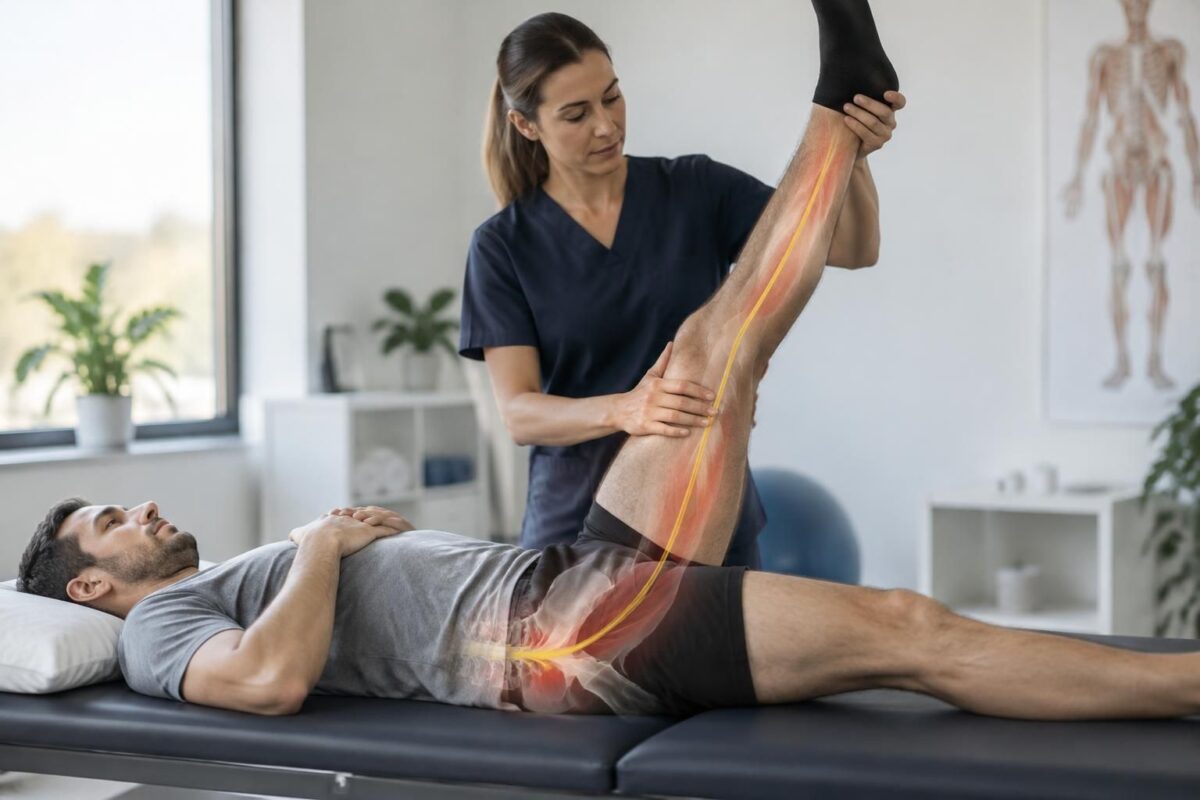
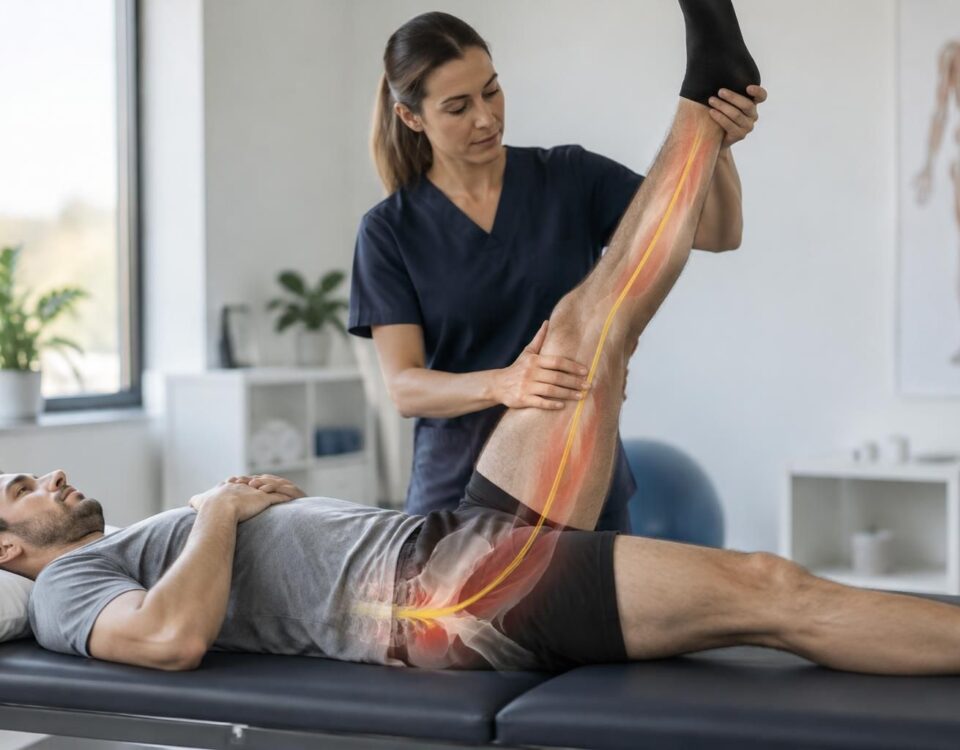
Sciatica and hamstring stretching: possible nerve tension
IN BRIEF Sciatica can make stretching the hamstrings uncomfortable, as the tension felt may come from the nerve rather than the muscle. A gentle stretch, with a straight back and without seeking maximum range, can help loosen the back of…
Sciatica and piriformis stretching: useful or worsening depending on the case
IN BRIEF Piriformis-related sciatica can cause deep pain in the buttock, sometimes radiating down the back of the thigh. A gentle stretch can loosen the hip and relieve discomfort if the muscle is involved, but it can worsen symptoms if…
What symptoms may accompany initial pain?
Sciatica can cause pain that starts in the lower back or buttock and radiates down one leg. It may manifest as burning, sharpness, pulling sensations, or electric shocks. Tingling, numbness, or a heavy feeling in the leg may also occur.
Pain does not always follow the same path. It may be felt primarily in the buttock, thigh, calf, or foot. Pain in the buttock without lower back pain may also have several causes. This content on buttock pain without back pain provides contextual information, without replacing a clinical examination.
A strain may precede the onset of pain radiating down the leg. To learn more about this scenario, consult these examples of radiation after physical exertion in Terrebonne and radiation after physical exertion in Montreal.

Sciatica and popular stretches: why to stay cautious
IN BRIEF Sciatica causes pain that radiates from the lower back down the leg. Popular stretches, such as the pigeon pose or hamstring stretches, are not always suitable: pulling on an irritated nerve can worsen the symptoms. Favor gentle movements,…

Sciatica and Pilates: movements to adapt
IN SHORT Sciatica causes pain that can radiate from the lower back down to the leg. The Pilates Reformer can promote a gradual return to movement and strengthen core control, provided that the movements, range, and resistance are adapted. Favor…
What to do when pain increases upon standing?
Stand up without rushing the first steps
When standing up, take a few seconds to change position. Lean on the armrests or a stable surface if it helps you. Once standing, pause briefly before starting to walk. Move at a comfortable pace and observe the evolution of the pain.
If walking remains tolerable, short movements may be preferable to prolonged immobility. You don’t need to force to “make the pain go away.” If each step significantly increases symptoms, stop and seek advice from a healthcare professional, especially if the situation recurs or worsens.
Vary positions throughout the day
Avoid sitting for several hours without interruption. Stand up regularly, change support, and alternate activities according to your tolerance. There is no perfect posture that suits everyone. The goal is to reduce periods of fixed position and limit movements that clearly exacerbate leg pain.
Recommendations on postures to limit may vary based on symptoms. You can read these resources on positions to avoid in case of sciatica, postures that may worsen pain, and ways to adapt postures. This general information does not determine the position that is personally suitable for you.

Sciatica and core stability: variable tolerance depending on symptoms
IN BRIEF Core strengthening in case of sciatica consists of progressively strengthening the trunk muscles. Its tolerance varies depending on pain and symptoms: suitable without worsening the pain, it can support mobility and the resumption of activities, but does not,…

Sciatica and lunges: leg pain to watch out for
IN BRIEF Sciatica is pain that starts from the lower back or buttock and radiates down the leg. If a lunge triggers or worsens this pain, stop the movement and adjust your activity: this exercise does not address sciatica. Consult…
When does initial pain warrant an evaluation?
Consult a healthcare professional if the pain persists, returns often, limits your movements, or is accompanied by worsening numbness. An evaluation can help determine if the symptoms correspond to sciatica or another cause. An MRI alone is not sufficient to explain the pain: the images must be interpreted alongside symptoms and examination. To delve deeper into this point, read the information on what the MRI cannot decide alone in cases of herniated disc and sciatica.
A pain triggered by coughing or sneezing can also accompany certain nerve irritations. However, it does not necessarily confirm sciatica on its own. This explanation about the sciatica pain when sneezing presents the main possible reasons.
Recognizing Emergency Signs
A significant or recent loss of strength, such as a foot that drags or a leg that gives out, requires prompt medical evaluation. A loss of sensation around the perineum, difficulties urinating, urinary incontinence, or loss of bowel control demand urgent care.
A very intense pain that does not ease, or worsening numbness, also justifies quick medical advice. Do not delay in seeking help if these signs appear or if your condition worsens.

Sciatica and deadlifts: risk depending on the cause
IN BRIEF Sciatica and deadlifts are not always incompatible: the risk depends on the cause of the pain and its intensity. During acute episodes, it’s best to avoid heavy loads and seek medical or physiotherapy advice before resuming. A gradual…

Sciatica and squats: why caution is needed
IN BRIEF Sciatica does not always prohibit squats, but a deep or loaded squat can aggravate symptoms, especially during a flare-up. Gradually resume with a neutral back and a comfortable range of motion, and stop if the pain travels down…
Frequently Asked Questions about Sciatica and First Steps
Is it normal to feel more pain when getting up?
This increase in pain can occur when the body transitions from a prolonged sitting position to walking. It does not automatically mean that an injury has worsened. If it is strong, persistent, or accompanied by weakness, seek medical advice.
Should I avoid walking when the pain increases at the start?
Not necessarily. If walking remains tolerable, start slowly and adjust the duration to your symptoms. Do not push yourself if the pain significantly increases or if your leg becomes weak or unstable.
How long should I stay seated?
There is no universal duration. Tolerance depends on the individual and the painful episode. Alternate positions before discomfort becomes significant and take regular breaks instead of sitting for long periods without moving.
Medical Disclaimer: The information and advice provided on this site do not replace the opinion, diagnosis, or treatment of a healthcare professional. Please note that Dr. Sylvain Desforges, osteopath, is neither a medical doctor nor a physician and is not specialized in a medical specialty as defined by the Collège des médecins du Québec. Manual medicine, functional medicine, and sports medicine as described on this site exclude any treatment or medical diagnosis made by a physician or medical specialist. Always consult your doctor for any medical inquiries. For more details, please read our full Legal Disclaimer.
Sciatica and Walking After Sitting: Why Pain Increases at the Start

After sitting, it is common for sciatica to hurt more during the first steps. Most often, this temporary increase is explained by the resumption of movement after a sustained posture, on a nerve that is already sensitive. It does not necessarily mean that a new injury has occurred. Getting up gradually, walking at a comfortable pace, and regularly interrupting long sitting periods can help better manage this discomfort.
Why can the first steps be painful?
A sustained posture can sensitize the area
In a sitting position, the lower back and pelvis remain relatively still. The back often takes on a slight curve, which is not abnormal. However, if you maintain this posture for a long time, the same areas bear a continuous strain. During sciatica, the nerve structures may be more sensitive than usual: moderate, sustained pressure over time may be enough to increase discomfort.
The sitting position generally does not abruptly “pinch” the sciatic nerve. Instead, it is the combination of prolonged posture and increased sensitivity that can make restarting uncomfortable. When you get up, the back, pelvis, and legs must readjust to movement. The first steps can then produce pain in the buttock or radiating down the leg.
Starting moves the body
After sitting, you may also feel transient stiffness or a heavy leg sensation. The pain may decrease after a few steps as you resume movement. This evolution varies from person to person: for some, it resolves quickly; for others, walking may increase symptoms as long as the duration or pace exceeds their current tolerance.
A discomfort at the start does not automatically indicate that an injury has worsened. Instead, observe its evolution: if it calms down while walking gently, it may simply reflect a gradual return to activity. On the other hand, pain that significantly intensifies or travels further down the leg invites one to slow down and adjust their effort.
How to stand up and walk more comfortably?
Resume gradually
Before leaving, straighten up without sudden movements and take a few seconds to find your balance. Start with small steps at a comfortable pace. There’s no need to force yourself to “loosen up” the back: choose a short distance, then increase it based on your tolerance. Several brief walks may be easier than a long, painful walk.
If the pain decreases after starting, continue gently without seeking performance. If it increases, slow down or take a break. The goal is to stay active as much as possible without ignoring a marked worsening. Occasional rest can be helpful, but staying in bed for a long time is generally not recommended in uncomplicated sciatica.
Avoid long periods without change
At work, in the car, or at home, try to regularly vary your position. Get up for a few minutes, walk a bit, or change your support before the discomfort becomes significant. There is no ideal sitting duration for everyone: adjust breaks based on your symptoms and activities.
When to seek medical advice?
Consult a professional if the pain persists, worsens, or prevents you from resuming your activities. A significant decrease in strength, a foot that drags, a progressive loss of sensitivity, or uncontrollable pain require quick evaluation. Numbness of the perineum, difficulties urinating, urinary incontinence, or loss of bowel control are signs of a medical emergency.
| When getting up and walking | Why the pain may increase |
|---|---|
| After prolonged sitting | The lower back has remained in a similar posture for a long time. |
| First steps | The change in position puts stress on a sensitive nerve. |
| Pain that radiates down the leg | The movement may temporarily awaken the symptoms. |
| Discomfort that eases when moving forward | Gradual movement can help better tolerate the strain. |
| Pain that persists or increases | Slow down, take a break, and adjust your walking. |
| Pain at the start | This does not necessarily mean that new damage has occurred. |
Sciatica and walking after sitting: why does the pain increase at the start?
Illustrative testimonials: these situations are examples and do not correspond to identified patients.
“After an hour at the office, the first steps are the hardest. The pain starts from the buttock and radiates down the thigh. Then, after a few minutes of slow walking, it diminishes.”
“When I get up from the couch, I feel a kind of jolt in my leg. I thought that walking necessarily worsened my sciatica, but taking a few gentle steps is often more comfortable than staying still.”
“The beginning of a walk can sometimes be painful after a car journey. I’ve noticed that getting up regularly and walking a bit before resuming my activities helps me avoid too much pain at the start.”
This discomfort when getting up can be explained by the increased sensitivity of the nerve during sciatica and by maintaining the same posture for too long. Sitting does not necessarily mean that the nerve is suddenly compressed: it can, however, maintain a continuous strain that the nerve tolerates less well during an episode.
The first steps mobilize the back and leg again after this period of immobility. The pain may then be more pronounced, and then fade as the movement becomes gradual and the tissues adapt. This does not automatically mean that a new lesion has occurred.
To facilitate resuming, try to get up without rushing, and then start with a short, comfortable walk. If sitting for a long time triggers your symptoms, alternate positions and take small regular breaks rather than waiting for the pain to become significant.
Walking is generally preferable to prolonged rest in bed when symptoms remain bearable. However, adjust the duration if the pain increases sharply or radiates further down the leg. A significant decrease in strength, loss of sensitivity in the perineum, or urinary or bowel issues require urgent medical attention.
Sciatica and walking after sitting: why does the pain increase at the start
After a period of sitting, the first steps can awaken pain that starts from the lower back and radiates to the buttock or leg. This discomfort is sometimes described as burning, pulling, or an electric shock. It may be surprising, but its appearance when getting up does not necessarily mean that a new lesion has just occurred.
By sitting for a long time, the lower back maintains a relatively stable posture. The pelvis and lumbar spine remain in a similar configuration, while the tissues do not benefit from the variations provided by movement. If a nerve root is already irritated, this continuous strain may become less tolerated. When getting up, the change in position and resumption of walking alters the stress on the back and nerve: the pain may then be more noticeable during the first steps.
In most cases, the sciatic nerve is not suddenly “crushed” because a person sits down. It is rather a sensitive structure that reacts more to certain positions or to maintaining them for long periods. The duration spent sitting, the comfort of the seat, the posture adopted, and the sensitivity of the moment can contribute to the discomfort. A very soft couch, a low chair, or a long trip can particularly make the restart more difficult.
Walking may then become more comfortable as the body moves, but this is not systematic. If symptoms decrease after a few minutes, this may simply reflect better tolerance to movement. If, on the contrary, the pain increases sharply, radiates further down the leg, or limits walking, it is better to reduce effort and seek advice from a healthcare professional.
To facilitate the transition from sitting to walking, it may be helpful to get up without rushing, take support if necessary, and start with a few steps at a comfortable pace. Regularly alternating positions throughout the day is often preferable to sitting for long periods without interruption. Short breaks, some gentle movements, or brief walking can help distribute stress, without forcing despite sharp pain.
However, there is no ideal posture or universal exercise that suits all sciatica cases. Management depends on symptoms, their evolution, and the cause of irritation. A significant or recent decrease in strength, a dragging foot, extreme pain, or urinary and bowel issues associated with loss of sensitivity in the perineum require urgent medical evaluation.
Dr. Sylvain Desforges specializes in osteopathy, naturopathy, and manual medicine. Founder and president of TAGMED clinics and the ACMA association, he dedicates his career to innovation in health and the management of chronic pain. His approach integrates technologies such as spinal decompression, laser, and shockwave therapy, as part of evidence-based care tailored to patients’ needs.
After sitting for a long time, sciatica pain can increase during the first steps because the back and leg transition from a maintained posture to movement. A nerve that is already sensitive may react to this resumption, without necessarily indicating that a new injury has occurred. Gradually standing up, walking at a comfortable pace, and varying positions often help regain better tolerance.
The pain that occurs at the beginning of walking after a sitting period is often explained by the combination of two factors: a maintained posture and an increased nerve sensitivity. While seated, the lower back remains in a relatively stable position. If this position is held for a long time, the strain continues; when getting up, the body must then readjust to movement and loading. The first steps can then awaken pain, pulling sensations, or tingling.
This starting discomfort does not automatically mean that the nerve is “compressed” or that damage has just occurred. It may simply indicate that the area is currently less tolerant of prolonged strain followed by a rapid change in posture. The duration spent sitting, the comfort of the seat, and individual sensitivity can influence symptoms. Advice on better managing sitting with sciatica and tips on sitting more comfortably can help limit periods of immobility.
To facilitate the resumption of walking, it is generally better to stand up without rushing, take a moment to find your balance, and then start with small steps. Short and regular movements are often easier to tolerate than a long walk imposed from the start. If symptoms decrease with gentle movement, it is not necessary to completely avoid walking; however, it remains useful to adapt the distance and pace to the current pain. Practical advice on how to sit without worsening symptoms and on adjusting the sitting position can complement this approach.
Pay special attention to the evolution of symptoms: a discomfort that lessens after a few steps does not have the same meaning as pain that progressively intensifies, descends further down the leg, or is accompanied by persistent numbness. Sciatica can sometimes manifest as pain in the buttock even without back pain, or as numbness in the leg or foot. To better understand these signs, consult the information on pain in the buttock without lumbar pain, numbness in the leg associated with sciatica, and pain or numbness after walking.
A marked or progressive decrease in strength, a leg that gives way, or a foot that drags requires prompt medical advice. Loss of sensitivity in the perineum, difficulties urinating, or bowel control issues are signs of urgency. In case of doubt, a healthcare professional can assess the situation and tailor advice to your symptoms. Additional information is available from the Geriatrics and Gerontology Society of Île-de-France, as well as on leg weakness and difficulty walking or sciatica pain after physical exertion.

Dr Sylvain Desforges, B.Sc., D.O., N.D., osteopath, is the founding president of TAGMED and of the ACMA association. He dedicates his practice to chronic spinal pain, low back pain and symptoms compatible with sciatica, particularly when pain radiates toward the buttock, leg, calf, foot or toes.
Through SOS Sciatique, he publishes educational content on sciatica symptoms, possible causes such as disc herniation, disc narrowing, foraminal stenosis or irritation of a lumbar nerve root, as well as non-surgical approaches that may be considered according to the evaluation. At Clinique TAGMED, care may include, depending on the case, motorized neurovertebral decompression, specific osteopathic care or precision percussion.
For an evaluation related to sciatica treatment in Montreal / Mount Royal or sciatica treatment in Terrebonne, please consult the services available at Clinique TAGMED.
Medical disclaimer
The information published on SOS Sciatique is provided for educational purposes only and does not replace a consultation, diagnosis, opinion or treatment provided by a physician or another authorized healthcare professional. The author of this article is neither a medical doctor nor a specialist in a medical specialty recognized by the Collège des médecins du Québec. The osteopathic, manual medicine or functional support approaches described on this site do not constitute medical acts and are not intended to replace medical follow-up.
Consult a physician or emergency service in cases of loss of bladder or bowel control, anesthesia in the saddle area, significant or progressive weakness in the leg or foot, fever, recent trauma, severe pain or rapid worsening of symptoms. For more details, please read our Legal Notice.