


Sciatica in Montreal: difference between L4-L5 and L5-S1
09/10/2026
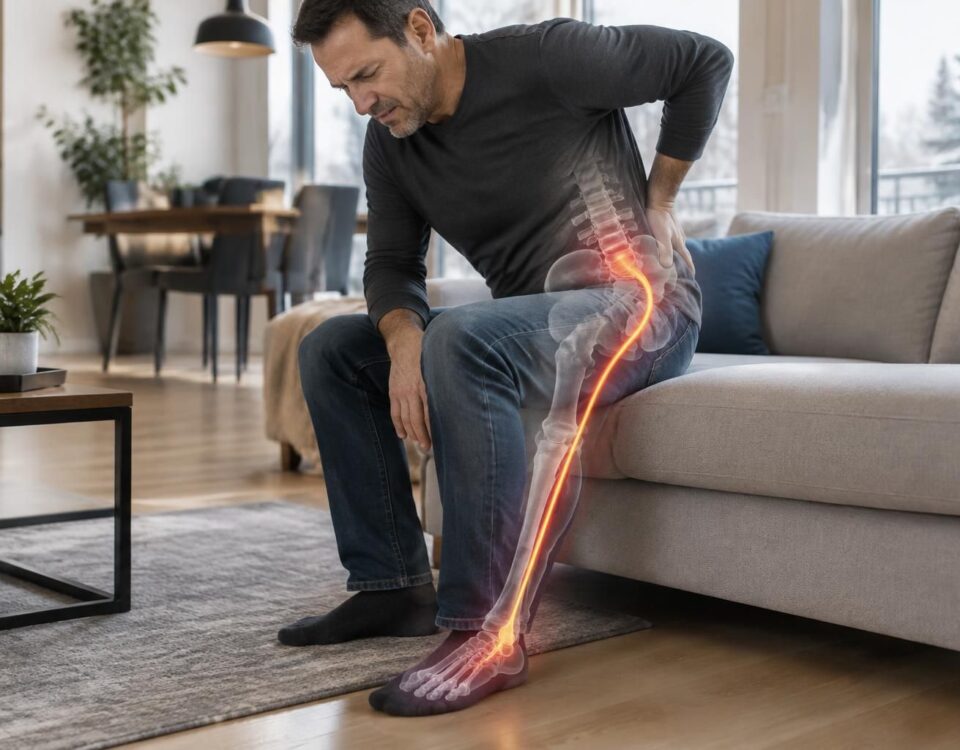
Sciatica and pain after driving
09/10/2026
IN BRIEF The difference between L4-L5 and L5-S1 concerns the level of the lumbar discs and the sometimes irritated nerve roots: an L4-L5 injury often affects L5, while an L5-S1 injury often affects S1. The sensory pathways overlap; thus, an examination of strength, sensitivity, reflexes, and gait helps to guide the assessment. In Terrebonne, as elsewhere, MRI must be interpreted alongside symptoms and clinical examination. A new or progressive weakness, drop foot, or urinary or bowel disturbances require prompt medical evaluation. |
L4-L5 and L5-S1 refer to levels between the vertebrae, while L5 and S1 are nerve roots. Irritation at L4-L5 often affects the L5 root and can particularly cause symptoms on the top of the foot or impact the lifting of the big toe. At L5-S1, the S1 root is frequently affected, with possible symptoms at the heel or outer edge of the foot and difficulty standing on tiptoes.
These pathways overlap and vary between individuals: an MRI image alone is not sufficient to identify the affected root. In Terrebonne, as elsewhere, the assessment compares the pathway of symptoms, strength, sensitivity, reflexes, and gait. A new or progressive weakness, drop foot, saddle anesthesia, or urinary or bowel changes require prompt or urgent medical evaluation.
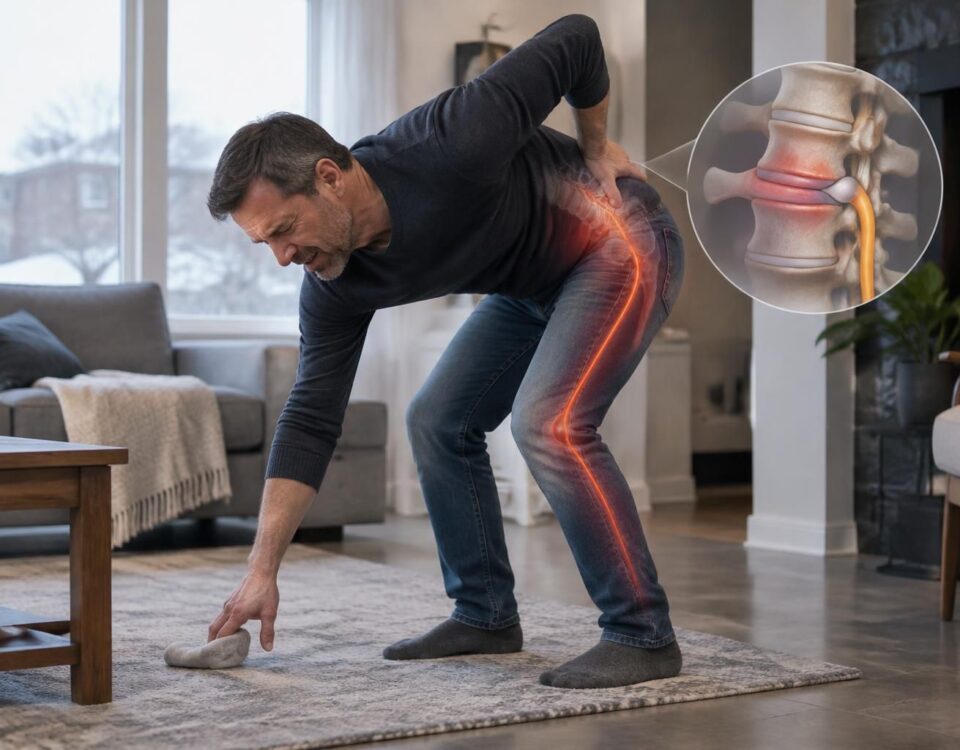
Pain radiating down the leg may be related to nerve irritation near the L4-L5 or L5-S1 discs. These levels are adjacent but do not correspond to the same nerve roots. The trajectory of pain, strength, sensitivity, and gait help to guide the assessment. No isolated symptom or imaging result is sufficient on its own to confirm the cause.
Understanding the difference between a disc level and a nerve root
L4-L5 and L5-S1 designate spaces between two vertebrae where the discs are located. L5 and S1 refer to nerve roots. These terms are related, but they do not mean the same thing.
A herniated disc at L4-L5 can often irritate the L5 root. A herniated disc at L5-S1 can often irritate the S1 root. However, the affected level depends on the location of the herniation and the individual’s anatomy. Therefore, imaging must be compared to symptoms and clinical examination.
The sensory territories of L5 and S1 overlap. A body map can help describe the symptoms, but it cannot provide a diagnosis on its own. To better understand the possible pathway of pain to the foot, refer to this article on sciatic pain in the foot.

Sciatica in Terrebonne: pain worsened in sitting position and lumbar disc
IN SHORT Aggravated sciatica in a sitting position may be related to the irritation of a lumbar nerve root, sometimes associated with a lumbar disc. In Terrebonne, varying positions, taking short active breaks, and getting an evaluation can help better…

Sciatica in Terrebonne: pain worsened by flexion and disc-related cause
IN BRIEF Aggravated sciatica by flexion is pain that starts in the lower back and radiates into the buttock or leg; a lumbar disc herniation can irritate a nerve root, although it may not be the only possible cause. In…
Sciatica in Terrebonne: difference between L4-L5 and L5-S1 based on symptoms
Possible signs of L5 irritation
Irritation of the L5 root can cause pain or numbness on the side of the leg and the top of the foot. Some people also notice an unusual sensation near the big toe. The strength to lift the foot or big toe may be diminished.
Difficulty walking on heels can provide a clue about the function of certain muscles, but this test does not confirm an L5 injury on its own. To learn more about this pathway, visit our page dedicated to pain towards the big toe associated with possible L5 irritation.
Possible signs of S1 irritation
Irritation of the S1 root can cause pain in the back of the leg, at the heel, or on the outer edge of the foot. The person may also experience tingling or loss of sensation in these areas. A decrease in strength to push the foot down may make walking on tiptoes more difficult.
These signs vary from person to person. The pathway of pain does not always follow a precise pattern and may not entirely correspond to a single nerve root.

Disc herniation in Terrebonne: why some stretches worsen
IN BRIEF Discogenic sciatica is pain related to the irritation of a nerve, sometimes worsened by certain stretches that intensify the symptoms. In Terrebonne, avoiding movements that cause pain to radiate down the leg and focusing on an appropriate approach…

Sciatica disc in Terrebonne: movements to avoid at the beginning
IN BRIEF Disc-related sciatica corresponds to a nerve irritation that can cause pain from the lower back to the buttock or leg. Initially, avoid movements that worsen the pain, such as deep bends, sudden twists, and carrying heavy loads. In…
Why pain alone does not pinpoint the affected level
It is possible to experience more pain in the leg than in the lower back. Some people also feel pain in the buttock without significant lower back pain. Therefore, the intensity or location of pain does not automatically conclude that a specific disc is involved.
A herniated disc, a bulging disc, foraminal stenosis, or another source of pain can produce similar symptoms. Additionally, a visible abnormality on an MRI may exist without being the cause of the symptoms. The assessment must check if the side, the pathway, and the clinical signs align with the image.
Pain in the buttock without back pain can have several explanations. This page on pain in the buttock without back pain in Terrebonne provides useful elements to discuss during an evaluation.

Sciatica in Terrebonne: disc herniation with leg weakness
IN SHORT Sciatica related to a disc herniation can cause pain that radiates down the leg, sometimes accompanied by weakness. In Terrebonne, an assessment helps guide management based on symptoms and their progression. A new, significant, or progressive weakness requires…

Sciatica in Terrebonne: herniated disc with foot numbness
IN BRIEF Sciatica related to a herniated disc can irritate a nerve root and cause pain that radiates down the leg, sometimes with a numbness in the foot. In Terrebonne, an evaluation helps to better understand the symptoms and consider…
How the evaluation proceeds in Terrebonne
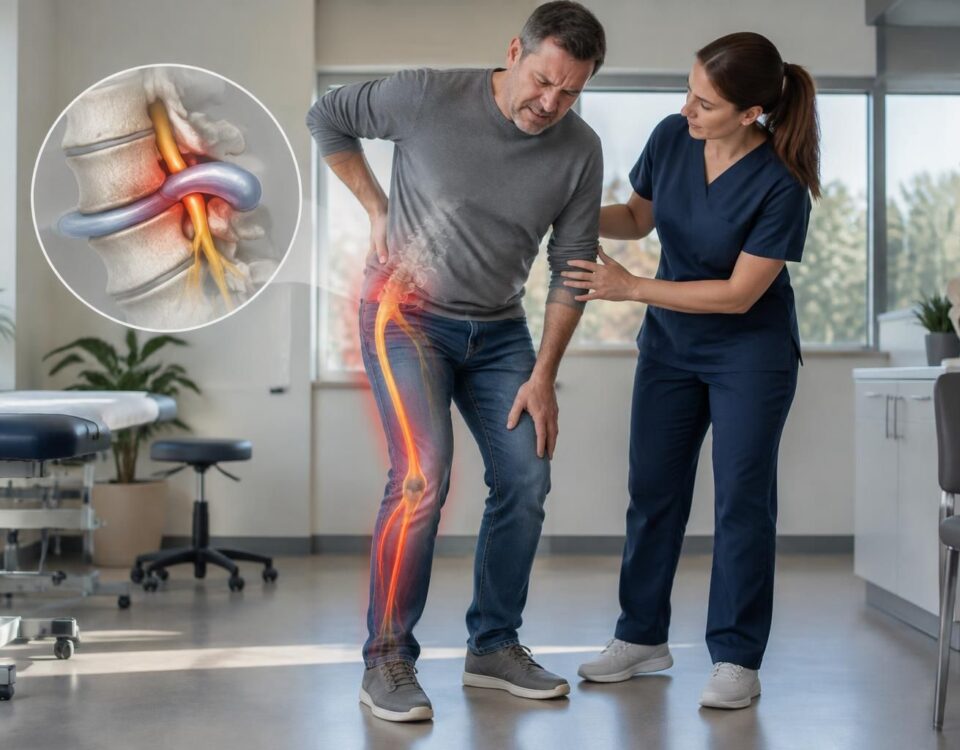
The evaluation compares symptoms on both sides of the body and seeks changes in function. The professional may check the strength of the foot and big toe, sensitivity, certain reflexes, and the way of walking. They may also examine the hip and observe the response to movements of the lower back.
It is helpful to note when symptoms started, where they radiate, and what aggravates or alleviates them. Bring, if available, imaging reports, a list of medications, and information on treatments already tried.
An MRI is not necessary in all cases before starting treatment. It may be considered when its result is likely to change the approach, particularly in the presence of neurological signs, persistent symptoms, or warning signs. The decision rests with the qualified healthcare professional based on the presented situation.

Sciatica in Terrebonne: lumbar disc and nerve root inflammation
IN BRIEF Lumbar disc-related sciatica occurs when irritation or inflammation of a nerve root causes pain that may radiate from the buttock down to the leg. In Terrebonne, an evaluation can help better understand the cause of symptoms and identify…

Sciatica and disc pinching in Terrebonne: when space decreases
IN BRIEF The disc bulge corresponds to a reduction in the space between two vertebrae; it can sometimes contribute to nerve irritation and sciatica, with pain that radiates down the buttock or leg. In Terrebonne, an assessment allows for a…
Choosing an appropriate management based on the situation
A care plan depends on the working diagnosis, the stability of neurological function, risks, and the individual’s goals. When function remains stable, a non-surgical approach may be considered with planned follow-up. Manual therapies or technologies can be discussed after assessment, but they do not replace medical advice when necessary.
At the TAGMED Clinic, services may include specific osteopathy, precision percussion, or motorized neurovertebral decompression, depending on the assessment and situation. These approaches are not suitable for everyone and do not guarantee a result. To learn about available services, consult the TAGMED Clinic or information on sciatica treatment in Terrebonne.
A serious plan also includes a reassessment date. Pain is not the only indicator to monitor. Walking, sleeping, strength, sensitivity, and the ability to resume important activities provide a more complete picture of progress. A temporary improvement does not necessarily confirm the suspected cause.
When to Seek Prompt Medical Evaluation
New or progressive weakness in the leg, drop foot, or increasing difficulty walking requires prompt medical evaluation. Immediate consultation is also necessary for numbness that spreads or marked loss of strength.
Loss of bladder or bowel control, numbness in the saddle area, fever with back pain, major trauma, or rapid aggravation requires urgent care. Do not prolong a planned care program if these signs appear.
Frequently Asked Questions About L4-L5 and L5-S1
Does an L4-L5 herniation always affect the L5 root?
No. L4-L5 often affects the L5 root, but the location of the herniation and anatomical variations can alter the structures involved. Clinical examination and imaging should be interpreted together.
Does an L5-S1 herniation always mean S1 sciatica?
No. S1 is often affected at this level, but the link is not automatic. The side of the pain, strength, sensitivity, and reflexes must be compared to imaging results.
Does pain towards the big toe prove L5 involvement?
No. This area may guide the evaluation towards L5, but nerve territories overlap. Pain should be interpreted alongside other symptoms and examination results.
Is an MRI always necessary?
No. An MRI is mainly useful when its result can modify the management. A healthcare professional can determine if it is indicated based on symptoms and examination.
What should be brought to a consultation?
Note the timeline of symptoms, their path, changes in strength or sensitivity, and activities that have become difficult. Also bring imaging reports, a list of medications, and previous care received.
About the Author
Sylvain Desforges, B.Sc., D.O., N.D., Doctor of Osteopathy is the founding president of TAGMED and the ACMA association. He dedicates his practice to chronic pain in the spine, lower back pain, and pain compatible with sciatica, especially when the pain radiates towards the buttock, leg, calf, foot, or toes.
Through SOS Sciatique, he publishes educational content on sciatica symptoms, possible causes such as disc herniation, disc compression, foraminal stenosis, or irritation of a lumbar nerve root, as well as non-surgical approaches that may be considered based on the assessment. At the TAGMED Clinic, care may include, depending on the case, motorized neurovertebral decompression, specific osteopathy, or precision percussion.
For an evaluation related to sciatica treatment in Montreal / Mont-Royal or sciatica treatment in Terrebonne, consult the available services at the TAGMED Clinic.
Medical Disclaimer
The information published on SOS Sciatique is provided for educational purposes and does not replace a consultation, diagnosis, advice, or treatment performed by a physician or other authorized healthcare professional. The author of this article is neither a doctor nor a specialist in a medical field recognized by the Collège des médecins du Québec. The approaches of osteopathy, manual medicine, or functional support described on this site do not constitute medical acts and are not intended to replace medical follow-up.
Medical disclaimer: The information and advice provided on this site do not replace the opinion, diagnosis, or treatment of a healthcare professional. Please note that Sylvain Desforges, B.Sc., D.O., N.D., Doctor of Osteopathy, is not a doctor of medicine or a physician, and is not a specialist in a medical field as defined by the Collège des médecins du Québec. Manual medicine, functional medicine, and sports medicine as described on this site exclude any treatment or medical diagnosis performed by a doctor or medical specialist. Always consult your physician for any medical questions. For more details, please read our complete legal notice.
L4-L5
- A herniation may often irritate the L5 root.
- Possible signs: pain or numbness on the top of the foot, difficulty lifting the big toe or foot.
L5-S1
- A herniation may often irritate the S1 root.
- Possible signs: symptoms towards the heel or outer edge of the foot, difficulty walking on tiptoes.
- To remember: the disc level does not confirm the affected root by itself; the territories may overlap.
- In Terrebonne, as elsewhere, the assessment compares strength, sensitivity, reflexes, and gait.
- A new or progressive weakness, a foot drop, or urinary or intestinal issues require a prompt or urgent medical evaluation.

In Terrebonne, pain that radiates down the buttock or leg may be associated with nerve irritation near the L4-L5 or L5-S1 levels, but an MRI image alone is not sufficient to determine its cause. These markers refer to discs, while L5 and S1 are nerve roots in overlapping territories. The assessment of strength, sensitivity, reflexes, and gait helps guide decisions and choose appropriate follow-up.
Understanding the difference between L4-L5 and L5-S1
L4-L5 and L5-S1 are two distinct disc spaces located in the lower back. A disc abnormality at these levels can sometimes irritate a nerve root, but it does not confirm the source of pain by itself. The affected side, the symptom trajectory, and examination findings must also be considered.
Often, a herniation at the L4-L5 level may affect the L5 root, while a herniation at L5-S1 may involve S1. However, anatomical variations and the overlap of nerve territories prevent drawing conclusions from a simple symptom map.
What signs can be observed?
Affecting L5 may be accompanied by pain or numbness on the top of the foot, sometimes extending to the big toe. Affected S1 may manifest towards the heel or the outer edge of the foot. The ability to lift the foot or big toe, as well as to walk on tiptoes, also provides clues. None of these signs, in isolation, allow for a diagnosis.
How to guide evaluation in Terrebonne
A qualified professional can compare the symptoms on both sides and assess the strength, sensitivity, reflexes, and gait. They can also examine the hip and see if certain lumbar movements change the pain. Possible causes are not limited to a disc herniation: stenosis, irritation of a peripheral nerve, or a hip problem can sometimes produce similar symptoms.
Imaging is not automatically necessary before starting care. It is mainly considered when its results could modify the management, particularly in the presence of neurological signs, persistent symptoms, or warning signs. The plan should match the examination and your goals, not simply an abnormality visible on an image.
Choosing care and tracking progress
When neurological function is stable, a graduated approach can be discussed based on the likely cause, tolerance, and the person’s preferences. It may include suitable activity and exercises recommended by a professional. Manual care or other options do not necessarily suit everyone; their relevance should be assessed on a case-by-case basis.
Before starting, establish a baseline measurement: walking distance, tolerance in sitting position, sleep, foot strength, and ability to walk on heels or toes. Also set a reevaluation date. If the numbness extends, if walking deteriorates, or if strength decreases, request a new evaluation instead of automatically repeating the same care.
When to seek prompt consultation
A new or progressive weakness, a foot drop, or worsening numbness requires prompt medical evaluation. Seek emergency services in cases of loss of urinary or bowel control, anesthesia in the saddle region, significant or rapidly progressive weakness, fever, or major trauma.
Useful questions to ask
Ask what the working diagnosis is, what examination signs support it, and what functional outcome will be monitored. Check when the plan will be reevaluated and what other options may be considered if progress is insufficient. Bring the timeline of symptoms, the list of tried treatments, and available imaging reports.
Medical warning: this content is educational and does not replace a consultation or diagnosis by a licensed healthcare professional. Care in osteopathy or manual approaches do not replace medical follow-up.
| Clinical marker | Typical difference |
|---|---|
| Disc level | L4-L5 often affects the L5 root; L5-S1 often affects the S1 root. |
| Area sometimes numb | L5: top of the foot or big toe; S1: heel or outer edge of the foot. |
| Strength to check | L5: lift the foot or big toe; S1: stand on tiptoes. |
| Useful reflex | The Achilles reflex may be diminished in cases of S1 involvement. |
| Limitations of these signs | The territories overlap: no isolated sign confirms the level. |
| Evaluation in Terrebonne | Compare strength, sensitivity, reflexes, and gait on both sides. |
| When to seek prompt consultation | New or progressive weakness, foot drop, saddle anesthesia, or urinary or bowel issues. |
Sciatica in Terrebonne: illustrative testimonials on the difference between L4-L5 and L5-S1
Note: the testimonies below are fictitious examples for educational purposes. They do not come from real patients and do not allow for determining the source of pain. Symptoms vary from person to person, and nerve territories overlap.
“My pain was radiating down to the top of my foot” — illustrative scenario: A person consults for lower back pain radiating to the buttock, back of the leg, and top of the foot. Involvement of the L5 root may correspond to this type of trajectory, sometimes accompanied by difficulty in lifting the big toe or foot. These signs are clues, not proof of the affected level.
“I mainly felt pain towards the outer edge of the foot” — illustrative scenario: Another person describes symptoms that extend towards the heel or the outer edge of the foot, with difficulty standing on tiptoes. This may direct the examination towards the S1 root, but other causes remain possible, and presentations are not the same for everyone.
Why levels can be confusing: L4-L5 and L5-S1 refer to spaces between the vertebrae, while L5 and S1 refer to nerve roots. A hernia located at L4-L5 often affects the L5 root; a hernia at L5-S1 often affects S1. However, this association is not automatic: the location of the anomaly and anatomical specifics also matter.
“My MRI showed an anomaly, but the examination nuanced the result” — illustrative scenario: An MRI image alone is not sufficient to attribute pain to a specific root. The professional compares the affected side, the symptom pathway, strength, sensitivity, reflexes, and walking. To monitor progress, they can notably observe walking on heels and tiptoes, as well as the lifting of the big toe.
An assessment adapted to Terrebonne as elsewhere is based on the same principles: specifying the pain pathway, looking for weakness or changes in sensitivity, examining function, and considering the person’s goals. Imaging is considered when it can help modify the management, and not solely because an anomaly might be visible.
When neurological signs are stable, a professional can discuss a non-surgical approach suitable for the situation, with functional goals and a date for re-evaluation. Exercise, manual therapy, medication, injections, and surgery do not all address the same indications. The plan should be revised if symptoms extend, if function does not improve, or if a new sign appears.
Consult quickly in the case of new or progressive weakness, foot drop, or worsening gait. Loss of urinary or bowel control, numbness in the saddle region, or significant or rapidly progressive weakness requires urgent medical evaluation.
About the author
Sylvain Desforges, B.Sc., D.O., N.D., Doctor of Osteopathy, is the founding president of TAGMED and the ACMA association. His practice is dedicated, in particular, to chronic spinal pain, low back pain, and symptoms consistent with sciatica.
Medical disclaimer
This content is provided for educational purposes and does not replace a consultation, diagnosis, opinion, or treatment by a physician or other authorized health professional. The author is neither a physician nor a specialist in a medical specialty recognized by the Collège des médecins du Québec. Osteopathic, manual medicine, or functional support approaches do not replace medical follow-up.
Sciatica in Terrebonne: understanding the difference between L4-L5 and L5-S1
Pain that starts in the lower back and radiates into the buttock or leg may suggest sciatica. To understand its origin, the lumbar segments L4-L5 and L5-S1, located in the lower part of the spine, are sometimes examined. These names refer to levels between the vertebrae, while L5 and S1 refer to nerve roots. The distinction is important: a visible disc anomaly on imaging does not, by itself, determine which root is irritated or explain all symptoms.
A hernia located between L4 and L5 often affects the L5 root; a hernia between L5 and S1 more frequently involves S1. These are tendencies, not absolute rules. Sensory pathways overlap and vary from person to person. Pain on the top of the foot or difficulty lifting the big toe may direct the examination towards L5. Discomfort in the heel or the outer edge of the foot, or difficulty rising on tiptoes, may suggest S1. However, these signs alone are not sufficient to establish a diagnosis.
In Terrebonne as elsewhere, a relevant evaluation relates the account of symptoms, their evolution, and the physical examination. The professional can compare the strength of both legs, sensitivity, certain reflexes, and gait, particularly on heels and toes. They can also examine the hip and observe the response to movements of the lower back. An MRI is not systematic: it is mainly useful when its result is likely to modify management, for example in the presence of persistent symptoms or a neurological deficit.
Management depends on the working diagnosis, neurological stability, activity tolerance, and the person’s goals. When strength remains stable, non-surgical care may be considered, with appropriate activity and planned follow-up. Exercises, manual therapy, certain technologies, medications, injections, or a specialized consultation address different situations. A serious plan specifies the desired changes — walking more, sleeping better, or resuming an activity — and includes a date for re-evaluation. Repeatedly administering a treatment without functional progress merits revision.
It is useful to note the pathway of pain, positions that worsen or alleviate it, walking distance, sleep, and activities that have become difficult. Bring to the consultation the timeline of symptoms, treatments already tried, and available imaging reports. This information helps compare results over time and verify that the radiological image corresponds accurately to the side and signs observed. A temporary improvement in pain does not necessarily confirm the cause; conversely, an isolated fluctuation does not, by itself, prove worsening.
A new or progressive weakness, foot drop, deteriorating gait, extending numbness, anesthesia in the saddle region, or a recent change in urinary or bowel control requires rapid or urgent medical evaluation. In the case of fever, recent trauma, severe pain, or rapid deterioration, also seek medical advice without delay.
About the author
Sylvain Desforges, B.Sc., D.O., N.D., Doctor of Osteopathy, is the founding president of TAGMED clinics and the ACMA association. His practice focuses in particular on chronic spinal pain, low back pain, and symptoms consistent with sciatica. He is interested in innovation in health and the thoughtful use of approaches such as motorized spinal decompression, laser, and shockwaves, according to the evaluation and needs of the person.
The information presented here is educational and does not replace a consultation, diagnosis, or treatment by a licensed healthcare professional. Sylvain Desforges is not a doctor nor a specialist in a medical specialty recognized by the Collège des médecins du Québec. Manual and functional approaches do not constitute medical acts and do not replace medical follow-up.
In Terrebonne, distinguishing an issue located at the disc level L4-L5 from an issue L5-S1 helps orient the evaluation of pain that radiates into the buttock or leg. These levels do not automatically correspond to a specific nerve root: symptoms, strength, sensitivity, reflexes, and gait must be examined together to establish a working hypothesis and choose the follow-up carefully.
What L4-L5 and L5-S1 refer to
L4-L5 and L5-S1 are levels between the vertebrae where intervertebral discs are located. The roots L5 and S1 are nerves whose sensory and motor territories may overlap. A visible anomaly on imaging is therefore not sufficient by itself to determine which nerve is irritated or whether it explains the symptoms.
A herniation located at L4-L5 can often affect the L5 root, while a herniation at L5-S1 can often affect S1. However, there are anatomical variations, and the path felt is not the same for everyone. To better understand the link between disc levels and nerves, check out this guide on nerve roots associated with sciatica as well as the article on the differences between disc herniation and discopathy.
Possible indicators in the leg and foot
Irritation of L5 may be accompanied by symptoms on the top of the foot or near the big toe. An issue with S1 may instead concern the heel or the outer edge of the foot. These markers are indicative: no sensory territory constitutes a perfectly accurate map. Pain, tingling, or numbness should be compared with the examination of strength and gait.
The evaluation may specifically compare the lifting of the big toe and foot, walking on heels, walking on toes, reflexes, and sensitivity on both sides. You can read the guide dedicated to pain consistent with L5 irritation towards the big toe and consult this guide on the possible path of symptoms associated with L5 and S1.
Why MRI alone is not sufficient
An MRI can show a discopathy, protrusion, or herniation, but these images must be related to the painful side, the path of symptoms, and the results of the examination. Some people show disc changes without pain, while symptoms may have other causes. Therefore, the choice of imaging depends on the situation and the possibility that its result will affect clinical management.
Pain originating from the hip, a peripheral nerve, or another structure can sometimes resemble sciatica. If the pain is mainly felt in the hip area, this resource explains several elements to distinguish: sciatica or hip pain. To delve deeper into disc problems that may irritate a nerve, also consult the guide on disc herniation and sciatica.
Choosing a suitable approach in Terrebonne
In Terrebonne, as elsewhere, the plan should take into account the working diagnosis, neurological progression, important activities for the individual, and their tolerance for treatment. When strength and gait remain stable, a graduated, non-surgical approach may be considered with functional objectives and a re-evaluation date. Depending on the case, options discussed with the relevant professionals may include adjusted activity, exercises, manual therapy, technologies, or specialized medical advice.
To track progress, it is useful to note the path of the pain or numbness, the ability to walk on heels and toes, foot strength, sleep, and activities that have become difficult. A temporary improvement in pain does not by itself prove that the cause is confirmed; conversely, a more painful day does not necessarily mean that the situation is worsening. The important thing is to observe the trend and function. This resource also presents the discopathy L4-L5 and L5-S1 and low back pain.
Prolonged vibrations from the road may influence symptoms in some individuals, without establishing the cause of pain by themselves. For this issue, consult the article on sciatica and road vibrations. Another guide describes sciatica associated with levels L4-L5 and L5-S1 in Montreal, and this resource addresses symptoms related to L4-L5.
When to seek a prompt evaluation
A new or progressive weakness, a foot drop, a deteriorating gait, or an extended numbness justifies a quick medical evaluation. A loss of bowel or bladder control, anesthesia in the saddle area, or significant and rapidly progressive weakness necessitates urgent evaluation. Do not delay a consultation to complete an already scheduled care program.
In case of persistent symptoms or uncertain diagnosis, ask what signs support the proposed hypothesis, what result will be measured, and when the plan will be revised. A local resource can be consulted separately at the Clinique TAGMED; services should be evaluated according to the clinical situation and do not replace medical consultation when it is necessary.
About the author
Sylvain Desforges, B.Sc., D.O., N.D., Doctor of Osteopathy, is the founding president of TAGMED and the ACMA association. His practice particularly focuses on chronic spinal pain, low back pain, and pain compatible with sciatica.
Through SOS Sciatique, he publishes educational content about symptoms, possible causes, and non-surgical approaches that may be considered based on the evaluation. At the Clinique TAGMED, care may include, depending on the case, motorized neurovertebral decompression, specific osteopathy, or precision impactor.
Medical Disclaimer
This information is provided for educational purposes and does not replace a consultation, diagnosis, advice, or treatment by a physician or other licensed healthcare professional. The author is neither a doctor nor a specialist in a medical specialty recognized by the Collège des médecins du Québec. The approaches of osteopathy, manual medicine, or functional support described do not constitute medical acts and are not intended to replace medical follow-up.
Consult a physician or emergency service in case of loss of urinary or bowel control, anesthesia in the saddle area, significant or progressive weakness of the leg or foot, fever, recent trauma, severe pain, or rapid worsening. For more details, please read the Legal Notice.

Sylvain Desforges, B.Sc., D.O., N.D., docteur en ostéopathie
Dr Sylvain Desforges, B.Sc., D.O., N.D., osteopath, is the founding president of TAGMED and of the ACMA association. He dedicates his practice to chronic spinal pain, low back pain and symptoms compatible with sciatica, particularly when pain radiates toward the buttock, leg, calf, foot or toes.
Through SOS Sciatique, he publishes educational content on sciatica symptoms, possible causes such as disc herniation, disc narrowing, foraminal stenosis or irritation of a lumbar nerve root, as well as non-surgical approaches that may be considered according to the evaluation. At Clinique TAGMED, care may include, depending on the case, motorized neurovertebral decompression, specific osteopathic care or precision percussion.
For an evaluation related to sciatica treatment in Montreal / Mount Royal or sciatica treatment in Terrebonne, please consult the services available at Clinique TAGMED.
Medical disclaimer
The information published on SOS Sciatique is provided for educational purposes only and does not replace a consultation, diagnosis, opinion or treatment provided by a physician or another authorized healthcare professional. The author of this article is neither a medical doctor nor a specialist in a medical specialty recognized by the Collège des médecins du Québec. The osteopathic, manual medicine or functional support approaches described on this site do not constitute medical acts and are not intended to replace medical follow-up.
Consult a physician or emergency service in cases of loss of bladder or bowel control, anesthesia in the saddle area, significant or progressive weakness in the leg or foot, fever, recent trauma, severe pain or rapid worsening of symptoms. For more details, please read our Legal Notice.