Sciatica and stomach pain
15/10/2026
Sciatica and squats: why caution is needed
15/10/2026
IN BRIEF A disc protrusion is a bulge of the intervertebral disc, which can be silent or irritate a nerve. Lumbar flexion is not necessarily dangerous but can worsen symptoms in some individuals. Adapting movements, avoiding those that aggravate pain, and gradually staying active helps maintain comfort and mobility. A healthcare professional can guide the resumption according to symptoms. |
When a lumbar disc protrusion is sensitive, leaning forward frequently or far can increase pain in some individuals, especially if the movement causes radiation into the buttock or leg. This does not mean that all flexion is dangerous: tolerance varies according to symptoms. Temporarily reduce movements that aggravate pain, without adopting strict rest, and prioritize a gradual resumption of movements with the advice of a healthcare professional. New or progressive weakness, loss of sensation in the saddle area, or urinary or bowel issues require urgent evaluation.
Lumbar flexion refers to the movement that tilts the lower back forward. In the presence of a disc protrusion, this movement can sometimes increase pain, especially if the disc irritates a nerve root. However, it should not be concluded that all flexion is dangerous: caution involves considering symptoms, avoiding positions that worsen them, and having the situation evaluated when pain persists or intensifies.
A disc protrusion corresponds to a bulge of the disc between two vertebrae. The outer layer of the disc generally remains contained, but its shape may change. This imaging observation alone is not sufficient to explain pain or to determine which movements to avoid.
Lumbar flexion can increase pressure on certain parts of the disc. If a nerve root is already irritated, certain forward-leaning positions can then trigger or exacerbate pain. The effect varies greatly from person to person: the same posture may be comfortable for one and painful for another.
Flexion is not always the cause of pain
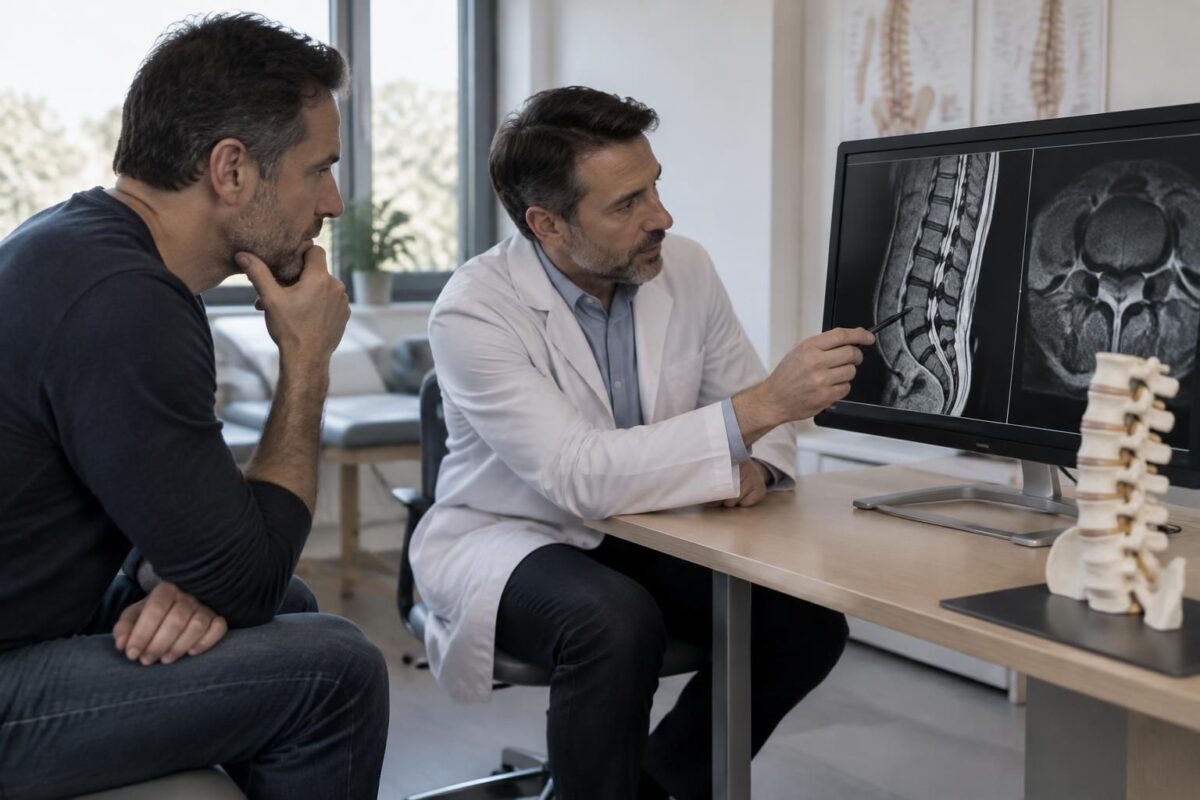
A protrusion visible on MRI may cause no symptoms. Conversely, a subtly marked bulge may be painful if it is near a sensitive structure. Therefore, the healthcare professional compares imaging results with the location of the pain, its path, changes in sensitivity, and muscle strength.
A lumbar pain that radiates into the buttock or leg may suggest nerve irritation, but it does not alone confirm sciatica caused by a protrusion. To better understand the link between symptoms and imaging, refer to these explanations on visible lumbar levels on MRI and on the reading of lumbar levels in Terrebonne.
Why some flexions may exacerbate symptoms
Leaning forward, sitting for long periods, or repeating flexed movements can place increased strain on the lower back. If the movement reproduces pain that radiates down the leg, tingling, or numbness, it is reasonable to temporarily reduce this strain and seek professional advice.
Pain behind the thigh can have several causes. It does not alone distinguish nerve irritation from a problem coming from another structure. To better locate this symptom, read our article on disc protrusion and pain behind the thigh.
What daily actions require caution?
It may be useful to identify situations that aggravate symptoms: bending to pick up an object, working for long periods with a hunched back, or lifting a load while twisting the trunk. The aim is not to prohibit all movement, but to avoid repeating an action that causes significant pain or increased radiation.
When you need to pick up an object, get close to it and avoid combining deep bending with sudden twisting. For sitting work, change position regularly if tolerated. These adjustments aim to reduce strain and improve comfort; they do not directly eliminate the protrusion.
Strict and prolonged rest is generally not an appropriate response to all lumbar pains. The level of activity must, however, correspond to your condition and the evolution of your symptoms. If a movement significantly increases pain in the leg or causes new weakness, stop repeating it and seek advice from a healthcare professional.
Disc bulge and diagnosis not to be simplified
IN BRIEF A disc bulge is a protrusion of a disc visible on imaging; it is not sufficient on its own to explain pain or to make a diagnosis. Its interpretation must take into account symptoms, clinical examination, and context.…
Disc bulge and lumbar osteoarthritis
IN BRIEF A disc bulge is a protrusion of the lumbar disc; wear can also contribute to lumbar osteoarthritis and lower back pain. Symptoms vary by individual and may sometimes radiate into the leg. Motion imaging may be considered by…
What does “protrusive disc herniation” mean in a report?
The terms used in reports may vary. A protrusion often describes a bulge of the disc, while the word hernia can refer to a more marked displacement of its contents. The term “protrusive disc herniation” may thus be used to describe a minimally expelled form. The interpretation depends on the complete report, examination, and symptoms.
The presence of an abnormality on MRI does not automatically mean that surgery is necessary, nor that the pain will persist. The relationship between an image and symptoms must be examined carefully. For more information, see the details on disc herniation without back pain and on the importance of a precise diagnosis in case of sciatica.

Disc bulge and narrowed foramen
IN BRIEF A disc bulge is a protrusion of the disc that can contribute to narrowing the foramen, the opening where a nerve root passes through. If this is irritated or compressed, pain, tingling, or weakness may occur, sometimes extending…

Disc bulge and loss of disc height
IN BRIEF A disc bulge is a protrusion of the disc between the vertebrae; a loss of disc height means that the disc has thinned. These changes may be related to wear and sometimes contribute to pain, stiffness, or nerve…
When should you consult quickly?
Consult a doctor promptly if you notice significant or progressive weakness in a leg or foot, marked loss of sensation, or rapid worsening of symptoms. Loss of bladder or bowel control, or loss of sensation in the saddle region, requires urgent evaluation.
A medical opinion is also indicated in case of fever, recent trauma, or severe pain that worsens. These signs do not allow for a remote diagnosis, but they justify immediate evaluation.

Disc bulging and disc degeneration
IN SHORT A disc bulge is a protrusion of the disc, sometimes associated with disc degeneration related to aging. These visible changes on imaging do not always cause symptoms. Their significance is determined by comparing the MRI to pain, strength,…

Herniated disc and recurring pain
IN BRIEF A disc bulge is a disc that protrudes without necessarily being ruptured; it does not always cause pain. When pain returns, it may be related to nerve irritation, but a professional must verify the link with the symptoms.…
Evaluation and support options
An assessment can help determine if the symptoms align with the level mentioned in the imaging and which movements are tolerated. At the TAGMED Clinic, support may include, depending on the assessment and the individual’s situation, specific osteopathy or motorized neurovertebral decompression. These approaches do not replace a medical diagnosis and may not be suitable for all cases.
To learn about available services, consult the TAGMED Clinic. Responsible care considers the examination, imaging, medical history, and symptom progression before considering an approach.
About the Author
Sylvain Desforges, B.Sc., D.O., N.D., osteopath and naturopath, is the founding president of TAGMED and the ACMA association. His practice focuses notably on chronic pain of the spine, lower back pain, and pain consistent with sciatica, including when pain reaches the buttock, leg, calf, foot, or toes.
Through SOS Sciatique, he publishes educational content on the symptoms and possible causes of sciatic pain, such as herniated discs, disc pinching, foraminal stenosis, or irritation of a lumbar nerve root. At the TAGMED Clinic, care may include, depending on the assessment, motorized neurovertebral decompression, specific osteopathy, or precision impact therapy.
For an assessment related to the sciatica treatment in Montreal or Mont-Royal, or for sciatica treatment in Terrebonne, consult the services of the TAGMED Clinic.
Medical Disclaimer: The information and advice provided on this site do not replace the advice, diagnosis, or treatment of a health professional. Please note that Sylvain Desforges, B.Sc., D.O., N.D., Doctor of Osteopathy, is neither a doctor of medicine nor a physician and is not a specialist in a medical specialty as defined by the Collège des médecins du Québec. Manual medicine, functional medicine, and sports medicine as described on this site exclude any treatment or medical diagnosis done by a physician or specialist. Always consult your doctor for any medical questions. For more details, please read our Complete Legal Notice.
Loaded bendingPicking up an object while bending can increase strain on the lower back.
Pain radiating down the legReduce movements that trigger or amplify radiation.
Adapted movementBending is not forbidden: adjust the range and gradually resume according to your tolerance.
Persistent symptomsSeek professional advice to adjust your activities and care.

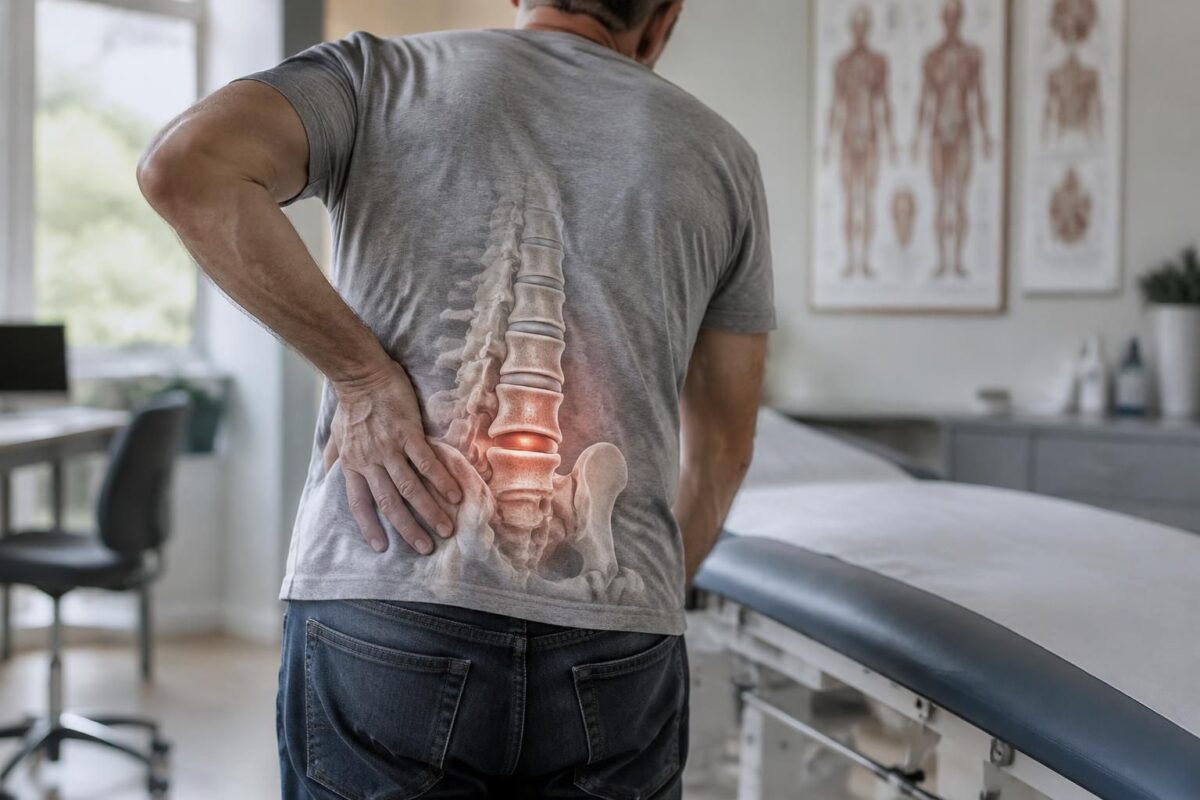
In the presence of a lumbar disc protrusion, bending the back is not automatically dangerous, but some repeated, forced movements or those done with a load can exacerbate symptoms. The goal is to temporarily adjust movements according to pain, stay active without overexerting yourself, and seek a professional assessment if pain radiates down the leg or worsens.

Disc bulge and pain after exertion
IN BRIEF A disc bulge is a disc that slightly protrudes between two vertebrae; after exertion, it may be associated with low back pain, sometimes radiating into the leg. An imaging result alone is not enough to explain the pain…

Disc bulge and tingling in the foot
IN SHORT A disc bulge refers to a disc that bulges beyond its boundary; if it irritates a nerve root, it can contribute to tingling in the foot, numbness, or pain in the leg. However, MRI alone is not sufficient…
Understanding the link between disc protrusion and lumbar flexion
Lumbar flexion corresponds to the movement of bending the torso forward. It occurs in common actions: picking up an object, putting on shoes, or sitting. A protrusion is a bulging of the intervertebral disc; its appearance on imaging does not, on its own, indicate whether this movement is harmful or explains the pain.
Caution is especially warranted when bending provokes or increases pain radiating into the buttock, thigh, calf, or foot, or when it leads to tingling or numbness. These reactions deserve to be considered without automatically concluding that the injury is worsening. Symptoms and their progression should be interpreted alongside the clinical examination.
Adapting movements without immobilizing the back
Temporarily reduce provocative bends
During a painful episode, avoid repeating deep bends if they clearly trigger your symptoms, especially with a load or trunk rotation. To pick up an object, come close to it, brace yourself if necessary, and bend at the hips and knees as much as your comfort allows. Break up tasks that require staying bent for long periods.
This does not mean keeping the back perfectly straight at all times or banning all forward movement. Total avoidance may increase stiffness and fear of movement. Gradually resume tolerated movements, focusing on controlled motions and monitoring your response during activity and in the hours that follow.
Vary positions and keep moving
Alternate between sitting, standing, and walking positions, especially if your work requires you to remain seated for long periods. Take short, regular breaks and try light walking if it does not increase radiation. Prolonged strict rest is generally not a helpful strategy for gradually regaining mobility.
When to seek professional advice
A health professional can correlate your symptoms, physical examination, and, if available, imaging. This evaluation helps determine which ranges of motion are appropriate and whether support, such as rehabilitation, is indicated. Manual or functional approaches may be considered depending on the situation, but they do not replace a medical diagnosis and do not guarantee a change in the protrusion.
Quickly check if the pain intensifies, if there is a loss of sensation or weakness, or if the symptoms severely limit your activities. A loss of bladder or bowel control, numbness in the saddle area, or significant or progressive weakness in the leg or foot requires urgent evaluation. In case of doubt, contact a doctor or an emergency service.
| Situation | Practical Indicator |
|---|---|
| Lumbar flexion | It may increase symptoms in some people, but not systematically. |
| Pain during movement | Reduce the range of motion and avoid forcing through the pain. |
| Repeated or prolonged flexion | Alternate positions and take regular breaks. |
| Picking up a load | Keep the load close to your body and prioritize a controlled motion. |
| Walking and daily activity | A gradual movement is generally preferable to prolonged immobility. |
| Pain radiating down the leg | Have the symptoms evaluated, especially if they persist or worsen. |
| Significant or progressive weakness | Quickly consult a healthcare professional. |
| Urinary, bowel issues, or loss of sensation in the saddle area | Request an urgent evaluation. |
Testimonials on disc protrusion and lumbar flexion: why caution is necessary
The testimonials below are fictional and composite. They illustrate possible experiences but do not allow for a diagnosis or predict the evolution of a disc protrusion. Lumbar flexion is not necessarily dangerous in itself: its tolerance depends notably on the symptoms, their evolution, and the situation of each person.
Marc, 42 — “Bending over triggered pain in my leg”
“When I bent down to put on my shoes, I sometimes felt pain starting from my lower back and radiating down into my buttock. I eventually completely avoided bending, even for simple tasks. During the evaluation, I realized that it was essential to observe what was truly triggering my symptoms and to avoid forcing into a position that accentuated them.”
Pain radiating into the buttock or leg may be compatible with nerve irritation, but it is not enough to confirm sciatica or determine its cause. If flexion significantly increases symptoms, a temporary adaptation of movements may be useful, without concluding that all forward movements are prohibited.
Émilie, 36 — “I was afraid to bend after my MRI”
“The report mentioned a disc protrusion, and I interpreted this as a disk ready to tear further. I kept my back very straight and asked for help to pick up even the slightest object. This fear made me particularly cautious but also stiffer in my movements. I learned to gradually resume certain activities while remaining attentive to my reactions.”
An MRI finding must be correlated with symptoms and clinical examination. A protrusion may be present without pain, and pain does not automatically mean that the disc is being damaged with each flexion. The goal is generally to find a way to move that remains tolerable, then to adapt activities according to the evolution and the advice of a healthcare professional.
Luc, 51 — “My job had me repeating the same movement”
“In my job, I often bent down to move equipment. The pains returned primarily after several hours, rather than after a single movement. I began to break some tasks down, keep objects closer to me, and vary my positions more. This allowed me to better identify the moments when fatigue made the movement less comfortable.”
Caution also involves considering the frequency of flexions, the weights being lifted, fatigue, and the time spent in a single posture. Bringing a load closer, avoiding sudden twists, and alternating positions can reduce felt constraints, without guaranteeing the disappearance of a protrusion or pain.
Nadia, 47 — “I no longer knew which movements to avoid”
“Some days, bending did not provoke much at all. Other days, I felt more discomfort, especially after sitting for a long time. I stopped trying to find a constant rule and started noting how my symptoms evolved according to movements, duration, and recovery.”
Tolerance can vary from day to day. It is often preferable to resume movements gradually, without forcing through a pain that intensifies, and without imposing prolonged immobility. A doctor or another qualified healthcare professional can help evaluate the symptoms and determine if examinations or follow-up are necessary.
When to quickly seek advice
Significant or progressive weakness in the leg or foot, loss of bladder or bowel control, or numbness in the saddle area warrants urgent evaluation. You should also consult in case of fever, recent trauma, severe pain, or rapid worsening.
When an imaging report mentions a disc protrusion, it is natural to wonder which movements to avoid. Lumbar flexion — the act of bending the trunk forward — often raises concerns, as it may increase the strain on the discs. Yet, it is not automatically dangerous and does not necessarily lead to worsening. The answer mainly depends on the symptoms, their evolution, and how the person tolerates the movement.
An intervertebral disc is located between two vertebrae and helps distribute loads. A protrusion generally corresponds to a bulging of the disc beyond its usual contour, without this being sufficient to explain pain. Some people present this feature on imaging without symptoms. Others experience lower back pain or radiation into the buttock and leg, especially if a nerve root is irritated. The image must therefore be interpreted alongside the clinical examination and the history of symptoms.
During flexion, pressures within the disc re-distribute. In some people, bending forward, lifting a load, or staying bent for long periods may temporarily worsen the pain. This reaction does not necessarily mean that the disc deteriorates with every movement. However, it may indicate that the task, for the moment, exceeds the tolerance of the tissues or that the maintained position irritates a sensitive area. Caution involves observing the body’s response rather than imposing a uniform rule on everyone.
In painful phases, it may be helpful to temporarily limit repeated bending or movements that combine bending, rotation, and load, especially if they trigger sharp pain or more pronounced radiation in the leg. To pick up an object, bring the load close to the body, bend at the hips and knees when comfortable, and avoid sudden movements to reduce effort. Alternating positions and interrupting prolonged periods in a sitting position are also possible adaptations.
Conversely, avoiding any bending or remaining bedridden for long periods is generally not a suitable strategy for recovery. A gradual return to activities, guided by tolerance and, if necessary, by a healthcare professional, helps to preserve mobility and confidence in movement. Walking or gentle exercises may be suitable for some individuals, but should be adjusted if symptoms worsen, extend further down the leg, or are accompanied by weakness.
An assessment can specify which movements worsen or soothe symptoms, check strength and sensitivity, and determine if the imaging matches the clinical picture. Care may include activity advice, progressive exercises, or manual approaches depending on the situation; they are not intended to “put” the disc back in place. Options, including motorized neurovertebral decompression, should be discussed in light of the assessment and do not replace a medical diagnosis.
Significant or progressive weakness in the leg or foot, loss of sensation in the saddle region, new difficulty controlling the bladder or bowels, fever, or rapid deterioration require urgent medical attention. In the absence of these signs, persistent or disabling pain also merits evaluation, especially if it limits daily activities.
About the Author
Sylvain Desforges, B.Sc., D.O., N.D., osteopath and naturopath, is the founding president of TAGMED and the ACMA association. His practice focuses notably on chronic spinal pain and low back pain compatible with sciatica. At the TAGMED Clinic, the care offered may include, depending on the assessment, specific osteopathy, motorized neurovertebral decompression, or precision impaction.
Medical Disclaimer
This content is provided for educational purposes and does not replace a consultation, diagnosis, or treatment by a physician or other licensed healthcare professional. The author is neither a physician nor a specialist in a medical specialty recognized by the Collège des médecins du Québec. The approaches described do not constitute medical acts and do not replace medical follow-up.
Lumbosacral flexion, meaning bending the trunk forward, is not automatically dangerous when imaging shows a disc protrusion. However, it can awaken or worsen pain if the movement irritates a sensitive structure, especially when repeated, held for a long time, or combined with a load. Caution means adapting the movement to the symptoms, without concluding that all bending movements are prohibited.
Lumbosacral Flexion and Disc Protrusion: Adapt Rather Than Systematically Avoid
A protrusion describes a bulge of the disc, but the image alone cannot determine which movements are appropriate. Pain, its pathway, sensitivity, strength, and the evolution of symptoms must be considered. A bend may be well tolerated by one person and cause lower back pain or radiation to the buttock and leg in another. To better distinguish imaging terms, consult this explanation on protrusion and protruding disc herniation.
Caution is particularly useful when bending forward — or repeating this movement — increases pain, tingling, or numbness. Pain that extends further down the leg deserves special attention: the sensation may sometimes be more pronounced in the leg than in the back, as explained in this article on pain related to a disc herniation. Tingling in the toes or loss of sensation are also symptoms to report to a healthcare professional: see information on tingling in the toes and loss of sensation.
In daily life, especially avoid forcing a position that triggers or significantly worsens symptoms. To pick up an object, get close to it, brace yourself if necessary, and bend at the hips and knees rather than rounding the lower back while carrying a load far from the body. Alternate positions if you must remain seated for long periods and resume movements gradually, according to your tolerance. The so-called “forbidden” gestures are not necessarily the same for everyone; this guide on movements to avoid with disc herniation can help think about adaptations without replacing an individualized assessment.
Strict rest and permanent avoidance of all movement do not constitute a universal response. Light activity, like walking, can be maintained if tolerated; the resumption of bending and effort should then be gradual, without trying to push through worsening or extending pain. Assessing symptoms allows for choosing relevant adaptations and checking whether the picture suggests nerve irritation or another cause of pain. Resources on symptoms of a disc protrusion, acute sciatica, and possible nerve irritation can complement this information.
Seek medical advice if the pain persists, significantly limits your activities, or is accompanied by new weakness or loss of sensation. Significant or progressive weakness, numbness in the saddle area, or loss of control over urination or bowel movements require urgent evaluation. General information on lumbar disc herniation and disc protrusion does not replace the examination by a healthcare professional.

Sylvain Desforges, B.Sc., D.O., N.D., docteur en ostéopathie
Dr Sylvain Desforges, B.Sc., D.O., N.D., osteopath, is the founding president of TAGMED and of the ACMA association. He dedicates his practice to chronic spinal pain, low back pain and symptoms compatible with sciatica, particularly when pain radiates toward the buttock, leg, calf, foot or toes.
Through SOS Sciatique, he publishes educational content on sciatica symptoms, possible causes such as disc herniation, disc narrowing, foraminal stenosis or irritation of a lumbar nerve root, as well as non-surgical approaches that may be considered according to the evaluation. At Clinique TAGMED, care may include, depending on the case, motorized neurovertebral decompression, specific osteopathic care or precision percussion.
For an evaluation related to sciatica treatment in Montreal / Mount Royal or sciatica treatment in Terrebonne, please consult the services available at Clinique TAGMED.
Medical disclaimer
The information published on SOS Sciatique is provided for educational purposes only and does not replace a consultation, diagnosis, opinion or treatment provided by a physician or another authorized healthcare professional. The author of this article is neither a medical doctor nor a specialist in a medical specialty recognized by the Collège des médecins du Québec. The osteopathic, manual medicine or functional support approaches described on this site do not constitute medical acts and are not intended to replace medical follow-up.
Consult a physician or emergency service in cases of loss of bladder or bowel control, anesthesia in the saddle area, significant or progressive weakness in the leg or foot, fever, recent trauma, severe pain or rapid worsening of symptoms. For more details, please read our Legal Notice.