Disc protrusion and pain on the outer edge of the foot
01/11/2026
Sciatica in Montreal: nerve pain and sensory territory
02/11/2026
IN BRIEF
| Sciatica is pain related to irritation or compression of the sciatic nerve. Exercises can help maintain mobility and reduce tension, but avoid those that intensify leg pain, as well as sudden twists, forced bends, and carrying heavy loads. Prioritize gentle movements, suitable for your symptoms, and stop if they worsen the pain. Consult a healthcare professional, especially if you experience weakness or numbness. |
In case of sciatica, avoid exercises that increase pain or cause it to travel further down the leg, as well as sudden twists, repeated back bends, and carrying heavy loads. If you feel tingling or numbness, adapt your movements and do not force stretches. Gentle walking can be resumed as long as it remains comfortable. Stop exercising if you experience sharp pain or worsening symptoms, and seek advice from a healthcare professional, especially if there is weakness in the leg or foot.
In case of sciatica, certain movements and activities can increase pain or tingling in the leg. The actions to avoid vary depending on the symptoms and their cause. This article outlines situations that require caution, signs that warrant medical advice, and precautions to take before resuming activity. Sciatica refers to pain associated with irritation or compression of a nerve root that contributes to the formation of the sciatic nerve. The pain may start from the lower back or buttock and radiate down the leg. It can be accompanied by tingling, numbness, or weakness. The symptoms are not the same for everyone. Their pathway can provide indications about the affected nerve root, but is not sufficient for diagnosis. The distinction between radicular pain and referred pain may also require clinical evaluation, as explained in this resource on radicular pain and referred pain. An exercise that helps one person may worsen the symptoms for another. In case of recent, intense pain or accompanied by neurological signs, avoid testing exercises or stretches without medical advice. This caution is particularly important if a herniated disc, spinal stenosis, or another disc issue is known or suspected. Bending forward frequently, rounding the back to pick up an object, or performing repeated bending movements can exacerbate symptoms in some people. The pain may then travel lower down the leg or intensify. Avoid repeating the movement that clearly triggers this reaction. Everyday actions count as well. To pick up an object, get close to it and avoid bending sharply at the waist. Do not lift a load if that movement increases pain, numbness, or weakness. Quick twists of the torso, especially when combined with carrying a load, can put significant strain on the lower back. Avoid abrupt movements and efforts that cause sharp pain or worsening symptoms in the leg. Recommendations about gestures and positions to limit are also discussed in this guide on sciatica and positions to avoid. A stretch should not cause an electric shock sensation, pain that travels further down the leg, or loss of sensitivity. If these signs occur, stop the movement. Avoid forcing the painful leg in hopes of “releasing” the nerve: this reaction does not guarantee relief and may increase irritation. Generic exercise lists do not fit all causes of sciatica. Check the precautions outlined regarding exercises to avoid, occasionally discouraged movements, and the limits of generic exercises. These resources do not replace a professional examination. Do not repeat movements forward that exacerbate the pain. Temporarily limit tasks that require you to bend for long periods or lift an object from the floor. If the pain travels further down the leg with each attempt, cease the activity and seek medical advice. A prolonged standing position can worsen symptoms in some people. Alternate positions without staying still for long and avoid repeated extensions of the lower back if they trigger pain in the leg. A healthcare professional can investigate the cause, especially if spinal stenosis is suspected. Persistent tingling or a less sensitive area deserve evaluation, especially if they spread or worsen. Avoid activities that increase these sensations. Irritation of the L5 root can lead to symptoms in certain areas of the leg or foot, but only a professional can determine if that root is involved. For more information, consult this resource on the irritation of the L5 root. New or progressive weakness should not be treated with exercises done solo. Avoid putting strain on the leg and quickly contact a healthcare professional. Sudden loss of strength, especially in the foot, requires urgent evaluation. A prolonged sitting position can increase discomfort in some people. Avoid staying for long in a position that exacerbates pain. Get up regularly if it remains tolerable and choose a stable seat with good support. Do not impose a specific posture if it increases symptoms. A change in position can provoke pain, especially if the pelvis and shoulders turn separately. Try to move slowly and avoid sudden twists. If you need help understanding this nighttime pain, refer to the advice on sciatica when changing positions in bed. The stationary bike is not suitable for every episode. The bent position or leg movement can increase pain in some individuals. Stop if the pain travels further down the leg, if numbness increases, or if weakness occurs. Possible effects vary based on symptoms, as detailed on this page about stationary biking in case of sciatica. Avoid resuming intense activity despite the pain. Running, high-impact movements, heavy lifting, and quick rotations should be suspended if they worsen symptoms. Advice on activities to do or avoid and on sciatica-related precautions can help identify risky situations, but they do not replace an individual assessment. Sciatica can be associated with several causes, including a herniated disc, spinal canal stenosis, nerve irritation, or a muscle problem. The same movement may produce different effects depending on the cause and the symptoms. It is preferable not to follow an online routine if it causes or increases pain. In the case of known or suspected herniated discs or spinal stenosis, this article does not recommend exercises or stretches. A healthcare professional can assess symptoms, examine strength and sensitivity, and determine useful precautions. A consultation is also advisable if the pain persists or limits daily activities. Consult a professional if the pain is severe, persists, recurs frequently, or is accompanied by numbness. Seek urgent assistance if there is sudden or progressive weakness, loss of sensitivity in the perineum, or sudden difficulty in controlling the bladder or bowels. These signs may indicate severe nerve compression. A healthcare professional can specify the cause of the pain and propose appropriate management. For information about services offered in Montreal or Terrebonne, you can consult the TAGMED clinic. A consultation does not replace emergency services when significant neurological signs appear. Medical disclaimer: The information and advice provided on this site do not replace the opinion, diagnosis, or treatment of a healthcare professional. Please note that Sylvain Desforges, B.Sc., D.O., N.D., doctor of osteopathy, is neither a medical doctor nor a physician, and is not a specialist in a medical specialty as defined by the Collège des médecins du Québec. Manual medicine, functional medicine, and sports medicine as described on this site exclude any medical treatment or diagnosis made by a physician or specialist. Always consult your doctor for any medical questions. For more details, please read our full Legal Notice.Movements to avoid when pain radiates down the leg
Repeated bending of the back
Sudden twists and heavy loads
Stretches that reproduce nerve pain
Precautions based on symptoms
If the pain increases when bending forward
If the pain increases when standing up or remaining upright
If you feel tingling or numbness
If the leg or foot seems weak
Common activities that can worsen sciatica
Sitting for long periods
Turning in bed
Using a stationary bike
Returning to physical activity too quickly
CONTENT ENDWhy generic exercises may not always be suitable
When to seek medical help
- Increased pain when sitting — Avoid long sitting sessions and seated exercises that revive the pain.
- Pain triggered when bending — Avoid repeated forward bends and rounded back exercises.
- Pain during rotation — Avoid sudden trunk twists and quick movements.
- Pain when lifting a load — Avoid heavy loads and lifting movements with a rounded back.
- Pain that travels further down the leg during an exercise — Stop the movement and do not force the stretch.
- Diagnosed spinal stenosis — Avoid lumbar extensions without medical advice.

In the case of sciatica, certain exercises may increase pressure on the nerve and intensify pain, tingling, or weakness. Avoid movements that worsen your symptoms, particularly deep bending, sudden twists, and heavy lifting. Favor a gradual return to activity and consult a professional if the pain persists or if you have unusual symptoms.
Tailor exercises to your symptoms
Sciatica refers to pain related to irritation or compression of a sciatic nerve root. It can travel from the buttock down the leg and may be accompanied by burning, numbness, tingling, or weakness. The movements to avoid depend on the cause and how your body reacts: an exercise comfortable for one person may worsen another’s symptoms.
If pain travels further down the leg
Stop a movement if the pain extends further down the leg, becomes sharp, or is accompanied by new tingling. Avoid repeating the exercise to “free” the nerve: forcing can exacerbate irritation. If a movement reduces pain in the leg but leaves you with moderate discomfort in the lower back, still seek advice from a professional before continuing it regularly.
Sciatica and movement that worsens: why stop it
IN BRIEF Sciatica is a pain related to the irritation of a nerve, which can extend from the lower back to the leg. If a movement or exercise increases the radiation, tingling, or weakness, stop it: this helps to avoid…
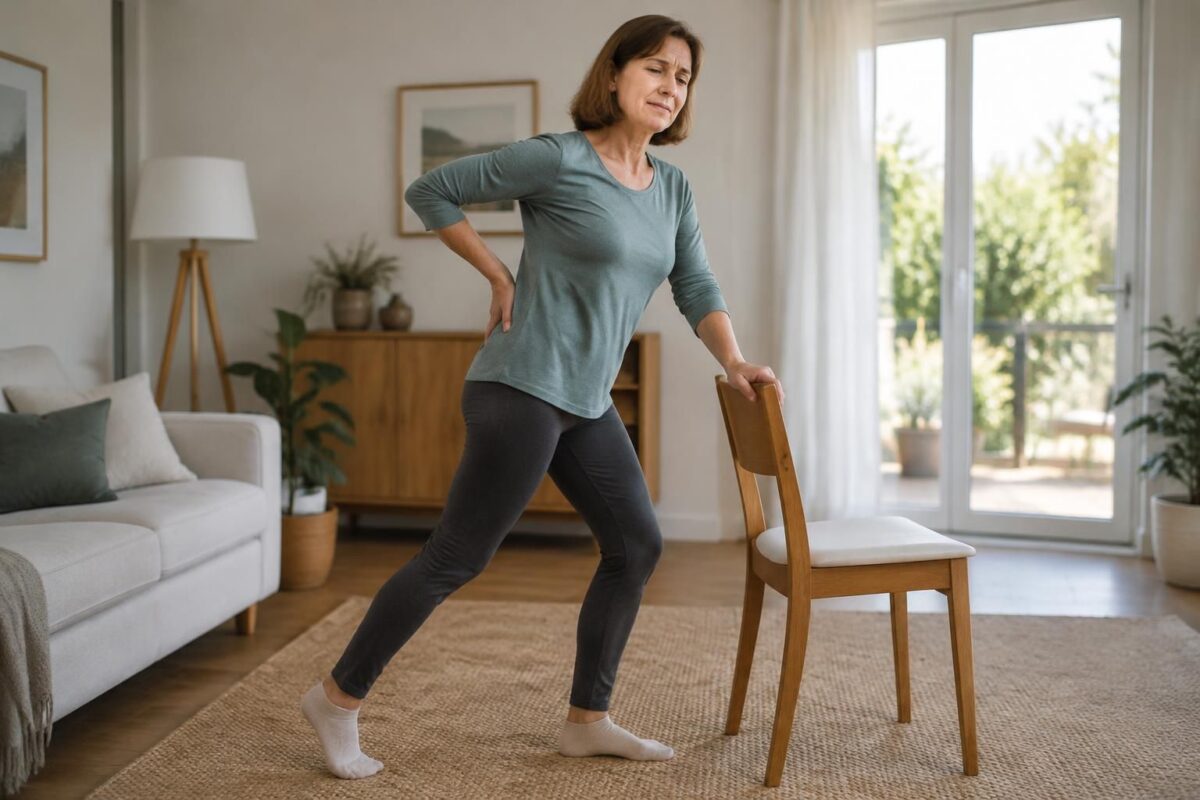
Sciatica and movement that provides temporary relief: is it enough?
IN BRIEF Sciatica is pain related to the irritation of the sciatic nerve, often felt from the lower back down to the leg. Gentle movement, walking for a few minutes, and changing positions regularly can provide temporary relief and limit…

Sciatica and exercises found on the Internet: caution depending on the cause
IN BRIEF Sciatica is pain that radiates from the lower back to the buttock and leg. Gentle exercises can promote mobility and relieve symptoms, but their effectiveness depends on the cause: a movement suitable for piriformis irritation may worsen a…
Exercises to avoid during a painful flare-up
Deep bends and forced stretches
Avoid deep forward bends, repeated rounded back movements, and intense hamstring stretches if these trigger pain radiating down the leg. Do not pull hard on the knee or ankle to seek a stretch: nerve tension can be felt as pain, shocks, or tingling. A stretch should remain gentle and not cause sharp pain.
Twists, impacts, and heavy loads
Sudden trunk twists, abdominals with rotations, and quick movements should be limited if they awaken symptoms. Also pause heavy lifting exercises, jumping, and intense sessions if the pain increases during or after the effort. To pick up an object, bend your knees, keep your back as straight as possible, and bring the load close to your body.
Lumbar extensions and targeted exercises
Lumbar extensions, sometimes recommended for certain sciatic cases, are not suitable for everyone. They may be inappropriate depending on the source of the pain, especially in the case of spinal canal narrowing. Do not start the McKenzie method or a strengthening program without assessment if your symptoms are significant or unusual.

Sciatica and generic exercises: why they are not suitable for everyone
IN BRIEF Sciatica is pain related to irritation or compression of the sciatic nerve. Generic exercises are not suitable for everyone: their effectiveness depends on the cause, intensity of symptoms, and recovery phase. Adapted movements can help maintain mobility without…

Sciatica and pain that travels lower after a stretch
IN BRIEF A sciatic pain that goes lower after a stretch may indicate that the movement is further irritating the nerve. A stretch should not intensify the pain or cause new tingling sensations: stop it and avoid forcing. Only resume…

Sciatica and aggressive stretches: possible sign of worsening
IN BRIEF Sciatica is pain that radiates from the lower back or buttock down the leg. Aggressive stretching does not necessarily relieve the nerve and can intensify the pain, especially if it moves further down to the foot or is…
Resume activity without worsening the pain
Prolonged bed rest is generally discouraged: it can increase stiffness. When pain allows, try short walks on flat ground and gradually increase the duration. Interrupt yourself if the pain significantly intensifies, if it travels further down the leg, or if weakness appears. In daily life, get up regularly if you are sitting for long periods and avoid maintaining a posture that causes you pain.
A doctor or a physiotherapist can help you choose exercises suited to your symptoms and their cause. Consult quickly in case of sudden or progressive loss of strength, difficulty lifting your foot, perineal numbness, or sudden urinary or intestinal control issues.
| Symptoms | Exercises to avoid |
|---|---|
| Pain that radiates further down the leg | Stretches or extensions that increase radiating pain |
| Sharp pain during movement | Do not force or continue the painful exercise |
| Acute lower back pain | Sudden twists and repeated bends of the back |
| Pain worsened in a seated position | Prolonged seated exercises and prolonged immobility |
| Increased numbness or tingling | Stretches that increase sensations in the leg |
| New or progressive weakness of the leg or foot | Stop exercises and seek medical advice quickly |
| Loss of sensation in the perineum or urinary issues | Do not exercise: consult urgently |
Testimonials on sciatica: which exercises to avoid based on symptoms?
Note: the testimonials below are fictional examples, designed to illustrate different situations. Sciatic pain can have several causes: seek advice from a healthcare professional before starting exercises.
“My pain started from the lower back and went down behind the leg. Repeated bends forward and stretches that made me touch my toes intensified the electric shocks. I stopped doing them and sought advice from my physiotherapist.” — Laurent, 46 years old
When the pain increases while bending forward or sitting, it’s better to avoid repeated bends of the back and forced stretches of the legs. Do not try to “unstick” the nerve by forcing: stop any movement that intensifies the pain or drives it further down the leg.
“I mainly had tingling in my buttock and the back of my thigh. An intense piriformis stretch awakened the pain. Since then, I prioritize small gentle movements and stop whenever the symptoms worsen.” — Samira, 39 years old
In case of pain or tingling in the buttock, avoid deep and prolonged stretches that reproduce your symptoms. A stretch should not cause sharp pain, increasing numbness, or feelings of electrical discharge. Have the technique evaluated by a professional if you have any doubts.
“I thought back extensions were necessarily beneficial. But for me, lying on my stomach and propping myself up made the pain worse right down to my calf. My doctor advised me not to continue this exercise without evaluation.” — Éric, 52 years old
Back extensions are not suitable for all sciatica cases. If they increase the pain in the leg, stop them. They may also be inappropriate depending on the cause of your symptoms, particularly in cases of spinal canal narrowing. Do not start this type of exercise without medical advice if you are unaware of the cause of your pain.
“When I stood still, my leg became more painful. I set aside intense exercises and long walks. Short walks on flat ground, without forcing, were easier to tolerate.” — Chloé, 43 years old
If standing triggers or worsens your symptoms, avoid exercises performed for long periods while standing, as well as sudden movements and trunk twists. Light activity may be preferable to immobility, but adjust the duration to your tolerance and stop if the pain worsens.
“My sciatica was accompanied by weakness in my foot. I stopped the exercises and quickly made an appointment because I was tripping while walking.” — Marc, 58 years old
A new or progressive weakness in the leg or foot requires prompt medical advice. Consult urgently in case of loss of sensation between the legs, sudden difficulty controlling the bladder or bowels, or paralysis. In these situations, do not attempt to treat the symptoms with exercises.
The sciatic nerve originates from the lower back, crosses the buttock, and descends into the leg. When irritated or compressed, pain may be accompanied by tingling, numbness, burning sensations, or muscle weakness. Its intensity and path vary depending on the cause and affected nerve root: thus, there is no single exercise to avoid for everyone. The right reflex is to consider your symptoms and avoid movements that worsen them.
Sylvain Desforges is a specialist in osteopathy, naturopathy, and manual medicine. Founder and president of the TAGMED clinics and the ACMA association, he dedicates his career to innovation in health and the management of chronic pain. His approach aims to provide evidence-based care tailored to the needs of each patient. He is particularly interested in integrating technologies like spinal decompression, laser, and shockwaves.
During a crisis, certain exercises may increase pressure on the lower back or further irritate the nerve. Avoid continuing a movement if the pain becomes sharp, significantly increases, or descends further down the leg. Repeated forward bends, sudden twists of the trunk, and efforts made with a rounded back should particularly be limited, especially if they trigger or amplify symptoms. Lifting a load while bending without bending the knees can also excessively strain the lower back.
Stretching exercises also require caution. An intense stretch of the hamstrings or buttock is not necessarily beneficial: if an electrical sensation, tingling, or pain radiating further down the leg appears, gently release the position. Do not try to “unstick” the nerve by forcing. A light tension may be acceptable, but a sharp or increasing pain is a signal to stop. Back extension exercises, sometimes proposed in certain situations, are not suitable for every diagnosis, particularly in case of spinal canal narrowing.
The reaction to exercises can guide caution without replacing diagnosis. If pain worsens while sitting or when bending, temporarily reduce bends and long sitting periods. If standing or walking for long periods exacerbates symptoms, break your movements into segments and look for a resting posture. In any case, prolonged bed rest is generally discouraged: when pain allows, gentle movements and short walks help avoid stiffness.
Personalized management allows for choosing exercises based on the origin of sciatica, the symptoms, and the person’s abilities. A healthcare professional can adjust the movements, their amplitude, and their progression, then support the resumption of strengthening and daily activities. Manual techniques or therapeutic technologies may be considered on a case-by-case basis, but they do not replace a medical evaluation when symptoms persist.
Consult quickly if you notice new or progressive weakness in the leg, difficulty in lifting the foot, significant loss of sensitivity, or urinary or intestinal disturbances. A loss of sensation in the perineum also requires urgent management. In these situations, do not attempt to correct symptoms through exercises: medical evaluation is a priority.
In the case of sciatica, the movements to avoid depend on the cause of the compression and the symptoms experienced. Exercises that increase pain, cause it to travel further down the leg, or provoke tingling, numbness, or weakness should be stopped. Conversely, a gentle and appropriate resumption can help maintain mobility without forcing or “unsticking” the nerve at all costs.
If the pain intensifies when you bend forward, temporarily avoid repeated back flexions, abdominal exercises that bring the torso close to the knees, and stretches that pull strongly behind the thigh. These movements can worsen symptoms in some people, especially when the pain is related to a lumbar disc. To better distinguish the exercises to avoid from those that can be adapted, consult this guide on movements to avoid and ways to move without worsening sciatica.
When pain is triggered by marked extension of the lower back, such as arching, avoid exercises that accentuate this position until a professional advises you. Some extensions may suit certain sciatica cases but not others, depending on their origin. Recommendations from your doctor or physiotherapist take precedence over exercises found online. You can also consult these resources on the discouraged exercises and movements likely to aggravate sciatic pain.
If a stretch triggers sharp pain, more intense electric shocks, or symptoms that extend further down the leg, do not hold it. Gently release and do not repeat the movement to “test” your pain. Stretches of the piriformis, hamstrings, and mobility exercises should remain comfortable and be adapted to your situation. Examples of movements and precautions are presented in this guide on exercises possible in cases of sciatica and those to avoid.
The location of symptoms can also guide caution, without allowing for their identification alone. Pain that radiates down the side of the leg to above the foot or the big toe, for example, may follow a different path than pain that goes behind the thigh and calf. To understand these variations, consult the explanations on the roots L4, L5, and S1 as well as on the involvement of the discs L4-L5 and L5-S1.
Weakness in the foot deserves special attention. If you have difficulty lifting the front of the foot, walking normally, or getting on your tiptoes, avoid strength training exercises that heavily strain the leg and seek medical advice promptly. Difficulty getting on the tip of the foot can, in particular, be addressed with a healthcare professional; information is available on the S1 root and this difficulty.
Running, jumping, and intense sessions should be paused if each impact triggers pain, if your gait is altered, or if symptoms increase after exertion. Resuming sports should be gradual, depending on tolerance and the evolution of symptoms, rather than following a fixed schedule. To assess the necessary caution, read these tips on sciatica and running.
After a long journey, avoid immediately following with demanding exercises if sitting has increased pain or stiffness. Take a few steps and gradually resume movements, without abrupt twisting or forced stretching. These precautions are also useful when symptoms appear or increase after prolonged movement, as explained in this guide on sciatic pain after a long journey.
In all cases, avoid sudden movements, trunk twists under load, and carrying heavy loads with a rounded back. Complete immobility is not a solution, however: if pain allows, a short and gentle walk can help maintain soft activity. For additional guidelines, consult the advice on positions to avoid in cases of sciatica.
Stop exercising and seek medical advice if the pain significantly worsens, persists despite activity adaptations, or is accompanied by increasing numbness or weakness. A loss of sensation in the perineum, sudden difficulties in controlling the bladder or bowels, or severe weakness in the leg require urgent medical evaluation. Choosing the appropriate exercises involves taking into account the symptoms, their evolution, and the diagnosis established by a healthcare professional.

Sciatica and calf stretching: when the pain increases
IN SHORT A calf stretch can exacerbate sciatica if it further irritates the nerve. It should not cause pain that increases or radiates down the leg: stop the movement and do not push through. Stretches may help with some tensions,…
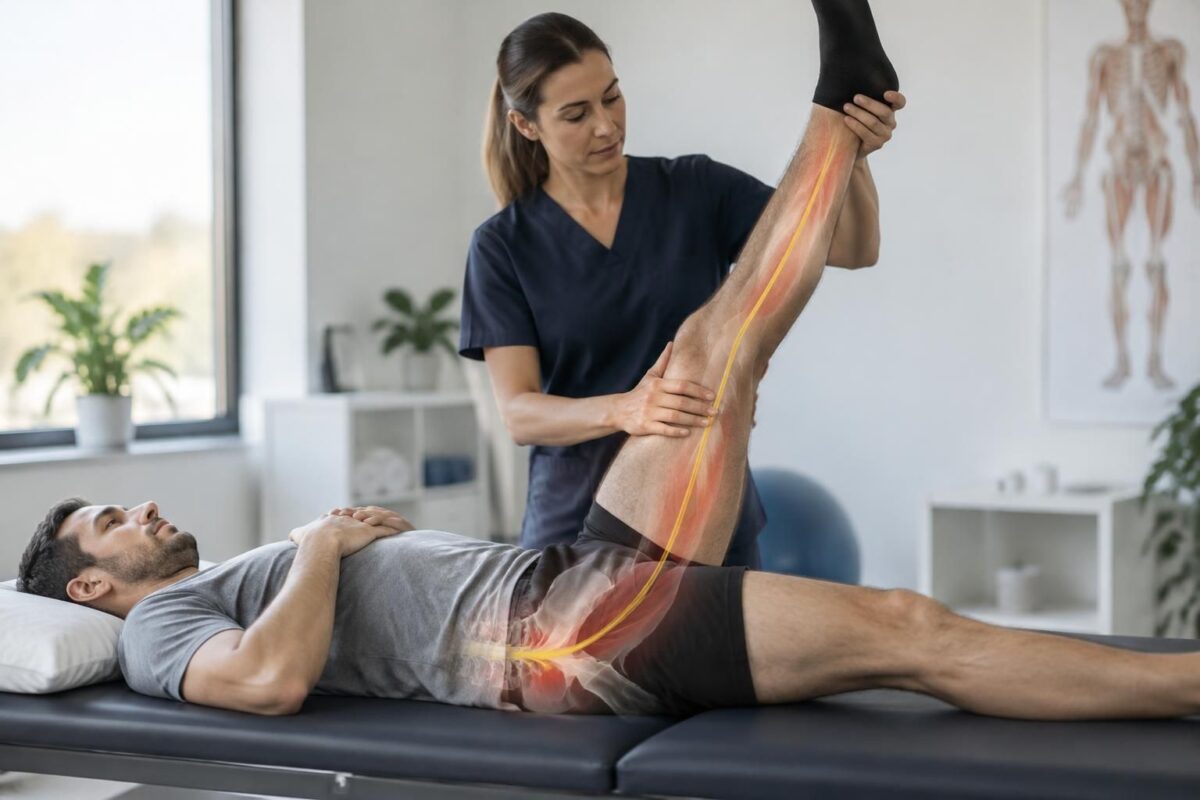
Sciatica and hamstring stretching: possible nerve tension
IN BRIEF Sciatica can make stretching the hamstrings uncomfortable, as the tension felt may come from the nerve rather than the muscle. A gentle stretch, with a straight back and without seeking maximum range, can help loosen the back of…

Sylvain Desforges, B.Sc., D.O., N.D., docteur en ostéopathie
Dr Sylvain Desforges, B.Sc., D.O., N.D., osteopath, is the founding president of TAGMED and of the ACMA association. He dedicates his practice to chronic spinal pain, low back pain and symptoms compatible with sciatica, particularly when pain radiates toward the buttock, leg, calf, foot or toes.
Through SOS Sciatique, he publishes educational content on sciatica symptoms, possible causes such as disc herniation, disc narrowing, foraminal stenosis or irritation of a lumbar nerve root, as well as non-surgical approaches that may be considered according to the evaluation. At Clinique TAGMED, care may include, depending on the case, motorized neurovertebral decompression, specific osteopathic care or precision percussion.
For an evaluation related to sciatica treatment in Montreal / Mount Royal or sciatica treatment in Terrebonne, please consult the services available at Clinique TAGMED.
Medical disclaimer
The information published on SOS Sciatique is provided for educational purposes only and does not replace a consultation, diagnosis, opinion or treatment provided by a physician or another authorized healthcare professional. The author of this article is neither a medical doctor nor a specialist in a medical specialty recognized by the Collège des médecins du Québec. The osteopathic, manual medicine or functional support approaches described on this site do not constitute medical acts and are not intended to replace medical follow-up.
Consult a physician or emergency service in cases of loss of bladder or bowel control, anesthesia in the saddle area, significant or progressive weakness in the leg or foot, fever, recent trauma, severe pain or rapid worsening of symptoms. For more details, please read our Legal Notice.