Sciatica and lifting a load: why technique isn’t always enough
28/11/2026
Sciatica in Terrebonne: foraminal or central herniated disc?
29/11/2026
IN BRIEF
| A foraminal disc herniation affects the opening where a nerve root exits, while a central herniation is located toward the spinal canal. In Montreal, distinguishing these forms helps compare imaging to symptoms, the affected side, and the neurological exam to guide the evaluation of sciatica. An image alone does not confirm the cause of the pain: the approach also depends on function and the progression of symptoms. |
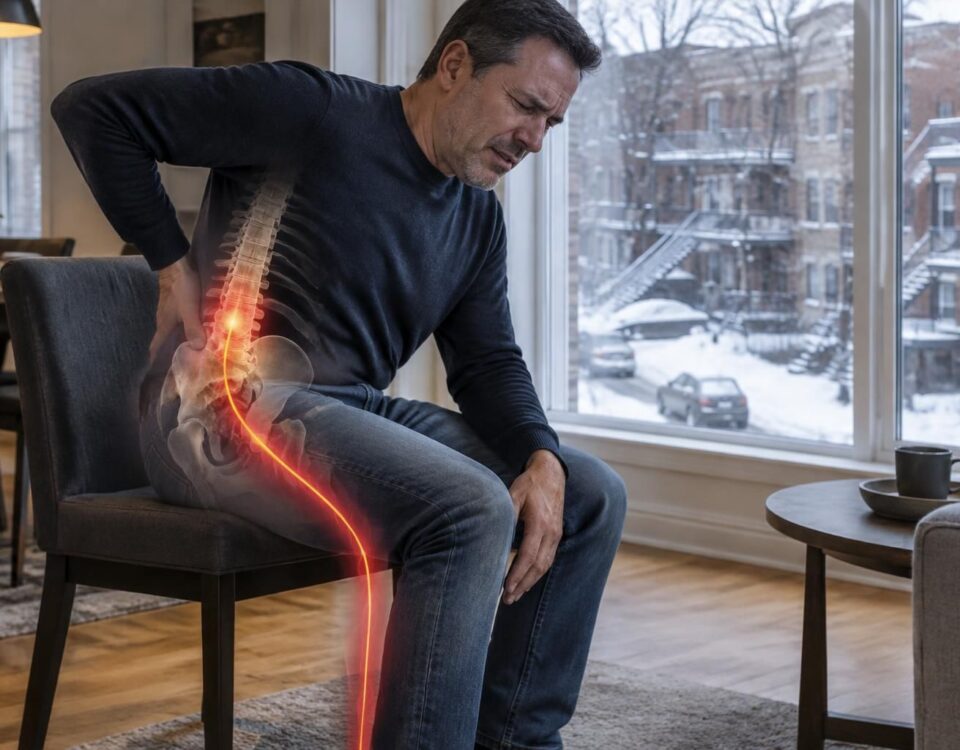
In Montreal, a foraminal disc herniation is near the opening where a nerve root exits, while a central herniation protrudes toward the spinal canal. Either can be associated with sciatica, but an image alone is not enough to explain the pain: the level, side, symptoms, and neurological examination must align. A new or progressive weakness, a foot drop, or urinary or intestinal issues require urgent evaluation.
A foraminal disc herniation and a central disc herniation are found in different areas of the disc and can irritate distinct nerve structures. In Montreal, the interpretation of an MRI must be correlated with the painful side, the pathway of symptoms, the neurological exam, and limitations in activities. The image alone does not confirm the cause of sciatica nor guide treatment choices. The foramen is the opening through which a nerve root exits the spine. A foraminal herniation is located near this opening. It can reduce the available space and irritate the nearby nerve root. Symptoms may affect the buttock and leg, but their pathway varies depending on the level and side involved. A foraminal herniation is not the same as foraminal stenosis. The herniation refers to a displacement of disc material. Stenosis describes a narrowing of the opening, which can also be related to bony or joint changes. To distinguish these concepts, consult this article on the difference between disc herniation and foraminal herniation. A central herniation projects toward the spinal canal, at the center of the spine. Depending on its size and location, it can irritate one or more nerve roots. It does not always cause symptoms. A central herniation visible on an MRI may thus be an incidental finding, with no direct link to the pain felt. The central canal, lateral recess, and foramen are different anatomical spaces. A herniation can affect more than one area. The imaging report must specify the level, side, and affected region. The document from the CHUM on disc herniation presents additional information on this condition. Sciatica describes pain that often follows a pathway into the buttock and leg. A pain that descends into the leg when coughing could be relevant for evaluation, but it does not alone confirm a herniation or its location. To learn more, visit our page on pain that descends into the leg when coughing. Pain in the calf, numbness, or symptoms that descend toward the foot can accompany nerve irritation. They may also have other causes. Numbness progressing to the foot merits evaluation, especially if accompanied by a decrease in strength. Consult these resources on the numbness that progresses to the foot and calf pain and possible nerve pathway. Difficulty walking on heels or toes can signal an impairment of strength. This observation does not alone identify the cause, but it should be considered during the examination. To better understand this sign, read our guide on difficulty walking on heels or toes. A useful interpretation compares several elements: the level of the herniation, its side, the pathway of symptoms, the results of the neurological examination, and the limited activities. If these elements do not align, other causes should be considered. Pain in the buttock alone, for instance, is not enough to establish radiculopathy. The healthcare professional can check strength, sensitivity, reflexes, and walking. They may also ask when the symptoms started, which positions modify them, and if the numbness or weakness is progressing. A comparison between both sides helps to detect certain functional changes. The MRI shows the discs, soft tissues, and nerve structures. X-rays answer other questions, including alignment and disc height. CT can help clarify certain bony details. The exam to choose depends on the clinical question and the likelihood that the result will alter the management. A herniation on the MRI is not automatically the source of pain. The apparent size of the herniation does not directly measure symptom intensity. To understand the differences between conditions associated with the disc, consult this guide on low back pain, disc herniation, and sciatica. The plan depends on the working diagnosis, the progression of symptoms, the neurological exam, and functional goals. It may aim to reduce limitations, monitor neurological signs, and determine if a medical consultation or referral to another professional is necessary. No conservative care can guarantee that a herniation will disappear or that the foramen will widen permanently. At the TAGMED Clinic, an assessment can serve to examine symptoms and discuss available non-surgical options. Depending on the case and assessment, care may include specific osteopathy or motorized neurovertebral decompression. The relevance of these approaches varies from person to person. Decompression is not suitable for all situations and does not replace a medical assessment when needed. A clear management plan sets a measurable goal, such as tolerance for walking, working, or sitting. It also specifies when the plan will be reevaluated and what changes require another referral. Temporary relief alone does not confirm the responsible mechanism. A movement can sometimes change the symptoms, but pain that travels lower after a movement does not allow us to determine if the hernia is central or foraminal. The evolution must be interpreted with other signs. Consult this content on pain that travels lower after a movement. Quickly consult a healthcare professional if new or progressive weakness appears, if the foot becomes difficult to lift, or if numbness spreads. An urgent evaluation is necessary in the case of loss of urinary or bowel control, anesthesia in the saddle region, fever, significant trauma, or marked weakness. These signs should not wait for the end of a care program. For general information on symptoms and possible causes, you can also consult this presentation on sciatica. Any online information does not replace an individual evaluation. Ask what connects the imaging to your symptoms and what other causes remain possible. Check that the level and side of the hernia correspond to the examination. Pain can be monitored, but walking, strength, sensitivity, sleep, and daily activities also provide useful indicators. Ask when these elements will be reassessed. Clarify the signs that require reassessment, additional imaging, or medical consultation. Progressing weakness demands special attention, even if the pain decreases. Sylvain Desforges, B.Sc., D.O., N.D., Doctor of Osteopathy and naturopath, is the founding president of TAGMED and the ACMA association. He devotes his practice to chronic pain of the spine, lower back pain, and pain compatible with sciatica, especially when pain travels to the buttock, leg, calf, foot, or toes. Through SOS Sciatique, he publishes educational content on the symptoms of sciatica, possible causes such as disc herniation, disc pinching, foraminal stenosis, or irritation of a lumbar nerve root, as well as on non-surgical approaches that can be considered based on the evaluation. At TAGMED Clinic, care may include, depending on the case, motorized neurovertebral decompression, specific osteopathy, or precision percussion. For an evaluation related to sciatica treatment in Montreal or Mont-Royal, or sciatica treatment in Terrebonne, consult the available services at TAGMED Clinic. The information published on SOS Sciatique is provided for educational purposes and does not replace a consultation, diagnosis, advice, or treatment performed by a physician or another authorized healthcare professional. The author of this article is neither a physician nor a specialist in a medical specialty recognized by the Collège des médecins du Québec. The approaches of osteopathy, manual medicine, or functional support described on this site do not constitute medical acts and are not intended to replace medical follow-up. Medical Disclaimer: The information and advice provided on this site do not replace the opinion, diagnosis, or treatment of a healthcare professional. Please note that Sylvain Desforges, B.Sc., D.O., N.D., doctor of osteopathy, is neither a doctor of medicine nor a physician, and is not a specialist in a medical specialty as defined by the Collège des médecins du Québec. Manual medicine, functional medicine, and sports medicine as described on this site exclude any medical treatment or diagnosis done by a doctor or specialist. Always consult your physician for any medical questions. For more details, please read our Complete Legal Disclaimer.Understanding the difference between foraminal and central herniation
The foraminal disc herniation
The central disc herniation
Symptoms are not sufficient to identify the type of herniation
How to establish concordance between MRI and symptoms
The neurological examination
The role of imaging exams
Selecting a care plan based on the situation
When to request a quick or urgent evaluation
Useful questions to ask during a consultation in Montreal
Does the hernia correspond to the side and path of my symptoms?
What results will be monitored?
When should the plan be modified or medical advice sought?
About the author
Medical Disclaimer
Foraminal Hernia
- Located near the opening where a nerve root exits.
- Can cause pain radiating into one leg, sometimes with numbness or weakness.
- The correlation between the affected side, symptoms, and examination is essential.
Central Hernia
- Located towards the center of the spinal canal.
- Can irritate one or more roots; symptoms vary depending on its size and position.
- A single image is not sufficient to establish the cause of sciatica.
In Montreal: the evaluation takes into account the path of pain, strength, sensitivity, walking, and relevant imaging results. New or progressive weakness, a dropped foot, or urinary or bowel issues require an urgent evaluation.

In Montreal, a foraminal disc hernia and a central disc hernia do not affect the same area of the spine, but the imaging alone is not sufficient to explain sciatica. To guide the next steps, it is necessary to compare the level and side of the hernia to the path of pain, the neurological examination, and the activities that have become difficult. The choice of care depends on this correlation and the evolution of symptoms.
Foraminal or Central Hernia: What’s the Difference?
The Foraminal Hernia
The foramen is the opening through which a nerve root leaves the spine. A hernia located in this area can reduce space around the root and irritate it. Depending on the level affected, pain can travel into the buttock and leg, sometimes down to the foot. Tingling, numbness, or weakness can also occur. However, a hernia visible on imaging may cause no symptoms at all.
The Central Hernia
A central hernia is located near the center of the spinal canal. Its effects vary depending on its size, location, and the structures affected. It can contribute to lower back pain or symptoms in one or both legs, but its mere presence does not predict their intensity. A central hernia and foraminal involvement can also coexist.
Sciatica in Montreal: disc degeneration and symptoms in the leg
IN BRIEF The sciatica related to disc degeneration can cause pain that radiates from the lower back to the buttock and leg, sometimes as far as the foot. In Montreal, an evaluation helps identify the cause of the symptoms and…
Linking Imaging to Symptoms
An MRI describes the structures but does not on its own make a functional diagnosis. A useful interpretation takes into account the affected side, level, pain pathway, and examination results. The professional can check strength, sensitivity, reflexes, and gait. They also consider positions that worsen or relieve symptoms and limited tasks, such as sitting or walking.
Sciatica refers to a pathway of pain; a radiculopathy involves functional impairment of a root, for example, a change in strength, sensitivity, or reflexes. Therefore, pain limited to the buttock does not alone establish that the cause is a disc herniation. If imaging does not match the symptoms, other explanations may need to be examined.
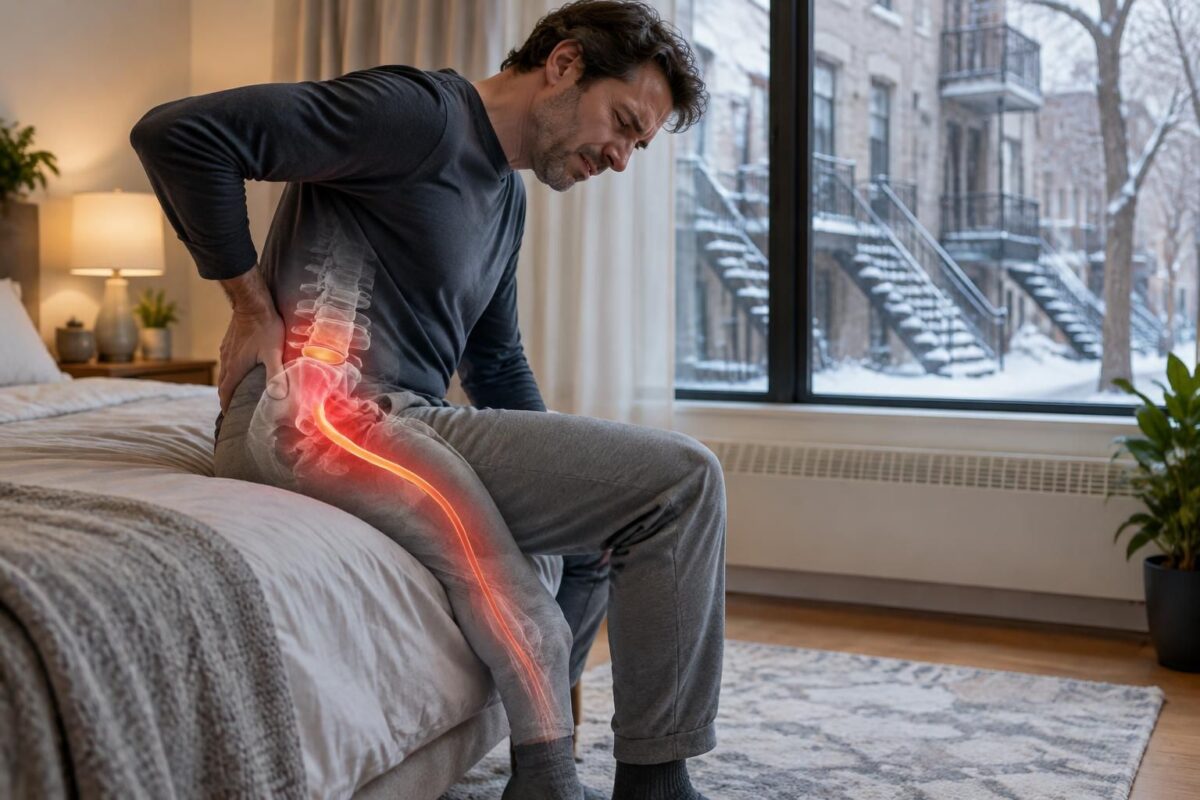
Sciatica in Montreal: disc desiccation and radiating pain
IN BRIEF Disc dehydration refers to a decrease in hydration of a lumbar disc; it does not necessarily mean that it causes sciatica. In Montreal, pain radiating from the lower back or buttocks down to the leg should be assessed…
Recommendations for Choosing Next Steps
Start by asking what working diagnosis is considered and what elements support it. Note affected activities, walking distance, sitting tolerance, and symptom progression. These benchmarks allow tracking function rather than relying solely on pain intensity.
If symptoms are stable and there is no progressive weakness, a graduated plan can be discussed with a healthcare professional. It should specify goals, limitations of interventions, and a reassessment date. Conservative care, including functional support or motorized neurovertebral decompression when deemed appropriate, is not suitable for everyone and does not guarantee lasting anatomical change. Additional imaging or medical referral can be discussed when results may change management.
In Montreal and nearby areas, the proximity of a service can facilitate follow-up but does not determine the appropriate treatment. At the TAGMED clinic, an assessment can help discuss available non-surgical options, depending on the situation. The decision must take into account contraindications, expected benefits, and criteria for continuing, modifying, or stopping the plan.
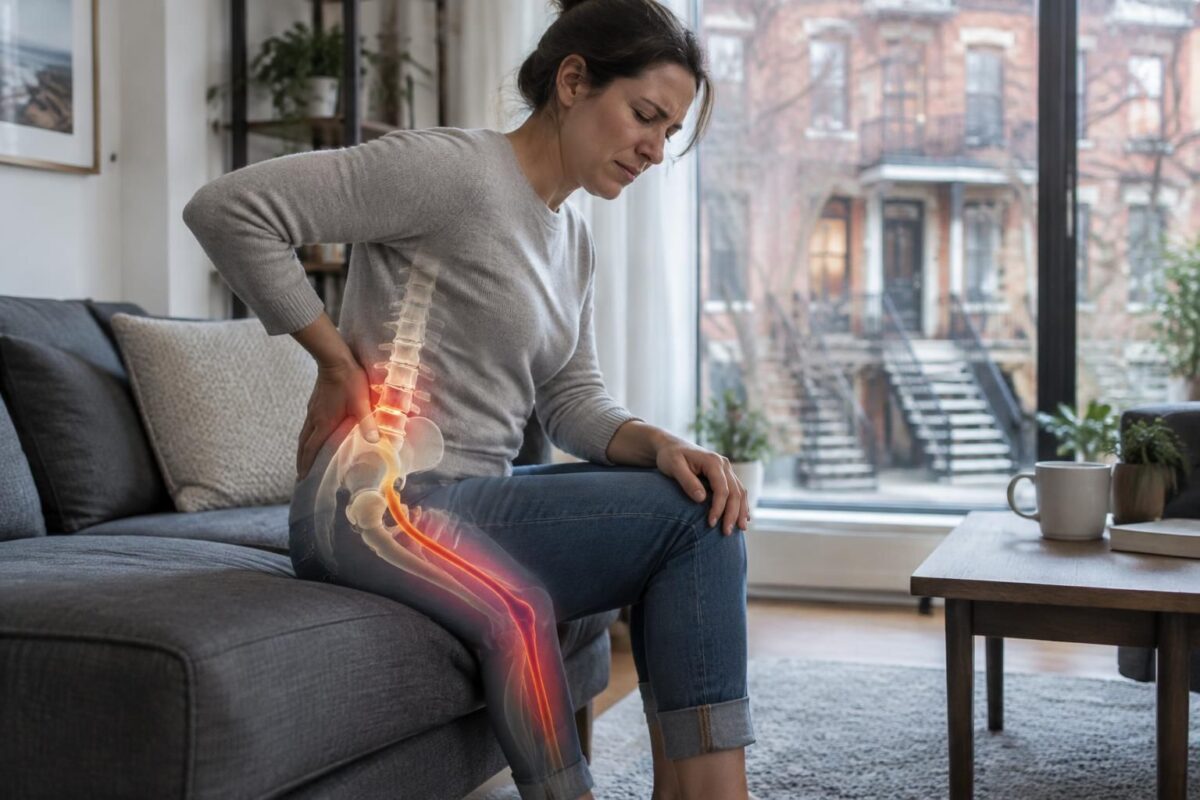
Sciatica in Montreal: possible annular tear and nerve irritation
IN BRIEF A disc tear is a small lesion of the disc that can sometimes contribute to irritation of a nerve root and symptoms of sciatica, such as pain radiating down the leg. It does not always mean that a…
When to Seek Urgent Help
Quickly consult a doctor or emergency service in cases of new or progressive weakness, foot drop, loss of bowel or bladder control, numbness in the saddle area, fever, significant trauma, or rapid worsening. A decrease in pain does not necessarily mean nerve function is improving: any progressing weakness should be evaluated.
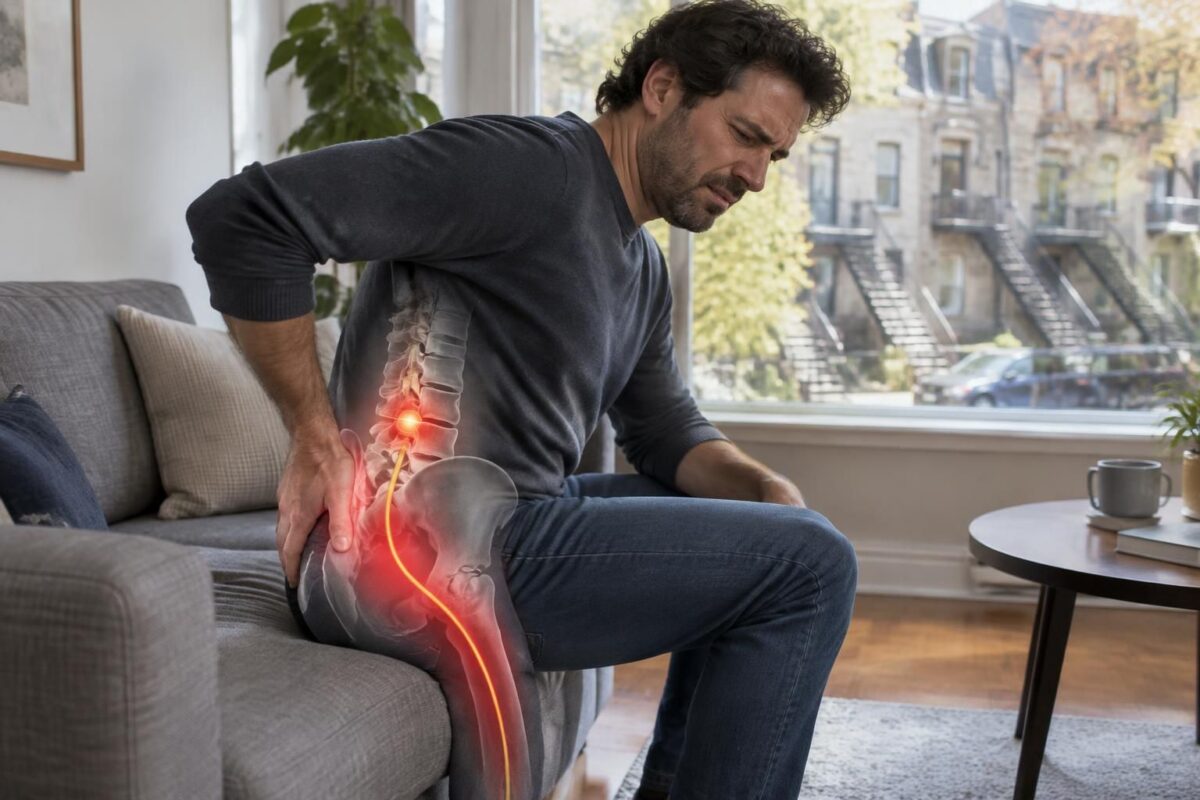
Sciatica in Montreal: disc bulge and buttock pain
IN BRIEF A disc bulge can irritate a nerve root and cause buttock pain, sometimes accompanied by pain that travels down the leg: this is referred to as symptoms compatible with sciatica. In Montreal, an evaluation helps specify the cause…
About the Author
Sylvain Desforges, B.Sc., D.O., N.D., Doctor of Osteopathy and Naturopath, is the founding president of TAGMED and the ACMA association. His practice focuses particularly on chronic spinal pain and symptoms compatible with sciatica.
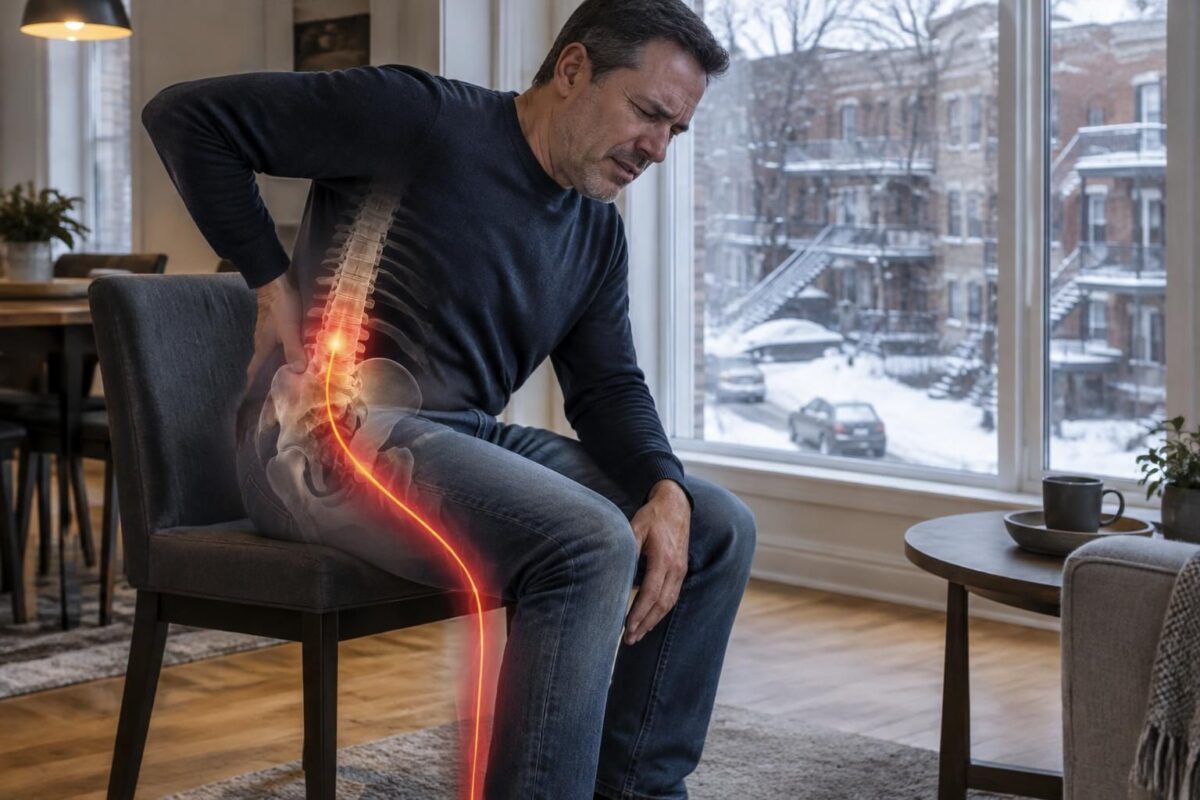
Sciatica in Montreal: disc protrusion and pain under the knee
IN BRIEF A disc protrusion can irritate a nerve root and contribute to sciatica with pain below the knee, sometimes down to the calf or foot. In Montreal, an evaluation helps clarify the cause of symptoms and consider suitable non-surgical…
Medical Disclaimer
This information is educational and does not replace a consultation, diagnosis, or treatment by a licensed healthcare professional. The author is neither a doctor nor a specialist in a medical specialty recognized by the Collège des médecins du Québec. Osteopathy and functional support approaches are not medical acts and do not replace medical follow-up.
| Indicator | Difference to Verify |
|---|---|
| Foraminal Herniation | Located near the opening where a nerve root exits; it can irritate this root. |
| Central Herniation | Located at the center of the canal; its effect depends on its size and the affected structures. |
| Possible Pain | Both forms can cause pain that radiates down the leg. |
| One or Both Sides | The side of the symptoms may help, but does not alone identify the responsible herniation. |
| Examination to Consider | Compare the painful pathway, strength, sensitivity, and reflexes with imaging. |
| MRI Interpretation | A visible herniation does not always explain the symptoms; clinical concordance must be verified. |
| Urgent Evaluation | Consult quickly in cases of progressive weakness, foot drop, or urinary or bowel disturbances. |

Sciatica in Montreal: herniated disc and painful cough
IN BRIEF Sciatica is a pain that extends from the lower back to the buttock and leg; a herniated disc can irritate a nerve root. Coughing can exacerbate the pain by increasing pressure in the back. In Montreal, an evaluation…
Illustrative Testimonials on Sciatica in Montreal: Foraminal or Central Disc Herniation?
Transparency Note: The testimonials below are fictional and serve only to illustrate different possible paths. They do not describe real patients and do not allow for a diagnosis. An MRI image must be interpreted alongside symptoms and clinical examination.
“The pain radiated down one leg, but the MRI did not explain everything”
“I felt pain that started in my lower back and radiated into my buttock and leg. My report mentioned a foraminal disc herniation. I understood that it was necessary to verify whether the affected side and the pathway of my symptoms truly matched the image. My strength, sensitivity, and walking ability were also monitored.”
A foraminal herniation is located near the opening through which a nerve root exits the spine. It can contribute to radiating symptoms if the level, side, and observed signs match, but its presence on imaging does not alone prove it is the cause of the pain.
“The term ‘central’ worried me, while my symptoms also needed evaluation”
“The imaging report mentioned a central disc herniation. I thought this automatically explained my sciatica. During the assessment, I was told that the location of the herniation was not sufficient: the pain pathway, any numbness, and the results of the neurological examination needed to be considered.”
A central herniation is located towards the center of the spinal canal. Its possible effects vary depending on its size, the affected level, and the involved structures. The distinction between a central and a foraminal herniation helps describe the anatomy but does not alone predict the intensity of symptoms or the appropriate treatment.
“The pain felt like sciatica, but the concordance needed verification”
“I had pain in my buttock and sometimes in my thigh. As I read a lot about sciatica, I was convinced that my spine was the issue. The assessment helped clarify the distribution of symptoms and check other possible causes before linking my pain to a disc anomaly.”
The word sciatica generally describes pain following part of the pathway of the sciatic nerve. A radiculopathy, on the other hand, involves signs of dysfunction of a nerve root, evaluated primarily through strength, sensitivity, and reflexes. Pain limited to the buttock does not necessarily confirm root involvement.
“My progress was also measured by my daily activities”
“Rather than only tracking the intensity of my pain, I noted how long I could sit, walk, and sleep. These benchmarks helped me discuss the progression of my symptoms and revise the plan when my function was not improving as expected.”
In the presence of a suspected foraminal or central disc herniation, useful follow-up may combine symptoms, neurological examination, and functional measures. The choice of imaging or care approach depends on the situation and the possibility that the result will change the course of action. Neuro-spinal decompression, specific osteopathy, or other non-surgical care options are not suitable for everyone and do not guarantee a lasting change in anatomy.
Questions to Ask During an Evaluation in Montreal
“What level and which side are described in my imaging? Do my symptoms follow a compatible pathway? Are my strength, sensitivity, or reflexes altered? What functional outcome will we follow, and when will the plan be reassessed?” These questions can facilitate a clear discussion with a healthcare professional.
A new or progressive weakness, a dropped foot, numbness in the saddle area, or loss of bladder or bowel control require urgent evaluation. Also seek prompt care in case of fever, significant trauma, or rapid worsening of symptoms.
Sylvain Desforges, B.Sc., D.O., N.D., Doctor of Osteopathy and Naturopath, dedicates his practice to supporting individuals living with persistent spinal pain, including lower back pain and symptoms compatible with sciatica. Founder of the TAGMED Clinic and the ACMA association, he is interested in the evolution of conservative approaches and the reasoned use of technologies that can support certain care plans, such as motorized neuro-spinal decompression. His approach aims to link symptoms, function, and examination results rather than treating an image in isolation.
In Montreal, the question “foraminal or central disc herniation?” often arises when imaging reveals a lumbar anomaly. These terms describe different anatomical regions. A foraminal herniation is located in or near the foramen, the opening through which a nerve root exits the spine. A so-called central herniation is found more toward the spinal canal. Depending on its size and position, it may affect one or more nerve structures or cause no symptoms at all.
The presence of a herniation on an MRI is therefore not sufficient to determine the cause of pain. Some anomalies are found in individuals who have no corresponding symptoms. To assess their relevance, it is necessary to check if the level and side observed match the pathway of the pain, any numbness, and the results of the neurological examination. Strength, sensitivity, reflexes, and ambulation can provide important information.
The term sciatica typically describes pain that starts in the lower back or buttock and radiates down the leg. A radiculopathy, on the other hand, refers to a dysfunction of a nerve root, which may manifest as weakness, altered sensitivity, or reflexes. Pain limited to the buttock or atypical irradiation may also have another origin. Therefore, the evaluation should consider possible diagnoses, not just radiological interpretation.
The choice of examination depends on the clinical question. MRI is particularly useful for examining soft tissues and nerve roots; CT helps clarify certain bony changes; X-ray provides information about alignment and the height of the discs. No examination is systematically necessary: its usefulness depends on the possibility that its result will modify care or direction. Weakness, symptoms that progress, or an unusual presentation may justify medical evaluation and appropriate tests.
In a care plan, Sylvain Desforges prioritizes observable functional goals: walking distance, sitting duration, sleep, ability to work, or tolerance to certain activities. Conservative options, including specific osteopathy or motorized neuro-spinal decompression, are not suitable for everyone and do not guarantee lasting changes to the foramen’s anatomy. Their relevance should be assessed according to the situation, limitations, risks, and measured progress. The plan should include a reassessment and criteria for modification or direction to another resource.
A new or progressive weakness, a dropped foot, loss of bladder or bowel control, numbness in the saddle area, fever, or significant trauma require rapid or urgent medical evaluation. The information presented here is educational and does not replace a consultation, diagnosis, or treatment by a licensed healthcare professional. Sylvain Desforges is neither a doctor nor a specialist in a medical specialty recognized by the Collège des médecins du Québec.
In Montreal, a foraminal disc herniation and a central disc herniation can both be associated with sciatica, but they do not necessarily affect the same structures or in the same way. The type of herniation observed in imaging is not sufficient to explain the symptoms: it is also necessary to check the affected side, the pain pathway, neurological signs, and activities that have become difficult.

Sciatica in Montreal: pain worsened when sitting and lumbar disc
IN BRIEF Worsening sciatica in a sitting position may be related to lower back irritation, sometimes associated with a disc, without this sign being sufficient to establish the cause. In Montreal, an evaluation that considers symptoms, strength, sensitivity, and function…
Foraminal or Central Herniation: A Difference in Localization
The foraminal herniation is located near the opening through which a nerve root exits the spine. Depending on its location, it can irritate or compress this root and cause pain that radiates toward the buttock or leg, sometimes accompanied by tingling, numbness, or decreased strength. The central herniation, on the other hand, is more centrally located in the spinal canal. Its effect varies depending on its size, the level involved, and the available space around the nerve structures.
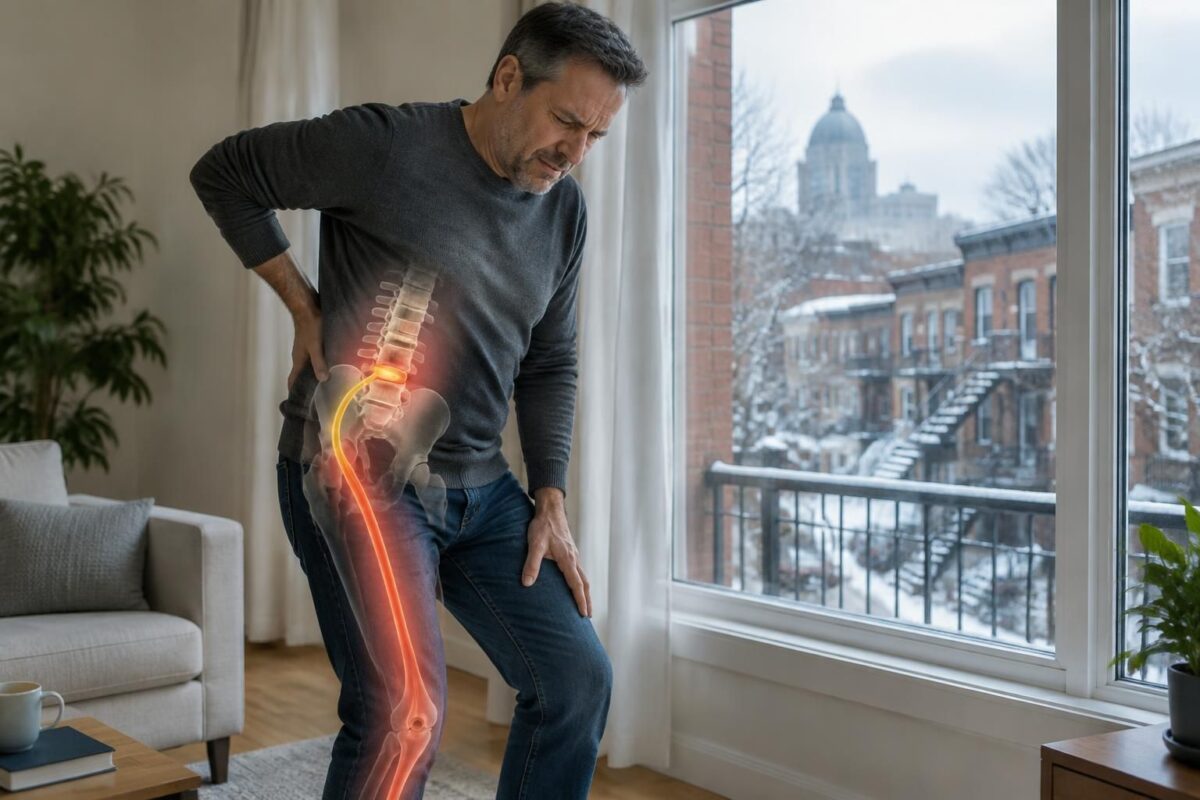
These terms thus describe a localization, not, on their own, the severity of symptoms. An image may show a herniation without it being the cause of the pain; conversely, interpretation must consider the entire clinical picture. To better understand how a herniation can lead to nerve irritation, consult this guide on the link between disc herniation and sciatica in Montreal.

Sciatica in Montreal: pain worsened by flexion and disc-related cause
IN BRIEF Flexion-Aggravated Sciatica is pain that starts in the lower back and may radiate into the buttock or leg; irritation related to a lumbar disc can be a possible cause. In Montreal, an assessment helps clarify the origin of…
Linking Imaging to Symptom Pathway
A relevant evaluation compares the level and side of the herniation to the reported symptoms and examination results. The location of pain, areas of numbness, muscle strength, reflexes, and tolerance to walking or sitting can guide the questions to ask. Pain in the buttock only does not systematically indicate radiculopathy; causes from other structures may also be considered.
The trajectory of symptoms can vary depending on the affected root. To delve into the possible differences between the L4, L5, and S1 territories, see this guide on sciatica and the painful trajectories associated with these roots. Numbness in the big toe, for example, should be contextualized within the examination and other signs, as explained in this resource on low back pain accompanied by numbness in the big toe in Montreal.
Sensations can also change with posture. Tingling that occurs while sitting does not alone determine the cause; they must be related to their distribution, duration, and other symptoms. To explore this situation further, consult the article on sciatica and tingling while sitting.
Understanding exams and disc changes
MRI can help visualize the discs, nerve roots, and soft tissues. X-rays and CT scans address other questions, particularly regarding alignment or certain bony structures. The choice of exam depends on the situation and the possibility that its result will alter the course of action. To differentiate signs that warrant special attention, you can consult this resource on herniated discs, sciatica, MRI, and warning signs.
A herniation can coexist with other changes, such as a disc bulge, loss of disc height, or lumbar osteoarthritis. These observations do not automatically prove they explain the pain, but they can be considered in the evaluation. To learn more, read the resources on disc bulge and disc degeneration as well as on combined causes of sciatica related to a herniated disc and lumbar osteoarthritis.
A general explanation of the trajectory of the sciatic nerve and how a herniation may be associated with symptoms is also provided by this resource dedicated to herniated discs and sciatica. However, this educational information does not replace the individualized interpretation of a licensed healthcare professional.
Choosing a suitable follow-up plan
Management depends on the symptoms, their evolution, the examination, and functional goals. A useful follow-up specifies what will be measured: walking distance, duration in a sitting position, sleep, ability to work or perform certain tasks, for example. It also sets a time for reevaluation and the criteria that may lead to modifying the plan or seeking medical advice.
Non-surgical options may not be suitable for everyone and do not guarantee a lasting change in the anatomy of the disc or foramen. The relevance of an approach must be evaluated on a case-by-case basis, considering expected benefits, limitations, risks, and the observed response. To consult information on evaluation and certain care offered in Montreal, visit the page of TAGMED Clinic on herniated discs and sciatica in Montreal.
For an additional overview of the evaluation of foraminal stenosis, sciatica, and radiculopathy in the Montreal area, consult the guide dedicated to these situations. The presence of a narrowing on imaging should also be interpreted with the symptoms and the examination rather than considered in isolation.
When to seek an evaluation without delay
New or progressive weakness, a foot drop, loss of sensation in the saddle area, changes in urinary or bowel control, fever, significant trauma, or rapid worsening require urgent medical evaluation. This evaluation should not be delayed to complete a care program or wait for pain improvement. A decrease in pain does not rule out concerning neurological weakness.
About the author
Sylvain Desforges, B.Sc., D.O., N.D., Doctor of Osteopathy and naturopath, is the founding president of TAGMED and the ACMA association. His practice focuses on chronic spinal pain, low back pain, and pain compatible with sciatica, notably when it radiates to the buttock, leg, calf, foot, or toes.
Through SOS Sciatique, he publishes educational content on sciatica symptoms, its possible causes—including herniated discs, disc pinching, foraminal stenosis, or irritation of a lumbar nerve root—and non-surgical approaches that can be considered based on evaluation. At TAGMED Clinic, care may include, depending on the case, motorized neurovertebral decompression, specific osteopathy, or precision tapping.
To learn more about the treatment of sciatica in Montreal / Mont-Royal or about the treatment of sciatica in Terrebonne, check the services available at the TAGMED Clinic.
Medical disclaimer
The information published on SOS Sciatique is provided for educational purposes and does not replace a consultation, diagnosis, advice, or treatment performed by a physician or another licensed healthcare professional. The author is neither a physician nor a specialist in a medical specialty recognized by the Collège des médecins du Québec. The osteopathy, manual medicine, or functional support approaches described on this site do not constitute medical acts and are not intended to replace medical follow-up. In case of concerning symptoms, consult a healthcare professional or an emergency service. For more details, please read our Legal notice.

Sylvain Desforges, B.Sc., D.O., N.D., docteur en ostéopathie
Dr Sylvain Desforges, B.Sc., D.O., N.D., osteopath, is the founding president of TAGMED and of the ACMA association. He dedicates his practice to chronic spinal pain, low back pain and symptoms compatible with sciatica, particularly when pain radiates toward the buttock, leg, calf, foot or toes.
Through SOS Sciatique, he publishes educational content on sciatica symptoms, possible causes such as disc herniation, disc narrowing, foraminal stenosis or irritation of a lumbar nerve root, as well as non-surgical approaches that may be considered according to the evaluation. At Clinique TAGMED, care may include, depending on the case, motorized neurovertebral decompression, specific osteopathic care or precision percussion.
For an evaluation related to sciatica treatment in Montreal / Mount Royal or sciatica treatment in Terrebonne, please consult the services available at Clinique TAGMED.
Medical disclaimer
The information published on SOS Sciatique is provided for educational purposes only and does not replace a consultation, diagnosis, opinion or treatment provided by a physician or another authorized healthcare professional. The author of this article is neither a medical doctor nor a specialist in a medical specialty recognized by the Collège des médecins du Québec. The osteopathic, manual medicine or functional support approaches described on this site do not constitute medical acts and are not intended to replace medical follow-up.
Consult a physician or emergency service in cases of loss of bladder or bowel control, anesthesia in the saddle area, significant or progressive weakness in the leg or foot, fever, recent trauma, severe pain or rapid worsening of symptoms. For more details, please read our Legal Notice.