


Herniated disc and sciatica: causes of recurring pain
01/10/2026
Sciatica in Montreal: Pain that Radiates Down the Leg Upon Waking
02/10/2026
IN BRIEF
| The difficulties in walking on tiptoes with sciatica may indicate muscle weakness related to nerve damage. This test helps identify a deficit but is not sufficient to establish a diagnosis. If the weakness is new, worsens, or is accompanied by a loss of sensation, consult a healthcare professional promptly. |
A difficulties in walking on tiptoes in the case of sciatica may reveal muscle weakness, especially in the calf. This sign deserves a medical evaluation, especially if it has appeared recently or is worsening. In case of significant loss of strength, urinary or bowel issues, consult urgently.
A difficulties in walking on tiptoes may be related to weakness in the calf muscles, sometimes associated with irritation of a nerve root like S1. Pain may also limit movement without true loss of strength. A medical examination allows for differentiation, evaluation of neurological signs, and determination of whether imaging is useful. New or worsening weakness requires prompt assessment. Walking on tiptoes requires the calf muscles to push the body forward. The nerve root S1 plays a key role in this action. Therefore, nerve irritation or compression can lead to calf weakness and make this movement difficult. This sign alone is not enough to confirm sciatica or to precisely locate the cause. Pain, an ankle or calf injury, and other neurological issues may also hinder walking. To better understand potential causes, refer to this presentation of sciatica, its symptoms, and treatments. A person may avoid standing on tiptoe because the movement triggers pain. In this case, pain limits effort, but the muscles may not necessarily be weak. True weakness may be evident by a weaker push on one side, difficulty lifting the heel, or a leg giving way. A healthcare professional typically compares both legs and examines strength, sensitivity, reflexes, and gait. They also check the back, hips, and feet, as other disorders can produce similar symptoms. The examination often begins with observing posture and gait. The professional looks for limping, a position adopted to reduce pain, or a foot that drags on the ground. They then evaluate the mobility of the back and examine each leg. The assessment may include a comparison of calf strength, checking sensitivity, and testing reflexes, including the Achilles tendon reflex. The professional may also examine the arms and hands if symptoms or results warrant it. A complete assessment helps distinguish lumbar involvement from other neurological or joint issues. The clinical presentation of sciatica and cruralgia describes the signs that the examination seeks to identify. Foot pain may also accompany nerve irritation: refer to this information on sciatic pain in the foot and nerve symptoms affecting the foot. Consult promptly if the difficulty in pushing on the foot is new, significant, or worsening. A loss of strength in the leg warrants a medical evaluation, even if the pain remains moderate. Weakness may sometimes progress and requires examination without unjustified delay. Urgent care is necessary in case of new difficulties urinating or retaining stool, numbness in the area between the legs, or significant weakness affecting both legs. A fever, recent trauma, or a general deterioration in condition also justify a quick consultation. A weakness in the leg with a loss of confidence in walking should be taken seriously. This information does not replace an examination: in doubt, contact a healthcare professional or an emergency service. The choice of examinations depends on symptoms, their evolution, medical history, and the results of the clinical examination. Imaging is not always necessary initially in cases of recent pain without concerning signs. However, motor weakness, worsening symptoms, or atypical progression may lead the doctor to request additional tests. MRI or another suitable examination can help search for a cause at the spinal level. The results must be interpreted alongside the symptoms, as an image showing a disc protrusion does not always prove it explains the pain. To understand this point, refer to the article on significant pain despite a small disc protrusion and that on the importance of a precise diagnosis in cases of disc herniation and sciatica. In the absence of severe signs, a daily activity adapted to the person’s tolerance is often preferable to prolonged rest. However, if walking on tiptoes reveals new weakness, do not repeatedly test it or force the movement. Have the symptom evaluated, especially if accompanied by a loss of strength or a dragging foot. Walking can be uncomfortable when pain increases after prolonged positions, such as while driving. Pain while driving is discussed in this article on sciatica interfering with driving. Pain that appeared after exertion, such as shoveling, is described in this article dedicated to sciatica after shoveling. For general information on managing sciatica, refer to the guide dedicated to sciatica management. These resources do not determine the cause of weakness remotely. An in-person examination remains necessary if walking on tiptoes is impaired. No. Most sciatic pains do not necessarily cause weakness in this movement. The difficulty may stem from pain, but any loss of strength should be evaluated by a healthcare professional. No. Walking on heels or on tiptoes can provide an indication, but it does not allow for a diagnosis. Do not rely solely on a self-administered test, especially if you risk losing balance or if the pain is strong. Yes. The intensity of the pain does not always indicate the significance of a nerve weakness. A new decrease in strength deserves an evaluation, even if the pain is mild. Medical disclaimer: The information and advice provided on this site do not replace the opinion, diagnosis, or treatment of a healthcare professional. Please note that Dr. Sylvain Desforges, osteopath, is neither a medical doctor nor a physician, and is not a specialist in a medical specialty as defined by the Collège des médecins du Québec. Manual medicine, functional medicine, and sports medicine as described on this site do not include any treatment or medical diagnosis made by a physician or medical specialist. Always consult your doctor for any medical questions. For more details, please read our full Legal Notice.True weakness or movement limited by pain?
How the professional assesses the difficulty in walking on tiptoes
When to consult urgently?
What examinations may be necessary?
Walking with sciatica when movement is difficult
Frequently asked questions
Does sciatica always prevent walking on tiptoes?
Can a self-test confirm nerve damage?
Can weakness appear without significant pain?
What it may indicate
- New difficulty standing on tiptoes: possible muscle weakness.
- A nerve injury related to sciatica may be involved, though this sign alone is insufficient to make a diagnosis.
- Compare both legs, without forcing or insisting if the movement is painful.
When to seek help
- Have any new or worsening weakness evaluated promptly.
- Consult urgently if urinary or intestinal disturbances arise, or if there is a loss of sensation between the legs.
- A healthcare professional can assess strength, reflexes, and sensitivity to guide treatment.

A difficulty walking on tiptoes during sciatica may indicate a decrease in strength in the leg. This sign should be taken seriously, though it alone cannot determine the cause or severity of the problem. Have your condition assessed quickly by a healthcare professional, especially if the weakness appears suddenly or worsens. In the meantime, prioritize activities suitable for your abilities and monitor the evolution of symptoms.
Why is walking on tiptoes evaluated?
During a clinical examination, the doctor or physiotherapist may ask you to walk on your heels and then on your toes. These actions help to identify potential muscle weakness, particularly in the calf. Difficulty performing the movement on one side may indicate neurological impairment, but it is not sufficient alone to make a diagnosis.
The examination also considers your walking pattern, balance, sensitivity of the leg, and strength of various muscle groups. The professional may check reflexes and examine the back, hips, and upper limbs. Other issues, such as a hip condition or an injury higher up in the spine, can sometimes contribute to the symptoms.

Sciatica and popular stretches: why to stay cautious
IN BRIEF Sciatica causes pain that radiates from the lower back down the leg. Popular stretches, such as the pigeon pose or hamstring stretches, are not always suitable: pulling on an irritated nerve can worsen the symptoms. Favor gentle movements,…

Sciatica and Pilates: movements to adapt
IN SHORT Sciatica causes pain that can radiate from the lower back down to the leg. The Pilates Reformer can promote a gradual return to movement and strengthen core control, provided that the movements, range, and resistance are adapted. Favor…
What to do if you have difficulty getting on tiptoes?
Seek medical advice promptly
A new loss of strength, even moderate, justifies a medical evaluation, especially if it concerns only one leg or is progressing. Do not wait several weeks hoping the symptom will disappear without advice. The professional can determine if further examinations are necessary. The choice of imaging depends particularly on the intensity and duration of the pain, its evolution, and the results of the clinical examination.
Consult urgently if you notice significant or rapidly worsening weakness, marked loss of sensation, difficulties urinating or controlling bowel movements, or numbness around the groin. Very intense pain, fever, or symptoms that appear after trauma also require prompt attention.
Avoid excessive self-testing
You might notice a difference between the two legs, but avoid repeating tests to the point of exhaustion or putting yourself off balance. A home test does not confirm sciatica nor precisely measure strength. If you attempt to stand on your toes, do so near a stable support and stop if you experience pain or instability.

Sciatica and core stability: variable tolerance depending on symptoms
IN BRIEF Core strengthening in case of sciatica consists of progressively strengthening the trunk muscles. Its tolerance varies depending on pain and symptoms: suitable without worsening the pain, it can support mobility and the resumption of activities, but does not,…

Sciatica and lunges: leg pain to watch out for
IN BRIEF Sciatica is pain that starts from the lower back or buttock and radiates down the leg. If a lunge triggers or worsens this pain, stop the movement and adjust your activity: this exercise does not address sciatica. Consult…
Should you continue to walk with sciatica?
If there are no signs of severity and walking remains possible, it is generally reasonable to maintain an appropriate level of activity rather than staying in bed. Walking can help avoid prolonged immobility, but it does not guarantee faster healing. Reduce the duration or distance if the pain significantly increases, and resume gradually according to your tolerance.
If walking becomes difficult due to weakness, tripping, or a risk of falling, do not push yourself and seek medical advice quickly. Note when the difficulty began, if it worsens, and if other symptoms accompany it: this information will help the professional guide the examination and treatment.

Sciatica and deadlifts: risk depending on the cause
IN BRIEF Sciatica and deadlifts are not always incompatible: the risk depends on the cause of the pain and its intensity. During acute episodes, it’s best to avoid heavy loads and seek medical or physiotherapy advice before resuming. A gradual…

Sciatica and squats: why caution is needed
IN BRIEF Sciatica does not always prohibit squats, but a deep or loaded squat can aggravate symptoms, especially during a flare-up. Gradually resume with a neutral back and a comfortable range of motion, and stop if the pain travels down…
What difficulty walking on tiptoes can reveal
| Indicator | To remember |
|---|---|
| What the movement tests | The strength of certain calf muscles and their nerve control. |
| Possible link to sciatica | A weakness may accompany nerve irritation, particularly in the S1 territory. |
| What this sign does not prove | It is not sufficient alone to confirm sciatica or identify its cause. |
| Comparing both sides | A clear difference between the legs should be reported to a healthcare professional. |
| When to consult | Consult quickly if the weakness is new, worsens, or hinders walking. |
| Signs of urgency | Significant weakness, urinary or intestinal disturbances require urgent evaluation. |
| To avoid | Do not force repetitions and do not rely solely on a self-test. |
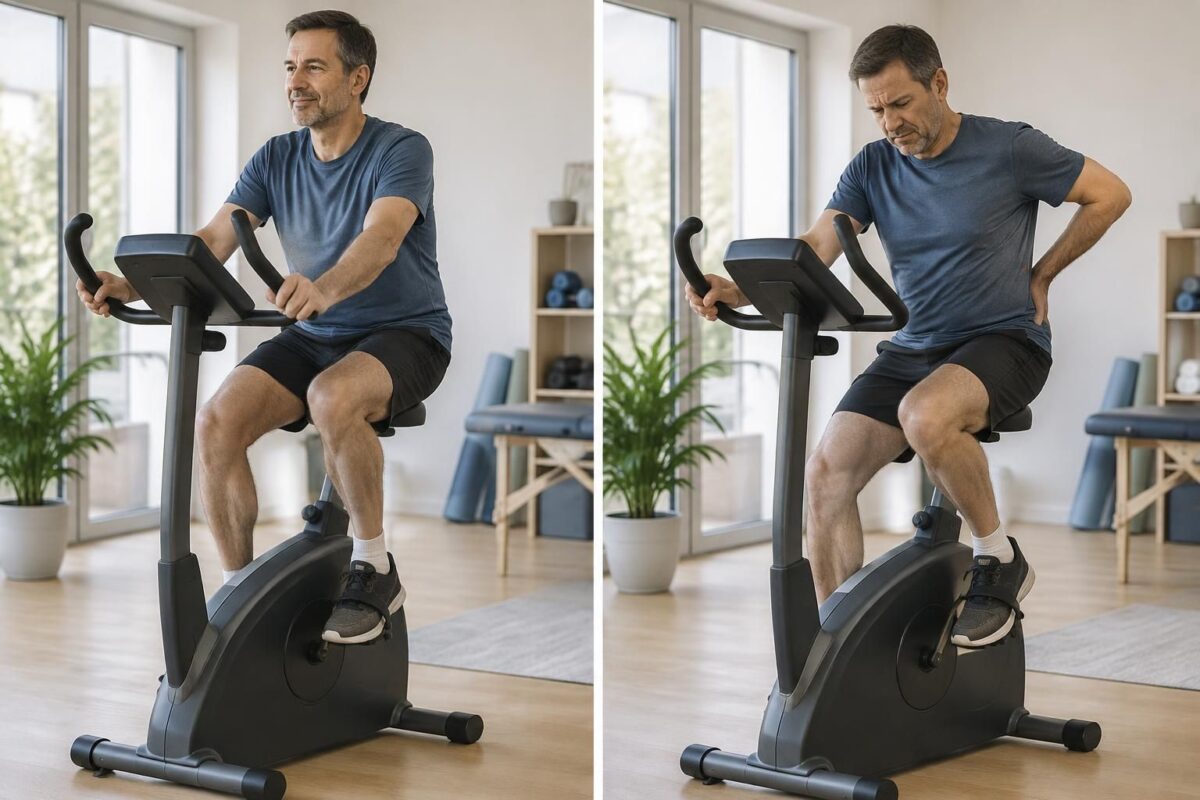
Sciatica and stationary bike: useful or aggravating depending on the case
IN BRIEF The stationary bike with sciatica can help you stay active if the pain is mild and stable. Start with a short session, at low resistance and in a comfortable position. If the pain goes further down the leg,…

Sciatica and cycling: sitting, bending, and symptoms
IN BRIEF Sciatica is pain related to irritation of the sciatic nerve, which can extend from the buttock down to the leg. Cycling may sometimes be possible if symptoms are mild and stable: a comfortable seat, a less bent posture,…
Testimonials about sciatica and difficulty walking on tiptoes
Important: the testimonials below are fictional examples, written to illustrate different experiences. They do not allow for a diagnosis to be established. A new or worsening difficulty walking on tiptoes warrants medical advice, as it may correspond to muscle weakness.
“My pain started in the lower back and radiated down behind the leg to the calf. I noticed that I couldn’t properly lift myself onto the tiptoe of the painful side. My doctor checked my strength and reflexes before advising me on the next steps.”
“I could walk, but I felt like my leg was pushing less hard when I tried to stand on tiptoes. Since this difficulty had appeared recently, I made an appointment rather than waiting for it to pass.”
“At first, I thought it was just the pain that prevented me from making the movement. Comparing the two legs, I noticed a difference. The healthcare professional explained that it is necessary to distinguish between discomfort related to pain and a real decrease in strength.”
“My sciatica made me limp, and I was almost afraid to put my foot down. I was advised to stay active as much as possible, avoiding painful movements, and to monitor the evolution of my strength.”
“I had difficulty walking on tiptoes, but also tingling in my leg. As the symptoms changed, I contacted a doctor again to be reassessed. This helped me understand what to monitor and which activities to adapt.”
To remember: if you lose strength, if your foot catches, or if the difficulty progresses, seek medical advice promptly. In case of urinary or intestinal issues, numbness in the area between the legs, or significant weakness, consult urgently.
Dr. Sylvain Desforges: Supporting Sciatica and Difficulties Walking on Tiptoes
Dr. Sylvain Desforges is a healthcare professional specializing in osteopathy, naturopathy, and manual therapy. Founder and president of TAGMED clinics and the ACMA association, he devotes his career to innovation in health and the management of chronic pain. His approach focuses particularly on symptoms that can accompany sciatica, such as pain radiating down the leg or difficulty moving normally.
Sciatica commonly refers to pain starting from the lower back or buttock and radiating into the leg. It may be associated with irritation or compression of a nerve root, often related to a spinal condition. However, pain following this path alone does not allow for precise identification of its cause. This is why clinical evaluation is an important step before choosing appropriate management.
The difficulty in walking on tiptoes deserves particular attention. This movement specifically engages the calf muscles and the nerve pathways that control them. Weakness on one side, a new inability to rise onto the toes, or a marked difference between the two legs may correspond to a motor deficit. This sign alone is not sufficient to establish a diagnosis, but it should be described to a doctor or healthcare professional, especially if it arises or worsens.
In his work dedicated to managing chronic pain, Dr. Desforges relies on an evaluation process that considers symptoms, their evolution, and their impact on daily activities. An examination can specifically observe posture and gait, test the strength of different muscle groups, check sensitivity, and test reflexes. The ability to walk on heels or toes may be part of the assessed movements. Examining the hips and other regions can also help distinguish a spinal issue from another source of pain.
Imaging tests are not systematic for all recent sciatica pain. Their relevance depends on the context, the evolution of symptoms, and the results of the clinical examination. In the presence of significant weakness, rapid worsening, or other concerning signs, a rapid medical evaluation is necessary to determine the appropriate tests and care.
Dr. Desforges is interested in integrating advanced technologies, such as spinal decompression, laser therapy, and shockwave therapy, into pain management. However, the choice of treatment must be personalized: it depends on the established diagnosis, the individual’s health status, and the goals pursued. His stated aim is to offer care based on available data and focused on improving patients’ health and well-being.
In the face of sciatica, staying active to the best of one’s abilities may be preferable to prolonged immobility, but the activity must be adjusted according to the symptoms. If walking becomes difficult, if the foot seems to catch, or if strength decreases, it is wise to seek medical advice rather than rely on self-monitoring. Urinary or intestinal issues, significant loss of sensation, or progressing weakness require urgent care.
A difficulty walking on tiptoes during sciatica may be related to pain, but it could also reveal a muscle weakness that requires medical evaluation. This sign alone does not allow for identifying the cause or severity of the problem: it must be interpreted alongside other symptoms and the clinical examination.
Getting onto tiptoes specifically engages the calf muscles and the S1 nerve root. If one leg cannot perform this movement, or if the calf seems significantly weaker on one side, this may indicate a motor deficit. However, pain may limit effort without necessarily indicating a true loss of strength. A healthcare professional can compare the two legs and check reflexes, sensitivity, and other muscle groups. For more information about this test and its connection to S1, see this explanation on walking on tiptoes.
A new or worsening difficulty warrants a rapid medical evaluation, particularly if accompanied by a foot catching on the ground, significant numbness, or weakness in other movements. Paralysis, urinary or intestinal issues, or loss of sensation in the groin require urgent care. Additional information on signs of weakness and foot drop is available in this article on foot drop associated with sciatica and in this guide dedicated to disabling sciatica.
The doctor determines whether imaging is useful based on the examination, the evolution of symptoms, and the possible presence of a neurological deficit. A recent and typical sciatica does not always require immediate imaging, while confirmed weakness or concerning evolution may alter the approach. Pain may stem from an issue with the spine, but other causes can sometimes produce similar symptoms; the relationship between disc herniation and pain is therefore not always evident without clinical evaluation. For further details, refer to this point on the correlation between disc herniation and sciatica.
In the absence of signs of severity and after appropriate advice, it is generally better to maintain reasonable activity rather than remain bedbound, adjusting walking to the pain and gradually increasing effort. Do not try to force yourself on your toes to “test” your leg if it causes significant pain or if you notice clear weakness. Additional advice on walking during sciatica is offered in this article dedicated to physical activity and sciatica.

Dr Sylvain Desforges, B.Sc., D.O., N.D., osteopath, is the founding president of TAGMED and of the ACMA association. He dedicates his practice to chronic spinal pain, low back pain and symptoms compatible with sciatica, particularly when pain radiates toward the buttock, leg, calf, foot or toes.
Through SOS Sciatique, he publishes educational content on sciatica symptoms, possible causes such as disc herniation, disc narrowing, foraminal stenosis or irritation of a lumbar nerve root, as well as non-surgical approaches that may be considered according to the evaluation. At Clinique TAGMED, care may include, depending on the case, motorized neurovertebral decompression, specific osteopathic care or precision percussion.
For an evaluation related to sciatica treatment in Montreal / Mount Royal or sciatica treatment in Terrebonne, please consult the services available at Clinique TAGMED.
Medical disclaimer
The information published on SOS Sciatique is provided for educational purposes only and does not replace a consultation, diagnosis, opinion or treatment provided by a physician or another authorized healthcare professional. The author of this article is neither a medical doctor nor a specialist in a medical specialty recognized by the Collège des médecins du Québec. The osteopathic, manual medicine or functional support approaches described on this site do not constitute medical acts and are not intended to replace medical follow-up.
Consult a physician or emergency service in cases of loss of bladder or bowel control, anesthesia in the saddle area, significant or progressive weakness in the leg or foot, fever, recent trauma, severe pain or rapid worsening of symptoms. For more details, please read our Legal Notice.


