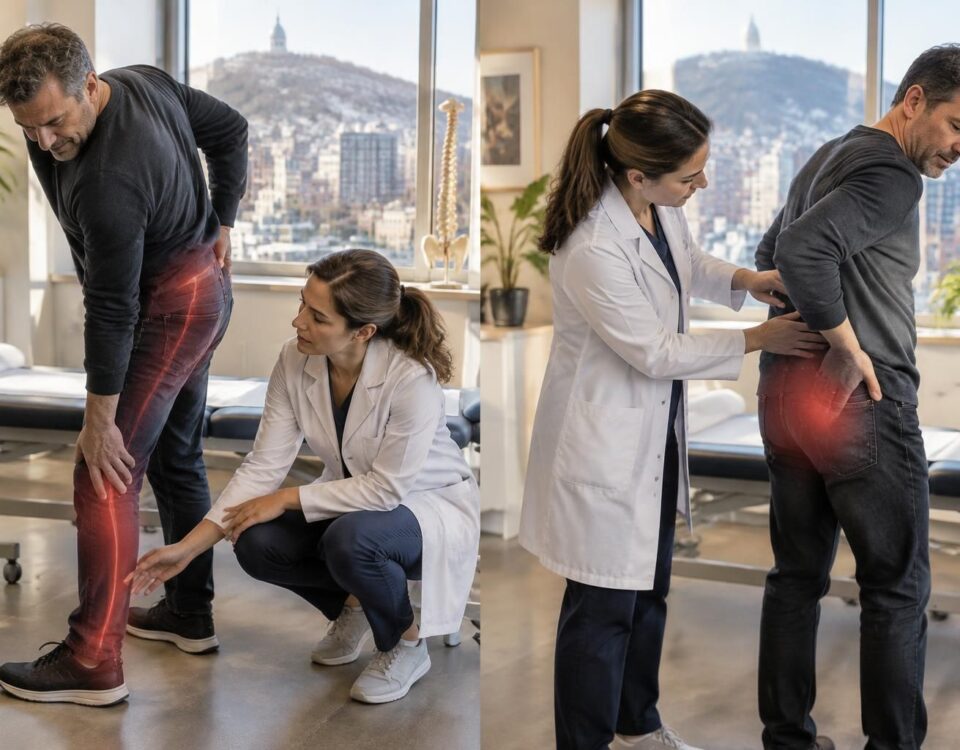
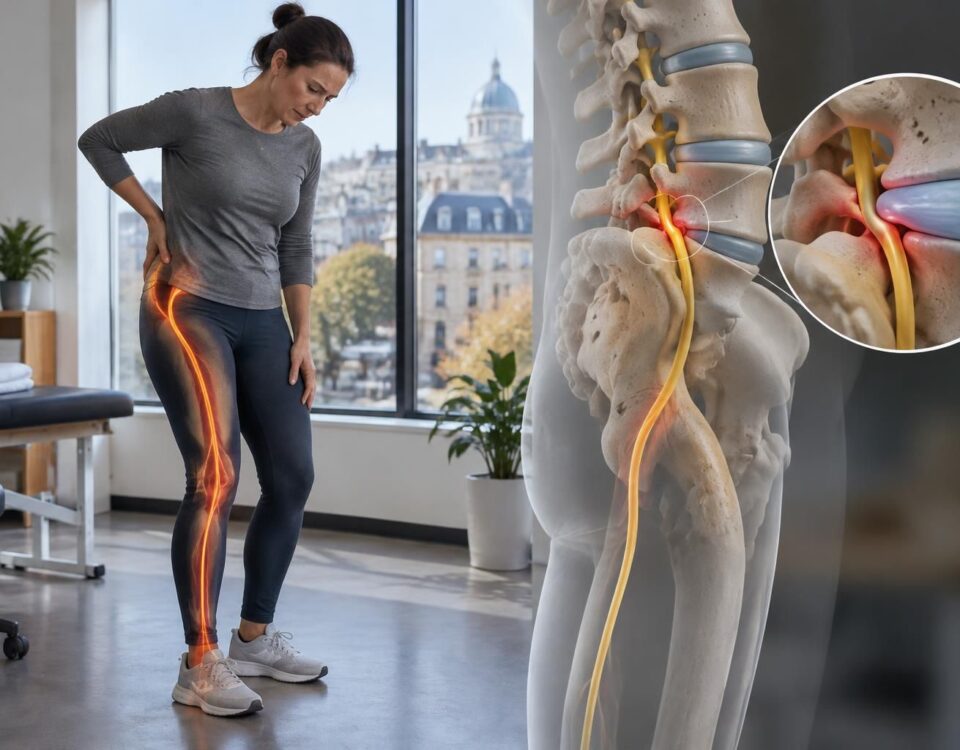
Sciatica and Difficulty Staying Seated for Long Periods
12/07/2026
Sciatica in Terrebonne: how to interpret pain that descends below the knee
13/07/2026
IN BRIEF
| In brief, sciatica that extends below the knee is a pain radiating along the leg due to a compression or irritation of the roots of the sciatic nerve, and not simply a joint injury of the knee. What is it? a nerve manifestation starting from the lower back and traveling towards the buttock, thigh, then the calf and foot. Benefits: rapid pain reduction, improved mobility, and prevention of recurrences through a non-surgical and personalized program (targeted exercises, manual therapy, trunk strengthening). How does it work? we identify the origin (e.g. herniated disc, foraminal stenosis, piriformis syndrome) and apply techniques and exercises that relieve pressure on the sciatic nerve and restore mobility while adjusting daily postures. In Montreal, this service is particularly effective for lower back pain radiating to the leg, with assessments and care at TAGMED Clinic aiming for a quick return to walking without surgery. |
In Montreal, understanding a pain that radiates below the knee helps differentiate sciatica from simple knee pain. This radiation is generally of nerve origin and not joint-related.
- Meaning: pain that starts in the lower back or buttock and travels up the leg is typical of irritation or compression of the sciatic nerve.
- Origin and Path: the sciatic nerve originates from the lumbar roots (L4 to S3) and travels through the buttock, thigh, then divides behind the knee into branches that serve the calf and foot.
- Common Causes: lumbar disc herniation, foraminal or spinal stenosis, and piriformis syndrome can cause this radiation.
- Evaluation: targeted clinical examination and, if necessary, imaging or EMG to locate the irritated area and confirm the root origin.
- Non-surgical management: physiotherapy and osteopathy with targeted exercises, nerve mobilization, and work on posture and mobility of the trunk and hips.
For a suitable evaluation in Montreal, TAGMED Clinic offers a personalized approach to calm pain, restore mobility, and prevent recurrences, without systematic recourse to surgery.
This practical article, written by a healthcare professional expert in lumbar and sciatic pathologies, explains how to interpret a sciatica that extends below the knee. You will discover the signals indicating a nerve origin, the key mechanisms of the sciatic nerve’s path, and the non-surgical options available in Montreal, notably through TAGMED Clinic.
Understanding the Path of the Sciatic Nerve
The sciatic nerve originates between the lumbar roots L4 to S3. It traverses the pelvis, passes under the piriformis muscle, then runs along the back of the thigh before splitting behind the knee into two main branches, the tibial nerve and the fibular nerve. This long trajectory explains why irritation or compression can cause pain radiating from the lower back to the foot. To understand the details of this path, you can consult resources associated with SOS Sciatica and the path of the sciatic nerve.
Pain that extends below the knee is a central clue. It reflects irritation or compression along the nerve’s path and directs the diagnosis towards a root origin rather than purely joint pain. The more your pain follows the posterior path from the thigh to the foot, the more likely the nerve explanation becomes, guiding the non-surgical management.
Signs and Interpretation
Typical signs include pain that starts in the lower back or buttock and extends along the leg. You may also experience paresthesias, electric shocks, or sometimes weakness in the foot. This constellation points towards a radicular involvement rather than a purely mechanical issue localized in the knee. To better understand these mechanisms, consult dedicated resources on the pathway of the sciatic nerve and clinical signs.
Useful resources detail why the path of the pain helps to orient the cause and how to interpret symptoms when the pain extends to the foot. For further details, see the pages dedicated to sciatica and its pathway.
Common Causes and Mechanisms
The most common mechanisms explaining pain that extends below the knee are a lumbar disc herniation, foraminal stenosis, or piriformis syndrome. Other factors, such as certain conditions related to pregnancy, can influence the onset or intensity of symptoms.
Knowing this path and these causes allows for rapid orientation towards non-surgical approaches suited to each patient. For theoretical and clinical resources on the mechanisms, you can consult dedicated content on SOS Sciatica and Merck Manuals.
Diagnosis and Evaluation in Montreal
Diagnosis is based on a thorough clinical examination, supplemented if necessary by imaging studies (MRI or CT scan) to visualize a herniation, stenosis, or other abnormalities. An EMG may be considered if there is doubt about the precise location of the compression or irritation.
In Montreal or Terrebonne, specialized evaluations can be offered by TAGMED Clinic. This approach aims to identify the exact source and direct suitable non-surgical treatments, without systematic recourse to surgery.
To better understand the mechanisms and clinical implications, you can consult resources on the path of the sciatic nerve and evaluation tests, especially the pages addressing pain that radiates down to the calf and foot.
Non-surgical Options and Management at TAGMED
When evaluation allows, non-surgical approaches are offered to reduce pressure on the nerve and improve the mobility of the spine and hips. These options are based on a personalized assessment and an adapted care plan, without a mandate to perform inappropriate actions. Technologies and techniques used may include motorized neurovertebral decompression and specific osteopathy, as needed.
In Montreal or Terrebonne, TAGMED Clinic can offer comprehensive care including, based on the assessment, manual approaches and measures aimed at optimizing the function of the lumbar belt and lower limbs. To explore the available options and services offered, check out the resources of TAGMED Clinic and the associated information on SOS Sciatica and the pages dedicated to sciatica.
For additional resources and details on possible mechanical causes and non-surgical management, you can refer to the following resources: Treatment of sciatica in Montreal – possible mechanical causes, Why the path of pain helps to pinpoint the cause, Sciatica and calf pain while sitting, Sciatica – Merck Manual, Pain in the buttock without back pain – sciatica, Sciatica link and knee pain, Understanding the path of the sciatic nerve, Sciatica – calf pain while sitting, Sciatica – buttock pain without back, and the general TAGMED page: TAGMED Clinic.
To deepen your general understanding, consult the following resources on the mechanisms and paths of the sciatic nerve: Why the path of pain helps to pinpoint the cause, Understanding the path.
For additional information on neurovertebral decompression and associated conditions, you can refer to Neurovertebral Decompression. Resources on lower back pain and sciatica are also accessible through the SOS Sciatica domain and the dedicated pages on symptoms and non-surgical treatments.
Medical disclaimer: The information and advice provided on this site do not replace the opinion, diagnosis, or treatment of a healthcare professional. Please note that Dr. Sylvain Desforges, osteopath, is neither a medical doctor nor a physician, and is not specialized in a medical specialty as defined by the Collège des médecins du Québec. Manual therapy, functional medicine, and sports medicine as described on this site do not include any treatment or medical diagnosis made by a physician or medical specialist. Always consult your doctor for any medical questions. For more details, please read our full Legal Notice.
— Medical disclaimer: The information and advice provided on this site do not replace the opinion, diagnosis, or treatment of a healthcare professional. Please note that Dr. Sylvain Desforges, osteopath, is neither a medical doctor nor a physician, and is not specialized in a medical specialty as defined by the Collège des médecins du Québec. Manual therapy, functional medicine, and sports medicine as described on this site do not include any treatment or medical diagnosis made by a physician or medical specialist. Always consult your doctor for any medical questions. For more details, please read our full Legal Notice.
- Interpretation axis: path of the sciatic nerve and root localization (roots L4–S3)
- Pain that radiates below the knee indicates root irritation/compression, not necessarily a knee injury
- The sciatic nerve crosses the pelvis, passes under the piriformis, then reaches the popliteal fossa and divides
- Common associated causes: disc herniation, foraminal stenosis, piriformis syndrome
- Clinical signs: burning, electric shock, paresthesia, and sometimes foot weakness
- Quick clinical tests to locate the irritated area along the path
- Recommended non-surgical approaches in Montreal: targeted physiotherapy and osteopathy to free the nerve
- Practical advice: guided mobility, neutral posture, gentle activities (walking), avoid prolonged resting
- When to consult quickly: persistent pain, marked weakness, loss of bowel/bladder control, emergency signs

This summary explains how to interpret sciatica when the pain “radiates below the knee.” It clarifies the path of the sciatic nerve, the signs to look for, the possible causes, and the preferred non-surgical options, particularly for the area of Montreal.
Understanding the path of the sciatic nerve and its implications
The sciatic nerve originates between the lumbar roots L4 and S3, crosses the pelvis, passes under the piriformis muscle, and runs along the back of the thigh before splitting behind the knee into tibial and fibular branches that supply the calf, foot, and toes. This route explains why pain that starts in the lower back or buttock can radiate down to below the knee and then to the foot. Understanding this path is key to distinguishing a nerve injury from a purely joint pain and to targeting suitable non-surgical treatments.
The path and its implications
The localization of pain along this path helps identify the involved nerve segments and guides clinical assessment and therapeutic choices. Irritation or compression on an L4–S3 root can cause symptoms that follow the posterior path of the thigh and extend beyond the knee.
Signs and clues for interpreting pain that descends below the knee
Typical signs include pain starting from the lower back or buttock and “descending” into the leg, associated with paresthesia, electric shocks, or sometimes weakness of the foot. If the pain is accompanied by impaired strength or abnormal sensations extending to the foot, it is a signal to take seriously. Warning signals necessitate prompt consultation: loss of urinary or bowel control, very intense pain persisting despite conservative measures, fever, or recent trauma.
Typical signs and warning signals
The presence of electric shocks, paresthesia, or weakness of the foot, associated with pain following the course of the sciatic nerve, points towards radicular involvement rather than simple muscular pain.
Common causes and their relation to the path
Several mechanisms can project pain along the path below the knee. Among the most common: a lumbar disc herniation, foraminal or spinal stenosis, and the piriformis syndrome which can compress the nerve near the gluteal entry. Factors such as pregnancy or postural variations can also influence the onset or intensity of symptoms.
Causes to know and clinical distinctions
Understanding these mechanisms helps guide examinations (imaging, EMG if necessary) and prioritize suitable non-surgical treatments focused on reducing pressure on the nerve and restoring mobility.
Non-surgical management and practical advice in Montreal
In practice, approaches like targeted physiotherapy and osteopathy can relieve pain and improve mobility without resorting to surgery. The work aims to strengthen muscle belts, improve flexibility, and correct postures that exacerbate the nerve’s path. Gentle exercises, mobilization techniques, and a personalized rehabilitation plan tailored to your situation in Montreal can reduce pressure on the nerve and prevent recurrences.
Recommended strategies and exercises
Maintain regular, appropriate activity (walking, gentle mobility), favor positions that respect spine-pelvis alignment, and use a targeted stretching and strengthening program. A consultation with a specialist in Montreal can determine the precise protocol and progress to be made.
When to consult and where in Montreal
If the pain is associated with warning signs or persists despite conservative measures, head towards a specialized clinic in lower back pain and sciatica in Montreal. An experienced professional will assess the nerve’s path, propose appropriate tests, and establish a personalized non-surgical plan to relieve pain descending below the knee quickly and durably.
| Indicator | Interpretation and action |
|---|---|
| Pain starting from the lower back or buttock and descending into the leg | Probable radicular sign; direction towards nerve assessment and non-surgical plan. |
| Irradiation to the calf or foot | Confirmed sciatic trajectory; prioritize targeted non-surgical approach. |
| Electric shocks or burning sensations along the leg | Nerve irritation; caution if weakness or loss of control. |
| Weakness or loss of strength in the foot | Possible nerve involvement; prompt consultation recommended. |
| Numbness or paresthesia in the leg | Useful nerve indicator for exercises and nerve mobilization. |
| Pain worsened by walking or prolonged sitting | Nerve tension; postural adjustments and mobility program. |
| Pain that does not subside with rest or simple analgesics | Specialized evaluation recommended for radiculopathy and conservative options. |
| Emergency signs such as loss of urinary/bowel control or saddle anesthesia | Immediate medical action, critical emergency. |
Testimonials in Montreal: interpreting pain that descends below the knee
Marie, 54, Montreal: before, I thought the pain simply came from my back or knee. But when the pain descended below the knee to the calf, I understood it was a sciatica. This signal helped me avoid searching for an isolated joint injury. After an assessment, I was offered simple gestures and targeted exercises that improved my mobility and reduced pain without unnecessary medication.
Thomas, 36, Montreal: I felt electric shocks that seemed stuck in the hollow of my knee. This quickly made me understand that it wasn’t a knee joint issue, but irritation of the sciatic nerve radiating along the leg. By following a non-surgical plan and progressive exercises, the pain decreased, and I returned to my usual activities.
Claire, 60, Montreal: during my pregnancy, the pain followed the path of the sciatic nerve and extended to the foot. Understanding that it was not local tension but nerve irradiation helped me adjust my positions and use appropriate supports. Through gentle movements and personalized advice, I gained comfort and mobility without jeopardizing the baby.
Lucas, 42, Montreal: as an athlete, feeling the pain “starting from the lower back and descending below the knee” immediately pointed me towards a radicular cause rather than a local muscular issue. The program mixed targeted strengthening, mobility, and load management so that I could gradually resume training without aggravating the nerve.
Antoine, 29, Montreal: behind the knee, the temptation was to think of a ligament injury. In reality, the pain followed the path of the sciatic nerve, which directed the diagnosis towards nerve irritation rather than a joint injury. With practical advice and simple exercises, the pain quickly gained clarity and control without surgical intervention.
Sciatica in Montreal: interpreting pain that descends below the knee
Dr Sylvain Desforges, osteopath and expert in manual medicine, is 59 years old and serves as the founder and president of the TAGMED clinics, as well as the ACMA association. His career, shaped by a practice focused on innovation in healthcare, concentrates on chronic pain and the integration of advanced technologies such as motorized neurovertebral decompression, laser devices, and shock wave therapy. His goal is to provide evidence-based care to optimize health and well-being for his patients in Montreal and the surrounding areas.
In his work around sciatica and pain radiating below the knee, Dr Desforges highlights a common reality: pain that descends along the leg does not necessarily reduce to a problem with the knee joint. On the contrary, it often reflects a irritation or compression of the sciatic nerve, traveling from the lumbar roots down to the foot. This approach helps avoid misdiagnoses and directs treatment toward the nerve root cause rather than localized symptoms in the leg.
His approach is based on the precise identification of the nerve origin. The path of the sciatic nerve, originating between L4 and S3, crosses the pelvis, runs beneath the piriformis muscle, and extends down the posterior thigh before branching behind the knee into tibial and fibular branches. This clinical mapping guides evaluation and interventions, allowing for the distinction between lumbar radiculopathy and peripheral impairment, and adapting therapeutic actions accordingly.
For patients in Montreal, a non-surgical approach is favored when relevant. Dr Desforges offers a range of options aimed at reducing pressure on the nerve and restoring mobility: targeted physiotherapy, movement-focused osteopathy, and functional rehabilitation programs centered on strengthening the trunk and lower limbs, relieving tension, and improving postures. In some cases, complementary technologies such as motorized vertebral decompression or stimulation techniques may be integrated, always following a thorough and personalized evaluation.
Dr Desforges also emphasizes the importance of patient education and self-management. He guides his patients through practical advice on daily living, postural habits, and simple exercises that promote gradual recovery without overloading the nerve. The objective is to avoid relapses and sustainably improve mobility, walking, and quality of life. This comprehensive approach, adapted to the urban context and local resources of Montreal, favors pragmatic and effective solutions while remaining true to scientifically validated principles.
In practice, patients consulting in Montreal benefit from a thorough diagnosis, a personalized care plan, and regular follow-up to assess progress. Dr Desforges adheres to a philosophy that considers sciatica as a neural sign requiring precise detection of the irritating mechanism and progressive management to preserve function and prevent long-term recurrences.
This text summarizes how to interpret pain that descends below the knee when related to sciatica in Montreal, distinguishing a nerve origin from potential joint involvement, and presenting clear signals, evaluation methods, and non-surgical approaches suited to urban life in Montreal.
Pain that “descends below the knee” is most often part of a sciatic radiculopathy rather than a purely joint issue. The sciatic nerve, originating from lumbar roots L4 to S3, travels from the lower back, passes beneath the piriformis muscle, and spreads down the thigh to the popliteal fossa before dividing into tibial and fibular branches. This trajectory explains why pressure higher up may manifest much lower in the leg, including the calf and foot. To deepen this mapping and its implications, consult the dedicated article on this path and its importance.
A reliable diagnosis rests on a thorough clinical evaluation, complemented by imaging options when necessary. The goal is to identify whether the origin is discal, foraminal, or related to the piriformis, and to favor non-surgical approaches when appropriate. In Montreal, several resources allow for personalized evaluation and an adapted treatment plan. To understand the indications and steps of this pathway, you can explore the resources dedicated to non-surgical management in Montreal and the care provided by TAGMED Clinic.
In practice, an approach centered on the path of the sciatic nerve allows for targeting non-invasive treatments and preventing recurrences. Available options include targeted physiotherapy, movement-focused osteopathy, and mobilization techniques along the nerve’s path, with strengthening of the abdominal and pelvic girdles to support the spine and hips. For those seeking solutions in Montreal, resources such as when to seek personalized evaluation and signs indicating a targeted treatment is necessary can guide your approach.
If the pain is associated with serious symptoms – marked loss of strength, progressive numbness, very intense pain persisting despite conservative measures, or urinary issues – it is imperative to consult quickly, as suggested by specialized resources on Montreal and medical opinions available on dedicated pages.
To enrich your understanding and consider concrete clinical options in Montreal, you can consult the following resources: pain in the foot and irritated nerve root, pain in the buttock and leg, and buttock pain and lumbar cause.
For a general overview of the non-surgical mechanisms and measures applicable in Montreal, also refer to the reference medical resource and practical guides on sciatica. Additional clinical resources, such as the MSD Manual, complement the clinical assessment and available therapeutic options.
In summary, the interpretation of a sciatica that descends below the knee relies on understanding the nerve pathway, precise assessment, and appropriate non-surgical management when possible. To access patient-centered care in Montreal, explore the options for targeted treatment and the services offered by TAGMED Clinic.
To go further and access various resources on conditions and symptoms related to sciatica, feel free to check the associated pages and practical guides published by SOS Sciatique and its partners.
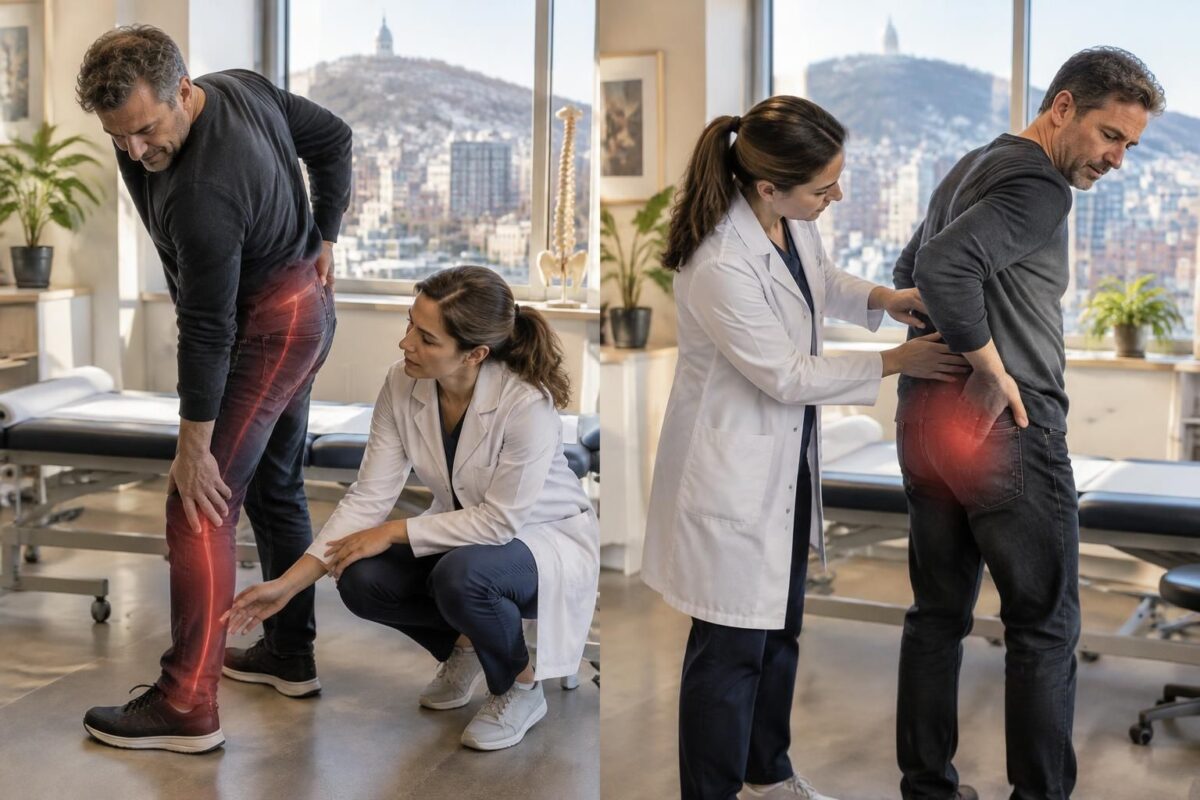
Sciatica in Montreal: radicular pain versus referred pain
IN BRIEF Radicular sciatica corresponds to irritation of a nerve root, while referred pain can spread to the buttock or leg without direct nerve involvement. In Montreal, distinguishing these pains helps guide the evaluation by linking the symptom route to…
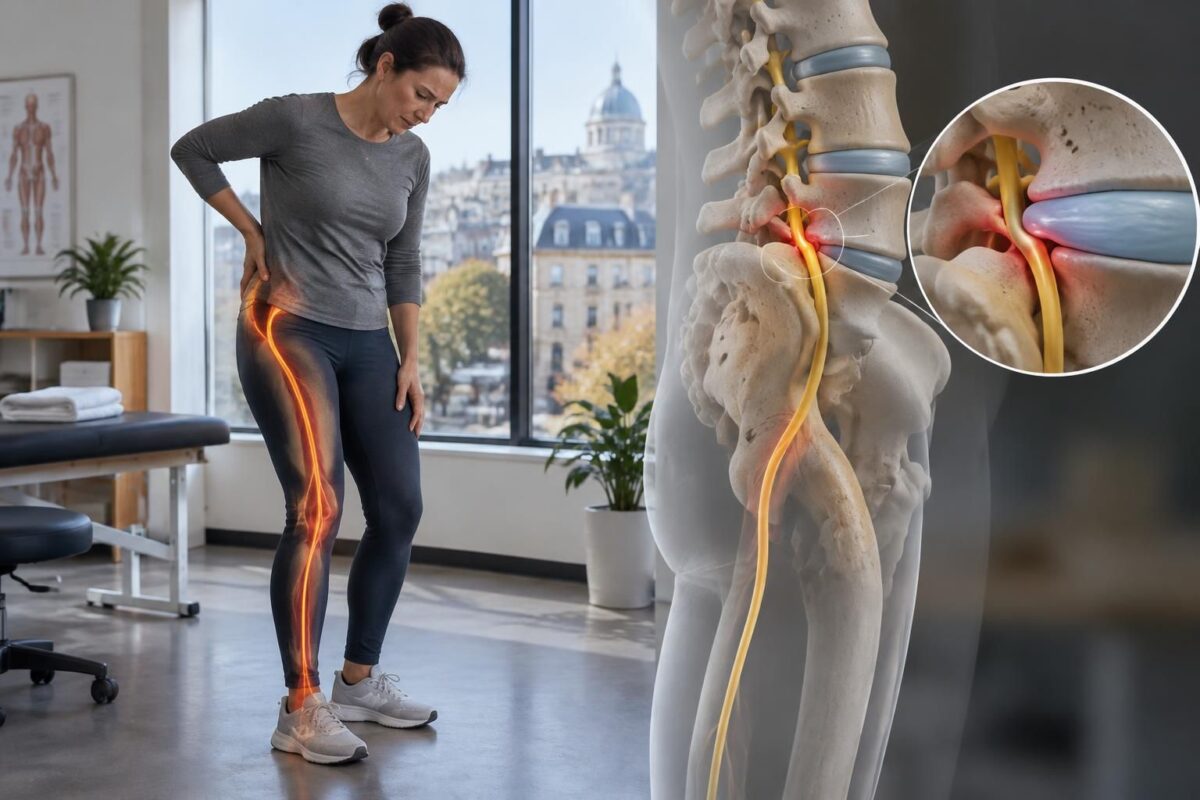
Sciatica in Montreal: nerve root, disc, and foramen explained simply
IN BRIEF Sciatica corresponds to pain linked to the irritation of a nerve root, sometimes near a lumbar disc or a narrowed foramen. In Montreal, distinguishing an L4-L5 issue that may affect the L5 root from an L5-S1 problem that…

Sciatica in Montreal: understanding L5-S1 foraminal compression
IN BRIEF L5-S1 foraminal compression is a narrowing of the opening where a nerve root exits, which can cause sciatica with pain, tingling, or weakness in the buttock and leg. In Montreal, an assessment allows for correlating symptoms, clinical examination,…

Sciatica in Montreal: why L5-S1 is often involved
IN BRIEF The sciatica L5-S1 often corresponds to irritation of the S1 root, sometimes related to a herniated disc. The pain may start in the buttock and descend behind the thigh to the calf or the foot. In Montreal, understanding…

Sciatica in Montreal: L5 and difficulty lifting the foot
IN BRIEF The difficulty in lifting the foot with sciatica can indicate weakness related to the involvement of the L5 root, sometimes caused by a herniated disc. This foot drop increases the risk of falling and requires prompt medical evaluation;…

Sciatica in Montreal: S1 and difficulty rising up on the toes
IN BRIEF S1 sciatica can cause pain from the buttock to the calf and foot, as well as difficulty getting on tiptoe. This weakness may suggest irritation of the S1 nerve root, but is not sufficient to establish a diagnosis.…

Sciatica in Montreal: L4-L5 and pain towards the top of the foot
IN BRIEF The sciatica related to L4-L5 can radiate from the lower back to the buttock and the leg; pain on the top of the foot may suggest involvement of the L5 root, but the pathways vary and symptoms overlap.…

Sciatica in Montreal: pain in the big toe, L5 root or another cause?
IN BRIEF Pain that radiates toward the big toe may indicate irritation of the L5 root, sometimes related to a herniated disc, but other causes are possible. In Montreal, evaluating the pain pathway, strength, sensitivity, and walking helps guide management…

Sylvain Desforges, B.Sc., D.O., N.D., docteur en ostéopathie
Dr Sylvain Desforges, B.Sc., D.O., N.D., osteopath, is the founding president of TAGMED and of the ACMA association. He dedicates his practice to chronic spinal pain, low back pain and symptoms compatible with sciatica, particularly when pain radiates toward the buttock, leg, calf, foot or toes.
Through SOS Sciatique, he publishes educational content on sciatica symptoms, possible causes such as disc herniation, disc narrowing, foraminal stenosis or irritation of a lumbar nerve root, as well as non-surgical approaches that may be considered according to the evaluation. At Clinique TAGMED, care may include, depending on the case, motorized neurovertebral decompression, specific osteopathic care or precision percussion.
For an evaluation related to sciatica treatment in Montreal / Mount Royal or sciatica treatment in Terrebonne, please consult the services available at Clinique TAGMED.
Medical disclaimer
The information published on SOS Sciatique is provided for educational purposes only and does not replace a consultation, diagnosis, opinion or treatment provided by a physician or another authorized healthcare professional. The author of this article is neither a medical doctor nor a specialist in a medical specialty recognized by the Collège des médecins du Québec. The osteopathic, manual medicine or functional support approaches described on this site do not constitute medical acts and are not intended to replace medical follow-up.
Consult a physician or emergency service in cases of loss of bladder or bowel control, anesthesia in the saddle area, significant or progressive weakness in the leg or foot, fever, recent trauma, severe pain or rapid worsening of symptoms. For more details, please read our Legal Notice.