Sciatica: burning in the leg and nerve irritation
12/07/2026
Sciatica in Montreal: how to interpret pain that radiates below the knee
13/07/2026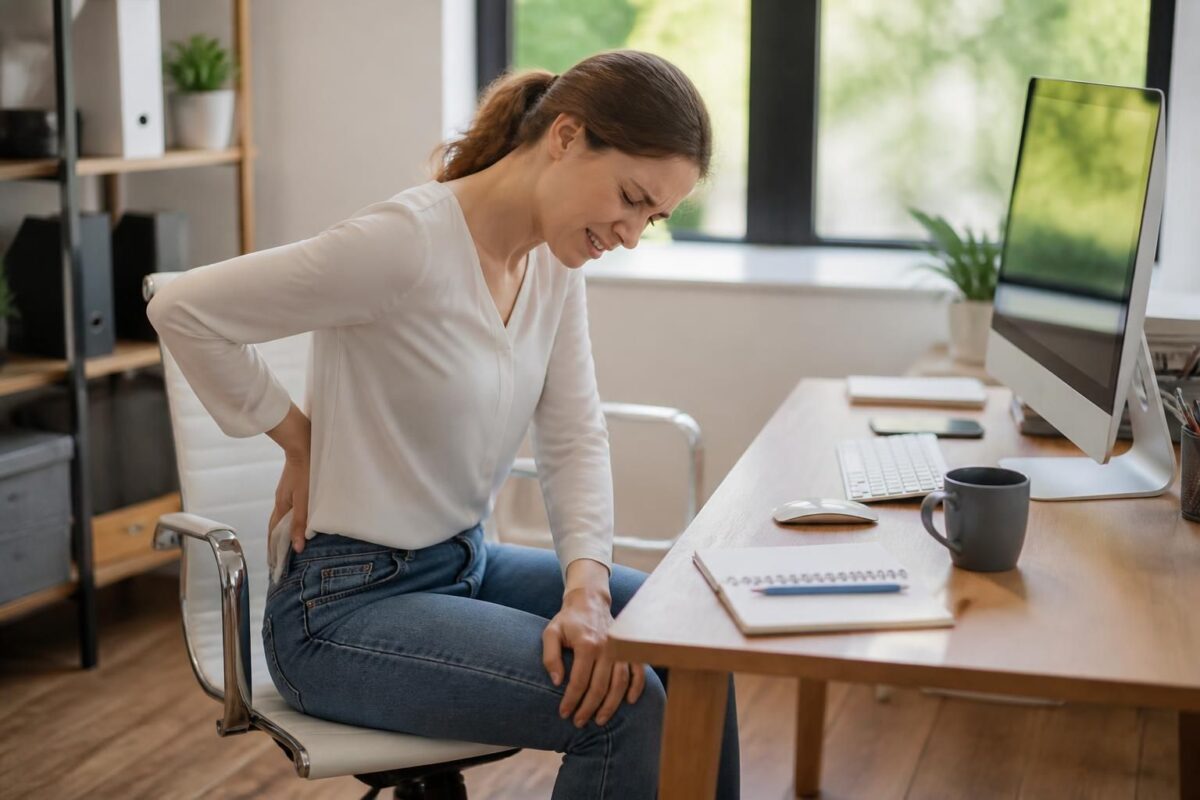
IN BRIEF
| In brief, sciatica and difficulty sitting for long periods describe pain that radiates from the lower back down the leg and worsens with prolonged sitting. What is it? It is pain related to the irritation or compression of the sciatic nerve. What are the benefits? Understanding this mechanism allows for adopting a dynamic posture and simple habits to reduce pain and gain comfort at work, at home, and while traveling. How does it work? By moving regularly, adjusting supports, and using appropriate lumbar support, we decrease pressure on the discs and relieve the nerve, making it possible to sit longer without suffering. |
Sciatica can make it difficult to stay sitting for long: the pain may worsen in a seated position and decrease when walking. The sciatic nerve becomes irritated when the sitting posture is incorrect and pressure on the lumbar discs increases.
Why is sitting for long periods problematic? The pelvis can become misaligned and the pain can pull on the nerve, especially in the absence of movement that would help the nerve glide. This is why immobility amplifies discomfort.
To sit longer without suffering, prioritize a dynamic sitting posture and these simple actions:
- Change position regularly, every 20–30 minutes.
- Use a sciatic cushion and a lumbar support to maintain a natural lordosis.
- Adjust the chair height so that your knees are at 90° and your feet are flat.
- Avoid crossed legs and pelvic twists.
- Prefer walking and moving rather than immobility.
By combining smooth breathing, movement, and proper posture, pain can decrease, making it possible to sit longer with less discomfort.
This article, written by a health professional and expert, explains why it is difficult to sit for long when sciatic pain is present. You will discover the simple mechanisms that explain this phenomenon, the positions to avoid, and practical strategies to limit pain while sitting, without resorting to complex exercises. You will also find reliable resources to deepen your understanding and guide your management.
Understanding the link between sitting and sciatic pain
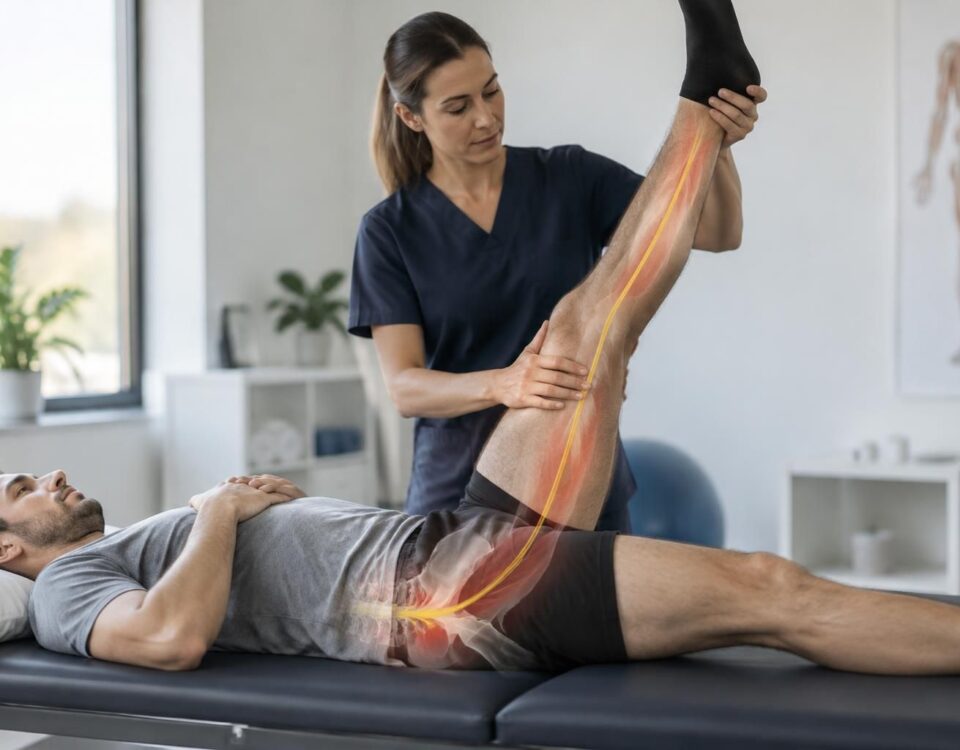
The sciatic nerve originates in the lumbar region and runs down the leg. In a seated position, pressure on the lumbar discs can increase and put stress on this sensitive nerve. The pelvis can become misaligned without us realizing it, pulling on the nerve and causing pain and discomfort. Immobility accentuates nerve gliding and increases pain over time. These mechanisms explain why sitting for long periods can worsen sciatica.
Postures to avoid when sitting
Rounded and slumped backs increase tension on the sciatic nerve. A too straight and rigid back can also block the natural movement of the lower back and maintain pain. Crossed legs unequally distribute weight on the pelvis and increase lumbar rotation. Feet tucked under the chair alter alignment and stress the lower back. Prolonged sitting without breaks blocks nerve gliding and perpetuates pain. In practice, avoid these configurations and prioritize micro-variations in position every 20 to 30 minutes.
How to sit to limit pain and promote comfort
Adopt a dynamic sitting posture rather than a fixed position. A neutral pelvis and aligned spine relieve the sciatic nerve. Place your feet flat on the ground and ensure your knees are at hip height or slightly lower, with balanced supports. Relax your shoulders and let go of tension in your abdomen to promote smooth breathing. Do not try to “sit up straight” all the time; instead, look for positions that reduce nerve tension and allow for movement.
To limit pain in the workplace, opt for an adjustable-height chair and use ergonomic innovations such as a sciatic cushion or a lumbar cushion to support the lower back without forcing alignment. Keep in mind that changes in posture and rhythm remain essential. Active breaks, even brief ones, help significantly.
You can learn about the mechanisms and nerve pathways to better guide your management, for example through these reliable resources: path of the sciatic nerve and pain and pain that progresses down the leg.
To complement this information, you can consult additional resources on aids and options available in ergonomics and pain management.
Optimizing the environment and practices at work and home
At the office, adjust the screen to eye level and choose a chair that allows your feet to be flat on the ground. Alternate sitting and standing and incorporate short walks into your day. In the car, prefer a slightly tilted seat and take regular breaks if possible. Guides and practical advice on these topics can be found in specialized and recognized resources.
In case of persistent pain, prioritize recommended clinical avenues. Useful resources and information are available, notably on Decompression Neurovertébrale and Sos Hernie Discale, to understand holistic approaches and management options to consider with your doctor or osteopath. For integrated procedures and approaches at the TAGMED clinic in Montreal or Terrebonne, you can consult Clinique TAGMED.
Useful links to deepen your understanding
To better understand the painful journey and the implications of nerve pathways, visit sciatica and pain pathway.
For additional information on the cause’s orientation and associated factors, visit Sciatica in Terrebonne.
For general resources on approaches and conditions related to the spine and nerve, see associated approaches and conditions.
For more options and clinical perspectives, explore painful pathway and cause orientation.
For details on treatments and options available in specialized clinical settings, refer to consultation and management in Montreal and reflections on positions to avoid.
For information on herniated discs and general approaches, see Herniated disc and trajectory.
For supplementary contexts and resources on pain and sciatica, you can also check Sciatica and provincial space.
For information on practices and professional issues around osteopathy and management, refer to accredited and specialized resources such as those mentioned above.
Important: some conditions may require direct clinical evaluation. For any medical questions or for an accurate diagnosis, consult a qualified healthcare professional.
Medical disclaimer: The information and advice provided on this site do not replace the opinion, diagnosis, or treatment of a healthcare professional. Please note that Dr. Sylvain Desforges, osteopath, is neither a medical doctor nor a physician, and is not a specialist in any medical specialty as defined by the Collège des médecins du Québec. Manual medicine, functional medicine, and sports medicine as described on this site exclude any treatment or medical diagnosis by a physician or specialist. Always consult your doctor for any medical question. For more details, please read our full Legal Notice.
Causes and Triggers
- Sitting posture that rounds the back and unbalances the pelvis
- Prolonged sitting increases pressure on the discs and nerve
- Crossed legs or feet under the chair, pelvic unbalance
- Lack of movement reduces nerve gliding and worsens pain
- Lumbar tensions and stiffened pelvis
Solutions and Actions
- Position variations every 20–30 minutes
- Sciatic cushion and/or lumbar cushion to free the nerve
- Seat adjustment: appropriate height, feet flat
- Knees position: at 90°, pelvis in neutral position
- Movements and walking: active breaks and light stretches

Sciatica can make it difficult to sit for long periods. This article provides concrete recommendations to understand the mechanisms at play and adopt simple positions and actions that reduce pressure on the sciatic nerve allowing you to remain effective without increasing pain.
Understanding Why Sitting for Long Periods Creates Tensions
When sitting, pressure on the intervertebral discs increases, especially if the back is rounded. This strain can irritate a nerve root and trigger pain along the sciatic pathway. The pelvis can become misaligned, leading to asymmetrical tensions and limiting the necessary nerve gliding for comfort. Finally, immobility blocks the movement of the nerve and can amplify pain over time.
Errors to Avoid When Sitting
Avoid postures that accentuate pelvic twisting and nerve tension: overly rounded or overly straight back, crossed legs, foot hidden under the chair, and especially prolonged sitting without breaks. These habits maintain irritation and gradually worsen pain.
How to Sit Correctly and Limit Pain
Pelvis Position
Sit on the sit bones and maintain a stable position without leaning back or excessively arching the spine. A neutral pelvis helps support a neutral postural chain.
Leg and Support Position
Feet should be flat on the ground, and knees aligned at least with the hips. Symmetrical supports avoid uneven tensions that aggravate sciatica.
Back Support and Breathing
Place appropriate lumbar support to keep the back straight without straining. Adopt smooth breathing and avoid blocked movements that increase nerve tension.
Adapting the Environment and Sitting Times
At the Office
Adjust the screen to eye level, set the chair so that feet rest flat, and alternate sitting/standing regularly. The goal is to encourage movement and avoid fixed positions that accentuate pain.
In the Car
Use a slightly reclined seat and stabilize the pelvis. Take breaks every 30 to 45 minutes to stretch or walk a bit to relieve tension.
At Home
Use footrests and a lumbar cushion when sitting on a couch or chair. Vary positions and move as much as possible to keep the sciatic nerve free of constraints.
Simple Actions to Promote Movement and Recovery
The key is dynamics: do not stay stuck in one posture. Get up every 20 to 30 minutes, move your pelvis, and do small walks or stretches. Controlled breathing and regular micro-movements reduce discomfort and support better tolerance to sitting.
Use dedicated tools
Sciatic cushion and lumbar cushion
A sciatic cushion alleviates pressure around the nerve pathway and can transform your comfort at the office, in the car, or at home. A lumbar cushion, on the other hand, helps maintain a natural lordosis and prevents strain.
Footrest and suitable chair
A footrest and an adjustable-height chair allow you to achieve an ideal posture and vary your supports without unnecessary effort. Prefer surfaces that provide a stable base and avoid seats that are too soft or too low.
| Aspect | Impact and concise solutions |
|---|---|
| Main trigger | Pain increases with prolonged sitting and decreases with movement; varying positions helps immediately. |
| Disc pressure | In a seated position, lumbar discs experience increased compression, especially with a slouched back; correcting posture alleviates pain. |
| Pelvis and alignment | Neutral pelvis = aligned spine; avoid misalignment that pulls on the sciatic nerve. |
| Position variability | Changing position every 20–30 minutes reduces inflammation and eases symptoms. |
| Support and chair | Adjustable chair + dynamic cushion to maintain balance and limit pressure points. |
| Leg position | Feet flat, knees at hip height; avoids twisting and asymmetrical supports. |
| Breathing and relaxation | Flowing breathing and relaxed shoulders reduce nerve tension. |
| Physical activity | Moderate and regular walking stimulates circulation without worsening pain. |
| Sleep and nighttime postures | Sleeping on your side with a cushion between your knees or on your back slightly elevated to limit pressure. |
Testimonials on Sciatica and Difficulty Staying Seated for Long Periods
“I live with sciatica that turns meetings into trials. During a presentation, a burning pain travels up my leg and I have to get up to avoid cracking. I discovered that a sciatic cushion and an adjustable chair that allows changing position every 30 minutes better tolerates my days at the office. The real change is also to incorporate small breaks and walk for a few minutes to let the nerve find its path without interruption.”
“On the road, staying seated for a long time has always been a nightmare. My pelvis and back scream when I’m stuck behind the wheel. I tested a slightly tilted seat and a well-supported pelvis; the pain decreases when I take breaks every 30 to 45 minutes to move and breathe. With a footrest and a suitable lumbar cushion, I feel less tension and I can still endure longer trips without pain.”
“Working from home, I thought that details made the difference, but not so much. What really helps is varying positions and not staying rigid. I use symmetrical supports, get up regularly, and alternate between standing and sitting. The sciatica flares less when I breathe slowly and don’t hold my breath while working. This small change has transformed my days.”
“Before, I would stay stuck in my chair, legs crossed and back hunched. Today, I prioritize a dynamic sitting posture: back slightly supported, feet flat, and knees at hip height. I take micro-breaks every 20 to 30 minutes and use a support cushion to avoid pressure points. My sciatic nerve is gradually recovering and I’m starting to enjoy my afternoons without sharp pain.”
“My job as a salesperson requires movements and periods of sitting in succession. When the pain appears, it reminds me that staying still is not an option. I started practicing simple variations: changing support, moving the pelvis, and keeping my shoulders relaxed. The most important thing is not to believe that you have to ‘sit up straight’ at all costs; you need to move intelligently and breathe. Now, my days go by with much less discomfort and muscle fatigue.”
Sciatica and Difficulty Staying Seated for Long Periods: Portrait of an Engaged Expert
Dr. Sylvain Desforges is recognized as a expert in osteopathy, naturopathy, and manual medicine. Founder and president of the TAGMED clinics and the ACMA association, he places innovation at the heart of his approach to care. His work is part of an evidence-based approach aimed at sustainably improving the health and well-being of his patients, especially when chronic pain and difficulties related to sitting affect daily life.
Dr. Desforges’ field of action extends to the management of chronic pain and the integration of advanced technologies such as spinal decompression, laser, and shockwave therapy. In addressing issues related to sciatica, he implements a combination of manual methods, natural approaches, and technological tools to reduce nerve compression and restore mobility. His goal is for each patient to regain the ability to sit and move without triggering the pain that hinders daily life.
For him, understanding the anatomical mechanisms and postural habits is essential. He explains that sciatic pain results from a long and sensitive nerve pathway, and that sitting posture can either aggravate or soothe symptoms depending on how the pelvis, back, and legs interact. His work emphasizes a dynamic approach to sitting, where micro-variations and tailored adjustments become full-fledged therapeutic tools.
Practically speaking, Dr. Desforges promotes simple and effective strategies to stay seated for long periods without exacerbating pain. He recommends integrating active breaks, adjusting the workstation, and using supportive devices like lumbar support or a specific cushion. He emphasizes the importance of a
“Dynamic sitting,” that is to say a position that evolves, rather than immobility. In addition, he ensures that patients adopt breathing methods and relaxation exercises that decrease tension in the lumbar muscles and facilitate the transmission of nerve information, in order to gradually improve their tolerance to the sitting position.
Dr. Desforges’ vision is as human as it is technical. He focuses on training his patients to understand their own pain, to reduce the fear associated with sitting, and to foster an active relationship with their body. This approach improves the quality of life and makes it possible, in professional and domestic settings, for moments where sitting is no longer an obstacle but a controlled step towards well-being.
To learn more about his approach and the services offered, Dr. Desforges invites you to explore the resources and care options available within his care network. His teams assist patients in implementing a personalized program designed to optimize sitting and sustainably limit pain related to sciatica and difficulties in remaining seated.
Quick summary: sciatica can make it extremely difficult to sit for long periods, but simple adjustments to posture, sitting, and movement can reduce discomfort and prevent symptom worsening. This article offers concrete suggestions for managing sitting in daily life, at the office, in the car, and at home, while preserving the sciatic nerve and promoting useful mobility.
Why sitting for long periods is problematic with sciatica
In a sitting position, the pressure on the lumbar discs increases, especially when the back is rounded or fixed. This tension can irritate an already sensitive nerve root and cause pain that radiates into the lower back, buttock, or leg. The sciatic nerve can be pulled by a misaligned pelvis or by insufficient nerve mobility during periods of inactivity, which explains why the pain may worsen after long periods of sitting. To better understand the mechanisms and possible causes, you can consult resources on mechanical causes and the lumbar canal that can compress nerve roots, for example through detailed information on these possible mechanical causes and lumbar canal compressions. Prolonged maintenance in a static position can also promote pelvis tilt and increase nerve tension.
Inappropriate sitting habits, like crossing legs or improperly adjusted chair height, can perpetuate pain and symptoms. For those who experience pain that worsens when sitting, the lack of movement can be as harmful as the sitting position itself. Detailed resources explain how pain can increase while sitting and provide tailored solutions to limit this phenomenon (pain that increases while sitting, sitting without pain).
To better understand the body’s signals and any alerts such as foot weakness associated with sciatica, it may be useful to consult dedicated resources on this sign and its monitoring (foot weakness – a sign to watch).
Adapting your sitting and work environment to limit pain
The key lies in a dynamic sitting position and simple adjustments: prioritize a seat with adjustable height so that the knees are at 90° and the feet are flat on the floor, while ensuring symmetrical support. The neutral pelvis and neutral spine require avoiding both an overly arched back and a back that is too straight. Using a lumbar cushion can help maintain the natural curve of the lower back while allowing for micro-movements. To learn more about best sitting practices and avoid positions that irritate the sciatic nerve, discover the advice provided in specialized resources like positions to avoid and how to sit.
Avoid positions that worsen pain: rounded or rigid back, crossed legs, or foot under the chair. Instead, adopt a posture where the supports are balanced, shoulders are relaxed, and breathing is fluid, in order to promote muscle relaxation and limit tension on the sciatic nerve.
For practical advice on specific environments, you can consult dedicated resources that cover sitting at the office, in the car, and elsewhere: Symptoms and duration, big toe pain while sitting, and Tops Santé file.
Move smartly and vary postures: micro-breaks and walking
Mobility is the best ally to limit discomfort. Instead of remaining frozen, take small breaks every 20 to 30 minutes to change position, get up briefly, and release tension. Light walking stimulates circulation and helps relax the back and leg muscles, without overloading the sciatic nerve when you adjust your pace and terrain. For practical ideas and concrete methods, the resources on pain that increases while sitting and planning advice can guide you.
If you spend a lot of time sitting, think about alternating activities and postures instead of insisting on just one. The principle is to acquire a habit of dynamic sitting that reduces nerve tension while maintaining your productivity and daily comfort. Articles detail how to sit differently and promote mobility without worsening symptoms (sitting without pain).
Practical advice by environment (office, car, couch)
In the office, prioritize a screen at eye level, a chair with adjustable height, and cutouts that allow for micro-breaks without straining the back. In the car, take regular breaks and ensure that the pelvis is well-supported and that the position of the legs does not impose excessive tension on the sciatic nerve. At home or on the couch, alternate positions and use cushions to support the lower back and knees if necessary—while remaining aware of the need not to sink into the couch and to move regularly. For additional references, you can consult resources on assessment and clinical evaluation in Montreal context (sciatica evaluation Montreal) or on recommended sitting positions from other specialized sources.
To delve deeper into the mechanisms and signals to watch out for, additional readings detail how symptoms can manifest and evolve in the context of sciatica, including signs such as pain radiating to the big toe and other nerve pathways (foot weakness – sign to monitor, pain in the big toe when sitting).
Additionally, general resources offer holistic and progressive approaches to managing pain while sitting and promoting a regression of symptoms, emphasizing movement, breathing, and symmetrical sitting (sitting position).

Sciatica and calf stretching: when the pain increases
IN SHORT A calf stretch can exacerbate sciatica if it further irritates the nerve. It should not cause pain that increases or radiates down the leg: stop the movement and do not push through. Stretches may help with some tensions,…
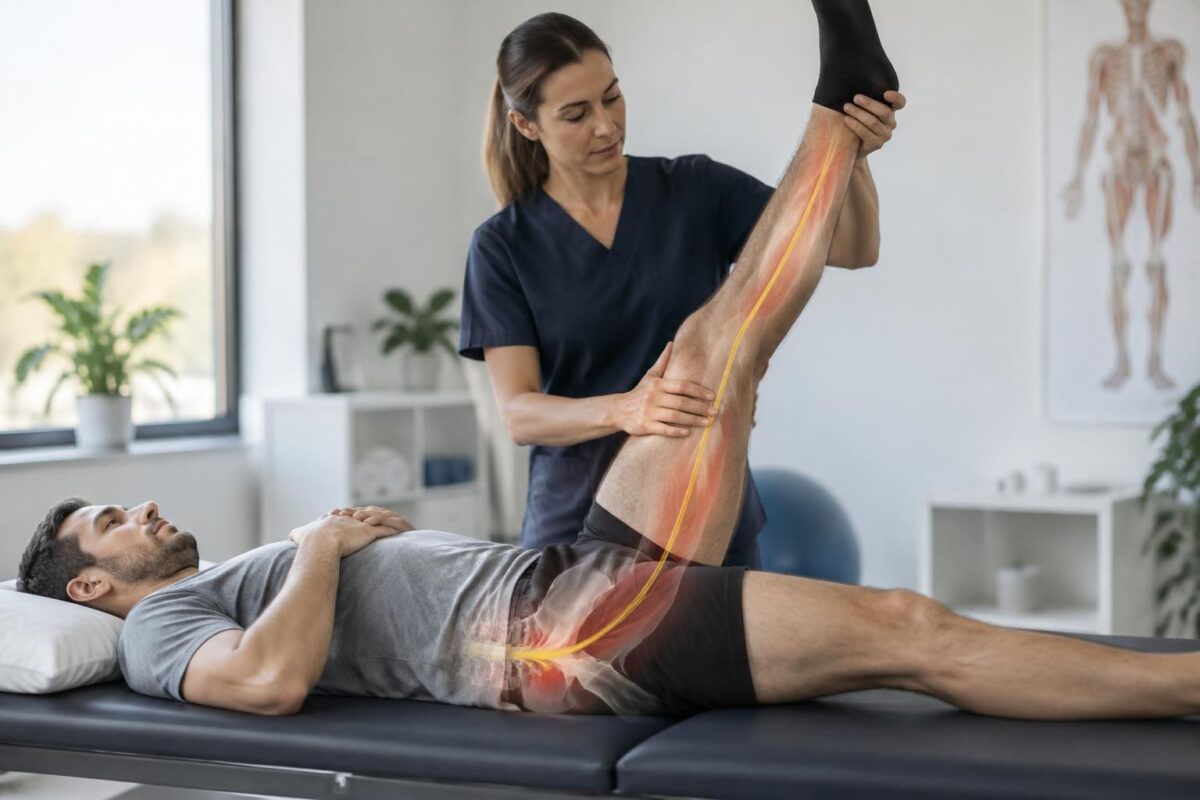
Sciatica and hamstring stretching: possible nerve tension
IN BRIEF Sciatica can make stretching the hamstrings uncomfortable, as the tension felt may come from the nerve rather than the muscle. A gentle stretch, with a straight back and without seeking maximum range, can help loosen the back of…
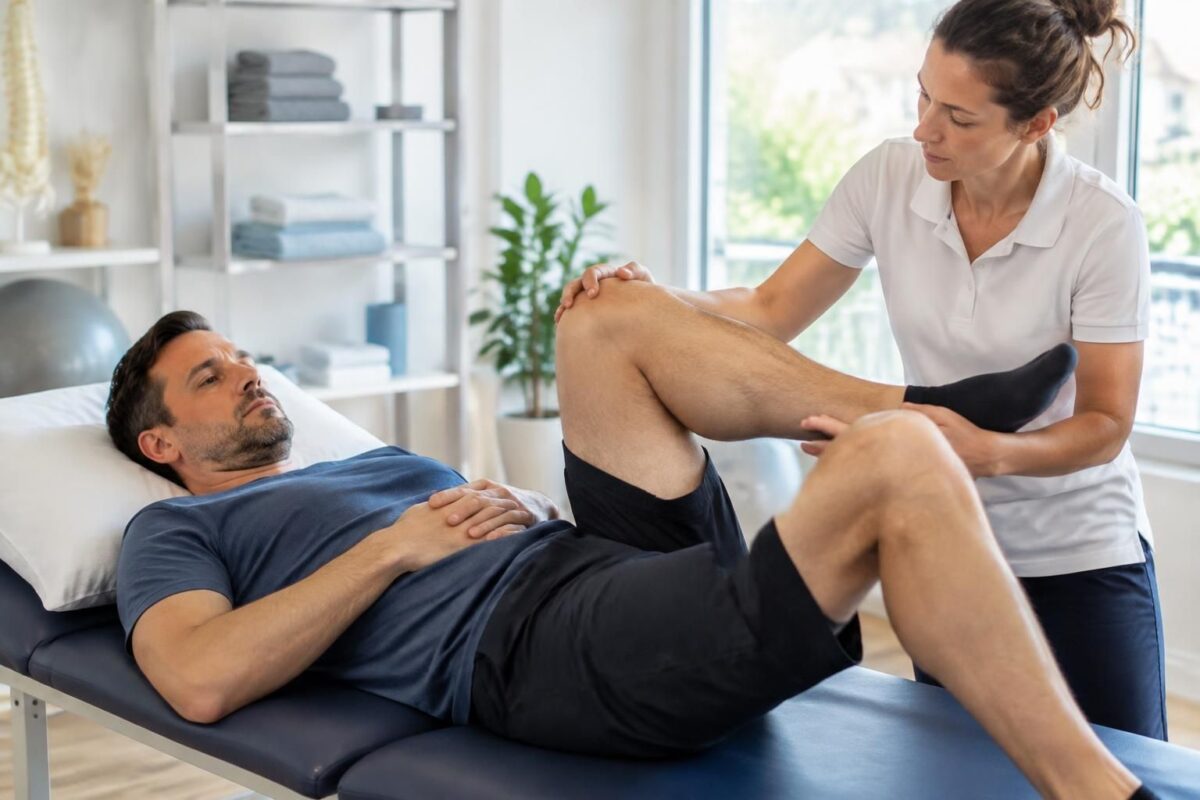
Sciatica and piriformis stretching: useful or worsening depending on the case
IN BRIEF Piriformis-related sciatica can cause deep pain in the buttock, sometimes radiating down the back of the thigh. A gentle stretch can loosen the hip and relieve discomfort if the muscle is involved, but it can worsen symptoms if…

Sciatica and popular stretches: why to stay cautious
IN BRIEF Sciatica causes pain that radiates from the lower back down the leg. Popular stretches, such as the pigeon pose or hamstring stretches, are not always suitable: pulling on an irritated nerve can worsen the symptoms. Favor gentle movements,…

Sciatica and Pilates: movements to adapt
IN SHORT Sciatica causes pain that can radiate from the lower back down to the leg. The Pilates Reformer can promote a gradual return to movement and strengthen core control, provided that the movements, range, and resistance are adapted. Favor…

Sciatica and core stability: variable tolerance depending on symptoms
IN BRIEF Core strengthening in case of sciatica consists of progressively strengthening the trunk muscles. Its tolerance varies depending on pain and symptoms: suitable without worsening the pain, it can support mobility and the resumption of activities, but does not,…

Sciatica and lunges: leg pain to watch out for
IN BRIEF Sciatica is pain that starts from the lower back or buttock and radiates down the leg. If a lunge triggers or worsens this pain, stop the movement and adjust your activity: this exercise does not address sciatica. Consult…

Sciatica and deadlifts: risk depending on the cause
IN BRIEF Sciatica and deadlifts are not always incompatible: the risk depends on the cause of the pain and its intensity. During acute episodes, it’s best to avoid heavy loads and seek medical or physiotherapy advice before resuming. A gradual…

Dr Sylvain Desforges, B.Sc., D.O., N.D., osteopath, is the founding president of TAGMED and of the ACMA association. He dedicates his practice to chronic spinal pain, low back pain and symptoms compatible with sciatica, particularly when pain radiates toward the buttock, leg, calf, foot or toes.
Through SOS Sciatique, he publishes educational content on sciatica symptoms, possible causes such as disc herniation, disc narrowing, foraminal stenosis or irritation of a lumbar nerve root, as well as non-surgical approaches that may be considered according to the evaluation. At Clinique TAGMED, care may include, depending on the case, motorized neurovertebral decompression, specific osteopathic care or precision percussion.
For an evaluation related to sciatica treatment in Montreal / Mount Royal or sciatica treatment in Terrebonne, please consult the services available at Clinique TAGMED.
Medical disclaimer
The information published on SOS Sciatique is provided for educational purposes only and does not replace a consultation, diagnosis, opinion or treatment provided by a physician or another authorized healthcare professional. The author of this article is neither a medical doctor nor a specialist in a medical specialty recognized by the Collège des médecins du Québec. The osteopathic, manual medicine or functional support approaches described on this site do not constitute medical acts and are not intended to replace medical follow-up.
Consult a physician or emergency service in cases of loss of bladder or bowel control, anesthesia in the saddle area, significant or progressive weakness in the leg or foot, fever, recent trauma, severe pain or rapid worsening of symptoms. For more details, please read our Legal Notice.