



Pain in one leg: possible sciatica in Montreal
19/08/2026
Sciatica and permanent numbness: sign to watch for
19/08/2026
IN BRIEF |
In brief, pain in a single leg related to sciatica is pain caused by the irritation or compression of a lumbar root, starting in the lower back and radiating to the buttock and leg. In Terrebonne, the management favors a conservative and tailored approach: rapid assessment, physiotherapy, posture advice, and regular physical activity to relieve pain and restore mobility, without immediately resorting to surgery; the benefits include pain reduction, improvement of mobility, and prevention of recurrences. The approach relies on targeted rehabilitation and non-surgical measures; if the pain persists or is accompanied by neurological signs, further examinations and options such as injections may be considered, with surgery remaining rare. |
In Terrebonne, pain in a single leg may indicate sciatica. This pain is usually due to irritation or compression of a lumbar nerve root (often L5 or S1) and may follow the path from the lower back to the buttock and leg.
The management prioritizes non-surgical and tailored solutions: rapid assessment, physiotherapy, posture advice, and regular physical activity to reduce pain and restore mobility.
Evolution: acute pain appearing suddenly and usually improving within a few weeks, or persistent pain (>3 months) requiring thorough evaluation and a multidisciplinary approach (targeted rehabilitation, imaging if necessary, injections; surgery considered only in the presence of deficits or refractory pain).
For an appropriate evaluation in Terrebonne, contact the TAGMED Clinic to determine a personalized care plan and available options.
Clear summary: This article written by Dr. Sylvain Desforges, osteopath, explains how pain in a single leg can be sciatica in Terrebonne, what signs to watch for, and which non-surgical options to prioritize locally. The text emphasizes rapid assessment and adapted conservative approaches, with indications of situations requiring specialized care.
What is sciatica and when is it referred to as pain in a single leg?
Sciatica is pain related to the irritation or compression of a lumbar nerve root, most often L5 or S1. The pain usually starts in the lower back and can radiate down to the buttock, thigh, and leg, even to the foot. Pain that follows the nerve path is called lumbar sciatica when both the back and the leg are affected by the pain.
The pain may be felt as burning, sharp, or electric. It may be accompanied by tingling or weakness in the leg.
In Terrebonne, the evaluation aims to distinguish radicular pain from referred pain. The doctor or osteopath looks for neurological signs and determines if further examinations are necessary.
Evaluation and clinical signs
The pain can be acute and sudden or persist over the long term. Acute pain may improve within a few weeks with appropriate management and tolerated activity. Persistent pain usually lasts more than three months and requires thorough evaluation.
Signs such as muscle weakness, loss of sensation, tingling, or pain worsening in the sitting position indicate nerve involvement and warrant a prompt consultation.
For evaluation, the clinical examination is supplemented, if necessary, by imaging studies and a multidisciplinary assessment to clarify the cause and guide treatment.
Local management in Terrebonne
In Terrebonne, priority is given to a tailored conservative approach. The plan may include rapid assessment, pain management measures, and rehabilitation focused on mobility and return to activity, without immediately resorting to surgery. Non-surgical options can be discussed based on the evaluation.
The TAGMED Clinic center offers local solutions for sciatica in Terrebonne. To learn more, visit: Treatment of Sciatica in Terrebonne and Sciatica pain leg.
Additional resources and advice can be found on dedicated websites for sciatica and leg pain, including guides on transitions from sitting to standing and signals to monitor during road trips or daily activities:
– Sciatica and pain during transitions from sitting to standing
– Electric shock sensation in the leg
– Signals sent by the leg
Comparative table of non-surgical approaches and associated options
| Approach | Objective | Overall effectiveness (Relative ranking) |
|---|---|---|
| Neurovertebral decompression | Reduction of inflammation around the nerve and improvement of mobility | Variable depending on the profile, sometimes favorable as a first step |
| Specific osteopathy | Comfort and functional support | Moderate effect and compatible with other approaches |
| Injections | Reduction of inflammation and local pain | Variable response; may delay surgery |
| Other non-surgical approaches | Reduction of inflammation and optimization of function | Variable results depending on the case |
| Surgery (discectomy, decompression) | Correction of significant or refractory nerve compression | Rarely necessary; specific management after evaluation |
When to consider surgery and what is the process in Terrebonne
Surgery is considered when neurological deficit progresses or when pain persists despite well-conducted conservative treatment. In this case, options like discectomy or decompression may be discussed after specialized assessment.
In Terrebonne, professionals first prioritize non-invasive and personalized approaches when possible. A decision (surgery or not) is made in consultation with the patient and according to the evolution of symptoms and examinations.
Prevent Recurrences and Local Resources
To reduce the risk of recurrence, maintain appropriate physical activity and mobility. Work on postural education and daily habits. The pathway is adjusted to your situation and profession to promote a swift return to activities.
To further explore the origins and local management, consult the following resources: Acute or persistent pain, Pain without lumbar pain, and TAGMED Clinic – Sciatica Treatment Terrebonne.
For quick contact and assessment, you can consult the following resources: Sciatica leg pain and Leg signals.
Concerning training and professional associations, this content is based on the standards taught in NUMSS, NAO, National University of Medical Sciences and National Academy of Osteopathy. For professional associations, the references remain ACMA, College of Canadian Osteopaths, and the College of Osteopaths of Canada.
To understand the signals sent by the leg and the mechanisms of pain, you can also consult: Leg signals, and Sitting-standing transitions.
For more information, also see the pages: Possible S1 root and Acute or persistent pain.
For details related to evaluation and guidance, also see the resources: Electric shock in the leg and Lumbar without pain.
For a local assessment and a care plan tailored to Terrebonne, see the resources published by TAGMED and partner sites: TAGMED Plan – Terrebonne.
Medical disclaimer: The information and advice provided on this site do not replace the opinion, diagnosis, or treatment of a healthcare professional. Please note that Dr. Sylvain Desforges, osteopath, is neither a medical doctor nor a physician, and is not a specialist in a medical specialty as defined by the Collège des médecins du Québec. Manual medicine, functional medicine, and sports medicine as described on this site exclude any treatment or medical diagnosis made by a physician or medical specialist. Always consult your doctor for any medical questions. For more details, please read our full Legal Notice.
Useful resources and references: Long-distance driving – signs, Herniated disc – resources, Herniated disc – additional resources.
- Unilateral pain along the path of the sciatic nerve: lower back → buttock → thigh → leg
- Type of pain: burning, electric shocks or paresthesias
- Aggravation by prolonged sitting and effort
- Possible neurological signs: weakness or numbness in the leg
- Useful differential diagnosis: sciatica vs isolated lumbar pain
- Local approach Terrebonne: quick assessment and conservative approach
- Initial management: physiotherapy, postural advice, appropriate physical activity
- Supplementary options according to assessment: specific osteopathy, motorized neurovertebral decompression, shock wave therapy
- Alert signs: progressive weakness, urinary/bowel issues, fever, very intense pain at rest
- Persistence > 6 weeks or deficit: multidisciplinary plan (imaging if necessary, injections); surgery considered if conservative treatments fail

This article provides practical recommendations for pain in a single leg that may correspond to sciatica in Terrebonne. You will learn how to recognize the signs, distinguish between acute and persistent pain, and understand non-surgical management options before considering an intervention, all within a personalized and results-oriented approach.
Understanding Unilateral Pain and Sciatica
Pain in one leg may be related to irritation or compression of a lumbar nerve root, most often at the L5 or S1 level. The painful route starts from the lower back and may radiate to the buttock, thigh, and leg, sometimes down to the foot. This is referred to as lumbar sciatica when lower back pain is accompanied by pain in the leg. The sciatic nerve is the longest in the body and may be involved even when the spine seems minimally affected on imaging.
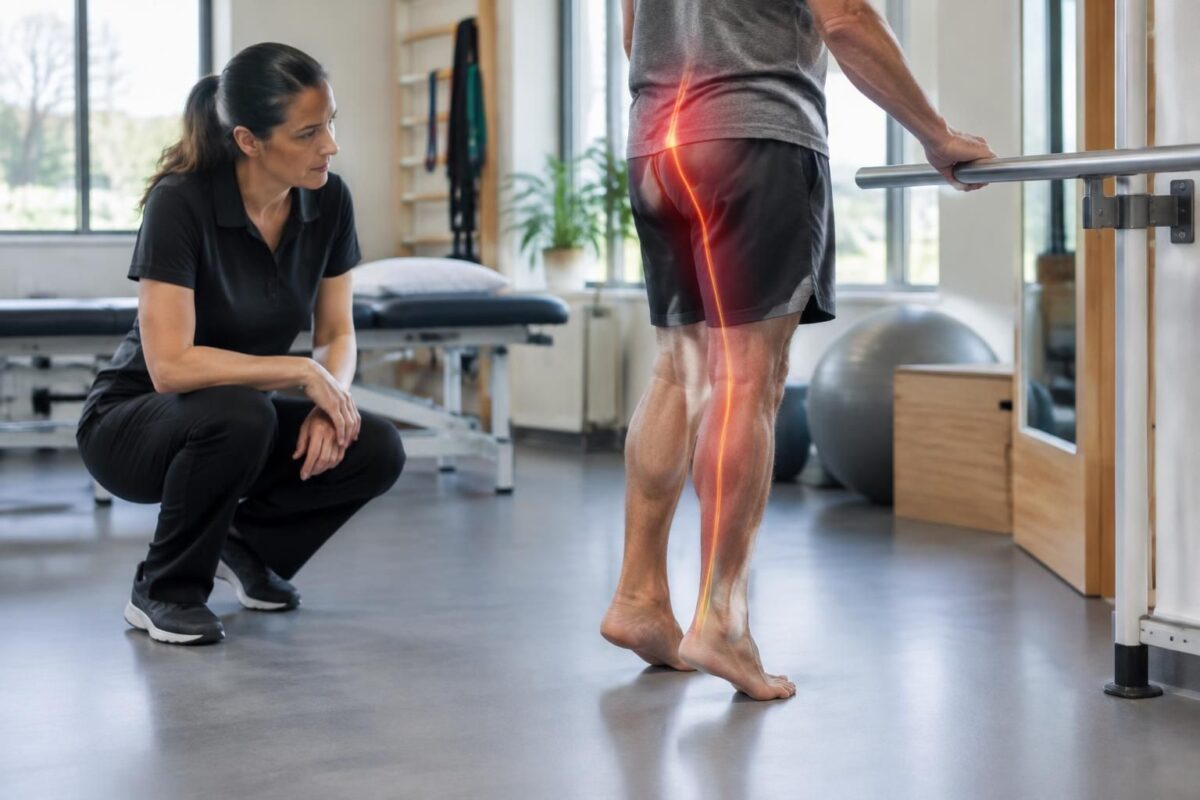
Sciatica in Terrebonne: S1 and difficulty standing on tiptoe
IN SHORT An S1 sciatica can irritate the nerve root associated with the calf and make it difficult to rise onto the balls of the feet. This sign should be evaluated with strength, sensitivity, reflexes, and walking: the pathway of…

Sciatica in Terrebonne: L4-L5 and pain towards the top of the foot
IN BRIEF A L4-L5 sciatica can radiate to the outer side of the leg and the top of the foot, sometimes reaching the big toe. This pathway can guide the assessment, though it does not suffice to confirm the cause:…
Signs, Symptoms, and Diagnosis
Typical characteristics include pain described as burning, throbbing, or resembling electric shocks, worsened by sitting or certain efforts. Paresthesias (tingling sensation) and sometimes muscle weakness may accompany the pain. Neurological signs such as decreased strength or reflexes require prompt evaluation. Diagnosis relies on history taking and clinical examination; imaging is considered if symptoms persist or worsen, or if there are evolving neurological signs.

Sciatica in Terrebonne: L5-S1 and symptoms in the calf
IN BRIEF A L5-S1 sciatica can cause pain that radiates down the calf, sometimes accompanied by tingling, numbness, or weakness. At Terrebonne, an assessment at the TAGMED Clinic helps to examine the symptom pathways, strength, and sensitivity, and then discuss…

Sciatica in Terrebonne: pain in the big toe, L5 root or another cause?
IN BRIEF Pain in the big toe accompanied by pain in the buttock or leg may be compatible with irritation of the L5 root, but other causes are possible. In Terrebonne, the evaluation notably compares strength, sensitivity, and gait to…
Acute Pain vs Persistent Pain
Acute pain appears suddenly after exertion and may last from a few days to a few weeks. It often evolves towards improvement with appropriate activity, physical therapy, and symptomatic treatments. Persistent pain lasts more than 3 months and requires a thorough assessment and a multidisciplinary approach (targeted rehabilitation, possible further investigations, and non-surgical options). In some cases, surgery may be considered if significant neurological deficits persist despite proper management.

Sciatica in Terrebonne: why the affected root changes the pain path
IN BRIEF Sciatica is a pain related to the irritation of a lumbar nerve root, the path of which varies depending on the affected root. Damage to L5 can radiate to the top of the foot, while damage to S1…

Sciatica in Terrebonne: L4-L5 disc, L5-S1 disc, and leg pain
IN BRIEF Sciatica is pain that travels down the leg when a nerve root is irritated. An injury to the L4-L5 disc often affects the L5 root; an L5-S1 injury affects the S1 root. The path of the pain and…
Recommended Conservative Approach in Terrebonne
For typical unilateral pain, the goal is to avoid prolonged rest and to favor appropriate activity and targeted rehabilitation. Key focuses include:
– Physical therapy and progressive exercises to restore mobility and strengthen the trunk and legs.
– Advice on posture and integrating regular physical activities into daily life.
– Management of inflammation with symptomatic treatments and, if necessary, targeted non-surgical interventions to reduce inflammation around the nerve.
– Possible complementary approaches such as specific osteopathy or other manual therapies based on evaluation.
– Options like motorized neurovertebral decompression may be discussed for certain selected patients based on examination results.
When to Consider Surgery
Surgery is rarely necessary and is considered when neurological deficit progresses or when pain persists despite well-managed conservative treatment. An informed and shared decision with a specialist is essential after a comprehensive evaluation.

Sciatica in Terrebonne: understanding lumbar levels on an MRI
IN BRIEF Sciatica may be related to irritation of a lumbar nerve root. A lumbar MRI shows the disks and nerves at different levels, such as L4-L5 or L5-S1, to help identify an abnormality and compare it with symptoms. In…

Sciatica L4-L5 in Terrebonne: possible pain, numbness, and weakness
IN BRIEF L4-L5 sciatica refers to pain related to irritation of a nerve root in the lower back. It can radiate to the buttock and leg, with numbness or weakness. Identifying these symptoms helps guide evaluation and care. In Terrebonne,…
Preventing Recurrences and Optimizing Daily Life
To reduce the risk of recurrence, adopt a regular and appropriate physical activity, strengthen the trunk muscles, work on posture, and take active breaks if sitting for long periods. A structured and personalized approach, focused on mobility and prevention, allows for a quick return to walking and daily activities without unnecessary surgery.
| Item | Quick Interpretation |
|---|---|
| Probable Origin | Lumbar route → buttock/leg; sciatic nerve irritated or compressed (L5-S1). |
| Pain Nature | Acute or persistent; acute calms down in weeks, persistent (>3 months) requires assessment. |
| Associated Signs | Burning pain or electric shocks; paresthesias and possible weakness. |
| Emergency Signs | Loss of urinary/bowel control, saddle anesthesia, rapid weakness; fever. |
| Diagnostics and Imaging | Imaging (MRI/CT) if persistence >6 weeks or deficit; otherwise clinical evaluation. |
| Initial Management | Appropriate activity, physical therapy, anti-inflammatories; avoid prolonged rest. |
| Non-Surgical Options | Osteopathy and manual therapies; targeted injections if necessary; multimodal approach. |
| When Surgery | Rare; evolving deficit or refractory pain after conservative treatment. |
| Prevention and Return to Activity | Regular activity, trunk strengthening, postural education; personalized plan. |
Testimonials: Pain in One Leg – Possible Sciatica in Terrebonne
Caroline, 39 years old — Terrebonne
I experienced sciatica in one leg, starting from the lower back and radiating to the buttock and leg. After a quick evaluation, the plan focused on physical therapy and posture advice allowed me to see a significant reduction in pain within a few weeks, with a gradual return to my activities without surgery.
Marc, 52 years old — Terrebonne
For several months, my sciatica persisted in one leg. The non-surgical treatment, focused on strengthening, posture, and physical therapy, improved my walking and reduced painful episodes. I feel better prepared to prevent recurrences.
Lise, 63 years old — Terrebonne
My lower back pain radiating to the leg was sometimes debilitating. Thanks to targeted rehabilitation and a specific osteopathy approach, I regained my daily activities and discomfort significantly decreased.
Julien, 28 years old — Terrebonne
After exertion at work, I suffered from acute sciatica in one leg. Simple and progressive exercises, followed by a gradual return to my activities, allowed me to get back to work quickly and avoid movements that worsen the pain.
Nadia, 45 years old — Terrebonne
Persistent episode related to sciatica and arthritis. A combined approach including physical therapy, osteopathy, and posture advice reduced crises and improved my quality of life without resorting to heavy interventions.
Dr Sylvain Desforges, expert in osteopathy, naturopathy, and manual medicine, is the founder and president of TAGMED clinics and the ACMA association. His career is guided by a desire for innovation in health and a particular focus on chronic pain in the spine, especially when the pain radiates down one leg. As a dedicated osteopath, he favors an integrated approach that combines traditional knowledge and advanced technologies to improve the mobility and well-being of patients in Terrebonne and the surrounding areas.
Graduated and practicing from a evidence-based perspective, Dr Desforges combines a background in B.Sc., D.O., N.D. with a clinical practice that emphasizes non-surgical management when possible. His approach to sciatica involves understanding the painful trajectory, functional profile, and neurological signs to differentiate radicular pain from simple referred back pain. This distinction immediately guides the care plan, aimed at achieving sustainable pain reduction, restoring mobility, and preventing recurrences.
When a patient presents with unilateral sciatica in Terrebonne, his assessment begins with a thorough history and a targeted neurological examination. The physician informs about common causes, such as irritation or compression of a lumbar nerve root, and highlights the role of mechanical and postural factors. The goal is to provide a progressive management plan that includes postural advice, tailored physiotherapy exercises, and regular physical activity to quickly restore function and avoid falls into recurrences.
For cases where pain persists or worsens despite initial measures, Dr Desforges offers a range of non-surgical and targeted solutions. He can combine specific osteopathy with sessions of physiotherapy, motorized neurovertebral decompression techniques, and complementary therapies such as laser or shock wave therapies, in order to reduce inflammation and promote a return to walking and daily activities. This all fits into a personalized and evolving pathway based on the patient’s progress.
The practice is based on a multidisciplinary framework and the measured use of technologies to monitor progress and adjust treatment. Through the TAGMED Clinic, Dr Desforges strives to create a local network where resources are mobilized in a coordinated manner for the prevention of recurrences, strengthening core muscles, and improving posture. His commitment is to provide effective and safe care tailored to the active lives of residents in Terrebonne and the region, transforming unilateral pain into active and sustainable recovery.
Beyond symptoms, Dr Sylvain Desforges places each patient at the center of their journey, explains options, and supports informed choices between rehabilitation, complementary therapies, and, if necessary, referral to specialized investigations or interventions. His approach aims to optimize quality of life and ensure a rapid and safe return to daily activities, even in cases of unilateral pain that can threaten everyday life and autonomy.
This text presents a clear summary on pain in one leg that may correspond to sciatica in Terrebonne, emphasizing management choices, warning signals, and non-surgical options, to facilitate a quick return to activity.
Within the context of Terrebonne, sciatica can manifest as pain corresponding to pain in one leg, reflecting irritation or compression of a lumbar nerve root, most often L5 or S1. The painful trajectory may start at the lower back and radiate to the buttock, thigh, and leg, down to the foot. In practice, an acute pain of rapid onset is distinguished from a persistent pain that can evolve into chronic radiculopathy; this distinction guides the therapeutic plan and recovery prospects.
The initial management relies on conservative quick measures: maintaining a tolerated activity, targeted rehabilitation (physiotherapy), strengthening, and working on posture. Symptomatic treatments may be proposed and, depending on the evaluation, complementary approaches such as osteopathy or motorized neurovertebral decompression can be considered as part of a comprehensive non-surgical plan. For more in-depth information, check these local resources: burning pain in the leg – is it sciatica in Terrebonne?, when the pain is stronger in the leg than in the back, and The sciatica solution.
If the pain persists beyond a few weeks or is accompanied by neurological signs (weakness, significant numbness, loss of bladder control), a more thorough assessment is useful and may include imaging and multidisciplinary evaluations. In this context, the goal is to restore mobility, reduce inflammation, and prevent recurrences, with a clear preference for non-surgical options when possible.
Surgery is considered only in rare cases: progressive neurological deficit, refractory pain after a well-conducted conservative plan, or emergency situations. Possible interventions (discectomy, decompression) are discussed after a specialized evaluation and taking into account the local context in Terrebonne.
To enhance your understanding and guide your journey, you can explore additional resources such as Herniated disc and sciatica – why the pain goes down the leg and Sciatica and herniated disc – understanding the link. Other useful resources on sciatica and associated pains in the area: sciatic pain, leg pain and sciatica, and pains and ailments.
For specific cases in Montreal or for assessments from a local network, resources like sciatica in Montreal — foot pain, numbness, and tingling can be helpful, while integrating into a coordinated approach with your professional in Terrebonne.
Lastly, for practical guidance and tailored care, contact TAGMED and explore the proposed solutions: The sciatica solution and related resources that lead to a quick assessment, a personalized care plan, and informed choices regarding mobility and comfort.

Dr Sylvain Desforges, B.Sc., D.O., N.D., osteopath, is the founding president of TAGMED and of the ACMA association. He dedicates his practice to chronic spinal pain, low back pain and symptoms compatible with sciatica, particularly when pain radiates toward the buttock, leg, calf, foot or toes.
Through SOS Sciatique, he publishes educational content on sciatica symptoms, possible causes such as disc herniation, disc narrowing, foraminal stenosis or irritation of a lumbar nerve root, as well as non-surgical approaches that may be considered according to the evaluation. At Clinique TAGMED, care may include, depending on the case, motorized neurovertebral decompression, specific osteopathic care or precision percussion.
For an evaluation related to sciatica treatment in Montreal / Mount Royal or sciatica treatment in Terrebonne, please consult the services available at Clinique TAGMED.
Medical disclaimer
The information published on SOS Sciatique is provided for educational purposes only and does not replace a consultation, diagnosis, opinion or treatment provided by a physician or another authorized healthcare professional. The author of this article is neither a medical doctor nor a specialist in a medical specialty recognized by the Collège des médecins du Québec. The osteopathic, manual medicine or functional support approaches described on this site do not constitute medical acts and are not intended to replace medical follow-up.
Consult a physician or emergency service in cases of loss of bladder or bowel control, anesthesia in the saddle area, significant or progressive weakness in the leg or foot, fever, recent trauma, severe pain or rapid worsening of symptoms. For more details, please read our Legal Notice.


