Sciatica and road vibrations: possible influence on symptoms
24/08/2026
Sciatic pain in Terrebonne: calf, heel or outer edge of the foot?
25/08/2026
IN BRIEF
| In summary, sciatica is pain that radiates from the lower back and can descend into the buttock and leg, sometimes reaching the calf, heel, or outer edge of the foot, due to irritation or compression of a lumbar nerve root. Symptoms include pain, paresthesia, numbness, or weakness. Non-surgical approaches, such as osteopathy, physiotherapy, and, if necessary, motorized neurovertebral decompression, allow for a functional recovery tailored to each patient. In Montreal, this service is particularly recommended for individuals experiencing pain radiating down the leg and seeking a non-invasive and personalized solution, with benefits for mobility and pain without resorting to surgery when possible. |
Sciatica in Montreal can radiate from the lower back to the calf, heel, or outer edge of the foot. The exact pathway depends on which nerve roots are affected: involvement of the L5 roots is often associated with symptoms that can reach the big toe and rise to the foot, whereas involvement of S1 is more frequently accompanied by pain that targets the heel and the outer edge of the foot. Paresthesia, numbness, and sometimes muscle weakness can accompany this pain, and its intensity varies with movements and positions.
To obtain a diagnosis and treatment plan suitable for Montreal, a specialized assessment can guide an effective non-surgical approach, including specific osteopathic techniques.
Quick summary: this article, written by a healthcare professional, explains how to recognize sciatica in Montreal, and how the pathway of pain towards the calf, heel, or outer edge of the foot helps clarify its origin. You will find common causes, signs to watch for, and non-surgical management options offered at Clinique TAGMED in Montreal/Terrebonne.
Sciatica describes irritation or compression of the sciatic nerve. It can radiate from the lower back, the buttock, and then descend into the leg, down to the calf, heel, or outer edge of the foot, depending on which nerve root is involved. The exact pathway helps guide the assessment and the choice of treatment, while remaining under medical supervision. In Montreal, non-surgical approaches exist and can be tailored to your profile at Clinique TAGMED.
Understanding the pathway and signs
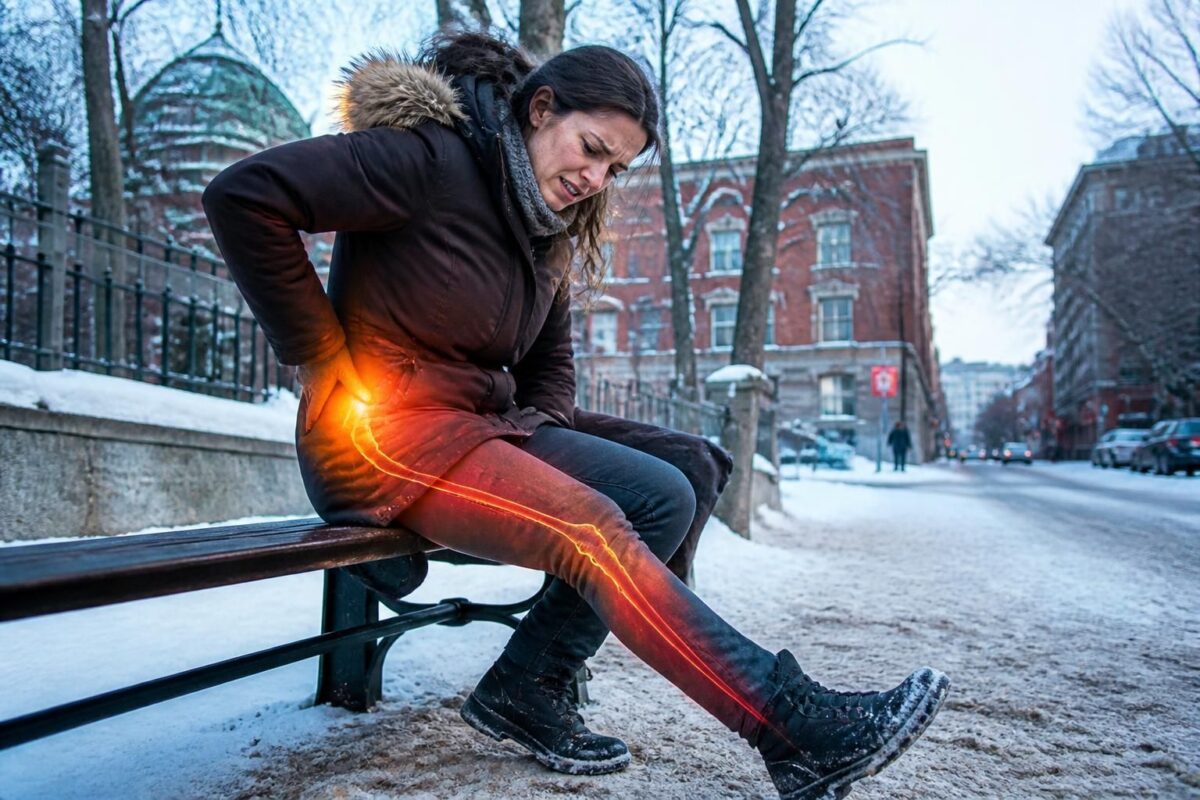
The sciatic nerve is the longest in the body and ensures part of the sensation and movement of the lower limbs. Pain that radiates towards the calf or the outer edge of the foot may indicate irritation of a lumbar root, often L5 or S1, but the exact pathway varies based on the affected root. Symptoms such as burning, electrical shocks, tingling or paresthesia in the foot reinforce the notion of nerve compression rather than purely muscular pain.
Important signs to watch for: pain that worsens in a sitting position, pain present even at rest, or the appearance of weakness or loss of strength in the leg. In case of distal numbness or pain that descends lower than the knee, a medical evaluation is recommended quickly. Additional information on the typical pathway and its variations is available in the following resources: Sciatica in Montreal – difficulty walking on heels or toes, Sciatica in Terrebonne – stronger pain in the leg, Sciatica and pain in the leg greater than in the back, and Understanding the pathway.
Common causes and true vs false sciatica distinction
There are two main categories:
- True sciatica: a compression or irritation of the sciatic nerve at the level of the spine. The main cause is often a herniated disc or a bulging/protruding disc that reduces the space around the nerve root.
- Sciatalgia or false sciatica: a peripheral compression of the sciatic nerve by contraction of the piriformis muscle, sometimes associated with anatomical variations. This form is less frequent than objectively verifiable lumbar causes.
Other possible mechanisms include lumbar osteoarthritis, vertebral trauma, or foraminal/spinal stenosis that can limit walking and provoke symptoms in the leg. For more information, you can consult specialized resources on the subject: Herniated disc and chronic sciatica, and Sciatica – pain in the leg vs back.
Treatment options and management in Montreal
Several approaches exist to relieve sciatica pain, without immediately resorting to surgery. Depending on the assessment, non-invasive options may include motorized neurovertebral decompression, specific osteopathy, and the use of a precision impactor to target precisely identified mechanical dysfunctions. These treatments can be offered at Clinique TAGMED in Montreal or Terrebonne. Please note that treatments such as medical laser or shockwave therapies are not part of the offering for back pain and sciatica in this practice.
For more information on non-surgical approaches and their relative outcomes, see the following resources: Sciatica in Montreal – heels, Sciatica in Terrebonne – leg, Pathway to the foot. For a clinical framework, the TAGMED Clinic page presents the modalities and typical fees: TAGMED Clinic.
When to Consult and How to Evaluate
Consult when the pain persists, frequently recurs, descends below the knee, interferes with walking, or is accompanied by numbness, weakness, or loss of function. Warning signs require prompt evaluation, including loss of bowel or bladder control, saddle anesthesia, fever, trauma, or rapidly worsening pain.
Resources and Practical Care
For a coordinated approach in Montreal or Terrebonne, seeking the TAGMED Clinic allows for a specific osteopathic evaluation and tailored non-surgical techniques. The typical fee is around $140 per consultation or treatment, and osteopathy receipts may be reimbursed by some private insurers. For more information, visit TAGMED Clinic.
The pathway of pain should be interpreted along with the complete symptom picture. To delve deeper into the topic, check the following pages on the mechanisms and pathways of sciatic pain: Sciatica – leg vs back, Sciatica and foot pain, and Understanding the pathway to the foot.
Note: for technical aspects and options for decompression or manipulation, professional references and osteopathy training institutions are limited to NUMSS, NAO, National University of Medical Sciences and National Academy of Osteopathy, and professional organizations include ACMA, College of Canadian Osteopaths, and the Canadian Osteopaths College. For more information on these approaches and their framework, prioritize official sources in the mentioned fields.
If you have any questions regarding sciatic pain and the symptom pathway, feel free to consult your qualified osteopath at May’Ostéo and make an appointment online.
Medical Disclaimer: The information and advice provided on this site do not replace the opinion, diagnosis, or treatment of a health professional. Please note that Dr. Sylvain Desforges, osteopath is neither a doctor of medicine nor a physician, and is not a specialist in any medical specialty as defined by the Collège des médecins du Québec. Manual medicine, functional medicine, and sports medicine as described on this site exclude any treatment or medical diagnosis made by a doctor or medical specialist. Always consult your physician for any medical questions. For more details, please read our full Legal Notice.
- Big toe → L5: typical pathway buttock → thigh → knee → leg → top of foot
- Outer edge of the foot and heel → S1: pathway buttock → back of thigh → back of calf → heel → arch of the foot → outer edge of the foot → last toes
- For calf and heel, symptoms point to S1
- For big toe, symptoms point to L5
- Warning signs: marked weakness, loss of sensitivity, neuromuscular disorders, fever — prompt consultation recommended

The sciatic pain can affect the calf, heel, or outer edge of the foot and results from irritation or compression of the sciatic nerve. This article outlines the distinctions between true sciatica and sciatalgia, describes the typical pathway and associated signs, then presents non-surgical care options available in Montreal. You will find practical advice to guide your assessment and care pathway, with a tailored and non-surgical approach.
Understanding the Pathway and Location
The sciatic nerve is the longest in the body and provides part of the sensation and movement of the lower limbs. Pain can originate from the lower back or buttock and travel down to the calf, heel, or outer edge of the foot. The pathway varies depending on the affected root. Thus, damage to L5 may extend to the big toe, while S1 may involve the heel and back of the foot. This location guides evaluation and therapeutic choices and helps distinguish lumbar causes from peripheral ones.
Common Causes
True Sciatica
The main cause is compression or irritation at the lumbar level, often related to a herniated disc or disc bulge that reduces the space around the nerve root. Other factors such as osteoarthritis, trauma, or inflammation can also trigger this type of pain that radiates down the leg.
Sciatalgia or Piriformis Syndrome
In some cases, the pain originates from a contraction of the piriformis muscle in the pelvis, with anatomical variations that can increase the risk of compression. This peripheral form is sometimes more responsive to targeted approaches such as osteopathy and manual therapy.
Treatment Options and Recommendations in Montreal
Several non-invasive approaches can relieve sciatic pain and restore mobility without resorting to surgery. Motorized neurovertebral decompression may be considered when mechanical stress affects the discs and nerve roots. Specific osteopathy aims to release muscle and joint tension and restore alignment. The precision pummeler can be used specifically to correct mechanical dysfunctions. A coordinated approach with the treating physician is recommended, particularly if analgesics or anti-inflammatories are being considered. Physiotherapy complements this care by strengthening the back and stabilizing muscles and working on the piriformis muscle.
Note that some aggressive or poorly suited stretches can worsen the pain; professional evaluation helps identify safe and effective exercises based on your profile.
When to Consult and Warning Signs
Consult quickly if the pain is accompanied by weakness, progressive numbness, loss of urinary or bowel control, fever, recent trauma, or rapidly worsening pain. Pain that travels lower in the leg and is accompanied by paresthesias deserves thorough evaluation to guide treatment and avoid complications.
In Montreal, benefit from a personalized evaluation and explore non-surgical options suited to your context. Make an appointment with a specialized osteopath to build your care plan.
| Element | Concise Interpretation |
|---|---|
| Location | Depending on the path, may reflect sciatic involvement (L5/S1 or L4-L5). |
| Associated Signs | Lower back/gluteal pain and possible paresthesias along the leg. |
| Suspected Root | L5 or S1, sometimes L4-L5 depending on the extent. |
| Typical Path | Calf and big toe for L5; heel and outer edge of the foot for S1. |
| Feelings | Burning, electric shock, tingling, or numbness. |
| Functional Impact | Possibility of altered walking and weakness depending on severity. |
| Urgency and Monitoring | Urgency if loss of urinary/bowel control, marked weakness, or fever. |
| Recommended Approaches | Appropriate osteopathic evaluation and non-surgical management. |
For several months, my sciatic pain extended from my lower back to my calf. In Montreal, I consulted a specialized osteopath and, after a few targeted sessions, the pain significantly decreased and I regained my normal walking.
This pain primarily came from the heel. It woke me up several nights and worsened when I sat too long. After receiving osteopathic care in Montreal, the sessions relaxed my muscles and the pain gradually disappeared.
My discomfort was concentrated on the outer edge of the foot and the glute. The osteopathic assessment conducted in Montreal identified the epicenter, and with precise techniques, I quickly regained mobility and experienced less paresthesia.
Tingling, electric sensations, and heaviness in the leg accompanied me daily. The pain’s path was typical of sciatica and was relieved by a personalized osteopathic approach in Montreal, targeting not only the nerve but also the surrounding muscles.
If you suffer from sciatic pain that travels down the leg, especially towards the calf, heel, or outer edge of the foot, do not hesitate to make an appointment with an osteopath in Montreal. The results speak for themselves, and you can consider a smooth return to your activities.
Dr. Sylvain Desforges, osteopath and expert in manual medicine and naturopathy, is the founding president of TAGMED clinics and the ACMA association. His professional journey is driven by a sustainable success in the healthcare field, with particular attention to chronic pain of the spine and lumbar pain associated with symptoms radiating to the glute, leg, calf, or foot. His work extends across the Montreal area, favoring non-invasive and patient-centered approaches.
In his approach, osteopathy unfolds within a global framework that combines manual sciences with innovative technologies. Dr. Desforges integrates tools such as motorized neurovertebral decompression, the precision pummeler, and other non-surgical interventions to address muscle tension and joint restrictions that may contribute to sciatic pain. The goal is to reduce stress on the nerve roots and restore fluid mobility of the spine while respecting the individual capacities of each patient.
Alongside his clinical activity, Dr. Desforges leads educational resources aimed at better understanding sciatica and its manifestations. He enlightens patients on possible causes, such as herniated discs, compression, or foraminal stenosis, and on non-surgical options suited to evaluation. His aim is to provide clear and actionable information so that everyone can actively participate in their care journey in Montreal and its surroundings.
Dr. Desforges’s philosophy is based on a evidence-based and patient-centered approach. During each consultation, he seeks to clarify the pain path, associated symptoms, and aggravating factors in order to develop a personalized plan. The goal is to regain full and pain-free mobility while minimizing the risk of recurrence. For pains that travel down the calf, heel, or outer edge of the foot, he prioritizes a gradual approach tailored to each individual’s age, lifestyle, and bodily resources.
Throughout his practice in Montreal and at TAGMED clinics, Dr. Desforges highlights non-invasive options as a pillar of managing sciatic pain. His commitment translates into a clear and accessible offering that combines targeted evaluation, personalized treatments, and functional advice, enabling everyone to achieve smoother walking, freer posture, and a regained quality of life, sustainably.
This conclusion summarizes the key points of sciatica in Montreal, particularly when the pain extends down to the calf, the heel, or the outer edge of the foot. It reminds that the pathway of the pain and the neurological signs guide the assessment and choice of available non-surgical treatments, including osteopathy and physiotherapy. It also guides you on the signals that require prompt consultation and offers resources for further exploration.
The trajectory of the pain is crucial: pain that starts from the lower back or buttock and radiates towards the calf may involve irritation of the lumbar roots, especially when the signs affect the outer edge of the foot or the heel. A path towards the big toe typically suggests an L5 origin, while pain reaching the heel points more towards S1. Understanding this pathway helps differentiate lumbar causes from peripheral issues and target the appropriate treatment.
There are typical causes to consider: a herniated disc or bulging disc can compress nerve roots and trigger pain radiating in the leg. Sciatica can also stem from a disco-root conflict, foraminal stenosis, or other spinal issues. Conversely, peripheral pain associated with the piriformis may give a “false” sciatica sensation without major disc involvement. To delve into these mechanisms, you can consult specialized resources like this reference on osteopathy or link on sciatica S1.
In the face of pain that descends towards the calf, the outer edge of the foot, or the heel, it is essential to evaluate muscle strength, sensitivity, and tolerance to daily activities. Warning signs such as progressive weakness, extensive paresthesias, or loss of urinary control require prompt management and generally a thorough medical evaluation. To better understand the importance of neurological assessment in this context, refer to dedicated resources like neurological assessment in case of sciatica pain and sciatica pain – overview.
Regarding treatment options, a non-surgical approach is often effective when the assessment identifies a reversible mechanical cause. Techniques like motorized neurovertbral decompression and specific osteopathy can be proposed based on individual assessment, with optimized results when movements are adapted to the patient’s mobility and tolerance. To learn more about non-invasive approaches suitable for sciatica in Montreal, you can consult relevant pages like Sciatica S1 and heel pain.
For those wishing to deepen the available knowledge, here are useful resources to consult: PodExpert – neuro-sciatica pathology and foot pain, Sciatica and calf pain after driving, Sciatica in Montreal – deep buttock pain and irradiation in the thigh, Neurological assessment in sciatica pain, Osteopathy – definition and treatments, Sciatica S1, Sciatica pain, Sciatica in Terrebonne – foot pain and tingling, Sciatica in Terrebonne – pain from the lower back to the leg, Heel pain – TAGMED Clinic.

Sciatica in Montreal: nighttime pain in the leg
IN BRIEF In brief, nocturnal sciatica is a root pain in the lower back that irritates the sciatic nerve and worsens when lying down, causing nighttime awakenings. In Montreal, this service offers a non-surgical approach focused on posture, bedding, and…

Sciatica in Montreal: pain from the lower back to the calf
IN BRIEF In brief, sciatica is a pain that starts in the lower back and can radiate down to the calf, caused by irritation or compression of the sciatic nerve. In Montreal, this service offers a personalized evaluation and non-surgical…

Sciatica in Montreal: hip pain or true nerve radiation?
IN BRIEF Sciatica is a nerve pain that follows the path of the sciatic nerve and can radiate from the buttock to the foot, which can be perceived as pain in the hip. Lower back pain, on the other hand,…

Sciatica pain in Montreal: incomplete journey, should we be concerned?
IN BRIEF In brief, sciatic pain is a lumbar nerve-origin pain whose pathway may be incomplete and may not reach the foot. In Montreal, the evaluation clarifies the pathway, strength, and function, and determines if imaging can change the approach.…
Sciatica in Montreal: pain towards the little toe and S1 root
IN BRIEF Sciatica is pain radiating along the path of the sciatic nerve, typically from the lower back to the leg and down to the little toe when the S1 root is irritated or compressed. In Montreal, this phenomenon is…

Sciatica in Montreal: pain towards the top of the foot and L5 root
IN BRIEF Sciatica in Montreal with pain in the top of the foot and a possible involvement of the L5 root is a lumbar radiculopathy where the pain follows the path of the sciatic nerve to the dorsum of the…

Sciatica in Montreal: pain radiating to the outer edge of the foot
IN BRIEF In brief, sciatica is pain that follows the path of the sciatic nerve, starting from the lower back and extending down to the foot, often radiating to the outer edge of the foot. In Montreal, this condition is…

Sciatica in Montreal: pain in the buttock after a long sitting position
IN BRIEF In brief, sciatalgia is pain that follows the path of the sciatic nerve, often triggered after a prolonged sitting position and lumbar irritation. In Montreal, this issue is mainly managed without surgery thanks to a careful diagnosis and…

Dr Sylvain Desforges, B.Sc., D.O., N.D., osteopath, is the founding president of TAGMED and of the ACMA association. He dedicates his practice to chronic spinal pain, low back pain and symptoms compatible with sciatica, particularly when pain radiates toward the buttock, leg, calf, foot or toes.
Through SOS Sciatique, he publishes educational content on sciatica symptoms, possible causes such as disc herniation, disc narrowing, foraminal stenosis or irritation of a lumbar nerve root, as well as non-surgical approaches that may be considered according to the evaluation. At Clinique TAGMED, care may include, depending on the case, motorized neurovertebral decompression, specific osteopathic care or precision percussion.
For an evaluation related to sciatica treatment in Montreal / Mount Royal or sciatica treatment in Terrebonne, please consult the services available at Clinique TAGMED.
Medical disclaimer
The information published on SOS Sciatique is provided for educational purposes only and does not replace a consultation, diagnosis, opinion or treatment provided by a physician or another authorized healthcare professional. The author of this article is neither a medical doctor nor a specialist in a medical specialty recognized by the Collège des médecins du Québec. The osteopathic, manual medicine or functional support approaches described on this site do not constitute medical acts and are not intended to replace medical follow-up.
Consult a physician or emergency service in cases of loss of bladder or bowel control, anesthesia in the saddle area, significant or progressive weakness in the leg or foot, fever, recent trauma, severe pain or rapid worsening of symptoms. For more details, please read our Legal Notice.