Herniated disc and stretches: why some movements worsen
31/08/2026
Numbness in the leg and sciatica in Montreal: what should be checked?
01/09/2026
IN BRIEF
| In brief, sciatica related to trips by bus is pain that follows the sciatic nerve, worsened by seated position and vibrations during the journey. The benefits of a tailored approach include improved posture, reduced pressure on the tailbone and lower back, and decreased pain during travel. The functionality relies on better relief of the coccyx and effective shock absorption through an ergonomic cushion and proper seat adjustment, which limits irritation of the sciatic nerve. In Paris and Île-de-France, this results in more comfortable bus trips and less daily discomfort. |
Sciatica can manifest or worsen during trips by bus or coach due to vibrations and prolonged seating. The sciatic nerve runs from the lower back down to the leg; jolts and pressure on the pelvis can intensify pain. To limit discomfort, prioritize a correct posture, adjust the seat, and take breaks when possible. A lumbar support or an ergonomic cushion can help relieve the coccyx and absorb shocks, making bus rides more bearable.
Quick summary: Sciatic pain can intensify during bus trips due to vibrations, prolonged seating, and poor seat adjustment. An adapted posture, an ergonomic cushion, and regular breaks can help limit pressure on the sciatic nerve and improve comfort. This article presents the mechanisms, simple gestures, and useful accessory choices for traveling by bus with less pain.
Understanding the mechanisms that aggravate sciatica on the bus
Sciatic pain follows the path of the sciatic nerve, from the lower back to the leg. On a bus, prolonged seating increases pressure on the pelvis and coccyx, which can irritate the sciatic nerve. The vibrations and micro-jolts from the road reinforce these tensions and worsen pain in the leg. To limit these effects, one must act on the seating, posture, and vibration absorption.
Adjusting seating and position during the trip
Choose a seat that provides lumbar support and avoid overly soft seats that encourage pelvic sinking. The backrest should be slightly tilted backward to allow a comfortable opening between the torso and legs. Using a firm postural cushion can help elevate the pelvis and relieve the coccyx. A relief for the coccyx helps reduce pressure on the sacrum and lower back, thus limiting tension on the sciatic nerve. Finally, opt for an accessory that offers good shock absorption and vibration dampening.
To understand the links between seating and pain, you can check dedicated resources on the effects of seated position and vibrations.
To delve into practical aspects of seating and ergonomics in motion, see this article on the influence of seated position: Sciatica and seated position.
Trip management and practical tips
Plan trips with breaks when possible. While stopped, gently move your feet and ankles to improve blood circulation. Simple micro-movements can help break the monotony of the position and relieve pressure on the sciatic nerve. If the trip is long, alternate between sitting and, when safety allows, standing briefly to walk in the aisle.
In case of increased pain during a trip, prioritize simple and quickly mobilizable solutions. For more information on the links between vibrations, seating, and pain during trips, consult dedicated resources such as: Sciatica and vibrations in seated position.
Choosing cushions and accessories for the bus
An appropriate ergonomic cushion can act on three levers: posture, relief of the coccyx, and shock absorption. Look for a firm model, thicker at the back, that allows slight elevation of the pelvis and provides coccyx relief to limit pressure on the sacrum. Shock absorption is crucial because repeated jolts can amplify pain if there is no good dissipation of vibrations.
As part of a practical choice, you can discover options and advice related to the use of orthopedic cushions during public transport trips through dedicated resources, including practical sheets and guides.
To deepen the comparison between available approaches and solutions, check resources such as: Sciatica and public transport – prolonged seated position and Sciatica and traffic jams – immobile position and nerve pain.
Clinical options and associated resources
If pain persists, it is useful to discuss available options with a healthcare professional. Some facilities offer clinical solutions tailored to travel and urban environments. To find advice and services near you, you can refer to the authoritative resources in the field, including exchanges and guides provided by TAGMED and other specialized clinics.
For additional information on care options in Montreal or the surrounding area, you can inquire at TAGMED clinic: TAGMED Clinic.
To learn more about specific aspects and available options, resources on dedicated websites for sciatic pain and transport can be consulted, including those listed below: Sciatica and car and Driving and sciatica.
Additional useful links to specialized resources for guidance on sciatic pain and transport trips: Herniated disc and trips and Sciatic pain resources.
Medical disclaimer: The information and advice provided on this site do not replace the opinion, diagnosis, or treatment of a healthcare professional. Please note that Dr. Sylvain Desforges, osteopath, is neither a medical doctor nor a physician, and is not a specialist in a medical specialty as defined by the Collège des médecins du Québec. Manual medicine, functional medicine, and sports medicine as described on this site exclude any treatment or medical diagnosis made by a physician or specialist. Always consult your doctor for any medical questions. For more details, please read our complete Legal Notice.
- Bus vibrations: they increase pressure on the sciatic nerve; solution: seat with good absorption and suitable cushion.
- Sitting position: adjust the height and tilt to support the lower back and limit coccygeal pressure.
- Coccyx relief: favor a cushion that relieves the coccyx and sacrum.
- Shock absorption: choose a cushion that dampens micro-vibrations and jolts.
- Break and mobility: stop regularly to walk and stretch during the ride.
- Sciatic pain: monitor signs (pain radiating down the leg, numbness) and adjust at the first symptoms.
- Posture and repositioning: keep the back supported and avoid prolonged positions that increase tension.

Do you regularly take the bus and suffer from sciatic pain that worsens with vibrations and an inadequate seating? This article provides simple and practical recommendations to reduce the impact of bus journeys. With a few adjustments to your seat layout, an improvement in your posture, and the use of a suitable ergonomic cushion, you can limit pain and gain comfort during your travels.
Understanding the effect of vibrations and seating on sciatica
Sciatic pain can be triggered or amplified by the jolts and micro-vibrations typical of bus journeys. When sitting for long periods, pressure on the pelvis and coccyx can increase, improperly releasing the lumbar muscles and irritating the sciatic nerve. The seat’s design plays a key role: an ill-suited support can promote a slumping posture or increased lumbar tension, reinforcing the symptoms.
Vibrations and the sciatic nerve
Repeated vibrations transmit forces down to the lower back. The older or less well-shocked the vehicle, the more the micro-oscillations accentuate the pain. Hence, adopting solutions that mitigate these shocks is an essential step, even when one cannot change buses.
Role of seating and coccyx
A seat that does not adequately relieve the coccyx can cause direct pressure on the sacrum and exacerbate lower back pain. Lasting comfort comes from a seat that supports the lower back, encourages a slight opening between the torso and thighs, and most importantly, relieves the coccyx when sitting for long distances.
Adapting your bus journey
Choosing and adjusting the seat
Prefer an ergonomic cushion designed to smooth out pressure points and absorb vibrations. Look for models that are thicker at the back, which promote a slight elevation of the pelvis and better posture. A coccyx-relieving cushion and suitable high-load foam can make a real difference during daily commutes.
Good posture and sitting position
Keep your back well supported against the backrest and avoid leaning forward, which increases lumbar tension. If possible, slightly raise the seat height to align your knees with your hips and avoid unhealthy angles that press on the sciatic nerve.
Breaks and micro-movements
During longer journeys, take small breaks when possible (at each stop or as soon as the bus is stationary). Take the opportunity to stand up, do some leg bends, and trunk rotations to stimulate circulation and reduce stiffness.
Useful exercises and habits
Simple exercises to consider during a journey
When stationary, gently perform a few exercises compatible with safety and the vehicle’s frame: ankle and knee bends, light stretches of the lower back and the back of the thighs. Breathe deeply and relax the shoulders to reduce overall tension.
Proactive pain management
Before and after the journey, consider simple options such as applying gentle heat to the painful area or using breathing techniques to reduce muscle stress. Good hygiene and visual attention to body alignment also facilitate daily bus use.
| Element | Impact and advice |
|---|---|
| Vibrations and buses | Repeated shocks increase pain; prefer a seat that absorbs shocks and suitable suspension. |
| Seating and lumbar support | A firm seat and good lumbar support reduce pressure on the sciatic nerve. |
| Coccyx relief | A cushion with coccyx relief releases the coccyx and sacrum from pressure. |
| Backrest posture | Back supported and slight incline limit lumbar tension. |
| Shock absorption | A suitable support absorbs micro-vibrations and protects the nerve. |
| Pelvis and discs | Slightly raising the pelvis improves the opening between the torso and legs and avoids pinching the discs. |
| Breaks and mobility | Plan breaks every hour to stand up and stretch. |
| Accessories and adjustments | Use ergonomic accessories and adjust the seat for each journey. |
Testimonials: Sciatica, vibrations, and seating in buses
Since I take the bus every day, my sciatica has become my worst nightmare on wheels. The vibrations and the seating of the vehicle worsen the pain that travels from my lower back down to my leg. With an ergonomic cushion placed on the seat, the pressure is better distributed, and I can sit without grimacing at every turn or traffic light.
During my business trips, the sciatic pain follows me like a shadow. The vibrations of the bus and a seat that offers little support made each journey unbearable. I started to prioritize correct posture and use an ergonomic cushion that relieves pressure on the tailbone; since then, the jolts are still there, but they no longer trigger pain.
As a student, my journeys by bus become problematic when the road is uneven. The vibrations and poorly adapted seating trigger a stabbing sciatic pain. A firmer seat cushion and light lumbar support help me keep my back straight and minimize nerve irritation.
My daily commutes by bus were turning into a trial because of my sciatic pain. The vibrations and prolonged sitting position increased the pain. After adding a cushion for sciatica and taking short breaks, I found some peace on the road and less stiffness in the evening.
The trip with my children on the bus was not easy: the vibrations and lack of support from the seating increased the sciatic pain. By installing a lumbar support and an ergonomic cushion, comfort returned, and traffic jams no longer had the same effect on my nerves.
With longer journeys by bus, the sciatica would strike as soon as the vehicle hit the slightest pothole. By improving the seating and using an ergonomic cushion that absorbs vibrations, the pain became more manageable, and stops turned into useful recovery moments rather than jabs of pain.
Dr. Sylvain Desforges is a multidisciplinary practitioner recognized for his integrated approach to health. An expert in osteopathy, naturopathy and manual medicine, he is the founding president of the TAGMED clinics and the ACMA association. His background reflects a constant commitment to innovation in care and chronic pain management, with particular attention to integrating advanced technologies such as spinal decompression, laser and shockwave therapy. His mission is to provide evidence-based care to optimize the health and well-being of his patients, even in everyday contexts like commutes.
In the context of bus travel, he observes how vibrations, the seating and prolonged sitting periods influence sciatica and the associated pain. His work aims to understand how seat configuration, cushioning, and the vehicle’s micro-movements can aggravate or alleviate symptoms, and to propose pragmatic solutions to limit pressure on the sciatic nerve during journeys.
His approach begins with a precise assessment of the patient’s clinical history and daily commutes. He combines posture analysis with evaluation of seat adjustments and lumbar support to provide personalized advice on which positions to adopt and breaks to take. The goal is to prevent tension and reduce constraints on the spine and the sciatic nerve, especially during travel.
To improve comfort in motion, he prioritizes suitable and pragmatic solutions. Using an ergonomic cushion can ensure tailbone relief and better pressure distribution during long, bumpy seats. Shock absorption and vibrations are enhanced by specific materials that limit micro-trauma to the lower back and improve pelvic stability.
At the core of the proposals are also modern therapeutic approaches, used in a targeted and adapted manner. Spinal decompression, laser, and shockwaves are part of a proven and personalized framework to address the causes and manifestations of pain and facilitate a smoother, less painful resumption of travel.
This orientation is part of a desire to make these tools accessible in daily life, beyond the clinic. Public transport and professional trips become spaces where prevention and targeted care play a key role. Emphasis is placed on patient education, self-management, and gradual adaptation of travel habits to limit the long-term establishment of pain.
Dr. Desforges’ journey is also marked by close collaboration with medical teams and manufacturers to improve existing solutions. His evidence-based approach relies on clinical data and experiences gained with patients suffering from sciatica during travel, in order to guide the development of more ergonomic and safer products for daily and professional commuting.
To learn more about his approach and the services available within the structures he oversees, he invites everyone to inquire at the TAGMED clinics and the associative initiatives he supervises, where action plans, prevention programs, and personalized solutions for bus travel and other means of transport can be found.
This text summarizes how bus rides can influence sciatica, with a focus on vibrations, seating and associated pain, and proposes simple and effective solutions to preserve comfort and limit pain throughout the journey.
Impact of Vibrations and Seating on Bus Journeys
The vibrations and jolts on the road transmit directly to the back, pelvis, and sacrum, which can trigger or worsen sciatic pain in some individuals. An ergonomically unsound seat, a seat that is too soft, or an inappropriate tilt increases pressure on the sciatic nerve and may exacerbate symptoms, especially during long trips. To understand the mechanisms and effects of vibrations on symptoms, you can consult specialized resources such as Sciatica and road vibrations.
Adjusting seating and lumbar support for comfort
Choose a seat that provides correct lumbar support and prevents pelvic sagging. An ergonomic seat cushion and, if necessary, a lumbar cushion can improve trunk alignment and reduce muscle tension around the lumbar area and coccyx. A slightly reclined seat back can help maintain a comfortable opening between the torso and thighs and limit pressure on the intervertebral discs, which can decrease irritation of the sciatic nerve. To delve deeper into the causes and aggravating factors in the context of driving and travel, refer to analyses such as those presented on Why journeys can worsen pain.
Practical techniques and habits to adopt during breaks
Plan regular breaks when possible, even on long public transport journeys, to stand up, stretch, and promote blood circulation around the sciatic nerve. When stopped, perform gentle movements of the legs and feet to promote venous return and prevent stiffness. Supplementary resources suggest avoiding certain positions and movements that increase pressure on the nerve pathway, such as overly marked inclines or sudden twists; you can refer to sciatica and positions to avoid to guide your postural habits.
Material solutions and product choices for the journey
To limit pain during travel, prioritize a correct posture and appropriate support. A seat cushion or a lumbar cushion can greatly relieve the coccyx and lumbar areas. Specialized options exist for journeys in public transport and vehicles, including models that combine high-density foam and vibration absorption technologies. To explore concrete solutions, discover dedicated resources such as Sciatica Car — suitable cushions and signs not to ignore in professional driving. Additional information on the mechanisms and vehicle adjustment tips is also available in Health Magazine — Sciatica and car.
Additional resources on the links between lower back pain and mobility in urban and interurban contexts can inform your choices and practices, such as general recommendations regarding driving and journeys, for example on avoiding aggravation during journeys and on Sciatica and walking difficulties.
Sciatica and pain that appears after a few minutes of walking
IN BRIEF Sciatica is a pain that follows the path of a nerve root from the lower back down to the leg. When it appears after a few minutes of walking, it indicates nerve irritation or compression, often due to…

Sciatica and prolonged walking: why does the pain increase?
IN BRIEF In brief, sciatica is pain that follows the path of the sciatic nerve and can intensify during prolonged walking, especially in the presence of lumbar stenosis or a herniated disc. The goal is an active and tailored management…

Sciatica and walking: helpful or aggravating?
IN BRIEF In brief, sciatica and walking is the analysis of whether walking can help or worsen pain related to the sciatic nerve. What is it? Sciatica is pain that radiates from the lower back down the leg, often due…

Sciatica and travel return: pain that travels down the leg
IN SHORT Sciatica is pain that runs down the leg, caused by irritation or compression of the sciatic nerve. In the context of return from travel, it may appear after long trips or repetitive movements. In practice, understanding this mechanism…

Sciatica and travel: how to recognize a worsening
IN BRIEF In brief, sciatica and travel describe the worsening of sciatic pain during a trip, with radiation into the leg and radicular signs. Benefits: it allows for quick identification of warning signs, adjustment of breaks and movements, and traveling…
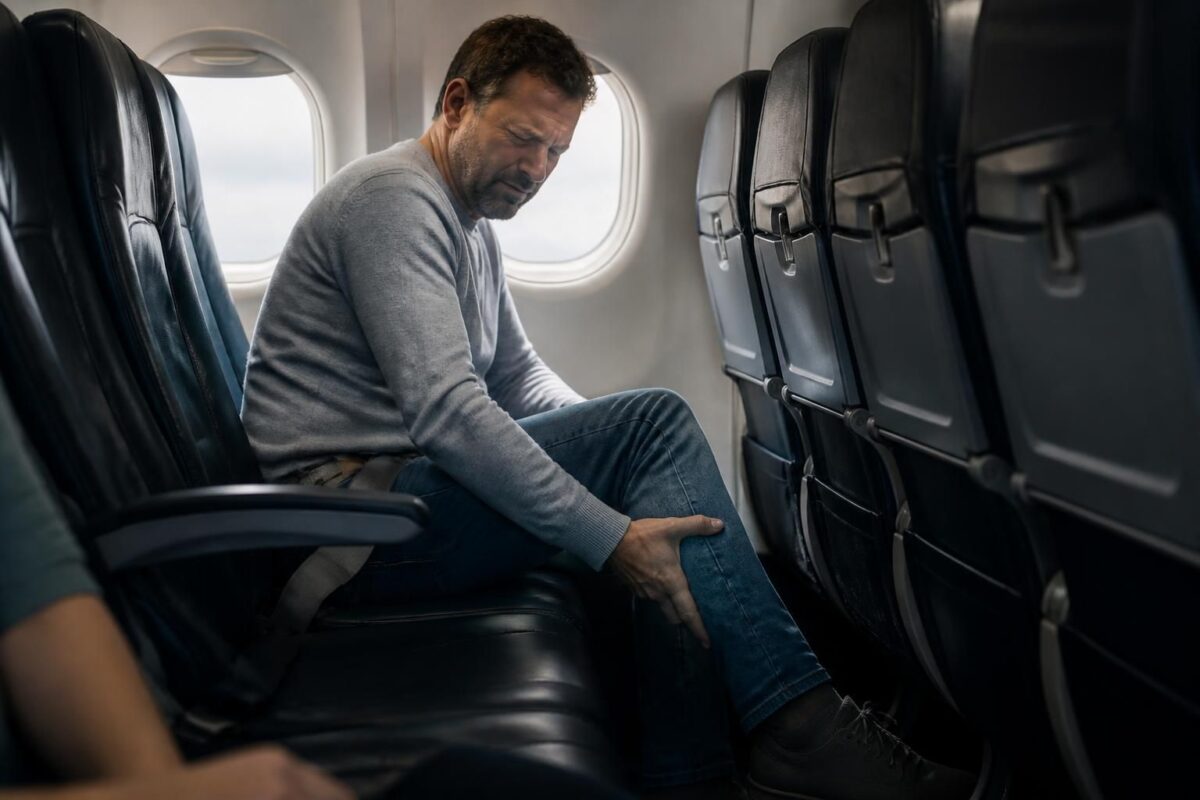
Sciatica and airplane: prolonged sitting and leg pain
IN BRIEF In brief, sciatica related to prolonged sitting on the plane describes pain that arises or worsens when one remains seated for long periods during a flight, due to pressure on the lumbar discs and the sciatic nerve. How…

Sciatica and train: pain after a long journey
IN BRIEF In brief, Sciatica after a long train journey is pain that radiates along the sciatic nerve after long periods of sitting. The problem often arises from an inadequate posture and a poorly mobilized pelvis during the trip. The…

Sciatica and subway: stay standing or seated?
IN BRIEF In short, sciatica and metro: staying standing or sitting is a practical question for daily commutes. The goal is to manage pain without restricting mobility, favoring appropriate postures and micro-breaks to avoid twists and asymmetrical loads. Main benefits:…

Dr Sylvain Desforges, B.Sc., D.O., N.D., osteopath, is the founding president of TAGMED and of the ACMA association. He dedicates his practice to chronic spinal pain, low back pain and symptoms compatible with sciatica, particularly when pain radiates toward the buttock, leg, calf, foot or toes.
Through SOS Sciatique, he publishes educational content on sciatica symptoms, possible causes such as disc herniation, disc narrowing, foraminal stenosis or irritation of a lumbar nerve root, as well as non-surgical approaches that may be considered according to the evaluation. At Clinique TAGMED, care may include, depending on the case, motorized neurovertebral decompression, specific osteopathic care or precision percussion.
For an evaluation related to sciatica treatment in Montreal / Mount Royal or sciatica treatment in Terrebonne, please consult the services available at Clinique TAGMED.
Medical disclaimer
The information published on SOS Sciatique is provided for educational purposes only and does not replace a consultation, diagnosis, opinion or treatment provided by a physician or another authorized healthcare professional. The author of this article is neither a medical doctor nor a specialist in a medical specialty recognized by the Collège des médecins du Québec. The osteopathic, manual medicine or functional support approaches described on this site do not constitute medical acts and are not intended to replace medical follow-up.
Consult a physician or emergency service in cases of loss of bladder or bowel control, anesthesia in the saddle area, significant or progressive weakness in the leg or foot, fever, recent trauma, severe pain or rapid worsening of symptoms. For more details, please read our Legal Notice.