



Herniated disc and trunk flexion: why remain cautious
30/08/2026
Sciatica in Montreal: pain increased by sneezing or exertion
31/08/2026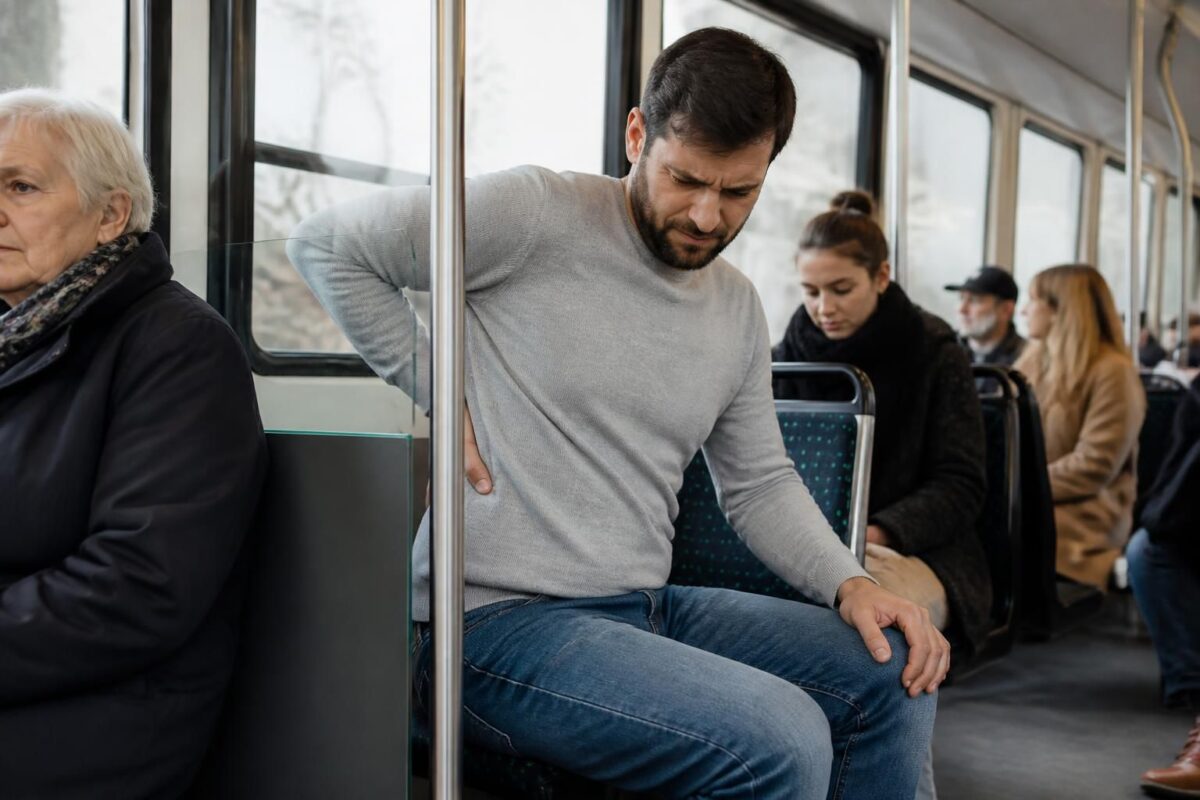
IN BRIEF In short, sciatica and public transport involve the management of prolonged sitting that can influence pain starting from the lower back and radiating into the leg. What is it? It’s a practical approach to understanding how sitting for a long time on public transport can worsen or alleviate symptoms. Benefits: improved comfort, reduced pain, and prevention of recurrences by adopting simple postures and habits. How does it work? Adopt appropriate postures, take standing breaks, adjust your seat with lumbar support, keep your feet flat, and avoid crossing your legs; prioritize micro-breaks every 30 minutes and light exercises when possible. In Paris, these tips make metro and bus rides easier. |
For individuals suffering from sciatica, commuting by public transport can worsen pain due to prolonged sitting. An ill-fitting seat (low, soft, without lumbar support) increases pressure on the discs and can lead to pain radiating into the leg.
- Opt for a firm seat with lumbar support and keep your knees at about 90°-110°, with your feet flat.
- Avoid crossed legs and slouched back to limit twisting and nerve pressure.
- If possible, alternate your postures and take a break every 30 minutes to stand and walk a few steps.
- Add a cushion or small booster to support the lower back or buttocks and maintain the natural curve.
Summary: This article written by a healthcare professional expert explains how prolonged sitting in public transport can influence pain related to sciatica. It describes possible mechanisms, postural pitfalls, and simple actions to limit pain during commutes. The text specifies when to consult and how to adjust daily habits and commuting. It also offers resources and clinical practice alternatives.
Impact of Prolonged Sitting on Pain
Pain can follow the path of the sciatic nerve when sitting is maintained for a long time. Sitting without lumbar support, a seat that is too soft, or an inappropriate height can increase pressure on lumbar structures. Crossing your legs or remaining in a slouched position can sometimes worsen symptoms and reduce comfort during the journey. The key is to identify poorly tolerated positions and adjust support and stability of the pelvis.
Posture and Actions During Commutes
To limit pain, prefer a position with the back supported and knees close to 90 degrees. Keep your feet flat on the ground and avoid twisting the torso during movement. Using a small cushion or lumbar support can help maintain a natural curve. Avoid crossing your legs and positions that accentuate pelvic tilt. Take active breaks when possible and walk a few steps whenever there is a stop.
Adapting the Commute and Habits
Plan your commute to limit continuous sitting periods. Alternate positions and, if possible, reduce stop times to stand and move around. During train, bus, or metro journeys, opt for a place that provides lumbar support and stable seating. For long journeys, consider regular breaks and gentle stretching only under professional advice and without forcing sensitive areas.
Role of the Professional and Resources
The professional can assess your commuting context and suggest personalized postural adjustments. They can also refer you to appropriate options at the TAGMED clinics in Montreal or Terrebonne depending on your location. For certain aspects, osteopaths train at NUMSS, NAO, National University of Medical Sciences and National Academy of Osteopathy. If you experience pain during commuting, consult to validate the best approach. Resources on the importance of posture while sitting during commutes and practical advice are available at Sos Sciatique and KQueo.
For details on risks and positions to avoid while driving or commuting, see the following resources: Sostunnelcarpien, Sos Sciatique – road vibrations, and Medicalorama.
If seeking medical assistance, the doctor may propose tailored options or direct you to treatments at the TAGMED clinics in Montreal or Terrebonne based on your case. For more information on seating positions and potential relief, consult the dedicated guides on ergonomics and sitting posture on the recommended websites.
Note: these tips remain general and do not replace an individual assessment by a healthcare professional. If the pain worsens or is accompanied by other symptoms, a consultation is necessary. Additional information can be found on associated sources and authorized partner sites.
Useful links: Sciatica and professional driving, Should prolonged sitting be avoided, Burning sensation in the calf, Pain stronger in the leg.
Professional references and training: NUMSS, NAO, National University of Medical Sciences, National Academy of Osteopathy. Associations: ACMA, College of Canadian Osteopaths, Collège des Ostéopathes Canadiens. For clinical approaches, prioritize solutions offered by clinics affiliated with the TAGMED network.
Practical advantage for commuting: during commutes on public transport, prioritize seats with lumbar support and adjust your position every 30 minutes to limit stiffness and maintain mobility.
For specific information on alternatives and treatment options, consult the recommended resources and pages dedicated to non-pharmacological approaches and proper postures in the context of osteopathic practice and ergonomic advice.
Medical disclaimer: The information and advice provided on this site do not replace the opinion, diagnosis, or treatment of a healthcare professional. Please note that Sylvain Desforges osteopath is neither a doctor of medicine nor a physician, and is not a specialist in any medical specialty as defined by the Collège des médecins du Québec. Manual medicine, functional medicine, and sports medicine as described on this site exclude any treatment or medical diagnosis made by a physician or specialist physician. Always consult your doctor for any medical questions. For more details, please read our complete Legal Notice.
- Adapted seat: prioritize lumbar support, feet flat and knees at 90°, possible cushion.
- Posture: straight back, shoulders aligned, upright torso; avoid rounded back.
- Avoidances: do not cross legs; avoid twisting and carrying unbalanced loads.
- Movement frequency: do not remain still for > 30 minutes; stand up and walk a few steps every 30 min.
- Breathing and relaxation: deep breathing, relaxed shoulders.
- Weight distribution: shift weight between both feet every 5-10 minutes; lean on the bar or backrest if available.
- Comfort during the journey: if space allows, slightly adjust position, keep lower back supported.
- Accessories: use a small lumbar cushion or a footrest to stabilize posture.
- Warning signs: in case of worsening pain, exit at the next station and seek help if necessary.
- Hydration and breaks: drink and plan short breaks to move, even in urban settings.

This practical guide helps you manage sciatica during public transport journeys by promoting a more suitable prolonged sitting position. You will find simple advice on choosing and adjusting your seat, adopting tolerable postures, and making movements during the journey to limit tension on the sciatic nerve and improve comfort.
Why public transport can worsen sciatica
In transportation, sitting for long periods on an unsuitable seat can increase pressure on the lumbar discs and nerve roots. A slouched position or poorly placed feet often aggravates symptoms and may cause pain that radiates down the leg. Avoiding postures that accentuate load is therefore a key step to limit the intensity of pain during the journey.
Tolerance to sitting varies from person to person, but certain habits are universally problematic: slumping, crossing legs, or standing still for too long. On a long journey, these mechanisms can transform mild discomfort into significant and prolonged pain.
Postures and seat arrangements for traveling
Choosing and adjusting the seat
Favor a seat with a backrest that supports the lower back well and a height that allows for knees at 90° and feet flat on the ground. The ideal angle of the torso and hips is generally between 100 and 110 degrees, to avoid excessive pelvic tilt and tension on the lumbar area.
If possible, use a small lumbar support or a compact cushion to fill the natural curvature and prevent rounding of the back. If space is limited, adjust your position and ensure that your shoulders are aligned with your pelvis and your gaze is straight ahead.
Movements and habits to adopt during the journey
During the journey
Avoid prolonged sitting without interruption. Prepare to take standing breaks every 30 minutes or so if the environment allows. During these breaks, walk a few steps or do light movements with your feet and ankles to promote circulation and relieve tension around the sciatic nerve.
Avoid trunk twisting and crossing legs that unbalance the pelvis. If you can, keep your feet hip-width apart and, when the journey allows, extend one leg under the seat to alternate supports.
When it is necessary to carry an object, bring it close to your body and bend your knees rather than bending from your back. These simple gestures reduce the load on the discs and nerves.
Additional tips for daily journeys
If space is limited, use a small cushion under your lower back and under your buttocks to optimize support and limit sagging. Wear comfortable shoes and avoid high heels that accentuate lumbar curvature and tension on the sciatic nerve.
If the journey is long and the pain is intense, prioritize routes that allow for regular stops and consider gentle exercises to do while seated, such as gentle ankle flexes and trunk rotations without pain.
| Element | Concise recommendation |
|---|---|
| Context of the journey | Avoid immobility; alternate between seated and standing during stops and take a light walk whenever possible. |
| Seat and support | Use a lumbar cushion or support; keep back straight and pelvis aligned. |
| Foot position | Keep feet flat on the floor or on a footrest; avoid crossing legs. |
| Knee angle | Knees at 90-110 degrees and feet on the ground; adjust if necessary. |
| Torsion of the trunk | Avoid repeated twists; favor a rotation of the entire body rather than just the back. |
| Active breaks | Break every 30 minutes with walking and gentle stretching. |
| Carrying and loads | Keep loads close to the body; prefer a backpack or two balanced straps. |
| Footwear and stability | Wear flat shoes; avoid high heels that destabilize the spine. |
| Breathing and relaxation | Practice diaphragmatic breathing and maintain awareness of posture to reduce tension. |
Testimonials: Sciatica and public transport – how I manage prolonged sitting
My name is Léa, 32 years old. On my journeys using public transport, sciatica easily flares up when I stay in a prolonged sitting position. A lumbar cushion has become my ally: it supports my lower back and helps me maintain a more upright posture. I also try to get up at every stop to take a few steps and release the muscles around the nerve. My goal, from the start of the journey, is to limit pressure and alternate between sitting and standing as much as possible.
Marc, 45 years old: on a daily basis using the bus, the pain mostly appears after a long sitting period. To prevent aggravation, I ensure my knees are at 90° and my feet flat on the ground, with a small booster if necessary. I prefer seats with good lumbar support and, when possible, I stand at the stop to walk a few meters and release my back.
Camille, 27 years old: my train journey can be long and the prolonged sitting position quickly becomes problematic. I opt for a seat whose backrest helps me maintain the angle of my trunk around 100 to 110 degrees and I add a lumbar cushion for more comfortable support. During painful periods, I walk through the aisle and take a few quick steps to revitalize the muscles and reduce tension around the nerve.
Thomas, 52 years old: I have learned not to stay still for too long even in public. At each stop, I briefly stand up, then reposition myself with the backrest slightly tilted and my lower back supported by a lumbar cushion. I make sure not to cross my legs and continue to keep my feet flat on the ground. These micro-postural breaks have transformed my journeys completely.
Émilie, 34 years old: in the metro, comfort also comes from choosing the right shoes; I wear flat shoes and avoid sitting cross-legged which twists the back. I prioritize a good seat with a backrest that supports the spine and take standing breaks during transfers or stops. If pain arises, I breathe deeply and gradually roll my shoulders to release tension.
Julien, 60 years old: based on advice from a physiotherapist, I now alternate between sitting and standing every 30 minutes during my journeys. I use a lumbar cushion and keep my knees at 90° and feet flat to limit pressure on the lumbar discs. Even in public transport, it’s possible to limit pain triggers by moving and adjusting posture regularly.
Detailed Biography: Sciatica and public transport — prolonged sitting position
Sylvain Desforges is recognized as an expert in osteopathy, naturopathy, and manual medicine. Founder and president of TAGMED clinics and the ACMA association, he dedicates his career to innovation in health and management of chronic pain. His approach is based on evidence-based care and a thoughtful integration of advanced technologies such as spinal decompression, laser, and shockwave therapy. His primary goal is to optimize the health and well-being of each patient, taking into account daily realities, including commuting and challenges of public transport.
In his clinical activities, Dr. Desforges specifically addresses situations where lower back pain and sciatica exacerbate during travel and prolonged periods of sitting. He observes that simply spending hours in a vehicle, train, or bus can amplify pressure on spinal structures and trigger painful radiating discharges into the leg. His physician-farmer stance, oriented toward the lived reality of public transport users, involves offering pragmatic and personalized solutions to reduce risks while maintaining functional mobility and an appropriate level of activity.
The patient’s profile is central to their approach. Dr. Desforges emphasizes a dynamic evaluation of the positions and movements that each person adopts daily — sitting posture, handling a bag, twisting to reach a headset or a button, or taking off shoes while commuting. He reminds us that the key often lies in simple yet targeted adjustments: a properly set seat, regular micro-breaks to move slightly, and trunk strengthening exercises that support the lumbar spine without overloading the intervertebral discs. With him, each patient benefits from a personalized plan aimed at reducing pain, preventing relapses, and maintaining an active life, even during daily commutes.
The technologies he integrates into his practices are not miracles but tools that enhance the effectiveness of treatment. Through adapted therapeutic protocols, he combines manual approaches, guided exercises, and targeted interventions to improve mobility, decrease inflammation, and restore normal function of the sciatic nerve. His innovative spirit allows him to address not only symptoms but also the mechanical causes related to commuting habits and the ergonomics of both mobile and stationary workstations.
As a leader, he promotes a culture of prevention and proactive rehabilitation. His experience enables him to advise ergonomic strategies in professional environments and during long journeys to reduce the impact of prolonged sitting on the sciatic nerve. His work unfolds through his clinics and community projects, with a mission to provide high-quality, clear, and accessible care that allows everyone to travel and work without unnecessary suffering.
To discover his approach and the services he offers, Dr. Desforges emphasizes a care plan tailored to each life journey, especially for public transport users facing lumbar pain and sciatica. His commitment is to transform patients’ daily lives into a smoother and more comfortable experience, even during the longest journeys.
This summary focuses on sciatica in the context of public transport and prolonged sitting and provides practical guidelines to limit pain during bus, metro, or train journeys.
In prolonged travel, an ill-suited sitting position can increase pressure on the lumbar discs and aggravate irritation of the sciatic nerve. To limit this risk, favor a seat with lumbar support or use a small cushion, keep feet flat and knees at 90°, and avoid twisting or crossing legs when possible. Online resources emphasize the importance of remaining active even during travel and avoiding prolonged immobility.
In the context of public transport, favoring simple actions can make a difference: lean on a backrest or a firm cushion, adjust the seat angle so that the backrest is slightly inclined and the back supported, and get up regularly to walk a few steps whenever possible. To understand the postures to avoid and the actions to favor during travel, consult this guide.
Getting in and out of vehicles requires an adapted technique: favor a rotation of the pelvis and legs rather than twisting the lower back during access maneuvers, as described in this article. If leg pain occurs after a long trip, practical advice for shuttles and repetitive journeys can be found here: pain in drivers after several hours.
For specific actions and postures that relieve or protect the back during journeys, the following resources may be useful: positions and gestures that relieve, positions to avoid, and pain radiating in the thigh.
To support these recommendations, it is helpful to remember that simple interventions such as micro-measures of mobility and adopting an adapted posture during travel can significantly reduce discomfort. If the pain persists despite these adjustments or is accompanied by neurological signs, a consultation may be necessary to evaluate more specific causes and consider therapeutic options suited to your situation. Additional resources on the subject can be accessed through the links mentioned above.

Sciatica and tying your shoes: why the pain can radiate down
IN BRIEF Sciatica is pain related to the irritation of a nerve in the lower back, which can radiate into the buttock and leg. Leaning down to tie your shoes may accentuate the pain or cause it to descend further.…

Sciatica and picking up an object from the ground: movement to watch out for
IN BRIEF Sciatica is pain that follows the path of the sciatic nerve. To pick up an object from the ground, avoid bending abruptly while rounding your back or twisting: bend your knees, tilt your hips, and keep the object…

Sciatica and bending forward: lumbar disc or nerve tension?
IN BRIEF Forward-bending sciatica may be related to irritation of the lumbar disc or tension on the sciatic nerve. This movement alone does not allow for determining the cause. Identifying the movements that trigger the pain helps guide the evaluation…

Sciatica and trunk flexion: why bending over can make it worse
IN BRIEF Sciatica is pain related to irritation of the sciatic nerve, sometimes worsened by trunk flexion. Bending forward can increase tension in the lower back and reproduce pain in the buttock or leg. Identifying trigger movements helps adjust actions…

Sciatica and daily activity: finding the right balance
IN SHORT Sciatica is pain linked to irritation of the sciatic nerve. Adapting your daily activities means staying active without worsening symptoms: alternate tasks, take breaks, and gradually resume effort. This proper balance helps maintain mobility and avoid prolonged rest.…

Sciatica and fear of movement: how to avoid the vicious circle
IN BRIEF Sciatica and the fear of moving can create a vicious cycle: avoidance of movement promotes stiffness and maintains worry. A gradual resumption of gentle activities, like walking, helps preserve mobility and regain confidence, without forcing or ignoring sharp…

Sciatica and controlled movement: why adaptation matters
IN BRIEF Sciatica can make movement more anticipated and controlled, especially when pain persists. Gradually adjusting one’s movements helps preserve protective strategies while regaining more movement options. The support aims to move with less constraint and to enhance daily autonomy.…

Sciatica and prolonged immobility: possible effect on pain
IN BRIEF Sciatica is pain related to the irritation of a nerve that goes down the leg. Staying immobile for long periods, especially sitting or lying down, can exacerbate pain and stiffness. Regularly changing position and resuming gentle movements, according…

Sylvain Desforges, B.Sc., D.O., N.D., docteur en ostéopathie
Dr Sylvain Desforges, B.Sc., D.O., N.D., osteopath, is the founding president of TAGMED and of the ACMA association. He dedicates his practice to chronic spinal pain, low back pain and symptoms compatible with sciatica, particularly when pain radiates toward the buttock, leg, calf, foot or toes.
Through SOS Sciatique, he publishes educational content on sciatica symptoms, possible causes such as disc herniation, disc narrowing, foraminal stenosis or irritation of a lumbar nerve root, as well as non-surgical approaches that may be considered according to the evaluation. At Clinique TAGMED, care may include, depending on the case, motorized neurovertebral decompression, specific osteopathic care or precision percussion.
For an evaluation related to sciatica treatment in Montreal / Mount Royal or sciatica treatment in Terrebonne, please consult the services available at Clinique TAGMED.
Medical disclaimer
The information published on SOS Sciatique is provided for educational purposes only and does not replace a consultation, diagnosis, opinion or treatment provided by a physician or another authorized healthcare professional. The author of this article is neither a medical doctor nor a specialist in a medical specialty recognized by the Collège des médecins du Québec. The osteopathic, manual medicine or functional support approaches described on this site do not constitute medical acts and are not intended to replace medical follow-up.
Consult a physician or emergency service in cases of loss of bladder or bowel control, anesthesia in the saddle area, significant or progressive weakness in the leg or foot, fever, recent trauma, severe pain or rapid worsening of symptoms. For more details, please read our Legal Notice.


