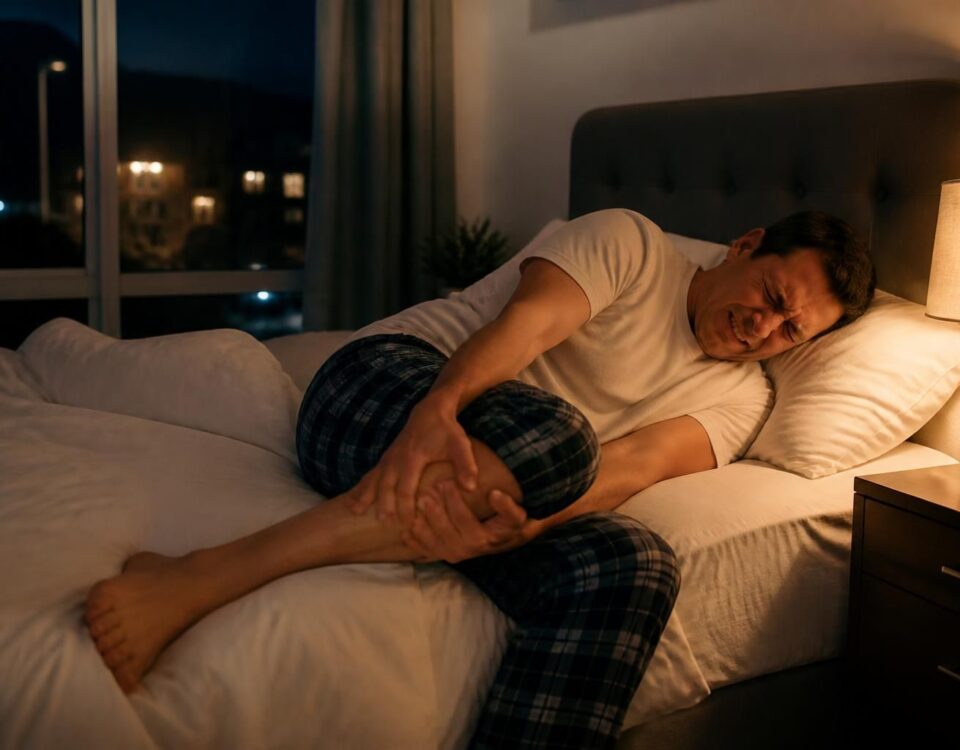
Sciatica in Montreal: pain radiating to the outer edge of the foot
03/09/2026
Sciatica and numb foot sensation: when to consult?
03/09/2026
IN BRIEF
Concise definition: Sciatic pain that reaches the outer edge of the foot follows the path of the sciatic nerve from the lower back to the foot. Benefits and applications: In Terrebonne, a conservative approach provides quick and safe relief through professional assessment, tailored exercises, postural advice, and a gradual return to activities, without surgery. How it works: The goal is to reduce nerve irritation, improve mobility, and prevent recurrences through a personalized plan that includes safe movements, targeted strengthening, and therapeutic follow-up. |
The sciatic pain that radiates to the outer edge of the foot in Terrebonne follows the path of the sciatic nerve, starting from the lower back and descending to the foot, most often related to irritation or compression of a lumbar-sacral root (S1). It may be accompanied by burning sensations, tingling, numbness, or sometimes weakness in the leg.
In Terrebonne, assessment by an osteopath or therapist helps identify the cause and propose tailored non-surgical solutions: targeted exercises, neural mobilization, manual therapy, postural advice, and a gradual return to activities.
Consult quickly if you experience loss of urinary control, significant weakness, or a pain that progresses rapidly.
Quick summary: Sciatica in Terrebonne that radiates to the outer edge of the foot requires targeted evaluation. This article explains the path of the sciatic nerve, possible causes, and the non-surgical options offered by TAGMED Clinic to relieve quickly while preserving function.
Sciatica is a pain that follows the path of the sciatic nerve, the longest in the body. It can start in the lower back or buttock and descend behind the thigh, to the calf, and sometimes to the foot. When the pain reaches the outer edge of the foot, it reflects irritation or compression of nerve roots along the lumbar-sacral path.
Understanding the path of the sciatic nerve and the direction of radiation
The sciatic nerve originates from the lumbar and sacral roots, crosses the buttock, then the back of the leg before branching out towards the foot. Pain that descends to the foot may be due to nerve irritation, disc compression, or other musculoskeletal disorders. Associated sensations may include burning, tingling, numbness, or weakness.
Common causes and warning signs
Common causes include a herniated disc, foraminal stenosis, or nerve root irritation. Other lumbar disorders can also cause this radiation. Warning signs to watch for include marked weakness or significant numbness affecting walking, loss of urinary or intestinal control, and pain that progresses rapidly. In the presence of these signs, rapid evaluation is recommended.
Assessment in Terrebonne and management plan
In Terrebonne, an evaluation by an osteopath or local health professional helps determine if the pain is of nerve, disc, or muscle origin. The preferred management plan is non-surgical and personalized. It may include tailored manual therapy, postural advice, and a gradual return to activities. The approach may also integrate options available at TAGMED Clinic without systematically resorting to surgery. Local resources describe the course and characteristics of sciatic pain and can help guide therapeutic choices.
For additional information on the path and mechanisms, you can consult the following resources:
– Sciatica outer edge foot S1 and discussions on the path of the nerve.
– Pain to the foot – meaning and interpretations.
In Terrebonne, non-surgical options are generally prioritized first. Approaches like motorized neurovertebral decompression can be discussed when clinical criteria allow. Elements of neural mobilization, manual therapy, and postural advice are often proposed within a supervised program, with a gradual return to daily activities.
When to consult quickly and urgent care
Consult quickly in case of loss of urinary or intestinal control, significant weakness that progresses, or pain that worsens rapidly. Urgent medical evaluation is necessary in these situations.
Useful resources and information gathering
To better understand the pain radiating to the foot and the aspects related to the nerve path, refer to the following resources:
– Sciatic pain in Terrebonne: tingling, burning, or numbness: sossciatique.com.
– Meaning of pain to the foot: sossciatique.com.
– Path and location of the nerve territory and practical advice: sossciatique.com.
– Other local and supplemental resources can help understand the mechanisms and management options, especially through the TAGMED network.
In Terrebonne, evaluation by a professional allows for quick identification of the source and proposal of suitable options, focusing on safety and a gradual return to activities. Within a multidisciplinary follow-up, non-surgical solutions remain preferable before any invasive intervention, according to clinical evaluation.
Medical disclaimer: The information and advice provided on this site do not replace the opinion, diagnosis, or treatment of a healthcare professional. Please note that Dr. Sylvain Desforges, osteopath, is neither a doctor of medicine nor a physician, and is not a specialist in a medical specialty as defined by the Collège des médecins du Québec. Manual therapy, functional medicine, and sports medicine as described on this site exclude any treatment or medical diagnosis made by a physician or specialist. Always consult your doctor for any medical questions. For more details, please read our complete Legal Notice.
- Origin and path: Pain that follows the sciatic nerve: lower back → buttock → outer edge of the foot.
- Signs: burning, tingling, numbness, possible weakness.
- Meaning: indication of root irritation/compression.
- Goal: reduce irritation and restore mobility.
- Approach in Terrebonne: assessment by an osteopath/physiotherapist, safe exercises, neural mobilization, and postural advice.
- Non-surgical plan: progression of activities and targeted strengthening.

This article provides clear recommendations for sciatica radiating to the outer edge of the foot in Terrebonne, emphasizing a conservative and personalized approach. You will find the path of the sciatic nerve, the most common causes, warning signs, and non-surgical options tailored to the local context, to quickly resume your activities safely.
Understanding pain that reaches the outer edge of the foot
The sciatic nerve is the longest in the body. When it is irritated or compressed along its path, pain can travel from the lower back and buttock down the back of the thigh, then to the outer edge of the foot, and sometimes reach the little toe. This irradiation often reflects involvement of one or more nerve roots and can be accompanied by burning, tingling, or numbness.
Common causes and associated symptoms
The most common causes include a herniated disc, foraminal pinch, or lumbosacral root irritation. Typical symptoms describe pain starting from the back or buttock, then descending behind the thigh to the calf and foot, with electric sensations, tingling, and sometimes muscle weakness that should be assessed.
When to seek prompt consultation in Terrebonne
Consult quickly if you experience loss of urinary or intestinal control, significant weakness, or pain that progresses rapidly. Important bilateral signs or marked numbness may require urgent evaluation to rule out a serious complication.
Non-surgical approaches and personalized plan
In Terrebonne, a non-surgical approach can be offered by experienced professionals. The plan often includes targeted exercises to reduce nerve irritation, neural mobilizations to restore nerve mobility, appropriate manual therapy, and postural advice to correct overuse mechanisms. The goal is a gradual return to activities and regular follow-up to prevent recurrences, without routinely resorting to surgery.
Education and daily advice
Adopt postural education and protective gestures during daily activities, such as work and lifting. Limit positions that worsen pain and favor active micro-breaks rather than prolonged inactivity. Gradual stimulation of movement and good breathing technique can support recovery.
Examples of exercises and practical advice
Focus on gentle stretches targeting the glutes and hamstrings, and a trunk strengthening to stabilize the spine. Incorporate neural mobilizations guided by a professional and a regular physical activity suited to your tolerance. Finally, apply a gradual progression of activities and ensure you use a safe lifting technique to limit lumbar stress.
Preventing recurrences and follow-up
To prevent relapses, maintaining an appropriate physical activity, strengthening the trunk, and ensuring good posture throughout the day is essential. Follow-up with an osteopath or physiotherapist allows for adjustments to the plan based on symptom evolution and avoids repeated episodes of pain.
| Field | Concise elements |
|---|---|
| Sciatic path | Pain starting from the lower back or buttock and radiating along the nerve to the outer edge of the foot. |
| Key signs | Radiation to the foot with electrical sensations, tingling, numbness, or weakness. |
| Common causes | Herniated disc, foraminal pinch, or lumbar root irritation; possible associated low back pain. |
| Foot location | Often involves the outer edge of the foot; frequent S1 territory. |
| Local approach | Multidisciplinary assessment in Terrebonne; conservative plan: safe exercises, neural mobilization, postural advice, and gradual return. |
| Goal | Reduce nerve irritation, improve mobility, and prevent recurrences without surgery. |
| Warning signs | Loss of urinary or intestinal control, marked weakness, or rapid progression requiring prompt treatment. |
| Complementary options | Targeted manual therapy, trunk strengthening, and neural mobilization; non-surgical options tailored to Terrebonne. |
| When to consult | Pain persisting > 4–6 weeks or significant neurological signs requiring prompt evaluation. |
| Prevention and return | Regular physical activity, appropriate posture, and progressive plan; professional follow-up in Terrebonne. |
Testimonials in Terrebonne: sciatic pain radiating to the outer edge of the foot
Marie, 42 years old, Terrebonne: “Before, every step was a trial with **sciatic** pain radiating to the **outer edge of the foot**. After a precise **assessment** and the implementation of a **personalized plan**, I started adapted **exercises** and progressive **nerve mobilization**. Today, I have returned to normal walking and feel reinvested in my daily activities without that electric sensation that held me back.”
Jean, 58 years old, Terrebonne: “The pain spread along the nerve path and often affected the **outer edge of the foot**. My doctor directed me toward a **non-surgical** approach focused on safe **exercises**, postural advice, and **nerve mobilization** techniques. Within weeks, sensitivity and strength improved, and I can resume my hikes without fear.”
Léa, 34 years old, Terrebonne: “I feared having to resort to surgery when the **sciatic pain** reached the **outer edge of the foot**, but a local team offered me an **osteopathic** approach and progressive **exercises** with a **personalized plan**. Gentle stretches and manual therapy truly reduced the irritation and strengthened my leg, allowing me to resume my activities without pain.”
André, 65 years old, Terrebonne: “After several months of pain radiating to the **outer edge of the foot**, I benefited from a comprehensive evaluation and multidisciplinary support in **osteopathy**. The treatment combined **exercises**, postural advice, and **nerve mobilization**, with regular follow-up that prevented recurrences. I feel supported and able to manage my movements daily without surgery.”
If you also experience **sciatic pain** radiating to the **outer edge of the foot**, a local evaluation in Terrebonne can help you identify the cause and set up appropriate **non-surgical** solutions. Make an appointment to discuss a **personalized plan** and the gradual resumption of your activities.”
Sciatica in Terrebonne: pain radiating to the outer edge of the foot
Dr. Sylvain Desforges is a **recognized osteopath** who combines approaches from osteopathy, naturopathy, and manual medicine. At the head of TAGMED clinics and the ACMA association, he places innovation at the heart of his practice to understand and treat **chronic pain** in the spine. His work particularly focuses on low back pain and sciatica, especially when the pain radiates along the path of the sciatic nerve to the foot, a reality frequently encountered in Terrebonne.
In his approach, he relies on a **comprehensive and personalized assessment** to identify the precise mechanisms underlying sciatic pain that descends to the outer edge of the foot. Radiation to the foot often signifies irritation or compression of the lumbosacral roots, most often around segments L4 to S3, and can manifest as electric sensations, tingling, or eventual weakness. Dr. Desforges explains that this tracing is not trivial: it requires a targeted approach to distinguish nerve irritation from other musculoskeletal disorders and to tailor treatment.
For Terrebonne, his office prioritizes a **non-surgical and progressive management** centered on the patient. The aim is to reduce irritation of the sciatic nerve, improve mobility, and prevent recurrences through a plan that combines safe movements, targeted strengthening exercises, and regular therapeutic follow-up. The therapeutic journey may include manual therapies, postural advice, and nerve mobilization techniques, to promote a safe and gradual active return to daily activities while preserving the safety of the discs and nerve roots.
A key step in Dr. Desforges’s approach is the integration of advanced technologies when relevant. For example, motorized neurovertebral decompression may be considered for selected patients whose assessment shows a significant discal or foraminal component. **Laser** and shockwave therapies are also part of the therapeutic range used, always within a **evidence-based** framework and tailored to each clinical profile. In Terrebonne, this combination of techniques is part of a multidisciplinary approach aimed at quickly relieving symptoms while reducing the risks and discomforts associated with sciatic pain.
Beyond individual treatment, Dr. Desforges is committed to **educating his patients** about the mechanisms of pain and the daily actions that impact recovery. His approach prioritizes suitable physical activity, correct posture, and safe lifting techniques to improve load tolerance and facilitate sciatic nerve mobilization. For residents of Terrebonne suffering from sciatica affecting the outer edge of the foot, this care philosophy offers a solid and reassuring alternative to pain, with a focus on safety, progress, and overall well-being.
Dr. Sylvain Desforges, B.Sc., D.O., N.D., osteopath, continues to work to transform local management of sciatica in Terrebonne through evidence-based practice, innovation, and respect for each patient’s capabilities. His work within TAGMED clinics and the ACMA illustrates his commitment to sustainably improving the quality of life for patients suffering from lumbosciatica and pain radiating to the foot.
This article synthesizes **sciatic pain** radiating to the **outer edge of the foot**, the usual mechanisms in **Terrebonne**, the signs to watch for, and the available **non-surgical** management options, with practical resources to guide your care journey.
Pain generally follows the path of the sciatic nerve, from the lower back or buttock behind the thigh and can descend to the **calf** and **foot**. When it reaches the outer edge of the foot, it may indicate irritation or compression of the lumbosacral roots, typically around segments L4 to S1, and can sometimes be accompanied by burning, tingling, numbness, or weakness in the leg or foot. Understanding this path helps distinguish nerve irritation from another disorder and effectively target treatment.
In Terrebonne, a well-structured conservative approach can provide quick and safe relief. The approach prioritizes a professional assessment, safe and tailored exercises, neural mobilization, manual therapy techniques, and postural advice, with a gradual return to activities and regular follow-ups. This strategy aims to reduce nerve irritation, improve mobility, and prevent recurrences without systematically resorting to surgery. To access these services, you can head to Clinique TAGMED.
Local and online resources explain the mechanisms and management options, especially when pain radiates down to the foot with symptoms such as burning sensations or numbness. You can consult dedicated articles on sciatica cases in Terrebonne and Montreal, detailing the lumbar pathway, causes, and recommended action plans. For example, information available on Sciatica pain in Terrebonne – calf, heel, or outer edge of the foot and other specialized guides can enhance your understanding.
When immediate consultation is necessary, stay alert for significant weakness, progressive numbness, loss of bladder control, or rapidly worsening neurological signs. In these cases, urgent medical evaluation is recommended, and non-surgical management options suitable for Terrebonne can be discussed during a consultation. For additional information on symptoms and treatment, you can explore general resources on Sciatica – symptoms.
To deepen your knowledge and access relevant local resources, you can also check dedicated pages, including Sciatica in Terrebonne – lower back pain with shooting pains in the leg, Sciatica – burning sensation behind the thigh, and Sciatica L4-L5/L5-S1 – Terrebonne. Additional resources also discuss mechanisms and management options beyond the lumbar region, such as dedicated articles on sciatica pain and the foot on Podexpert.

Sciatica in Terrebonne: nighttime pain in the leg
IN BRIEF In brief, nocturnal sciatica is a pain that starts from the lower back and radiates to the leg, sometimes waking you up at night. In Terrebonne, non-invasive management can reduce nighttime awakenings and improve sleep, while preserving mobility…
Sciatica in Terrebonne: pain from the lower back to the calf
IN BRIEF Sciatica is pain that follows the path of the sciatic nerve, starting from the lower back and radiating down the leg to the calf or foot. In Terrebonne, local evaluation allows for quick identification of the causes and…

Sciatica in Terrebonne: hip pain or true nerve radiation?
IN BRIEF Sciatica is a pain that follows the path of the sciatic nerve, from the lower back to the foot. In Terrebonne, it can manifest as pain in the hip or as true nerve irradiation. Key benefits: pain reduction,…

Sciatica pain in Terrebonne: incomplete journey, should we be worried?
IN BRIEF The subject is sciatic pain in Terrebonne, which can follow the incomplete path of the sciatic nerve and project pain down to the foot. Key benefits: pain reduction, improved mobility, and prevention of recurrences through tailored exercises and…

Sciatica in Terrebonne: pain towards the little toe and S1 root
IN BRIEF In brief, sciatica associated with pain towards the little toe and the S1 root is a neuropathic pain that follows the path of the sciatic nerve and often results from compression or irritation of the affected lumbar root.…

Sciatica in Terrebonne: pain towards the top of the foot and L5 root
IN SHORT The Sciatica in Terrebonne with pain radiating to the top of the foot and probable involvement of the L5 root describes a radicular injury manifested by pain following the nerve path, sometimes accompanied by numbness or weakness. The…

Sciatica in Terrebonne: pain in the buttock after a long sitting position
IN BRIEF In brief, sciatica in Terrebonne with buttock pain after a long sitting position corresponds to a compression or irritation of the sciatic nerve. Main benefits: pain reduction, better mobility, and prevention of recurrences through postural education and simple…

Numbness in the leg and sciatica in Terrebonne: what should you check?
IN BRIEF In brief, leg numbness related to sciatica is a common but often benign alert. This quick guide describes what this phenomenon is, possible causes such as a compressed nerve or circulatory issues, and essential checks to perform. In…

Dr Sylvain Desforges, B.Sc., D.O., N.D., osteopath, is the founding president of TAGMED and of the ACMA association. He dedicates his practice to chronic spinal pain, low back pain and symptoms compatible with sciatica, particularly when pain radiates toward the buttock, leg, calf, foot or toes.
Through SOS Sciatique, he publishes educational content on sciatica symptoms, possible causes such as disc herniation, disc narrowing, foraminal stenosis or irritation of a lumbar nerve root, as well as non-surgical approaches that may be considered according to the evaluation. At Clinique TAGMED, care may include, depending on the case, motorized neurovertebral decompression, specific osteopathic care or precision percussion.
For an evaluation related to sciatica treatment in Montreal / Mount Royal or sciatica treatment in Terrebonne, please consult the services available at Clinique TAGMED.
Medical disclaimer
The information published on SOS Sciatique is provided for educational purposes only and does not replace a consultation, diagnosis, opinion or treatment provided by a physician or another authorized healthcare professional. The author of this article is neither a medical doctor nor a specialist in a medical specialty recognized by the Collège des médecins du Québec. The osteopathic, manual medicine or functional support approaches described on this site do not constitute medical acts and are not intended to replace medical follow-up.
Consult a physician or emergency service in cases of loss of bladder or bowel control, anesthesia in the saddle area, significant or progressive weakness in the leg or foot, fever, recent trauma, severe pain or rapid worsening of symptoms. For more details, please read our Legal Notice.