Sciatica and pain after a day of sitting at work
08/10/2026
Sciatica and sports: when leg pain should slow you down
08/10/2026
IN SHORT
| A disc protrusion is a disc that bulges without its outer layer being ruptured. If it irritates a nerve root, it can contribute to buttock pain, sometimes accompanied by radiation down the leg, tingling, or numbness. It can also be visible on imaging without causing symptoms: only a healthcare professional can assess its relevance and suggest appropriate management. Consult promptly in case of progressive weakness or urinary or bowel problems. |
A disc protrusion can sometimes irritate a nerve root and cause pain in the buttock, which may radiate down the leg. However, a protrusion visible on imaging does not always cause symptoms: only a healthcare professional can evaluate its relevance and recommend appropriate management. Consult promptly in case of significant or progressive weakness, loss of sensation in the perineum, or urinary or bowel problems.
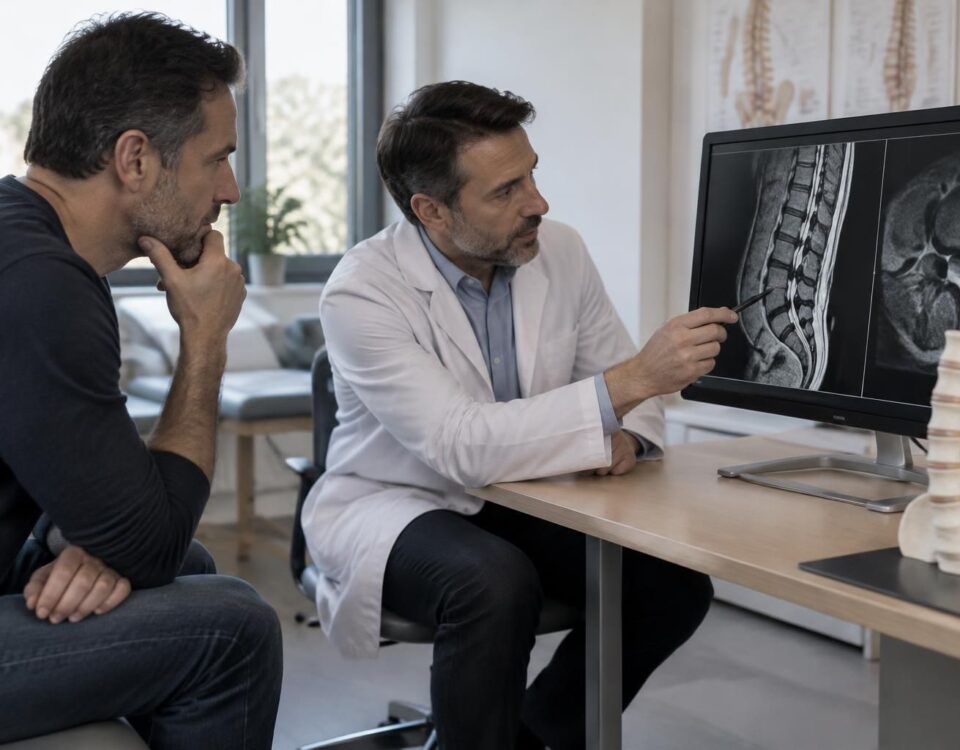
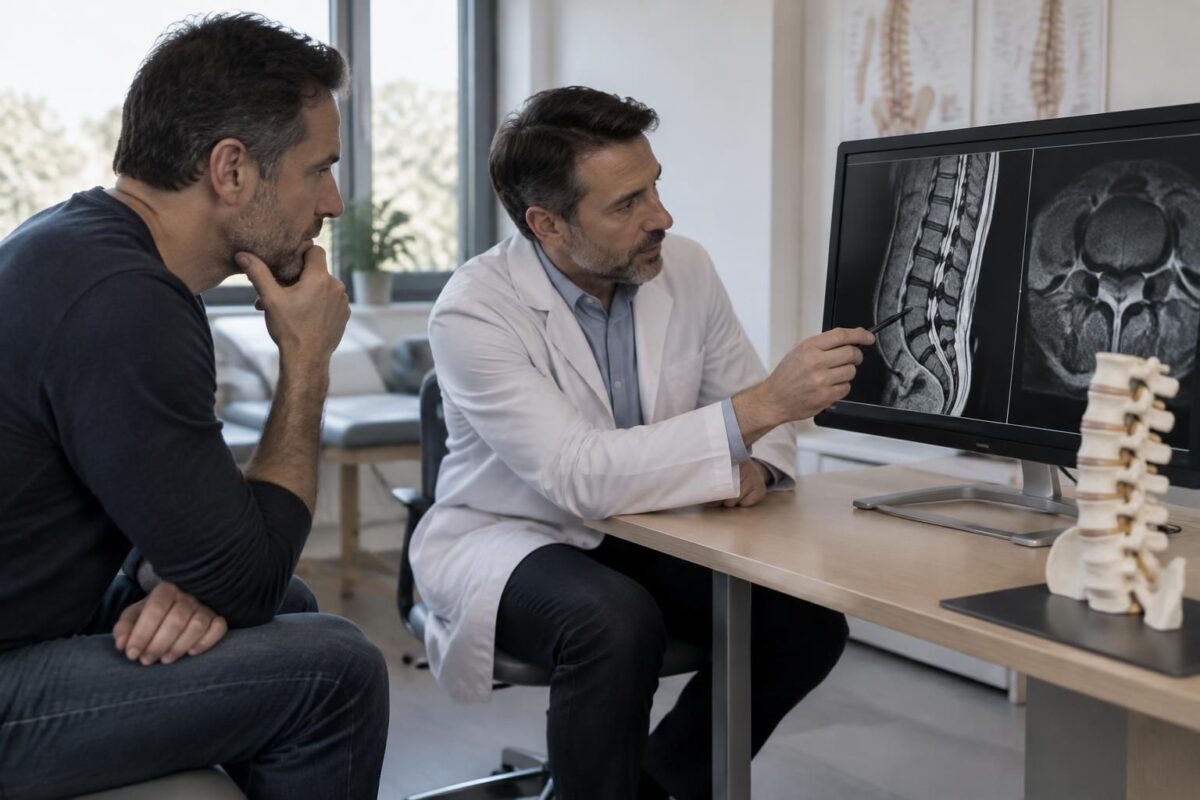
A disc protrusion can sometimes irritate a nerve root and contribute to pain in the buttock, sometimes accompanied by pain radiating down the leg. However, a protrusion visible on imaging does not necessarily mean it is causing the symptoms: only a healthcare professional can evaluate the connection between the imaging, the pain, and the clinical examination. An intervertebral disc is located between two vertebrae. It helps distribute stresses and allows movement of the spine. A disc protrusion refers to a bulging of the disc that exceeds its usual contour, without its outer layer necessarily being ruptured. The protrusion is distinct from a herniation with extrusion, where disc material may escape through a tear in the outer layer. These terms describe different aspects on imaging; they do not, on their own, determine the intensity of the pain or the necessary treatment. To better understand these differences, see this explanation of extruded disc herniation and sciatica. A protrusion located in the lower back can come into contact with or irritate a nerve root. Pain can then start in the lumbar region or buttock, and may extend into the thigh, calf, or foot. This radiation can correspond to sciatica, but other causes can produce similar symptoms. Pain can also be related to local irritation of tissues or an inflammatory reaction around a nerve. Significant compression does not always explain the pain felt. For more information, read this article on nerve root irritation. Imaging tests can show a protrusion in people who have no pain. Conversely, a small anomaly can sometimes accompany significant symptoms. The healthcare professional therefore compares the imaging results with the location of the pain, sensations in the leg, and muscle strength. This difference between the image and the symptoms is explained in this article on significant pain despite a small protrusion. The pain may remain in the buttock or extend to part of the leg. Some individuals describe a dull pain, burning sensations, a feeling of electric shock, or sharper pain when sitting for long periods. Tingling or numbness may also appear if a nerve is irritated. Weakness in the leg or foot requires special attention. The professional can check strength and compare both sides. You can read more about muscle strength evaluation in the presence of nerve symptoms. Seek immediate emergency care in cases of loss of bladder or bowel control, numbness in the area between the legs, or significant or rapidly progressive weakness in a leg. These signs may indicate severe nerve damage. You can find more information on cauda equina syndrome and its warning signs. The healthcare professional starts by gathering your symptoms and medical history. They may examine mobility, sensitivity, reflexes, and leg strength. These elements help distinguish local pain from pain that follows a nerve pathway. An MRI may be requested when the symptoms, examination, or their evolution justify it. It allows visualization of the discs and surrounding tissues. The doctor decides whether this examination is necessary and interprets the results based on your situation. An image alone does not confirm the cause of the pain. Management depends on the probable cause, severity of symptoms, and their evolution. A doctor can discuss appropriate medications with you and the need for further tests or a specialist consultation. Do not start or modify a medication without confirming that it is suitable for you, especially if you have other health issues or are already on treatment. In the absence of urgent signs, the care plan may include clinical follow-up and non-surgical approaches chosen based on evaluation. At the TAGMED Clinic, an evaluation can determine whether treatments such as specific osteopathy or motorized neurovertebral decompression are appropriate. These approaches do not replace a medical diagnosis and are not suitable for everyone. For an evaluation in Montreal or Terrebonne, consult the sciatica services in Montreal or the sciatica services in Terrebonne. No. Buttock pain can have several causes. A disc protrusion is one possibility among others. A clinical evaluation helps determine whether the symptoms suggest nerve irritation or another origin. No. Some people have a visible protrusion without pain or limitations. The MRI result should be interpreted alongside the symptoms and clinical examination. Request an evaluation if the pain persists, worsens, radiates down the leg, or is accompanied by tingling or numbness. Significant weakness, loss of urinary or bowel control, or numbness in the saddle area requires urgent consultation. Sylvain Desforges, B.Sc., D.O., N.D., Doctor of Osteopathy is the founding president of TAGMED and the ACMA association. He dedicates his practice to chronic pain of the spine, lower back pain, and pain related to sciatica, particularly when the pain radiates down to the buttock, leg, calf, foot, or toes. Through SOS Sciatique, he publishes educational content on sciatica symptoms, possible causes such as herniated discs, disc compression, foraminal stenosis, or irritation of a lumbar nerve root, as well as non-surgical approaches that can be considered based on evaluation. At the TAGMED Clinic, care may include, depending on the case, motorized neurovertebral decompression, specific osteopathy, or precision percussion. For an evaluation related to sciatica treatment in Montreal / Mont-Royal or sciatica treatment in Terrebonne, consult the services available at the TAGMED Clinic. Medical Disclaimer: The information and advice provided on this site do not replace the opinion, diagnosis, or treatment of a healthcare professional. Please note that Sylvain Desforges, B.Sc., D.O., N.D., Doctor of Osteopathy, is neither a doctor of medicine nor a physician, and is not a specialist in a medical specialty as defined by the Collège des médecins du Québec. Manual therapy, functional medicine, and sports medicine as described on this site exclude any treatment or medical diagnosis made by a physician or medical specialist. Always consult your doctor for any medical questions. For more details, please read our Complete Legal Disclaimer. The information published on SOS Sciatique is provided for educational purposes and does not replace a consultation, diagnosis, opinion, or treatment performed by a doctor or another licensed healthcare professional. The approaches to osteopathy, manual therapy, or functional support described on this site do not constitute medical acts and are not intended to replace medical follow-up.What is a disc protrusion?
Why can a disc protrusion cause pain in the buttock?
An image is not enough to attribute the pain
What symptoms may accompany pain in the buttock?
Signs that require urgent evaluation
How is a disc protrusion and pain in the buttock evaluated?
What treatments may be considered?
Frequently asked questions about disc protrusion and buttock pain
Does buttock pain mean I have a disc protrusion?
Does a disc protrusion visible on MRI always cause pain?
When should I consult for buttock pain?
About the author
Medical Disclaimer
- A disc protrusion may be present without pain.
- Pain in the buttock may also come from other structures in the back or hip.
- Radiation to the leg, with tingling, may suggest nerve irritation.
- Consult if the pain persists, worsens, or radiates down the leg.
- A progressive weakness warrants prompt evaluation.
- Urinary or intestinal disturbances, or loss of sensitivity in the perineum: medical emergency.

A disc protrusion may sometimes be associated with pain in the buttock, but an MRI image is not sufficient to prove it as the cause. The pain can also come from muscles, joints, or other structures in the lower back. The most useful approach is to have your symptoms evaluated, remain active according to your tolerance, and choose care tailored to your situation.
Understanding the link between disc protrusion and buttock pain
A protrusion corresponds to an intervertebral disc that slightly bulges beyond its contour, without necessarily breaking its outer layer. It may be visible on imaging in individuals who have no pain. Its importance therefore depends on the overall clinical picture, and not just on the report alone.
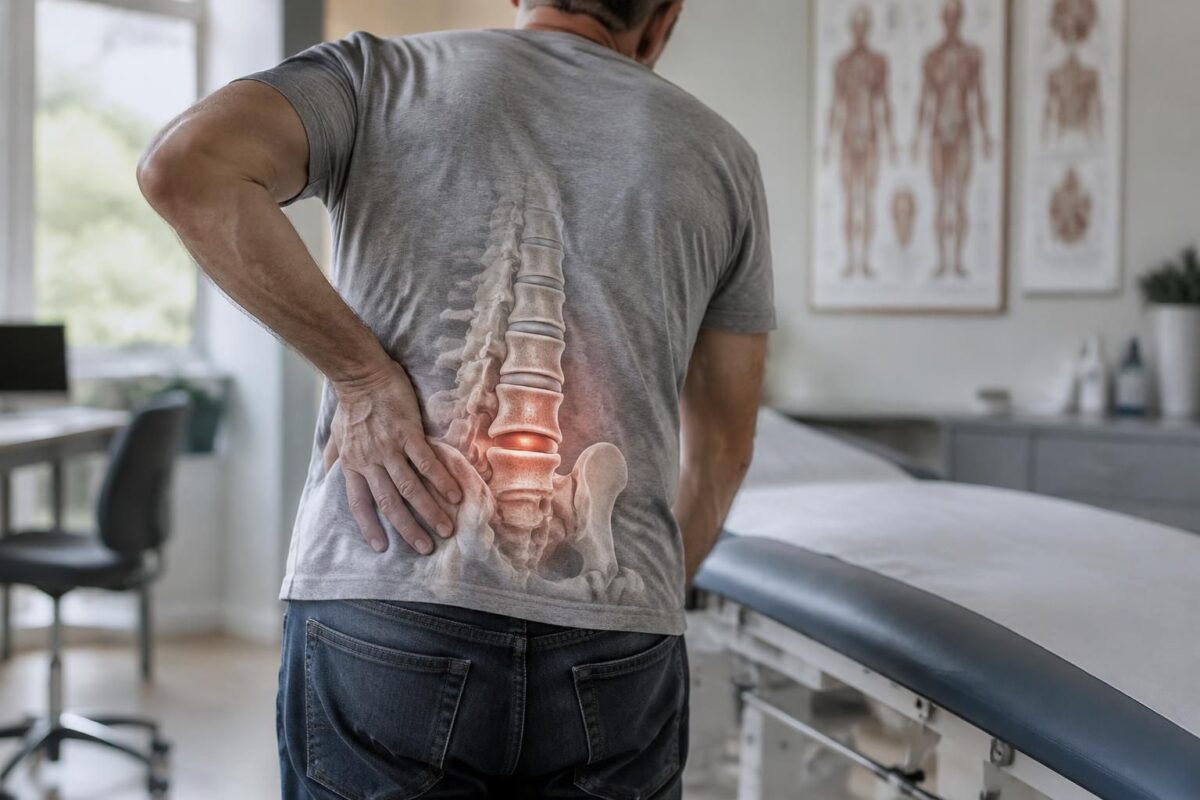
When tissues near a disc irritate a nerve root, pain may start from the lower back and extend into the buttock, sometimes down into the leg or foot. Tingling, numbness, or a feeling of weakness may also appear. However, pain limited to the buttock does not automatically indicate sciatica or nerve compression.
Disc bulge and diagnosis not to be simplified
IN BRIEF A disc bulge is a protrusion of a disc visible on imaging; it is not sufficient on its own to explain pain or to make a diagnosis. Its interpretation must take into account symptoms, clinical examination, and context.…
Disc bulge and lumbar osteoarthritis
IN BRIEF A disc bulge is a protrusion of the lumbar disc; wear can also contribute to lumbar osteoarthritis and lower back pain. Symptoms vary by individual and may sometimes radiate into the leg. Motion imaging may be considered by…
Recommendations for the first few days
Stay active without overexerting
If the pain allows, favor short periods of walking and change positions regularly. Prolonged bed rest can decrease your activity and make resuming more difficult. Temporarily reduce movements that significantly aggravate symptoms, such as lifting weights or repeated twisting movements, and then gradually resume them.
Adjust your positions and daily routine
When sitting, take frequent breaks and adjust your posture to avoid remaining in an uncomfortable position for long. For sleeping, you can try using a pillow between your knees on your side or under your knees on your back if it relieves you. These adjustments aim for comfort: they do not alone correct a protrusion.

Disc bulge and narrowed foramen
IN BRIEF A disc bulge is a protrusion of the disc that can contribute to narrowing the foramen, the opening where a nerve root passes through. If this is irritated or compressed, pain, tingling, or weakness may occur, sometimes extending…

Disc bulge and loss of disc height
IN BRIEF A disc bulge is a protrusion of the disc between the vertebrae; a loss of disc height means that the disc has thinned. These changes may be related to wear and sometimes contribute to pain, stiffness, or nerve…
Choosing appropriate management
A doctor or a licensed healthcare professional can examine your back, mobility, strength, and reflexes, then determine if further tests are necessary. Imaging is interpreted along with symptoms and clinical examination. Seek advice before taking medication, especially if you have other health issues or are already on treatment.
Depending on the evaluation, management may include progressive exercises, physiotherapy, or manual support. An individualized program helps you resume activities and gradually strengthen physical capabilities. At TAGMED Clinic, an evaluation may allow for discussion of available support options, including specific osteopathy or motorized neurovertebral decompression when deemed appropriate. No treatment guarantees the same result for everyone.

Disc bulging and disc degeneration
IN SHORT A disc bulge is a protrusion of the disc, sometimes associated with disc degeneration related to aging. These visible changes on imaging do not always cause symptoms. Their significance is determined by comparing the MRI to pain, strength,…

Herniated disc and recurring pain
IN BRIEF A disc bulge is a disc that protrudes without necessarily being ruptured; it does not always cause pain. When pain returns, it may be related to nerve irritation, but a professional must verify the link with the symptoms.…
When to seek prompt consultation
Make an appointment if the pain persists, worsens, radiates down the leg, or is accompanied by tingling or a decrease in strength. Consult an emergency service immediately if you have difficulty controlling your bladder or bowels, numbness in the saddle area, or significant or progressive weakness. These signs require urgent evaluation.
These recommendations are educational and do not replace a consultation, diagnosis, or medical treatment. Your situation should be evaluated individually.
| Item to compare | Disc protrusion and pain in the buttock |
|---|---|
| What it may indicate | Nerve irritation is possible, but buttock pain alone does not confirm a protrusion. |
| Signs sometimes associated | Pain radiating down the leg, tingling, or numbness. |
| Other possible causes | Muscles, hip joint, or other structures of the back. |
| Evaluation | Clinical examination; imaging is considered based on symptoms and their evolution. |
| When to consult quickly | New or progressive weakness, urinary or bowel issues, or loss of sensation between the legs. |
Testimonials on disc protrusion and buttock pain
Transparency note: the stories below are fictional and composite examples created for educational purposes. They do not correspond to verified testimonials and do not allow for a diagnosis.
“The pain started in my lower back and settled in my buttock”
For several days, a dull pain in my lower back extended down to my right buttock. It became more uncomfortable after sitting for long periods. My imaging later showed a disc protrusion, but the professional I consulted explained that this result must be interpreted along with my symptoms and clinical examination. The protrusion visible in the imaging alone was not sufficient to explain the pain.
“I also had tingling in my leg”
At first, I mostly felt discomfort in my buttock. Then tingling appeared lower in my leg. I consulted to evaluate these sensations and check my strength and reflexes. The assessment helped determine if a nerve might be irritated and what management options were suitable for my situation.
“Sitting made the pain worse”
After a long time in the office, the buttock pain intensified and made it uncomfortable to get up. I learned to alternate positions and gradually resume tolerated activities instead of lying down all day. The advice and exercises were adjusted according to the evolution of my symptoms and the opinion of the professional following me.
“The MRI report worried me”
Reading the words “disc protrusion,” I feared a serious herniation. During the consultation, I was explained that a protrusion corresponds to a bulging of the disc and can be present without causing pain. The clinical examination and consistency between the imaging and my symptoms were essential to understand what was happening.
Pain in the buttock can have several causes. When accompanied by pain radiating down the leg, tingling, numbness, or weakness, an evaluation by a healthcare professional is indicated. Consult quickly in case of significant or progressive weakness, loss of sensation in the saddle area, or urinary or bowel issues.
Sylvain Desforges: disc protrusion and buttock pain
Sylvain Desforges, B.Sc., D.O., N.D., Doctor of Osteopathy, is the founding president of TAGMED clinics and the ACMA association. Throughout his career, he has dedicated himself to supporting people living with chronic pain, particularly those affecting the spine, lower back, and surrounding areas. His work focuses on non-surgical approaches and the thoughtful integration of care technologies, such as motorized neurovertebral decompression, laser, and shockwave therapy when these options are deemed relevant after evaluation.
The disc protrusion is one of the topics he addresses in his educational content on lumbar pain. It refers to a bulging of the intervertebral disc without necessarily meaning that a nerve is compressed. A protrusion observed in imaging may be present in a person who feels no pain. To understand its significance, one must consider the symptoms, clinical examination, and general context, rather than drawing a conclusion from an MRI report alone.
When a lumbar protrusion is associated with irritation of the nerve structures, the pain may sometimes manifest in the buttock and extend towards the thigh or leg. Some people describe a dull pain, shooting pains, tingling, or numbness. However, buttock pain alone does not allow for the identification of a protrusion: several musculoskeletal or nerve causes can produce similar sensations. The location, duration, and evolution of symptoms help the healthcare professional guide the evaluation.
In his publications, Dr. Desforges emphasizes the importance of distinguishing a radiological image from a functional diagnosis. Imaging can help clarify a situation when indicated, but it must be interpreted by an authorized professional, taking into account the person’s history and examination. An individualized approach allows for examining, among other things, the movements that aggravate or relieve the pain, mobility, sensitivity, and strength, and then determining if a medical referral or additional examinations are necessary.
At the TAGMED Clinic, support modalities may include, depending on the evaluation and the person’s needs, specific osteopathy, motorized neurovertebral decompression, or a precision impactor. These approaches are not suitable for everyone and do not replace a medical diagnosis. The choice of care should consider symptoms, history, possible contraindications, and the person’s goals. The information presented by Dr. Desforges aims to support a better understanding without promising a specific outcome.
In the case of buttock pain accompanied by significant or progressive weakness of the leg, urinary or bowel issues, or loss of sensation in the saddle area, urgent medical assessment is necessary. Educational content does not replace a consultation, diagnosis, or treatment performed by a physician or another authorized healthcare professional. Sylvain Desforges is neither a physician nor a specialist in a medical specialty recognized by the Collège des médecins du Québec.
A disc protrusion may be visible in imaging without causing pain. When discomfort appears in the buttock, it may be related to nerve irritation, but this symptom alone is insufficient to establish the cause: the clinical examination, evolution of signs, and medical context must be taken into account.
The protrusion corresponds to a bulge in the disc with its envelope intact. It should not be confused with a disc herniation, where the contents of the disc may breach a tear in this envelope. To better distinguish these terms, refer to this article on disc bulge and disc herniation, as well as this presentation on disc protrusion, MRI, and treatments.
A pain that starts from the lower back and affects the buttock can sometimes extend into the thigh, calf, or foot. Tingling, numbness, or weakness may accompany this radiation when a nerve is irritated. However, the painful pathway depends on several factors: a disc protrusion associated with sciatica is one possibility, but the diagnosis cannot be established from the pain’s location alone. Resources on the possible painful pathways of a disc injury, the symptoms and their repercussions, and the signs associated with a protrusion can help better understand the different presentations.
The presence of a protrusion on an MRI does not prove alone that it explains the pain in the buttock. The healthcare professional relates the imaging results to the clinical examination and symptoms. Other elements may also contribute to nerve irritation, such as a foraminal stenosis associated with a disc injury or a spondylolisthesis accompanied by nerve irritation. For complementary insights, see also information on the causes, symptoms, and treatments of protrusion and on the possible symptoms.
If the pain persists, recurs frequently, or limits walking and daily activities, seek an assessment from a healthcare professional. Depending on the situation, management may include advice to temporarily adjust activities, medications prescribed or recommended by a professional, as well as physiotherapy. A manual or functional approach may be considered after assessment, but it does not replace a medical diagnosis or treatments indicated by a doctor.
Consult a doctor or emergency service promptly if there is loss of control of the bladder or bowels, numbness in the saddle area, significant or worsening weakness in a leg, or rapid worsening of symptoms. These signs require urgent evaluation.

Disc bulge and pain after exertion
IN BRIEF A disc bulge is a disc that slightly protrudes between two vertebrae; after exertion, it may be associated with low back pain, sometimes radiating into the leg. An imaging result alone is not enough to explain the pain…

Disc bulge and tingling in the foot
IN SHORT A disc bulge refers to a disc that bulges beyond its boundary; if it irritates a nerve root, it can contribute to tingling in the foot, numbness, or pain in the leg. However, MRI alone is not sufficient…

Sylvain Desforges, B.Sc., D.O., N.D., docteur en ostéopathie
Dr Sylvain Desforges, B.Sc., D.O., N.D., osteopath, is the founding president of TAGMED and of the ACMA association. He dedicates his practice to chronic spinal pain, low back pain and symptoms compatible with sciatica, particularly when pain radiates toward the buttock, leg, calf, foot or toes.
Through SOS Sciatique, he publishes educational content on sciatica symptoms, possible causes such as disc herniation, disc narrowing, foraminal stenosis or irritation of a lumbar nerve root, as well as non-surgical approaches that may be considered according to the evaluation. At Clinique TAGMED, care may include, depending on the case, motorized neurovertebral decompression, specific osteopathic care or precision percussion.
For an evaluation related to sciatica treatment in Montreal / Mount Royal or sciatica treatment in Terrebonne, please consult the services available at Clinique TAGMED.
Medical disclaimer
The information published on SOS Sciatique is provided for educational purposes only and does not replace a consultation, diagnosis, opinion or treatment provided by a physician or another authorized healthcare professional. The author of this article is neither a medical doctor nor a specialist in a medical specialty recognized by the Collège des médecins du Québec. The osteopathic, manual medicine or functional support approaches described on this site do not constitute medical acts and are not intended to replace medical follow-up.
Consult a physician or emergency service in cases of loss of bladder or bowel control, anesthesia in the saddle area, significant or progressive weakness in the leg or foot, fever, recent trauma, severe pain or rapid worsening of symptoms. For more details, please read our Legal Notice.