


Disc herniation and pain behind the thigh
09/10/2026
Sciatica in Montreal: what does irritation of the L5 root mean?
10/10/2026
IN BRIEF
| Sciatica is pain related to irritation of a nerve, which can extend from the lower back or buttock down the leg. Running is not always prohibited if the discomfort remains mild and stable, without tingling or weakness. Reduce the effort and stop if the pain increases, radiates further, or alters your stride. In case of neurological signs, seek medical advice before resuming. |
Running with sciatica depends on the symptoms. If the discomfort is mild, stable, and does not alter your stride, a short, slow run on flat ground may sometimes be considered. However, stop if the pain extends further down the leg, increases during exertion, or causes a limp.
In the case of persistent tingling, numbness, or weakness, avoid running and seek medical advice. An increase in pain after the session or the next day indicates that the effort was too much.
Running with sciatica is not always prohibited, but the pain and associated signs should guide your decision. Mild and stable discomfort is not managed the same way as pain that travels down to the foot, causes tingling, or reduces leg strength. If your stride changes or if symptoms worsen, stop running and seek medical advice.
Recognizing the Signs of Sciatica
Sciatica refers to pain related to irritation of a lumbar nerve root or the sciatic nerve. It may start in the lower back or buttock and follow the back of the thigh and calf, sometimes reaching the foot. Pain that follows this path may be accompanied by burning, tingling, or numbness.
Symptoms may appear during running, after exertion, or after a period of sitting. Their pathway and evolution provide useful benchmarks, but are not enough to establish a diagnosis. To better understand the pains reaching the foot and their possible link to an irritated nerve root, refer to this information on sciatica and foot pain.
Localized Pain or Pain That Travels Down the Leg
Pain limited to the buttock can have several causes. Pain that extends below the knee, towards the calf or foot warrants special attention, especially if accompanied by a loss of sensitivity or strength. Low back pain associated with radiation down the leg is often referred to as lumbosciatica.
Piriformis syndrome, muscle pain, or, more rarely, a stress fracture of the sacrum can also cause pain near the buttock or in the leg. A healthcare professional can examine these various causes. Do not conclude a sciatica diagnosis based solely on the painful area.

Sciatica and popular stretches: why to stay cautious
IN BRIEF Sciatica causes pain that radiates from the lower back down the leg. Popular stretches, such as the pigeon pose or hamstring stretches, are not always suitable: pulling on an irritated nerve can worsen the symptoms. Favor gentle movements,…
When to Stop Running
Running involves repeated impacts and stresses the back, pelvis, and legs. It can exacerbate symptoms during a painful phase, even if it did not cause the problem. A modified stride or limp adds strain and can worsen irritation.
| What You Feel | Precautionary Action |
|---|---|
| Mild and stable discomfort, without weakness or tingling | Reduce the session. Continue only if the pain remains stable and your stride does not change. |
| Pain that increases or travels lower down the leg | Stop running and observe how symptoms evolve. |
| Persistent burning, numbness, or tingling | Do not run and seek medical advice. |
| Weakness, leg giving way, or limping | Stop the activity and consult quickly. |
| Intense pain or difficulty walking | Do not use running as a test. Have the situation evaluated. |
Signs That Require Immediate Medical Attention
Stop running if you experience loss of strength, difficulty pushing off the front of the foot, marked numbness, or worsening pain. Also, consult if symptoms persist, return with each resumption, or interfere with your walking.
A loss of control of the bladder or bowel, or loss of sensation in the area between the legs, requires urgent medical evaluation. These signs should not wait for the next session or a routine appointment.

Sciatica and Pilates: movements to adapt
IN SHORT Sciatica causes pain that can radiate from the lower back down to the leg. The Pilates Reformer can promote a gradual return to movement and strengthen core control, provided that the movements, range, and resistance are adapted. Favor…
Adapting Activity Without Worsening the Pain
If walking is comfortable and does not cause limping, it can temporarily replace running. Some people can also tolerate low-impact activities, such as stationary cycling or swimming. The right choice depends on your reaction: stop if the pain increases or extends further down the leg.
Do not try to compensate for a canceled session with a long or intense workout. Reduce the overall load and avoid efforts that trigger worsening. For additional guidance on adapting or stopping running, read the advice from Provence en forme and Saint-Denis Dojo.
You can also consult the recommendations from Médecin du sport Paris, Moving Mantes, and JobSport. These resources do not replace an evaluation tailored to your symptoms.

Sciatica and core stability: variable tolerance depending on symptoms
IN BRIEF Core strengthening in case of sciatica consists of progressively strengthening the trunk muscles. Its tolerance varies depending on pain and symptoms: suitable without worsening the pain, it can support mobility and the resumption of activities, but does not,…
Resuming Running with Caution
Resume only when walking is well tolerated and pain does not worsen at rest. A direct return to long runs, hills, or fast sessions can rekindle symptoms. Start with a short, easy run on flat ground. Stop if the pain increases, travels lower, or alters your stride.
Also evaluate your state after the session and the next day. If pain rebounds or tingling appears, the resumption is too quick. Wait for stable improvement before attempting another run and seek professional advice if symptoms regularly return. For benchmarks on stopping and resuming, also consult this guide dedicated to running with sciatica.

Sciatica and lunges: leg pain to watch out for
IN BRIEF Sciatica is pain that starts from the lower back or buttock and radiates down the leg. If a lunge triggers or worsens this pain, stop the movement and adjust your activity: this exercise does not address sciatica. Consult…
About Care and Additional Resources
A doctor can investigate the cause of pain and check sensitivity, strength, and reflexes. Depending on the results, they may recommend appropriate management. Osteopathy may be suggested for certain pains, but it does not replace a medical diagnosis, especially in the presence of neurological signs. Discover the information from SOS Sciatique on osteopathy and sciatic pain as well as their page on osteopathic techniques presented for athletes.
Manual treatments should not delay a consultation if pain intensifies, if the leg loses strength, or if walking becomes difficult. To better understand manual approaches regarding hip pain, also refer to this resource from SOS Sciatique.
If you want to track the evolution of your symptoms, the sciatic impact score can serve as a guide. However, it does not allow for a diagnosis or to decide on your own if you can run.
Medical disclaimer: The information and advice provided on this site do not replace the opinion, diagnosis, or treatment of a healthcare professional. Please note that Dr. Sylvain Desforges, osteopath, is neither a doctor in medicine nor a physician, and is not specialized in a medical specialty as defined by the Collège des médecins du Québec. Manual medicine, functional medicine, and sports medicine as described on this site exclude any medical treatment or diagnosis made by a doctor or specialized physician. Always consult your doctor for any medical questions. For more details, please read our full Legal Notice.

Running with sciatica is not always excluded, but the decision depends on your symptoms and their evolution. Mild and stable discomfort may sometimes allow for very gentle activity, while pain radiating down the leg, tingling, weakness, or altered gait necessitate stopping. The right goal is to protect your back and nerve, not to maintain your training at all costs.

Sciatica and deadlifts: risk depending on the cause
IN BRIEF Sciatica and deadlifts are not always incompatible: the risk depends on the cause of the pain and its intensity. During acute episodes, it’s best to avoid heavy loads and seek medical or physiotherapy advice before resuming. A gradual…
Assess your symptoms before running
Sciatica corresponds to irritation of the sciatic nerve or the nerve roots located in the lower back. The pain can start in the lower back or buttock, then follow the back of the thigh and calf down to the foot. It may be accompanied by burning, tingling, or numbness. Describe these sensations precisely to a healthcare professional if they persist or worsen.
When gentle jogging may be considered
If the discomfort remains mild, localized, and stable, without tingling or loss of strength, you may eventually test a very short, slow outing on flat terrain. Significantly reduce the distance and avoid hills, descents, intervals, and long outings. During the run, your pain should neither increase nor alter your gait.
Also monitor your condition after effort and the next day. If the pain is stronger, radiates lower down the leg, or reappears more, the session was too demanding. Replace running with a gentler activity or take the time to seek advice.

Sciatica and squats: why caution is needed
IN BRIEF Sciatica does not always prohibit squats, but a deep or loaded squat can aggravate symptoms, especially during a flare-up. Gradually resume with a neutral back and a comfortable range of motion, and stop if the pain travels down…
Stop running if the pain progresses
Pain that extends towards the calf or foot, persistent burning sensations, tingling, or numbness are reasons to not continue your session. The same applies if you are limping, if your leg seems less reliable, or if you have to compensate your movement. An altered gait can add stress when the area is already irritated.
Signs to have evaluated
Seek medical advice in case of loss of strength, difficulty pushing off with the forefoot, marked numbness, or symptoms that persist despite a temporary stoppage of running. Also consult if the pain is intense, worsening, or hinders walking. A doctor can investigate the origin of the symptoms and direct management; a physiotherapist can then support resumption depending on the situation.
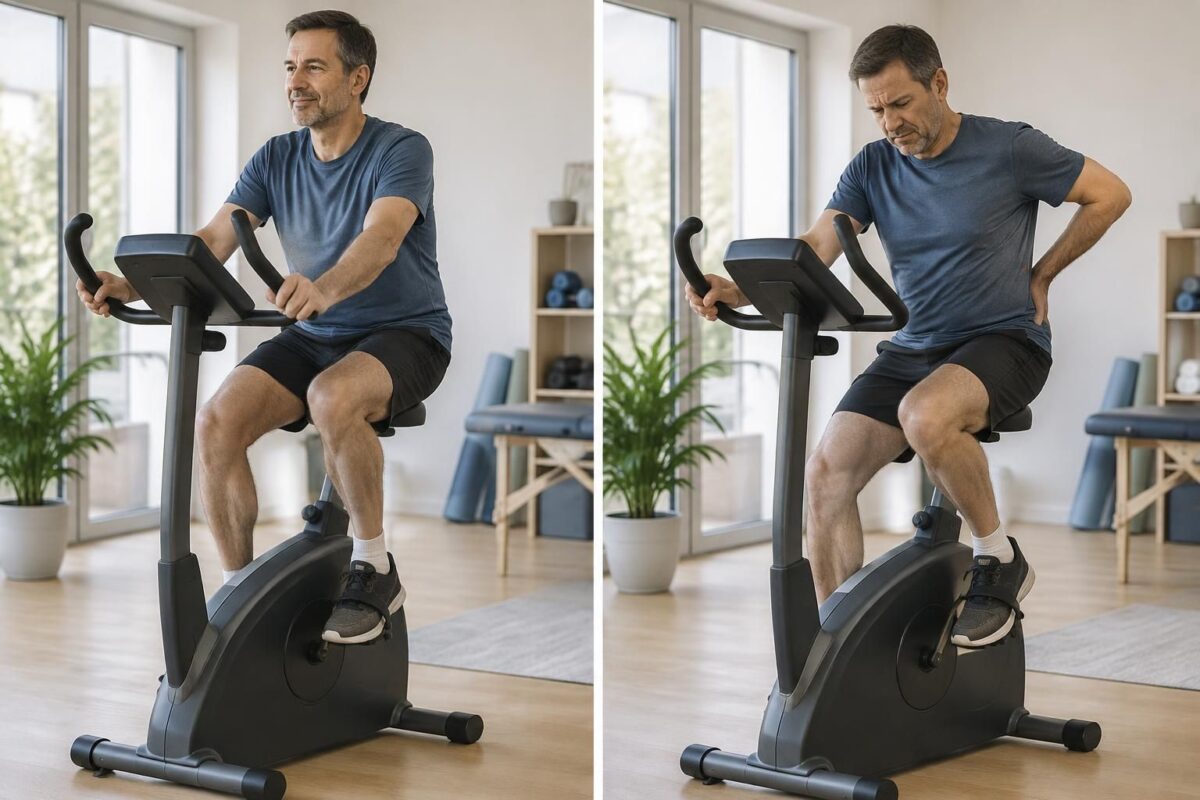
Sciatica and stationary bike: useful or aggravating depending on the case
IN BRIEF The stationary bike with sciatica can help you stay active if the pain is mild and stable. Start with a short session, at low resistance and in a comfortable position. If the pain goes further down the leg,…
Stay active without aggravating irritation
During an episode, continuing an intensive training regime is rarely indicated, but prolonged immobility is not systematically necessary. Try gentle walking if it doesn’t lead to limping. Stationary cycling, swimming, or using the elliptical can also be considered if pain remains low and stable. Stop any activity that increases radiating pain, even low-impact activities.
Focus on comfortable movements
Gentle mobility and gradual strengthening may be appropriate, but there is no universal exercise for sciatica. Avoid forced stretching and stop any movement that triggers a jolt, burning sensation, or tingling. If every attempt brings back the pain, seek guidance rather than insisting.

Sciatica and cycling: sitting, bending, and symptoms
IN BRIEF Sciatica is pain related to irritation of the sciatic nerve, which can extend from the buttock down to the leg. Cycling may sometimes be possible if symptoms are mild and stable: a comfortable seat, a less bent posture,…
Gradually resume running
Wait until you can walk quickly without increasing pain or limping. Then start on flat terrain by alternating short periods of slow running and walking. Space out the outings and observe the reactions during effort, after the session, and the next day. First, increase the duration, then reintroduce speed and elevation only after several well-tolerated sessions.
| Observed Signal | Cautious Conduct |
|---|---|
| Mild and stable discomfort, no neurological signs | Short, slow, flat jogging, if pain does not increase. |
| Pain radiating further down the leg | Stop running and focus on a tolerated low-impact activity. |
| Tingling, burning, or numbness | Do not run and seek medical advice. |
| Weakness or leg giving way | Stop the activity and consult quickly. |
| Limping or altered gait | Stop to avoid compensations. |
| Stronger pain after the session or the next day | Reduce the load and wait for improvement before resuming. |
| Intense or persistent pain | Avoid running and have symptoms evaluated. |
Illustrative Stories: the situations below are fictional and inspired by difficulties frequently encountered by runners. They do not replace medical advice.
Camille, 34 years old: “I first felt discomfort in my buttock after my outings. As it remained mild and did not change my running, I tried a very short and slow jog on flat ground. As soon as the pain started to travel down the back of my thigh, I stopped. I preferred to walk and monitor the symptoms rather than push through.”
Thomas, 42 years old: “During an outing, I felt tingling in my calf, then pain that extended to my foot. I stopped my run. It was stronger the next day, so I made an appointment with a healthcare professional instead of testing my leg at every training session.”
Nadia, 39 years old: “My pain was changing the way I ran, and I was starting to limp. I realized it was no longer just discomfort. I put intervals and long runs on hold, and I only resumed after I could walk quickly without worsening.”
Julien, 47 years old: “The stationary bike seemed like a good solution, but the sitting position intensified my symptoms. I stopped that activity too. I learned that exercise is only suitable if it remains well tolerated during the session and after, even if it is low-impact.”
Élodie, 31 years old: “I wanted to stretch hard to make the pain go away. The burning sensation in my leg increased, so I stopped that stretch. My physiotherapist helped me resume with gentler movements tailored to my symptoms.”
Marc, 51 years old: “The pain was accompanied by weakness in my foot. I didn’t try to run to see if it would go away: I stopped training and sought medical advice. For me, a loss of strength is a signal that requires caution, not a challenge to overcome.”
In a runner, pain starting from the lower back or buttock and traveling down the back of the thigh may indicate sciatica. It can sometimes extend to the calf or foot and be accompanied by burning, tingling, or numbness. These symptoms correspond to irritation of the sciatic nerve or a nerve root. Their intensity, trajectory, and evolution are important indicators in deciding whether it is prudent to run.
Running is not necessarily prohibited in case of sciatalgia. However, repeated impacts can exacerbate symptoms during a painful period. Mild, stable, and localized discomfort may sometimes allow for a very moderate trial, provided to run slowly, for a short time, and on flat terrain. Pain should not increase during the session, alter the gait, or intensify in the hours following or the next day.
Conversely, pain radiating further down the leg, persistent tingling, numbness, or loss of strength are warning signals. One should then stop running and seek medical advice, especially if walking becomes difficult or if a limp appears. Continuing despite a leg that responds less well risks disrupting foot placement and adding stress to an already sensitive area. In case of intense or worsening pain, it is better to avoid running to “test” the situation.
To stay active without replicating the impacts of running, some runners try gentle walking, stationary biking, or swimming. The choice depends, however, on their tolerance: if an activity increases radiating pain or causes worsening after effort, it needs to be adapted or stopped. Not all stretches and mobility exercises are suitable for every situation. It is best to avoid forced movements, especially those that exacerbate pain in the leg, and to seek advice from a professional when symptoms persist.
Recovery should be gradual, once walking quickly is well tolerated, without limping or worsening. Short sequences alternating walking and slow running allow for observing the body’s reaction. Flat terrain and an easy pace should be prioritized initially; intervals, hills, long outings, and competitions can wait. The reaction the next day is as important as the sensations during training. If symptoms return with every attempt, a professional assessment may help re-evaluate the load and recovery strategy.
This cautious approach aligns with the work of Dr. Sylvain Desforges, an expert in osteopathy, naturopathy, and manual medicine. Founder and president of the TAGMED clinics and the ACMA association, he dedicates his career to health innovation and the management of chronic pain. His practice focuses on integrating advanced technologies, such as spinal decompression, laser, and shockwave therapy. His declared objective is to offer care based on available data to support the health and well-being of patients.
In the context of running with sciatica, assessing pain and neurological signs remains essential before resuming training. Support can help better understand symptoms, adapt activities, and progress without confusing maintenance of movement with forced continuation of the training program.
Running with sciatica is not always excluded, but the decision should depend on your symptoms, not your training schedule. A mild, stable discomfort without neurological signs may sometimes allow for very gentle activity; increasing pain that radiates down the leg or alters your stride requires more caution. To run without taking unnecessary risks, monitor your condition during exertion, after the session, and the next day.
When to Stay Cautious
If the pain increases with each stride, radiates further down to the calf or foot, or causes you to limp, stop running. Do the same in case of persistent tingling, numbness, or weakness. A leg that responds less well is not just a sign of fatigue: seek medical advice, especially if symptoms persist or worsen. Additional guidance on stop signals and resuming activity is provided by FMC Academy, Love Fitness, and Tout pour ma santé.
When symptoms remain mild and stable, replace your usual run with a very short, slow test on flat terrain. Reduce the distance and avoid hills, accelerations, intervals, and long runs. Stop if the pain progresses or if your stride changes. Walking, gentle cycling, or swimming may be suitable depending on your tolerance, but they too must remain comfortable: a low-impact activity is not automatically suitable if it triggers radiating pain.
Gradually Resume
Before running again, check that brisk walking is well tolerated, without limping or worsening in the hours following. Start with alternating between walking and easy running, spacing out the sessions to observe the reaction of your back and leg. First, increase the duration, then the intensity, only if symptoms remain stable during exertion and the next day. You can find more practical tips from Velobar and Montagne et Nature.
Exercises and stretches should remain gentle and individualized: do not force a movement that increases pain in the leg. A healthcare professional can help clarify the cause of symptoms and tailor the resumption. Osteopathy may be considered as a complementary option depending on your situation, but should not replace a medical examination in the presence of neurological signs; consult the resources from SOS Sciatique on sports recovery and on posture in active individuals.
Deep gluteal pain or a band-like pain in the lower back with radiating symptoms can have various origins: the painful path alone is not enough to establish a diagnosis. To better describe your symptoms before a consultation, you can read the pages of SOS Sciatique on deep gluteal pain and radiating symptoms in the thigh and on lumbar pain with radiation. Their resource dedicated to recovery after a sprain is also available here.

Dr Sylvain Desforges, B.Sc., D.O., N.D., osteopath, is the founding president of TAGMED and of the ACMA association. He dedicates his practice to chronic spinal pain, low back pain and symptoms compatible with sciatica, particularly when pain radiates toward the buttock, leg, calf, foot or toes.
Through SOS Sciatique, he publishes educational content on sciatica symptoms, possible causes such as disc herniation, disc narrowing, foraminal stenosis or irritation of a lumbar nerve root, as well as non-surgical approaches that may be considered according to the evaluation. At Clinique TAGMED, care may include, depending on the case, motorized neurovertebral decompression, specific osteopathic care or precision percussion.
For an evaluation related to sciatica treatment in Montreal / Mount Royal or sciatica treatment in Terrebonne, please consult the services available at Clinique TAGMED.
Medical disclaimer
The information published on SOS Sciatique is provided for educational purposes only and does not replace a consultation, diagnosis, opinion or treatment provided by a physician or another authorized healthcare professional. The author of this article is neither a medical doctor nor a specialist in a medical specialty recognized by the Collège des médecins du Québec. The osteopathic, manual medicine or functional support approaches described on this site do not constitute medical acts and are not intended to replace medical follow-up.
Consult a physician or emergency service in cases of loss of bladder or bowel control, anesthesia in the saddle area, significant or progressive weakness in the leg or foot, fever, recent trauma, severe pain or rapid worsening of symptoms. For more details, please read our Legal Notice.


