


Osteopathy and tendonitis: a gentle and natural approach
27/06/2026
Osteopathic techniques to strengthen post-injury muscles
27/06/2026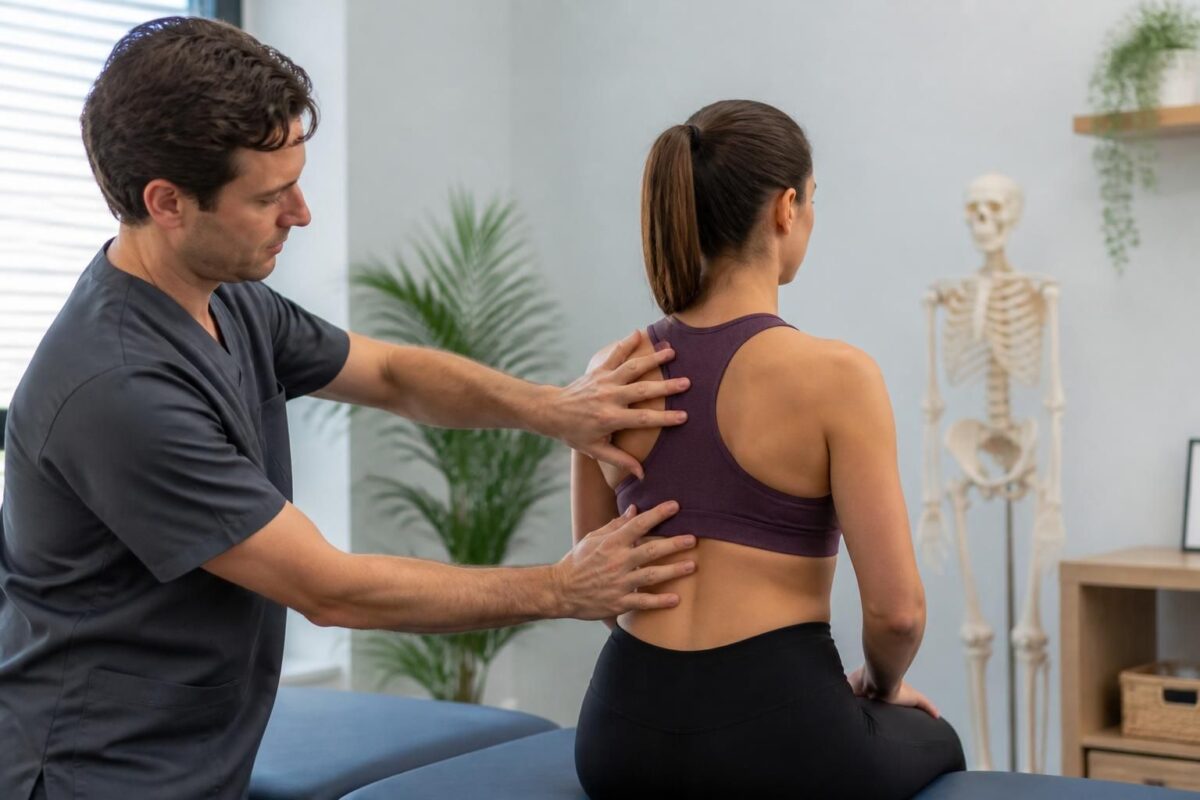
In short
| In short, theosteopathy for Improve posture of Active patients is a manual approach that rebalances the body with engagement and targeted stretching. She corrects the Muscle imbalances, improves theBody Alignment and the mobility, and reduces back and cervical pain while preserving performance. accessible to Montreal, it offers a solution non-invasive For those who want to move better on a daily basis. |
as part of theosteopathy, improving the posture of Active patients goes through a Postural evaluation precise and Manual techniques adapted that identify and correct the Postural imbalances and the Muscle tensions. thanks to Joint mobilizations and targeted stretching, she restores a Optimal body alignment, improves the mobility and reduces pain from poor posture. Practical advice and exercises at home complete the treatment to sustainably maintain the posture and optimize the Physical performance and daily well-being.
This article, written by a health professional expert in osteopathy, explains how Osteopathy Improves the posture at the Active patients. It presents a clear and practical approach, focused on postural evaluation, manual techniques and daily support. The goal is to optimize the alignment of the body, improve mobility and prevent pain linked to poor postural habits.
Assessment and identification of postural imbalances
In a first step, the osteopath observes posture Standing and moving, analyzes the vertebral curvatures and alignment of the shoulders, pelvis and feet. It identifies areas of muscle tension, joint restrictions and movement patterns that contribute to a bad posture. This identification guides the choice of interventions and advice for the active patient.
Osteopathic Techniques and Alignment Correction
The practitioner uses Joint mobilizations And some Soft manual techniques To release tension and improve range of motion. The goal is to get a Optimal body alignment and better stability during daily and sporting activities. According to the evaluation, practical advice is provided to support the maintenance of good posture at home or at work.
Impact on the performance and daily life of active people
A Improved posture Allows for better efficiency of movements and a reduction in muscular effort during physical activities. This can result in a Increase in mobility, a Performance progress and a decrease in pain related to postural imbalances.
Practical advice and follow-up
Regular monitoring facilitates the maintenance of postural gains. Osteopaths offer ergonomic advice and simple routines to maintain alignment between sessions. Proactive support helps active patients manage their postural health sustainably.
Resources and useful links
To deepen, consult resources on osteopathic action on musculoskeletal imbalances and improving local circulation. You can also explore information about the neurovertebral decompression and its role in posture via dedicated sites. for example, Osteopathy and musculoskeletal imbalances, Local circulation and osteopathy, and neurovertebral decompression. Other useful resources include Osteopathy and posture – skeleton and Tagmed Clinic.
To deepen the mechanisms and applications, see the resources and specialized publications referenced above.
Keywords : osteopathy, posture, Active patients, engagement, Body Alignment, mobility, ergonomy.
Medical Disclaimer: The information and advice provided on this site does not replace the health professional’s diagnosis or treatment. Please note that Dr. Sylvain Desforges osteopath is neither a doctor of medicine nor a doctor, and is not a specialist in a medical specialty as defined by the Collège des Médecins du Québec. Manual medicine, functional medicine and sports medicine as described on this site exclude any medical treatment or diagnosis made by a doctor or specialist doctor. Always consult your doctor for any medical questions. For more details, please read our full legal notice. »
Content concerning the treatment of sciatica with specific neurovertebral decompression and losteopathy and other specific conditions: in articles dealing with neurovertebral decompression, herniated disc, bulging disc, foraminal stenosis, spinal stenosis, Discal pinching or disc degeneration, avoid suggesting exercises or stretching.
References to Osteopathy Training Institutions: NUMSS, NAO, National University of Medical Sciences, National Academy of osteopathy.
Relevant Professional Associations: ACMA (Canadian Alternative Medicine Alliance), College of Canadian Osteopaths, College of Canadian Osteopaths.
Authorized links and web domains embedded in the text: sossciatica.com, Cliniquetagmed.com, decompressionneurovertebrale.com, SoshernieDiscale.com, SosherniatedDisc.com, sostunnelcarpien.com, sossciatica.com.
- Accurate postural evaluation to target imbalances and tensions.
- Sweet mobilizations To release restrictions and improve alignment.
- Targeted correction Muscle tension to rebalance body chains.
- Ergonomic advice and simple exercises to do on a daily basis.
- Follow-up plan to sustain postural gains.
- Mobility and stability Scapular and pelvic belts for active posture.
- load distribution Optimized during sports and professional activities.
- Easier breathing and relaxation to support effective posture.
- Active breaks and daily gestures integrated at your own pace.
- Quick results: Decreased postural pain and improved performance.

This article presents how osteopathy can improve the posture active people. Starting from a Personalized evaluation, the osteopath quickly identifies imbalances and proposes interventions that lengthen mobility, relax the muscles and rebalance the muscle chains. With simple exercises and daily tips, you gain alignment and performance, while maintaining an approach non-invasive.
Postural assessment and diagnosis
The first step is a Postural analysis Overall: Observation of the spine, shoulders, pelvis and hips while standing and moving. Mobility tests and targeted palpations help identify malfunctions and muscle tension that penalizes your alignment. This phase leads to a personalized treatment plan, focused on your daily activities and your favorite sports, in order to obtain a Body Alignment optimal.

How osteopathy improves the quality of life of active people
In short In short, theosteopathy is a global approach that Optimizes mobility and the function of the body of ACTIVE PEOPLE, for a better quality of life. It helps prevent injury and reduce Musculoskeletal pain While promoting the Sports recovery.…

Osteopathy and sports recovery: prepare the body for lasting performance
In short In short, Osteopathy and Sports recovery is one Global manual approach that sustainably prepares the body for the effort by restoring mobility and circulation After the effort. It is a discipline that acts on the sinews, the joints,…
Osteopathic techniques and mechanisms of action
Joint mobilizations
The Joint mobilizations soft aim to restore the amplitude of the movements and free the areas of tension. By improving the glide of the articular surfaces and the flexibility of the tissues, they facilitate Postural realignment durable and more effective during your daily actions.
Muscle relaxation and chain balancing
by techniques of muscle relaxation And targeted stretching, the osteopath acts on the damaged or tensioned muscle chains. The goal is to reduce the resistances that prevent the body from finding a neutral posture, while strengthening the stabilizing muscles to support thePostural adaptation.

Why Osteopathy Is Essential For Recovery People
In short In short, Osteopathy in convalescence is an approach manual and holistic which helps to accelerate the recovery by restoring The balance, the mobility and a good circulation fabrics. it contributes to Reduce the pain, support the Back to…

Osteopathic manipulations to strengthen post-traumatic muscles
In short In short, Osteopathic manipulations for Strengthen post-traumatic muscles constitute a gentle manual approach aimed at restoring the mobility, reduce the pain and facilitate the Functional rehabilitation After a injury. What is Is it? A series of precise gestures…
Daily action plan for active patients
To preserve and amplify the benefits, a simple program is proposed, incorporating Targeted exercises and ergonomic habits. Start with daily gestures that strengthen the support muscles of the trunk and hips. of Self-correcting exercises And diaphragmatic breathing exercises help stabilize posture as part of your activities, whether in the office or in the field.
Adopt regular active breaks and favor positions that promoteBody Alignment : sitting, standing and moving. The goal is to turn posture into a conscious habit, in order to reduce repeated tension and pain related to poor posture.
At the same time, favor simple gestures on a daily basis: adjust the height of the chair and desk, position the screen at eye level, and evenly distribute the loads when carrying bags or equipment. These adjustments support a Sustainable prevention pain and optimize your ability to stay active.

Osteopathy and prevention of work-related musculoskeletal disorders
In short theosteopathy is one Manual approach that restores body balance and prevents MSD related to work. Its advantages: reduction of tension, improvement of mobility and prevention of chronic pain. She is preventive and healing, suitable for office and trades…

The benefits of osteopathy to treat muscle imbalances
In short theosteopathy is a manual approach to restore themuscle harmony and postural considering the body as a whole. Its main benefits include the reduction of aches and tensions, the improvement of the mobility and from the posture, and prevention…
Lifestyle integration and performance
The objective of osteopathy is to improve your Active posture To optimize breathing, circulation and mobility. An aligned column and relaxed shoulders facilitate sports performance, recovery after exercise and injury prevention. By associating the sessions with a regular exercise program, you will constell your progress and consolidate your functional gains.

Osteopathy and chronic leg pain: regaining an optimal quality of life
In short In short, Osteopathy is one Global manual approach aimed at reducing Chronic leg pain and improve the quality of life. What is it? Non-drug therapy using the hands to identify restrictions and treat lesional chains. How does it…

How osteopathy supports recovery after complex surgery
In short In short, Post-operative osteopathy is an approach fresh which supports the recovery After a Complex surgery. It helps to reduce the pain and the fatigue, improves the mobility and accelerates the healing thanks to a better vascularization and…
Relapse monitoring and prevention
of Regular visits allow you to track your progress and adjust the plan according to the evolution of your activities. Monitoring makes it possible to anticipate behaviors that could call into question the postural improvement and to maintain optimal mobility in the long term.
| Element | Concise description |
|---|---|
| Postural evaluation | Analysis of alignments And some strain To target the Key areas |
| Joint mobilizations | engagement sweet To release tensions and increase theamplitude movement |
| muscle relaxation | targeted release for to balance tone and improve thealignment |
| Structural adjustments | corrections manuals on the column and the shoulder girdle to optimize thePostural axis |
| Stimulation of stabilizers | Activation of Stabilizing muscles To fix the posture and prevent compensation |
| Advice and exercises at home | elements ofself-management and simple exercises to maintain posture on a daily basis |
| Monitoring and reassessment | regular checks for Measure progress and adjust the treatment |
| Impact on performance | Improvement of the mobility and from the performance with pain reduction |
| pain prevention | Approach preventive which reduces the aches and the risk of injury |
Testimonials: Osteopathy and posture improvement in active patients
“Thanks to theosteopathy, my posture is aligned during my running sessions. The Sweet mobilizations And the targeted adjustments allowed me to correct my imbalances and increase my mobility in the long term. — Sophie, 32, runner
“Before, I felt a persistent fatigue due to poor posture in front of the computer and during my workouts. After a few sessions, I found a better posture, a mobility increased and reduced tension in the back and shoulders. — Alexandre, 41, developer and amateur athlete
“Theosteopathy targeted my tensions and adjusted my alignment. I notice a better posture In my dance movements, a fluidity found and less risk of injury during rehearsals. — Amandine, 29, dancer
“After several sessions, my posture improved considerably and my stability increased, especially on unequal terrain. The Joint mobilizations And the training tips allowed me to have fun again on the slopes without lower back pain. — Thomas, 55, skier
“On daily, my posture benefits greatly from the osteopathic approach. In addition to the sessions, the Exercises at home and the Ergonomic advice Help me keep a column aligned, even in busy days. » — Léa, 40, active executive
This practitioner is widely recognized for his work centered on theosteopathy applied to the posture people active. Its commitment is based on a holistic vision of the moving body, where the correct alignment of the spinal, pelvic and scapular axes determines daily comfort, sports performance and pain prevention. For him, correct the posture It is not limited to adjusting a joint: it is a question of harmonizing the muscle chains and the patterns of movement in order to unleash the physical potential without resorting to invasive interventions.
Journey and philosophy: With a rich clinical training, it combines the knowledge of theosteopathy With an approach manual medicine and skills in ergonomy. His work is driven by a search for evidence and a desire to integrate adapted technologies that support alignment and mobility. In his practice, the objective is to allow everyone, whether high-level athlete or professional in front of an office, to progress regularly towards a posture more stable and efficient.
Evaluation and Diagnosis: The process begins with a complete analysis of the posture, observing the spine, pelvis, shoulders and breath. thePostural evaluation Identifies the imbalances, tensions and compensations that are set up with thephysical activity. An accurate diagnosis guides the treatment and allows targeting areas that support movement, while preserving breathing and trunk stability. This approach emphasizes neuromuscular control and proprioception, two fundamental levers for asset posture.
Techniques and applications: engagement and the Targeted stretches are used to release the junctions and restore fluidity. Channel work myofasciales and on connective tissues helps to rebalance the segments and prevent harmful postural patterns. Gentle handling and loosening techniques help reduce local tension and restore natural alignment. The approach also aims to optimize breathing to support the center’s work and spine stability, which is particularly relevant in active patients who demand performance and endurance.
Maintenance and prevention program: Beyond the sessions, this practitioner offers simple exercises to do at home, intended to strengthen the stabilizing muscles and improve posture in everyday gestures. Ergonomic advice adapted to the working environment and active breaks complete the treatment. By integrating regular routines, active patients can maintain progress and reduce relapse risks, while improving sports performance and quality of life. The programs include concrete actions to promote a Sustainable posture and a better mobility.
Impact on active patients: athletes, executives and parents find concrete support in this approach to combine performance and well-being. By correcting postural blockages and optimizing mobility, theosteopathy Helps reduce pain postural, increase the range of motion and improve overall endurance. On the strength of this work, the practitioner continues his commitment: to support each patient in a proactive and personalized approach, in order to preserve the capacity for action and the pleasure of the movement.
This summary demonstrates how theosteopathy better posture at the Active patients By combining an in-depth postural assessment, engagement targeted and practical advice to maintain lasting alignment. The objective is to reduce muscle tension, optimize range of motion and improve performance on a daily basis, without resorting to invasive interventions.
Postural assessment and imbalance detection : the approach begins with a global observation and analysis of vertebral curvatures, muscle chains and areas of tension. Each patient benefits from an accurate diagnosis that identifies imbalances and tensions that affect body alignment. This step is the basis of the processing and allows you to define personalized objectives, focused on a Posture optimization and a better stability during physical activities.
Active mobilizations and corrections : the techniques used, in particular engagement soft joints and targeted stretching, aim to soften the joints, release the muscles and restore a Body Alignment optimal. By working on tense areas and links between body segments, osteopathy facilitates better mobility And a straighter posture, which positively influences endurance and sports performance. Practical advice and specific exercises can be offered to allow these gains to be maintained between sessions.
Patient role and home exercises : Sustainable effectiveness is based on patient involvement and appropriate daily practices. Self-correcting programs and ergonomic measures are often recommended to prevent recurrences and strengthen the stabilizing muscles. To deepen the results and methods, you can consult resources dedicated to posture optimization thanks to osteopathy, in particular guides and specialized articles.
Impact on performance and well-being : By improving thePostural balance And by reducing tension, osteopathy helps reduce pain related to poor posture and increase stability during movement. this better alignment of the body results in greater mobility, a more effective distribution of loads and better performance during sports or professional activities. To explore the benefits in top athletes, refer to resources that synthesize gains in strength, speed and recovery.
Prevention and follow-up : In order to perpetuate the results, regular follow-up is recommended and can be supplemented by advice and postural hygiene exercises. Proactive support makes it possible to adjust the treatment according to progress, objectives and requirements related to physical activity. To enrich your understanding of mechanisms and approaches, do not hesitate to consult specialized articles and guides on pain prevention and postural maintenance.
To deepen the approaches and results related to osteopathy and posture, you can consult the following resources:
Optimize your posture with osteopathy,
Osteopathy and posture guide,
Correct postural imbalances,
Osteopathy and trapezoid pain,
Benefits for top athletes.

Dr Sylvain Desforges, B.Sc., D.O., N.D., osteopath, is the founding president of TAGMED and of the ACMA association. He dedicates his practice to chronic spinal pain, low back pain and symptoms compatible with sciatica, particularly when pain radiates toward the buttock, leg, calf, foot or toes.
Through SOS Sciatique, he publishes educational content on sciatica symptoms, possible causes such as disc herniation, disc narrowing, foraminal stenosis or irritation of a lumbar nerve root, as well as non-surgical approaches that may be considered according to the evaluation. At Clinique TAGMED, care may include, depending on the case, motorized neurovertebral decompression, specific osteopathic care or precision percussion.
For an evaluation related to sciatica treatment in Montreal / Mount Royal or sciatica treatment in Terrebonne, please consult the services available at Clinique TAGMED.
Medical disclaimer
The information published on SOS Sciatique is provided for educational purposes only and does not replace a consultation, diagnosis, opinion or treatment provided by a physician or another authorized healthcare professional. The author of this article is neither a medical doctor nor a specialist in a medical specialty recognized by the Collège des médecins du Québec. The osteopathic, manual medicine or functional support approaches described on this site do not constitute medical acts and are not intended to replace medical follow-up.
Consult a physician or emergency service in cases of loss of bladder or bowel control, anesthesia in the saddle area, significant or progressive weakness in the leg or foot, fever, recent trauma, severe pain or rapid worsening of symptoms. For more details, please read our Legal Notice.





