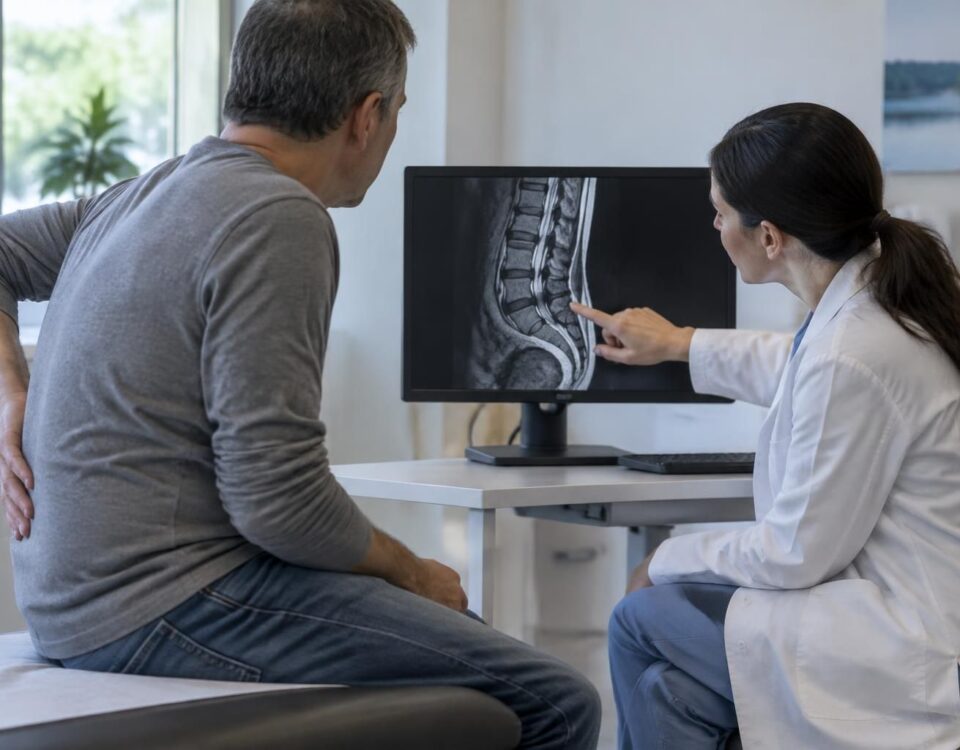
Sciatica in Montreal: L4-L5 and pain towards the top of the foot
21/10/2026
Sciatica and end-of-day pain
21/10/2026
IN BRIEF A L4-L5 sciatica can radiate to the outer side of the leg and the top of the foot, sometimes reaching the big toe. This pathway can guide the assessment, though it does not suffice to confirm the cause: a professional checks the symptoms and muscle strength. In Terrebonne, an evaluation helps to better understand the pain and consider appropriate management. |
In Terrebonne, sciatica associated with an L4-L5 lesion can irritate the L5 root and cause pain that descends into the leg to the top of the foot, sometimes towards the big toe. Tingling or difficulty lifting the foot may also occur. This pathway is an indication, but alone does not confirm the cause: a professional evaluation helps to guide the next steps.
A pain that starts from the lower back or buttock and descends to the top of the foot may be related to irritation of the L5 nerve root, sometimes associated with a herniated disc at the L4-L5 level. This pathway can guide the assessment, but it is not sufficient to make a diagnosis: a professional must consider your symptoms, muscle strength, and clinical examination. The nerve roots exit the lumbar spine and converge in the pelvis to form the sciatic nerve. The L5 root contributes to the sensitivity and movement of certain parts of the leg and foot. When irritated, pain or tingling can descend the outer side of the leg and reach the top of the foot, sometimes to the big toe. A herniated disc at L4-L5 can irritate the L5 root. However, the level indicated on an image does not always directly correspond to the cause of the symptoms. The perceived pain, clinical examination, and, if necessary, imaging must be interpreted together. To learn more about this level, check out this article on lumbar herniated disc L4-L5 and this page on pain towards the top of the foot associated with L4-L5. Pain reaching the big toe may be compatible with L5 irritation. More pronounced pain in the heel or on the outer edge of the foot may suggest involvement of another root, such as S1. These areas sometimes overlap and vary from person to person. The trajectory of symptoms helps the professional guide their examination, but it does not alone allow certainty in identifying the cause. You can read more about symptoms sometimes associated with L5 on the pages dedicated to pain towards the big toe and L5 nerve root irritation. The pain may begin in the lower back or buttock and then descend through the thigh and leg. Some individuals also experience tingling, a sensation of numbness, or weakness. Difficulty lifting the foot or big toe may also arise if the control of the affected muscles is impaired. These signs are not identical for everyone. Therefore, pain that descends to the foot does not prove that an L4-L5 hernia is present. Other causes can produce similar symptoms. A general overview of causes and signs is available in this guide on sciatica, its causes, and symptoms. The professional asks you about the onset of pain, its pathway, and situations that modify it. They may examine sensitivity, strength of certain movements, and reflexes. They may also check if leg movements reproduce your symptoms. These elements help distinguish between irritation of a nerve root and another cause of pain. An MRI or other imaging exam is not always necessary right from the start. The professional can discuss it when symptoms, examination, or their evolution warrant it. An image must be related to your clinical condition: a visible disc anomaly does not automatically prove that it explains the pain. To deepen the links between herniated discs and radiated pain, consult this resource on lumbosciatica related to a lumbar herniated disc as well as this presentation of lumbar levels visible on an MRI. The sciatic nerve divides into the tibial and fibular nerves. Their branches extend into the calf and foot. The fibular branch contributes to the sensitivity of the top of the foot, while the tibial branch mainly supplies the sole of the foot. Irritation lower on the nerve pathway can therefore produce signs different from those of irritation of a lumbar root. Pain that descends to the foot may also be linked to irritation of the S1 root. The perceived pathway and other signs help guide the assessment, without replacing it. To learn more, check the information on pain that can descend to the foot in L5-S1 sciatica. Seek prompt evaluation if the leg or foot becomes increasingly weak, if you have new difficulty walking, or if your foot drops. Significant or progressive weakness requires special attention. Immediately consult an emergency service in case of loss of control of the bladder or bowels, numbness around the genitals or anus, or symptoms affecting both legs. Fever, recent trauma, severe pain, or rapid aggravation also warrant medical evaluation. General information on sciatic-type pain is available on this page dedicated to sciatica and pain of the lumbar spine. In Terrebonne, an evaluation relates the pathway of the pain, changes in sensitivity, and the strength of the leg or foot. Depending on the results and your situation, medical follow-up may be indicated. At the TAGMED Clinic, non-surgical support options, such as specific osteopathy or motorized neurovertebral decompression, are considered only after evaluation and depending on the case. These approaches do not replace a diagnosis or medical follow-up. To learn about the available services, visit the page on treatment of sciatica in Terrebonne or the website of TAGMED Clinic. A supplementary resource also describes the problems that can affect the sciatic nerve. Does pain on the top of the foot always mean L4-L5 sciatica? Does pain extending to the big toe confirm L5 compression? Can an MRI show a herniation that does not cause pain? Sylvain Desforges, B.Sc., D.O., N.D., osteopath and naturopath, is the founding president of TAGMED and the ACMA association. He dedicates his practice to chronic pain of the spine, lumbar pain, and pain associated with sciatica, particularly when the pain radiates to the buttock, leg, calf, foot, or toes. Through SOS Sciatique, he publishes educational content on the symptoms of sciatica, possible causes such as disc herniation, disc pinching, foraminal stenosis, or irritation of a lumbar nerve root, as well as on non-surgical approaches that may be considered based on the evaluation. At the TAGMED Clinic, care may include, depending on the case, motorized neurovertebral decompression, specific osteopathy, or a precision impactor. For an evaluation related to treatment of sciatica in Montreal / Mont-Royal or treatment of sciatica in Terrebonne, consult the available services at TAGMED Clinic. Medical disclaimer: The information and advice provided on this site do not replace the opinion, diagnosis, or treatment of a healthcare professional. Please note that Dr. Sylvain Desforges, osteopath, is neither a medical doctor nor a physician and is not a specialist in a medical specialty as defined by the Collège des médecins du Québec. Manual medicine, functional medicine, and sports medicine as described on this site exclude any treatment or medical diagnosis made by a physician or specialist. Always consult your doctor for any medical questions. For more details, please read our complete legal notice.Why can L4-L5 pain reach the top of the foot?
The big toe and the top of the foot: landmarks, not a diagnosis
What signs may accompany L4-L5 sciatica?
How an assessment helps clarify the origin of symptoms
What other areas of the foot may be affected?
When should you seek prompt consultation?
Evaluation of sciatica in Terrebonne
Frequently Asked Questions
No. This pathway may suggest irritation of L5, but other causes are possible. Clinical evaluation helps specify the origin of the symptoms.
No. It may be consistent with irritation of L5, but does not alone confirm compression. The professional takes into account all signs and the examination.
Yes. Some disc abnormalities may be visible in individuals without symptoms. Imaging must therefore be interpreted with the clinical history and examination.About the Author
Medical Disclaimer
Pain Guidelines
- A disc lesion L4-L5 can irritate the L5 root.
- The pain may radiate down the side of the leg to the top of the foot and to the big toe.
- Numbness or difficulty in lifting the foot may also occur.
What to Watch in Terrebonne
- The pathway of symptoms helps direct the evaluation but does not confirm the level reached by itself.
- A consultation allows checking sensitivity, strength, and involved movements.
- Significant or progressive weakness, urinary disturbances, or insensitivity of the perineum: consult immediately.

Pain that starts from the lower back or the buttock and radiates to the top of the foot may be consistent with irritation of the L5 root, sometimes associated with a disc problem at the L4-L5 level. This pathway provides useful guidelines but does not alone confirm the cause: an evaluation in Terrebonne can help specify the symptoms and choose appropriate measures.
L4-L5 Sciatica: Understanding Pain to the Top of the Foot
Between the lumbar vertebrae, the discs help absorb stresses. At the L4-L5 level, nerve irritation or compression can cause pain radiating into the buttock, down the side of the leg, and to the top of the foot, sometimes extending to the big toe. Tingling, numbness, or weakness may also manifest.
This pathway is often associated with the L5 root, but symptoms vary from person to person. Therefore, pain in the foot does not prove that an L4-L5 herniation is present. Other causes may produce similar signs. The healthcare professional considers the history of symptoms and the examination, including sensitivity and strength, before determining if further tests are necessary.
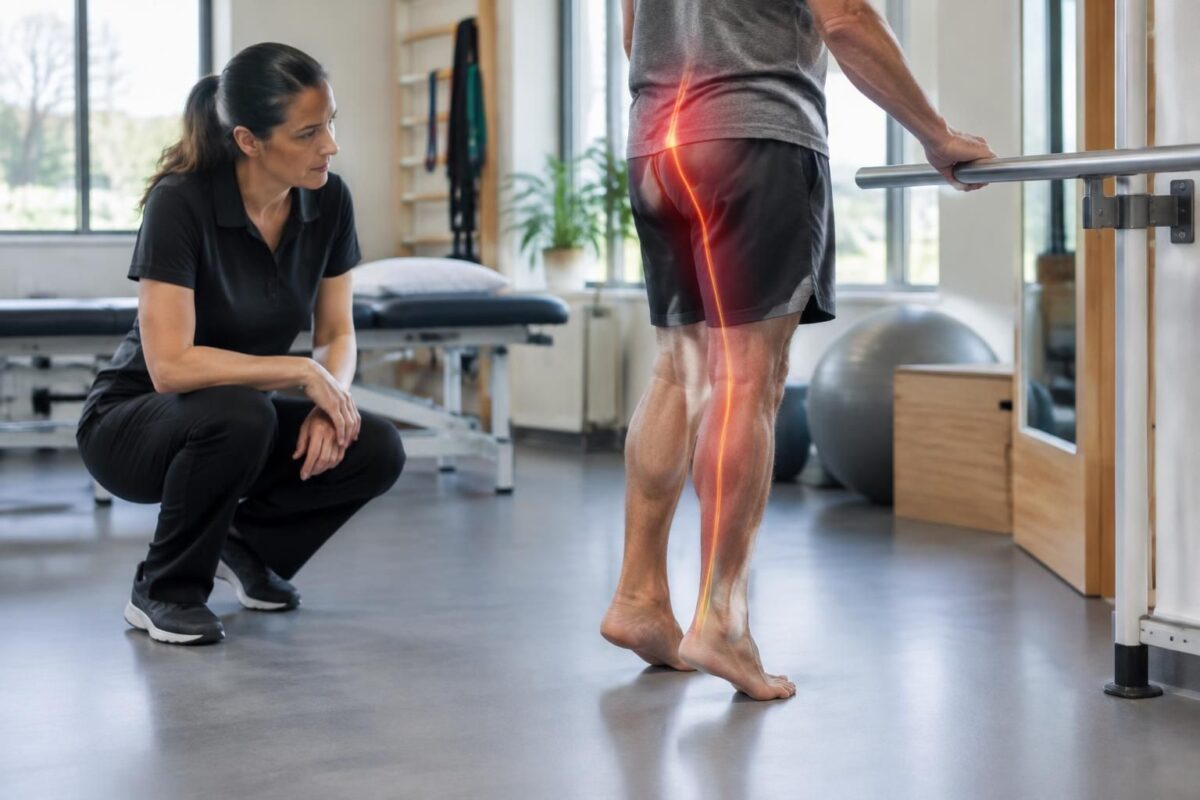
Sciatica in Terrebonne: S1 and difficulty standing on tiptoe
IN SHORT An S1 sciatica can irritate the nerve root associated with the calf and make it difficult to rise onto the balls of the feet. This sign should be evaluated with strength, sensitivity, reflexes, and walking: the pathway of…

Sciatica in Terrebonne: L5-S1 and symptoms in the calf
IN BRIEF A L5-S1 sciatica can cause pain that radiates down the calf, sometimes accompanied by tingling, numbness, or weakness. At Terrebonne, an assessment at the TAGMED Clinic helps to examine the symptom pathways, strength, and sensitivity, and then discuss…

Sciatica in Terrebonne: pain in the big toe, L5 root or another cause?
IN BRIEF Pain in the big toe accompanied by pain in the buttock or leg may be compatible with irritation of the L5 root, but other causes are possible. In Terrebonne, the evaluation notably compares strength, sensitivity, and gait to…
What Measures Can Help in Daily Life?
Adjusting Positions and Activities
Avoid sitting or being immobile for long periods if it exacerbates the pain. Change positions regularly and prefer short periods of walking or manageable movement rather than prolonged bed rest. Temporarily reduce movements that clearly trigger radiation, such as lifting a load by bending, without stopping all activity if the movement remains comfortable.
Observing the Evolution of Symptoms
Note where the pain starts, how far it radiates, which toes are affected, and what aggravates or relieves it. Report any weakness in lifting the foot or walking on the heels. This information helps to guide the evaluation. Avoid trying to determine the exact level of compression yourself or forcing stretches that increase the symptoms.

Sciatica in Terrebonne: why the affected root changes the pain path
IN BRIEF Sciatica is a pain related to the irritation of a lumbar nerve root, the path of which varies depending on the affected root. Damage to L5 can radiate to the top of the foot, while damage to S1…

Sciatica in Terrebonne: L4-L5 disc, L5-S1 disc, and leg pain
IN BRIEF Sciatica is pain that travels down the leg when a nerve root is irritated. An injury to the L4-L5 disc often affects the L5 root; an L5-S1 injury affects the S1 root. The path of the pain and…

Sciatica in Terrebonne: understanding lumbar levels on an MRI
IN BRIEF Sciatica may be related to irritation of a lumbar nerve root. A lumbar MRI shows the disks and nerves at different levels, such as L4-L5 or L5-S1, to help identify an abnormality and compare it with symptoms. In…
When to Request an Evaluation in Terrebonne?
A consultation is indicated if the pain persists, limits your activities, or is accompanied by tingling and numbness. The evaluation allows checking whether the condition is compatible with nerve irritation and discussing non-surgical options based on your situation. At the TAGMED Clinic, support may include specific osteopathy or motorized neurovertebral decompression, when the evaluation suggests that these approaches are appropriate. They do not replace a medical diagnosis or necessary follow-up.
Quickly consult a doctor or an emergency service in case of significant or progressive weakness, foot drop, loss of urinary or bowel control, or numbness in the saddle area. A fever, recent trauma, or rapid deterioration also warrants an immediate evaluation.
About the Author
Sylvain Desforges, B.Sc., D.O., N.D., osteopath and naturopath, is the founding president of TAGMED and the ACMA association. He dedicates his practice to chronic spinal pain, lower back pain, and pain compatible with sciatica.
Medical warning: this information is educational and does not replace a consultation, diagnosis, or treatment by a licensed healthcare professional. The author is neither a doctor nor a specialist in a medical specialty recognized by the Collège des médecins du Québec. The approaches described do not constitute medical acts and do not replace medical follow-up.
| Marker | What it may indicate |
|---|---|
| Pain starting from the lower back or buttock | A lumbar nerve irritation is possible. |
| Pain that descends behind or along the side of the leg | A pathway compatible with sciatica may be present. |
| Pain or numbness on the top of the foot | May correspond to the area of the L5 root. |
| Symptoms extending to the big toe | May also point to irritation of L5. |
| Pain associated with the L4-L5 level | A disc lesion may irritate L5, without confirming the cause. |
| Difficulty raising the foot or big toe | Have this weakness evaluated quickly by a healthcare professional. |
| Loss of urinary or bowel control, or numbness in the perineum | Medical emergency: consult without delay. |
| Evaluation in Terrebonne | A clinical examination helps specify the origin; imaging is not always necessary right away. |
Sciatica in Terrebonne: Illustrative accounts of L4-L5 pain to the top of the foot
Note: the testimonials below are fictional and composite accounts, written for educational purposes. They do not correspond to authentic patient opinions and do not predict the outcome of care. Pain toward the top of the foot may be compatible with irritation of a nerve root, particularly L5, but its origin must be evaluated by a healthcare professional.
“My pain started in my lower back and descended to my big toe.”
In this fictional account, a person from Terrebonne describes lower back pain that travels through the buttock and leg, then reaches the top of the foot. The pathway worries them because they thought the problem was only in the foot. The anatomical explanation helps them understand that nerve irritation near the spine can cause symptoms lower down in the leg.
“I didn’t know how to explain the tingling.”
Another composite scenario features a person who feels tingling on the top of the foot, sometimes extending to the big toe. By noting the precise pathway, the times when the symptoms increase, and the positions that reduce them, they prepare useful information to share during an evaluation. These observations can guide the examination but are not sufficient to establish a diagnosis.
“The mention of L4-L5 made me believe the cause was certain.”
In this illustrative account, a person immediately associates pain to the top of the foot with an L4-L5 issue. However, this level may be linked to irritation of the L5 root, but the symptoms alone do not confirm a disc herniation or its location. The clinical examination and, when indicated, imaging allow the professional to put the elements in context.
“I started to monitor my ability to raise my foot.”
This fictional account depicts a person who notices weakness when trying to lift the front of the foot. This sign deserves particular attention, especially if it appears recently or worsens. Significant or progressive weakness requires quick medical evaluation rather than self-diagnosis or waiting for a routine appointment.
During an evaluation for sciatica in Terrebonne, describing whether the pain starts in the back or buttock, whether it descends below the knee, and whether it reaches the top of the foot or the toes can help guide the examination. However, the pathway does not solely identify the cause: multiple issues can produce similar symptoms.
Non-surgical approaches are selected based on the evaluation and situation of each person. They may include movement advice or manual therapy but do not replace a diagnosis or medical follow-up when necessary. Be wary of promises of guaranteed cures or conclusions drawn solely from an image or isolated symptom.
Consult without delay in case of loss of urinary or bowel control, numbness in the saddle area, significant or progressive weakness of the leg or foot, fever, recent trauma, or rapid worsening of symptoms.
About the Author
Sylvain Desforges, B.Sc., D.O., N.D., osteopath and naturopath, is the founding president of TAGMED and the ACMA association. His practice focuses in particular on chronic spinal pain, lower back pain, and pain compatible with sciatica. At the TAGMED Clinic, the contemplated care may include, depending on the evaluation, motorized neurovertebral decompression, specific osteopathy, or precision impacting.
Medical Warning
The information presented is provided for educational purposes and does not replace a consultation, diagnosis, advice, or treatment by a doctor or other licensed healthcare professional. The author is neither a doctor nor a specialist in a medical specialty recognized by the Collège des médecins du Québec. The approaches of osteopathy, manual medicine, or functional support do not constitute medical acts and are not intended to replace medical follow-up.
Sciatica in Terrebonne: L4-L5 pain to the top of the foot
Pain that starts from the lower back or buttock and descends to the top of the foot may correspond to irritation of a lumbar nerve root. When a disc located between the L4 and L5 vertebrae bulges or irritates, the L5 root may be involved. The pain, tingling, or numbness may then follow the outer side of the leg to the top of the foot, sometimes down to the big toe. This pathway is a useful marker, but it does not alone confirm a diagnosis.
Sciatica refers to a set of symptoms related to the irritation of a nerve root or the sciatic nerve. The problem may be located in the lower back while sensations are primarily felt in the leg or foot. This is why treating only the painful area is not always enough to understand the origin of the symptoms. An evaluation takes into account their path, duration, the positions that worsen or relieve them, as well as strength, sensitivity, and reflexes.
In consultation at Terrebonne, it is useful to precisely describe where the pain starts, how far it descends, and which toes are affected. Discomfort on the top of the foot or towards the big toe may direct the examination towards the L5 root, without constituting proof of compression at L4-L5. Other causes may produce similar symptoms. The healthcare professional can examine the movements of the back and leg, sensitivity, and the ability to raise the foot. Imaging is not systematically necessary from the outset; its usefulness depends on the history, examination, and progression.
Symptoms vary from person to person. Some experience sharp or burning pain, while others mainly feel tingling, numbness, or weakness. Prolonged sitting, certain movements, or coughing can sometimes change the pain. Noting these variations for a few days can help explain them better during a consultation. However, avoid jumping to conclusions about a herniated disc or multiplying painful exercises: the same sensation can have different origins and requires a tailored evaluation.
Management depends on the probable cause, the intensity of the symptoms, and the person’s capabilities. It may include advice to temporarily adapt activities, maintaining tolerable movement, and, depending on the evaluation, manual or functional approaches. At the TAGMED Clinic, options may include specific osteopathy or motorized neurovertebral decompression, when deemed appropriate. These services do not replace a medical evaluation and do not guarantee a particular outcome. For persistent or concerning pain, seek advice from a licensed healthcare professional.
Significant or progressive weakness, a foot that becomes difficult to lift, loss of bladder or bowel control, or numbness in the perineal region requires urgent evaluation. Also consult quickly in case of fever, recent trauma, or rapid worsening of symptoms.
About the author
Sylvain Desforges, B.Sc., D.O., N.D., osteopath and naturopath, is the founding president of TAGMED and the ACMA association. He devotes his practice to chronic spinal pain, particularly lower back pain and symptoms consistent with sciatica. His approach focuses on evaluation and non-surgical options that may be considered for each situation.
Medical disclaimer
This content is provided for educational purposes and does not replace consultation, diagnosis, or treatment by a physician or other licensed healthcare professional. The author is neither a physician nor a specialist in a medical specialty recognized by the Collège des médecins du Québec. The approaches of osteopathy, manual medicine, or functional support do not constitute medical acts and do not replace medical follow-up.
Pain that starts in the lower back or buttock and descends towards the top of the foot may be consistent with irritation of a nerve root, particularly L5, which can sometimes be affected in a disc problem at L4-L5. However, the path of the pain is not sufficient to establish a diagnosis: a clinical evaluation allows symptoms to be contextualized and determines whether management at Terrebonne is appropriate.
The sciatic nerve is formed from several lumbar and sacral nerve roots, then traverses the buttock region and descends behind the thigh. Lower down, its branches contribute to the sensitivity and movements of the foot. Irritation of the L5 root can cause pain or abnormal sensations on the side of the leg and the top of the foot, sometimes reaching the big toe. To visualize this path, consult the explanations on the path of the sciatic nerve and those provided by Beyond.
It is useful to distinguish the level of the disc from the affected nerve root. A disc involvement at L4-L5 may irritate the L5 root, but symptoms vary depending on the location and severity of the involvement. Pain towards the top of the foot may guide the examination, without proving on its own that it is indeed an L5 sciatica. To better understand this distinction, you can consult the information on the path of L5 sciatica and on the levels L4-L5 and L5-S1.
The healthcare professional looks at the whole picture: starting point of the pain, affected areas, numbness or tingling, foot strength, and progression of the symptoms. Difficulty in lifting the toe or walking on the heels deserves particular attention. A protrusion or herniated disc may sometimes affect a nerve root, but a visible anomaly on imaging does not automatically explain the pain; the result must be interpreted along with the symptoms and examination. To delve deeper into these two aspects, read the pages on disc protrusion and nerve irritation and on herniated disc visible without pain.
If the pain reaches the big toe, the L5 root may be part of the hypotheses considered, but other causes are possible. The doctor or licensed professional will also consider sensitivity, strength, and the circumstances of onset. Additional information is available on pain in the big toe and the L5 root as well as on L5 sciatica with pain towards the big toe.
Note for a few days what triggers or alleviates the pain: walking, sitting position, movements of the back, or getting out of bed. These observations can assist during the evaluation, without replacing it. If symptoms are especially present upon waking, you may also consult the advice regarding sciatica and pain when getting out of bed. Avoid assigning yourself a level of compression or starting exercises that significantly increase the pain radiating down the leg.
For an evaluation related to sciatica in Terrebonne, the possible approaches depend on the symptoms, the examination, and your situation. At TAGMED Clinic, care may include, depending on the case, motorized neurovertebral decompression, specific osteopathy, or precision percussion. These approaches do not replace a medical diagnosis; appropriate options should be discussed with a licensed healthcare professional.
Quickly consult a doctor or an emergency service in cases of significant or progressive weakness in the leg or foot, loss of urinary or bowel control, numbness in the saddle area, fever, recent trauma, or rapid deterioration. These signs require prompt evaluation.

Sciatica L4-L5 in Terrebonne: possible pain, numbness, and weakness
IN BRIEF L4-L5 sciatica refers to pain related to irritation of a nerve root in the lower back. It can radiate to the buttock and leg, with numbness or weakness. Identifying these symptoms helps guide evaluation and care. In Terrebonne,…

Sciatica L5-S1 in Terrebonne: why the pain can radiate down to the foot
IN BRIEF L5-S1 sciatica refers to pain related to irritation of a lumbar nerve root, which may start from the lower back and radiate into the buttock, leg, and down to the foot. The pathway varies: the top of the…

Dr Sylvain Desforges, B.Sc., D.O., N.D., osteopath, is the founding president of TAGMED and of the ACMA association. He dedicates his practice to chronic spinal pain, low back pain and symptoms compatible with sciatica, particularly when pain radiates toward the buttock, leg, calf, foot or toes.
Through SOS Sciatique, he publishes educational content on sciatica symptoms, possible causes such as disc herniation, disc narrowing, foraminal stenosis or irritation of a lumbar nerve root, as well as non-surgical approaches that may be considered according to the evaluation. At Clinique TAGMED, care may include, depending on the case, motorized neurovertebral decompression, specific osteopathic care or precision percussion.
For an evaluation related to sciatica treatment in Montreal / Mount Royal or sciatica treatment in Terrebonne, please consult the services available at Clinique TAGMED.
Medical disclaimer
The information published on SOS Sciatique is provided for educational purposes only and does not replace a consultation, diagnosis, opinion or treatment provided by a physician or another authorized healthcare professional. The author of this article is neither a medical doctor nor a specialist in a medical specialty recognized by the Collège des médecins du Québec. The osteopathic, manual medicine or functional support approaches described on this site do not constitute medical acts and are not intended to replace medical follow-up.
Consult a physician or emergency service in cases of loss of bladder or bowel control, anesthesia in the saddle area, significant or progressive weakness in the leg or foot, fever, recent trauma, severe pain or rapid worsening of symptoms. For more details, please read our Legal Notice.