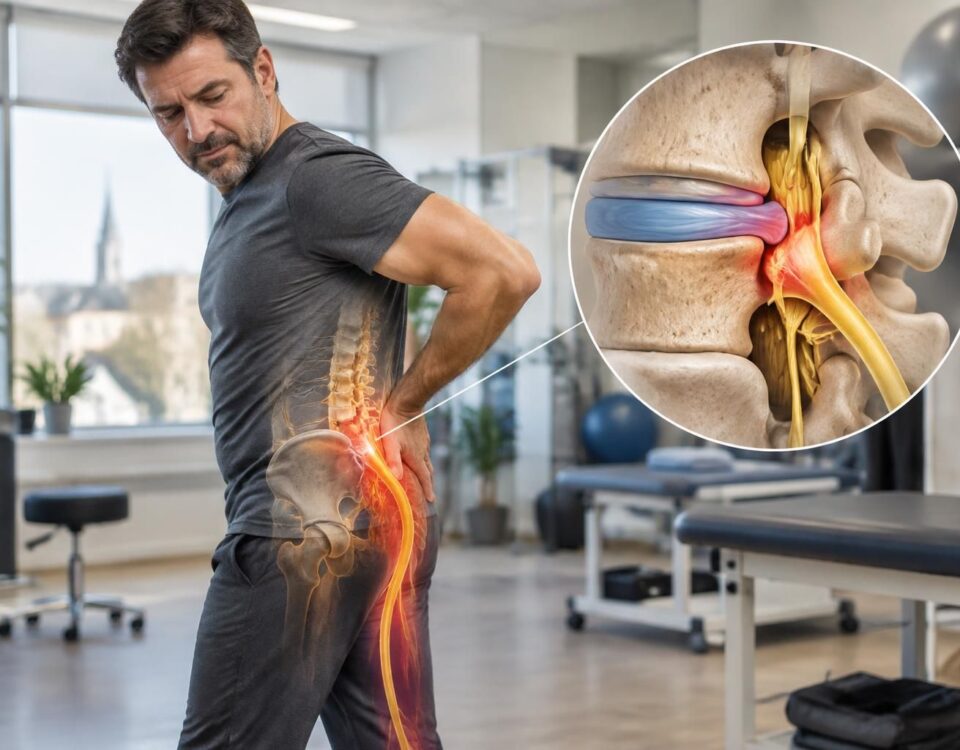
Sciatica in Montreal: radicular pain versus referred pain
27/10/2026
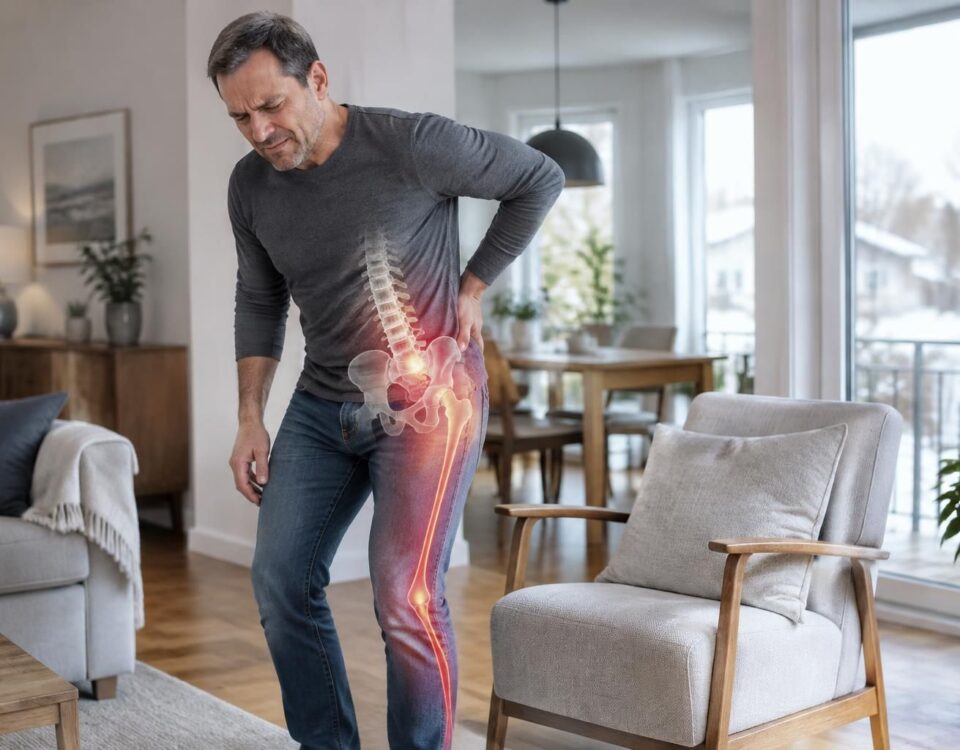
Sciatica and pain relieved by bending: possible stenosis
27/10/2026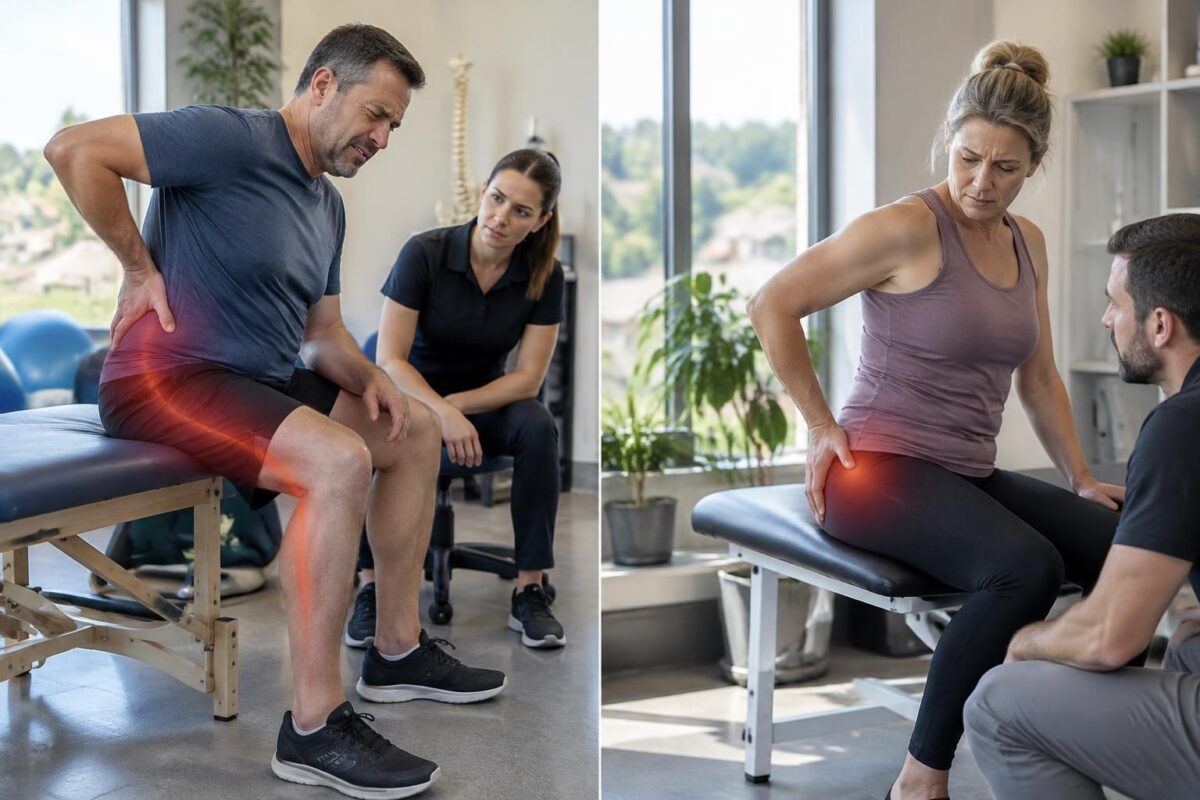
IN BRIEF
| Sciatica refers to pain that radiates into the buttock and sometimes the leg. A radicular pain comes from the irritation of a nerve root and may be accompanied by tingling, numbness, or weakness; a referred pain spreads from another structure without necessarily involving the nerve. In Terrebonne, distinguishing these profiles helps guide the assessment and the next steps, without replacing a professional diagnosis. |
In Terrebonne, pain that descends into the buttock or leg can correspond to radicular pain, related to the irritation of a nerve root, or to referred pain, felt at a distance from its origin without direct involvement of that root. The location, the path of symptoms, the numbness, and the strength help direct the assessment, but are not sufficient to establish a diagnosis. A clinical evaluation allows for better distinction of these profiles and discussion of appropriate options.
In Terrebonne, pain that descends into the buttock or leg may originate from an irritated nerve root, but it can also be a referred pain coming from the lower back or hip. The path of the symptoms, the neurological examination, and their link with movement help distinguish these causes. An MRI alone does not always allow for a diagnosis to be established.
The term “sciatica” often describes pain that follows the path of the sciatic nerve. It does not always specify the cause. Radicular pain comes from the irritation or compression of a nerve root. Referred pain originates in another structure, such as a disc, a joint, or a muscle, and is then felt in the buttock or leg without necessarily involving a nerve root.
This distinction guides the evaluation and the choice of options to discuss. To understand the main landmarks, also check our page on the difference between sciatica and referred lumbar pain.
How to recognize radicular pain?
A nerve root can become irritated near the lumbar spine. The pain can then radiate from the buttock down the thigh, calf, or foot. It often affects one side and may be accompanied by tingling, numbness, or weakness. The affected area depends on the involved root.
A lesion at the L5-S1 level can produce symptoms in the calf or foot. However, the path can vary from person to person. The professional evaluates the distribution of symptoms and compares it to strength, sensitivity, and reflexes. To learn more, check the pages on L5-S1 and symptoms in the calf and nerve root, disc, and foramen.
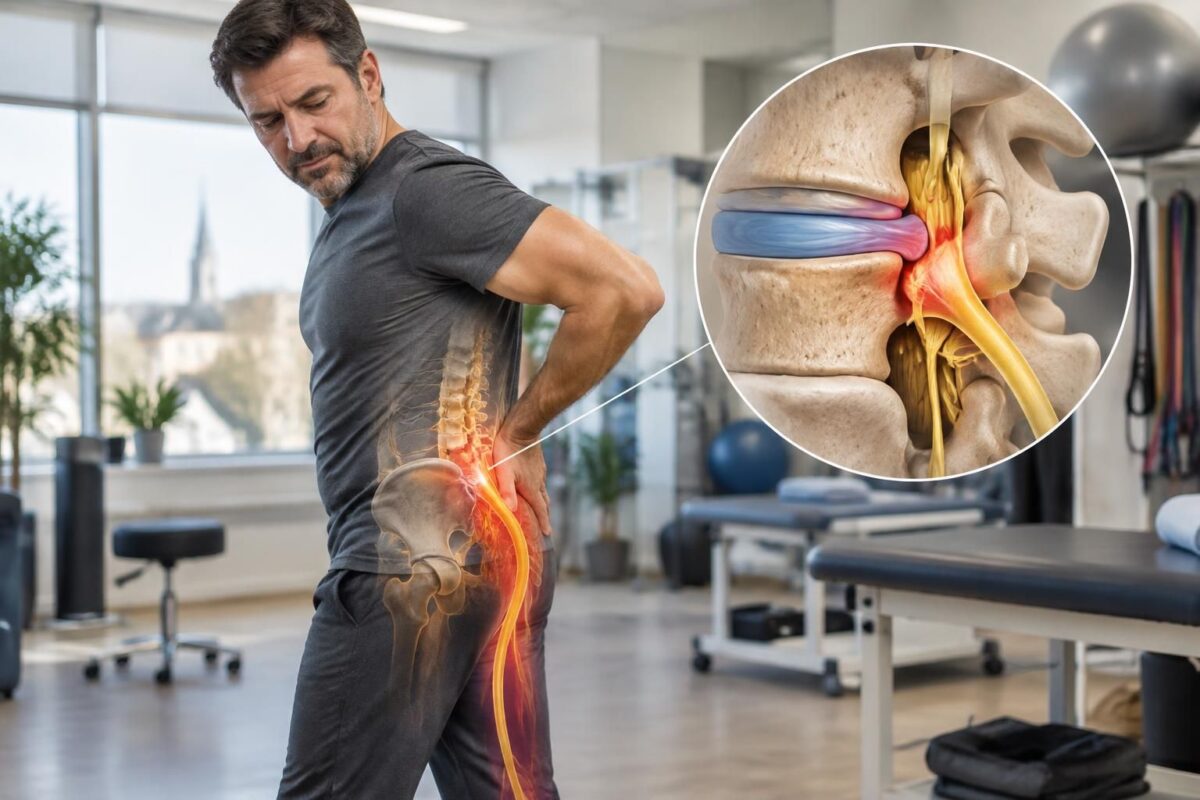
Sciatica in Terrebonne: nerve root, disc, and foramen explained simply
IN BRIEF Sciatica is pain that occurs when a nerve root in the lower back is irritated or compressed, sometimes by a disk or a narrowed foramen. Understanding these structures helps better locate the possible cause of symptoms and guide…
How to recognize referred pain?
Referred pain can originate from the lower back and spread to the buttock or thigh. It does not always follow a specific path down to the foot. It is less often accompanied by a loss of sensation or weakness corresponding to a nerve root. However, this difference alone is not sufficient to confirm the cause; an examination remains necessary.
The pain can also vary depending on position or activity. For instance, some people experience more pain when sitting. This sign alone does not allow for the distinction between radicular and referred pain. Consult this resource on pain that prevents sitting.
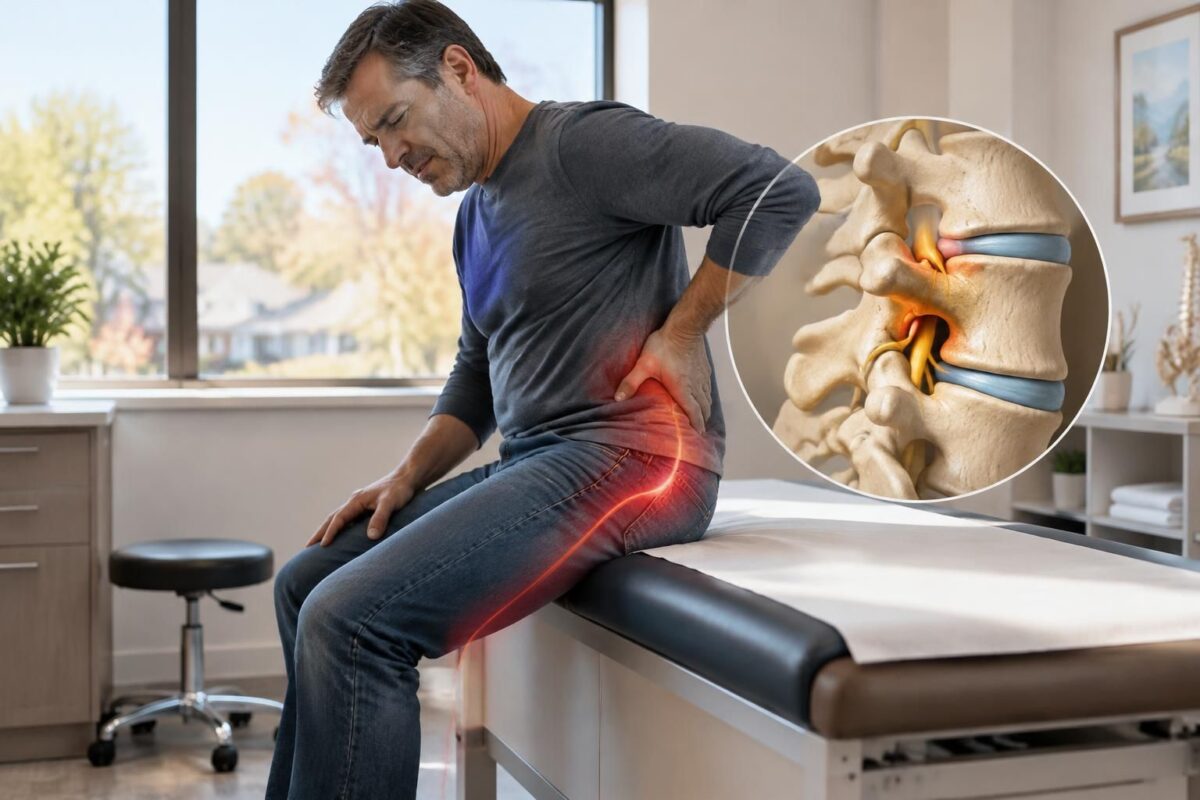
Sciatica in Terrebonne: understanding the L5-S1 foraminal compression
IN BRIEF The L5-S1 foraminal compression corresponds to a narrowing of the opening through which a nerve root passes, potentially contributing to sciatica. In Terrebonne, the assessment compares the side and course of the symptoms, neurological examination, imaging, and limited…
Why the path of pain is not sufficient
Pain from a nerve root and referred pain can resemble each other. Therefore, pain descending into the leg does not automatically prove nerve compression. The professional checks if the side, the painful area, and examination results correspond with each other.
Pain can also change locations over time. For example, it may descend into the leg and then concentrate more in the buttock. This evolution should be described precisely during the evaluation. For more guidelines, consult the article on pain that descends and then rises towards the buttock.
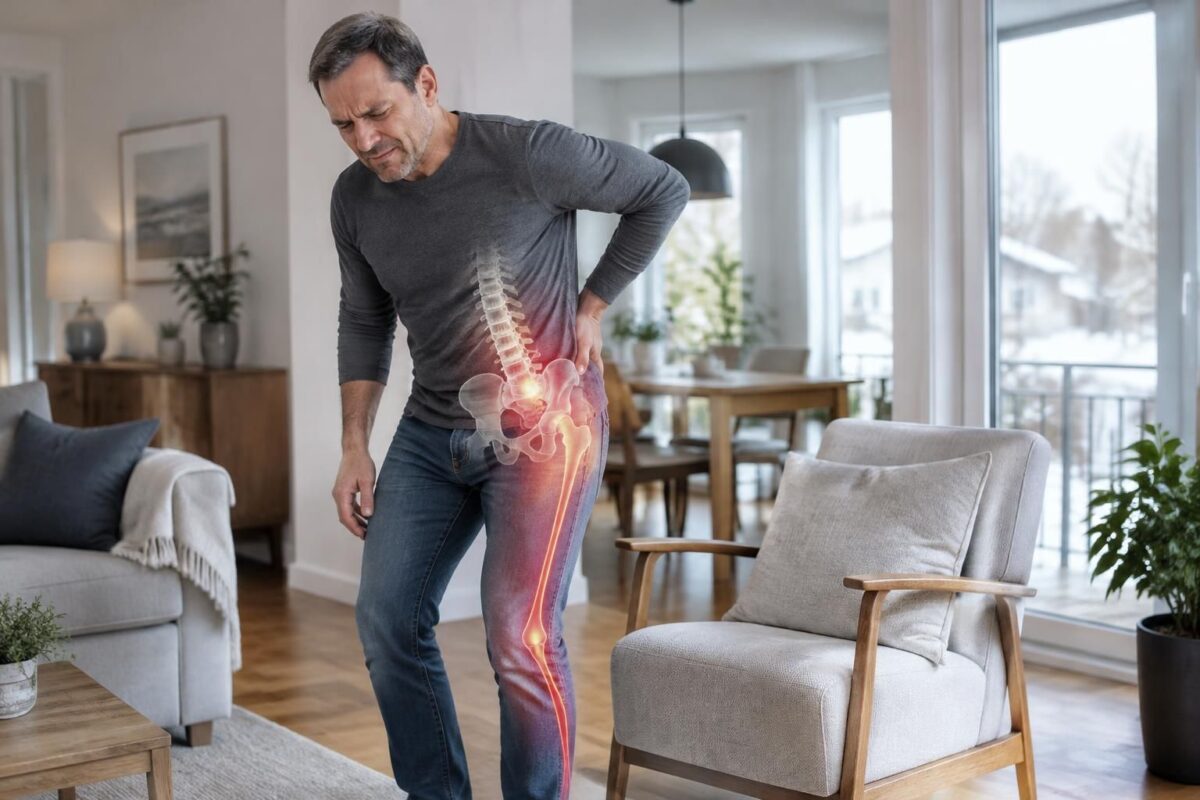
Sciatica in Terrebonne: why L5-S1 is often involved
IN BRIEF Sciatica corresponds to pain related to the irritation of a nerve root, which can extend from the buttock down to the leg. The L5-S1 level is often involved, as a disc herniation or irritation at this location can…
The role of the foramen and lumbar canal
The foramen is the opening through which a nerve root exits the spine. A narrowing at this point can irritate a root and cause more pronounced symptoms on one side. Central stenosis reduces the space in the lumbar canal and can affect several roots.
In some cases, the symptoms primarily occur when standing or walking and diminish in a sitting or forward-leaning position. This profile may suggest neurogenic claudication, but other causes, such as a vascular issue, hip pathology, or peripheral neuropathy, can produce similar signs. Imaging must be interpreted with symptoms and examination. For further information, read the pages on foraminal compression L5-S1 and facet syndrome and sciatic-type pain.

Sciatica in Terrebonne: L5 and difficulty lifting the foot
IN SHORT The L5 sciatica can cause pain or numbness on the side of the leg, the top of the foot, and the big toe, sometimes with difficulty lifting the foot. In Terrebonne, an evaluation compares strength, sensitivity, reflexes, and…
How does the evaluation proceed in Terrebonne?
The evaluation starts with the description of symptoms: their starting point, path, frequency, and factors that aggravate or relieve them. The professional may also ask how far you can walk, how long you can stand or sit, and if the pain changes with certain positions.
The examination may include checking strength, sensitivity, and reflexes. Depending on the profile, the professional may also consider balance, gait, and circulation in the legs. An MRI may be discussed when symptoms persist, a neurological sign appears, or a procedure is being considered. The imaging result does not replace the clinical examination.
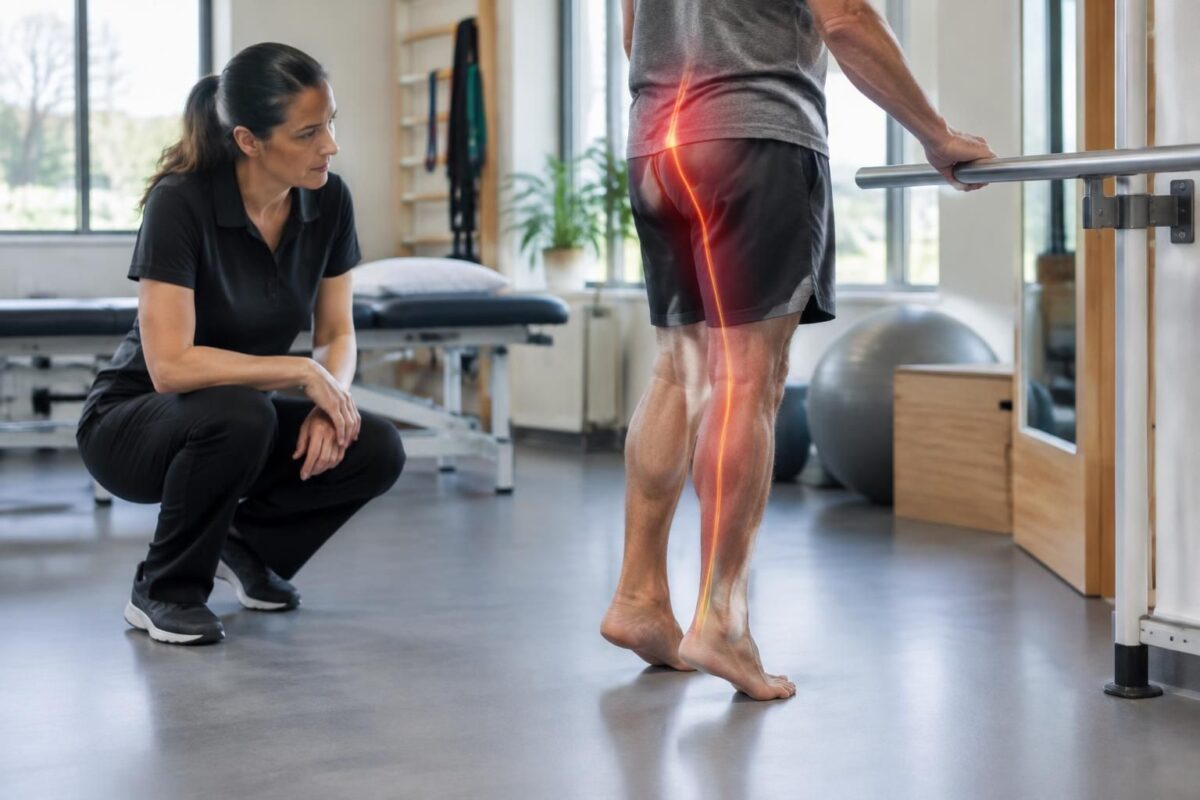
Sciatica in Terrebonne: S1 and difficulty standing on tiptoe
IN SHORT An S1 sciatica can irritate the nerve root associated with the calf and make it difficult to rise onto the balls of the feet. This sign should be evaluated with strength, sensitivity, reflexes, and walking: the pathway of…
What options can be discussed?
The management depends on the likely cause, the intensity of symptoms, and the neurological state. When the situation is stable, the professional can discuss a conservative approach, monitoring progress, and adjustments to activities. Depending on the assessment results, specific osteopathy care or a motorized neurovertebral decompression may be considered at Clinique TAGMED. Their relevance and tolerance vary for each person; they do not replace a medical evaluation.
An injection may be discussed with a doctor in certain radicular cases, particularly to attempt to temporarily reduce pain. A specialized consultation can be useful if the limitation remains significant, if imaging corresponds to the symptoms, or if a neurological deficit is progressing.
In Terrebonne, you can consult the page dedicated to sciatica treatment in Terrebonne to discover the available services at Clinique TAGMED. This information alone cannot determine the approach that suits you.

Sciatica in Terrebonne: L4-L5 and pain towards the top of the foot
IN BRIEF A L4-L5 sciatica can radiate to the outer side of the leg and the top of the foot, sometimes reaching the big toe. This pathway can guide the assessment, though it does not suffice to confirm the cause:…
Monitoring Pain and Function Progress
Monitoring compares symptoms and abilities over time. It may be helpful to note the pain trajectory, walking distance, position tolerance, as well as any changes in strength or sensitivity. A decrease in pain does not always mean that function is restored. Conversely, a more painful day does not necessarily confirm a deterioration.
A care plan should include a moment for reevaluation. If walking, sleeping, or important activities do not improve, the professional may revisit the assumptions and discuss other options. Care should not continue automatically without measurable progress.

Sciatica in Terrebonne: L5-S1 and symptoms in the calf
IN BRIEF A L5-S1 sciatica can cause pain that radiates down the calf, sometimes accompanied by tingling, numbness, or weakness. At Terrebonne, an assessment at the TAGMED Clinic helps to examine the symptom pathways, strength, and sensitivity, and then discuss…
When to Seek Quick Evaluation?
Quickly consult a doctor if you observe new or progressive weakness, a footdrop, significant loss of sensation, or rapid worsening of walking. Loss of bowel or bladder control, or numbness in the saddle area, requires urgent medical evaluation.

Sciatica in Terrebonne: pain in the big toe, L5 root or another cause?
IN BRIEF Pain in the big toe accompanied by pain in the buttock or leg may be compatible with irritation of the L5 root, but other causes are possible. In Terrebonne, the evaluation notably compares strength, sensitivity, and gait to…
Frequently Asked Questions about Sciatica in Terrebonne
Is pain that radiates down the leg always radicular?
No. Referred pain can also radiate into the buttock or leg. The symptom trajectory, neurological examination, and context help distinguish the causes.
Does an MRI confirm the cause of the pain?
No, not by itself. An MRI shows the structures of the spine. The professional must check if the results correspond to the side, level, and trajectory of the symptoms.
Does stenosis always cause sciatica?
No. Some stenoses visible on imaging do not cause symptoms. The correlation between the examination and imaging remains important.
When can a specialized consultation be helpful?
It can be discussed if the symptoms significantly limit walking or activities, persist despite appropriate management, or are accompanied by progressive weakness.
Where to find information on options in Terrebonne?
The page on the Clinique TAGMED website describes its services. You can also consult the guide on sciatica management in Terrebonne.
About the Author
Sylvain Desforges, B.Sc., D.O., N.D., osteopath and naturopath, is the founding president of TAGMED and the ACMA association. He dedicates his practice to chronic pain of the spine, lumbar pain, and pain compatible with sciatica, particularly when pain radiates to the buttock, leg, calf, foot, or toes.
Through SOS Sciatique, he publishes educational content on sciatica symptoms, possible causes such as disc herniation, disc pinching, foraminal stenosis, or irritation of a lumbar nerve root, as well as non-surgical approaches that may be considered based on evaluation. At Clinique TAGMED, care may include, depending on the case, motorized neurovertebral decompression, specific osteopathy, or precision percussion.
For an evaluation related to sciatica treatment in Montreal or Mont-Royal, or sciatica treatment in Terrebonne, consult the services available at Clinique TAGMED.
Medical Disclaimer: The information and advice provided on this site do not replace the opinion, diagnosis, or treatment of a healthcare professional. Please note that Dr. Sylvain Desforges, osteopath, is neither a medical doctor nor a physician, and is not a specialist in a medical specialty as defined by the Collège des médecins du Québec. The manual medicine, functional medicine, and sports medicine described on this site exclude any treatment or medical diagnosis performed by a medical doctor or specialist. Always consult your physician for any medical questions. For more details, please read our complete Legal Notice.
Radicular Pain
- Derives from irritation of a nerve root.
- May radiate from the buttock down to the leg, sometimes to the foot.
- May be accompanied by tingling, numbness, or weakness.
- The trajectory and neurological examination help assess it.
Referred Pain
- Is felt away from the area that causes it, without direct involvement of a root.
- Often remains in the buttock or thigh, but can vary.
- Less often accompanied by specific neurological signs.
- May be related to different structures of the back, hip, or pelvis.
To remember: the location of pain alone does not allow differentiation of these profiles. A clinical assessment takes into account the trajectory, strength, sensitivity, and reflexes.

In Terrebonne, pain that starts from the lower back and radiates down the leg can be a radicular pain, related to irritation of a nerve root, or a referred pain, felt distantly without direct involvement of that root. The trajectory of symptoms, associated sensations, and their evolution help guide the assessment, but are not sufficient to establish a diagnosis. A consultation helps clarify possible causes and choose appropriate measures.
Radicular pain and referred pain: what are the differences?
Radicular pain
Radicular pain occurs when a nerve root is irritated or compressed. It can radiate from the buttock down the thigh, calf, or foot, sometimes along a path corresponding to the affected nerve. Tingling, numbness, or weakness may also be present. Coughing, sneezing, or certain positions can exacerbate symptoms in some individuals, but this alone does not confirm their origin.
Referred pain
Referred pain originates in one structure, such as a muscle, joint, or disc, but manifests in another area. It can affect the buttock and thigh, and sometimes radiate lower, without precisely following the path of a nerve root. It is less often accompanied by neurological signs, but presentations vary: the location alone does not allow for distinguishing between the two types of pain.
What elements to observe before evaluation?
Note where the pain starts, how far it radiates, and whether it affects one or both legs. Also record sensations of numbness, changes in strength, positions that worsen or alleviate symptoms, and activities that have become difficult. In Terrebonne and elsewhere, this information can help the professional guide their examination and determine whether medical evaluation or further testing is warranted.
An examination may include observing walking, comparing strength and sensitivity of the legs, and assessing reflexes and back movements. Imaging, such as an MRI, is not always necessary from the outset. Its usefulness particularly depends on the duration of symptoms, neurological signs, and clinical decisions being considered. Images must be interpreted in relation to symptoms and examination.
Recommendations for managing symptoms
If symptoms are stable and no warning signs are present, prioritize suitable movement and gradually resume tolerated activities. Short periods of rest can be helpful, but remaining immobile for long can reduce mobility and functional capacity. Temporarily adjust tasks that significantly worsen pain and gradually increase activity, monitoring the reaction during and after exertion.
A conservative approach may include education, tailored exercises, and, depending on the assessment, manual therapy or other options. Discuss measurable goals, such as walking longer, sleeping better, or returning to an activity. If function does not improve, if pain persists or worsens, have the situation reassessed rather than automatically continuing an ineffective strategy.
When to consult promptly?
A new or progressive weakness, a foot drop, an extending numbness, or increasing difficulties in walking require prompt evaluation. Loss of bladder or bowel control, or loss of sensation in the saddle area, demands emergency care. Also consult in case of fever, recent trauma, severe pain, or rapid deterioration.
About the author
Sylvain Desforges, B.Sc., D.O., N.D., osteopath and naturopath, dedicates his practice to chronic spinal pain and symptoms compatible with sciatica.
Medical disclaimer: This content is provided for educational purposes and does not replace consultation, diagnosis, or treatment by a licensed healthcare professional. The author is neither a physician nor a specialist in a recognized medical specialty. Manual and functional approaches do not replace medical follow-up.
| Radicular pain | Referred pain |
|---|---|
| Irritation or compression of a nerve root | Pain projected from another structure |
| Often radiates down the leg along a specific path | Often localized in the buttock or thigh, path less defined |
| May be accompanied by tingling or numbness | Nerve sensations are usually absent |
| A weakness may appear in certain muscles | Neurological weakness is less typical |
| Coughing or certain movements may enhance the pain | Pain may vary with posture or activity |
| A neurological examination helps assess strength and sensitivity | The examination rather seeks structures that may project pain |
| Imaging should correspond to the side and trajectory of symptoms | An image alone does not identify the source |
| A new or progressive weakness requires prompt evaluation | A persistent or worsening pain also merits evaluation |
Sciatica in Terrebonne: illustrative testimonies on radicular pain and referred pain
Transparency note: the stories below are fictitious examples for educational purposes and not verified patient testimonies. They illustrate possible differences between radicular pain and referred pain. Only an individual evaluation can help determine the cause.
“The pain radiated down to my foot” — example of radicular pain
A person from Terrebonne describes pain starting from the lower back and traveling through the buttock to the calf. They also notice tingling in the foot, especially after sitting for a long time. This type of trajectory may suggest irritation of a nerve root, but is insufficient to confirm sciatica. The examination particularly considers the affected side, sensitivity, strength, and reflexes.
“My buttock was hurting, but the pain did not go down to the thigh” — example of referred pain
Another person experiences a dull pain in the lower back and buttock, sometimes extending into the thigh. They report neither numbness nor weakness, and the pain varies with certain postures or movements. Referred pain can manifest away from the area that causes it, without necessarily involving a nerve root. This profile also deserves an evaluation rather than a conclusion based solely on description.
“Walking caused heaviness in the legs” — symptoms to clarify
A person reports heaviness or pain after a certain time standing or walking, with relief when sitting or bending forward. This profile may be compatible with neurogenic claudication related to a narrowing of the canal or foramen, but other causes, including vascular ones, can produce similar symptoms. The distance traveled before the onset of symptoms and their evolution with position are useful information to gather.
“MRI showed a narrowing, but should it be associated with my pain?” — example of clinical correlation
A person discovers a mention of stenosis in their imaging examination and questions its connection to their symptoms. An image must be interpreted considering the affected level, side, pain pathway, and results of the neurological examination. The presence of a narrowing on MRI does not, by itself, prove that it is responsible for the symptoms.
To distinguish radicular pain from referred pain, the professional may clarify the pathway of the symptoms, their triggers, the presence of tingling or numbness, and their effect on walking. The evaluation may also examine strength, sensitivity, reflexes, and, when warranted, pulses and vascular risk factors.
In the case of persistent symptoms, follow-up should measure concrete changes: possible duration in a standing position, walking distance, recovery after exertion, sleep, and ability to carry out important activities. Temporary relief does not necessarily confirm the cause; the evolution of function and neurological status also matters.
New or progressive weakness, a dropped foot, loss of sensation in the saddle region, or changes in urinary or bowel control requires rapid or urgent medical evaluation.
About the author
Sylvain Desforges, B.Sc., D.O., N.D., is an osteopath and naturopath. His educational content focuses particularly on low back pain and symptoms compatible with sciatica.
Medical disclaimer
This text is provided for educational purposes and does not replace a consultation, diagnosis, or treatment by a physician or another licensed healthcare professional. The examples presented are fictional and do not allow for diagnosing a condition.
Sciatica in Terrebonne: radicular pain or referred pain?
A pain that starts from the lower back and radiates into the buttock or leg is often referred to as “sciatica.” However, this term describes a set of symptoms and does not necessarily indicate a single cause. To better guide the evaluation in Terrebonne, it is useful to distinguish between radicular pain, related to irritation of a nerve root, and referred pain, felt distant from the area that causes it without direct involvement of that root.
Radicular pain may appear when a lumbar nerve root is irritated or compressed, for example, in the presence of a herniated disc, foraminal narrowing, or canal stenosis. It sometimes follows a relatively precise pathway in the buttock and leg and may be accompanied by burning sensations, electric shocks, tingling, or numbness. In some cases, muscle weakness or changes in reflexes are also observed. However, these signs are not identical for everyone and do not, by themselves, establish a diagnosis.
Referred pain is generally felt in a region distant from its source, for example, in the buttock or thigh, while the nerve root is not necessarily affected. Structures in the lower back, hip, or surrounding tissues may contribute to this type of pain. It can be diffuse, vary with movements or positions, and not follow a typical nerve pathway. Nevertheless, referred pain can be significant and limit walking, sleep, or daily activities.
The difference is not determined solely by observing where the pain is felt. An evaluation considers its onset, pathway, activities that worsen or relieve it, strength, sensitivity, and reflexes. The ability to walk or stand may also be examined. Pain that descends below the knee does not automatically establish radicular involvement, just as pain limited to the buttock does not exclude it.
Imaging, including MRI, may be considered when symptoms persist, when there are neurological signs, or when a procedure is discussed. It shows anatomical characteristics, but a visible abnormality does not necessarily prove that it explains the symptoms. The level and side observed must be compared to the pain pathway and examination results. This correlation helps avoid drawing conclusions from an isolated image.
Depending on the profile and evolution, a graduated approach may include information, temporary activity modifications, and progressive exercises aimed at preserving function. Manual or technological approaches may be discussed on a case-by-case basis, considering their limitations, tolerance, and measurable goals. It is useful to track not only the intensity of pain but also walking distance, sleep, mobility, and the ability to resume important activities.
New or worsening weakness, a dropped foot, loss of sensation in the saddle region, or changes in urinary or bowel control requires rapid or urgent medical evaluation. In case of doubt about the cause of pain radiating into the leg, a licensed healthcare professional can help determine the appropriate next steps.
About the author
Sylvain Desforges, B.Sc., D.O., N.D., osteopath and naturopath, is the founding president of TAGMED and the ACMA association. His practice particularly focuses on chronic spinal pain, low back pain, and symptoms compatible with sciatica. At the TAGMED Clinic, the options discussed may include, depending on the evaluation, specific osteopathy, motorized neurovertebral decompression, or precision impactor. The proposed approaches must be tailored to each person’s situation and do not replace a medical diagnosis.
Medical warning: This content is provided for educational purposes and does not replace consultation, diagnosis, or treatment by a physician or another authorized healthcare professional. The author is neither a physician nor a specialist in a medical specialty recognized by the Collège des médecins du Québec.
In Terrebonne, pain radiating down the leg may be related to irritation of a nerve root — a radicular pain — or come from another structure and be felt at a distance — a referred pain. The path of the symptoms, their triggers, changes in sensitivity or strength, and the examination results help to differentiate them; an MRI image alone does not always determine the cause.
Radicular Pain and Referred Pain: Clues to Connect
Radicular pain occurs when a nerve root is irritated or compressed. It can travel to the buttock and leg, sometimes down to the foot, and may be accompanied by tingling, numbness, or weakness. Referred pain, on the other hand, is felt in an area distant from its origin without necessarily following the path of a root or displaying the same neurological signs. These profiles sometimes overlap: thus, the examination must complement the description of the symptoms.
The affected area may guide the evaluation, though it is not sufficient to establish a diagnosis. Pain toward the outer edge of the foot or the top of the foot can be useful to describe; refer to the guidelines on pain radiating to the outer edge of the foot and on the associated symptoms of L4-L5 and the top of the foot. However, the location of the symptoms must be interpreted along with strength, sensitivity, reflexes, and clinical context.
It is also important not to confuse sciatica with cruralgia, which generally corresponds to pain following another territory of the leg. To compare these presentations, see the explanations on the difference between cruralgia and sciatica and on the territories associated with each. Leg pain can also have other origins; leg pain and sciatica are not always synonymous.
During a consultation, specifying the starting point, the path, the affected side, sensations, and the activities that worsen or relieve the pain makes the evaluation more useful. You can refer to these tips for describing your symptoms in Terrebonne. If the path seems incomplete or atypical, the indications regarding incomplete sciatica can also help prepare your questions.
Numbness deserves to be described precisely: its location, extent, evolution, and the movements that seem affected matter in the evaluation. Additional guidelines are presented in this article on numbness of the leg and sciatica in Terrebonne. The distinction between pain of radicular origin and pain related to the nerve further along its path can also be explored in this resource on truncal or radicular sciatica pain.
Narrowing of the spinal canal or foramen can sometimes irritate a nerve root, especially when symptoms appear while standing or walking and diminish when seated. Imaging must then correspond with the side, the path of the symptoms, and the examination; visible stenosis does not automatically mean it explains the pain. To learn more, refer to the guidelines on foraminal or spinal stenosis and sciatica in Terrebonne.
A new or progressive weakness, a dropped foot, anesthesia in the saddle region, or a change in urinary or bowel control requires rapid or urgent medical evaluation. These signs should be taken seriously even if the intensity of the pain varies.

Dr Sylvain Desforges, B.Sc., D.O., N.D., osteopath, is the founding president of TAGMED and of the ACMA association. He dedicates his practice to chronic spinal pain, low back pain and symptoms compatible with sciatica, particularly when pain radiates toward the buttock, leg, calf, foot or toes.
Through SOS Sciatique, he publishes educational content on sciatica symptoms, possible causes such as disc herniation, disc narrowing, foraminal stenosis or irritation of a lumbar nerve root, as well as non-surgical approaches that may be considered according to the evaluation. At Clinique TAGMED, care may include, depending on the case, motorized neurovertebral decompression, specific osteopathic care or precision percussion.
For an evaluation related to sciatica treatment in Montreal / Mount Royal or sciatica treatment in Terrebonne, please consult the services available at Clinique TAGMED.
Medical disclaimer
The information published on SOS Sciatique is provided for educational purposes only and does not replace a consultation, diagnosis, opinion or treatment provided by a physician or another authorized healthcare professional. The author of this article is neither a medical doctor nor a specialist in a medical specialty recognized by the Collège des médecins du Québec. The osteopathic, manual medicine or functional support approaches described on this site do not constitute medical acts and are not intended to replace medical follow-up.
Consult a physician or emergency service in cases of loss of bladder or bowel control, anesthesia in the saddle area, significant or progressive weakness in the leg or foot, fever, recent trauma, severe pain or rapid worsening of symptoms. For more details, please read our Legal Notice.