


Sciatica and movement that worsens: why stop it
31/10/2026
Sciatica and pain that varies from day to day
01/11/2026
IN SHORT
| Sciatica is a pain that can radiate from the buttock down the leg when a nerve root is irritated. The levels L4, L5, and S1 can produce overlapping symptoms; therefore, the pathway of the pain alone is not enough to identify the affected root. In Terrebonne, the evaluation particularly compares strength, sensitivity, reflexes, and gait to guide management and determine if imaging is necessary. |
The levels L4-L5 and L5-S1 refer to spaces between the vertebrae, while L4, L5, and S1 correspond to nerve roots. Irritation of L5 can notably be accompanied by symptoms on the top of the foot; irritation of S1 can affect the heel or the outer edge of the foot. These pathways overlap: they do not allow for determining the cause or the affected level on their own.
In Terrebonne, the evaluation takes into account the pathway of pain, strength, sensitivity, reflexes, and gait. A new or progressive weakness, urinary or intestinal issues, or a loss of sensation in the saddle area require rapid or urgent medical evaluation.
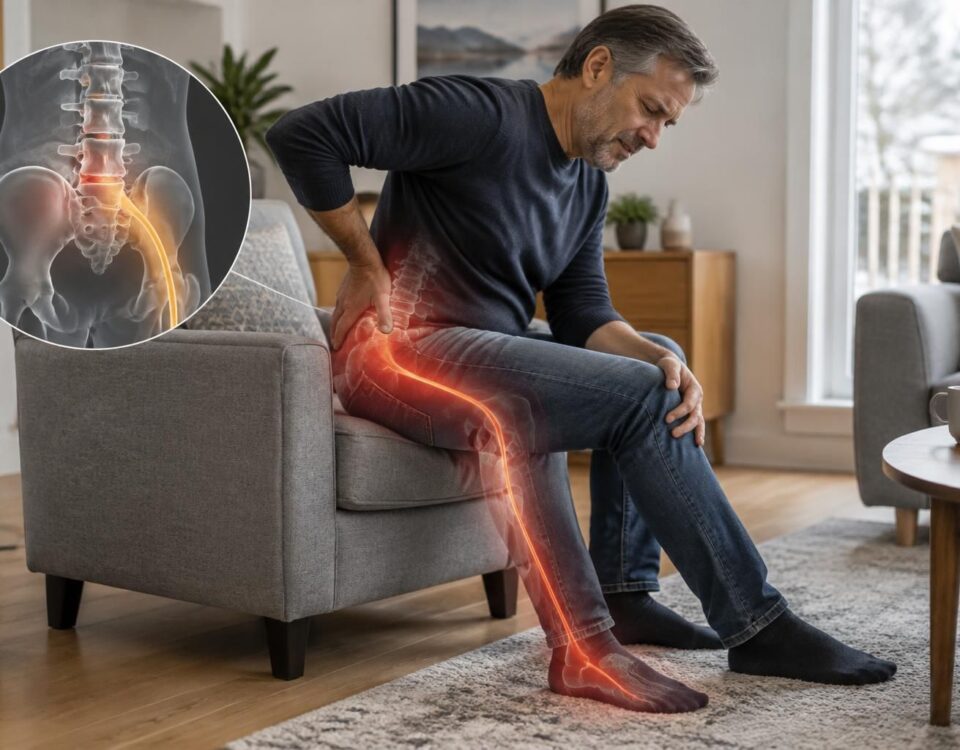
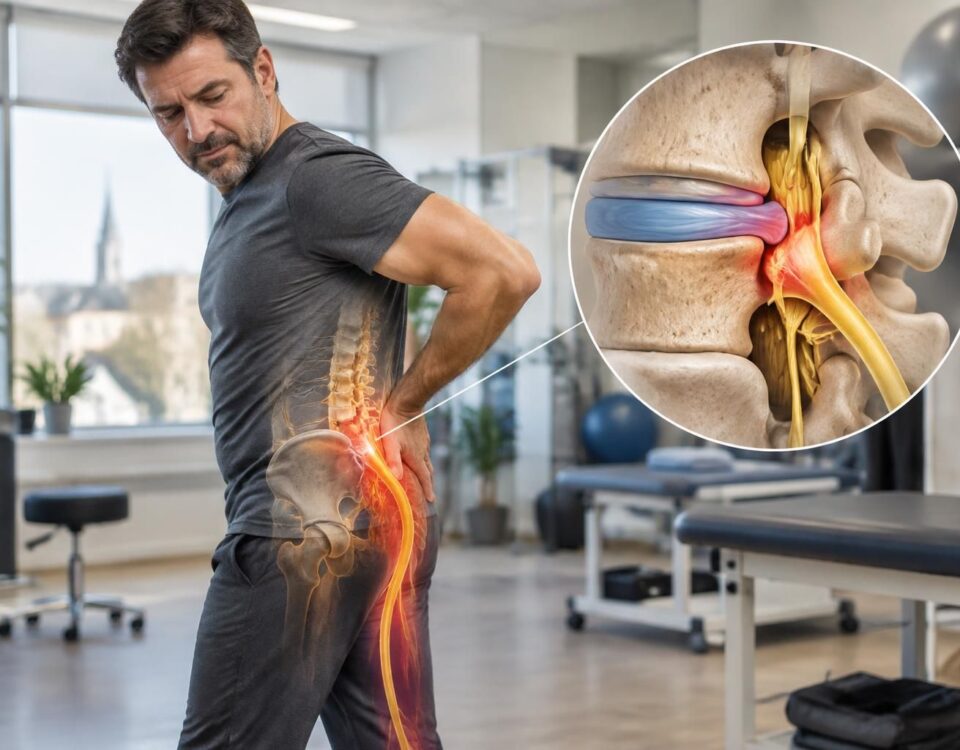
A pain that starts from the lower back or buttock and descends into the leg may correspond to irritation of a nerve root. The roots L4, L5, and S1 present overlapping symptoms, but certain signs of sensitivity, strength, and reflexes can help distinguish them. In Terrebonne, the evaluation must compare these signs with clinical examination and imaging results, without concluding from one image alone.
The terms L4, L5, and S1 refer to nerve roots in the lower back. They transmit information between the spine, the leg, and the foot. Irritation or compression can cause pain, tingling, loss of sensitivity, or weakness.
Sciatica generally describes pain related to the roots that contribute to the sciatic nerve, especially L4, L5, and S1. However, pain in the leg alone does not confirm sciatica. Pain that is mainly in the front of the thigh may suggest a different issue, such as femoral pain. To compare these conditions, check out our article on the difference between sciatica and femoral pain.
A disc level is not the name of a root
L4-L5 and L5-S1 indicate levels between the vertebrae and discs. L5 and S1 refer to nerve roots. A herniated disc at the L4-L5 level often affects the L5 root, while a herniated disc at L5-S1 often affects S1. This link is not automatic: the location of the hernia and anatomical variations can change the affected root.
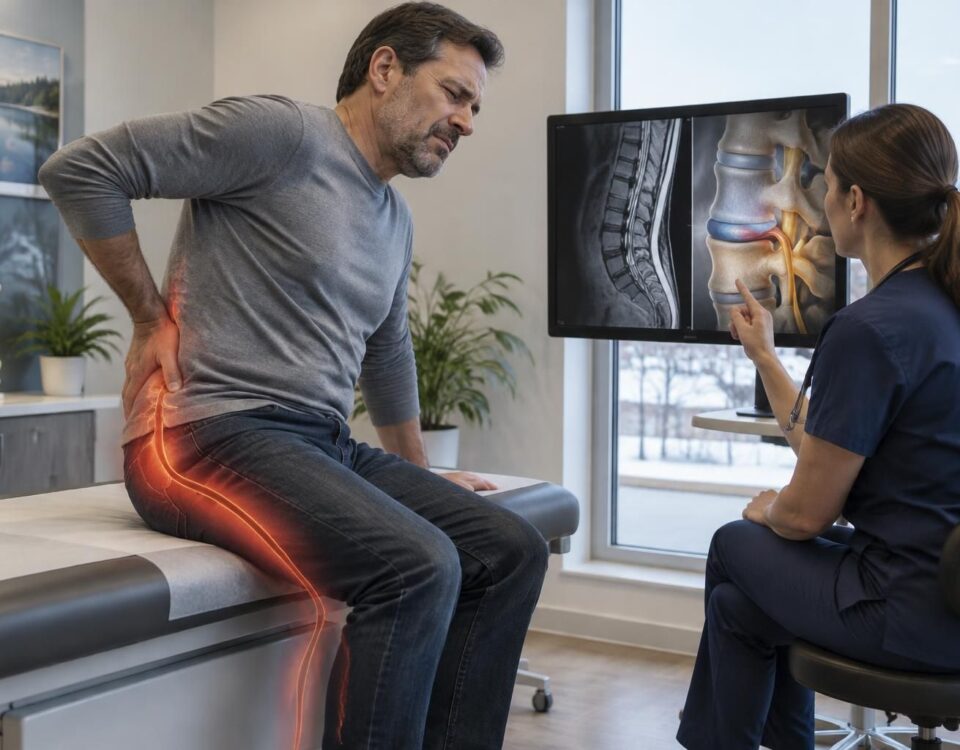
An MRI image should therefore be interpreted along with symptoms and physical examination. A visible anomaly may not explain the pain felt. To better understand the possible links between the disc and nerve root, see the guide on sciatica and disc herniation as well as the resource on the levels L4, L5, and S1.
What symptoms can guide towards L4, L5, or S1?
The pathways of the nerves vary from person to person and overlap. The signs below provide guidelines, but they do not allow for a diagnosis without examination. A comparison between the two legs helps to identify a difference in strength, sensitivity, or reflex.
Signs sometimes associated with the L4 root
A lesion of L4 can cause symptoms towards the front of the thigh, the knee, or the inner part of the leg. The examination may look for weakness when the person extends the knee and a change in the patellar reflex. However, symptoms may follow a different pathway or mix with those of other roots.
Signs sometimes associated with the L5 root
A lesion of L5 can cause pain or numbness on the side of the leg and the top of the foot, sometimes extending to the big toe. The professional may check the strength needed to raise the foot or the big toe. A new difficulty in raising the front of the foot, sometimes called foot drop, deserves rapid medical evaluation.
To learn more about this sign in Terrebonne, check out the article on the L5 root and the difficulty in raising the foot.
Signs sometimes associated with the S1 root
A lesion of S1 can lead to pain in the back of the thigh and calf, then towards the heel or the outer edge of the foot. The examination may check for sensitivity in these areas, the strength to push the foot down, and the Achilles reflex.
The distinction between L4-L5 and L5-S1 is based on several clues, not on a single painful spot. Consult the guide dedicated to the difference between L4-L5 and L5-S1 in Terrebonne and this explanation of the link between the affected root and the pain pathway.

Sciatica in Terrebonne: L5 or S1 irritation, why the clinical examination matters
IN BRIEF Sciatica is pain related to the irritation of a nerve root, often L5 or S1. The pathway of symptoms, strength, sensitivity, and walking provide clues, but the territories may overlap: the clinical examination therefore helps guide the assessment…
Why can a nerve root be irritated?
A herniated disc is one of the possible causes. Bone changes related to osteoarthritis, narrowing of the spinal canal, or the opening through which the nerve exits can also contribute to symptoms. More rarely, another condition may compress a nerve root. The cause cannot be determined from the pain alone.
Pain can be burning, sharp, or stabbing. Some people also experience tingling, numbness, or weakness. Coughing or certain efforts may exacerbate the pain in some cases. Pain that changes with position or walking does not, alone, indicate the affected root. You can read our article on sciatica pain that improves with walking and this resource on the pathway of the sciatic nerve.
For general medical information, consult the pages of the MSD Manual on lumbosacral radiculopathy and the MSD Manual on sciatica.
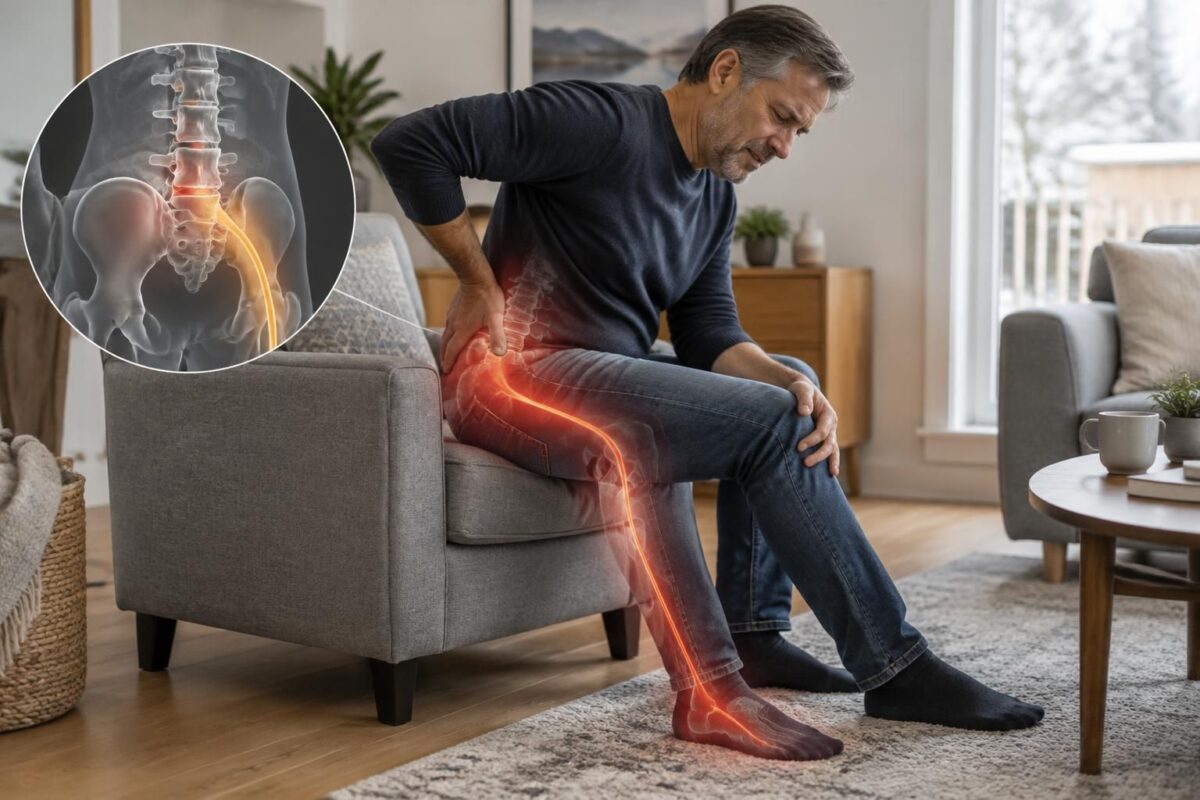
Sciatica in Terrebonne: L5-S1 Herniation and Pain Towards the Foot
IN BRIEF A sciatica related to a possible L5-S1 herniation can cause pain from the lower back or buttock down to the calf, heel, or foot. The path of the symptoms alone is not enough to confirm the cause: the…
How does the evaluation proceed in Terrebonne?
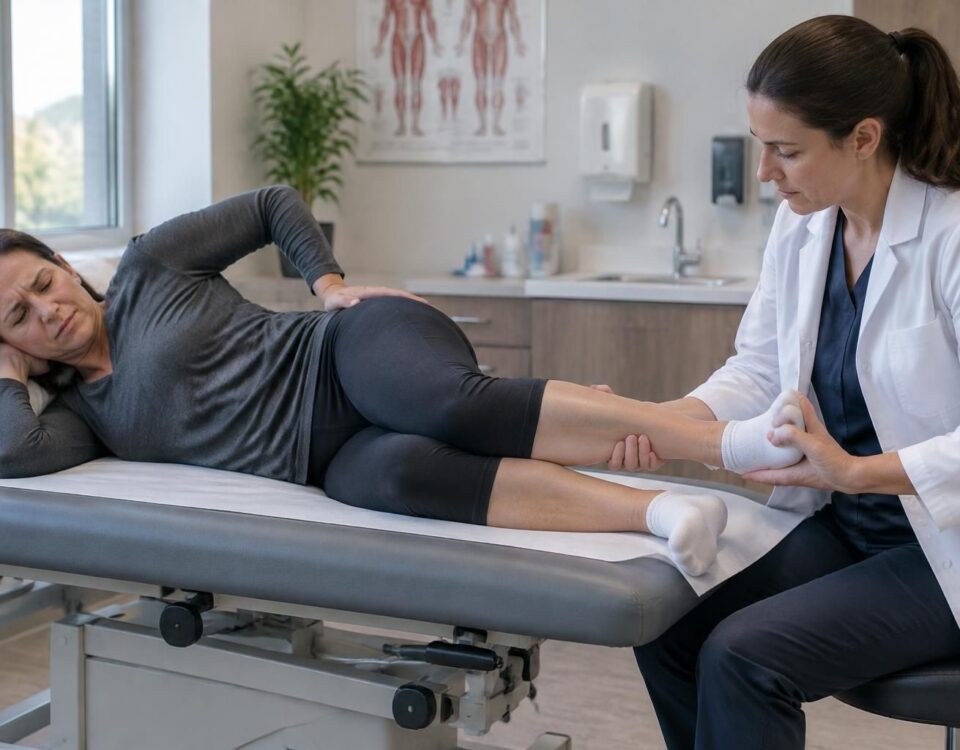
The professional collects the timeline of symptoms and asks which activities or positions change them. He then assesses strength, sensitivity, reflexes, and gait. He compares both sides and checks if the signs match the described path.
An MRI or a CT scan may be considered when symptoms persist, a neurological deficit appears, or the result may change the management. Nerve conduction studies or electromyography may sometimes help specify the level reached or distinguish radiculopathy from another nerve issue. The choice of these exams is up to the concerned medical professional.
The summary from the MSD Manual on lumbosacral radiculopathy describes the signs and exams that may contribute to the assessment. Imaging alone does not always confirm that the observed anomaly is the cause of the symptoms.

Sciatica in Terrebonne: L4-L5 protrusion and leg pain
IN BRIEF A L4-L5 disc protrusion is a bulging of a lumbar disc that may, depending on its relationship with the nerves, contribute to sciatica, with pain, tingling, or numbness in the leg. In Terrebonne, an assessment helps relate symptoms,…
What management options can be considered?
The plan depends on the probable cause, the intensity of symptoms, neurological function, and their evolution. When strength and sensitivity remain stable, a professional may discuss a non-surgical management and schedule a follow-up date. Medications and injections should be discussed with a doctor or a professional authorized to prescribe them.
At the TAGMED Clinic, the assessment may explore, as appropriate, non-surgical approaches such as specific osteopathy or motorized neurovertebral decompression. These options are not suitable for everyone and do not replace a medical diagnosis. The choice must take into account symptoms, contraindications, and functional goals. Services related to sciatica are presented in the TAGMED Clinic guide on sciatica and disc herniation.
A useful follow-up defines observable benchmarks: evolution of strength, extent of numbness, ability to walk, sleep, and daily activities. If symptoms spread, if strength decreases, or if no functional progress is observed, the plan should be reevaluated rather than automatically repeated.
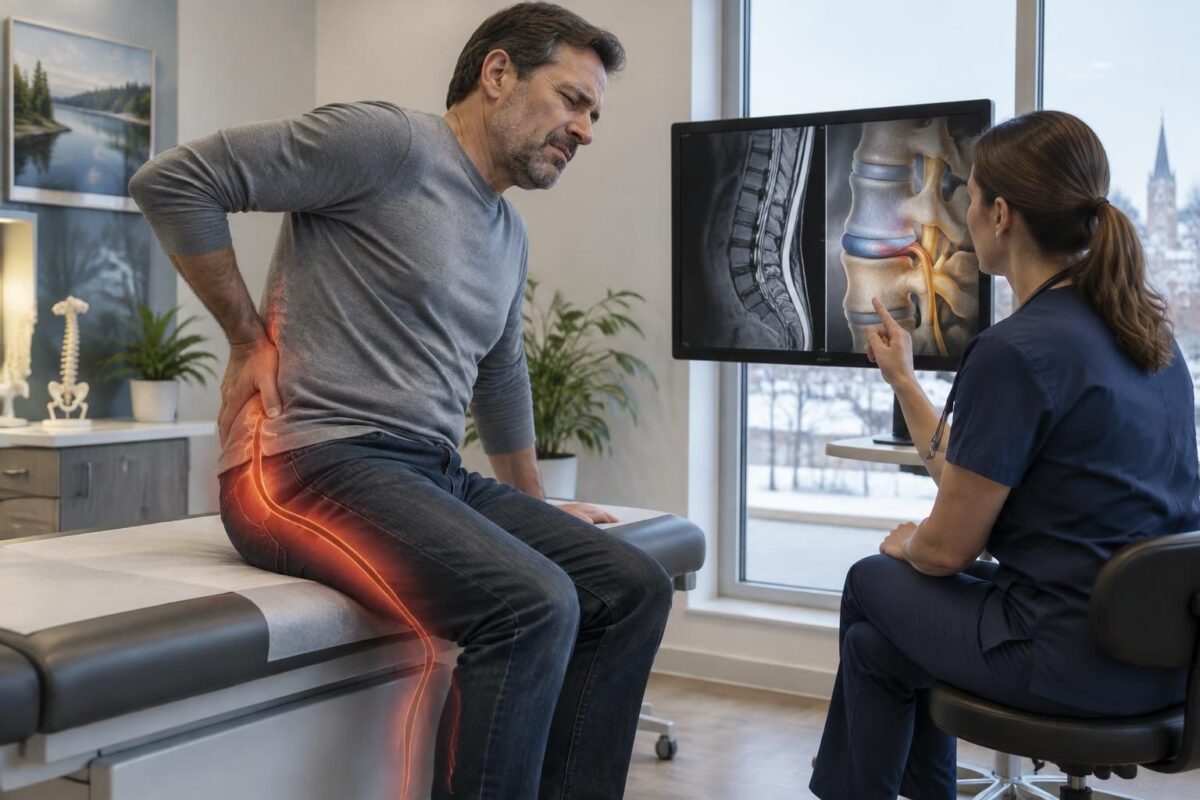
Sciatica in Terrebonne: what “disc-root conflict” means
IN BRIEF A disc-root conflict occurs when an intervertebral disc irritates or compresses a nerve root in the lower back. It can cause sciatica: lower back pain that radiates down into the buttock and leg, sometimes accompanied by sensory disturbances…
When should medical help be sought quickly?
A new or progressive weakness, increasing difficulty lifting the foot, or worsening gait requires prompt medical evaluation. Consult quickly if numbness progresses or if neurological symptoms change.
A loss of bladder or bowel control, numbness in the saddle area, significant or rapidly progressive weakness, fever, recent trauma, or severe worsening pain warrants urgent consultation. Do not delay this evaluation to complete an already scheduled care program.
Sciatica in Terrebonne: radicular pain versus referred pain
IN BRIEF Sciatica refers to pain that radiates into the buttock and sometimes the leg. A radicular pain comes from the irritation of a nerve root and may be accompanied by tingling, numbness, or weakness; a referred pain spreads from…
Frequently asked questions about L4, L5, and S1
Does foot pain suffice to know which nerve root is affected?
No. The painful area can guide the examination, but nerve territories overlap. The professional compares sensitivity, strength, reflexes, and imaging results when indicated.
Does an L4-L5 herniation always affect L5?
No. It often affects L5, but the precise location of the herniation and the person’s anatomy can change the affected root. Clinical examination helps verify if the imaging corresponds to the symptoms.
Is an MRI always necessary?
No. An MRI is not necessary in all cases. A professional may request it if symptoms persist, if a neurological deficit is present, or if the result is likely to change management decisions.
What should be brought to a consultation?
Note the onset of symptoms, their trajectory, what aggravates or alleviates them, and changes in strength or sensitivity. Bring imaging reports, a list of medications, and information about care already received if available.

Sciatica in Terrebonne: nerve root, disc, and foramen explained simply
IN BRIEF Sciatica is pain that occurs when a nerve root in the lower back is irritated or compressed, sometimes by a disk or a narrowed foramen. Understanding these structures helps better locate the possible cause of symptoms and guide…
About the author
Sylvain Desforges, B.Sc., D.O., N.D., Doctor of Osteopathy and naturopath, is the founding president of TAGMED and the ACMA association. He dedicates his practice to chronic pain of the spine, lower back pain, and pain compatible with sciatica, especially when pain radiates to the buttock, leg, calf, foot, or toes.
Through SOS Sciatique, he publishes educational content on sciatica symptoms, possible causes such as herniated discs, disc bulging, foraminal stenosis, or irritation of a lumbar nerve root, as well as on non-surgical approaches that may be considered based on the evaluation. At TAGMED Clinic, care may include, as appropriate, motorized neurovertebral decompression, specific osteopathy, or a precision impactor.
For an assessment related to treatment of sciatica in Montreal / Mont-Royal or treatment of sciatica in Terrebonne, check the available services at the TAGMED Clinic.
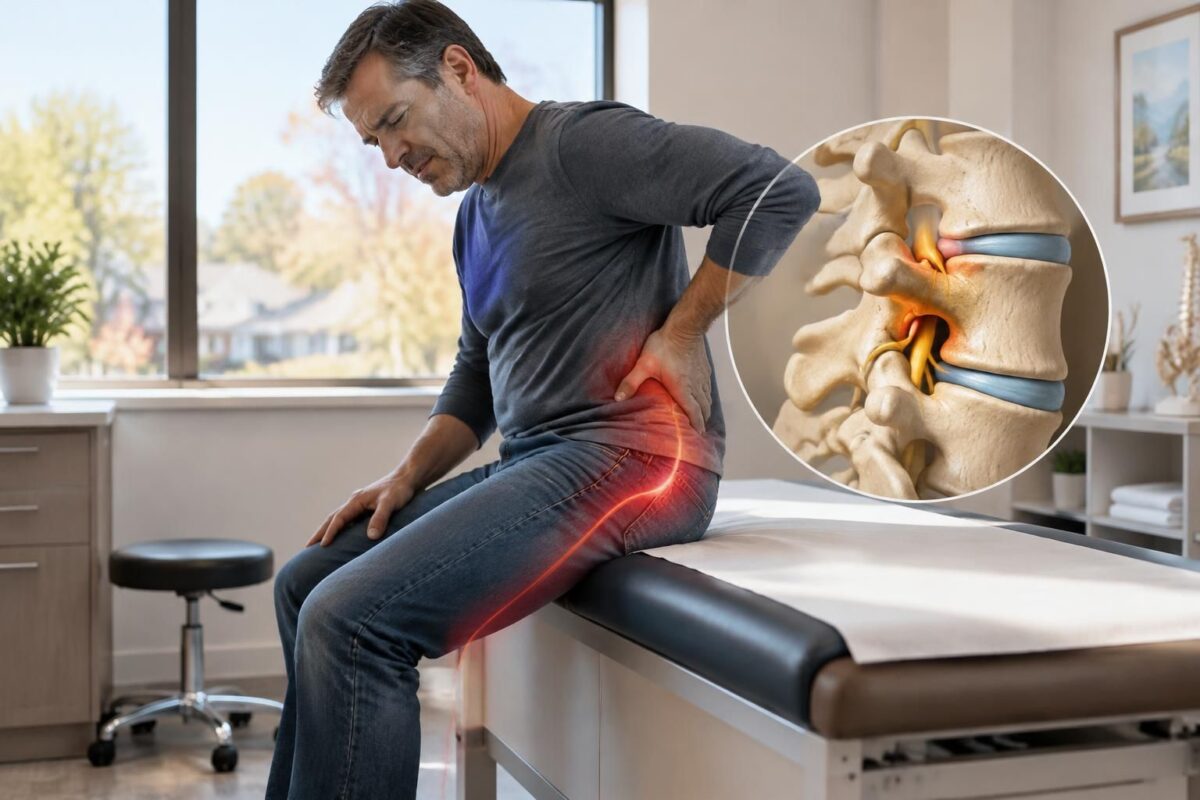
Sciatica in Terrebonne: understanding the L5-S1 foraminal compression
IN BRIEF The L5-S1 foraminal compression corresponds to a narrowing of the opening through which a nerve root passes, potentially contributing to sciatica. In Terrebonne, the assessment compares the side and course of the symptoms, neurological examination, imaging, and limited…
Medical disclaimer
The information published on SOS Sciatique is provided for educational purposes and does not replace a consultation, diagnosis, opinion, or treatment performed by a doctor or other authorized healthcare professional. The author of this article is neither a physician nor a specialist in a medical specialty recognized by the Collège des médecins du Québec. The osteopathy, manual medicine, or functional support approaches described on this site do not constitute medical acts and are not intended to replace medical follow-up.
Medical disclaimer: The information and advice provided on this site do not replace the opinion, diagnosis, or treatment from a health professional. Please note that Sylvain Desforges, B.Sc., D.O., N.D., Doctor of osteopathy, is neither a medical doctor nor a physician, and is not a specialist in a medical specialty as defined by the Collège des médecins du Québec. Manual medicine, functional medicine, and sports medicine as described on this site exclude any medical treatment or diagnosis made by a physician or medical specialist. Always consult your doctor for any medical questions. For more details, please read our Complete Legal Notice.
- L4: pain or numbness towards the front of the thigh and knee; strength for extending the knee and the patellar reflex can be evaluated.
- L5: symptoms sometimes felt on the top of the foot; notably checking the raising of the big toe and walking on heels.
- S1: symptoms sometimes felt in the heel or on the outer edge of the foot; notably checking walking on toes and the Achilles reflex.
- These pathways overlap: no isolated symptom confirms alone the affected root.
- L4-L5 and L5-S1 refer to disc levels, not directly a nerve root; the examination must check their concordance.
- In Terrebonne as elsewhere, the assessment compares symptoms, strength, sensitivity, reflexes, and walking. New or progressive weakness requires prompt medical evaluation.

In Terrebonne, pain that radiates down to the buttock or leg may be compatible with nerve irritation, but the felt pathway alone is not sufficient to identify the affected root. The L4, L5, and S1 markers help guide the assessment; they must be interpreted with strength, sensitivity, reflexes, and walking. A useful care plan takes these elements, their evolution, and daily goals into account.
Understanding the L4, L5, and S1 Markers
L4, L5, and S1 refer to nerve roots located in the lumbosacral region. The disc levels L4-L5 and L5-S1 are different spaces in the spine: an anomaly at one level does not, alone, confirm which root is irritated. Sensory pathways overlap and vary among individuals.
Clues, not a diagnosis on their own
An L5 issue may accompany symptoms on the top of the foot or difficulty raising the big toe. S1 may be associated with discomfort near the heel or outer edge of the foot, as well as difficulty standing on tiptoes. L4 may influence certain sensations in the leg and knee strength. However, these markers are not precise enough to establish a diagnosis without examination.
What elements to observe daily?
Note the starting point of the pain, its pathway, areas of numbness, and activities that worsen or relieve symptoms. Also monitor strength and function: walking on heels or toes, lifting the foot, sitting, or covering a usual distance. Comparing both sides and noting changes over time can help the professional assess the progression.
Pain radiating into the buttock and back of the leg may correspond to lumbar radiculopathy, sometimes called sciatica. Other causes may produce similar symptoms. A herniated disc, stenosis, or bony changes are among the possibilities, but their presence on an image does not automatically prove they explain the symptoms.
How does the assessment proceed in Terrebonne?
The assessment may include the history of symptoms, walking, strength, sensitivity, and reflexes, in addition to the pain response to certain movements. An MRI or CT scan is not necessary for every person: imaging is considered when it can guide management, especially if symptoms persist or if neurological deficits are observed. Electrodiagnostic examinations can sometimes help clarify the affected level or distinguish other nerve issues.
Choosing a management plan and knowing when to re-evaluate
When the neurological condition is stable, the professional can discuss a graduated approach suitable for the person, which may include modified activity, exercises, or supportive care. Any intervention, including manual therapy or decompression technology, should be considered according to the assessment, goals, and tolerance. Define follow-up measures: walking, sleep, activities, strength, and sensitivity. Also plan a re-evaluation date; in the absence of measurable progress or if symptoms evolve, the plan should be revised.
Consult quickly if new or progressive weakness, foot drop, or extending numbness appears. New urinary or bowel issues, numbness in the saddle region, fever, recent trauma, or rapid deterioration require urgent medical evaluation.
About the author
Sylvain Desforges, B.Sc., D.O., N.D., Doctor of osteopathy and naturopath, is the founding president of TAGMED and the ACMA association. His practice notably focuses on chronic pain of the spine and symptoms compatible with sciatica. At the TAGMED Clinic, care options may include, depending on the assessment, specific osteopathy, motorized neurovertebral decompression, or precision percussion.
Medical disclaimer
This content is educational and does not replace a consultation, diagnosis, or treatment by a doctor or another licensed health professional. The author is neither a doctor nor a specialist in a medical specialty recognized by the Collège des médecins du Québec. The approaches presented do not replace medical follow-up.
| Index | Possible markers in Terrebonne |
|---|---|
| Pain pathway | Buttock and leg: a pathway compatible with nerve irritation, without solely identifying the affected root. |
| L4 | Pain or numbness that may affect the front of the thigh or the knee; the patellar reflex can be assessed. |
| L5 | Symptoms sometimes felt on the top of the foot or towards the big toe; the strength to lift the foot can be compared. |
| S1 | Symptoms sometimes felt in the heel or on the outer edge of the foot; walking on tiptoes and the Achilles reflex can be checked. |
| Overlap | The L5 and S1 territories vary and overlap: a single symptom is not enough to conclude. |
| Evaluation | Strength, sensitivity, reflexes, and gait are compared on both sides; imaging depends on the clinical context. |
| When to act quickly | New or progressive weakness, dropped foot, saddle anesthesia, or urinary or intestinal issues: consult immediately. |
The testimonials below are fictional examples for educational purposes. They do not come from identifiable patients and do not allow for a diagnosis. Symptoms associated with the L4, L5, and S1 roots may overlap: the pathway of pain alone is not sufficient to determine the affected root.
“My pain radiated over the top of my foot” — fictional example. This person described pain starting from the buttock and radiating down the leg, with discomfort on the top of the foot. This territory may be compatible with L5 irritation, but strength, sensitivity, reflexes, and gait must also be checked. An isolated symptom does not confirm the affected level.
“It was mainly the outer edge of the foot” — fictional example. In this situation, the numbness affected the outer edge of the foot and the heel. These signs can point towards S1, especially if the examination also finds a change in strength when walking on tiptoes or a modification of the Achilles reflex. However, nerve territories vary and overlap from person to person.
“My report mentioned L4-L5, but I didn’t know which root was affected” — fictional example. L4-L5 refers to a level between two vertebrae, and not automatically to a specific nerve root. A herniation in that area can often irritate L5, but the interpretation depends on its position and the examination results. The imaging report must be correlated with the affected side, the pathway of symptoms, and neurological signs.
“The pain changed from day to day” — fictional example. Variations in pain alone do not indicate whether the situation is improving or worsening. Follow-up can also consider the ability to walk on heels and on tiptoes, toe strength, sensations, sleep, and daily activities.
In Terrebonne as elsewhere, an evaluation can compare strength, reflexes, sensitivity, and gait, then take into account the evolution of symptoms. An MRI or other examination is not necessary for everyone: its usefulness primarily depends on the duration of symptoms, the clinical examination, and the possibility that its result will change the management approach.
When neurological signs are stable, non-surgical options can be discussed and reassessed according to observed progress. The plan should specify functional objectives and the timing of follow-up. A temporarily less intense pain does not necessarily mean that strength or nerve function has recovered.
Consult quickly in cases of new or progressive weakness, dropped foot, spreading numbness, or increasing difficulty walking. Loss of control over urination or defecation, anesthesia in the saddle area, fever, or significant trauma requires urgent medical evaluation.
About the author
Sylvain Desforges, B.Sc., D.O., N.D., Doctor of Osteopathy and naturopath, is the founding president of TAGMED and the ACMA association. His practice focuses particularly on chronic spinal pain, low back pain, and symptoms compatible with sciatica.
Through SOS Sciatique, he publishes educational content on symptoms, their possible causes, and non-surgical approaches that can be considered based on the evaluation. At the TAGMED Clinic, the care offered may include, depending on the situation, motorized neurovertebral decompression, specific osteopathy, or precision percussion.
Medical disclaimer
This information is provided for educational purposes and does not replace a consultation, diagnosis, or treatment by a doctor or another licensed health professional. The author is neither a doctor nor a specialist in a medical specialty recognized by the Collège des médecins du Québec. The approaches of osteopathy, manual medicine, or functional support described do not constitute medical acts and do not replace medical follow-up.
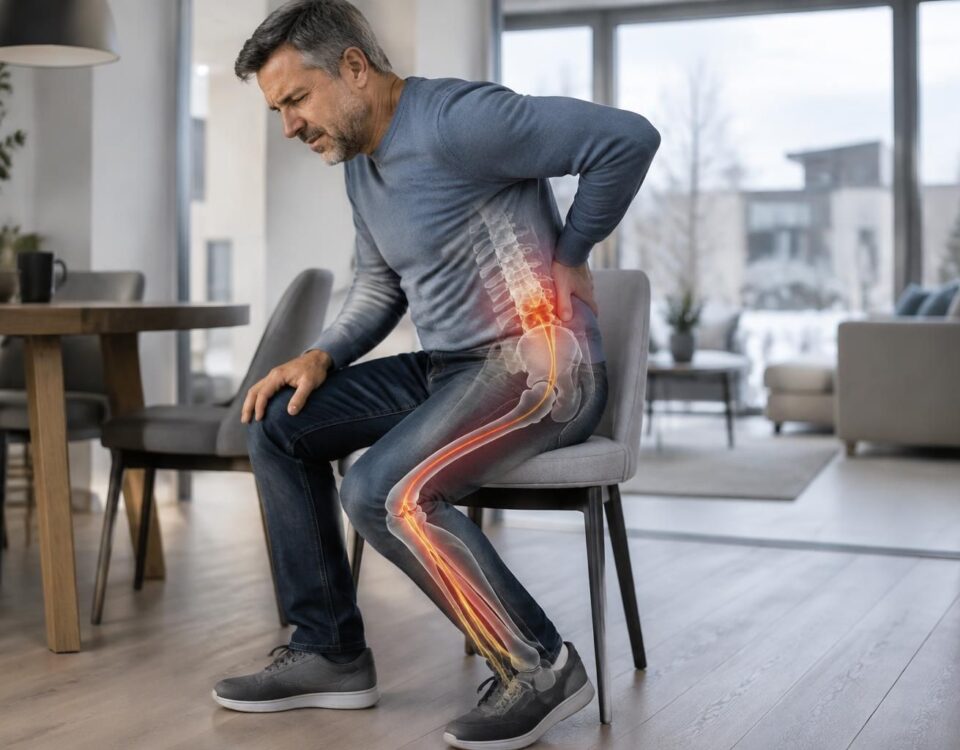
Pain that starts from the lower back or buttock and radiates down the leg may be related to the irritation of a lumbar or sacral nerve root. This is referred to as lumbosacral radiculopathy. The term “sciatica” is often used to describe this pain, especially when it follows the back of the thigh and extends below the knee. However, this word does not specify alone which root is concerned or what the cause is. In Terrebonne as elsewhere, the evaluation must take into account the pathway of symptoms, strength, sensitivity, reflexes, and the ability to walk or perform usual activities.
L4, L5, and S1 refer to nerve roots that contribute to the sensitivity and movement of the leg and foot. Their territory can provide clues, but the areas overlap and vary from person to person. An L5 impairment may particularly be accompanied by symptoms on the top of the foot or difficulty lifting the big toe. An S1 impairment may affect the heel or outer edge of the foot and may sometimes alter the ability to rise on tiptoes. These markers are not sufficient to establish a diagnosis: they must be compared to a clinical examination.
The disc levels and nerve roots are not interchangeable. A hernia at the L4-L5 level often affects the L5 root, while a disc impairment at L5-S1 frequently concerns S1. These are common associations, not absolute rules. The position of the anomaly, anatomical particularities, and other present structures can influence the picture. This is why an MRI image should not be interpreted in isolation: it must correspond to the affected side, the pain pathway, and the findings of the examination.
Possible causes include a disc herniation, bone spurs related to osteoarthritis, narrowing of the spinal canal, or stenosis of the opening through which a nerve root passes. More rarely, other issues may produce similar symptoms. Burning, stabbing, or electric shock-like pain may accompany tingling, numbness, or weakness. Coughing or certain efforts may exacerbate symptoms in some individuals, but no isolated sign confirms the cause on its own.
The evaluation may include comparison of the strength of both legs, sensitivity, reflexes, and walking. The professional may also observe the ability to walk on heels or toes and to lift the big toe. An MRI or a CT scan may be considered when symptoms persist, a neurological deficit is present, or the result is likely to modify management. Electrodiagnostic tests may sometimes help to specify the affected level or differentiate radiculopathy from other nerve disorders.
When neurological function remains stable, the plan is typically adjusted gradually to the situation, tolerance, and the person’s goals. Activity may be modified rather than eliminated, and care may include active or manual approaches depending on the evaluation. At TAGMED Clinic, Sylvain Desforges, osteopath and naturopath, indicates a preference for an approach based on available data and the integration of technologies, particularly neurovertebral decompression, laser, or shockwave therapy when deemed relevant. These options do not automatically suit every situation and do not replace medical advice when necessary.
Useful follow-up measures more than just the intensity of pain: it may also focus on walking, sleep, time spent sitting, foot strength, and resuming activities. New or worsening weakness, a dropped foot, numbness in the saddle area, or changes in urinary or intestinal control require a rapid or urgent medical evaluation. A fever, recent trauma, or rapid deterioration also justifies prompt medical attention.
Guidelines for Understanding Levels L4, L5, and S1
Pain that starts from the lower back or buttock and radiates down the leg may be compatible with lumbosacral radiculopathy, often referred to as sciatica when certain nerve roots are involved. In Terrebonne, as elsewhere, the level of a disc — L4-L5 or L5-S1 — is not sufficient to determine which root is irritated: symptoms, strength, sensitivity, reflexes, and walking must be assessed together.
An impairment of the L5 root may particularly accompany symptoms on the top of the foot or difficulty lifting the big toe; an S1 impairment may affect the heel or the outer border of the foot and alter the ability to stand on tiptoes. These territories overlap and vary from person to person. To better distinguish the disc level from the nerve pathway, consult the guide on sciatica in Terrebonne and discs L4-L5 and L5-S1, as well as this resource on sciatica L4-L5 and L5-S1 in Terrebonne.
A herniated or protruding disc may irritate a root, but that is not the only possibility: foraminal narrowing, bone changes, or stenosis can also contribute to symptoms. Imaging should therefore be interpreted alongside clinical examination rather than considered in isolation. For further insights, see resources on L4-L5 disc protrusion, L5-S1 foraminal compression, and L4-L5 lumbar disc herniation. Additional pages also address L5-S1 foraminal compression in Terrebonne and the differences between levels in the Montreal context: L4-L5, L5-S1 and pain in the leg.
Follow-up is best when measuring concrete changes: strength of both legs, ability to walk on heels or toes, extent of numbness, sleep, and tolerance for walking or sitting. An adjusted activity may be favored when neurological status remains stable; however, the plan should be reassessed if symptoms spread, if function does not progress, or if a new deficit appears. The path of the sciatic nerve, general information on sciatica, and symptoms at the out of bed may complement this reading, without replacing a professional evaluation.
A new or progressive weakness, a dropped foot, numbness in the saddle area, or changes in urinary or intestinal control require a rapid or urgent medical evaluation. Significant pain accompanied by fever, recent trauma, or rapid deterioration also calls for immediate medical advice.
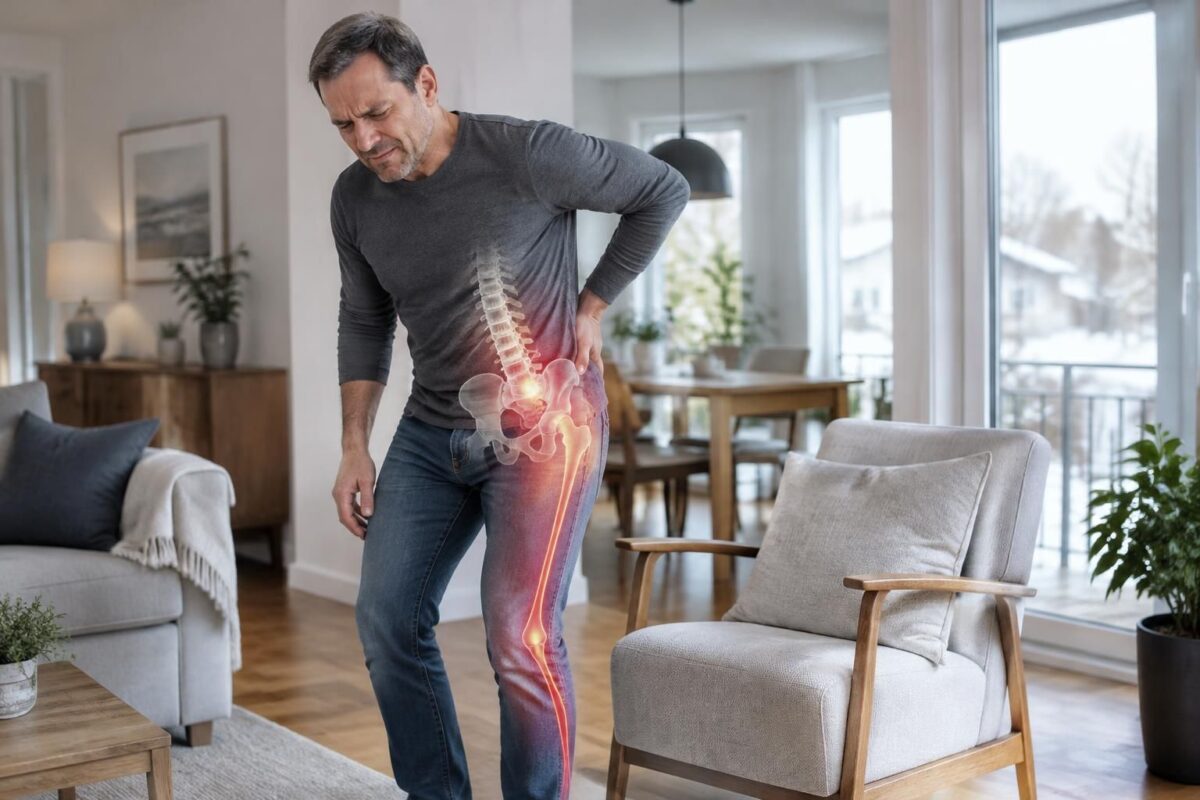
Sciatica in Terrebonne: why L5-S1 is often involved
IN BRIEF Sciatica corresponds to pain related to the irritation of a nerve root, which can extend from the buttock down to the leg. The L5-S1 level is often involved, as a disc herniation or irritation at this location can…

Sylvain Desforges, B.Sc., D.O., N.D., docteur en ostéopathie
Dr Sylvain Desforges, B.Sc., D.O., N.D., osteopath, is the founding president of TAGMED and of the ACMA association. He dedicates his practice to chronic spinal pain, low back pain and symptoms compatible with sciatica, particularly when pain radiates toward the buttock, leg, calf, foot or toes.
Through SOS Sciatique, he publishes educational content on sciatica symptoms, possible causes such as disc herniation, disc narrowing, foraminal stenosis or irritation of a lumbar nerve root, as well as non-surgical approaches that may be considered according to the evaluation. At Clinique TAGMED, care may include, depending on the case, motorized neurovertebral decompression, specific osteopathic care or precision percussion.
For an evaluation related to sciatica treatment in Montreal / Mount Royal or sciatica treatment in Terrebonne, please consult the services available at Clinique TAGMED.
Medical disclaimer
The information published on SOS Sciatique is provided for educational purposes only and does not replace a consultation, diagnosis, opinion or treatment provided by a physician or another authorized healthcare professional. The author of this article is neither a medical doctor nor a specialist in a medical specialty recognized by the Collège des médecins du Québec. The osteopathic, manual medicine or functional support approaches described on this site do not constitute medical acts and are not intended to replace medical follow-up.
Consult a physician or emergency service in cases of loss of bladder or bowel control, anesthesia in the saddle area, significant or progressive weakness in the leg or foot, fever, recent trauma, severe pain or rapid worsening of symptoms. For more details, please read our Legal Notice.