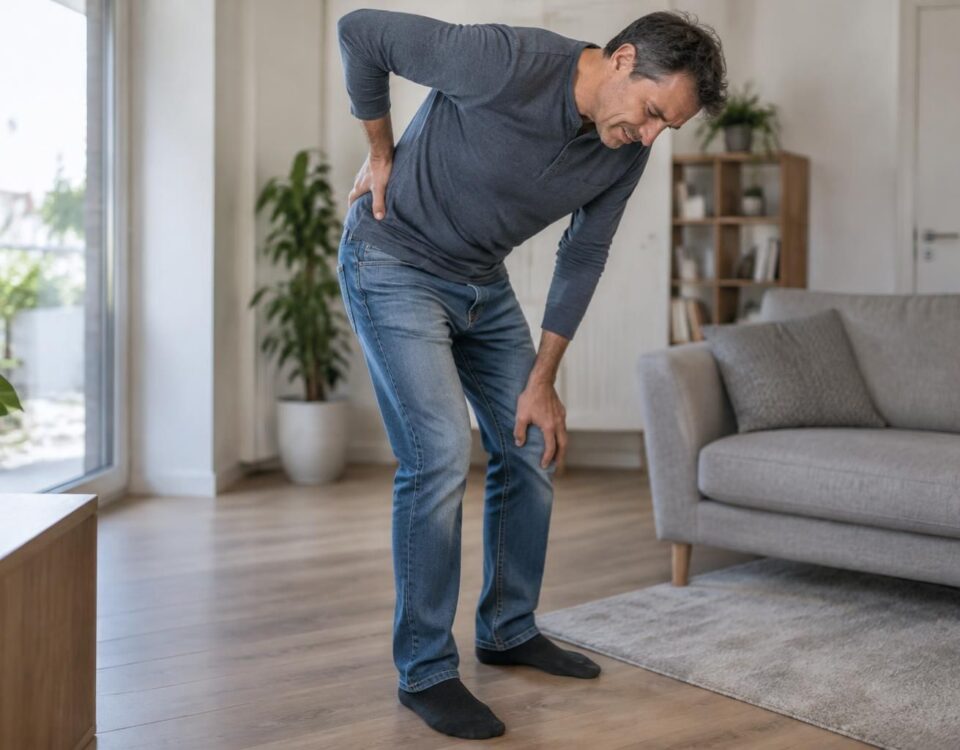
Sciatica in Terrebonne: L4, L5, S1, how to find your way?
01/11/2026
Disc protrusion and pain on the outer edge of the foot
01/11/2026
IN BRIEF
| Sciatica can vary from day to day depending on fatigue, activities, and the sensitivity of the nervous system. These fluctuations are common and do not necessarily mean that the situation is worsening. A gradual return to movement and appropriate rehabilitation can help better tolerate efforts and make symptoms more predictable. |
Pain related to sciatica can vary from day to day, depending on fatigue, activities, and the sensitivity of the nervous system. A more painful day does not necessarily mean that the situation is worsening. A gradual return to movements and proper management of efforts can help better tolerate these fluctuations. Consult quickly if you experience significant or progressive weakness, loss of bowel or bladder control, or numbness in the saddle area.
Sciatic pain can change in intensity and location from day to day. A more painful day does not always mean that the situation is worsening: fatigue, activities, prolonged positions, and the sensitivity of the nervous system can modify symptoms. This article explains why these variations occur, what signs should prompt consultation, and how to assess persistent pain.
Sciatica refers to pain that follows the path of a lumbar nerve root, often from the lower back or buttock to the thigh and leg. It can sometimes reach the calf, foot, or toes. To learn more about the possible mechanisms, check this presentation on sciatica and its causes.
Symptoms do not always remain the same. They can be mild in the morning, increase after activity, or ease with rest. The pain can also vary in duration or seem to move along the leg. These changes are common and do not, by themselves, prove that an injury has worsened.
Why does pain change in intensity?
Pain depends on several factors. The load carried by the back, the time spent sitting or standing, fatigue, and sleep quality can influence symptoms. An activity tolerated one day may be more difficult another day, especially if the body is tired or if stresses have accumulated.
When a nerve root is irritated, the nervous system may become more sensitive. It then responds more to certain stimuli, even if the anatomical structure has not changed. Therefore, the pain felt does not alone indicate whether the compression or irritation has increased.
Can pain change its path?
Yes. Pain can remain in the buttock or thigh and then travel further down the leg. Pain that reaches the foot deserves special attention, but its path must be interpreted along with all symptoms and clinical examination. You can read our article on sciatic pain that travels to the foot.
Conversely, pain that does not follow the whole usual path does not rule out nerve irritation. Location alone is not sufficient to make a diagnosis. To better understand this situation, refer to the information on an incomplete sciatic pain path.
What situations can worsen symptoms?
A prolonged position can increase stiffness or discomfort. Some people also notice an increase in pain after a movement, a busy day at work, or a period of less restorative sleep. Vibrations and sitting in a bus can also be difficult for some people. Our article on sciatica in a bus, vibrations, and sitting addresses this topic.
Certain movements of the lower back can also alter symptoms. For example, pain that increases when the back arches should be evaluated in context: it does not alone identify the cause. To learn more, refer to the article on sciatic pain aggravated by lumbar extension.
Pain can vary even without obvious changes in posture or activity. Thus, it is useful to observe trends over several days rather than drawing conclusions from a single bad day. This resource also provides explanations on daily variations of sciatica pain.

Sciatica and pain that varies with activity
IN BRIEF Sciatica is pain related to irritation of a lumbar nerve root; it can vary with movements and activities. Gentle mobility, such as walking, and adapted exercises can help maintain flexibility and strength, while prolonged rest can increase stiffness.…

Sciatica and pain that varies with posture
IN BRIEF Sciatica can vary depending on posture, as certain positions or their duration increase sensitivity of the nerve. Alternating positions, moving regularly, and adjusting sitting or standing periods can help distribute strains better and gradually improve tolerance to movement.…
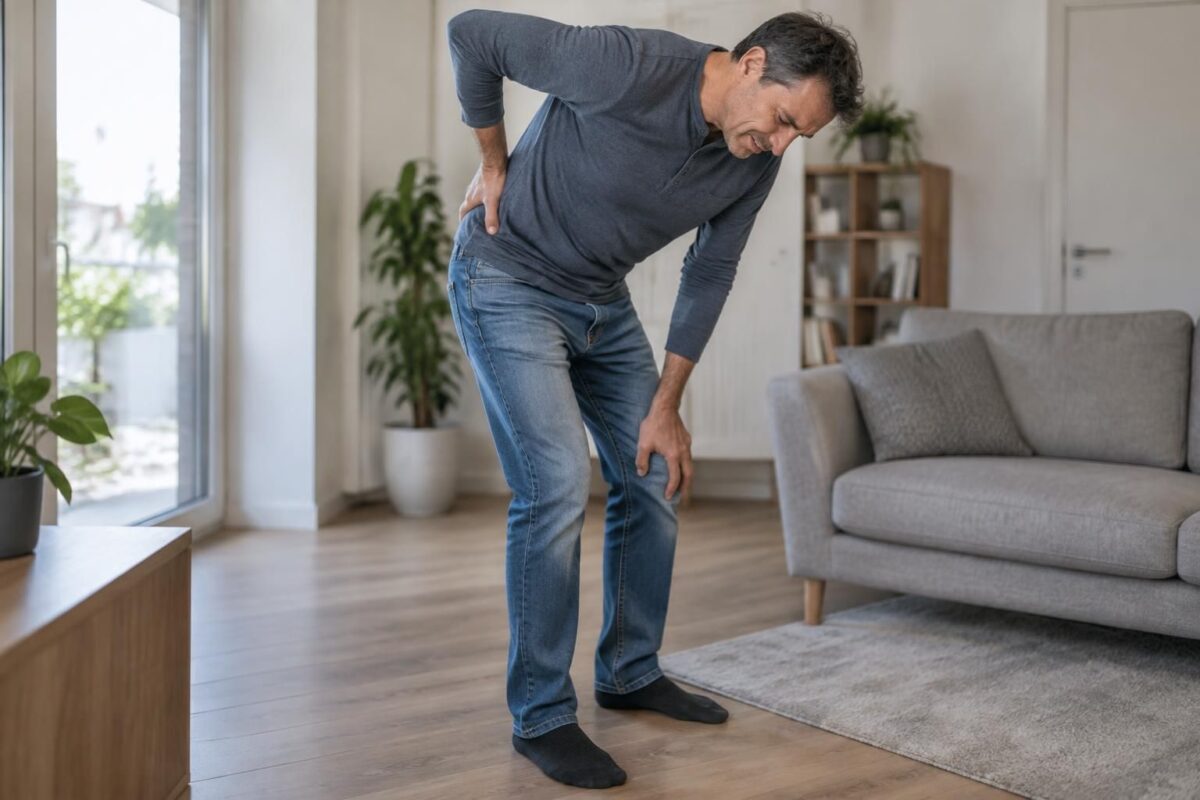
Sciatica and pain worsened in lumbar flexion
IN BRIEF Aggravated lumbar flexion sciatica refers to pain that increases when bending the lower back forward and can radiate from the buttock to the leg. This movement may exacerbate the irritation of a nerve root, for example, in the…
Pain variation: when should you worry?
A temporary fluctuation is often compatible with the evolution of nerve pain. However, you should seek medical advice if the pain significantly increases, becomes persistent, or increasingly limits activities. An assessment is also important in the presence of new numbness, weakness, or changes in gait.
Consult urgently if there is loss of control of the bladder or bowels, numbness in the saddle area, or significant or progressive weakness in a leg or foot. Fever, recent trauma, or severe pain that worsens rapidly also warrant quick evaluation.
Why is a neurological examination useful?
A healthcare professional can check strength, sensitivity, reflexes, and movements. This examination helps locate symptoms and determine whether further tests are necessary. Discover the role of neurological assessment in cases of sciatic pain.
Pain that varies does not automatically require new imaging. The doctor may consider an MRI or another test based on the duration of symptoms, their evolution, and the assessment results. For general information on sciatica, you can also refer to this health resource and the guide from Doctolib on understanding and relieving sciatica pain.

Sciatica and pain worsened in lumbar extension
IN BRIEF Lumbosacral sciatica aggravated in extension is a pain that radiates down the buttock or leg and increases when the lower back arches. This position can exacerbate irritation of a nerve root, particularly in cases of stenosis; however, it…

Sciatica and pain relieved by bending: possible stenosis
IN BRIEF A sciatica-type pain relieved by leaning forward may be compatible with lumbar stenosis, a narrowing that can irritate or compress nerves. Flexion may temporarily decrease pressure, but does not confirm the diagnosis or treat the cause. A professional…

Sciatica and pain worsened while sitting: consider the disc?
IN BRIEF Sciatica aggravated in a seated position may be related to irritation of a nerve root, sometimes caused by a herniated disc. Remaining seated can exacerbate pain that radiates from the buttock down the leg, but this symptom alone…
How to track the evolution of sciatic pain?
Note the intensity of the pain, its path, and the activities that seem to modify it. You can also note the duration of painful periods and the time needed to return to your usual level. These markers help the consulted professional to understand the evolution without replacing their examination.
It is not necessary to eliminate all movement for fear of pain variation. However, activities should be adapted to your condition and the advice received. If a movement causes severe pain, weakness, or persistent worsening, stop it and seek professional advice.
When symptoms persist, recur frequently, or disrupt sleep and daily activities, a consultation allows for a reassessment of the situation and management options. For an overview of the possible duration of episodes, refer to this article on the duration of a sciatic episode.
What management options should be discussed?
Management depends on the probable cause, symptoms, and results of the evaluation. A doctor may discuss medications, the need for imaging, or other treatments. Do not change a prescribed treatment without discussing it with the professional who is following you.
At TAGMED Clinic, an evaluation may allow for discussions about non-surgical approaches, including specific osteopathy or, when the context allows, motorized neurovertebral decompression. These treatments do not replace a medical diagnosis and are not suitable for every situation. To better understand sciatica and possible options, also check our page on sciatica treatment in Montreal and Mount Royal or the one on sciatica treatment in Terrebonne.
About the author
Sylvain Desforges, B.Sc., D.O., N.D., Doctor of Osteopathy and Naturopath, is the founding president of TAGMED and the ACMA association. He dedicates his practice to chronic pain in the spine, lower back pain, and pain associated with sciatica, especially when the pain radiates down to the buttock, leg, calf, foot, or toes.
Through SOS Sciatique, he publishes educational content about sciatica symptoms, possible causes, and non-surgical approaches that can be considered based on the evaluation. At TAGMED Clinic, treatments may include, as appropriate, motorized neurovertebral decompression, specific osteopathy, or a precision impactor.
For an evaluation, consult the services of the TAGMED Clinic.
Medical disclaimer
The information published on SOS Sciatique is provided for educational purposes and does not replace a consultation, diagnosis, advice, or treatment conducted by a physician or another licensed healthcare professional. The author of this article is neither a doctor nor a specialist in a medical specialty recognized by the Collège des médecins du Québec. The osteopathy, manual medicine, or functional support approaches described on this site do not constitute medical acts and are not intended to replace medical follow-up.
Consult a physician or emergency service in case of loss of bowel or bladder control, anesthesia in the saddle area, significant or progressive weakness in the leg or foot, fever, recent trauma, severe pain, or rapid worsening. For more details, please read our Legal notice.
Medical disclaimer: The information and advice provided on this site do not replace the advice, diagnosis, or treatment of a healthcare professional. Please note that Sylvain Desforges, B.Sc., D.O., N.D., Doctor of osteopathy, is neither a medical doctor nor a physician, and is not a specialist in a medical specialty as defined by the Collège des médecins du Québec. Manual medicine, functional medicine, and sports medicine as described on this site exclude any treatment or medical diagnosis performed by a physician or specialist. Always consult your physician for any medical questions. For more details, please read our complete Legal Notice.
What can affect pain variation
- Prolonged activity and positions
- Fatigue or insufficient sleep
- Variation in nerve sensitivity
How to react
- Adapt effort without stopping all movement
- Gradually resume tolerated activities
- Consult if pain worsens or if weakness appears

A sciatica can vary from day to day: some days, the pain is moderate; other days, it radiates more into the buttock or leg. These fluctuations do not necessarily mean that your condition is worsening. Activity load, fatigue, sleep, and the sensitivity of the nervous system can modify symptoms. The goal is to observe their evolution, adapt your activities without immobilizing yourself, and know when to seek professional advice.
Why does pain change from day to day?
Nerve system sensitivity
Pain is not a direct and constant reflection of an injury. When a nerve root is irritated, the nervous system can become more reactive. An activity usually well-tolerated may then provoke more symptoms, especially after a demanding day or a less restorative night. The intensity, duration, and location of the pain can also fluctuate.
Daily stresses
A long period of sitting, unusual movements, carrying a load, or a too rapid return to exercise can influence symptoms. Stress and fatigue can also make pain harder to tolerate. These factors do not necessarily indicate that a structure in your back has changed; they provide clues for better adjusting your pace.
What to do on a more painful day?
Avoid turning a pain flare-up into complete immobility, unless otherwise advised by a healthcare professional. Instead, try to temporarily reduce the intensity or duration of activities, and then gradually return to them according to your tolerance. Breaking tasks into smaller parts, changing positions regularly, and doing short periods of gentle walking can help limit stiffness.
Do not try to “test” your pain endlessly with repetitive movements or forced stretches. Any exercise that significantly increases radiating pain in the leg or causes new numbness or weakness should be stopped and discussed with a professional. There is no universally suitable movement for all sciatica patients.
How to better identify triggers?
For a few weeks, briefly note the intensity and location of your symptoms, your activities, your sleep, and rest periods. This tracking can reveal trends without requiring you to analyze every sensation. Instead, look at the general evolution: Are you recovering more quickly after an activity? Are difficult days occurring less frequently? These clues are often more helpful than isolated fluctuations.
If pain persists, recurs often, or limits your activities, seek an evaluation from a healthcare professional. An examination allows for checking the symptoms and determining whether further investigations or appropriate management are necessary. Rehabilitation can particularly aim for a gradual return to activities and better tolerance to efforts, according to your situation.
When to consult quickly?
Consult a doctor or emergency service without delay in case of loss of control over the bladder or bowels, numbness in the saddle region, or significant or progressive weakness in the leg or foot. A fever, recent trauma, severe pain, or rapid worsening also warrant prompt medical advice.
About the author
Sylvain Desforges, B.Sc., D.O., N.D., Doctor of Osteopathy and naturopath, is the founding president of TAGMED and the ACMA association. His practice notably focuses on chronic spinal pain and pain compatible with sciatica.
Medical disclaimer: this content is educational and does not replace a consultation, diagnosis, or treatment by a licensed healthcare professional. The author is neither a doctor nor a specialist in a medical field recognized by the Collège des médecins du Québec. Manual or functional approaches do not replace medical follow-up.
| Observed Factor | What it may indicate |
|---|---|
| Increased pain after activity | The load of the day may have exceeded your current tolerance. |
| Symptoms worsened by fatigue | A sensitized nervous system may become more reactive. |
| Variable pain from day to day | These fluctuations do not necessarily indicate worsening. |
| Pain that changes in intensity or location | Nerve sensitivity and movement patterns can influence symptoms. |
| Slow recovery or persistent symptoms | An evaluation by a healthcare professional can help adapt the management. |
| Progressive weakness or urinary or bowel issues | Consult a doctor or emergency service quickly. |
Testimonials: sciatica that varies from day to day
The testimonials below are fictional examples, written for educational purposes. They do not necessarily describe real patients and do not predict the progression of your situation.
“Some days, I walk almost normally”
“My pain starts from the lower back and goes down to the hip and leg. I sometimes have a fairly calm day, then feel more pain the next day, even without particular effort. I’ve learned not to automatically interpret every flare as a worsening.” — Marc, 52 years old
“Fatigue seems to affect my symptoms”
“When I sleep poorly or have a very busy day, my sciatica seems more sensitive. The pain can be sharper at the end of the day, then decrease after rest and some gentle movements. Understanding these variations helps me better distribute my activities.” — Isabelle, 47 years old
“Painful periods don’t always feel the same”
“Sometimes, the pain mainly stays in the hip. Other times, it goes down to the calf. This difference worried me, but I understood that intensity or location could fluctuate. I talk to my healthcare professional when I notice a significant or persistent change.” — Daniel, 61 years old
“I gradually resumed my activities”
“At first, I wanted to wait until I was completely pain-free before moving. By discussing with a professional, I learned to gradually resume based on my tolerance. My symptoms still vary, but I manage harder days better and sometimes recover more quickly after effort.” — Nadia, 39 years old
Sciatic pain can fluctuate depending on activities, fatigue, sleep, or nervous system sensitivity. A more painful day does not necessarily mean that the situation is worsening, but new, persistent, or marked symptoms deserve appropriate evaluation.
Consult a doctor or emergency service quickly in case of significant or progressive weakness in the leg or foot, loss of urinary or bowel control, numbness in the saddle region, fever, or pain that is worsening rapidly.
Sciatica: why does pain vary from day to day?
Sciatica does not always present with the same intensity. Some days allow for almost normal movement, while others are marked by sharper pain in the lower back, hip, or leg. This fluctuation may be concerning, but it does not automatically mean that the spine or nerve has been further damaged. Symptoms depend on several factors, including the sensitivity of the nervous system and the physical demands placed on the body throughout the day.
The term sciatica generally refers to pain that follows the path of a lumbar nerve root, often from the hip down the back or side of the leg, sometimes as far down as the calf, foot, or toes. A herniated disc, narrowing around a nerve root, or other causes may be involved. However, the presence and intensity of pain alone do not precisely identify its origin. An evaluation by a healthcare professional is necessary to make a diagnosis.
Pain can vary after a long period of sitting, a physically demanding day, unusual exertion, or a night of poor sleep. Fatigue, stress, and a temporary decrease in activity can also change how the body tolerates movement. A sensitive nerve may react more to a stimulus that, just a few days earlier, caused little symptom. Therefore, a temporary variation does not necessarily indicate structural worsening.
It is helpful to observe the circumstances without monitoring each sensation with concern. Note, for example, the activities performed, the duration spent in the same position, and the time needed to recover. These markers can help better distribute tasks and adjust effort. Rather than stopping everything during a difficult day, some people benefit from gentle and adapted activity, like short walks, respecting their limits and the recommendations of their healthcare professional.
The management generally aims to gradually improve tolerance to movement and daily activities. Depending on the situation, a professional may propose gradual exercises, coordination work, or strategies to break up sitting periods and efforts. Manual therapy or available clinical technologies may be considered after assessment, but their relevance depends on each individual. No treatment guarantees the same result for everyone, and persistent pain deserves appropriate follow-up.
Consult a doctor or emergency service promptly in case of loss of bladder or bowel control, numbness in the saddle area, or significant or progressive weakness of the leg or foot. Fever, recent trauma, severe pain, or rapid worsening also justify medical evaluation. If symptoms persist, frequently return, or limit your activities, seek advice from a professional to determine suitable next steps.
About the author: Sylvain Desforges, B.Sc., D.O., N.D., Doctor of Osteopathy and naturopath, is the founding president of TAGMED and the ACMA association. His practice focuses, in particular, on chronic spinal pain, lower back pain, and symptoms consistent with sciatica. His approach is concerned with functional evaluation and non-surgical options that may be considered depending on the case, including specific osteopathy and motorized neurovertebral decompression.
Medical disclaimer: this text is provided for educational purposes and does not replace a consultation, diagnosis, or treatment by a licensed healthcare professional. The author is neither a doctor nor a specialist in a recognized medical specialty. The approaches described do not constitute medical acts and do not replace medical follow-up.
Pain associated with sciatica can change in intensity from day to day, sometimes without an obvious cause. These fluctuations are often related to load, fatigue, movements, and sensitivity of the nervous system; they do not prove alone that the situation is worsening. However, it remains important to monitor the evolution of symptoms and consult if weakness appears, if pain rapidly intensifies, or if warning signs occur.
Why does sciatic pain vary?
Sciatica does not solely depend on a structure of the spine. When tissues or a nerve root are irritated, the nervous system can become more sensitive to stress. An activity tolerated one day may then seem more challenging the next, especially after a less restorative night, a period of sustained activity, or a long time in the same position. To better understand symptoms, possible causes, and relief options, consult this guide on sciatica and this overview of its anatomy, causes, and management.
Symptoms can also change in duration or location: pain may be more present in the buttock one day, then descend more into the leg another day. This type of variation alone does not determine if a herniated disc, disc pinching, or another cause is at play. A healthcare professional can assess symptoms as a whole; the MédecinDirect page on sciatica also offers general benchmarks.
What to do when symptoms fluctuate?
It may be helpful to observe the circumstances preceding more difficult days: time spent sitting or standing, unusual exertions, sleep, and fatigue level. This observation does not replace an assessment, but can help better dose activities. Unless otherwise instructed by a doctor, prioritize gentle movements and a gradual return rather than prolonged immobility or efforts that trigger sharp pain. For practical advice on what to do, consult the recommendations from ameli.fr.
Walking may be more difficult during certain periods, but the significance depends on the context and associated signs. You can read this information about walking becoming difficult in Montreal and about difficulty walking in Terrebonne. Pain that does not follow the usual path also deserves to be interpreted according to the examination and evolution: see the benchmarks on an incomplete path of sciatic pain.
When to request an evaluation?
A pain that persists, frequently returns, or limits activities may warrant an individualized evaluation, even if its intensity varies. The location of symptoms can guide the examination but is not sufficient for establishing a diagnosis: for example, pain towards the top of the foot can be addressed on this page about the L4-L5 region and the top of the foot. To know when to consider a personalized approach, also check the information on an evaluation of sciatic pain in Montreal.
If symptoms have lasted for several weeks or months, a healthcare professional can reassess the situation and discuss suitable options. The persistence of pain does not automatically mean that surgical intervention is necessary: the decision also depends on symptoms, examination, and, when indicated, imaging results. To explore possible avenues when pain persists, consult this guide on chronic sciatica and options to consider.
Quickly seek medical advice in case of significant or progressive weakness of the leg or foot, loss of urinary or bowel control, or numbness in the saddle area. A fever, recent trauma, severe pain, or rapid deterioration also require medical attention. In case of doubt, contact a doctor or an emergency service.
About the author
Sylvain Desforges, B.Sc., D.O., N.D., Doctor of Osteopathy and naturopath, is the founding president of TAGMED and the ACMA association. His practice is dedicated to chronic spinal pain, lower back pain, and pain compatible with sciatica, especially when the pain radiates down to the buttock, leg, calf, foot, or toes.
Through SOS Sciatique, he publishes educational content on the symptoms of sciatica, its possible causes, and non-surgical approaches that may be considered based on the evaluation. At TAGMED Clinic, care may include, depending on the case, motorized neurovertebral decompression, specific osteopathy, or a percussion tool.
For an evaluation related to sciatica treatment in Montreal or Mont-Royal, or sciatica treatment in Terrebonne, check the available services at TAGMED Clinic.
Medical Disclaimer
The information published on SOS Sciatique is provided for educational purposes and does not substitute for a consultation, diagnosis, opinion, or treatment performed by a physician or other authorized healthcare professional. The author is neither a doctor nor a specialist in a medical specialty recognized by the Collège des médecins du Québec. The osteopathy, manual medicine, or functional support approaches described on this site do not constitute medical acts and are not intended to replace medical follow-up.
For more details, please consult our Legal Notice.

Sciatica and pain relieved while seated: consider stenosis?
IN BRIEF A sciatica relieved in a seated position may suggest a lumbar stenosis and neurogenic claudication, but this sign alone is not sufficient for a diagnosis. Observing walking, weakness, and symptom evolution helps guide the evaluation and compare signs…

Sciatica and pain that worsens when walking
IN BRIEF A sciatica that worsens with walking is pain radiating from the buttock down the leg, exacerbated by walking. Several causes are possible: this symptom alone does not suffice for a diagnosis. Temporarily reduce walking duration, change positions, and…

Sylvain Desforges, B.Sc., D.O., N.D., docteur en ostéopathie
Dr Sylvain Desforges, B.Sc., D.O., N.D., osteopath, is the founding president of TAGMED and of the ACMA association. He dedicates his practice to chronic spinal pain, low back pain and symptoms compatible with sciatica, particularly when pain radiates toward the buttock, leg, calf, foot or toes.
Through SOS Sciatique, he publishes educational content on sciatica symptoms, possible causes such as disc herniation, disc narrowing, foraminal stenosis or irritation of a lumbar nerve root, as well as non-surgical approaches that may be considered according to the evaluation. At Clinique TAGMED, care may include, depending on the case, motorized neurovertebral decompression, specific osteopathic care or precision percussion.
For an evaluation related to sciatica treatment in Montreal / Mount Royal or sciatica treatment in Terrebonne, please consult the services available at Clinique TAGMED.
Medical disclaimer
The information published on SOS Sciatique is provided for educational purposes only and does not replace a consultation, diagnosis, opinion or treatment provided by a physician or another authorized healthcare professional. The author of this article is neither a medical doctor nor a specialist in a medical specialty recognized by the Collège des médecins du Québec. The osteopathic, manual medicine or functional support approaches described on this site do not constitute medical acts and are not intended to replace medical follow-up.
Consult a physician or emergency service in cases of loss of bladder or bowel control, anesthesia in the saddle area, significant or progressive weakness in the leg or foot, fever, recent trauma, severe pain or rapid worsening of symptoms. For more details, please read our Legal Notice.