Sciatica in Terrebonne: what “disc-root conflict” means
28/10/2026
Sciatica and generic exercises: why they are not suitable for everyone
28/10/2026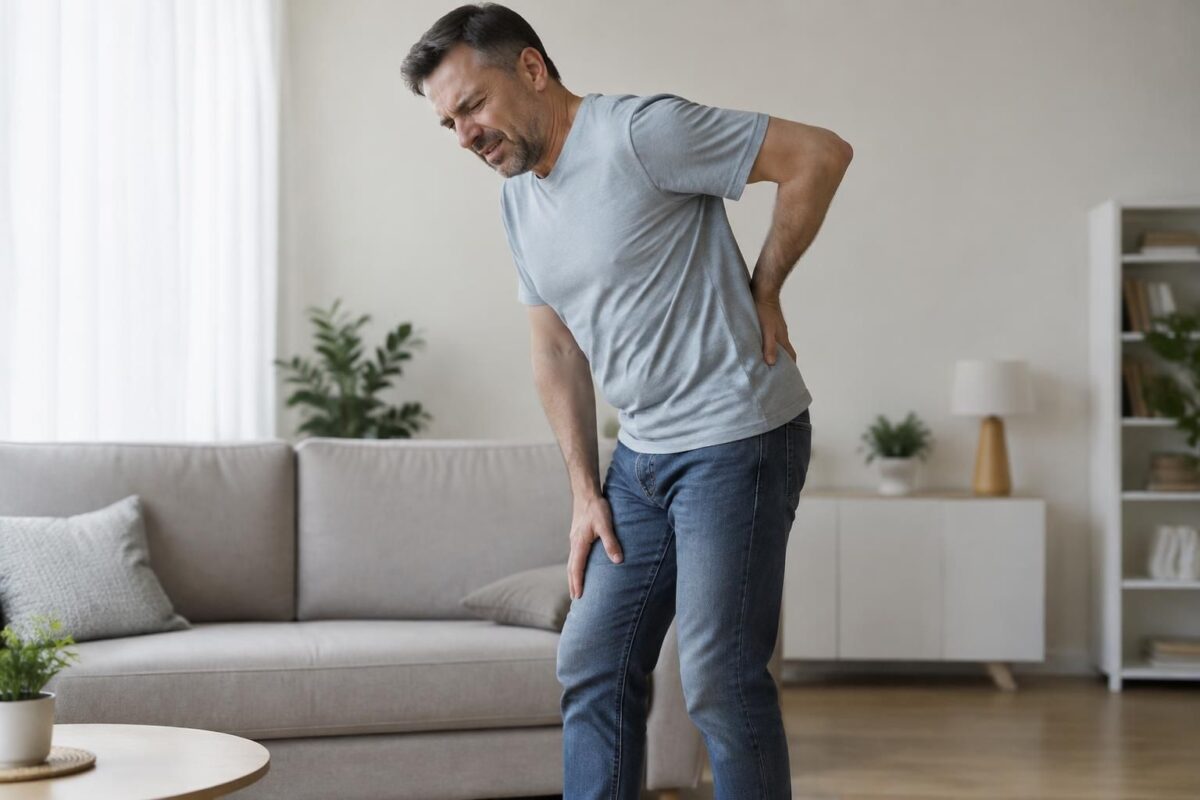
IN BRIEF
| Lumbosacral sciatica aggravated in extension is a pain that radiates down the buttock or leg and increases when the lower back arches. This position can exacerbate irritation of a nerve root, particularly in cases of stenosis; however, it is not sufficient to establish a diagnosis. Identifying triggering movements helps guide the assessment and adapt activities. Significant or progressive weakness, loss of sensation in the perineum, or urinary or bowel issues necessitate urgent consultation. |
A sciatica aggravated when the lower back is arched may be related to a reduction in the space around a nerve root, particularly in cases of lumbar stenosis or arthritic changes. The pain may start in the buttock and radiate down the leg. However, this reaction to extension alone is not sufficient to determine the cause: a clinical evaluation can clarify the origin of the symptoms.
Avoid positions that significantly exacerbate pain, without remaining bedridden for long, and gradually resume tolerated activities. Consult promptly in cases of significant or progressive weakness, numbness in the perineum, or urinary or bowel issues. This information is educational and does not replace professional consultation.
Radiating pain that increases when the back arches may be related to irritation of a nerve root or narrowing of the nerve exit spaces. This sign alone does not identify the cause. The pathway of the pain, associated symptoms, and a professional examination help direct the assessment and next steps. The lumbar extension corresponds to the movement that arches the lower back, for example by leaning backwards. For some individuals, this position increases pain in the lower back, the buttock, or the leg. It can also cause tingling or a sensation of electric shock. Sciatica typically describes pain following the pathway of a lumbar nerve root, often L5 or S1. The pain may radiate from the buttock to the thigh, calf, or foot. To better understand the role of these roots, consult the information on the possible involvement of L5 and S1. When the lower back arches, certain posterior structures of the spine move closer together. For some individuals, this movement can reduce the space around a nerve root, particularly if there is already narrowing present. A foraminal stenosis, for example, can contribute to irritating a root as it exits the spine. However, the details depend on the anatomy and the cause of the symptoms. A herniated or bulging disc can also irritate a nerve root. Pain does not always react the same way to extension from one person to another. The level of the affected disc, inflammation, tissue sensitivity, and other factors influence the symptoms. Thus, a painful movement alone does not prove that a disc is involved. For more information on the links between lumbar discs and pain in the leg, consult this article on L4-L5, L5-S1, and Sciatic Symptoms. You can also read this page dedicated to foraminal compression at L5-S1. Pain radiating below the knee, especially if accompanied by tingling, numbness, or weakness, may suggest nerve irritation. Pain that is primarily localized to the back or buttock may have other causes. Several issues can resemble one another; thus, it is best not to draw conclusions from a single symptom. Involvement of the L5 root can cause pain on the side of the leg and the top of the foot, sometimes extending to the big toe. S1 involvement may instead affect the back of the thigh and calf, the heel, or the outer edge of the foot. These pathways provide guidance but do not replace an examination. For further explanations on sciatica pain and associated symptoms, consult this guide on sciatic symptoms. Pain that worsens while standing or walking and then decreases when changing position may also be present in certain lumbar canal stenoses. This profile is not sufficient to establish a diagnosis. The professional takes into account the duration of symptoms, their progression, and the results of the examination. The evaluation begins with questions about the onset of pain, activities that modify it, its pathway, and associated symptoms. The examination may involve observing movements, checking sensitivity, strength, and reflexes, as well as tests that put tension on the nerves. Imaging is not always necessary from the outset. A doctor may request an MRI or another exam if symptoms are atypical, persist despite appropriate management, if weakness appears, or if a specific treatment is being considered. Imaging should be interpreted alongside symptoms and the clinical examination, as a visible abnormality does not always mean that it causes the pain. Avoid repeating a movement that triggers severe pain or clearly increases symptoms in the leg. This does not mean that you need to remain bedridden for long. A gradual resumption of usual activities is often preferable to prolonged rest, within the limits of symptoms and according to the advice of a healthcare professional. In cases of pain possibly linked to a herniated disc, a bulge, or foraminal narrowing, it is better to avoid choosing exercises or stretches on your own. Some movements may further irritate the symptoms. This article explains why caution is necessary with popular stretches for sciatica. Medications should be discussed with a doctor or pharmacist, especially in cases of chronic illness, pregnancy, taking other medications, or previous digestive or kidney issues. Do not extend self-medication without professional advice. Consult an emergency service immediately if you lose control of the bladder or bowels, if you experience loss of sensation in the perineum, or if significant weakness rapidly appears in one leg or foot. These signs may indicate nerve involvement requiring urgent evaluation. Also, seek medical advice promptly in case of fever, recent trauma, severe pain that worsens quickly, or symptoms accompanied by significant changes in general condition. If the pain radiates down the leg and is accompanied by numbness or weakness, a medical evaluation helps determine the level of urgency. After an assessment, non-surgical support may be considered depending on the situation and the individual’s goals. At the TAGMED Clinic, services may include specific osteopathy, precision percussion, or, when deemed appropriate by the professional, motorized neurovertebral decompression. These approaches do not replace a medical diagnosis and may not be suitable for everyone. Their relevance must be determined after an individual assessment. To learn about the available services, visit the TAGMED Clinic in Montreal or Terrebonne. Information about sciatica care in Montreal and Mont-Royal and the treatment of sciatica in Terrebonne is also available online. Sylvain Desforges, B.Sc., D.O., N.D., Doctor of Osteopathy and Naturopath, is the founding president of TAGMED and the ACMA association. He dedicates his practice to chronic pain of the spine, lower back pain, and pain compatible with sciatica, particularly when the pain radiates down to the buttock, leg, calf, foot, or toes. Through SOS Sciatique, he publishes educational content on the symptoms of sciatica, possible causes such as disk herniation, disc pinching, foraminal stenosis, or irritation of a lumbar nerve root, as well as on non-surgical approaches that may be considered based on the assessment. At the TAGMED Clinic, care may include, depending on the case, motorized neurovertebral decompression, specific osteopathy, or precision percussion. Medical disclaimer: The information and advice provided on this site do not replace the opinion, diagnosis, or treatment of a health professional. Please note that Sylvain Desforges, B.Sc., D.O., N.D., Doctor of Osteopathy, is neither a medical doctor nor a physician, and is not specialized in a medical specialty as defined by the Collège des médecins du Québec. Manual therapy, functional medicine, and sports medicine as described on this site exclude any treatment or medical diagnosis made by a physician or medical specialist. Always consult your doctor for any medical questions. For more details, please read our Complete legal notice.Why can an arched back trigger pain?
What symptoms may indicate
Pain varies according to the nerve pathway
How does the evaluation proceed?
What to do if extension worsens the pain?
When to seek urgent help?
Support options at the TAGMED Clinic
About the Author
Medical Disclaimer
What it may evoke
- Back extension may intensify the pain in some individuals.
- The pain radiating into the buttock or leg may be compatible with nerve irritation.
- This sign alone does not identify the cause.
Helpful Reflexes
- Avoid movements that significantly worsen symptoms temporarily.
- Prefer gentle and suitable activity rather than prolonged rest.
- Consult quickly if weakness occurs or worsens.
- In case of urinary or bowel issues, or perineal numbness, seek urgent medical help.

When sciatic-type pain increases by arching the lower back, lumbar extension may contribute to irritating a nerve root or reducing the space around it. However, this sign alone is not sufficient to establish a diagnosis. The goal is to temporarily limit movements that aggravate symptoms, to remain gently active, and to have the pain evaluated if it persists or is accompanied by neurological signs.
Why can lumbar extension worsen the pain?
Sciatica corresponds to pain that often starts from the lower back or buttock and radiates down the leg. It is generally related to the irritation of a lumbar nerve root. A herniated disc is a common cause, but arthritis, narrowing of the openings where nerves pass, or other issues may also be involved.
In the extended position, the lower back arches. In some individuals, this posture increases pressure on the joints or reduces the space available for nerve roots. The pain may then intensify in the buttock or leg, sometimes with tingling. The reaction varies from person to person: pain worsened by extension alone does not determine the source of the problem.
Sciatica and pain worsened in lumbar flexion
IN BRIEF Aggravated lumbar flexion sciatica refers to pain that increases when bending the lower back forward and can radiate from the buttock to the leg. This movement may exacerbate the irritation of a nerve root, for example, in the…
Sciatica and pain relieved by bending: possible stenosis
IN BRIEF A sciatica-type pain relieved by leaning forward may be compatible with lumbar stenosis, a narrowing that can irritate or compress nerves. Flexion may temporarily decrease pressure, but does not confirm the diagnosis or treat the cause. A professional…

Sciatica and pain worsened while sitting: consider the disc?
IN BRIEF Sciatica aggravated in a seated position may be related to irritation of a nerve root, sometimes caused by a herniated disc. Remaining seated can exacerbate pain that radiates from the buttock down the leg, but this symptom alone…
Adapting movements without being confined to bed
Identifying positions that relieve
During a painful flare-up, temporarily reduce activities that require you to bend backward, stand for extended periods, or work with an arched back. Avoid repeating movements that further propagate pain down to the calf or foot. Instead, try a comfortable position without forcing: some people find relief by walking gently or lying on their side with their knees slightly bent.
Strict prolonged rest is generally not advised. Alternate periods of rest and light movements according to your tolerance. Gradually resume daily activities, stopping or modifying a movement if it significantly increases symptoms. Avoid sudden manipulations and extension exercises performed without professional assessment.
Resuming activity gradually
When the most painful phase eases, a healthcare professional can guide you toward suitable exercises: gentle mobility, walking, or gradual strengthening of the trunk and hips. There is no single exercise suitable for all sciatica cases. A movement should be adjusted if it causes pain to radiate further down the leg, increases numbness, or causes weakness.

Sciatica and pain relieved while seated: consider stenosis?
IN BRIEF A sciatica relieved in a seated position may suggest a lumbar stenosis and neurogenic claudication, but this sign alone is not sufficient for a diagnosis. Observing walking, weakness, and symptom evolution helps guide the evaluation and compare signs…
Sciatica and pain that worsens when walking
IN BRIEF A sciatica that worsens with walking is pain radiating from the buttock down the leg, exacerbated by walking. Several causes are possible: this symptom alone does not suffice for a diagnosis. Temporarily reduce walking duration, change positions, and…

Sciatica and pain that improves when walking
IN SUMMARY Sciatica is pain that radiates from the lower back or buttock down to the leg, sometimes all the way to the foot. If it decreases with walking, a gentle and regular walk can help limit stiffness and maintain…
When to request an evaluation?
Consult a healthcare professional if the pain is significant, recurs frequently, limits your activities, or does not improve. The evaluation may include examination of strength, sensitivity, and reflexes. Imaging is not systematic in typical forms without alarming signs; its usefulness depends on the examination and progression.
Consult urgently in case of loss of control of the bladder or bowels, numbness in the saddle area, or significant or progressive weakness in the leg or foot. A fever, recent trauma, severe pain, or rapid deterioration also requires urgent medical advice.
About the author
Sylvain Desforges, B.Sc., D.O., N.D., doctor in osteopathy and naturopath, is the founding president of TAGMED and the ACMA association. He publishes educational content on lower back pain, sciatica, and non-surgical approaches that may be considered after evaluation. The care provided in the clinic may include, depending on the situation, specific osteopathy or motorized neurovertebral decompression.
Medical warning
This content is provided for educational purposes and does not replace a consultation, diagnosis, or treatment by a licensed healthcare professional. The author is neither a doctor nor a specialist in a medical specialty recognized by the Collège des médecins du Québec. Osteopathy and manual medicine approaches do not replace medical follow-up.
| Compared item | Clinical marker |
|---|---|
| Sciatica | Pain radiating from the buttock to the leg, sometimes down to the foot. |
| Pain in lumbar extension | Pain worsened by arching the lower back. |
| Possible causes | Nerve irritation, stenosis, or involvement of the lumbar joints may be at play. |
| Associated index | Worsening pain while walking that is relieved by leaning forward may suggest lumbar stenosis. |
| To remember | Painful extension alone is not enough to determine the cause; clinical examination is necessary. |
| When to consult urgently | In case of progressive weakness, numbness of the perineum, or urinary or bowel disturbances. |
Illustrative testimonials: sciatica worsened in lumbar extension
Reading note: The stories below are fictional examples, written for educational purposes. They do not correspond to verified testimonials and do not allow for diagnosis. Pain that increases when the lower back arches deserves appropriate evaluation according to each individual’s situation.
“As soon as I lean back, the pain goes down my leg”
For several days, pain starts from the lower back and travels through the buttock to the calf. Prolonged standing and arching the back intensify it; sitting or leaning slightly forward sometimes seems to bring relief. This progression may be compatible with lumbar irritation, but other causes are possible. A healthcare professional can examine strength, sensitivity, and reflexes to determine the next steps to take.
“I thought it was enough to stretch my back backward”
After following online exercises, a person notices that extension movements increase her pain in the buttocks and side of the leg. She stops the exercises that clearly reproduce the pain and seeks advice before continuing. Not all exercises are suitable for every episode of sciatica: it is better to avoid forcing in a direction that exacerbates the symptoms and to tailor movements to one’s condition.
“The pain mainly occurs when I walk upright”
Another person describes leg pain that occurs after a few minutes of walking, especially when the back remains arched. She sometimes feels better sitting or leaning slightly forward. This profile can guide the evaluation towards several lumbar mechanisms, but is not sufficient to identify the cause. A clinical examination is useful, especially if walking distance decreases or symptoms persist.
“I’ve learned to stay active without provoking more pain”
In this example, the person avoids movements that trigger strong radiation but does not stay in bed all day. She gradually resumes tolerated activities and seeks a tailored plan. Generally, a gradual return to movement is preferable to prolonged strict rest, but the level of activity should take into account pain and associated signs.
When to seek urgent help: new difficulty urinating or controlling bowel movements, numbness of the perineum, or significant or progressive weakness of the leg or foot requires urgent medical evaluation. Also consult quickly in case of fever, recent trauma, severe pain, or rapid deterioration.
About the author
Sylvain Desforges, B.Sc., D.O., N.D., Doctor of Osteopathy and naturopath, is the founding president of TAGMED and the ACMA association. His practice focuses in particular on chronic spinal pain, lower back pain, and pain compatible with sciatica. Depending on the assessment and situation, care provided at the TAGMED Clinic may include motorized neurovertebral decompression, specific osteopathy, or precision percussion.
Medical warning
This information is provided for educational purposes and does not replace a consultation, diagnosis, or treatment by a licensed healthcare professional. The author is neither a doctor nor a specialist in a medical specialty recognized by the Collège des médecins du Québec. Osteopathy, manual medicine, or functional assistance approaches do not constitute medical acts and do not replace medical follow-up.
Pain that starts from the lower back or buttock and descends into the leg may correspond to sciatica, also called lumbosciatica. It is generally related to irritation or compression of a lumbar nerve root, often L5 or S1. The pain may take the form of burning, electric shock, or sharp pain, sometimes accompanied by tingling, numbness, or weakness. Its path depends on the affected root and can extend to the calf, foot, or toes.
When symptoms worsen in lumbar extension—for example, when leaning backward or standing for a long time—it provides useful information but does not alone identify the cause. Extension may reduce the available space around certain nerve roots, especially in the presence of lumbar canal stenosis or the openings through which the nerves exit. It may also increase stress on the back’s posterior joints. A herniated disc, osteoarthritis, or other changes in the spine may also contribute to the symptoms.
The relieving posture varies from person to person. Some people feel better sitting or slightly leaning forward, while others do not tolerate this position well. Pain can also be influenced by walking, coughing, sneezing, or leg movements. It is therefore important to consider all symptoms and their progression, rather than drawing conclusions from a single movement. A healthcare professional can assess strength, sensitivity, and reflexes, then determine if further examinations are necessary.
In the absence of urgent signs, management often prioritizes the gradual maintenance of activities, temporarily adapting the movements that trigger significant pain. Prolonged strict rest is generally discouraged. Based on the assessment, a professional may suggest gradual exercises, physiotherapy, and strategies to resume daily activities. Manual therapies or other complementary approaches should be selected with caution and adjusted to symptoms; forced movements or aggressive manipulations are not suitable for all situations. Medications should be discussed with a professional, especially in cases of medical history or ongoing treatments.
A quick consultation is necessary in case of significant or progressive weakness in the leg or foot, new difficulty in walking, loss of sensation in the perineal area, or issues with urinary or intestinal control. Fever, recent trauma, intense pain that worsens quickly, or altered general condition also justify immediate medical evaluation. These signs do not all mean the same thing, but they require ruling out a cause that demands urgent care.
About the author
Sylvain Desforges, B.Sc., D.O., N.D., Doctor of Osteopathy and Naturopath, is the founding president of TAGMED and the ACMA association. He dedicates his practice to the management of chronic pain and the integration of technological approaches, including neurovertebral decompression, laser, and shockwaves. His work aims to provide informed support tailored to the evaluation of each person.
Medical disclaimer
This content is provided for educational purposes and does not replace a consultation, diagnosis, or treatment by a licensed healthcare professional. The author is neither a doctor nor a specialist in a recognized medical specialty. If you have concerning or persistent symptoms, seek medical advice.
Sciatic-type pain that increases when the lower back arches may be related to sensitivity in the lumbar structures, but this single sign does not identify the cause. The extension position can particularly change the space around the joints and nerve roots. Therefore, the pathway of the pain, associated symptoms, and clinical examination are essential to guide the assessment and choose appropriate movements.
What lumbar extension pain may mean
Lumbar extension corresponds to the movement that arches the lower back, for example when leaning backward or standing for a long time in an arched posture. In some people, this position may exacerbate symptoms by increasing strain on the posterior joints or reducing the available space around a nerve root. This can occur notably in the presence of radicular irritation or narrowing of the openings through which the nerves exit the spine, but pain in extension alone is not enough to confirm these hypotheses.
Pain can also originate from muscles, joints, or other tissues in the lower back, without direct irritation of the sciatic nerve. To distinguish radicular pain from referred pain, it is necessary to consider its pathway, characteristics, and possible neurological signs. The dossier on radicular pain versus referred pain provides guidelines for understanding this distinction. A general overview of lumbosciatica is also available on PasseportSanté and Santé on le Net.
The pathway of symptoms and observable elements
Sciatica typically corresponds to pain that starts in the lower back or buttock and travels down one leg, sometimes to the foot. Tingling, a feeling of numbness, or weakness may accompany it. The pathway can provide clues about the affected root, but is not sufficient to establish a diagnosis. For more in-depth information about anatomy, causes, and symptoms, refer to the resource from Science & Santé as well as the MSD Manuals.
It is helpful to note the positions that increase or reduce pain, the distance it travels down the leg, and the presence of symptoms such as weakness or changes in sensitivity. Lower back pain is not necessarily sciatica: the article on the difference between sciatica and lumbago explains the general distinctions. If imaging has been performed, its interpretation should be related to symptoms and clinical examination; the guidelines on lumbar levels on an MRI can help understand the vocabulary, without replacing the advice of the professional managing the case.
Adapting movements without forcing
When extension triggers or significantly intensifies symptoms, it is wise not to repeat this movement to a painful amplitude in an attempt to “unblock” the back. This does not mean avoiding all movement or staying in bed: activity can generally be maintained at a tolerable level by temporarily adapting movements that cause lasting aggravation. Stretching of the hamstrings, for example, can sometimes tension the nerve structures; guidelines are provided in this article on possible nerve tension when stretching hamstrings.
Pilates or strengthening exercises can be adjusted according to symptoms, rather than being performed through pain that intensifies or extends further down the leg. Extension movements are not necessarily unsuitable for everyone, but their relevance depends on individual assessment and reaction. Refer to the guidance on how to adapt Pilates movements in the event of sciatica. The term disc-root conflict refers to a possible situation where a disc comes into contact with a nerve root; however, it cannot be inferred from pain in extension alone.
When to Seek an Assessment
A healthcare professional can assess strength, sensitivity, reflexes, and movements that reproduce the symptoms. Imaging is not automatically necessary in all situations: its usefulness particularly depends on the evolution, clinical signs, and the presence of alarm signs. Have persistent, atypical, or worsening pain evaluated, especially if it is accompanied by significant weakness or numbness.
An urgent consultation is required in cases of loss of bladder or bowel control, anesthesia in the saddle area, significant or progressive weakness of the leg or foot, fever, recent trauma, or rapid deterioration. These signs should not be treated with exercises or home manipulations.
About the Author
Sylvain Desforges, B.Sc., D.O., N.D., Doctor of Osteopathy and naturopath, is the founding president of TAGMED and the ACMA association. He dedicates his practice to chronic spinal pain, lower back pain, and pain compatible with sciatica, particularly when the pain radiates down to the buttock, leg, calf, foot, or toes.
Through SOS Sciatique, he publishes educational content on the symptoms of sciatica, its possible causes, and non-surgical approaches that can be considered based on assessment. At the TAGMED Clinic, care may include, depending on the case, motorized neurovertebral decompression, specific osteopathy, or precision percussion.
For an assessment related to the sciatica treatment in Montreal / Mont-Royal or to the sciatica treatment in Terrebonne, consult the services available at the TAGMED Clinic.
Medical Disclaimer
The information published on SOS Sciatique is provided for educational purposes and does not replace a consultation, diagnosis, advice, or treatment performed by a physician or another authorized healthcare professional. The author of this article is neither a physician nor a specialist in a medical specialty recognized by the Collège des médecins du Québec. The approaches to osteopathy, manual medicine, or functional support described on this site do not constitute medical acts and are not intended to replace medical follow-up.
Consult a physician or emergency service in case of loss of urinary or intestinal control, anesthesia in the saddle area, significant or progressive weakness of the leg or foot, fever, recent trauma, severe pain, or rapid deterioration. For more details, please read our Legal Notice.

IN BRIEF Sciatica is pain that often starts from the lower back or buttock and travels down the leg. Pain that worsens at the end of the day may be related to activities or prolonged positions, but it is not…

Sciatica and pain that worsens in the evening
IN BRIEF more painful sciatic pain in the evening is often related to inactivity, fatigue, and increased attention to sensations. This does not necessarily mean that the nerve is worsening. Gently changing positions, walking for a few minutes, and finding…

Sylvain Desforges, B.Sc., D.O., N.D., docteur en ostéopathie
Dr Sylvain Desforges, B.Sc., D.O., N.D., osteopath, is the founding president of TAGMED and of the ACMA association. He dedicates his practice to chronic spinal pain, low back pain and symptoms compatible with sciatica, particularly when pain radiates toward the buttock, leg, calf, foot or toes.
Through SOS Sciatique, he publishes educational content on sciatica symptoms, possible causes such as disc herniation, disc narrowing, foraminal stenosis or irritation of a lumbar nerve root, as well as non-surgical approaches that may be considered according to the evaluation. At Clinique TAGMED, care may include, depending on the case, motorized neurovertebral decompression, specific osteopathic care or precision percussion.
For an evaluation related to sciatica treatment in Montreal / Mount Royal or sciatica treatment in Terrebonne, please consult the services available at Clinique TAGMED.
Medical disclaimer
The information published on SOS Sciatique is provided for educational purposes only and does not replace a consultation, diagnosis, opinion or treatment provided by a physician or another authorized healthcare professional. The author of this article is neither a medical doctor nor a specialist in a medical specialty recognized by the Collège des médecins du Québec. The osteopathic, manual medicine or functional support approaches described on this site do not constitute medical acts and are not intended to replace medical follow-up.
Consult a physician or emergency service in cases of loss of bladder or bowel control, anesthesia in the saddle area, significant or progressive weakness in the leg or foot, fever, recent trauma, severe pain or rapid worsening of symptoms. For more details, please read our Legal Notice.