

Disc herniation and lumbar stiffness
12/11/2026
Sciatica in Montreal: disc protrusion or herniated disc?
13/11/2026
IN SHORT Sciatica is pain linked to irritation of the sciatic nerve. Adapting your daily activities means staying active without worsening symptoms: alternate tasks, take breaks, and gradually resume effort. This proper balance helps maintain mobility and avoid prolonged rest. If the pain intensifies or persists, seek advice from a healthcare professional. |
With sciatica, staying active while respecting your limits can help better manage daily life. Alternate gentle movements and breaks, avoid actions that worsen the pain, and gradually increase your activities. If symptoms persist or intensify, seek advice from a healthcare professional.
Sciatica can make daily tasks more difficult, but a complete stop to all activity is not always necessary. The right approach is to distribute efforts, adjust tasks according to symptoms, and gradually return to your routine. Here are guidelines to manage walking, sitting, household tasks, and rest periods without straining.
Sciatica often causes pain that starts in the lower back or buttock and radiates down one leg. Some people also experience tingling, numbness, or weakness. Symptoms can change depending on the task, position, and duration of effort.
The appropriate activity level varies from person to person. A task tolerated in the morning may become more difficult after a long period standing or sitting. It is therefore useful to monitor your body’s reactions rather than following a fixed rule.
Stay active without straining
Prolonged rest can make returning to activities more difficult. It is generally better to keep tasks that remain tolerable and temporarily reduce those that significantly worsen symptoms. The goal is not to ignore the pain but to avoid oscillating between excessive effort and prolonged immobility.
For an activity like meal preparation or tidying up, break the task into stages. Take a break before the pain becomes severe. If symptoms increase during the activity or remain noticeably aggravated afterward, reduce the duration or load next time.
Adjust walking and movement
Start with a walking duration that you can tolerate without significant worsening. If walking goes well, gradually increase the duration or frequency, without changing several elements at once. If the pain travels further down the leg or persists after movement, slow down and reassess your pace.
For stairs and necessary movements, proceed at a comfortable pace and plan for breaks as needed. A cane or another walking aid may sometimes be helpful, but its choice should be discussed with a healthcare professional.
Manage sitting position and household tasks
Prolonged sitting can exacerbate symptoms in some individuals. Change positions regularly and balance sitting periods with short movements if those remain tolerable. For work, adjust the screen height and seat position to reduce uncomfortable postures.
For household tasks, limit heavy loads and repetitive movements that increase pain. Distribute bags between several small trips rather than carrying a large load. If a task triggers marked symptoms, seek help or postpone it.
Monitor symptom reactions
Note the activities performed, their duration, and symptom changes in the hours that follow. This simple tracking can help identify tasks that go well and those that require adjustment. A slight variation in symptoms does not always mean that an injury is worsening, but pain that rapidly increases or becomes persistent deserves evaluation.
Possible causes of sciatica vary. A conflict between a disc and a nerve root may be among the elements examined by a professional. To better understand this expression, consult the article on disc-radicular conflict and sciatica. The article on the L5-S1 region, the canal, the foramen, and nerve compression also provides guidelines on these structures.
What to do if the pain returns often?
A pain that goes away and then returns may require reevaluation, especially if it limits your activities more or if new symptoms appear. You can read articles dedicated to recurring sciatica and symptoms that often return and the possible reasons for recurring pain.
If the pain is moderate but does not improve, worsens, or interferes with your usual activities, seek advice from a healthcare professional. The article Moderate sciatica: when to consult? explains some guidelines for choosing the right time.
When to seek medical help quickly
Consult promptly if you notice new or worsening weakness in one leg, significant loss of sensation, or pain that worsens sharply. Loss of control of the bladder or bowels, or numbness around the genitals and anus, requires urgent evaluation.
To discuss your symptoms and management options, you can contact the TAGMED clinic in Montreal or Terrebonne. A professional can assess your situation and guide you according to your needs.
“Medical disclaimer: The information and advice provided on this site do not substitute for the opinion, diagnosis, or treatment of a healthcare professional. Please note that Sylvain Desforges, B.Sc., D.O., N.D., doctor of osteopathy, is neither a medical doctor nor a physician, and is not a specialist in a medical specialty as defined by the Collège des médecins du Québec. Manual medicine, functional medicine, and sports medicine as described on this site exclude any treatment or medical diagnosis made by a doctor or specialist. Always consult your physician for any medical questions. For more details, please read our complete Legal Notice.”
Sciatica: dosing activity throughout the day
To prioritize
- Alternate between gentle movement and pauses.
- Break tasks into short periods.
- Walk according to your tolerance, without pushing yourself.
To adjust
- Reduce an activity if pain intensifies.
- Avoid long periods in the same position.
- Gradually resume after a break.

Sciatica can make everyday movements difficult, but complete rest is usually not the best strategy. The goal is to stay active without pushing to the point of worsening: alternate activities and breaks, adapt movements that trigger pain, and gradually increase your level of activity. If symptoms persist or intensify, consult a healthcare professional.
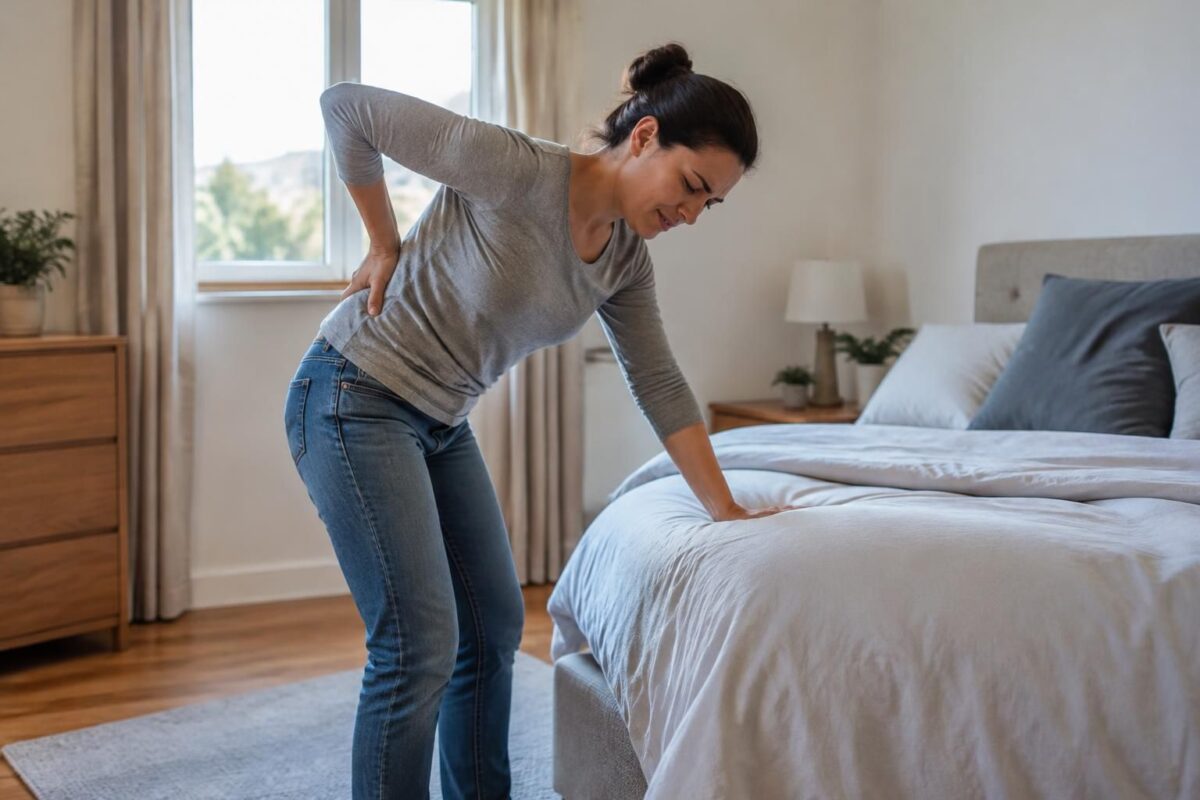
Sciatica and Making the Bed: Repeated Flexion and Lumbar Irritation
IN SHORT Sciatica is pain related to irritation or compression of the sciatic nerve. Making your bed can strain the lower back if bending is repeated, especially when rounding the back or twisting the torso. To limit lumbar irritation, bend…
Stay active without exceeding limits
When pain radiates into the buttock or leg, it may be tempting to lie down all day. However, unless there is a specific medical indication, gentle and regular activity is often preferable to prolonged immobility. Walking at a comfortable pace can be a good starting point: begin with a few minutes, then adjust the duration based on your response.
Use your symptoms as a guide. Mild and transient discomfort can sometimes accompany the resumption of movement. In contrast, if the pain becomes significantly stronger, radiates further down the leg, or remains aggravated after the activity, reduce the intensity or stop the movement. The idea is not to “push through”, but to find a tolerable dosage.
Break tasks instead of doing everything at once
Household chores, shopping, or gardening can be easier to manage in several short periods. Alternate an activity with a break or a less demanding task, and avoid long sessions in the same position. This approach to effort management helps to limit pain spikes without completely giving up your activities.
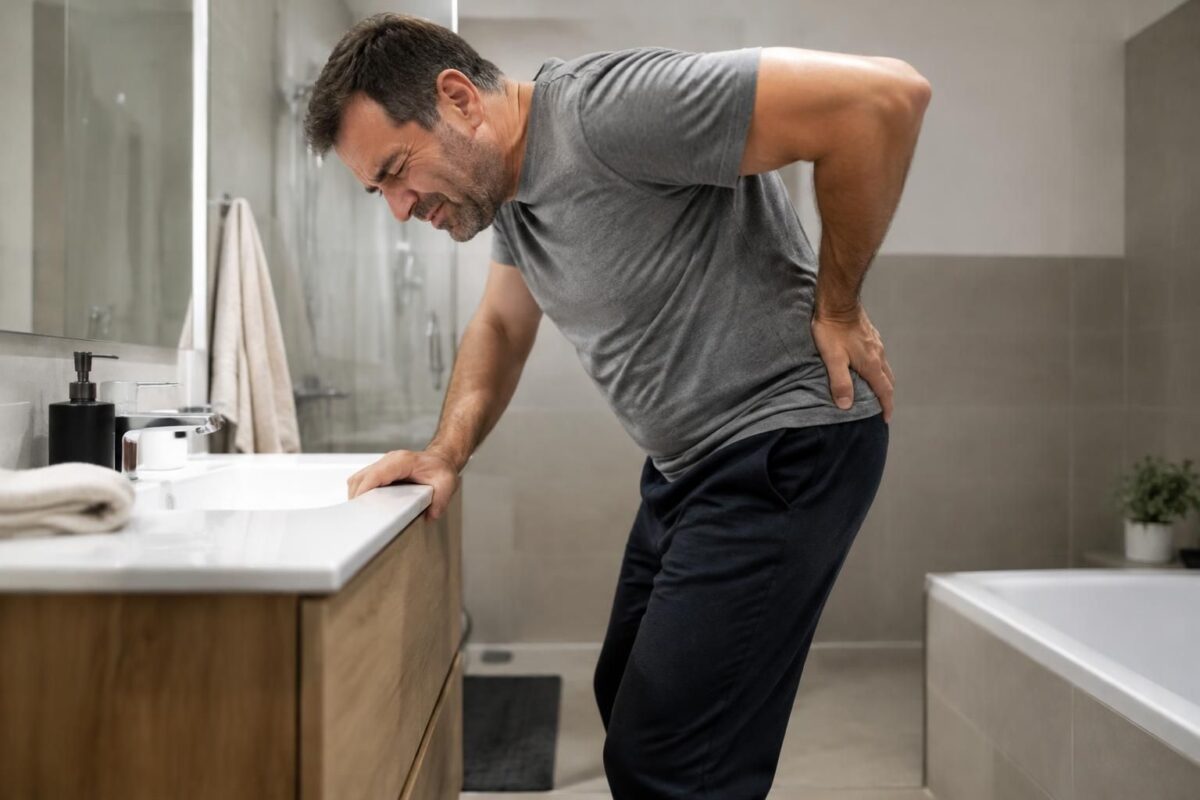
Sciatica and bending over the sink: pain in the leg
IN BRIEF Sciatica is pain related to irritation or compression of the sciatic nerve, which can extend from the lower back down to the leg. Bending over the sink can exacerbate the pain, especially if this position increases pressure on…
Adapt everyday movements
To pick up an object, get close to it and bend your knees instead of bending abruptly with your legs straight. When carrying a load, keep it close to your body and distribute the weight if possible. Avoid quick twists: turn instead with your feet and the whole body.
When sitting, change your posture regularly and stand up for a few moments when you can. A comfortable seat and good support can enhance comfort, but no position should be held for too long. In the car or at the office, plan for short breaks to stretch your legs.
Gradually resume activities
Don’t try to catch up in one day on tasks that have been set aside. Increase one thing at a time: the duration of a walk, the number of tasks, or the time spent standing. Note the activities that relieve or aggravate symptoms to identify your personal rhythm. A doctor or physiotherapist can guide you in choosing suitable exercises, especially if certain movements trigger sharp pain.

Sciatica and washing feet: lumbar flexion to monitor
IN BRIEF Sciatica can make washing your feet uncomfortable, as bending forward accentuates lumbar flexion and may trigger pain. To limit strain, sit down, bring your foot closer to you, or use a long-handled aid. These adjustments make personal hygiene…
When to seek medical advice
Consult a professional if the pain is significant, occurs frequently, limits your activities, or does not improve. Seek urgent medical help if you experience worsening weakness in one leg, loss of sensation around the genitals or anus, or new difficulty controlling the bladder or bowels. These signs require rapid evaluation.
For comfort, heat or cold can be tried if it provides relief, while protecting the skin and not prolonging application. Continue to adjust your activities over the days: a measured progression, guided by your symptoms, is generally more helpful than alternating between complete immobility and excessive effort.
| Daily activity | Recommended dosage |
|---|---|
| Walking | Short regular outings, according to tolerance. |
| Sitting position | Alternate positions and take frequent breaks. |
| Standing work | Change support and sit down as needed. |
| Stairs | Use them quietly, without forcing. |
| Carrying loads | Reduce weight and keep the load close to the body. |
| Household chores | Divide tasks and avoid sudden movements. |
| Rest | Recover briefly, without remaining immobilized for long. |
| Intensifying pain | Slow down and seek advice from a healthcare professional. |
“At first, I alternated between wanting to do everything and staying still for fear of worsening my sciatica. I learned to move forward in small steps: a short walk, a break, then a few everyday actions. This rhythm helps me stay active without feeling pressured to do too much.” — Camille, 42 years old
“For me, the hardest part was knowing when to stop. I now break down tasks: I tidy one room, then I take a rest. This organization allows me to preserve my energy and handle days when the pain is more present.” — Laurent, 56 years old
“I gradually resumed walking, starting with a few minutes on flat ground. I increase the duration only if I feel comfortable. Finding this good dosage of activity has helped me maintain a routine without trying to push my limits.” — Nadia, 37 years old
“Some days I can do more; other days I have to lighten my schedule. I try not to feel guilty and adapt my activities to how I feel. Breaks are now part of my day, just like movement.” — Éric, 61 years old
“The advice of a healthcare professional helped me choose activities suited to my situation. I stay attentive to changes in symptoms and avoid forcing if movement significantly increases pain. This approach reassures me and helps me progress more regularly.” — Sophie, 49 years old
These testimonials are fictitious examples. Sciatica and tolerance to activity vary from person to person; a healthcare professional can help adapt activities to each situation.

Sciatica and dressing: daily gestures to adapt
IN BRIEF Sciatica can make dressing uncomfortable, but a few simple gestures help limit tension. Sit down to put on pants, socks, and shoes, choose easy-to-wear clothing, and avoid bending or twisting suddenly. These adjustments make daily dressing easier without…
Sylvain Desforges: supporting sciatica and finding the right dosage daily
Expert in osteopathy, naturopathy, and manual medicine, Sylvain Desforges has dedicated his career to health innovation and supporting people living with persistent pain. Founding president of TAGMED clinics and the ACMA association, he is particularly interested in managing chronic pain and approaches that can improve long-term well-being. His experience informs a holistic view of health, attentive to the needs of each patient and to how symptoms influence daily life.
Sciatica can make ordinary movements like sitting, walking, bending, or doing regular tasks difficult. For Dr. Desforges, the challenge is not simply to avoid all activity or to resume a high pace immediately. It is rather about seeking a suitable dosage: maintaining as much as possible the tolerated movements while respecting the body’s reactions. This individualized approach helps to envision daily activities with more confidence and less uncertainty.
In this perspective, physical activity and lifestyle habits are not approached with a one-size-fits-all formula. The duration of a walk, screen time, or the frequency of breaks may need to be adjusted according to symptoms and the demands of the day. A gradual progression, guided by the evolution of pain and the person’s capabilities, allows for a better understanding of what is bearable. The goal is to maintain active participation in daily life without multiplying efforts that worsen symptoms.
Dr. Desforges prioritizes care based on evidence and tailored to each individual’s clinical situation. His approach may integrate advanced technologies, particularly spinal decompression, laser, or shockwave therapy when these options are relevant for the patient. These tools are part of a broader care approach: they do not replace personalized evaluation and do not promise recovery. The choice of interventions depends on the needs, goals, and health status of the person.
For someone struggling with sciatica, this attention to individualization can help to establish concrete strategies: breaking tasks down, alternating positions, planning recovery periods, or gradually reintroducing sidelined activities. The idea is to observe the body’s reactions and adjust the pace over time, rather than following a uniform program. In cases of unusual symptoms or significant aggravation, an evaluation by a healthcare professional is necessary.
Through his roles at TAGMED clinics and the ACMA, Sylvain Desforges emphasizes innovation, listening, and optimizing health. His work around chronic pain aims to help patients better understand their options and find realistic ways to continue their activities. For individuals affected by sciatica, support can thus help define a balance between movement, rest, and care, taking into account the specific constraints of each daily life.
With sciatica, the goal is not to stop everything or to push through the pain, but to find a rhythm that allows you to stay active without worsening your symptoms. By adjusting the duration of activities, alternating positions, and observing your leg’s reaction, you can better manage your daily life and choose the next steps with more confidence.
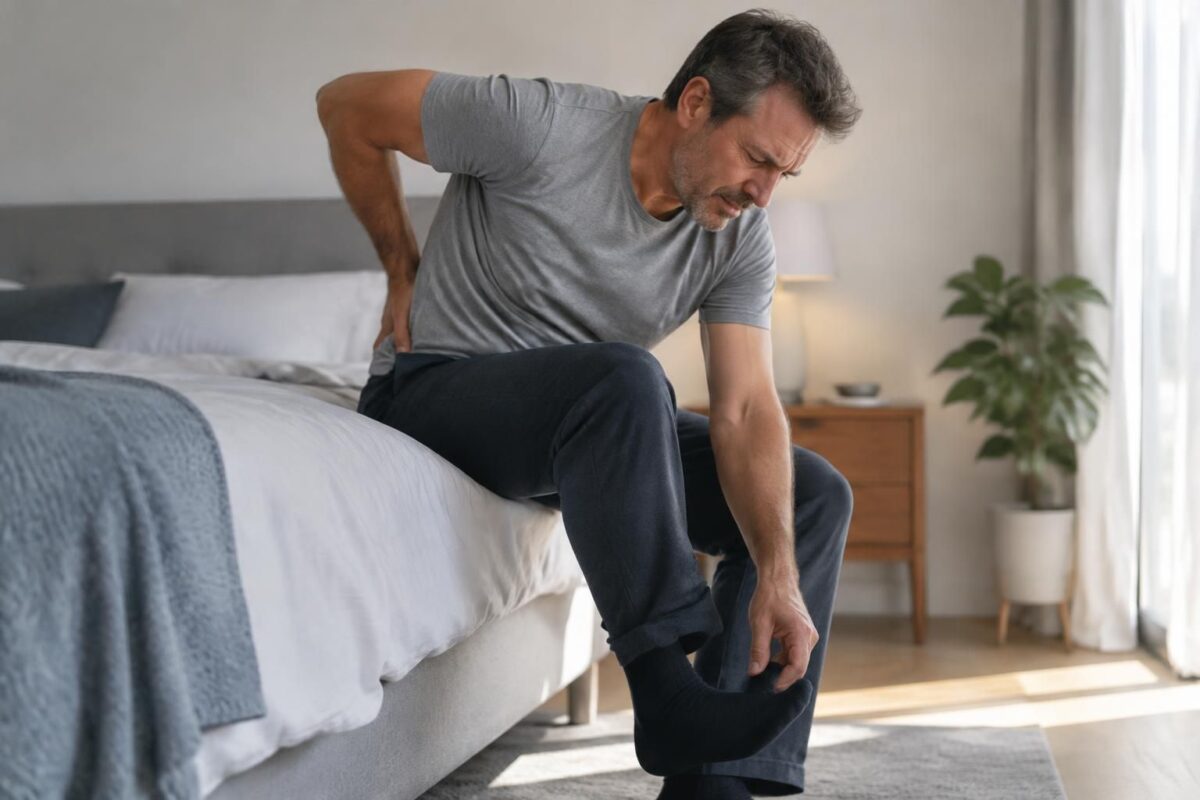
Sciatica and putting on socks: bending and pain in the leg
IN BRIEF Sciatica can make it difficult to put on your socks: bending over can increase the pain that radiates down the leg. Sitting down, using a sock aid, or avoiding painful bends can make this daily task easier. If…
Finding the right balance between activity and rest
The right amount of activity depends on your symptoms and their evolution. Start with tasks you can accomplish without triggering a significant increase in pain, then break them into shorter periods. If sitting for long periods, walking, or bending accentuates symptoms, change positions before discomfort settles in further.
Rest can provide temporary relief, but prolonged immobility may make it more difficult to resume activities. Favor small, regular movements and adapt them to your tolerance. Some mild discomfort may sometimes appear; however, if the pain spreads further into the leg or intensifies sharply, reduce the effort and seek advice from a professional.

Sciatica and tying your shoes: why the pain can radiate down
IN BRIEF Sciatica is pain related to the irritation of a nerve in the lower back, which can radiate into the buttock and leg. Leaning down to tie your shoes may accentuate the pain or cause it to descend further.…
Adapting activities to symptoms
Pain that radiates down the leg can be associated with various conditions and does not manifest the same way in everyone. For instance, an L4-L5 protrusion and pain in the leg or an L4-L5 disc herniation with pain radiating to the foot may make some tasks more difficult. Therefore, adjusting movements and pace according to your symptoms is preferable to applying a universal rule.
If the pain reaches the foot, a weakness appears, or your walking changes, do not try to compensate by forcing it. A sciatica associated with an L5-S1 herniation and pain towards the foot may require an appropriate evaluation. Muscle weakness depending on the irritated nerve root also deserves special attention, especially if it progresses.

Sciatica and picking up an object from the ground: movement to watch out for
IN BRIEF Sciatica is pain that follows the path of the sciatic nerve. To pick up an object from the ground, avoid bending abruptly while rounding your back or twisting: bend your knees, tilt your hips, and keep the object…
Gradually resuming daily activities
For household tasks, work, or travel, alternate demanding activities with breaks and avoid, when possible, long periods in a position that increases your symptoms. Gradually resume the movements you have sidelined, monitoring the reaction during the activity and afterwards. This approach helps you identify your tolerance threshold and avoid exerting too much effort at once.
When pain severely limits walking, sleeping, working, or usual activities, support can help you establish a plan suited to your situation. If your sciatica becomes disabling and your leg limits your activities, do not face the choices alone: seek an evaluation to determine how to adjust your activity level and what options to consider.

Sciatica and bending forward: lumbar disc or nerve tension?
IN BRIEF Forward-bending sciatica may be related to irritation of the lumbar disc or tension on the sciatic nerve. This movement alone does not allow for determining the cause. Identifying the movements that trigger the pain helps guide the evaluation…

Sylvain Desforges, B.Sc., D.O., N.D., docteur en ostéopathie
Dr Sylvain Desforges, B.Sc., D.O., N.D., osteopath, is the founding president of TAGMED and of the ACMA association. He dedicates his practice to chronic spinal pain, low back pain and symptoms compatible with sciatica, particularly when pain radiates toward the buttock, leg, calf, foot or toes.
Through SOS Sciatique, he publishes educational content on sciatica symptoms, possible causes such as disc herniation, disc narrowing, foraminal stenosis or irritation of a lumbar nerve root, as well as non-surgical approaches that may be considered according to the evaluation. At Clinique TAGMED, care may include, depending on the case, motorized neurovertebral decompression, specific osteopathic care or precision percussion.
For an evaluation related to sciatica treatment in Montreal / Mount Royal or sciatica treatment in Terrebonne, please consult the services available at Clinique TAGMED.
Medical disclaimer
The information published on SOS Sciatique is provided for educational purposes only and does not replace a consultation, diagnosis, opinion or treatment provided by a physician or another authorized healthcare professional. The author of this article is neither a medical doctor nor a specialist in a medical specialty recognized by the Collège des médecins du Québec. The osteopathic, manual medicine or functional support approaches described on this site do not constitute medical acts and are not intended to replace medical follow-up.
Consult a physician or emergency service in cases of loss of bladder or bowel control, anesthesia in the saddle area, significant or progressive weakness in the leg or foot, fever, recent trauma, severe pain or rapid worsening of symptoms. For more details, please read our Legal Notice.