

Herniated disc and pain when sneezing: possible disc sign
27/08/2026
Sciatica pain in Montreal: tingling, burning, or numbness?
28/08/2026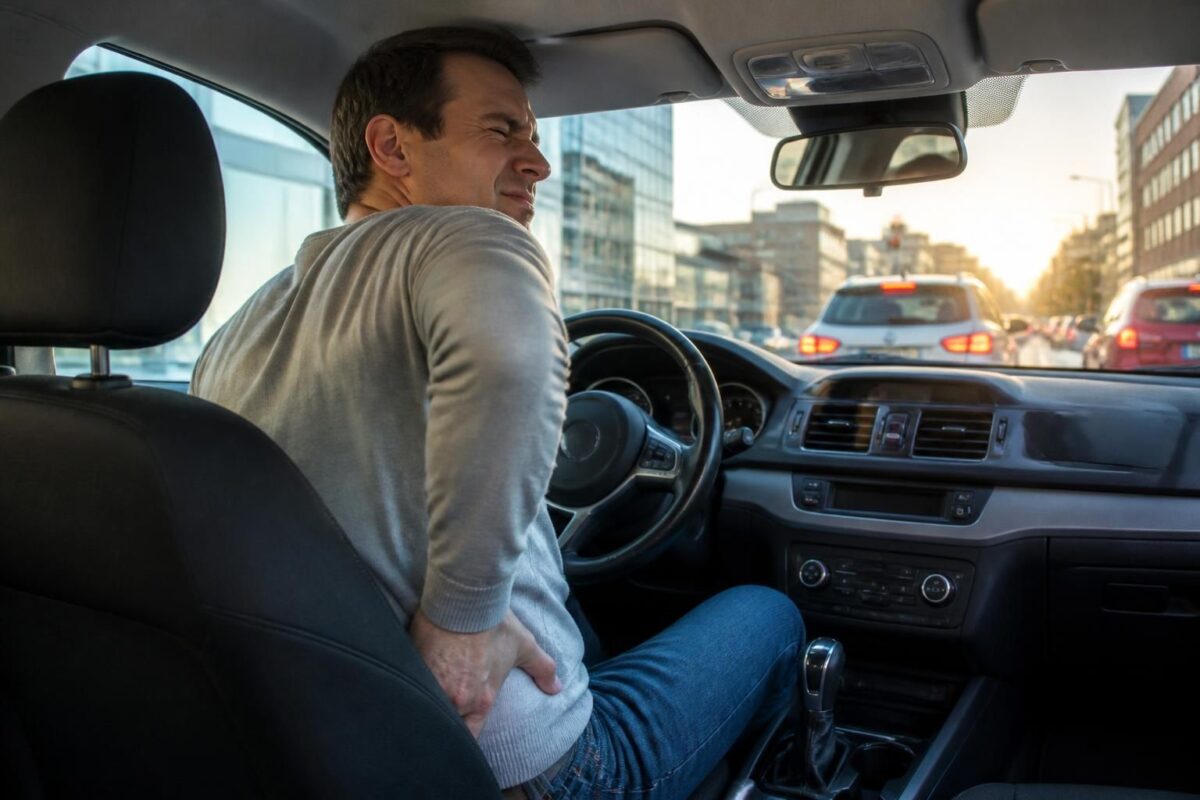
IN BRIEF In short, sciatica and the daily commute can become exacerbating factors while driving. The prolonged sitting, vibrations, and lack of movement increase pressure on the discs and nerve roots, causing pain that can radiate from the lower back down into the buttock, thigh, calf, or foot, sometimes with numbness or electric shocks. The benefits include better tolerance to driving through an appropriate posture, regular breaks, and core strengthening exercises to stabilize the spine and reduce tension. Accessible in Montreal, this framework offers practical tips and non-surgical solutions for both short and long trips, while supporting road safety. |
Sciatica can become more painful during the daily commute, and driving can be an exacerbating factor. The prolonged sitting, vibrations, and lack of movement increase pressure on the discs and nerve roots, causing pain that can radiate from the buttock down to the calf or foot, sometimes with electric shocks or numbness.
To limit the impact while driving, prioritize an appropriate posture, adjust the seat and steering wheel, use a lumbar cushion, and take regular breaks to walk and stretch. If the pain extends below the knee or is accompanied by weakness or loss of sensation, consult quickly.
This article gathers essential information to understand why sciatica and the daily commute can become a painful duo. It offers clear guidelines and simple actions to limit pain while driving, while directing towards suitable non-surgical solutions for an active life, without neglecting road safety.
Mechanisms and Triggering Factors
Sciatica results from irritation or pressure on the sciatic nerve. In the car, prolonged sitting, vibrations, and a maintained posture increase pressure on the discs and nerve roots. This combination can amplify pain and irritate areas like the buttock, thigh, calf, or foot, sometimes with burning sensations or tingling. The most common causes include a herniated disc or foraminal stenosis, which can be aggravated by driving. To limit damage, the goal is to reduce strain on the spine and improve road tolerance through appropriate posture and regular breaks.
Warning Signs While Driving
The pain can remain localized, but it can also radiate along the nerve pathway down to the leg. Warning signs such as numbness, tingling, or weakness in the foot require prompt evaluation. If the pain extends below the knee or is accompanied by a loss of sensation or control, consider seeking medical consultation without delay.
Good Driving Practices and Vehicle Adjustments
Adopt a stable posture that supports the lumbar curvature. The pelvis may be slightly tilted forward, and the seat should not be too reclined. Bring the steering wheel closer to keep the legs relaxed and knees slightly bent. Using a lumbar cushion can improve support. Prefer a automatic transmission to reduce repetitive leg movements and decrease pain for some individuals. Additionally, adjust the seat and steering wheel distance before each trip, and avoid positions that force the back for long periods.
Managing Trips and Breaks
Plan regular breaks every 60 to 120 minutes during trips, even short ones. Walking for a few minutes and stretching slightly helps to restart circulation and relax the lumbar muscles. For certain trips, an ergonomic cushion and lumbar support can enhance comfort and driving tolerance while reducing pressure on the sciatic nerve. If pain persists or worsens, consider adjusting the driving position and discuss a personalized plan with a healthcare professional.
When to Consult and Which Approaches to Favor
Consult quickly if the pain is accompanied by significant weakness, severe numbness, sensitivity issues in the foot, or a lack of vehicle control. A professional can help distinguish disc-related causes from other origins and propose suitable non-surgical options, especially when trips become frequent or challenging. At the TAGMED Clinic, non-surgical approaches suitable for Montreal or Terrebonne can be considered based on the evaluation.
Prevention and Non-Surgical Management
Regular physical activity and core strengthening contribute to stabilizing the spine and limiting lumbar tension. Before a long trip, prioritize breaks and ensure that the driving position is properly adjusted. An appropriate posture and simple actions during trips can make a difference. To delve deeper into the mechanisms and non-surgical options associated with sciatica and driving, you can consult specialized resources on phenomena related to travel and pain.
For certain situations, practical solutions exist at TAGMED, where evaluation allows for guidance towards appropriate non-surgical approaches. Options may include motorized neurovertebral decompression and targeted osteopathy, in addition to a core strengthening plan and ergonomic guidance for the driving position. Additional information and useful resources can be found on the following sites: Sciatica and Pain Increasing While Driving, Driving and Pain Relief, and Why the Car Can Be a Pain Trap. Further readings provide insights into the influence of vibrations and the connection between mobility and pain during trips.
Resources and Practical Cases
For additional information, you can consult dedicated resources, particularly on the mechanisms of pain and safe driving strategies. Articles and guides describe how trips can influence pain and offer practical approaches to drive with less discomfort. For further readings, you can visit the following sites: Sciatica and car – why driving can worsen pain, and Sciatica and pain that increases in the car.
As part of professional support, the TAGMED Clinic offers a non-surgical approach tailored to each trip and individual. To learn more, do not hesitate to contact the clinic or consult the dedicated pages of TAGMED.
Ergonomic and practical solutions offered include appropriate posture cushions. Options like the Ergoccyx Vehicles exist to help support the pelvis and absorb vibrations, which can enhance comfort during repeated or prolonged trips.
For those who wish to deepen their understanding of the impact of vibrations and vehicle adjustments on symptoms, specialized resources and testimonials present concrete approaches to adapt the driving position and limit pain during the trip.
Let’s briefly mention useful and relevant resources to understand the mechanisms and precautions to take during trips: Sciatica and road vibrations, Driving and pain.
Non-surgical solutions at the TAGMED Clinic are offered based on assessment, combining road safety and quality of life. For readers seeking general information on the causes and non-invasive treatment options, other resources can guide the understanding of the link between driving and lower back pain.
To learn more about the mechanisms and solutions related to sciatica and driving, additional resources are available on dedicated websites and relay practical approaches tailored to daily driving.
Medical disclaimer: The information and advice provided on this site do not replace the opinion, diagnosis, or treatment of a healthcare professional. Please note that Dr. Sylvain Desforges, osteopath, is neither a physician nor a doctor and is not a specialist in a medical specialty as defined by the Collège des médecins du Québec. Manual medicine, functional medicine, and sports medicine as described on this site exclude any treatment or medical diagnosis made by a physician or specialist. Always consult your doctor for any medical questions. For more details, please read our full Legal Notice.
Her death: This paragraph draws no conclusion; it summarizes the essential elements and invites a personalized assessment for each trip and each pain, prioritizing adapted non-surgical approaches and a safe driving posture.
- Prolonged sitting and disc pressure
- Vibrations and exacerbating road shocks
- Restrictive posture: sustained lumbar flexion
- Radicular pain radiating to buttock and leg
- Adjustment of seat and backrest
- Lumbar cushion and coccyx relief
- Automatic transmission to limit movements
- Breaks every 60-90 minutes
- Walking and stretching during breaks
- Core strengthening to stabilize the spine
- Comfortable clothing and hydration

This article reminds us that sciatica can become a significant exacerbating factor during daily trips. It outlines the mechanisms, signs to monitor, and simple gestures to limit pain while ensuring safety at the wheel. You will discover practical advice on optimizing posture, adjusting the vehicle, and organizing effective breaks, as well as pathways for non-surgical management suitable for driving.
Mechanisms and effects of driving on sciatica
Mechanical factors of the trip
In the car, the prolonged seated position, hip flexion, and repeated vibrations increase the pressure exerted on the discs and nerve roots in the lower back. This compression can cause pain to rise along the path of the sciatic nerve, notably towards the buttock, thigh, calf, and sometimes the foot. Immobility and limited movements during the trip also promote stiffness and muscle tension around the spine.
Impact of posture and turbulence
Poorly adapted posture and long trips with jolts can keep the spine in flexion or tension, exacerbating discomfort. Energy transfers during acceleration and braking can also aggravate pain in sensitive individuals, especially when the seat does not sufficiently support the lumbar area or when the vehicle is not properly adjusted.

Sciatica and calf stretching: when the pain increases
IN SHORT A calf stretch can exacerbate sciatica if it further irritates the nerve. It should not cause pain that increases or radiates down the leg: stop the movement and do not push through. Stretches may help with some tensions,…
Sciatica and hamstring stretching: possible nerve tension
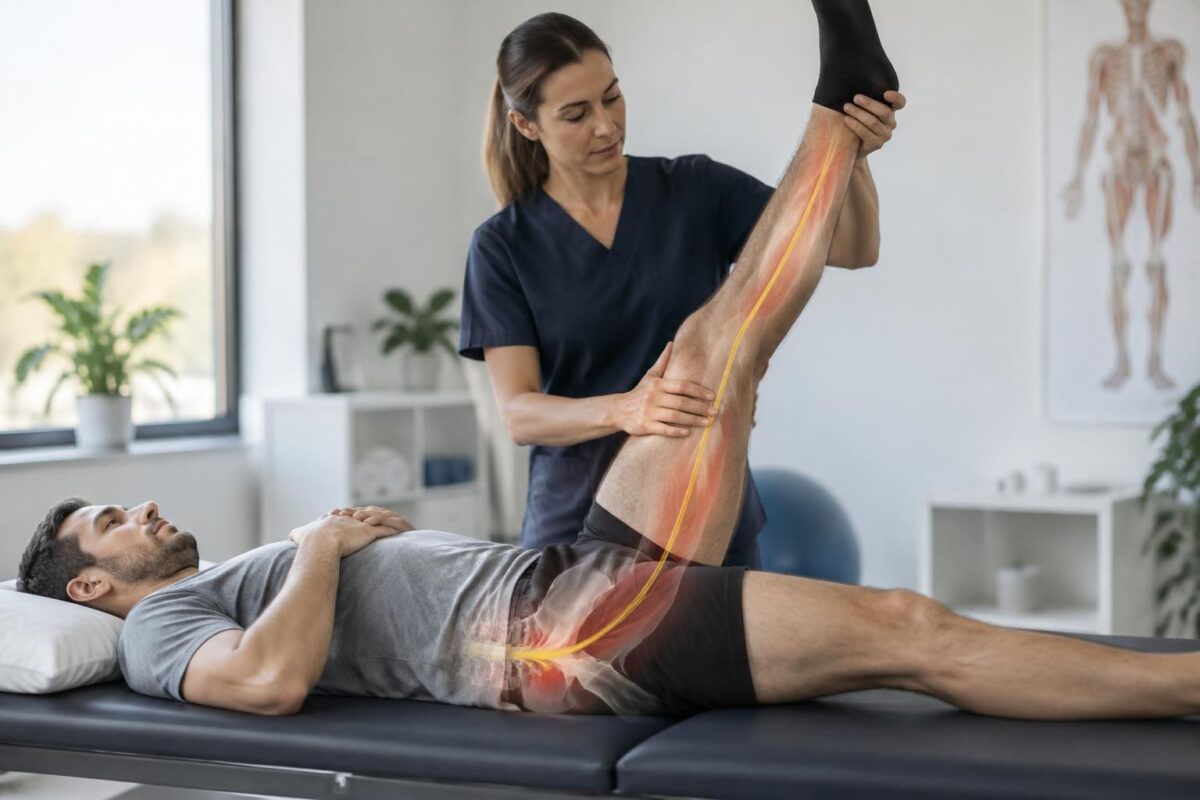
IN BRIEF Sciatica can make stretching the hamstrings uncomfortable, as the tension felt may come from the nerve rather than the muscle. A gentle stretch, with a straight back and without seeking maximum range, can help loosen the back of…
Signs to watch for during the trip
Typical symptoms
Pain may remain localized in the lower back or radiate to the buttock, thigh, calf, and sometimes the foot. Burning sensations, tingling, or electric shocks may accompany this radiation, with or without numbness.
Warning signs requiring a consultation
If the pain extends beyond the knee, is accompanied by marked weakness, significant loss of sensitivity, or urinary issues, a prompt medical evaluation is recommended. Signs of concern also arise if the pain rapidly increases during the trip and does not improve after stopping.
Sciatica and piriformis stretching: useful or worsening depending on the case
IN BRIEF Piriformis-related sciatica can cause deep pain in the buttock, sometimes radiating down the back of the thigh. A gentle stretch can loosen the hip and relieve discomfort if the muscle is involved, but it can worsen symptoms if…

Sciatica and popular stretches: why to stay cautious
IN BRIEF Sciatica causes pain that radiates from the lower back down the leg. Popular stretches, such as the pigeon pose or hamstring stretches, are not always suitable: pulling on an irritated nerve can worsen the symptoms. Favor gentle movements,…
Good practices for driving with sciatica
Preparation before the trip
Adjust your seat and backrest to support the lumbar curve, and ensure that the pelvis is slightly tilted forward. Keep the knees slightly bent and bring the steering wheel closer to avoid straining the legs. If necessary, add a lumbar cushion or seat cushion to enhance support. In case of significant pain, prefer an automatic transmission to limit repetitive movements of the left leg.
During the trip
Plan for regular breaks every 60 to 90 minutes to walk and stretch gently, which helps relax the lumbar muscles and boost circulation. Adopt calm breathing and brief relaxations to reduce tension.
Posture and accessories
Keep your back well supported against the backrest and avoid leaning too far forward. Using a seat cushion and lumbar support can stabilize posture and decrease pressure on the sciatic nerve. An appropriate distance from the steering wheel prevents twisting and unnecessary strain on the spine.

Sciatica and Pilates: movements to adapt
IN SHORT Sciatica causes pain that can radiate from the lower back down to the leg. The Pilates Reformer can promote a gradual return to movement and strengthen core control, provided that the movements, range, and resistance are adapted. Favor…

Sciatica and core stability: variable tolerance depending on symptoms
IN BRIEF Core strengthening in case of sciatica consists of progressively strengthening the trunk muscles. Its tolerance varies depending on pain and symptoms: suitable without worsening the pain, it can support mobility and the resumption of activities, but does not,…
Care and non-surgical options
Assessment and guidance
A personalized assessment helps identify whether symptoms come from a disc, foraminal, or other origin, and guides appropriate non-surgical treatments for your situation.
Strengthening and prevention
Regular physical activity and core strengthening contribute to stabilizing the spine and reducing lumbar tension. Before and after a trip, prioritize simple stretching and planking exercises, as well as targeted exercises to improve hip flexibility and tolerance for driving.
When to consult quickly
In the presence of emergency signs — marked foot weakness, significant loss of sensation, or rapidly worsening pain — contacting a healthcare professional is essential. Appropriate care may include non-invasive, personalized options based on your profile and usual trips.
| Axis | Concise description |
|---|---|
| Position and posture | Maintain a sustained lumbar curve and a slightly tilted pelvis; adjust the seat so that the knees are bent and the steering wheel is close to limit tension on the sciatic nerve. |
| Duration and breaks | Break every 60–90 minutes to walk and relax the muscles; avoid fixed positions that worsen the pain. |
| Vibrations and absorption | Jolts worsen the pain; prefer a suitable cushion and better suspension or smoother roads. |
| Mobility and strengthening | Regular physical activity and core strengthening reduce tension and improve driving tolerance. |
| Warning signs | Pain radiating down the leg, numbness or weakness in the foot; consult if this evolves. |
| Accessories and adjustments | Lumbar cushion, adjustable seat and, if possible, automatic transmission to limit repetitive movements and pain. |
| Immediate measures | Slow breathing, application of heat or cold, and breaks with stretching during the trip. |
| Triggering factors | Frequent triggering factors: herniated disc or foraminal stenosis, prolonged sitting posture, and vibrations that increase pressure on nerve roots. |

Sciatica and lunges: leg pain to watch out for
IN BRIEF Sciatica is pain that starts from the lower back or buttock and radiates down the leg. If a lunge triggers or worsens this pain, stop the movement and adjust your activity: this exercise does not address sciatica. Consult…

Sciatica and deadlifts: risk depending on the cause
IN BRIEF Sciatica and deadlifts are not always incompatible: the risk depends on the cause of the pain and its intensity. During acute episodes, it’s best to avoid heavy loads and seek medical or physiotherapy advice before resuming. A gradual…
Testimonials: Sciatica and daily commute – when driving becomes an aggravating factor
Marie, 38, sales representative: “Before, every home-office trip brought me pain that started from my lower back and went up to my leg. The vibrations and prolonged sitting triggered shocks that prevented me from moving forward. Since adjusting my driving position and incorporating regular breaks, my sciatica is much better tolerated, and I regain some freedom during daily trips.”
Karim, 29, urban delivery driver: “My job requires me to go on routes in the same car. The journey had become a real struggle due to the pain that intensified with jolts and pedals. Switching to an automatic transmission and a better-adjusted seat has reduced the strain, and I can make my deliveries without driving systematically worsening my sciatica. Small breaks every 90 minutes do the rest.”
Sophie, 45, active mother and sales representative: “My daily trips, between school and work, caused my lumbar pain to climb up to my thigh. The prolonged support and micro-vibrations subjected me to jabs that ruined my days. I adopted a better posture at the wheel and a lumbar cushion; since then, breaks and light stretching allow me to drive more calmly and be present for my family without being hindered by pain.”
Alain, 52, taxi driver: “Heavy traffic and long trips made driving almost unbearable due to my sciatica. I improved the adjustment of my seat and use frequent breaks to walk a bit and release tension. Today, even during rush hour, I can maintain a stable posture and limit the pain that travels up my leg.”
Fatima, 33, employee on the move: “My professional trips required constant concentration, and driving became a source of painful assaults. By working on better seat management and micro-breaks, as well as core strengthening exercises, I noted a significant improvement: my sciatica is less intrusive and my daily trips no longer demand so much from me physically.”
Dr. Sylvain Desforges is an expert in osteopathy, naturopathy, and manual medicine, and he is the president and founder of TAGMED clinics as well as the ACMA association. His career is guided by innovation in healthcare, with a sharp specialization in the management of sciatica and chronic pain. He relies on the integration of advanced technologies such as motorized neurovertebral decompression, laser, and shockwave therapy to offer evidence-based non-surgical approaches. His mission is clear: to provide care that sustainably improves the health and well-being of his patients, particularly those suffering from pain radiating into the leg during daily commutes or business travel.
In the context of daily commutes, he observes that sciatica can worsen when sitting for too long, as vibrations and a constraining posture maintain pressure on the discs and nerve roots. His approach emphasizes a holistic perspective on driving: ergonomic adjustments to the vehicle, appropriate lumbar support, and regular active breaks to walk and stretch, in order to limit strain during the commute and restore tolerance to driving. To achieve this, he combines non-invasive methods with advanced technological devices, such as motorized neurovertebral decompression, targeted osteopathy, and stimulation techniques like precision perceivers, to release tension and restore space around the nerve roots. In some cases, an automatic transmission may be recommended to reduce repetitive movements and decrease stress on the left lower limb during long trips.
His philosophy is based on a personalized assessment that links the symptoms experienced during driving to a possible disc, foraminal, or gluteal origin, to guide an appropriate non-surgical treatment plan. Patient education and prevention are central: strengthening the core, expanding hip mobility, and providing practical road ergonomics advice. The aim is to help drivers adopt habits that promote spinal stability and reduce lumbar strain, while ensuring safety and comfort behind the wheel. TAGMED’s collaborative approach, which blends osteopathy, manual techniques, and advanced technologies, aims to make commutes more bearable, even when pain persists.
Over the years, Dr. Desforges and his team have developed protocols dedicated to drivers—both professionals and individuals—to improve driving tolerance and prevent recurrences. His work is characterized by attentive listening, multidisciplinary assessment, and rapid implementation of non-surgical solutions tailored to each patient’s profile. To discover his approach and the services offered by TAGMED, directly contact TAGMED Clinic for personalized support focused on measurable results.
This text reminds us that sciatica can become more painful during daily commutes and that driving can be an aggravating factor. A prolonged sitting position, vibrations, and lack of movement increase pressure on the discs and nerve roots, with manifestations radiating from the buttock to the foot. At the same time, simple actions and adjustments can allow driving with increased tolerance and enhanced road safety, while prioritizing appropriate non-surgical solutions.
The key mechanism is that the commute can amplify irritation or compression of the sciatic nerve in the lumbar region. Hip flexion, jolts, and long periods of immobility keep the spine under tension and tend to reduce the space around the nerve roots, which can trigger pain radiating to the buttock and the leg, sometimes with electric sensations or numbness extending to the foot.
The signs to watch for while driving include pain that may remain localized in the lower back or extend down the thigh and calf, paresthesias, and sometimes weakness in the foot that interferes with pedal control. If the pain rapidly spreads or is associated with a loss of sensation or strength, an evaluation is essential. If it begins after a few minutes of driving or recurs over the trips, it is useful to adapt your posture and driving position.
To limit the severity of pain during commutes, prioritize a setup that supports the lumbar curve: slightly inclined backrest, pelvis slightly tilted forward, and knees bent with the steering wheel close to relax the legs. A lumbar aid can be helpful, and when possible, prefer an automatic transmission to reduce repetitive movements of the left leg.
Beyond adjusting the vehicle, plan regular breaks every 60 to 90 minutes to walk, stretch, and stimulate circulation. Simple exercises to perform while stopped and targeted core strengthening contribute to stabilizing the spine and reducing lumbar strain over the long term. Specialized resources explore how commutes influence pain and offer concrete strategies for driving with reduced discomfort.
A personalized approach, based on an appropriate assessment, can guide non-invasive options and the strengthening or stretching programs best suited to your profile. For further insights, check the resources related to sciatica and driving: Driving Position and Sciatica Pain – Tips, Relieve Sciatica Pain – Driving a Car, Lumbago-Sciatica and Commutes – How to Avoid Them.
In addition, you can also explore specific resources on symptoms and commutes: Sciatica and Tingling in the Big Toe – Possible L5 Root, Pain in One Leg – Possible Sciatica in Terrebonne, Herniated Disc and Recurrence of Sciatica – Possible Factors, Sciatica in Terrebonne – Numbness Progressing to the Foot.
Pragmatic solutions also exist on the hardware side: an appropriate ergonomic cushion can help relieve the coccyx and absorb vibrations during journeys, while maintaining favorable pelvic alignment. For a recent and effective option, specialized resources recommend non-invasive approaches and suitable tools to support the back and lower back muscles during driving.
Finally, if the pain persists despite adjustments, a consultation with a healthcare professional can determine the precise origin (disc, radicular, or other) and propose appropriate guidance for non-surgical treatments, while ensuring safety on the road. For further ideas and practical advice, you can consult the following resources: Sciatica and driving – is it not advised?, Why journeys worsen pain and how to avoid them, Foot weakness and sciatica – when to seek quick consultation.

Dr Sylvain Desforges, B.Sc., D.O., N.D., osteopath, is the founding president of TAGMED and of the ACMA association. He dedicates his practice to chronic spinal pain, low back pain and symptoms compatible with sciatica, particularly when pain radiates toward the buttock, leg, calf, foot or toes.
Through SOS Sciatique, he publishes educational content on sciatica symptoms, possible causes such as disc herniation, disc narrowing, foraminal stenosis or irritation of a lumbar nerve root, as well as non-surgical approaches that may be considered according to the evaluation. At Clinique TAGMED, care may include, depending on the case, motorized neurovertebral decompression, specific osteopathic care or precision percussion.
For an evaluation related to sciatica treatment in Montreal / Mount Royal or sciatica treatment in Terrebonne, please consult the services available at Clinique TAGMED.
Medical disclaimer
The information published on SOS Sciatique is provided for educational purposes only and does not replace a consultation, diagnosis, opinion or treatment provided by a physician or another authorized healthcare professional. The author of this article is neither a medical doctor nor a specialist in a medical specialty recognized by the Collège des médecins du Québec. The osteopathic, manual medicine or functional support approaches described on this site do not constitute medical acts and are not intended to replace medical follow-up.
Consult a physician or emergency service in cases of loss of bladder or bowel control, anesthesia in the saddle area, significant or progressive weakness in the leg or foot, fever, recent trauma, severe pain or rapid worsening of symptoms. For more details, please read our Legal Notice.