


Herniated disc and sciatica: when to reassess symptoms
30/09/2026
Sciatica in Montreal: pain that worsens during sitting-standing transitions
01/10/2026
IN BRIEF
| The difficulty in walking on heels with sciatica may be related to weakness in the muscles that lift the foot, sometimes caused by nerve irritation or compression. This sign alone does not determine the cause: have it assessed by a healthcare professional. If weakness appears suddenly or worsens, or if you can no longer walk, seek help quickly. Gentle walking can still be beneficial if it doesn’t worsen the pain, but it does not replace a proper diagnosis or treatment. |
A difficulty in walking on heels with sciatica may reflect weakness in the foot muscles, sometimes associated with nerve irritation or compression. Do not force yourself to walk and seek medical advice quickly, especially if the weakness appears or worsens. In case of loss of control over the bladder or bowels, or numbness between the legs, consult the emergency services.
A difficulty in walking on heels can signal weakness in the muscles that lift the foot. In the presence of sciatica, this weakness may be linked to irritation or compression of a nerve root, often at the lumbar level. Pain alone does not determine the cause: a healthcare professional must assess strength, sensitivity, and associated symptoms. To walk on heels, the front of the foot must be lifted. This movement depends particularly on the ankle muscles and the nerves that control them. If one side of the foot lifts less well, or if the foot drops when you move forward, this may indicate muscle weakness. Sciatica can cause pain that starts in the lower back or buttock and radiates down the leg. It may also be accompanied by tingling, numbness, or reduced strength. However, some people feel pain in the foot without lower back pain. This symptom also deserves assessment: foot pain without lower back pain. The L5 nerve root participates in the movement that lifts the foot and toes. Therefore, irritation of this root can make walking on heels difficult. Pain may radiate down the leg or reach the top of the foot. However, a difficulty in walking on heels does not confirm, on its own, L5 involvement. The professional must compare both sides and check several nerve functions. Additional information on walking on heels and the L5 root is available from the TAGMED Clinic. Pain can prevent you from putting weight on or maintaining a position on your heels, even if muscle strength remains. Conversely, a person may feel little pain but find that the front of the foot no longer lifts correctly. This distinction is important. Describe precisely to your doctor what you can do and what has changed. A progressive weakness, a dragging foot, or repeated falls require prompt medical evaluation. Do not increase attempts to walk on heels to test yourself if this increases pain or the risk of falling. An imaging study may show a small disc protrusion, but the size of this anomaly does not always predict the pain or weakness. The doctor correlates symptoms, clinical examination, and, if necessary, imaging results. To better understand this point, consult this article on sciatic pain sometimes significant despite a small protrusion. Quickly contact a healthcare professional if you notice new weakness in the foot, worsening difficulty in walking, or significant loss of sensation. Pain that radiates down the leg after exertion may also require evaluation, especially if accompanied by weakness: radiation in the leg after physical exertion. Consult emergency services if you lose control of your bladder or bowels, have new difficulty urinating, or experience numbness around the genitals and inside the thighs. These signs may indicate serious nerve damage. A pain that wakes you at night should also be reported to a doctor, especially if it persists or is accompanied by other symptoms: sciatica and nighttime pain. Walking can remain possible with sciatica, but it is not suitable for everyone at the same time. Walk only if you can do so without losing balance and without significant worsening of symptoms. Start with a short distance, on flat and safe ground. Stop if weakness increases, if the foot starts to drag, or if the pain becomes difficult to tolerate. Do not force walking on heels to correct the problem. If your foot lacks strength, use support only after consulting a professional. Advice on the benefits and precautions related to walking is presented in this article: walking with sciatica. You can also consult advice regarding walking in case of sciatica and adapting walking to symptoms. The professional will ask about the onset of symptoms, their progression, and the affected areas. They may check the strength in the legs and feet, reflexes, sensitivity, and your walking pattern. They will then determine if a specialized consultation or imaging examination is necessary. Orthotics do not systematically correct sciatica or nerve weakness. Their relevance depends on the examination and the cause of the difficulties. To avoid exaggerated wait times, read this overview on sciatica and orthotics. If you wish to obtain further evaluation, the TAGMED Clinic, in Montreal or Terrebonne, presents its services and management options. This process does not replace a medical consultation, especially in cases of new or progressive weakness. Medical disclaimer: The information and advice provided on this site do not replace the opinion, diagnosis, or treatment of a healthcare professional. Please note that Dr. Sylvain Desforges, osteopath, is neither a medical doctor nor a physician and is not a specialist in a medical specialty as defined by the Quebec College of Physicians. Manual medicine, functional medicine, and sports medicine as described on this site exclude any treatment or diagnosis made by a physician or medical specialist. Always consult your doctor for any medical questions. For more details, please read our full Legal Notice.The possible link with L5 nerve root involvement
Weakness, pain, or loss of control of the foot
A disc herniation does not always explain the intensity of symptoms
When to consult without delay
Walking with sciatica: adapting effort
How the medical evaluation proceeds
What this may indicate
What to do

A difficulty walking on heels when suffering from sciatica may be related to pain, tingling, or weakness of the muscles that lift the foot. This sign deserves particular attention, especially if it is new or worsening: do not force walking and seek medical advice to assess the cause and choose appropriate measures.
Why walking on heels can become difficult
To advance on the heels, you must be able to lift the front of the foot. Irritation or compression of a nerve root in the lower back can disrupt this action, sometimes in addition to causing pain that radiates into the buttock and leg. You may notice that the foot drops, catches on the ground, or appears weaker on one side.
The difficulty may also be due to the pain itself, a feeling of numbness, or a lack of confidence in support. It is not possible to determine the cause based solely on this sign: a health professional can examine your strength, sensitivity, and reflexes.

Sciatica and popular stretches: why to stay cautious
IN BRIEF Sciatica causes pain that radiates from the lower back down the leg. Popular stretches, such as the pigeon pose or hamstring stretches, are not always suitable: pulling on an irritated nerve can worsen the symptoms. Favor gentle movements,…

Sciatica and Pilates: movements to adapt
IN SHORT Sciatica causes pain that can radiate from the lower back down to the leg. The Pilates Reformer can promote a gradual return to movement and strengthen core control, provided that the movements, range, and resistance are adapted. Favor…
When to seek medical help
A new weakness requires quick assessment
Contact a doctor quickly if you can no longer lift a foot, if your gait deteriorates, or if weakness progresses. A loss of strength may indicate nerve damage that requires examination without delay. Avoid driving if your foot control is diminished and take precautions to limit the risk of falling.
Recognizing emergency signs
Consult emergency services immediately in case of loss of control over the bladder or bowels, difficulty urinating, numbness around the genitals or anus, or significant and rapidly increasing weakness in one or both legs. These symptoms require urgent care.

Sciatica and core stability: variable tolerance depending on symptoms
IN BRIEF Core strengthening in case of sciatica consists of progressively strengthening the trunk muscles. Its tolerance varies depending on pain and symptoms: suitable without worsening the pain, it can support mobility and the resumption of activities, but does not,…

Sciatica and lunges: leg pain to watch out for
IN BRIEF Sciatica is pain that starts from the lower back or buttock and radiates down the leg. If a lunge triggers or worsens this pain, stop the movement and adjust your activity: this exercise does not address sciatica. Consult…
How to adapt walking while awaiting advice
If you can walk without significant aggravation and safely, prefer short, slow movements on flat, clear surfaces. Wear stable shoes, keep your phone handy, and ask someone to accompany you if your balance is uncertain. A cane or walking aid may be helpful, but choose it with the advice of a professional.
Do not repeat the heel-walking test to check your strength and do not try to “push through” the pain. Stop if the leg buckles, if the foot catches, if the pain significantly increases, or if you feel unstable. Also, avoid sitting for long periods in the same position; change your posture gently according to your tolerance.

Sciatica and deadlifts: risk depending on the cause
IN BRIEF Sciatica and deadlifts are not always incompatible: the risk depends on the cause of the pain and its intensity. During acute episodes, it’s best to avoid heavy loads and seek medical or physiotherapy advice before resuming. A gradual…

Sciatica and squats: why caution is needed
IN BRIEF Sciatica does not always prohibit squats, but a deep or loaded squat can aggravate symptoms, especially during a flare-up. Gradually resume with a neutral back and a comfortable range of motion, and stop if the pain travels down…
Resuming activity without forcing
Prolonged complete rest is generally not necessary for sciatica, but activity should remain compatible with your symptoms and safety. Gradually resume movements that do not cause significant aggravation, without aiming for a predetermined distance or duration. Walking can help maintain activity, but it does not alone treat the cause of sciatica.
A doctor or physiotherapist can advise you on suitable exercises and check if weakness requires examinations or specific management. Specify exactly when the difficulty began, which foot is affected, and whether you have noticed a change in your strength or sensitivity.
| What you observe | Useful marker |
|---|---|
| Difficulty walking on heels | May reflect weakness of the foot, not just pain. |
| Pain preventing movement | Pain can limit the movement without real loss of strength. |
| Foot dropping or catching | Have this new weakness assessed quickly. |
| Tingling or numbness | Report their location and evolution to a professional. |
| Stable and mild symptom | Walk cautiously, over a short distance, without forcing. |
| Weakness worsening | Seek medical advice quickly. |
| Loss of bladder or bowel control | Consult urgently. |
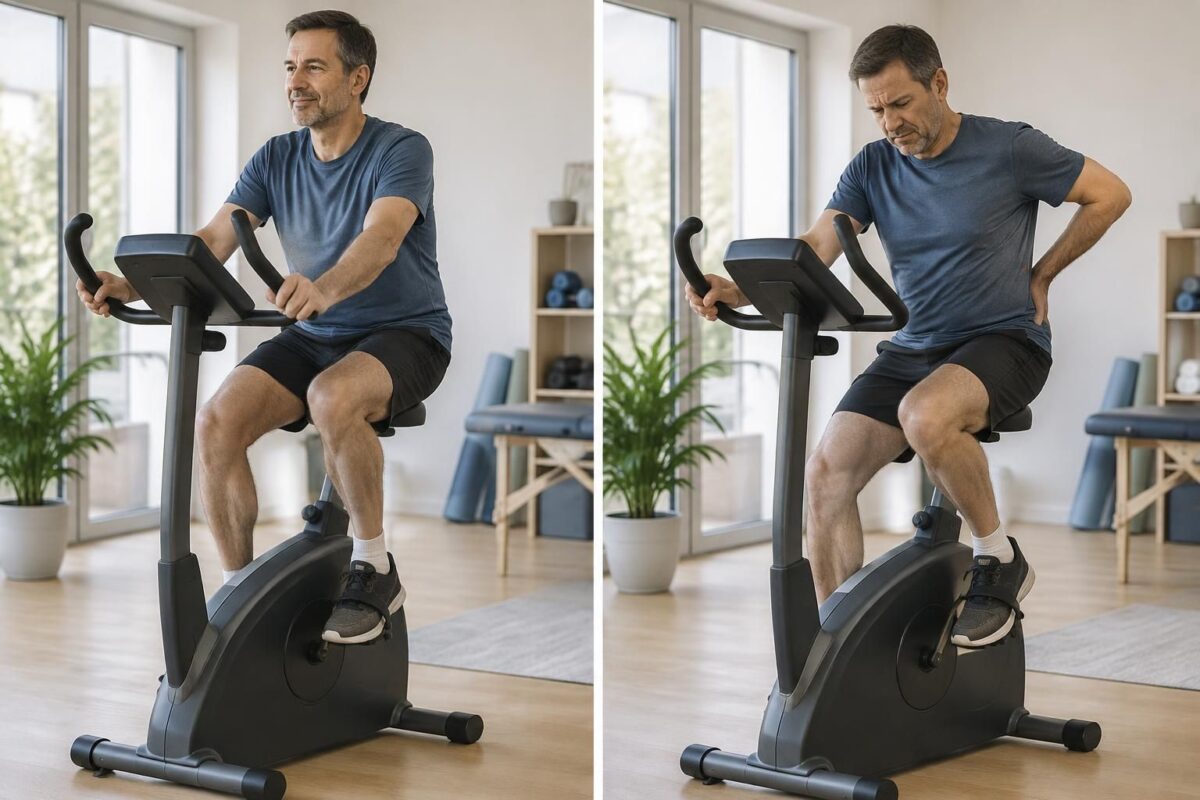
Sciatica and stationary bike: useful or aggravating depending on the case
IN BRIEF The stationary bike with sciatica can help you stay active if the pain is mild and stable. Start with a short session, at low resistance and in a comfortable position. If the pain goes further down the leg,…

Sciatica and cycling: sitting, bending, and symptoms
IN BRIEF Sciatica is pain related to irritation of the sciatic nerve, which can extend from the buttock down to the leg. Cycling may sometimes be possible if symptoms are mild and stable: a comfortable seat, a less bent posture,…
Sciatica and difficulty walking on heels: testimonials
The testimonials below are fictional examples, inspired by difficulties sometimes reported by people suffering from sciatica. Each situation is different: discomfort while walking alone does not establish a diagnosis.
“I could no longer walk on the heel of my right foot” — For several days, pain radiated from my lower back down my leg. I also had tingling and difficulty lifting the front of my foot. My doctor advised me not to force it and examined me quickly. It reassured me to know what to watch for and how to adapt my movements.
“The pain increased after a few minutes of walking” — At first, I thought I had to keep walking regardless. But the pain became sharper, and my foot seemed harder to control. I took breaks, reduced distances, and sought advice from a health professional instead of trying to reach a step goal.
“I could walk, but not on my heels” — I felt an unusual weakness in one leg, without being sure it came from the pain. The health professional explained that difficulty raising the foot or walking on heels needed to be assessed, especially if it was new or worsening. So, I avoided driving and walking alone on uneven ground while waiting for their advice.
A cane helped me move more safely — When the sciatica was strong, I lacked stability and feared tripping. With my physiotherapist’s agreement, I temporarily used a cane and chose short, flat, nearby routes. I stopped as soon as the pain or weakness increased.
To remember: not being able to walk on your heels may be related to pain, but also to foot weakness that warrants medical advice. Consult quickly if this difficulty appears suddenly, worsens, or is accompanied by a dragging foot. In case of loss of control of the bladder or bowels, numbness in the perineal area, or significant weakness, seek urgent care.
Sciatica and Difficulty Walking on Heels: Dr. Sylvain Desforges’ Approach
Dr. Sylvain Desforges is a health professional specializing in osteopathy, naturopathy, and manual medicine. Founder and president of the TAGMED clinics as well as the ACMA association, he dedicates his career to innovation in care and supporting individuals facing persistent pain. His expertise in managing chronic pain leads him to focus on symptoms that can disrupt walking, such as those associated with sciatica.
Sciatica refers to pain related to irritation or compression of a nerve root that contributes to the formation of the sciatic nerve. It can manifest in the lower back, buttock, and leg, sometimes extending to the foot. Some individuals also experience tingling, numbness, or weakness. Difficulty walking on the heels requires special attention: it may reflect muscle weakness in the foot or leg and should not be automatically attributed to mere pain.
In this context, Dr. Desforges favors an approach based on assessment and evidence. The objective is to clarify the origin of the symptoms, their progression, and their impact on daily activities before considering treatment. A new or increasing difficulty in raising the front of the foot, walking on the heels, or controlling the leg requires prompt medical evaluation. In case of significant weakness, marked loss of sensation, or issues with bladder or bowel control, urgent care should be sought.
Walking can sometimes help maintain gentle activity when symptoms allow, but it does not on its own constitute a sciatica treatment. It is generally better to start with short distances at a comfortable pace, then to adjust the effort according to the body’s reaction. If walking becomes significantly more painful, if the leg gives way, or if the foot catches on the ground, do not push through: these signs should be reported to a health professional. An appropriate diagnosis helps distinguish possible causes and choose the appropriate care.
In his work on chronic pain, Dr. Desforges is interested in integrating various approaches and technologies, including spinal decompression, laser therapy, and shockwave therapy. Their relevance depends on the clinical situation of each person and must be evaluated on a case-by-case basis. They do not replace the necessary medical examination when muscle weakness or difficulty walking arises, nor urgent care when concerning signs are present.
His approach aims to provide personalized care, informed by available knowledge, to optimize the health and well-being of patients. For a person affected by sciatica and hindered when trying to walk on their heels, the first issue is to understand the cause of the problem and assess nerve function. Professional support can then help determine appropriate measures to maintain mobility and promote a safe return to activities.
A difficulty in walking on the heels when suffering from sciatica may be related to pain, tingling, or muscle weakness in the leg or foot. This sign deserves special attention: if it is new, worsens, or prevents lifting the front of the foot, it is important to contact a health professional promptly rather than forcing the walk.
Walking on the heels requires the ability to raise the front of the foot. If this movement becomes difficult on one side, or if the foot seems to drop when you advance, it may indicate muscle weakness. Nerve irritation or compression may sometimes be the cause, but only a medical examination can determine the origin. Sciatic pain can also manifest down to the foot; to better understand the possible signs, consult this article on the sciatic nerve and foot pain.
Do not attempt to repeat the heel-walking test if it increases pain or if you feel unstable. Also, avoid continuing a walk while limping or risking tripping. A new weakness of the foot or leg, growing difficulty walking, or a loss of confidence in your supports justify seeking medical advice. Additional guidelines are presented in this article dedicated to leg weakness and walking.
If the pain is bearable and no concerning symptoms have been identified, short walks at a leisurely pace may be considered, without seeking performance. Choose a level surface, stable shoes, and take breaks as soon as symptoms increase. However, walking does not replace the diagnosis or treatment needed for the cause of sciatica. This practical guide for walking with sciatica can help think through a cautious return to activity.
Sciatica may be associated with a herniated disc, but symptoms and their progression vary from person to person. Imaging, such as MRI, should be interpreted alongside clinical examination: an image alone is not sufficient to explain a difficulty in walking. To learn more, you can check the explanations of what an MRI can show and the factors that influence the progression of a herniated disc and sciatica.
Pain is not always limited to the lower back: it can occur in the buttock, thigh, leg, or foot, sometimes without marked lower back pain. Information on this presentation is available regarding foot pain without lower back pain. An activity like gardening can also trigger or exacerbate symptoms in some people; see the tips regarding sciatica after gardening.
Consult quickly if weakness sets in or worsens. In case of loss of bladder or bowel control, numbness around the groin, or significant and sudden weakness, seek urgent medical assistance. For general information on difficulties walking during an episode, you can read what to do when sciatica prevents walking. An overview of causes, symptoms, and treatments is also provided by a specialized spinal surgery service.

Dr Sylvain Desforges, B.Sc., D.O., N.D., osteopath, is the founding president of TAGMED and of the ACMA association. He dedicates his practice to chronic spinal pain, low back pain and symptoms compatible with sciatica, particularly when pain radiates toward the buttock, leg, calf, foot or toes.
Through SOS Sciatique, he publishes educational content on sciatica symptoms, possible causes such as disc herniation, disc narrowing, foraminal stenosis or irritation of a lumbar nerve root, as well as non-surgical approaches that may be considered according to the evaluation. At Clinique TAGMED, care may include, depending on the case, motorized neurovertebral decompression, specific osteopathic care or precision percussion.
For an evaluation related to sciatica treatment in Montreal / Mount Royal or sciatica treatment in Terrebonne, please consult the services available at Clinique TAGMED.
Medical disclaimer
The information published on SOS Sciatique is provided for educational purposes only and does not replace a consultation, diagnosis, opinion or treatment provided by a physician or another authorized healthcare professional. The author of this article is neither a medical doctor nor a specialist in a medical specialty recognized by the Collège des médecins du Québec. The osteopathic, manual medicine or functional support approaches described on this site do not constitute medical acts and are not intended to replace medical follow-up.
Consult a physician or emergency service in cases of loss of bladder or bowel control, anesthesia in the saddle area, significant or progressive weakness in the leg or foot, fever, recent trauma, severe pain or rapid worsening of symptoms. For more details, please read our Legal Notice.


