Sciatica: when the lumbar canal compresses the nerve roots
05/07/2026
Pain in the buttocks and leg: consultation for sciatica in Montreal
06/07/2026
IN BRIEF
| In brief, sciatica is a pain that radiates down the leg related to the compression or irritation of the sciatic nerve. This article looks at the pain that occurs while sitting and presents simple actions to alleviate it. Benefits: quick relief while sitting, improved posture, and relief for the lumbar discs, which can prevent worsening. How it works: by relieving the discs and respecting the natural curvature of the back, the angle between the trunk and thighs is opened, reducing pressure on the nerve. Practical tips: use a suitable chair or lumbar cushion, keep your feet flat, and take active breaks instead of staying still. This approach is relevant for those suffering from sciatica related to poor sitting posture, whether at the office or at home, and aims to enable you to stay effective without pain during your daily activities. |
Sciatica can cause pain that radiates down the leg when the nerve is irritated or compressed. In sitting position, this pain worsens if the back rounds or if the angles do not provide good support. To limit it, favor a seat that relieves the lumbar discs by opening the angle between the trunk and thighs, keep your feet flat, and avoid twisting. Ideally, use a suitable chair or a lumbar cushion to keep the spine straight and, during trips, get up and walk regularly. By applying these simple actions, you relieve the discs and reduce the pain that radiates down the leg.
This article, written by a healthcare professional, explains why pain that radiates down the leg can occur or worsen while sitting, and offers clear and safe measures to limit pain in daily life. You will discover possible mechanisms, principles of ergonomics, and simple actions to preserve your spine and reduce the impact of sitting on the sciatic nerve.
Understanding the Mechanism While Sitting
The pain that follows the path of the sciatic nerve can stem from irritation or compression along this nerve. In prolonged sitting, pressures on the lumbar and gluteal structures can accumulate and amplify symptoms. Maintaining a neutral posture and lumbar support can influence how the discs and nerves react, though it does not guarantee a rapid relief of pain. For more insights on the topic, you may consult specialized resources online.
Posture and Ergonomics While Sitting
Choose a chair height that allows your feet to remain flat on the floor. Keep your back straight and supported by the backrest, with adequate lumbar support. Slightly open the angle between the trunk and thighs and avoid positions that compress the lower back. Your buttocks should be in full contact with the seat, and your knees bent at about 90 degrees. If the seat is too low or too soft, adjust the height or add discreet support to maintain the pelvis and back in a natural position.
Preventing Worsening During Trips and Daily Tasks
When moving or at work, prioritize regular breaks to get up and walk for a few minutes. Avoid remaining seated in one position for too long. If you need to carry loads, bring them close to your body and distribute the weight between both hands when possible. For activities like toileting, brushing teeth, or dressing, get closer to the sink, place one hand to stabilize the trunk, and favor a stable posture rather than risky balances.
Driving, Traveling, and Restrictions
In the car or on a plane, adjust the seat to ensure adequate support for your back and keep your knees slightly bent. Use lumbar pillows or cushions to support the spine and maintain a slight opening between the trunk and thighs. For long trips, alternate positions and take small breaks to stretch your legs.
Small Gestures to Favor and Avoid
Favor simple gestures that support the back when you are seated. Avoid crossing your legs for long periods and avoid sudden twists of the trunk. Avoid heavy loads held with outstretched arms and movements that carry weight far from the body. For any activity, seek to maintain a natural alignment of the spine and limit significant twisting.
The Role of Resources and Specialized Approaches
To deepen your understanding of practices related to pain radiating down the leg, some online resources offer analyses and additional advice. You can consult guides and articles on sites dedicated to sciatica and ergonomics, ensuring to prioritize recognized and up-to-date sources. For informational purposes, you can explore content on topics such as sciatica and pain after a day of sitting or seven good gestures to counter sciatica. Other useful resources cover ergonomic aspects and positions to avoid while sitting, such as the position to avoid and why pain increases when sitting.
For information on care options in certain contexts, you can also refer to resources that describe cautious approaches and clear indications to avoid inappropriate treatments, particularly those discussed regarding practices in Montreal and ergonomics-focused approaches.
Additional sources explain the relationship between pain behind the thigh and the sciatic nerve, which can clarify clinical reasoning during radiating pain and guide evaluation and treatment decisions based on the clinical context. For an overview and practical advice, consult resources dedicated to sitting posture and preventing lumbar and sciatic pain.
Notes: This text is based on principles of ergonomics and posture considered by healthcare professionals for the prevention and management of sciatic pain related to sitting posture.
For more information, see especially resources intended for ergonomics and sciatic pain on the following sites: sciatica in Montreal – cautious approach, Santé Magazine, and KQueo – sitting posture.
It is important to remember that any persistent pain requires an appropriate medical evaluation. For additional information on mechanisms and approaches, you can refer to specialized resources in the field.
Medical disclaimer: The information and advice provided on this site do not replace the opinion, diagnosis, or treatment of a health professional. Please note that Dr. Sylvain Desforges, osteopath, is neither a medical doctor nor a physician and is not a specialist in a medical specialty as defined by the Collège des médecins du Québec. Manual therapy, functional medicine, and sports medicine as described on this site exclude any treatment or medical diagnosis made by a physician or specialist. Always consult your doctor for any medical questions. For more details, please read our full Legal Notice.
- Axis: alignment and lumbar support to relieve discs while sitting.
- Posture: open trunk-thigh angle, straight back, and lumbar supported.
- Seat and feet: high seat, flat feet, knees slightly bent.
- Entry/exit vehicle: enter and exit without twisting, using supports.
- Lifting: favor objects close to the body and avoid heavy loads.
- Breaks and mobility: breaks every hour and walking during trips.
- Comfort: add a lumbar cushion or memory foam pillow.
- Standing and picking up: bend knees, keep back straight and bring the object closer.
- Twists: avoid twisting; turn towards the object and squat.
- Loads: opt for light and balanced loads (two bags) and do not exceed 5 kg.

The pain that travels down the leg, typical of a sciatica, can be aggravated by prolonged sitting. This article guides you to adopt a sitting position that relieves the lumbar discs and reduces pain while allowing you to remain effective at work and in your daily activities.
Understanding the link between sitting position and sciatica
By sitting for long periods, the lower back can curve unfavorably and compress the roots of the sciatic nerve. To limit this pressure, it is important to favor a posture that maintains or accentuates the natural curve and avoids rounding the lower back. The goal is to open the angle between the trunk and thighs and support the lumbar area to relieve the lumbar discs.
Pain can also be influenced by factors such as torso twisting or lack of pelvic stability. A good sitting position not only helps alleviate pain at rest but also prevents painful awakenings during daily activities and work in front of a screen.
Adopting a favorable sitting position
Seat adjustments
Choose a seat that offers good lumbar support and adjust the height so that your feet rest flat on the ground. The goal is to achieve a comfortable angle between the thighs and the torso, without one knee being too high or too low compared to the pelvis.
Position of the torso and legs
Sit with your buttocks at the back of the seat and, if necessary, use a small cushion under the lumbar area. Avoid crossing your legs and using overly soft seats that encourage rounding of the back. When seated, keep your shoulders relaxed, back straight, and feet firmly planted on the ground.
Practical rules when traveling and at work
Car and public transport trips
During trips, move the seat closer and slightly raise the backrest to maintain a natural curve and avoid stretching your legs to brake or accelerate. Use lumbar support and consider a lumbar cushion for constant support. The trip should not be too long without a break; plan stops to get up and walk for a few minutes.
Posture in front of a screen
For work in front of a computer, your feet should remain flat, elbows close to the body, and forearms aligned with the torso. The back should be supported by the backrest, and the screen should be at eye level to limit cervical and lumbar tensions.
Daily activities and gentle exercises
In everyday life, favor gestures that preserve the back. To pick up an object, get close and bend your knees instead of bending forward while straightening up. If possible, use a lumbar belt during painful periods and prefer gentle activities like brisk walking or swimming, which strengthen the back muscles without excessively straining the discs.
Preventing and knowing when to consult
Avoid movements that trigger pain and, when the pain is moderate, adapt your activities without stopping them completely. In case of persistent pain, night pain, or neurological deficits, consult a health professional. In parallel, alternate heat and cold according to what provides the best relief and favor gentle and progressive exercises to strengthen the back and abs.
Comparative Table: Sciatica and Pain Radiating Down the Leg While Sitting
| Item | Brief Description |
|---|---|
| Definition of the symptom | Sciatica is pain that follows the path of the sciatic nerve and can intensify when sitting for extended periods. |
| Causes while sitting | Nerve compression due to a herniated disc or poor ergonomics in sitting posture. |
| Typical signs while sitting | Pain radiating to the buttock and leg, sometimes tingling, worsened by prolonged sitting. |
| Recommended posture while sitting | High seat with lumbar support, thighs slightly apart and straight back. |
| Posture to avoid while sitting | Legs bent at 90°, rounded back, twists, and carrying heavy loads forward. |
| Aids and equipment | Lumbar backrest, cushion under the knees, and adapted chair to limit tension. |
| Activities and breaks | Avoid fixed positions; stand and walk for a few minutes every hour. |
| Exercises and useful gestures | Encourage active rest, gentle stretching, and trunk strengthening when possible. |
| When to consult | Pain persisting >6 weeks or presence of weakness, see a doctor. |
Testimonials on Sciatica and Pain Radiating Down the Leg While Sitting
“Before, when I sat for a long time, the pain related to Sciatica would radiate down my leg and become unbearable. By adopting a better way of sitting and applying a few simple rules, I felt the pain decrease within a few days.”
“While traveling and during car rides, I learned to protect my sciatic nerve by adjusting the seat and using lumbar support. Now, the pain that was radiating down my leg while sitting is much less present, even after long hours.”
“Working in front of a screen had become a challenge: my feet, elbows, and back were never in the right positions. By positioning myself correctly and favoring a posture that relieves the discs, I tolerate sitting better and the pulling sensations along my leg have decreased.”
“For everyday tasks, like brushing my teeth, I lean against the sink and stand close to the counter to avoid bending forward. This reduces strain on my back and the sciatic nerve when I’m sitting.”
“Long hours in the waiting room or at the office required an adjustment: I use a lumbar cushion and I get up to walk regularly. As a result: the pain in my leg is better managed and I can continue my activities without sharp pain.”
“I’ve found that a few simple rules make all the difference: adjusting seat height, supporting the lower back, and adopting an angle between the trunk and thighs that relieves the lumbar discs. Today, this has become my reflex when I’m sitting, whether at work or during transport.”
Detailed Biography of Dr. Sylvain Desforges and His Approach to Sciatica While Sitting
Dr. Sylvain Desforges is a multidisciplinary practitioner recognized for his expertise in osteopathy, naturopathy, and manual medicine. As head of the TAGMED clinics and founding president of the ACMA association, he places innovation and evidence at the heart of his approach. His career is dedicated to managing chronic pain and integrating advanced technologies to treat pathologies related to the spine, particularly sciatica that can radiate down the leg and manifest strongly when sitting for extended periods.
With this specialization, he develops therapeutic pathways aimed at relieving the discs and maintaining a natural curvature of the spine. His reasoning combines principles of ergonomics, biomechanics, and rehabilitation to reduce pressure on the nerves when the patient is sitting, whether at work, during transport, or at home. This philosophy allows for sustainable solutions tailored to daily life, rather than temporary measures that leave the patient in a vulnerable position.
His approach is based on a comprehensive and personalized evaluation, including a detailed analysis of postural habits and movements that trigger pain. Dr. Desforges emphasizes clear information and practical advice: choosing ergonomic seats, appropriate lumbar support, regular active breaks, and simple but effective exercises. By combining these elements, he aims to release the bodily adjustments that maintain pain and promote rapid functional recovery while minimizing the risk of recurrence.
Among the key therapies he incorporates into his protocols are manual techniques combined with advanced technologies: spinal decompression, laser, and shock waves. These tools, used discreetly and precisely, help reduce inflammation, improve mobility, and promote tissue recovery around the sciatic nerve. All this is part of a evidence-based approach, where each intervention is justified by clinical data and adapted to the patient’s profile.
Dr. Desforges embodies a patient-centered vision: to optimize overall health and well-being while reducing limitations related to pain radiating down the leg while sitting. His commitment to continuing education and innovation is reflected in his clinics and his associative involvement, promoting science-based practices and a coordinated approach to chronic pain disorders. His approach aims to transform the experience of patients dealing with sciatica and to enable them to live a life without limits when sitting is inevitable.
In summary, Dr. Sylvain Desforges offers a professional biography focused on integrating advanced tools and a multidisciplinary know-how to treat lower back pain and sciatica associated with sitting. His mission remains to provide evidence-based, effective, and accessible care to sustainably improve the quality of life for those suffering from radiating pain in the leg.
This article details the mechanisms of sciatica accompanied by pain that radiates down the leg, and emphasizes the solutions to prioritize in a sitting position. You will find practical advice to relieve lumbar discs, improve your daily habits, and optimize your trips to limit flare-ups and facilitate a return to your activities without necessarily resorting to surgery.
When sitting, one of the key levers is to open the angle between the torso and the thighs to reduce stress on the lumbar discs and decrease pressure on the sciatic nerve. Choose a suitable chair that supports the lower back, sit slightly forward on the seat, and prioritize a posture that extends the freedom of movement in the hips. Avoid low or overly soft seats that force rounding of the back and twisting of the torso.
In daily activities and during trips, prioritize techniques that protect the spine: do not bend without support, keep objects close to your body, and use your legs rather than your back to pick up or move loads. For heavy lifting, adopt a “two hands close to the heart” approach, and if necessary, use a step stool to reach items above you. These principles also apply when cleaning, gardening, and similar activities to reduce the risk of lumbar strain.
At work and during travel, adjust your workstation and your movements. Move the chair forward to avoid having your feet too far from the pedals, support the lumbar region, and keep your shoulders relaxed. If you carry bags or suitcases, opt for balanced loads and avoid holding loads with outstretched arms that increase pressure on the discs. For long trips by plane or train, use a lumbar pillow and take walking breaks every hour to boost circulation and limit stiffness.
On the side of sleep and lying positions, prioritizing configurations that relieve pressure on the discs can make a significant difference. Sleeping on your back can help relieve the discs when the torso and buttocks remain aligned, while sleeping on the side with bent knees and a pillow between the knees helps stabilize the spine. If the piriformis compresses the nerve and pain radiates primarily down the leg, considering adjustments like sleeping on your stomach with the thigh open can provide temporary relief, and using an ergonomic mattress or memory foam pillow can be beneficial.
From a therapeutic perspective, most episodes of sciatica diminish spontaneously within a few months, and non-surgical options exist to relieve pain and support recovery. If the pain persists or worsens, it is recommended to consult a doctor to evaluate available treatments, which may include physical therapy, pain relief medications, and, in some cases, more specialized interventions. For further information, you can consult additional resources such as MSD Manuals, Ameli, and Top Santé. You can also explore specialized resources covering surgery and non-surgical approaches based on the severity and location of nerve compression, such as Sciatica and lumbar canal and non-surgical treatment. For specific cases, practical advice on pain that may burn in the leg or associated sensations can be consulted via Sciatica and burning in the leg or Qare.
In summary, adopting a comprehensive approach that combines appropriate posture, thoughtful daily gestures, travel management, and, if necessary, non-surgical treatments offers an effective pathway to limit pain and improve quality of life in the presence of sciatica radiating down the leg in a sitting position.

Sciatica and calf stretching: when the pain increases
IN SHORT A calf stretch can exacerbate sciatica if it further irritates the nerve. It should not cause pain that increases or radiates down the leg: stop the movement and do not push through. Stretches may help with some tensions,…
Sciatica and hamstring stretching: possible nerve tension
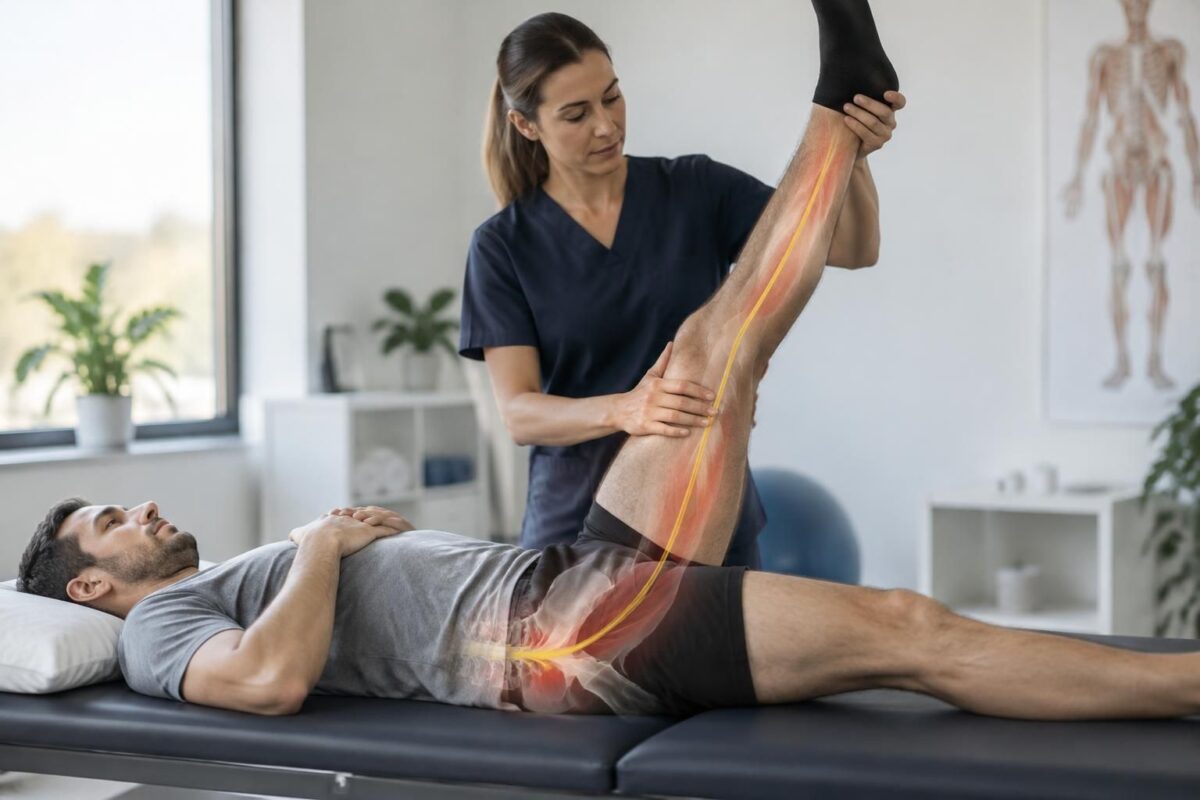
IN BRIEF Sciatica can make stretching the hamstrings uncomfortable, as the tension felt may come from the nerve rather than the muscle. A gentle stretch, with a straight back and without seeking maximum range, can help loosen the back of…
Sciatica and piriformis stretching: useful or worsening depending on the case
IN BRIEF Piriformis-related sciatica can cause deep pain in the buttock, sometimes radiating down the back of the thigh. A gentle stretch can loosen the hip and relieve discomfort if the muscle is involved, but it can worsen symptoms if…

Sciatica and popular stretches: why to stay cautious
IN BRIEF Sciatica causes pain that radiates from the lower back down the leg. Popular stretches, such as the pigeon pose or hamstring stretches, are not always suitable: pulling on an irritated nerve can worsen the symptoms. Favor gentle movements,…

Sciatica and Pilates: movements to adapt
IN SHORT Sciatica causes pain that can radiate from the lower back down to the leg. The Pilates Reformer can promote a gradual return to movement and strengthen core control, provided that the movements, range, and resistance are adapted. Favor…

Sciatica and core stability: variable tolerance depending on symptoms
IN BRIEF Core strengthening in case of sciatica consists of progressively strengthening the trunk muscles. Its tolerance varies depending on pain and symptoms: suitable without worsening the pain, it can support mobility and the resumption of activities, but does not,…

Sciatica and lunges: leg pain to watch out for
IN BRIEF Sciatica is pain that starts from the lower back or buttock and radiates down the leg. If a lunge triggers or worsens this pain, stop the movement and adjust your activity: this exercise does not address sciatica. Consult…

Sciatica and deadlifts: risk depending on the cause
IN BRIEF Sciatica and deadlifts are not always incompatible: the risk depends on the cause of the pain and its intensity. During acute episodes, it’s best to avoid heavy loads and seek medical or physiotherapy advice before resuming. A gradual…

Dr Sylvain Desforges, B.Sc., D.O., N.D., osteopath, is the founding president of TAGMED and of the ACMA association. He dedicates his practice to chronic spinal pain, low back pain and symptoms compatible with sciatica, particularly when pain radiates toward the buttock, leg, calf, foot or toes.
Through SOS Sciatique, he publishes educational content on sciatica symptoms, possible causes such as disc herniation, disc narrowing, foraminal stenosis or irritation of a lumbar nerve root, as well as non-surgical approaches that may be considered according to the evaluation. At Clinique TAGMED, care may include, depending on the case, motorized neurovertebral decompression, specific osteopathic care or precision percussion.
For an evaluation related to sciatica treatment in Montreal / Mount Royal or sciatica treatment in Terrebonne, please consult the services available at Clinique TAGMED.
Medical disclaimer
The information published on SOS Sciatique is provided for educational purposes only and does not replace a consultation, diagnosis, opinion or treatment provided by a physician or another authorized healthcare professional. The author of this article is neither a medical doctor nor a specialist in a medical specialty recognized by the Collège des médecins du Québec. The osteopathic, manual medicine or functional support approaches described on this site do not constitute medical acts and are not intended to replace medical follow-up.
Consult a physician or emergency service in cases of loss of bladder or bowel control, anesthesia in the saddle area, significant or progressive weakness in the leg or foot, fever, recent trauma, severe pain or rapid worsening of symptoms. For more details, please read our Legal Notice.