Sciatica: the most common lumbar causes to know
29/06/2026
Sciatic pain in Montreal: when to request a personalized assessment?
29/06/2026
In short
| In short, the sciatica is a pain that follows the path of the sciatic nerve and can intensify depending on the sitting Adopted. The mechanism is based on increasing the nerve pressure and load on disks; The duration and the combination of the postures determine the intensity. By integrating a good ergonomy, by alternating the positions and moving regularly, we increase the Nervous system tolerance And we reduce the painful episodes. Accessible in physiotherapy practice or in medical practice, this approach makes it possible to sustainably improve lumbar comfort and mobility without invasive recourse. |
The sciatic pain may increase When we stay in sitting too long, because this posture increases the Pressure on discs and on the sciatic nerve.
This is not an isolated reaction: these are the combination of factors and their duration that determine the intensity of the pain. A one-day tolerated configuration can become uncomfortable on another day.
This aggravation does not necessarily indicate structural damage; It mainly reflects a Nervous system tolerance which can be improved gradually.
To limit the pain, Alternate positions, introduce movement and adjust the duration sitting periods. Opt for a Adapted ergonomics: chair with good lumbar support, Break every 30 to 45 minutes, feet flat and back straight; Avoid crossing your legs and adjust the seat height for neutral posture.
This article, written by a health professional and expert, explains why the sciatica may get worse when you stay in sitting, what mechanisms come into play and what simple and effective measures make it possible to limit discomfort at work and at home. This is a clear approach, focused on understanding daily gestures and progressive improvement in nervous system tolerance.
Physiological mechanisms of pain while sitting
Staying seated extends the time spent in a configuration that can amplify the pressure exerted on the elements of the lumbar spine. This increased pressure can influence the nerve sciatica by constraints on disks and adjacent structures. The pain does not necessarily result from an immediate structural change, but from a fluctuating tolerance of the nervous system to these constraints.
factors that combine and their duration
The painful effects do not come from a single factor. The combination posture, fatigue, stress and duration of exposure to a particular configuration acts cumulatively. The same position can be tolerated one day and become uncomfortable the next day, without structural modification.
Nervous system tolerance and adaptation
pain related to sitting depends on the context and the ability to adapt. The objective of the care is to gradually improve this tolerance. Alternating positions, introducing movement, adjusting seating times and working on proprioception help make sensitive areas less reactive over time.
Good practices while sitting
To limit the impact of sitting on the sciatica, choose a Ergonomic chair with appropriate lumbar support. When the pain is acute, a lumbar cushion can help maintain the natural curvature of the spine and decrease the pressure on the nerve.
Adopt these simple habits during your sitting sessions:
Get up every 30 to 45 minutes to walk and unload the column lightly. Avoid crossing your legs and leaning forward without support, which increases the pressure. Sit at the bottom of the chair with your feet flat and knees at right angles. Keep your back straight, shoulders relaxed and avoid forcing on the neck and shoulders. Lift the height of the chair so that the pelvis is slightly higher than the knees, in order to promote a neutral position.
Illustration: A common situation shows that a professional can see an improvement in painful episodes after the adoption of an ergonomic chair and regular breaks to walk. These postural adjustments are an integral part of the routine and help reduce the frequency of pain.
How to adapt without aggravating the pain
Tolerance can improve over time thanks to simple and progressive adjustments. Alternating postures, avoiding sudden gestures and staying alert to fatigue can help limit painful peaks. The goal is to distribute the load over the entire back and muscle resources in order to reduce the load on the sciatic nerve.
Additional resources and approaches
To go further, you can explore specialized resources that deal with posture and pain related to sciatica. For example, informative and practical content on the risks associated with certain positions or on ergonomic choices are available on dedicated sites. For general information and additional perspectives, you can consult resources like Leg numbness and sciatica and Movements to avoid. Other articles address the links between sciatica and disc protrusion or osteopathic approaches, available on Sciatica and disc protrusion and Why osteopathy can be effective against sciatica.
For information on options at the clinic, you can also consult The Tagmed Clinic, and for notions on the issues of neurovertebral decompression in some contexts, visit neurovertebral decompression.
Practical example and continuity of care
An illustrative example shows how proactive accompaniment can reduce painful episodes. By combining a suitable ergonomic chair, active breaks and daily load management, the pain can become more tolerable and the usual activities less disturbed.
Finally, for those looking for appropriate care, additional advice and personalized follow-up can be offered by specialized professionals, while remaining within the framework of clearly established resources and without directly prescribing exercises or stretching not suitable for all situations.
To deepen the general framework and available options, you can explore other resources on domains like Disc and sciatica protrusions and Actions to avoid.
Avoid abrupt gestures and favor controlled and conscious movements when handling loads, remembering that the goal is to preserve lumbar health and reduce stress on the sciatic nerve.
To learn more about specific aspects and considerations related to posture on a daily basis, refer to the resources mentioned above and discuss with your health professional for personalized support.
Medical Disclaimer: The information and advice provided on this site does not replace the health professional’s diagnosis or treatment. Please note that Dr. Sylvain Desforges osteopath is neither a doctor of medicine nor a doctor, and is not a specialist in a medical specialty as defined by the Collège des Médecins du Québec. Manual medicine, functional medicine and sports medicine as described on this site exclude any medical treatment or diagnosis made by a doctor or specialist doctor. Always consult your doctor for any medical questions. For more details, please read our full legal notice.
- Pressure on discs and increased sciatic nerve while sitting
- Rounded lumbar which increases pain when the back is arched
- Postural fatigue and lower tolerance of the nervous system
- nerve pinching during repeated flexions or twists
- Context and fatigue that modulate tolerance to the same posture
- Adopt a Break and rotation Every 30–45 minutes
- Ergonomic chair with lumbar support
- Hold a neutral position : Feet flat and slightly high basin
- Avoid from fold one’s legs and of Thinking without support
- Move regularly: walking short to unload the column
- Limit them Bending and twisting trunk; Bend your knees to pick up
- In acute pain, plan a Lumbar belt and consult

Sciatica-related pain can get worse when you stay in a sitting position for too long. The explanation is that it is not a single cause that triggers pain, but the combination and duration of the stress exerted on the nervous system. By varying positions, introducing movement and working on proprioception, you can gradually improve your tolerance and reduce painful episodes.
Why sitting can increase pain
The Extended sitting position Increases pressure on the intervertebral discs and can amplify sciatic nerve compression. This posture often promotes a rounding of the lower back, which should be avoided. The sciatic nerve becomes more sensitive when the spine is maintained in a configuration that lacks support or excessively strains certain segments.
The role of constraint and fatigue
The factors do not act in isolation: their combination and duration determine the painful reaction. The same position can be tolerated one day and become uncomfortable the next day if your fatigue, energy or the state of your nervous system differ.
How the nervous system adapts
The treatment aims to gradually improve this tolerance. By alternating positions and integrating movements, the nervous system becomes less reactive and previously sensitive configurations become better supported over time.

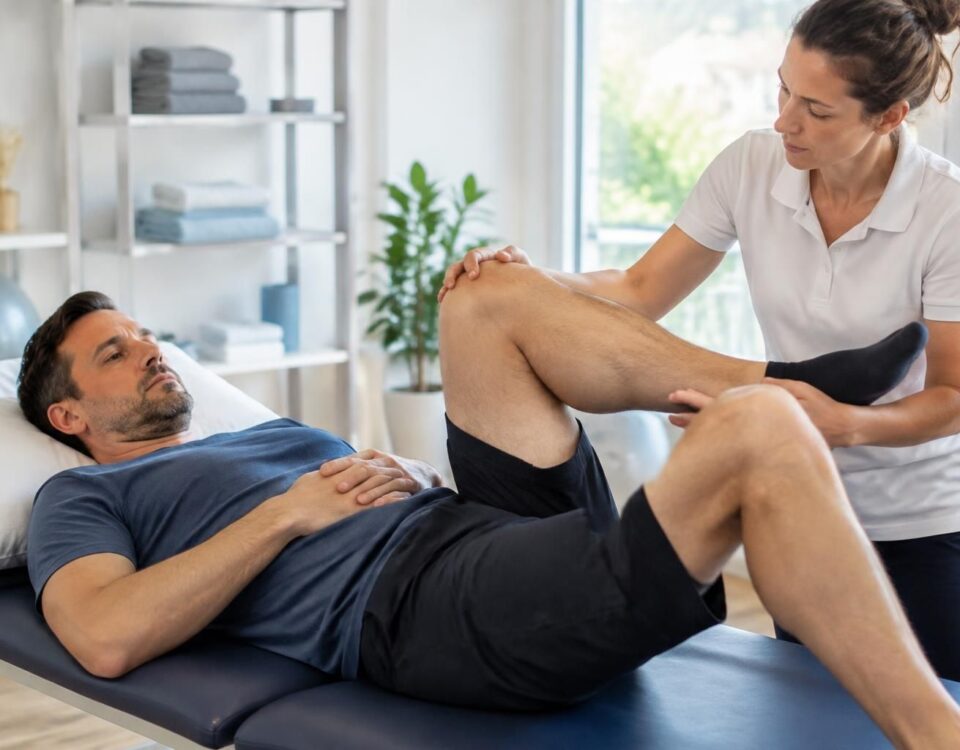
Sciatica and calf stretching: when the pain increases
IN SHORT A calf stretch can exacerbate sciatica if it further irritates the nerve. It should not cause pain that increases or radiates down the leg: stop the movement and do not push through. Stretches may help with some tensions,…
How to limit pain while sitting
Posture and ergonomics
Choose one Ergonomic chair with a good Lumbar support. Adopt a Neutral posture: Feet flat on the ground, knees forming a right angle, pelvis slightly raised compared to the knees. Sitting at the bottom of the chair and keeping the shoulders relaxed helps to distribute the load and limit tension.
habits to adopt
Do you get up all 30 to 45 minutes To walk and unload the column. Avoid crossing your legs or leaning forward without support. Position the screen and keyboard so your arms stay close to the body and your shoulders relaxed. Use a Lumbar cushion or a Lumbar belt During the painful phases to maintain a natural curvature.
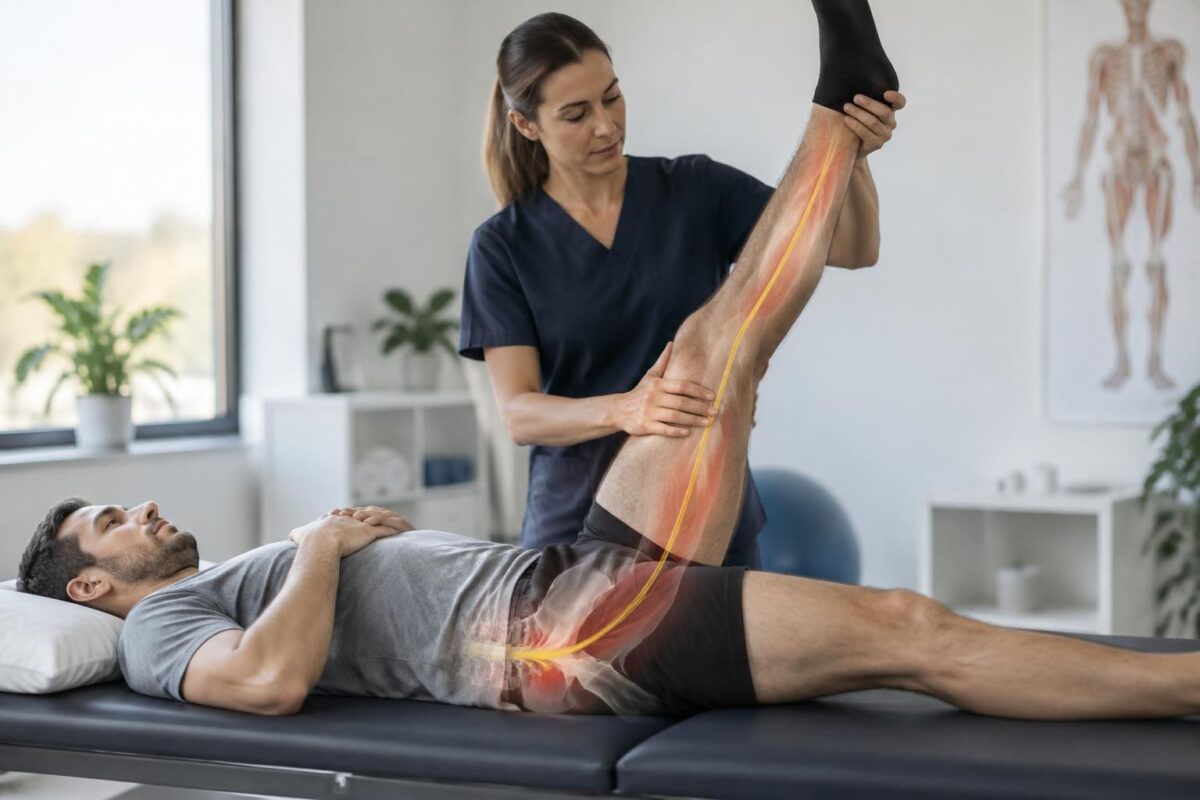
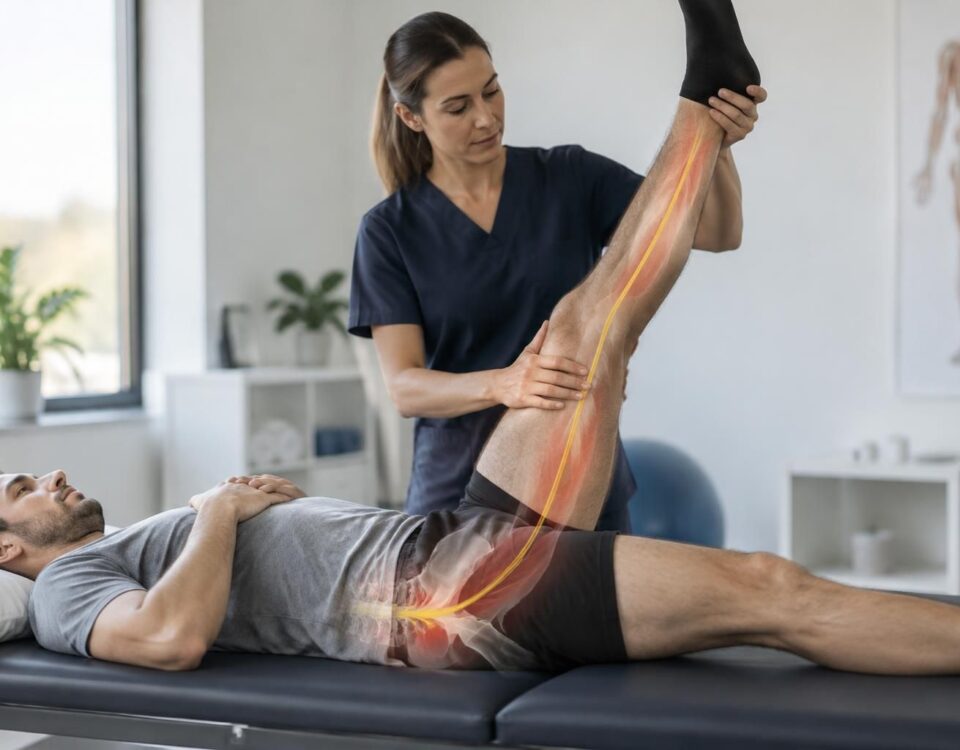
Sciatica and hamstring stretching: possible nerve tension
IN BRIEF Sciatica can make stretching the hamstrings uncomfortable, as the tension felt may come from the nerve rather than the muscle. A gentle stretch, with a straight back and without seeking maximum range, can help loosen the back of…
Gestures and habits to avoid
Actions to avoid
Avoid them trunk twists, repeated flexions and prolonged periods forward without support. Prefer to pick up or carry objects by bending your knees and keeping your back straight, and favor smoothly controlled movements during your daily tasks.
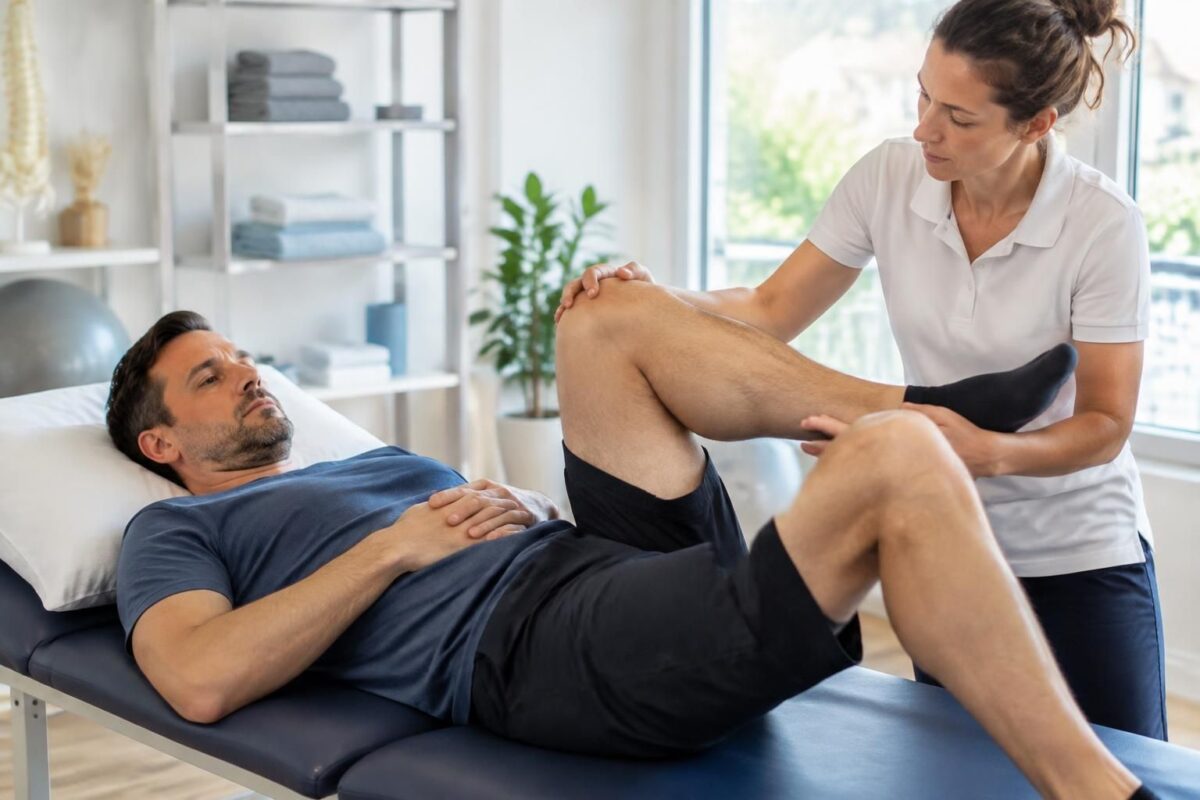
Sciatica and piriformis stretching: useful or worsening depending on the case
IN BRIEF Piriformis-related sciatica can cause deep pain in the buttock, sometimes radiating down the back of the thigh. A gentle stretch can loosen the hip and relieve discomfort if the muscle is involved, but it can worsen symptoms if…
Concrete examples and practical advice
For example, Julie, 42, saw an improvement by using an ergonomic chair with lumbar support and multiplying active breaks. Antoine, commercial, has integrated standing and alternate periods and found the lumbar support prescribed by his doctor to reduce his discomfort.
| Element | Impact on pain |
|---|---|
| Extended sitting position | Increases the pressure on the discs and requires the sciatic nerve, aggravating the pain. |
| Mobility and position change | Alternating positions and moving steadily increases tolerance and decreases painful peaks. |
| Bust and lordosis posture | A curvature inadequate may compress the nerve and increase pain. |
| Lumbar seat support | One support adequate lumbar preserves curvature and reduces tension on the nerve. |
| Alignment of knees and feet | misaligned knees and pelvis amplify the load on the lower back. |
| Repeated bending and rotations | the gestures that turn where is inclination Increase the pressure on the disc and nerve. |
| prolonged standing | The staying up Extended increases the pressure on the discs and can trigger pain. |
| Breaks and rhythm | of Active breaks And a suitable rhythm limit the accumulation of load and pain. |
| Proprioception and stability | strengthen the proprioception And the stabilizing muscles increases tolerance and decreases painful episodes. |

Sciatica and popular stretches: why to stay cautious
IN BRIEF Sciatica causes pain that radiates from the lower back down the leg. Popular stretches, such as the pigeon pose or hamstring stretches, are not always suitable: pulling on an irritated nerve can worsen the symptoms. Favor gentle movements,…
Testimonials: sciatica and sitting — why the pain increases
Julie, 42, suffers from sciatica and found that his pain Intensifies when it stays in sitting Too long. It describes increasing pressure on the discs and sciatic nerve irritation, especially when the spine folds forward without support. After introducing a chair ergonomic with a good Lumbar support And some breaks Regular to walk, it feels less tightness and can better distribute the load on the back.
Antoine, trader, says that his prolonged standing days precipitated the peaks of pain. favoring sitting micro-breaks and using a Lumbar belt Prescribed by his doctor, he learned to alternate positions and limit loads on lumbar discs. Result: a tolerance increased and fewer periods of repeated discomfort.
Marie, administrative assistant, noticed that the pain worsened when she crossed the legs Or turns without support. By adopting a Neutral posture, feet flat and the screen slightly opposite, she found a noticeable reduction in symptoms and better management of the sciatica on a daily basis.
Émilie, secretary, redesigned her workspace with a chair ergonomic, a Lumbar support and an extension setting (screen, keyboard) to keep the shoulders relaxed. With these adjustments, its pain related to the sciatica has become more bearable and she can sit longer without a sudden trigger.
Word of a professional, the doctor and the physiotherapist insist on the importance of alternating the bearings And to integrate soft movements throughout the day. A logic ofergonomy and postural education allows the nervous system to better tolerate sitting configurations, reducing painful episodes and protecting the nerve sciatica.
Dr. Sylvain Desforges is a recognized practitioner who unites the approaches osteopathy, naturopathy and manual medicine. Founder of the TagMed and ACMA clinics, he places innovation at the heart of his action, with a clear vocation: to offer treatments evidence-based To optimize the health and well-being of his patients. His work is particularly part of the management of the chronic pain and the integration of advanced technologies to treat pain affecting the back and sciatic nerve.
When addressing the issue of sciatica, he recalls that the pain linked to the sciatic nerve is strongly modulated by the bearings and by their duration. Some configurations, especially when sitting for too long, standing still or during specific gestures, can Increase stress exercised on the nerve. This relationship is not purely structural: it depends on how the nervous system tolerates the constraints generated by these positions. The central message is that there is not a “good” or “bad” position in itself, but a dynamic balance between loads, fatigue and ability to adapt the body.
To change the course of pain, Dr. Desforges promotes a progressive and personalized approach. he promotes Alternate positions, introduce movement, adjust the duration and work the proprioception. Over time, these strategies allow the the nervous system to become less responsive and to formerly sensitive positions to be better tolerated. The goal is not to remove any pain immediately, but to improve the tolerance and the function Neuromuscular to achieve a better quality of life on a daily basis.
In his practice, theergonomy Occupies a major place: office, car, house—each environment is analyzed to limit loads and promote neutral posture. The therapist insists on the role of daily gestures and on the importance of fitting out your workspace with appropriate equipment, in order to prevent painful peaks and to support re-educational action. This global vision is based on patient education and protocols that gradually integrate the movement and the Postural control to reduce nerve responsiveness.
Dr. Desforges also includes Advanced technologies To enhance the effectiveness of treatments: vertebral decompression, laser and Shockwave therapy are complementary tools that are part of a process obvious and individualized. By associating these techniques with targeted exercises and educational support, it aims to achieve lasting pain reduction and significant functional improvement for its patients with sciatica and lower back pain related to sitting.
This approach is at the heart of the commitments of TagMed clinics, which are committed to proposing a model of care that combines scientific rigor and human support. To discover its approach and the services offered by its teams, check with the TagMed and ACMA clinics in order to benefit from a personalized follow-up, adapted to your situation and your daily life.
This text explains why the sciatica May get worse in position course, and how to alternate positions, move and work on proprioception makes it possible to gradually improve the tolerance of the nerve. It shows that the effect depends on a set of factors: duration, pressure on the discs and constraints on the nervous system, and that simple daily gestures can transform comfort durably.

Sciatica and Pilates: movements to adapt
IN SHORT Sciatica causes pain that can radiate from the lower back down to the leg. The Pilates Reformer can promote a gradual return to movement and strengthen core control, provided that the movements, range, and resistance are adapted. Favor…
Why sitting can increase pain
The sciatic pain Can be amplified when you sit for a long time, as the pressure on the intervertebral discs and structures around the sciatic nerve increases. A prolonged lumbar rounding and frozen posture promote increased tension on the nerve, which can manifest itself in pain that radiates into the leg. This reaction is not inevitable: it depends on how the position influences the stresses on the nervous system and the ability of the body to tolerate these constraints.

Sciatica and core stability: variable tolerance depending on symptoms
IN BRIEF Core strengthening in case of sciatica consists of progressively strengthening the trunk muscles. Its tolerance varies depending on pain and symptoms: suitable without worsening the pain, it can support mobility and the resumption of activities, but does not,…
How to limit pain while sitting
To limit the impact of sitting position, focus on ergonomy adapted and regular breaks. Use an ergonomic chair with good lumbar support and, if necessary, a lumbar cushion. the pelvis should be slightly higher than the knees and feet flat to promote Neutral posture. Do you get up all 30 to 45 minutes To walk and unload the column. Avoid crossing your legs and leaning forward without support, to reduce pressure on the column.
Concrete examples testify to the effectiveness of these measures: the use of a suitable chair, coupled with active breaks, can significantly reduce painful episodes and improve overall tolerance to sitting. To find out more about the positions to avoid and the improvements to be preferred, you can consult dedicated resources such as CET#ATFP_CLOSE_TRANSLATE_SPAN# Article or CE#ATFP_CLOSE_TRANSLATE_SPAN# Practical guide. You will find additional advice to adapt your workstation and your daily life.
For illustration, Julie, 42, saw a significant improvement in her pain after adopting an ergonomic chair with lumbar support and taking regular breaks to walk in the office. These adjustments are an integral part of her routine and reduce painful episodes.

Sciatica and lunges: leg pain to watch out for
IN BRIEF Sciatica is pain that starts from the lower back or buttock and radiates down the leg. If a lunge triggers or worsens this pain, stop the movement and adjust your activity: this exercise does not address sciatica. Consult…
The role of gestures and postures in everyday life
Repetitive gestures and thoracic or lumbar flexions expose the sciatic nerve to increased loads. Prefer to bend your knees and keep your back straight when lifting objects, and avoid twisting the trunk during common activities. In practice, picking up an object at the height or crouching rather than stretching with your legs stretched can make a big difference to your sciatica.
Dedicated resources also evoke these gestures to monitor and offer functional choices to limit sudden or repetitive efforts on a daily basis. To deepen, you can consult CET#ATFP_CLOSE_TRANSLATE_SPAN# Article on postures to avoid at rest and sleep and CE#ATFP_CLOSE_TRANSLATE_SPAN# Practical guide on seating.

Sciatica and deadlifts: risk depending on the cause
IN BRIEF Sciatica and deadlifts are not always incompatible: the risk depends on the cause of the pain and its intensity. During acute episodes, it’s best to avoid heavy loads and seek medical or physiotherapy advice before resuming. A gradual…
The role of activity and ergonomics in everyday life
Change of habit also means favoring adapted physical activities and ergonomic management of the vehicle, office and household chores. A gentle activity such as swimming or yoga can strengthen the back without attacking the sciatic nerve, and a balanced distribution of loads when traveling avoids unilateral efforts. The objective is to gradually increase the tolerance of the nervous system and to avoid painful peaks linked to positions held for too long.
To deepen non-pharmacological approaches and appropriate management options, you can consult specialized resources such as LA#ATFP_CLOSE_TRANSLATE_SPAN#Neurovertebral decompression and its alternatives, LES#ATFP_CLOSE_TRANSLATE_SPAN# Benefits of Osteopathy, or Les#ATFP_CLOSE_TRANSLATE_SPAN# Advice for seniors. You will find additional explanations and practical scenarios to adapt your daily life.
Resources and support
In case of frequent pain, the support of a back professional can help personalize your plan and progress safely. A specialist doctor or a physiotherapist can offer targeted follow-up, including exercises and ergonomic advice, in order to refine the posture at rest and during activities. To enrich your approach, explore additional resources like LA#ATFP_CLOSE_TRANSLATE_SPAN# Efficient support and les#ATFP_CLOSE_TRANSLATE_SPAN# Foot pain and sciatica links.

Dr Sylvain Desforges, B.Sc., D.O., N.D., osteopath, is the founding president of TAGMED and of the ACMA association. He dedicates his practice to chronic spinal pain, low back pain and symptoms compatible with sciatica, particularly when pain radiates toward the buttock, leg, calf, foot or toes.
Through SOS Sciatique, he publishes educational content on sciatica symptoms, possible causes such as disc herniation, disc narrowing, foraminal stenosis or irritation of a lumbar nerve root, as well as non-surgical approaches that may be considered according to the evaluation. At Clinique TAGMED, care may include, depending on the case, motorized neurovertebral decompression, specific osteopathic care or precision percussion.
For an evaluation related to sciatica treatment in Montreal / Mount Royal or sciatica treatment in Terrebonne, please consult the services available at Clinique TAGMED.
Medical disclaimer
The information published on SOS Sciatique is provided for educational purposes only and does not replace a consultation, diagnosis, opinion or treatment provided by a physician or another authorized healthcare professional. The author of this article is neither a medical doctor nor a specialist in a medical specialty recognized by the Collège des médecins du Québec. The osteopathic, manual medicine or functional support approaches described on this site do not constitute medical acts and are not intended to replace medical follow-up.
Consult a physician or emergency service in cases of loss of bladder or bowel control, anesthesia in the saddle area, significant or progressive weakness in the leg or foot, fever, recent trauma, severe pain or rapid worsening of symptoms. For more details, please read our Legal Notice.